The first drop of water appeared where no water had any right to exist.
It gathered between two flat stones at the bottom of the trench, trembled beneath the dull Kansas sky, and slid slowly across Eli Merritt’s mud-streaked thumb.
For three months, the back forty had produced nothing but dust.
The wheat had failed before reaching Eli’s knees. The pond had become a cracked brown bowl. Even the cottonwoods along the fence line had begun shedding leaves in June, as if the trees themselves had surrendered.
Yet the water touching Eli’s skin was cold.
Not rainwater.
Not sweat.
Water from somewhere deep beneath the dead field.
Above the trench, Silas Crowley stopped laughing.
The sixty-seven-year-old farmer still held Eli’s great-grandfather’s journal in one hand, but his grip had tightened around the leather cover. His mocking blue eyes moved from the darkening stones to the faint line of moisture running through the old channel.
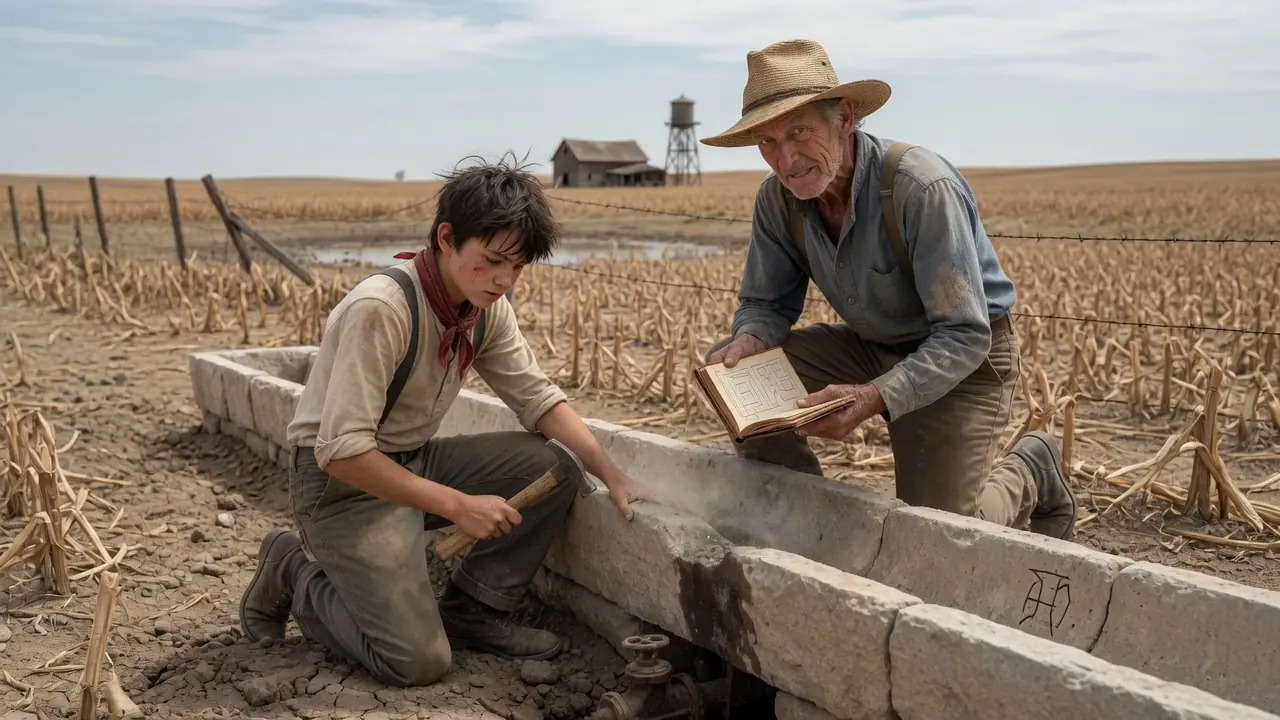
Eli scraped the next stone clean with his short-handled shovel.
Another bead of water appeared.
Then another.
Silas’s cruel grin weakened.
“Dead dirt doesn’t confess,” he said. “And dead men don’t leave miracles for foolish boys.”
Eli looked up from the trench.
His cheek was scraped, his overalls were stained with mud that should not have existed in a drought, and his gray-green eyes held more anger than fear.
“Then why are your hands shaking?”
Silas looked down.
They were.
He shoved the journal beneath one arm and stepped away from the trench.
“That’s seepage,” he said. “Nothing more.”
“There hasn’t been rain in six weeks.”
“Ground holds water.”
“Not this ground.”
Silas’s eyes hardened.
“You don’t know anything about land.”
Eli drove the shovel between two stones.
A faint hollow sound answered from below.
Not solid earth.
Empty space.
Silas heard it too.
He moved quickly, dropping to one knee at the edge of the trench.
“That’s enough.”
Eli pulled the shovel back.
“Give me the journal.”
“This old thing belongs in a stove.”
“It belongs to my family.”
“Your family is about to lose this field.”
Silas leaned closer.
“And when they do, all this becomes my problem.”
Eli stared at him.
Silas had been saying similar things for months.
Sometimes he said them kindly, while standing in the Merritt kitchen with his hat pressed against his chest. He spoke about difficult seasons, bank pressure, and the wisdom of selling before debt swallowed everything.
Other times, when no adults were present, the kindness disappeared.
Then he called the land ruined.
He called Eli’s father stubborn.
He said the Merritts had survived only because other people had been too polite to tell them when to quit.
That afternoon, there was no kindness left in him.
Silas placed one boot on the loose soil beside the trench.
“You’ve had your fun. Fill this in.”
Eli looked at the journal beneath Silas’s arm.
“No.”
“You think a few damp rocks will save four hundred acres?”
“No.”
“Then what are you doing?”
“Finding out why you’re scared.”
Silas’s face changed.
Only slightly.
But Eli saw it.
The old farmer climbed to his feet.
“You have until sunset to fill this trench. If one of my cattle breaks a leg in it, your mother will be paying for more than a failed crop.”
“This is our land.”
“For now.”
Silas turned and walked toward his pickup truck.
Eli climbed out of the trench.
“Where are you taking the journal?”
Silas did not answer.
Eli ran after him.
The older man reached the truck first and opened the driver’s door.
Eli grabbed the leather cover.
Silas twisted around.
For one sharp second, they stood pulling against each other, a thirteen-year-old boy in worn overalls and a weathered farmer twice his weight.
The journal tore loose from Silas’s hand.
Eli stumbled backward and fell.
The book landed beside him.
A folded page slipped from the binding and blew across the dry grass.
Silas froze.
Eli scrambled after it.
The paper caught against a thistle near the fence.
It was not part of the journal.
It was a map.
Hand-drawn.
Faded.
Covered in measurements, arrows, and names written in his great-grandfather’s narrow script.
Eli read the words at the bottom.
MERRITT-CROWLEY WATER AGREEMENT, 1936.
Silas crossed the distance between them faster than Eli expected.
He snatched for the page.
Eli rolled aside, grabbed the map, and ran toward the farmhouse.
Behind him, Silas shouted his name.
Eli did not stop.
The Merritt farm had belonged to his family for ninety-two years.
His great-grandfather, Amos Merritt, had purchased the first one hundred sixty acres during the final years before the Dust Bowl. He arrived with two horses, a pregnant wife, and enough money to build half a barn.
By 1936, the farm should have been dead.
That was what the old newspapers said.
Dust storms blackened the afternoon sky. Wells failed. Families abandoned homesteads with furniture still inside because carrying it cost more than it was worth.
Amos stayed.
Family stories credited stubbornness.
The journal told a different story.
Eli found it three weeks earlier in a wooden chest beneath the attic eaves.
A storm had torn loose part of the farmhouse roof. While helping his mother move boxes away from the leak, Eli noticed the chest behind a stack of broken picture frames.
Inside were tax receipts, yellow photographs, seed catalogs, and a journal wrapped in oilcloth.
Most of the early pages described ordinary farm work.
Calf born before sunrise.
South fence repaired.
Four acres of winter wheat damaged by wind.
Then the entries changed.
Amos began writing about limestone beneath the property.
Cold air rising through cracks.
A spring discovered by Walter Crowley while digging a post hole on the neighboring farm.
The two men spent months building something underground.
A stone channel.
A settling chamber.
A buried gate that divided the water between their properties.
The final complete entry was dated September 18, 1941.
Walter wants control of the north line. Says his cattle need more than our wheat. I reminded him the spring belongs to neither family alone. We found it together. We built the channel together. The agreement is filed. Ruth knows where.
After that came several pages torn cleanly from the book.
Eli showed the journal to his mother, Hannah.
She read the entries at the kitchen table while unpaid bills sat beside her.
His father, Caleb Merritt, had died eighteen months earlier when a grain truck crossed the center line on a rain-slick highway. The loss was more than emotional.
Caleb had understood the machinery.
He knew which fields could tolerate late planting and which debts could be delayed. He remembered conversations with bankers, seed dealers, and neighbors that Hannah had never expected to manage alone.
After his death, she did everything she could.
She sold half the cattle.
Took bookkeeping work in town.
Delayed repairs.
Borrowed against the following year’s crop.
Then the drought arrived.
By midsummer, the Merritts had six weeks before the bank could begin foreclosure proceedings.
Hannah wanted to believe the journal.
She could not afford to.
“Even if there was a spring,” she told Eli, “it might be dry now.”
“Great-Grandpa wrote that it survived the Dust Bowl.”
“That was almost ninety years ago.”
“The measurements are still here.”
“Some of them.”
“Let me look.”
Hannah closed the book.
“You have schoolwork.”
“School ended last month.”
“Then help me with the west fence.”
Eli leaned across the table.
“Silas keeps asking to buy the back forty.”
“He has asked to buy everything.”
“Why does he want dead land?”
“Because it touches his property.”
“He specifically wants the back forty.”
Hannah looked toward the window.
Across the yard, the rusted windmill stood motionless above the barn.
Silas Crowley’s land began beyond the northern fence. His fields were brown too, but his cattle still had water. He claimed his wells were deeper and his family had planned better.
Hannah had never questioned it.
Eli had.
The journal described a stone channel running from a spring beneath Crowley Ridge, south toward the Merritt windmill, then west into the back forty.
If the water still existed, it should have crossed exactly where Silas wanted to buy.
Hannah returned the journal.
“One afternoon,” she said. “You can look for the stones. After that, you stop.”
Eli did not stop.
For twelve days, he measured from the old windmill using lengths of baling twine.
He dug where the journal told him.
At first, he found nothing.
Then, beneath twenty inches of cracked earth, his shovel struck a flat limestone slab.
He uncovered another beside it.
Then a third.
The stones formed a line.
A man-made line.
On the thirteenth afternoon, Silas found him in the trench.
Now Eli ran toward the farmhouse with the hidden map pressed against his chest.
He reached the porch and threw open the screen door.
“Mom!”
Hannah appeared from the kitchen.
“What happened to your face?”
“Silas tried to take the journal.”
“Silas was here?”
“He knew.”
“Knew what?”
Eli spread the map across the table.
Hannah leaned over it.
The paper showed both farms as they existed in 1936.
A blue pencil line began beneath a hill on the Crowley property. It ran through a circular structure labeled SPRING HOUSE, crossed beneath the fence, and divided near the Merritt windmill.
One branch led to the Crowley cattle ponds.
The other continued toward the back forty.
Beside the dividing point, Amos had written:
BRASS GATE. TWO EQUAL CHANNELS. EACH FAMILY HOLDS PERMANENT HALF SHARE.
Hannah touched the faded words.
“Where did this come from?”
“It was hidden inside the journal binding.”
“Silas had the book?”
“He tried to burn it.”
“He said that?”
“He said it belonged in a stove.”
Hannah looked toward the door.
“Lock it.”
Eli obeyed.
She picked up her phone and called the sheriff’s office.
A deputy arrived forty minutes later.
By then, Silas was gone.
Deputy Ray Nolan examined the trench, the journal, and the map. He was a patient man with a sun-reddened neck and twenty years of experience mediating disputes between rural neighbors.
“Did Mr. Crowley threaten you?” he asked Eli.
“He took the journal.”
“Did he strike you?”
“No.”
“How did your cheek get scraped?”
“I fell when I pulled the book back.”
Nolan looked toward Hannah.
“This could be attempted theft, but it will become his word against Eli’s unless he admits it.”
“What about the map?” Hannah asked.
“That may matter in a property dispute. It doesn’t prove Mr. Crowley did anything today.”
“It proves there was shared water.”
“It proves someone drew shared water on a piece of paper.”
“The agreement says it was filed.”
Nolan nodded.
“That is the part worth checking.”
The county courthouse kept property records in a basement room that smelled of paper dust and old concrete.
The next morning, Hannah, Eli, and Deputy Nolan met County Clerk Margaret Vance beside a steel table stacked with ledgers.
Margaret had worked there for thirty-two years.
She read Amos’s map twice.
“A 1936 water agreement should be in the land records.”
She searched by both family names.
Nothing appeared.
She searched by parcel number.
Still nothing.
Then she pulled a handwritten index from a locked cabinet.
Her finger moved down the page.
“Merritt, Amos.”
She stopped.
“There.”
Hannah leaned closer.
The entry read:
Shared spring and channel agreement with Walter Crowley. Book 19, page 447.
Margaret walked toward the shelves and returned with a large leather-bound volume.
Page 446 was intact.
Page 448 was intact.
Page 447 had been removed.
Not torn accidentally.
Cut close to the binding with a sharp blade.
The room became silent.
“Who had access to these?” Nolan asked.
“Employees. Attorneys. Surveyors. Members of the public under supervision.”
“Any record of who requested this book?”
“Not from decades ago.”
Eli looked toward the empty line where the page had been.
“Silas’s father.”
Hannah placed a hand on his shoulder.
“We don’t know that.”
“He knew about the journal.”
“We know Silas knew something.”
Margaret examined the binding.
“There may be another copy.”
“Where?” Hannah asked.
“Agreements involving water rights were sometimes filed with the state engineer or attached to federal conservation records. Especially during the Dust Bowl.”
“How long would that take to locate?”
Margaret sighed.
“Days if we are lucky. Months if we are not.”
The Merritts did not have months.
The bank meeting was scheduled for Friday.
If Hannah could not present a credible plan to repay the operating loan, the foreclosure process would begin.
Silas knew it.
That afternoon, his truck appeared in the Merritt driveway.
Hannah met him on the porch.
Eli watched through the kitchen window.
Silas removed his hat.
“I heard you went to the courthouse.”
“News travels quickly.”
“People talk.”
“You tried to take my son’s journal.”
“He was digging an unsafe trench.”
“That was not your concern.”
Silas looked toward the back forty.
“I came to make one final offer.”
“We are not selling.”
“You owe more than the land will produce in the next five years.”
“That is between me and the bank.”
“My offer covers the operating loan and lets you keep the house, barn, and eighty acres.”
“You want the back forty.”
“I want a clean boundary.”
“You want what is under it.”
Silas’s expression did not change.
Hannah took the map from her pocket and unfolded it.
For the first time, the old farmer lost complete control of his face.
Only for a second.
Then he smiled.
“Children draw things.”
“This was drawn in 1936.”
“Old men drew things too.”
“The county index lists an agreement.”
“Then show me the agreement.”
“The page was cut out.”
Silas placed his hat back on his head.
“That sounds like your problem.”
Hannah stepped off the porch.
“My husband trusted you.”
Silas looked away.
“Caleb trusted everyone.”
“You stood in this kitchen after his funeral and promised to help us.”
“I did help.”
“You offered loans secured by land you believed we would lose.”
“I offered options.”
“You offered a trap.”
Silas’s eyes moved toward Eli in the window.
“Be careful what stories you fill that boy’s head with.”
“He found the story.”
Silas walked back to his truck.
Before opening the door, he looked toward Hannah.
“Friday is coming whether that channel holds a cup of water or not.”
The bank meeting began at ten in the morning.
Hannah sat across from loan officer Daniel Price with a folder of crop estimates, insurance claims, and handwritten repayment plans.
Eli waited outside in the hallway.
Daniel was not cruel.
That almost made the meeting harder.
He had known Caleb Merritt for years. He had attended the funeral. He wanted the farm to survive.
But banks did not operate on sympathy.
“The wheat loss is nearly total,” he said. “You have no remaining cattle inventory large enough to secure another extension.”
“We may have a water source.”
“May?”
Hannah showed him the journal and map.
Daniel read them carefully.
“This is interesting.”
“It could restore irrigation to the back forty.”
“Do you have an engineer’s report?”
“Not yet.”
“A verified flow rate?”
“No.”
“A legal water-right document?”
“The county record was removed.”
Daniel closed the folder.
“I cannot base a loan extension on a missing page and a hand-drawn map.”
“How much time can you give me?”
“The formal notice will be issued Monday.”
“After that?”
“You will have the statutory period before sale.”
Silas was waiting in the parking lot.
He leaned against his truck while Hannah and Eli exited the bank.
“I could stop this today,” he said.
Hannah walked past him.
Silas called after her.
“My offer drops when the notice is filed.”
Eli turned.
“You blocked the water.”
Silas’s expression remained flat.
“You have no idea what you’re talking about.”
“You were scared when I found the stones.”
“I was concerned a child would collapse a trench on himself.”
“The map says there’s a brass gate.”
Silas took one step toward him.
Hannah moved between them.
“Do not speak to my son.”
Silas looked over her shoulder.
“Some gates should stay buried.”
That night, Eli opened the journal again.
He read every surviving entry.
Near midnight, he found something he had missed.
A sentence written faintly along the lower edge of a page:
If courthouse copy is lost, Ruth placed duplicate with Reverend Bell before winter.
Ruth was Amos’s wife.
Reverend Bell had led the First Methodist Church from 1929 until 1958.
The old church still stood in town.
Its current pastor, Evelyn Shaw, met them the following morning.
She listened to the story, then led them downstairs to a storage room beneath the sanctuary.
Church records filled metal cabinets.
Old donation ledgers sat beside baptism certificates and marriage records.
They searched for three hours.
Nothing.
Eli refused to leave.
“What did pastors keep private papers in?”
Evelyn pointed toward an old wooden safe in the corner.
“That has not opened in twenty years.”
The combination had been lost before she arrived.
A locksmith came that afternoon.
Inside the safe were property deeds left for safekeeping, handwritten wills, wartime letters, and sealed envelopes from families that no longer lived in the county.
Near the bottom sat a packet labeled:
AMOS AND RUTH MERRITT
WALTER AND EDNA CROWLEY
WATER AGREEMENT AND SURVEY
Hannah stopped breathing.
The original document was six pages long.
It granted each family half the permanent flow from Crowley Spring. Maintenance costs were shared. Neither family could obstruct, divert, sell, or reduce the other family’s portion without written consent.
Attached was a survey map bearing the county seal.
A second attachment had been added in 1954.
It was a letter from Edna Crowley, Silas’s mother.
Walter closed the south gate after Amos died. He said Ruth could not farm enough land to need the water. I told him the agreement was sacred. He threatened to send me away if I interfered.
I have hidden this copy with Reverend Bell because one day the Merritts may need proof. Silas was fourteen when Walter moved the gate. He saw us argue. He knows.
Eli read the final sentence twice.
Silas had known since he was fourteen.
For fifty-three years, he had known the Merritts owned half the spring.
Pastor Evelyn called Deputy Nolan.
Nolan called the county attorney.
By sunset, a civil judge issued a temporary order preventing Silas from interfering with inspection of the water system.
The inspection began the following morning.
County engineer Laura Kim arrived with two technicians, a survey crew, Deputy Nolan, Hannah, and Eli.
Silas stood at the property line with his attorney.
“You may inspect the Merritt side,” the attorney said. “You may not enter Crowley land without further order.”
Laura followed the old measurements.
The stone channel near Eli’s trench continued underground toward the windmill.
A small camera inserted through a gap revealed an intact passage beneath the field.
The channel was not dry.
Water stood several inches deep behind something blocking the northern end.
They excavated carefully.
Six feet beyond the trench, they uncovered a circular stone chamber.
At its center sat a brass gate.
The mechanism had been turned completely shut toward the Merritt channel.
A newer steel chain held it in place.
The chain was not from 1954.
Laura scraped dirt from the metal tag attached to it.
CROWLEY FEED AND SUPPLY
PURCHASED 2021
Everyone looked toward Silas.
His attorney spoke first.
“That proves nothing about who installed it.”
Eli pointed toward the lock.
Silas’s initials were engraved on the side.
S.C.
Silas stepped backward.
Deputy Nolan approached him.
“Do you have the key?”
“No.”
“Mr. Crowley.”
“I said no.”
Laura examined the gate.
“The northern branch is flowing heavily. The south branch is fully blocked.”
Hannah stared at Silas.
“2021.”
Silas said nothing.
“That was the year Caleb refinanced after the first dry summer.”
Silas’s face tightened.
“He would have lost the place eventually.”
“You shut off our water.”
“The system was failing.”
“You shut it off.”
“My cattle needed it.”
“You already had wells.”
“The wells were dropping.”
“So you took ours.”
Silas looked toward the field.
“My father built that channel.”
“With my great-grandfather,” Eli said.
Silas turned toward him.
“You think farming is about fairness? It is about survival.”
Eli looked at the lock.
“Then why were you waiting for us to fail instead of telling us the water existed?”
Silas had no answer.
The county attorney obtained a broader order that afternoon.
The lock was cut.
Laura warned everyone that the gate had not moved in decades and the channel might collapse under sudden pressure.
They opened it slowly.
At first, nothing happened.
Then the old stone passage groaned.
Mud pushed through the southern branch.
A dark stream entered the channel.
The water carried leaves, mineral flakes, and decades of trapped silt.
Eli knelt beside the opening.
Cold water touched his fingers.
The same cold he had felt between the stones.
The flow strengthened.
It traveled beneath the windmill and disappeared toward the back forty.
They followed it across the field.
At the far end, a line of cracked soil began darkening.
The water emerged into a buried settling basin beneath a collapsed wooden cover.
It was not enough to irrigate four hundred acres immediately.
It was enough to prove the system worked.
Engineer Laura Kim calculated the spring’s output.
With repairs, storage tanks, and modern low-pressure irrigation, the Merritts could support eighty acres of high-value crops and provide livestock water.
The farm would not return to what it had been.
It could become something different.
Daniel Price from the bank visited the following day.
He stood beside the restored channel while water moved through the stones.
“I have never seen anything like this,” he said.
Hannah handed him the court order, engineering estimate, and verified water-right agreement.
“Is it enough?”
Daniel looked toward the wet line spreading through the field.
“It is enough to delay the notice.”
“Delay?”
“I still need a complete operating plan.”
“You will have it.”
Eli stepped forward.
“We can plant sorghum on the dry acres. Vegetables and seed crops near the channel. Mom already talked to the county extension office.”
Daniel smiled faintly.
“You have been busy.”
“We had a deadline.”
The bank granted a one-year restructuring.
The state water authority recognized the Merritts’ legal half share.
Silas faced civil claims for unlawful diversion, document concealment, and damages caused by withholding water.
The county prosecutor also investigated whether he had removed the courthouse page.
There was no proof he had done it.
But in the Crowley farmhouse attic, investigators found Walter Crowley’s tools, old correspondence, and a ledger recording every year the family diverted more than its share.
The final entry belonged to Silas.
South gate chained. Merritts won’t survive another dry year. Make offer after harvest failure.
The ledger ended any remaining argument.
Silas avoided prison by accepting a plea agreement involving restitution, probation, and the permanent transfer of several acres surrounding the spring into a protected water easement.
He was ordered to pay damages to the Merritt family.
The amount did not make them wealthy.
It repaired the channel.
Purchased storage tanks.
Covered seed.
And stopped the foreclosure.
Silas did not apologize immediately.
For months, he remained inside his farmhouse while contractors rebuilt the shared spring house.
His cattle were watered through his legal half of the system.
The Merritts received theirs.
The old arrangement worked exactly as Amos intended.
In September, Eli was repairing a section of fence when Silas approached from the north field.
He looked smaller without his battered hat.
Older too.
Eli kept working.
Silas stopped on the opposite side of the fence.
“You planted sunflowers.”
“County extension agent recommended them.”
“They use less water.”
“I know.”
Silas watched the yellow heads turning beneath the afternoon sky.
“Your father hated sunflowers.”
“He said they made fields look messy.”
“He was wrong.”
Eli tightened the wire.
Silas cleared his throat.
“My father told me the Merritts stole the spring.”
“Your mother said otherwise.”
“I found her letter after he died.”
“And you still kept the gate closed.”
“Yes.”
“Why?”
Silas looked toward his own farm.
“When you grow up believing your family survived because someone else tried to take something from you, the story becomes useful.”
“Useful for what?”
“Explaining every cruel thing you do afterward.”
Eli waited.
Silas rubbed one hand across the fence post.
“When Caleb died, I knew Hannah would struggle.”
“You chained the gate before Dad died.”
“Yes.”
“You planned this for years.”
Silas did not deny it.
“I told myself I was protecting what my father built.”
“You were protecting a lie.”
Silas nodded.
“Yes.”
Eli returned to the wire.
“Are you apologizing?”
“I don’t know how.”
“Start by saying the words.”
Silas looked at him.
“I am sorry.”
Eli pulled the wire tight.
“That doesn’t fix it.”
“No.”
“It doesn’t make me trust you.”
“I know.”
“It doesn’t give Dad back the years he spent believing this farm was naturally dry.”
Silas lowered his eyes.
“No.”
Eli tied off the wire.
“But it is the first true thing you’ve said to me.”
Silas stood there for another moment.
Then he walked home.
The Merritt farm changed during the following year.
They stopped trying to force wheat across every acre.
Hannah leased the driest fields for grazing and planted drought-resistant sorghum on the rest.
Near the restored channel, they grew seed pumpkins, beans, and vegetables for local markets.
A university agriculture program helped install moisture sensors and drip lines.
The rusted windmill remained.
It no longer pumped water, but Eli repaired the tail and painted the blades.
He wanted it standing above the channel as proof that old things did not become useless merely because people forgot how they worked.
The back forty turned green first.
Not the bright, impossible green of advertisements.
A quieter green.
Rows of young plants.
Grass returning beside the stones.
Cottonwood leaves holding through summer.
One evening, Hannah and Eli stood at the edge of the field while water moved beneath the soil.
“Your father would have believed you,” she said.
Eli looked toward the farmhouse.
“You didn’t.”
“I was afraid to.”
“That’s different.”
“Not to a thirteen-year-old.”
Eli smiled slightly.
“No.”
Hannah placed one arm around his shoulders.
“I am sorry.”
He leaned against her.
“You let me dig.”
“I gave you one afternoon.”
“I used it efficiently.”
She laughed.
It was the first easy laugh he had heard from her since Caleb died.
Years later, visitors sometimes came to see the Merritt-Crowley channel.
County conservation groups studied it as an example of early drought engineering. Historians photographed the stonework. Students read copies of Amos’s journal and Edna Crowley’s letter.
Eli disliked when people called the water a miracle.
A miracle sounded accidental.
The channel was not an accident.
Two farmers had built it during one of the worst droughts in American history. A woman had preserved the truth when her husband tried to bury it. A boy had followed measurements no one else believed mattered.
The water had always been there.
What disappeared was honesty.
By the time Eli turned eighteen, the farm was profitable again.
Not wealthy.
Not easy.
Farms were rarely either for long.
But the bank debt was shrinking, the soil was improving, and the back forty produced more each year than Silas had claimed it ever could.
Eli studied agricultural engineering at Kansas State University.
He returned home every summer to work beside Hannah.
For his final university project, he designed an inexpensive gravity-fed irrigation system based partly on the old stone channel. It was intended for small farms unable to afford large pumping systems.
He named it the Amos Gate.
At the presentation, someone asked why he had chosen that name.
Eli thought about the trench.
Silas laughing above him.
The first cold drop touching his thumb.
“Because my great-grandfather understood something we keep forgetting,” he said. “Water is powerful, but access to it is a choice people make.”
After graduation, Eli returned to Merritt Farm permanently.
Silas Crowley was seventy-two by then.
His health had weakened, and his granddaughter handled most of his operation.
One spring morning, Silas arrived at the shared water house carrying the original brass lock that once held the Merritt gate closed.
He placed it on the stone wall.
“I found this in a drawer.”
Eli picked it up.
The metal was rusted around the engraved initials.
S.C.
“What do you want me to do with it?”
“Whatever you think is right.”
Eli studied it.
Then he carried the lock to the Merritt barn.
He did not destroy it.
He mounted it beneath the framed water agreement and Edna’s letter.
Beside them, he placed the short-handled shovel he had used at thirteen.
Visitors often asked why the family displayed the object used to steal their water.
Eli always gave the same answer.
“Because forgetting a lie is how someone gets to use it again.”
The summer he turned twenty-five brought another severe drought.
Creeks narrowed.
Wells dropped.
Crops failed across the county.
But the shared spring continued moving beneath Crowley Ridge.
Both farms rationed carefully.
Neither took more than half.
One evening, Eli walked alone into the back forty.
The soil was dry between the rows, but the plants remained alive.
He stopped beside the place where he had dug the original trench.
The stones were visible beneath a protective grate.
Cold water whispered through the channel below.
He remembered Silas calling it a grave for dead land.
In a way, the old man had been right.
Something had been buried there.
Not the farm.
A secret.
A stolen agreement.
A fear passed from father to son until it became entitlement.
Eli knelt and placed his hand against the stone.
The water moved beneath it, patient and steady.
For decades, the Crowleys believed hiding the channel made the spring theirs.
But water did not recognize family names.
It did not care who owned more land, who had the larger herd, or who spoke with greater authority.
It followed the path opened before it.
So did truth.
Silas had spent forty years believing silence could bury both.
A thirteen-year-old boy with a worn shovel had proved otherwise.