Nobody stopped the bus, not the woman in the third row who had watched the whole thing from behind her phone screen, not the man in the gray coat who had given up his seat for her twenty minutes earlier and was now looking out the window like the snow was the most interesting thing he had ever seen. Not even the driver of the bus behind them who saw her standing on the curb in 19-degree weather with one hand on her stomach and the other reaching for a door that had already closed. Route 63 southbound February 14th and a bus driver’s jacket folded on the seat beside him that he was about to give away and never get back. Nobody on Route 63 that evening knew that the man driving the bus ahead of them the one who had just pulled over and opened his doors had once been left in the cold himself and that he had been seven years old when it happened. Cedric Darnell Holloway grew up in East St. Louis, Illinois in a house where the front porch light stayed on all night because his mother worked the shift that started when most people were already asleep.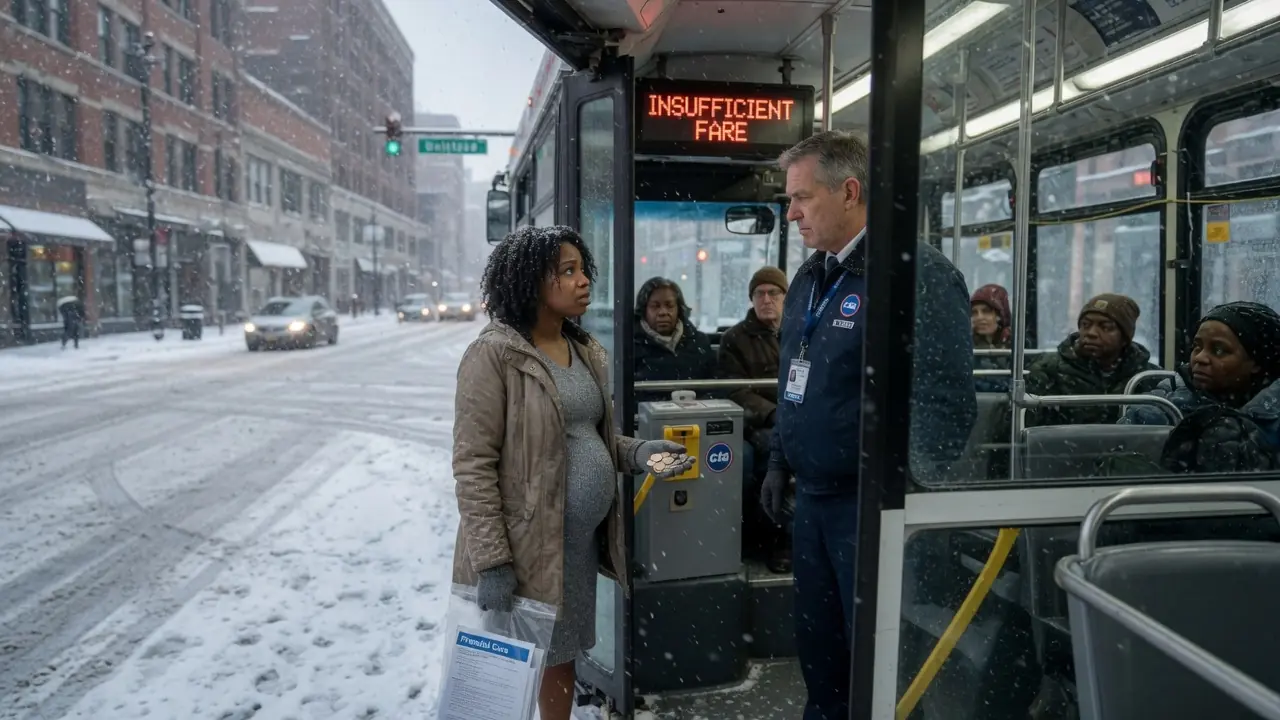
His father’s name was Roland. Roland left when Cedric was four. He did not leave dramatically. He simply stopped coming home one winter and by spring the closet where his coats had been was just a closet. Cedric did not remember the leaving.
He remembered the closet. The empty hangers. The particular silence of a space that used to hold someone and then held nothing. His mother Lorraine did not explain where Roland went. She did not need to.
The explanation was in the empty closet and the extra shifts and the way she started locking the front door with both locks instead of one. Cedric was seven years old the evening everything he would later become was set in motion. Lorraine was working a double at the plant. His after-school tutor dropped him at the bus stop on Martin Luther King Drive at 4:15. The bus was supposed to come at 4:30.
It did not come at 4:30. It did not come at 5:00. The snow started at 5:12. He knew the time because there was a clock on the bank across the street, and he watched it the way you watch something when there is nothing else to do, and the thing you are waiting for has not arrived, and you are beginning to understand that it may not. Cars passed, not many.
The ones that did had their wipers going and their windows up and their headlights cutting through the snow in a way that made the snow look like it was moving sideways. He stood at the bus stop with his backpack and his hands in his jacket pockets, and he waited. He was seven. He did not know what else to do besides wait. A woman in a sedan the color of rust pulled over at 6:21.
He had been standing there for two hours and six minutes. She leaned across the passenger seat and opened the door. She was wearing a dark blue coat. She did not ask his name. She did not ask where he lived.
She looked at him standing in the snow with his backpack and his thin jacket, and she said three words, “You looked cold.” He got in the car. She drove him home. She did not say much else. He did not say much either.
She pulled up to the house, and he got out, and she drove away, and he never learned her name. Lorraine was already at the front door when he turned around. She had gotten home eleven minutes earlier. She had called the tutor. She had called the school.
She had called the bus line. She was standing in the doorway with the phone still in her hand and the kind of terror on her face that does not look like panic, but looks like a woman who has already lost one person from this house and cannot survive losing another. She pulled him inside. She held him against her coat. She did not say anything for a long time.
Then she said she was sorry. Then she said it again. He told her it was okay. It was not okay, but he said it because that was what you said when you were seven and the person holding you was shaking. Years later, when people asked Cedric why he always kept a jacket folded on the seat next to the driver’s seat, he did not tell them about the bus stop.
He did not tell them about the two hours. He did not tell them about the woman in the blue coat whose name he never knew. He just said he liked to be prepared. The jacket sat there every shift. A CTA jacket, navy blue regulation issue, slightly too large for him because he had requested one size up so it could fit over whatever someone was already wearing.
It sat on the seat beside him the way some people keep a photograph in their wallet not to show anyone, just to know it was there. He did not remember the cold from that evening, not really. The body forgets cold eventually. What he remembered was the passing. The cars that went by, the headlights that swept across him and kept moving.
The specific feeling of being visible and ignored at the same time, which is not the same as being invisible. It is worse because invisible means nobody sees you. Visible and ignored means they see you and decide you are not their problem. He remembered that. He carried it the way you carry something you did not choose to pick up but cannot figure out how to set down.
And he remembered the woman, the blue coat, the three words, “You looked cold.” That was the whole thing. She had seen him. She had stopped. She had not made it complicated.
She had not asked for context or identification or an explanation of why a seven-year-old was standing alone in the snow. She had just opened the door. He was the kind of man who stopped. That was all. That was everything.
Lorraine Holloway worked the night shift at the Tyson Foods processing plant in East St. Louis for nineteen years. 10 at night to 6:00 in the morning, five days a week, sometimes six. She would get home in time to make breakfast for Cedric and his younger sister Nyla before they left for school. Eggs and toast if there were eggs, oatmeal if there were not. Then she would sleep for four hours, sometimes three, and wake up and do whatever the house needed before doing it all again. She had been doing this long enough that her body had stopped protesting and had simply rearranged itself around the schedule the way a tree grows around a fence post, not gracefully, just eventually.
Her hands told the story her mouth never did. They were thick in the knuckles and rough across the palms and they smelled faintly of industrial soap no matter how many times she washed them at home. The cold from the plant floor had settled into her joints permanently by the time she was 40. She opened and closed her fingers in the morning like someone testing a machine that used to work smoothly and now required negotiation. She never complained about the hands.
She never complained about much of anything. It was not because she did not feel it, but because complaining required an audience and energy, and she had neither to spare. What Lorraine had was a system. The system was simple. You got up.
You went. You came home. You fed your children. You went again. The system did not require motivation or inspiration or someone telling you that you were doing a good job.
The system only required that you showed up, which she did, every night for nineteen years, in the kind of quiet relentlessness that nobody writes about because it is not dramatic enough to be a story. Except that it is. It is the whole story. Lorraine did not teach her children with words. She taught with behavior.
Which bus to take to the clinic. Which church gave out winter coats in November. Where the cheaper laundromat was. She gave what she had. What she had was knowledge of how to survive a place that was not designed to make survival easy.
She did not do these things because she had read something about kindness or because someone had told her it was important. She did them because that was simply what you did when someone needed something and you were the person standing closest. That was the lesson. Not spoken. Just lived.
Over and over in a hundred small acts that nobody recorded and nobody applauded and that her children absorbed the way children absorb everything. Not by listening, but by watching. Cedric watched. He watched her carry the soup pot across the street in the dark. He watched her knock on doors.
He watched her sit with people in their kitchens when they were having a hard time not saying much, just being there, which he would later understand was the harder thing. Talking is easy. Staying is the thing that costs you something. There was one thing Lorraine said out loud. One sentence she repeated enough times that it lived in the house like furniture.
You do not have to fix everything. You just have to not walk past. She said it when Cedric came home from school upset about a kid who was being picked on and did not know what to do. She said it when Nyla asked why their neighbor was crying and whether they should do something. She said it the way some people say grace before dinner.
She said it not as a performance, but as a fact—the floor the whole house was built on. Cedric heard it so many times that he stopped hearing it as a sentence and started hearing it as the sound of his mother’s voice. The two became the same thing, the words and the woman. He learned what a man was supposed to be not from watching one but from the specific shape of the space where one should have been standing. His father had left a hole.
His mother had filled it. She filled it not with a replacement, but with herself, with the soup pot, with the night shift, with the sentence that lived in the walls. You just have to not walk past. Cedric moved to Chicago when he was 28. He had spent six years after high school doing the kind of work that was available in East St. Louis, which meant warehouse jobs and temp shifts and one eleven-month stretch driving a delivery truck for a linen company that went out of business on a Tuesday without telling anyone until Wednesday.
He applied for the CTA because it was steady and it had benefits and because driving was the one thing he had always been good at in the way that some people are good at things without being able to explain why. He was not fast or flashy, just attentive. The kind of driver who checked mirrors more than most people checked their phones. He passed the training. He got assigned route 63, southbound.
The route ran through Woodlawn and Englewood and into the neighborhoods on the south side where the city’s investment had been deferred so long that the deferral itself had become a kind of policy. The bus stops along route 63 did not look like the bus stops along Michigan Avenue. On Michigan Avenue, there were shelters with glass panels and real-time arrival displays that told you the bus was 4 minutes away and you could believe it. On route 63, there were poles, sometimes a sign. The average wait on the north side was 12 minutes.
On Cedric’s route, it was 28. It was not because fewer buses were scheduled, but because the buses that were scheduled broke down more often, got pulled from service more often, and were replaced more slowly because the maintenance budget followed the same pattern as everything else in the city. The money went where the money always went. Route 63 was the kind of route that drivers with seniority traded away the moment they had enough years to request a transfer. The kind of route new drivers inherited like furniture nobody wanted.
Cedric had enough seniority now. He had been offered a transfer twice. He stayed. He did not explain why. The reason was not complicated.
The people on this route needed a bus that showed up, and Cedric was the kind of person who showed up. He knew them. He knew them not by name, but by pattern and presence. The old woman who boarded at Halsted every Tuesday and Thursday at 7:10 in the morning. Always the same stop.
Always with a small bag. She was going to dialysis. He knew because of the bag and the way she held her arm carefully, protecting the place where the needle went in. He never asked. She never told him.
They had an understanding that existed entirely in the space between a nod and a door opening on time. The young man who got on at 63rd and Ashland five nights a week at 9:45. Night shift at the Amazon warehouse in Pullman. Always tired. Always polite.
Always wearing headphones that were not playing anything because Cedric could see the cord was not plugged in. He wore them so people would not talk to him. Cedric understood that. Sometimes silence is the only privacy a person can afford. And there was the girl.
The pregnant girl who boarded every Friday afternoon at 55th and Halsted, she carried a clear plastic bag from what looked like a clinic. She was young, perhaps in her early twenties. She sat near the front and held the bag on her lap and put one hand on her stomach and watched the city go by like she was trying to memorize it. She was trying to memorize it. She did not know she was.
Cedric did not know her name. He did not know her story. He knew she was carrying something heavier than the clinic bag. He could see it the way his mother had seen people, not past them, through them, into the specific shape of what they were carrying. He saw her every Friday.
She saw him every Friday. Neither of them said a word beyond the usual. The transaction of the fare. The nod. The doors closing.
That was all. On the seat beside him, the jacket sat folded. The CTA jacket, navy blue, one size too large, placed there on his first day six years ago and never moved since. Nobody asked about it. He did not explain it.
It sat there like a promise he had made to someone he could not name. Six years. Every shift. The jacket had never been used. It had never needed to be used.
It simply waited. The way some things wait. Quietly. Without urgency. Until the one evening they are needed and everything that came before becomes the reason they were there.
Cedric was not driving the afternoon shift on February 14th. He had worked the morning, 6:00 to 2:00. The afternoon belonged to Gerald Pitts. Gerald was 52 years old and had been driving for CTA for fourteen years. He was not a bad driver.
He was not a bad man. He was the kind of man who had been doing a job long enough that the job had replaced the person who used to do it. Gerald did not see passengers. He saw schedules. He saw the clock on the dashboard and the number of minutes between where he was and where he was supposed to be and the distance between those two numbers was the only distance that mattered to him anymore.
He ran on time. That was his reputation. That was his whole identity behind the wheel. Gerald Pitts ran on time. The bus arrived at 55th and Halsted at 4:47, 4 minutes behind schedule.
The snow had been falling since 3:00 and the roads were getting worse and Gerald had already made two unscheduled stops because of a traffic reroute near Garfield Boulevard and each one had cost him time. He could feel like a weight on his chest. Imani boarded at 55th. She stepped up the stairs slowly because the stairs on a CTA bus are steep when you are seven months pregnant and carrying a plastic bag from a clinic and your center of gravity has shifted in a way that makes every surface feel like it is tilted slightly against you. She reached the fare box.
She tapped her Ventra card. The reader beeped. Insufficient fare. 75 cents short. She looked at the screen. She looked in her bag.
She looked in her coat pocket. She found a quarter and two dimes and held them out toward the fare box like they might be enough if she held them at the right angle. They were not enough. Gerald looked at the fare box. He looked at the clock.
The bus was now 5 minutes behind. He did not look at her stomach. He did not look at the snow outside. He looked at the clock and the fare box and the distance between those two numbers and he said the sentence he had been trained to say, “Miss, the fare is $2. If you don’t have the full fare, I can’t let you ride.”
She stood there, the coins in her hand, the plastic bag from the clinic hanging from her other wrist. She did not argue. She did not raise her voice. She stood in the doorway of the bus with the cold coming in from behind her, and she looked at Gerald Pitts, and she said, “I’m 75 cents short. I just need to get home.”
Gerald said, “I understand, but I can’t override the system.” She looked past him at the passengers. The bus was half full, eighteen people. Not one of them moved. The woman in the third row had been watching since Imani boarded.
She had seen the card fail. She had seen the coins. She had seen the belly and the clinic bag and the snow, and she had made a decision in the first two seconds that this was not her scene. She looked back at her phone. The screen was already dim.
She tapped it to keep it awake. The man in the gray coat was sitting in the fourth row by the window. He had boarded twenty minutes earlier at an earlier stop. When Imani had gotten on at that stop, he had stood up and given her his seat without being asked. It was a small kindness, the kind that costs nothing and means something for exactly as long as the moment lasts.
Now, he was looking out the window. The snow was coming down harder. He could see her reflection in the glass standing in the doorway with her coins and her bag. The kindness had cost him nothing. This would cost him something.
He chose the window. The mother with two small children was three rows back. She had her daughter on her lap and her son beside her, and she was looking at Imani with the specific expression of a woman who knows exactly what it feels like to stand somewhere with not enough money and too much need and no one saying the word that would make the difference. She wanted to say it. She opened her mouth.
Gerald pulled the lever. The doors opened. The cold came in. Imani stepped out. Nobody said the word.
Gerald closed the doors. The bus pulled forward. It was 4:49. He was back on schedule. He did not look in the mirror.
There was a bus stop at 55th and Halsted, but it was the kind of bus stop that existed on the south side of Chicago, which meant a pole and a sign and nothing else. No shelter, no bench, no glass panel, no overhead covering. On the north side, the stops had heated shelters with digital arrival boards and clear walls that blocked the wind. On the south side, you stood in whatever the sky was doing and you waited. Imani stood on the curb in 19-degree weather with one hand on her stomach and the other holding a plastic bag that contained the results of her prenatal checkup, which had gone well, which the doctor had said looked good, which had been the first piece of good news she had received in weeks.
She stood in the snow and watched the bus pull away and she did not cry. She was too cold to cry. Crying requires a certain minimum of safety and she was not at the minimum. Her name was Imani Rochelle Webb. She was 23 years old, seven months pregnant, and she was not what the bus stop made her look like.
She was a nursing student in her final year at Malcolm X College on the west side. She took three buses to get to her prenatal appointments because the hospital that used to be 5 minutes from her house, Roseland Community Hospital, had closed its doors in 2020, just closed. The emergency room, the labor ward, the outpatient clinic, all of it gone in the amount of time it takes a city to decide that a neighborhood does not generate enough revenue to justify keeping its people alive nearby. When Roseland closed, the nearest hospital with a maternity ward was 40 minutes away by bus, if the buses ran on time, if you could afford the fare, if the weather was not 19° and falling. Imani had grown up in Roseland.
Her mother, Denise Webb, had worked as an emergency room nurse at that same hospital for 11 years before it shut down. Denise had been the kind of nurse who remembered patients by name and condition, not by chart number. The kind who stayed past the end of her shift, not because she was asked, but because the person in the bed was not done needing her yet. When the hospital closed, Denise transferred to a facility 35 minutes away by car. She had not missed a shift.
The commute had cost her something that did not show up on a pay stub, but she went. That was the Webb way. You went. Imani was going to be a nurse. Not just any nurse.
She was going to work labor and delivery. She was going to be the person in the room when someone’s child arrived. She was going to be the first hands. She had known this since she was 16 and had watched her mother come home from a double shift at Roseland with blood on her scrubs and a look on her face that was not exhaustion, but something closer to purpose. The kind of tired that meant you had done something that mattered.
Imani wanted that tired. She was almost finished. One more semester. Clinical rotations in the spring, then the boards, then a job, then the beginning of the life she had been building since she was 16 years old. Sitting on the edge of her mother’s bed, watching Denise untie her shoes with hands that had held other people’s emergencies all day.
The father of the baby was named Terrence. Terrence is not a large part of this story because Terrence had chosen not to be a large part of any story that required difficulty. He had said the right things for 7 months. Then, the ultrasound confirmed it was a girl and Terrence had stopped saying anything at all. Not suddenly, gradually, the way some people leave.
Calls shorter, replies slower, plans vaguer, until one day the phone just stopped lighting up with his name, and she understood that he had been leaving in pieces for weeks, and she had been watching it happen the way you watch weather move in from a distance, knowing it is coming, unable to do anything but stand where you are. She did not chase him. She did not ask for an explanation. She understood the explanation. The explanation was that the easier version of his life did not include a baby girl and the woman carrying her.
Imani carried a photograph in her wallet. Not a photograph, exactly. An ultrasound image, the first one. Eight weeks. The image showed almost nothing.
A gray blur with a small white dot in the center that the technician had circled with a marker and labeled with an arrow. It did not look like a baby. It did not look like anything recognizable. She kept it, not because it showed anything, but because it was the first proof that something was there. The first evidence that she was not carrying this alone, even when she was.
She had been carrying it for 5 months now, folded and refolded so many times that the crease had become a white line running through the center of the image, cutting the small dot almost in half. She did not take it out often. She just kept it, the way some people keep a promise in a place where they can feel its weight without having to look at it. On February 14th, the checkup had gone well. The doctor said the baby was healthy, growing on schedule, strong heartbeat.
Imani had walked out of the clinic into the cold afternoon with the results in her plastic bag and a feeling in her chest she had not felt in weeks. Something close to relief. Something close to the belief that things were going to work out. She boarded the bus at 55th and Halsted. The card failed.
The door opened. She stepped off. The relief had lasted eleven minutes. Then the door closed. Cedric was not supposed to be driving that afternoon.
Gerald had called the depot at 3:15 and said the roads were getting bad and he was ending his shift early. The dispatcher called Cedric at 3:22. Cedric had been home for an hour. He was sitting at his kitchen table in the apartment in Woodlawn eating a sandwich he had made with the last of the bread. He picked up the phone.
He said yes. He always said yes. He drove to the depot. He signed in. He took the bus out on route 63 southbound running 12 minutes behind Gerald’s abandoned schedule.
He was passing 55th and Halsted at 5:03 when he saw her. She was standing at the bus stop, not under a shelter because there was no shelter. Just standing at the pole with the sign. One hand on her stomach, one hand holding a plastic bag, snow on her shoulders, snow in her hair. She was not waving the bus down.
She was just standing there the way people stand when they have stopped expecting the next thing to be the thing that helps them. Cedric was three blocks from the next scheduled stop. If he stopped here, it was a violation. CTA regulation 7.4. Operators may not make passenger stops at non-designated locations.
If he let her ride without fare, it was another violation. Revenue policy. The fare box is not optional. He thought about the rules. He thought about the job.
He thought about the seven years he had spent building something stable after 28 years of nothing being stable. He thought about the apartment and the rent and the fact that this job had benefits, real benefits, the kind with dental and a pension, and that a pension was not something people from East St. Louis took for granted because a pension meant you had stayed somewhere long enough for the staying to be worth something. He thought about all of that. Then he saw her hand on her stomach. And he did not remember a specific memory.
He remembered a shape. The shape of standing somewhere cold and watching things move past you without stopping. The shape of being seven years old at a bus stop in East St. Louis and watching headlights sweep across you and keep going. The shape of being visible and ignored. He pulled the lever.
The doors opened. The cold came in. He reached across the seat. He picked up the jacket, the CTA jacket, navy blue, one size too large, folded on the seat beside him every shift for six years. He unfolded it.
He stood up. He stepped off the bus into the snow. Without his jacket, he walked to where she was standing. She looked up at him. He put the jacket on her shoulders.
She did not move. He did not say what the woman in the blue coat had said to him 27 years ago. He did not need to. The jacket said it. “The bus is warm.
Come on.” She looked at him, two words back, barely a whisper. “Okay. Thank you.” He walked her to the bus.
She stepped up the stairs. He followed her in. He sat down behind the wheel. He pulled the lever. The doors closed.
He did not enter a fare. He did not log the stop. He turned the heat to maximum and pulled the bus back onto the road. He was 14 minutes behind schedule now. He did not look at the clock.
Imani sat in the front row. The jacket was too big for her. It smelled like the bus, like the heater and the vinyl seats, and the particular neutral scent of a man who had been doing honest work in a small space for a long time. She pulled it around her shoulders and put both hands on her stomach and watched the snow through the windshield and did not say anything else. The bus was quiet.
Not the normal quiet of people ignoring each other, a different quiet. The quiet of people who had just seen something and were not sure yet what it meant. The girl in the second row, young maybe 19, looked at Imani sitting down in the oversized jacket and stood up without a word and moved to the back so Imani could sit closer to the heater vent. She did not explain why. She just moved.
The old man in the fifth row had been riding route 63 for 4 years. He had seen Cedric almost every day for as long as he had been taking this bus. The driver who nodded. The driver who waited the extra few seconds when he saw someone running for the stop. The driver who never seemed to be in a hurry even when the schedule said he should be.
He had never once thought about the man driving the bus. He was thinking about him now. He looked at Cedric through the rearview mirror. No jacket. Both hands on the wheel.
Eyes on the road. Something about the back of his neck, the set of his shoulders. The absence of the jacket that had always been there on the seat beside him. The old man had never seen him without it. He was seeing him without it now.
The mother with the two children had transferred from Gerald’s bus at the previous stop. She had been there when the door opened. She had been there when Imani stepped off. She had been there. And she had not said the word.
And now she was here on this bus watching a different driver do the thing she had not done. And she was crying. Not loudly. Just tears on her face that she was not wiping away because wiping them would mean acknowledging them. And acknowledging them would mean admitting that she had been on the other bus when it mattered and had chosen silence.
She was not crying because it was sad. She was crying because she had watched the door close and had not said the word and someone else had. The young man near the back had his headphones on. He had not seen Cedric stop the bus. He had not seen the jacket.
He had not seen any of it. He just noticed that the bus was unusually quiet. The kind of quiet that does not happen on city buses. He took off his headphones. He looked around.
He saw a pregnant woman in the front row wearing a bus driver’s jacket that was three sizes too big for her. He did not know the story. He did not know what had happened on the bus before this one or what it had cost the driver to stop where he was not supposed to stop. He just knew that something had happened on this bus that did not usually happen on buses. He put his headphones in his lap.
He kept them there for the rest of the ride. Cedric did not turn around. He did not check on her. He drove. Both hands on the wheel.
The cold from outside pressing through the gap in the driver’s side window where the seal had worn thin years ago and nobody had replaced it because route 63 was the kind of route where things did not get replaced quickly. He felt the cold on his arms and the side of his neck. He did not feel heroic. He felt cold. Those two things were not contradictions.
They rode in silence for 7 minutes. Imani in the front row. Cedric behind the wheel. The snow coming down against the windshield in the kind of steady fall that means it is not going to stop anytime soon. She had her hands on her stomach and her eyes on the window and she was watching the city go by the way you watch things when you are too tired to think about them and too awake to stop seeing them.
The storefronts on Halsted. The laundromat with one light on. The church with the marquee sign that still said Merry Christmas because nobody had changed it in two months. The city moved past the glass and she let it move. He did not speak.
He drove. The heater was on high and the bus was warm now and the silence between them was not the uncomfortable kind. It was the kind that happens when two people have arrived at the same understanding without discussing it. The understanding that sometimes the thing that just happened does not need to be talked about yet. It just needs to be sat in.
She spoke first without turning her head, quiet, almost to herself, “Thank you.” Cedric looked at her in the rearview mirror, the jacket around her shoulders, her hands still on her stomach. He said she did not have to thank him. She was quiet for a moment. Then, still looking at the window, she said, “People keep saying that, but nobody does it.”
He did not answer. He drove past two more stops, picked up one passenger who boarded without noticing anything unusual, dropped off another who pulled the cord and stepped out into the snow without a word. The bus moved. The wipers moved. Then, Cedric said something he had not planned to say.
He said his mother would have done the same thing. He did not know why he said it. He did not talk about Lorraine to strangers. He did not talk about Lorraine to most people who were not strangers. But, that was the thing about buses.
You said things to strangers on buses that you did not say to the people who knew you because the strangers were leaving and the words could leave with them. Imani did not ask about his mother. She just nodded. The small nod of someone who understood that when a person mentions their mother in that tone, it is not an invitation to ask questions. It is a door being opened just enough to let the light through.
She reached into the plastic bag from the clinic. She took something out. Not to show him, she just held it, a small piece of paper folded and refolded so many times that the creases had become part of it, a white line running through the center of whatever image was on it. She held it in her lap with both hands, the way you hold something that is not fragile, but that you have decided to treat as if it is. Cedric saw it in the mirror.
He did not ask what it was. He understood without seeing clearly. He understood the way you understand that someone is holding proof of something they have been told is not there. That someone is carrying evidence of a thing the world keeps asking them to justify. He kept his eyes on the road.
She kept her hands on the paper. The bus moved south. The cord pulled. Her stop. Imani stood up slowly.
She started to take the jacket off. She had one arm out of the sleeve when Cedric spoke without turning around. He told her to keep it. He said it was cold out there. She stopped.
One arm in the jacket, one arm out. She looked at the back of his head, at the set of his shoulders, at the place where the jacket had sat every day for six years and was no longer sitting. She put her arm back in. She pulled the jacket around her. She walked to the door.
She stepped off the bus into the snow. She did not look back. He did not watch her go. The doors closed. The bus moved forward.
The jacket went south. Three days later, Cedric was called into the depot office on 77th Street. The supervisor’s name was Mitchell. Mitchell had a desk with a computer and a stack of incident reports and a coffee mug that said world’s okayest boss, which someone had given him as a joke and which he had kept because he did not realize it was a joke. There was a report on the desk.
Cedric could see his name on it. Operator Holloway, Cedric D. Route 63, February 14th, three violations. Unscheduled stop at a non-designated location. Failure to collect fare.
Exiting the vehicle during an active route. The report had been filed by Gerald Pitts. Gerald, who had opened the door and let the cold in and let a pregnant woman step out and then closed the door and driven on and ended his shift early because the roads were bad. Gerald had filed the report not because he wanted Cedric punished. Gerald had filed the report because Gerald was the kind of person who followed procedures because procedures were the last thing holding his version of order together.
And when someone broke a procedure, it was not personal. It was structural. The structure had a crack in it and the crack needed to be documented. That was all Gerald saw. Mitchell looked at Cedric across the desk.
He read the violations out loud. He asked if Cedric had anything to say. Cedric said there was a pregnant woman standing in the snow and he stopped. Mitchell leaned back and said that was not how the system worked. Cedric looked at him and said he knew how the system worked and that was why he stopped.
Mitchell was quiet for a moment. The kind of quiet that means someone has heard something they did not expect and is deciding whether to acknowledge it or move past it. He moved past it. He explained that CTA policy was clear, that there had been other cases. A driver in Cleveland had let a homeless man sleep on the bus during a cold snap and had been suspended.
A driver in Milwaukee had given a stranded woman a ride home off route and had been terminated. The policy existed because the policy existed. That was the logic, the circle that closes on itself. Cedric listened. He did not argue.
He did not raise his voice. He signed the paper. He turned in his badge. He walked out of the depot into the February air without a jacket because the jacket was somewhere on the south side keeping someone warm. He drove home to the apartment in Woodlawn.
He sat down at the kitchen table. The table was small. The apartment was small. Everything in Cedric’s life was small except the thing he had just done. Which was large in the way that losing your income in February is large when you are a single man with no savings and no family in the city and the rent is due in 14 days.
He had $340 in his checking account. Rent was $675. The math was not complicated. The math was never complicated for people who lived like this. The math was simply a countdown.
He called Lorraine that evening. She picked up on the second ring the way she always did. Because Lorraine was the kind of mother who kept the phone close in case one of her children needed her. Even when her children were grown and living in other cities and had not needed her in the way they once had. He told her what happened.
The bus. The woman. The jacket. The report. The meeting.
She listened without interrupting. She listened the way she had always listened which was completely with the phone held tight against her ear and her body still and her breathing steady and nothing in the background. Because when Lorraine listened she cleared the room. When he finished she was quiet for a long time. Then she asked him whether he had done what he was supposed to do or what was right.
He told her they were not the same thing. She said they never are baby they never are. The line was quiet again. Then she told him to eat something and he said he would. And they both knew he probably would not.
He sat at the table after he hung up. He looked at the kitchen, the bill from ComEd on the counter, the gas bill next to it, the calendar on the wall still showing January because he had not turned it. February outside the window, the city doing what it always did at night on the South Side, not quite sleeping, just dimming. He thought about the jacket. He did not regret giving it away.
He did not not regret it. He was simply a man sitting in a cold apartment in February who had done the right thing and was now paying for it in the specific currency that rightness often costs. Imani wore the jacket every day. It was too big for her. The sleeves hung past her wrists and the shoulders sat wide on her frame and the zipper did not close all the way over her belly, which was growing now in the way that bellies grow in the eighth month, not gradually anymore, but with a kind of insistence, a physical announcement that something was almost ready.
The jacket smelled like the bus, not unpleasant, just specific. The vinyl and the heater and the particular neutral scent of someone who had been doing honest work in a small space for a long time. She did not wash it. Not yet. She did not know the driver’s name.
She did not know his badge number or the number of the bus. She knew only what had happened. A man got off the bus. He put his jacket on her. He said the bus was warm.
He did not ask her name or her story or whether she could pay him back. He just opened the door. She thought about him sometimes, not often, the way you think about someone who did something ordinary that happened to land on the one day you could not have survived the alternative. She continued her life. She went to class.
She took the bus to clinical rotations at the hospital on the West Side. She took three buses to her prenatal appointments because the hospital that should have been 5 minutes away had closed its doors, and the city had decided that the gap it left behind was someone else’s problem. 45 minutes each way, three transfers, each one a place where the system could fail, where the connection could be missed, where the weather or the schedule or the fare could turn a routine trip into something that did not happen. She knew women in Roseland who had missed appointments because of the buses. Not once, regularly. Women who had been told their blood pressure needed monitoring and who had to choose between the bus fare and the copay and chose neither because choosing meant something else did not get paid.
The numbers behind this were not small. Black women in America died during pregnancy or shortly after at three times the rate of white women. Not because their bodies were different, because the systems around their bodies were different. The hospitals closed in their neighborhoods first. The bus routes in their neighborhoods ran last.
The appointments in their neighborhoods required the most transfers and the longest waits and the highest likelihood that something would go wrong between the front door and the exam room. Imani knew this, not as a statistic. She knew it as a Tuesday afternoon standing at a bus stop in the rain with a clinic bag in her hand wondering whether the second bus was coming or whether she had already missed it. And the answer to that question was the difference between a checkup that happened and one that did not. She was going to be a nurse in these rooms.
She was going to be the person who understood why a woman showed up late or did not show up at all because she had been that woman. She rode the buses in the jacket. The ultrasound photograph, the first one, the 8-week image with the small white dot and the crease running through the center was in the left pocket now. She had moved it from her own coat to the jacket without thinking about it the way you move important things to the place that feels safest. His jacket was carrying her proof now, without knowing it was there.
Six weeks after the night on Route 63, on a Wednesday morning in early April, Imani woke up at 4:15 with a feeling that was not pain exactly, but pressure, the kind that arrives from somewhere deep and does not negotiate. Denise drove her to the University of Chicago Medical Center, 40 minutes in the dark. Denise had done this drive in her head a hundred times since Roseland closed, practiced it the way you practice a fire drill, knowing the route by heart because the moment it matters is never the moment you have time to look it up. They arrived at 5:02. The labor ward was bright, the kind of bright that exists only in hospitals and in kitchens at 3:00 in the morning and in the specific places where things begin or end.
Imani was in a gown and on a bed and holding her mother’s hand and doing the thing she had spent months preparing to help other women do, and finding that preparing for something and living through it are two entirely different categories of experience. She did not scream. She was not quiet, either. She made sounds that were hers and hers alone, the kind that do not belong to language because language is too slow for what the body is doing. Denise held her hand.
Denise, who had spent 11 years in emergency rooms, who had seen every kind of arrival and every kind of departure, who knew better than most people that the distance between the two was sometimes measured in minutes, she held her daughter’s hand and said nothing because there was nothing to say that the hand was not already saying. The room was very bright and very loud, and then it was very quiet, and then there was a sound that was not hers, and she understood that the sound was the beginning of someone. A girl, 6 lb, 11 oz, born at 7:41 in the morning on a Wednesday in April while the city outside was doing the thing Chicago does in early spring, which is pretend that winter is over while the wind off the lake says otherwise. Imani named her Zora. She did not explain the name to anyone in the room.
The name explained itself if you knew where to look. Denise held the baby and looked at her for a long time without speaking. Then she said she looked like she already knew things. Imani laughed, a tired laugh, the kind that comes out of you after hours of work that is not like any other work because the result is breathing and looking at you with eyes that have never seen light before and are deciding what to make of it. The jacket was folded on the chair beside the bed.
She had worn it to the hospital, taken it off when she changed into the gown, folded it the way it had been folded on the bus seat. It sat there beside the bed the way it must have sat beside the driver’s seat for six years before he gave it away. She looked at it. She looked at Zora. She looked at the jacket again.
For the first time since that night, she thought not about what had happened but about the person it had happened to, not herself, him, the driver who had stepped out into the snow without a jacket in February. She did not know what it had cost him. She did not know that 3 days after he gave it to her he had sat in a depot office and signed a piece of paper that ended the only stable job he had ever had. She did not know about the $340 or the kitchen table or the February math. She only knew that a man had taken off his jacket in the cold and had told her to keep it and she had kept it and it was here now in a hospital room in April with a baby sleeping next to it who would not exist in this room in this city on this morning if a certain set of things had gone differently on a certain night in February.
She looked at the jacket on the chair. She said quietly that she should find him, not to Denise, not to Zora, to the room, to the jacket, to the person who was not there. She did not know yet that finding him would take four months or that when she did, he would be standing in the last place she expected. Cedric applied for 14 jobs in the first 3 weeks. Warehouse work, delivery routes, a janitorial position at a school on the west side, a loading dock job at a distribution center near Midway.
He filled out the applications at the kitchen table with a pen that kept running out of ink and he wrote the same thing on every one of them. Previous employer, Chicago Transit Authority. Reason for departure, terminated. Nobody called back. Not because he was unqualified, because the word terminated sat on a resume the way a stain sits on a shirt.
You could explain it. You could contextualize it, but the person reading it had already decided what it meant before they reached the explanation. He was 34 years old, no degree, six years of driving a bus and a termination letter and a kitchen table and a pen that did not work. Lorraine sent $200 through Western Union on the 1st of March. He did not ask for it.
She did not ask if he needed it. She just sent it the way she had always done things without announcement, without waiting to be asked because she could feel the shape of a need from four hours away the same way she had always felt it from across a kitchen. He cashed it and sat with the specific shame of a grown man being kept alive by his mother’s money. Not because the shame was reasonable, because it was there. Shame does not need to be reasonable to take up space in a room.
The neighbor’s car broke down on a Tuesday. The neighbor’s name was Otis. He was 67 and he drove a 2003 Buick LeSabre that had been making a sound from the engine for 2 months that Otis had been ignoring because ignoring a problem is free and fixing it is not. Cedric heard the sound from his apartment window. He went outside.
He asked Otis to pop the hood. He looked at the engine the way his hands knew how to look at engines which was a skill he had taught himself in East St. Louis when he was 17 because when you cannot afford a mechanic, you become one. He fixed it in 40 minutes with a set of tools that had arrived in a box from Lorraine two weeks after he moved to Chicago. The tools had belonged to his father, Roland, the man who left. Lorraine had kept them not out of sentimentality, not out of anger.
She had kept them because tools do not leave even when people do and a good wrench does not care who owned it last. It just does what it was built to do. Cedric used Roland’s tools to fix Otis’s Buick and Otis told his neighbor and his neighbor told a woman at church and by the end of March, Cedric was fixing cars in the small lot behind his building three or four days a week. Not a garage, not a business, just a man and a set of tools and a word of mouth reputation that traveled the way reputations travel in neighborhoods where people still talk to each other which is quickly and specifically. He did not charge much.
Sometimes he did not charge at all. He was not building a business. He was just doing the thing that was in front of him because it was in front of him and because not doing it was not something he knew how to do. Then something shifted. Not suddenly the way things shift when you are paying attention to a pattern that has been there all along but that you did not have the angle to see until your life changed and gave you a different angle.
The people bringing him cars were not people with car problems. They were people with transportation problems. Mrs. Givens on 64th Street had missed two dialysis appointments in February because the bus was late and the clinic would not hold her slot past 15 minutes. Tanya Coleman on Woodlawn Avenue had lost a shift at her job because route 63 was rerouted for construction and nobody told the riders until the bus did not show up. A teenager named Devon had missed a placement exam at Kennedy-King College because his transfer did not connect and by the time he arrived the testing center was closed.
The Centers for Disease Control listed transportation as a social determinant of health, which meant that whether or not you could get to the doctor was as important as what the doctor told you when you got there. Cedric did not know the term. He knew the fact. He had been driving through it for six years. He started writing things down.
Names, addresses, appointments, who needed to be where and when and how far it was and whether the bus could get them there and how often it did not. He kept the list in a small notebook he bought at the Dollar Tree on Cottage Grove. Then he started driving. Mrs. Givens to dialysis on Tuesday. Tanya’s mother to the pharmacy on Thursday.
Devon to the retake of his placement exam on a Friday morning in April. He used the car he had been fixing for Otis, which Otis had given him in exchange for the repairs because Otis had decided he was too old to drive anyway and the car was better off with someone who would use it for something that mattered. Cedric drove. He did not charge. He did not name what he was doing.
He just did it the way Lorraine had carried soup across across in the dark. The way the woman in the blue coat had pulled over on Martin Luther King Drive and opened her door. You do not have to fix everything. You just have to not walk past. Four months after the night on Route 63, Imani was standing outside the Woodlawn Community Health Center on a Thursday morning in June.
She had graduated from Malcolm X College in May. She was doing her clinical rotation at the health center three days a week, working the intake desk and assisting with prenatal appointments and learning the specific rhythms of a community clinic, which are not the rhythms of a hospital. A hospital moves fast. A community clinic moves at the speed of the people it serves, which means slowly, because the people it serves have been waiting for everything else in their lives for so long that they have learned to wait here, too. Even though this is the one place that is supposed to be for them.
She was standing outside because she had stepped out to check on a patient who had called to say she was running late. The patient’s name was Mrs. Givens. Mrs. Givens was 68 and came in for blood pressure monitoring every two weeks and had missed her last appointment because the bus had not come. Imani was looking down the street for her when she saw a car pull up, an old Buick, rust on the passenger door. A man got out of the driver’s side and walked around to the passenger side and opened the door for Mrs. Givens, who stepped out slowly with her bag in one hand and his arm in the other.
Imani watched the man. He was in his mid-30s. He was not wearing a jacket, even though the morning was cool in the way that Chicago mornings are cool in June, which is not winter cool, but cool enough that most people wore something over their arms. He stood beside the car and waited while Mrs. Givens adjusted her bag. He did not rush her.
He did not check his phone. He just stood there with a specific patience of a man who stops. Imani recognized the posture before the face. She had never seen his face clearly. That night in February it had been dark and snowing and she had been looking down at the sidewalk and then looking at his shoulders from the front seat and then looking at the back of his head from behind.
She did not recognize his face. She recognized the way he stood, the way he waited, the way he opened a door for someone without making it into a performance. She stood at the entrance to the clinic. Mrs. Givens walked past her and inside. The man turned back toward the car.
He saw Imani standing there. He looked at her. He did not recognize her. Why would he? He had seen her once in the snow at night for less than 3 minutes.
She was one passenger on one evening on a route he no longer drove. Then his eyes moved down from her face to the jacket, the CTA jacket, navy blue, one size too large, zipped halfway up over a white scrub top. He stopped. She said he had stopped the bus. He looked at the jacket.
He looked at her. He looked at the thing she was carrying against her chest in a cotton sling which was a two-month-old baby with her eyes closed and her hands curled into fists the size of plums. He did not speak for a moment. Then he said she had kept the jacket. She said he had given it away in February without asking whether he would get it back.
They stood there. Neither of them moved. Then she said, “This is Zora.” He looked at the baby. He looked at her for a long time.
Very quietly, almost to himself, he said, “She looks warm.” The words landed in the space between them and stayed there. She looks warm. The echo of a sentence he had never said out loud but that had lived in his body for 27 years. You looked cold.
He had seen a woman standing in the cold and he had given her the only warm thing he had. And now, he was looking at her daughter wrapped in cotton and sleeping in the June air with the particular ease of someone who has never known cold. She looks warm. The loop closed. She asked him what had happened after that night.
He was quiet. Then he told her, “The depot, the report, the termination, the $340, and the $675 rent, and the February math.” The cars, the neighbor, the tools, the notebook with the names and the addresses and the appointments. She listened the way her mother listened, which was completely without interrupting, without arranging her face into an expression that was supposed to mean something. When he finished, she asked him if they had fired him for stopping.
He said they had fired him for stopping where he was not supposed to stop. She looked at him. She said he had stopped where he was supposed to stop, and they just did not have a sign there. Neither of them said anything for a while. They stood outside the clinic in the early summer air with a 2-month-old baby between them and a jacket that had traveled further than either of them had expected.
And for the first time in four months, Cedric felt something that was not cold. They sat on the bench outside the clinic, and they compared notes. Not deliberately, not in the way of two people who have decided to collaborate. In the way of two people who start talking about the same thing from different ends, and slowly realize they are describing the same room. Imani told him about the clinic, about the patients who did not come. 15 to 20% of scheduled appointments missed every month, and the number one reason was not that people did not want to come.
It was that they could not get there. The bus took too long. The transfer did not connect. The fare was too much. On a week when the fare was the difference between getting to the doctor and getting to work.
She told him about the pregnant women who missed prenatal visits because the hospital was 45 minutes away by bus, and the bus was late, and the appointment was at 8:00 in the morning, and you cannot hold an 8:00 appointment when the 6:45 bus does not arrive until 7:20. She told him about the numbers. 3.6 million Americans missed medical appointments every year because they could not get there. Not because they were careless. Not because they did not value their health. Because the distance between where they lived and where the care was had a cost attached to it that the system had decided was their problem to solve.
Cedric listened. Then he took out the notebook. The small one from Dollar Tree. He opened it to the page with the names. Mrs. Givens, Tonya Coleman’s mother.
A man named Harold who needed to get to the VA hospital on the west side every other Friday. A woman named Patrice who had a standing appointment at a clinic on 71st Street for her son’s asthma. Eight to 10 people a week. He drove them. He paid for the gas.
He did not have a name for it. He did not have a structure. He just had a car and a list. Imani looked at the list. She read the names.
She stopped on the third one. Mrs. Givens. The same Mrs. Givens who had just walked into the clinic. The same Mrs. Givens whose missed appointment last month was in the file on Imani’s desk. She looked at the fourth name.
Patrice Williams. Also a patient at the clinic. Also in the system. She looked at Cedric. She looked at the notebook.
Three of the people on his list were her patients. The same people. The same need. The same gap between where they were and where they needed to be. He had been filling the gap from one side.
She had been watching it from the other. They had been building toward the same corner of the same problem from two different directions without ever comparing notes. She told him the clinic did not have a transportation budget. He told her he did not have a budget at all. She told him there were federal models for this, community health transportation programs that connected volunteer drivers to clinics and hospitals, grant funding available through the Department of Health and Human Services, organizational structures that had been tested in other cities and that worked when someone was willing to do the work of putting them together.
He listened the way he listened to everything, which was carefully, without interrupting, filing each piece the way his hands filed the parts of an engine. Then he said he had never formalized anything in his life. He had spent his life doing things because they needed to be done, not because there was a structure around doing them. He did not say this as a refusal. He said it as a fact, the way a man describes the only way he has ever known how to work.
She looked at him. She said he did not have to do this alone. He looked at her. Nobody had said that to him before. Not because people did not care, because nobody had been standing close enough to the same problem to see that he was already in it.
He called Lorraine that night. She picked up on the first ring. She was in the kitchen in East St. Louis, the same kitchen where she had paid bills after the kids were asleep and cried once in the year after Roland left when she thought both children were in bed. She was drinking tea. She was always drinking tea at this hour.
The mug was the one with the chipped handle that she had kept for 12 years because it held heat longer than the others and because Lorraine did not throw things away that still worked. Cedric told her everything. The clinic, the woman from the bus, the jacket she was still wearing four months later, the baby, Zora. He told her the woman was a nurse now working at the same clinic where he had been dropping off patients. He told her about the notebook and the names and the three names that matched.
He told her the woman wanted to build something together. A program, a real one. Lorraine listened. She did not interrupt. She listened the way she had always listened, which was with her whole body, the phone pressed to her ear, her tea getting cold because she had forgotten it was there.
When he finished, she was quiet for a long time. Then she said he had given that jacket away in February and it was still keeping somebody warm in June. She said that was not a jacket, that was a sermon. Cedric laughed, a short one, the kind that comes when someone has said something so precisely true that the body does not know what else to do with it. Then he said something he had never said to her before.
He said he kept thinking about the woman in the blue coat, the one who picked him up when he was seven. He said he never knew her name. Lorraine was quiet. She said she knew. He said he thought about her every time he stopped for someone.
Lorraine said she knew that, too. The line held. Neither of them spoke. Outside the kitchen window in East St. Louis, the street light was doing the thing it always did, which was flicker twice before staying on. And Lorraine watched it the way she watched most things patiently without expecting it to change.
Then she said his daddy left. That woman stopped. He stopped. She said that was the whole story. She told him he could stop telling it to himself like it was a question.
It was not a question. It was the answer. They built it in three months, not because three months was fast, because three months was all they had before the grant deadline. Imani wrote the proposal at the kitchen table in her apartment in Roseland with Zora sleeping in the bassinet beside her and the laptop balanced on a stack of nursing textbooks she had not yet returned to the college bookstore. She had never written a grant before.
She learned the way she learned most things by reading what other people had done and then doing it herself and fixing the mistakes as she went. She found models, rides to wellness in Michigan, faith in action in Missouri. The NEMT programs that existed in 37 states for Medicaid patients who qualified, which was a smaller number than the number who needed them because qualification and need are two different lists and the gap between them is where people fall through. She wrote the proposal for a community health transportation program based out of the Woodlawn clinic. Volunteer drivers, used cars, a dispatch system run out of a donated closet-sized room in the back of the building.
Cost per ride less than a third of what an ambulance billed for a non-emergency transport. Cedric recruited the drivers, four people from the neighborhood. Each one had a car that ran in time that was not accounted for and the specific willingness to show up for something that did not pay because the something mattered more than the pay. Otis was one of them. He had gotten his Buick back after Cedric fixed a newer car donated by a church on Cottage Grove.
They called it Route Home because every route should take you somewhere you need to be. The first month they served 47 patients. Mrs. Givens to dialysis, Tanya Coleman’s mother to the pharmacy, Patrice Williams and her son to the asthma clinic, Harold to the VA. 47 people who got to the doctor. 47 people who did not have to choose between the bus fare and the co-pay. The missed appointment rate at the clinic dropped 22%. It was not a miracle, but a logistics problem that someone had finally treated as a logistics problem instead of a personal failure.
Gerald Pitts heard about Route Home. It made the local news, a short segment on a community health program in Woodlawn built by a former CTA driver and a nurse. Gerald saw it on the television in the break room at the depot where he still worked and where he still drove route 63 and where the seat beside the driver’s seat on his bus was empty the way it had always been empty because Gerald had never been the kind of man who kept something there just in case. He watched the segment. He did not call.
He did not write. He did not feel the thing that some people feel when they see the aftermath of something they could have prevented. Some people hear about the thing they could have prevented and feel something. Others hear about it and turn the page. Gerald turned the page.
The morning Route Home officially launched. Imani arrived at the clinic at 6:30 with Zora in the carrier on her chest and the jacket folded over her arm. She had washed it, pressed it, folded it the way it had been folded on the bus seat for six years. She found Cedric in the dispatch room which was a closet with a desk and a phone and a whiteboard with the day’s routes written in dry erase marker. Twelve volunteer drivers listed on the board now.
Eight runs scheduled for the morning. She held the jacket out to him. He looked at it. He looked at her. He took it.
He held it for a moment. The weight of it. The specific weight of something that has been more places than you expected it to go and has come back changed in the way that things change when they have been needed. He did not put it on. He walked to the wall beside the whiteboard.
There was a hook there. A simple hook, the kind you buy at a hardware store for $2. He hung the jacket on the hook. It hung there in the small room beside the whiteboard and the phone and the schedule. The jacket was no longer his.
It was no longer hers. It was the first piece of something that belonged to the room. Imani reached into the left pocket of the jacket before she let it go. She took out the ultrasound photograph, the first one, 8 weeks, the small white dot, the crease running through the center. She held it for a moment.
Then she put it in the pocket of her scrubs. The jacket could belong to the program. The proof belonged to her. Some things start before you know they have started and some things stop being yours the moment they become something larger. Two years later, Route Home had six cars and fourteen volunteer drivers and served three clinics on the South Side.
Cedric was the coordinator. He still drove three days a week because he was the kind of person who did not stop doing the work just because he was also organizing it. His desk in the dispatch room had a phone and a computer and the whiteboard had gotten too small and been replaced by a larger one that Otis had found at a school that was throwing it away. The jacket still hung on the hook by the door. Nobody moved it.
Nobody asked about it. It was simply there. Imani was a full-time nurse at the Woodlawn Clinic, labor and delivery referrals, prenatal intake. She was the first hands. Just like she had planned.
She was the person in the room when someone arrived and she was the person who understood when someone did not arrive because the bus had not come or the transfer had not connected or the fare had been 75 cents too much on a day when 75 cents was the distance between showing up and not showing up. She understood because she had been that person. Zora was two. She went to the community daycare in the basement of the church on Cottage Grove while Imani worked. She was the kind of two-year-old who looked at everything with a seriousness that made adults uncomfortable because it felt like she was deciding something about them.
She did not know yet about the bus, about the snow, about the jacket. She would someday when she was old enough to understand that the world does not always stop for you, but that sometimes if you are lucky or if someone is paying attention, it does. Lorraine came to Chicago in October. She took the Greyhound from East St. Louis because she did not like flying and because the bus was $32 and the plane was $180. And Lorraine had spent her whole life knowing the difference between those two numbers even when she no longer had to.
She arrived at the Woodlawn apartment and Cedric opened the door and she looked the way she always looked at him, which was completely reading his face the way she had read it since he was a boy knowing every configuration of it. She saw something new in it, something settled. She met Zora. She held the baby the way she held everything completely without needing to say what it meant. On a Tuesday morning in October, Cedric drove a Route Home car past the bus stop at 55th and Halsted.
The same stop where Imani had stood in the snow two years before. There was a shelter there now, glass panels, a bench, an overhead covering that blocked the rain and the wind and the snow. CTA had installed it six months ago after a community petition with 400 signatures, half of which had been collected by patients at the Woodlawn Clinic who had spent years standing at that pole in whatever the sky was doing. Cedric slowed the car. He looked at the shelter.
He looked at the bench. He looked at the place where she had been standing. The shelter had not been there when it mattered. It was there now. That was the difference between fixing something and preventing it.
He was learning the difference. He was learning it every day. He drove on. Cedric was not extraordinary. He did not change a system.
He did not pass a law. He did not make a speech. He stopped a bus. He took off his jacket. He lost his job for it.
He did not save the world; he changed one evening for one person on one cold night in February. That decision cost him everything he had built and became the foundation of everything he built after. Some people say stopping was the right thing. Others say the right thing should not cost you your livelihood. Both of those are real.
Neither one is the question that will stay with you. The question is this. You have been on buses like that. You have watched doors close on someone.
You may have been the person the door closed on. You may have been the person who looked out the window. You may have been the driver who checked the clock. The question is not whether you would have stopped.
That is too easy to answer from where you are sitting. The question is whether you will stop the next time. Because there is always a next time. There is always someone standing in the cold.
There is always a door that has just closed. And there is always a jacket. You do not have to fix everything. You just have to not walk past.