She took the photo on day one, not of the mold that came later, but of the missed spot Gary Pratt pointed to, tapping the rim of the third floor bathroom with two fingers and explaining with the patience of someone explaining something to someone he did not expect to understand it quickly, that she had missed a spot. The spot she had not missed—the spot she had spent 40 seconds documenting from three angles with the inspection grade camera built into the lanyard badge around her neck, which the Grand Meridian Hotel knew only as the standard ID badge issued to supplemental housekeeping staff by the staffing agency. Gary Pratt had been at the hotel for 9 years. He had managed this floor for six of them. He did not know what the camera was for.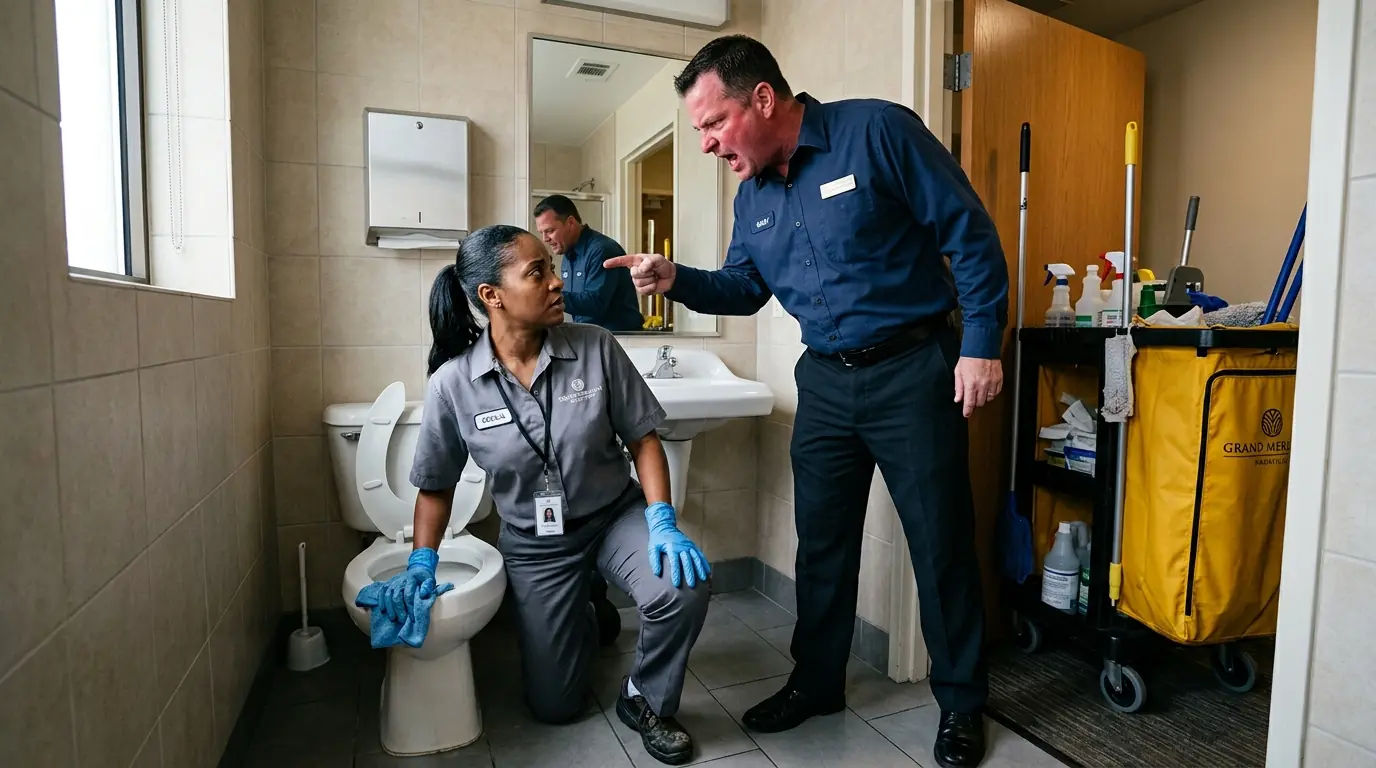
He did not know what Cecilia Broward was for by the time he found out. By the time the certified letter arrived at the general manager's desk on a Tuesday morning 11 days later, Cecilia was in Murfreesboro beginning her next assignment and the Grand Meridian's kitchen was closed. 3 years before the assignment, this is where it started. The first time Cecilia Broward conducted a covert compliance assessment, she was 41 years old and had been with the Tennessee Department of Health's Environmental Health Division for 13 years. The assignment was a restaurant in East Nashville that had received three illness complaints in 6 weeks and had twice rescheduled formal inspection appointments.
And the protocol for that situation, which existed in the division's policy manual and which Cecilia had helped draft in 2018, was to send a trained assessor in an undercover capacity to document conditions as they actually existed rather than as they appeared during a scheduled visit. The protocol required specific training, specific documentation methodology, and specific legal authorization from the division director. It was not surveillance. It was inspection. The same legal authority and the same regulatory purpose as a standard visit applied in the only format that produced accurate information from a facility that had demonstrated a pattern of preparation before formal inspection.
Cecilia had written the protocol with that distinction in mind. She had spent a year researching comparable programs in other state health departments, had consulted with the division's legal team on the boundary between regulatory authority and overreach, and had produced a document that was thorough enough to have survived two subsequent reviews by the department's general counsel. She had not expected to be the one implementing it. Initially, she had written it as a policy document. The division director had read it and asked if she would be willing to lead the first assessment herself.
She was patient. She was thorough. She wrote documentation that the division's legal team had described on two occasions as the clearest regulatory record they had reviewed in combined careers of over 40 years. She had conducted 11 covert assessments in 3 years. All 11 had produced actionable findings.
Seven had resulted in closure orders pending remediation. Four had resulted in operating certificate suspensions. The Grand Meridian was the 12th. The Grand Meridian Hotel occupied a 14-story building on Union Street in downtown Nashville glass facade. A rooftop bar that appeared in every lifestyle publication that ran a Nashville travel feature.
A lobby with Italian marble floors and live floral arrangements that were refreshed on Monday and Thursday mornings. a four-star designation it had held for 9 years. It served 340 guest rooms, two restaurants, a spa with eight treatment rooms, and a conference center that hosted corporate events generating significant recurring revenue for the property. Its TripAdvisor rating was 4.2. Its staff wore uniforms that cost more than Cecilia's first work blazer. The guest experience as marketed and largely delivered was one of comfortable authority.
The hotel that made you feel you were exactly where you deserve to be. The spaces behind the guest experience were different in the way that the spaces behind all guest experiences are different. Governed not by the logic of aesthetics, but by the logic of operational throughput. Housekeeping carts and corridors, supply closets stocked to efficiency rather than appearance, kitchen prep areas where speed and volume were the primary metrics and where the procedures designed to sit between those metrics and the food reaching the guest were sometimes honored and sometimes not. It was in those spaces, the ones that guests never entered and managers visited only occasionally, that the three illness complaints had originated, the epidemiological team suspected, and the inspection appointments had twice been rescheduled, and then a third outreach had gone unanswered.
Cecilia had reviewed the file before the assignment began. She had read the illness complaints. Nausea, vomiting, onset within 8 hours of a hotel meal consistent with a foodborne pathogen. Three separate incidents across 8 months with no common guest but a common venue. She had read the inspection history, the last formal visit 19 months ago, two rescheduled appointments, one nonresponse.
She had studied the floor plans. She knew which bathroom was on the third floor corridor closest to the supply closet. She knew where the ice machines were on each floor. She knew the kitchen layout from the building permit filings. She arrived at the staffing agency's onboarding session on a Monday morning with a housekeeping uniform in her bag and a documentation protocol memorized and the specific composure she brought to all 12 assignments. the composure of someone who is about to spend several days being told who they are by people who do not know who they are and who has decided that this is a condition of the work rather than an obstacle to it.
The agency placed her on the third floor. Gary Pratt ran the morning briefing. Eight housekeepers assigned sections, 7 minutes, efficient and brisk. He did not introduce Cecilia by name to the other staff. He pointed to her and said, "New hire, third floor east." Which was enough information for the operational purpose and none of the social one.
The other housekeepers who had been navigating Gary's management style for an average of 2 years each absorbed this with the practiced invisibility of people who had learned not to draw his attention by questioning his methods. Cecilia absorbed it and began her assignment every morning without fail. Cecilia arrived at the housekeeping station at 6:55, 5 minutes before briefing, and reviewed the day's room assignments while mentally mapping what she needed to observe. She moved through the third floor with the efficiency of someone who had cleaned before, not at this hotel, but she had worked housekeeping at two facilities during college and knew the rhythm of the work. And she documented with the systematic patience of someone who had spent 16 years identifying what standard looked like and where the gap was.
Every bathroom got the same inspection. Grout lines, caulk seams, ventilation grate, drain, water line at the base of fixtures. The mold behind the caulk line in room 312 was the first finding. Room 314 had it too. By end of day one, she had documented six bathrooms on the third floor with varying degrees of the same finding, a condition that developed when humidity was not properly managed and cleaning protocols did not include removal of the caulk line rather than surface cleaning over it.
She noted all six in her log that evening. She noted the bathroom Gary had told her she had missed. She noted the time of day, the specific fixture, the specific nature of the finding he had directed her attention to, which was a surface calcium deposit on the rim consistent with hard water buildup and wholly unrelated to the mold she had already documented behind the caulk. She noted these things because her job was to document what she observed. And what she observed was that the person responsible for quality on this floor had directed her attention to calcium deposits and had not noticed mold in six bathrooms.
But then something changed in the nature of what she was finding and the change mattered more than the mold. On day two, working the corridor near the supply closet at the end of the third floor east wing, Cecilia opened the closet to return a bottle of cleaning solution and found what the protocol called a mixed storage condition. Cleaning chemicals and personal protective equipment on the same shelf as sealed linen packages. The chemicals were correctly stored in secondary containment. They were not leaking or improperly labeled, but the proximity to linens that would go into guest rooms violated both fire code and the hotel's own posted supply storage procedure, which was taped to the inside of the closet door.
She photographed the contents, photographed the posted procedure, photographed the shelf arrangement, and noted the discrepancy between the two. She closed the closet and continued her rounds. On day three, she was working the corridor near the service elevator when Tara Shields, food and beverage manager, whose name Cecilia had memorized from the hotel staff directory, came through the corridor on her way to the kitchen, and asked Cecilia to move her cart, which was against the wall adjacent to the elevator doors without saying please and without pausing to register that she had spoken to a person rather than issued an instruction to a piece of furniture. As Cecilia moved the cart, she heard Tara say to the colleague walking with her that housekeeping always left things in the worst places, which was the kind of comment made by people who have decided that the category of person they are speaking to is not present enough to be affected by being spoken about in their presence. Cecilia moved the cart to the housekeeping alcove.
She noted the time, the location, the name, and the comment. She also noted that the corridor they were in ran adjacent to the kitchen's receiving area and that the door to the receiving area had been propped open with a doorstop and that the propped door provided a sight line into the receiving area that she had not previously had access to. and that from this sight line she could observe the arrangement of the cold storage units in a way that suggested a proximity between raw poultry storage and the prep counter that she needed to document more thoroughly. She requested a cart rotation to the kitchen corridor area the following morning on the grounds that she wanted to learn more of the property. Gary approved it with the indifference of a man who did not consider that a new housekeeper's preference for a different corridor was worth analysis. He told her to make sure she was keeping up with her room count.
On day four, she documented the cross-contamination pathway. It took two mornings of observation from the corridor and one careful sweep of the kitchen during the post breakfast cleaning when the prep staff had stepped away. And what it produced in her documentation log was the finding that the epidemiological team's hypothesis about the illness complaints had been correct. The surface between the raw poultry storage and the ready-to-eat prep area was insufficiently sanitized between uses, and the sanitization procedure documented on the posted kitchen protocol had not been followed on any of the three mornings she had observed. This was the critical finding.
This was the one that would close the kitchen. She knew it when she documented it the way she always knew when a finding was the one. Not with satisfaction exactly, but with the specific recognition of something that has been looked for and found. She finished the cross-contamination documentation by day four's end. Day five brought two additional findings she had not anticipated in the original file review, but which the physical inspection produced.
The HVAC filter serving the conference center was accessible from a maintenance panel in a utility corridor she was assigned to clean. The panel was not locked, which was itself a notation, and the filter behind it was visibly gray brown with accumulation in the specific pattern of long-term neglect rather than recent use. She estimated 11 weeks based on the uniformity of the dust layer, which was a conservative estimate she would note as such in the report. She photographed it. She replaced the panel.
The ice machine on floor 6 was the last finding and the one that troubled her most from a guest safety standpoint. The interior of the ice collection bin had a biofilm residue visible at the lower interior seam. It was a thin dark line that was easy to miss unless you were looking for it, and that indicated a sanitization gap that had likely been producing contaminated ice for weeks or months. She collected a surface swab with the collection kit she carried in the front pocket of her housekeeping cart beneath the cleaning supply trays, labeled it with the room and date and time, and sealed it in the small insulated case she transferred it to at the end of each shift. The lab confirmation would come later.
She already knew what it would say. On day five, Robert Callaway walked through the third floor corridor during Cecilia's morning rounds. He was giving a tour of the property to someone she did not recognize, a colleague or a prospective partner or a corporate visitor of some kind. He gestured at the corridor in the way that people gesture at spaces they are proud of. He did not acknowledge Cecilia as he passed, which was not unusual.
Hotel general managers do not typically acknowledge housekeeping staff individually during property tours, but which she noted because she also noted the sconce with the burned out bulb he passed without observing. the carpet seam coming up at the edge near room 317 that his tour companion nearly caught a heel on and the cart with the broken wheel she had been pushing all week because the replacement request she had submitted on day two had not been addressed. She noted the general manager's presence and what the corridor looked like in the presence of the general manager. She noted the broken wheel. She noted the date of the original replacement request. She noted the six days that had elapsed.
She finished her sixth shift on a Friday evening. She returned her badge and her uniform to the housekeeping station. The woman at the station asked if she'd be back Monday. She said she didn't think so. The woman said that was too bad, that they needed reliable people.
Cecilia thanked her. She was at her desk at the Environmental Health Division offices on Charlotte Avenue at 7:15 Saturday morning. She had been composing the report in her head since day two, the way she always composed reports, building the structure as the findings accumulated, so that the writing itself was the final step rather than the first. She wrote for 4 hours. The report was 41 pages, 14 photographs, all timestamped and geotagged by the inspection camera.
43 documented violations across six categories, sanitation, chemical storage, food safety, has fact maintenance, structural maintenance, and documentation compliance. The cross-contamination finding occupied pages 14- 19 and included four warnings of observation, two photographs, and a reference to the Tennessee Food Service establishment rules that the condition violated. The mold findings occupied pages 7 through 13 and listed 14 bathrooms by room number with photographic documentation. The report included a section she wrote carefully and in plain language because plain language was what the law required and what the situation deserved. a notation that two prior inspection appointments had been rescheduled by the facility and one had received no response from the facility and that this pattern documented across 19 months had allowed conditions to persist beyond acceptable regulatory timelines and that the methodology of the current assessment had been necessitated by that pattern. She did not use the word undercover in the report because the division's protocol used the term compliance assessment and because precision in language was how regulatory findings survived legal challenge.
She used the word compliance assessment six times. She submitted the report at 11:47 a.m. on Saturday. The division director reviewed it over the weekend. On Tuesday morning at 11:00 a.m., the Grand Meridian Hotel received formal notice from the Tennessee Department of Health. 43 violations documented immediate closure of kitchen operations required pending remediation of the critical food safety finding.
Formal reinspection of all guest bathrooms on floors 2 through 5 required within 30 days. A response was required within 72 hours regarding a remediation plan for all remaining violations. The notice was delivered by certified mail to Robert Callaway and simultaneously by email to the hotel's legal counsel. Robert Callaway read the notice at his desk. He read it twice.
His face, his assistant, would later describe to a colleague, went through several changes in the 60 seconds of reading, the last of which was the expression of a man who has been proud of something for a long time and has just received evidence that the pride was built on an incomplete accounting. He called the hotel's legal counsel. He called his food and beverage manager. He called his housekeeping supervisor. He asked, among other things, when their last formal inspection had been scheduled.
Gary Pratt told him they'd had some trouble with scheduling. Robert Callaway said he was aware of that. He said he had been unaware of what the scheduling trouble had allowed to develop. Tara Shields received the section of the report pertaining to the cross-contamination pathway. She read it.
She read the observation dates. She calculated which mornings those were. She thought about who had been in the kitchen corridor on those mornings. She thought about the new housekeeper she had asked to move a cart without saying please. She thought about what she had said to her colleague as the cart was being moved.
The report did not mention this conversation. The report documented physical conditions and regulatory violations, not interpersonal dynamics. But Tara Shields thought about it anyway. In the way people think about things, they cannot unknow. Gary Pratt received the section of the report pertaining to the mold findings.
He looked at the room numbers. He looked at the timestamps on the photographs. He understood that someone had been in those bathrooms with a camera on the days he had assigned the new hire to the third floor east, and that the new hire had been in room 312, the room where the worst mold finding was documented. On the same morning he had stood in that bathroom and pointed to a calcium deposit on the rim and told her she had missed a spot. He set the report down.
He picked it up again. He set it down again. The kitchen was closed for 11 days while the remediation was completed. The Grand Meridian brought in a third-party environmental contractor for the mold remediation. The HVAC filter was replaced.
The chemical storage closet was reorganized. The food service temperature logging procedure was revised and retraining was conducted for all kitchen staff. The ice machine on floor 6 was disassembled, sanitized, and tested. The carpet seam near room 317 was repaired. The burned out sconce bulb was replaced.
A formal reinspection was conducted 31 days after the notice by a different inspector in the standard format. The hotel passed. Six months later, Robert Callaway spoke at a Nashville hospitality industry conference about his experience receiving a compliance assessment and what it had produced. Not as a complaint, not as a critique of the process, but as a specific account of what it is like to believe a property is well-run and discover through the instrument of someone else's observation that your belief has been founded on incomplete information. He said the hardest part was not the remediation.
He said the hardest part was understanding that the spaces he had been proud of were spaces he had not actually been in, not in the way someone is in a space when they are responsible for it, when they know it the way the people who work in it everyday know it. He said that the assessment had been conducted by a person he had walked past in a corridor without seeing and that this fact had stayed with him. He did not know her name. The report's author was identified by inspector identification number rather than name per the division's protocol. He had not asked.
He said at the conference that he wished he had. Cecilia Broward was not at the conference. She was on her 13th assignment, a residential care facility in Knoxville that had received two complaint reports in 4 months and had not responded to scheduling outreach. She reviewed the file on the drive up, composing the structure of the report she had not yet written, building it as the findings would accumulate. patient with the work in the way she had always been patient with it. Not because patience was easy, but because it was what thoroughness required, and thoroughness was what the work was for.
The file on this facility had photographs of the building, a converted Victorian house on a tree-lined street, well-kept exterior, flower boxes in the windows. She looked at the photographs and thought about what the spaces behind the exterior looked like and what she was going to find in them, which was a question she had been answering for 16 years by going inside and looking. She drove north on I40. She had work to do.