The moment I realized my family no longer saw me as a person, I was sitting at the wrong table with a bowl of mashed potatoes cooling in front of me. The dining room was full of laughter, clinking forks, football noise from the living room, and voices overlapping in that warm holiday way that used to make me feel safe. But none of it reached me. I was close enough to see everyone I loved and far enough away to understand I no longer belonged among them.
My name is Renee Matthews, and I was sixty-eight years old that Thanksgiving. Five years earlier, my husband David had died on a rainy Tuesday morning in Columbus, Ohio, after forty-three years of marriage. Losing him felt like someone had removed half the foundation from under my life and expected the rest of me to stand straight. I did stand, because mothers and wives learn to do that, even when no one asks how much it costs.
David had been the center of our family without ever trying to be. People gathered around him because he made the room easier to breathe in. He fixed bicycles, remembered birthdays, helped neighbors move furniture, and knew how to make a frightened child laugh. When he died, I told myself the distance that grew between me and our children was grief.
At first, that explanation helped. Jennifer, my daughter, buried herself in work and her perfect suburban house outside Cincinnati. Michael, my son, became quieter, more practical, less tender. Phone calls became shorter, visits became rarer, and conversations slowly changed from how are you, Mom, to have you checked the paperwork, Mom?
For years, I excused everything. They were busy. They had families. They were grieving in their own ways. I told myself that family love sometimes becomes quieter with age, but that did not mean it had disappeared.
That Thanksgiving morning, I woke at 5:30 and stood alone in my kitchen while snow drifted past the window. The house was too quiet, the kind of quiet that reminds you someone is missing before your mind is fully awake. I made coffee, put on the old jazz record David loved, and took out his handwritten recipe card for mashed potatoes. The card was stained at the edges and carried the slant of his handwriting like a fingerprint from another life.
I cooked for two days, even though Jennifer had said she was hosting and no one had specifically asked me to bring food. I made sweet potato casserole, green bean casserole, cranberry sauce, pumpkin pies, and David’s mashed potatoes. I told myself that mothers show love through effort, whether anyone notices or not. It was a comforting thought until I realized how many years I had survived on being unnoticed.
Jennifer called around one o’clock. The call lasted less than two minutes. She asked if I was still coming, said things were busy, and hung up before I could ask whether she needed help. I stood in the kitchen afterward, holding the phone, feeling like I had just confirmed an appointment instead of spoken to my daughter.
By three, my SUV was packed with dishes wrapped in towels and foil. I drove the hour to Jennifer’s house with the heater humming and memories crowding the windshield. Christmas mornings, school plays, scraped knees, graduations, sleepless nights, hospital visits. David and I had given everything to our children because that was what parents did, and I would have done it again, but somewhere along the way, they had stopped seeing the giving and started assuming it would never end.
Jennifer’s driveway was full when I arrived. Cars lined the street, lights glowed in the windows, and laughter came through the front wall before I even reached the porch. For a moment, hope rose inside me. Maybe I had imagined the distance. Maybe tonight would feel like family again.
No one opened the door. No one looked out the window. I stood there holding a heavy casserole dish, watching my own family celebrate behind the glass like I was a neighbor delivering leftovers. Finally, I opened the door myself and stepped inside.
“Hello,” I called.
A few people glanced over, smiled politely, and returned to their conversations. Jennifer appeared from the kitchen, kissed my cheek quickly, and said, “Oh, hi, Mom. Need help with those?” Before I could answer, she turned back toward the kitchen and disappeared. I stood in the entryway holding the casserole as if I had arrived at the wrong house.
In the kitchen, the counters were already crowded with food. I placed my dishes beside store-bought trays and waited for someone to say something. No one asked what I had brought. No one thanked me. My mashed potatoes, David’s favorite recipe, sat there in a bowl like one more anonymous contribution.
Michael was near the refrigerator with Brian, Jennifer’s husband. When they saw me looking their way, their conversation stopped too quickly. Michael gave me a thin smile and said, “Hey, Mom. Happy Thanksgiving.” Brian nodded without warmth and looked back down at something near the counter.
That was when I first noticed the blue folder.
It sat partly open on the buffet counter near Brian’s hand. At the time, it meant nothing to me. I only noticed that he moved slightly in front of it when I came closer. Later, I would remember that small movement as the first visible crack in a plan that had been building behind my back for months.
The living room was crowded, but I felt like smoke passing through it. Ashley, Jennifer’s oldest daughter, barely looked up from her phone. Emma, the younger one, jumped up and hugged me, and for a few minutes my heart warmed in a way it had not all day. She asked about my drive, my pie, my sweater, and her art class.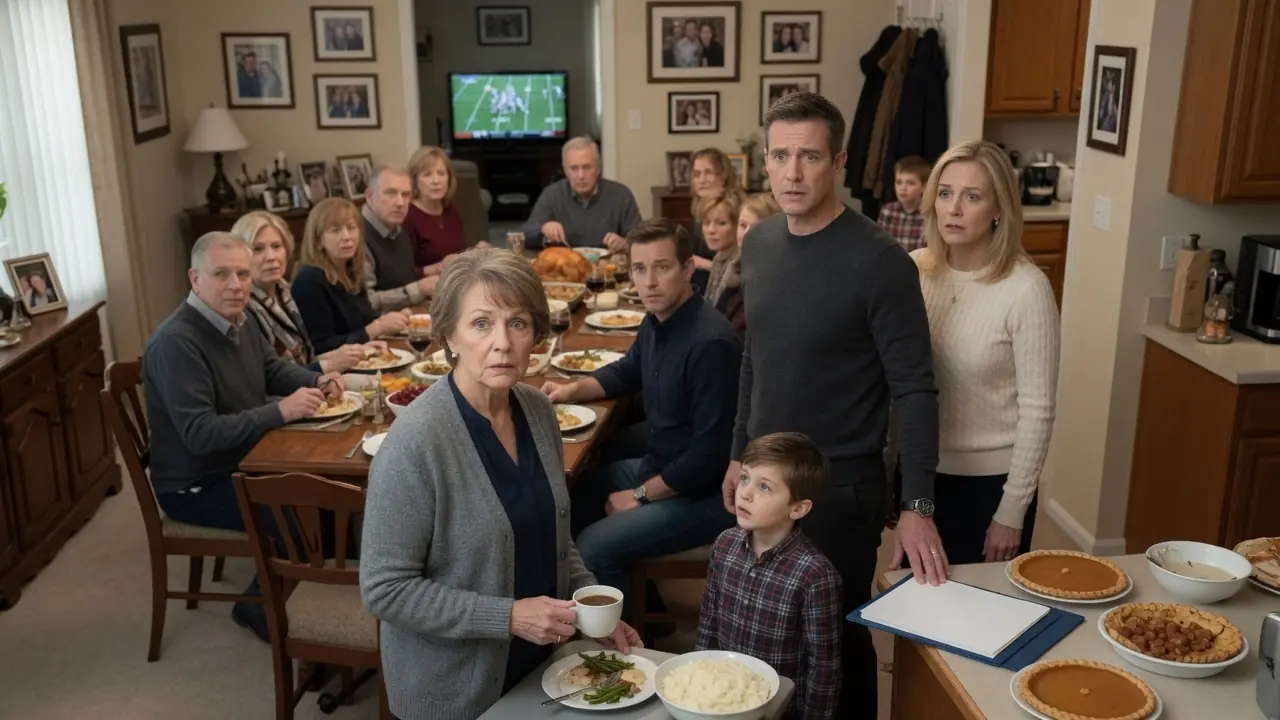
Again, I was alone.
Dinner was announced at six. Everyone moved toward the dining room, and I followed, already reaching in my mind for the chair beside where David used to sit. That had been my place for nearly twenty years of Thanksgiving dinners. Even after he passed, Jennifer kept that seat for me, and I had clung to it because grief sometimes survives on small mercies.
This year, the chair was occupied by one of Brian’s business associates.
I stopped at the edge of the dining room. Every chair at the main table had a plate, napkin, glass, and name card. Every chair except mine. Jennifer noticed me standing there and pointed toward a small folding table near the kitchen doorway.
“Oh, Mom, we set up extra seating over there.”
Over there.
The words should not have hurt as much as they did, but pain is rarely about the object in front of you. It was not the folding table. It was the message behind it. I had spent decades building the table, and now there was no room for me at it.
I sat quietly beside two children and an elderly neighbor who barely knew me. From where I was placed, I could see the main table laughing, passing food, telling stories, and leaning into one another’s lives. Brian raised his glass. Jennifer smiled for guests. Michael laughed harder at someone else’s joke than he had laughed with me in years.
Halfway through dinner, someone complimented the mashed potatoes. Brian said they were excellent. Jennifer nodded and passed the bowl down the table. Not one person looked toward me.
I lowered my eyes to my plate.
I told myself not to be childish. I was sixty-eight, not eight. But some wounds make children of us again, especially when they come from the people we once held in our arms. I had never needed applause for loving my family, but I had not realized how hungry I was for the smallest sign that my love still mattered.
During dessert, I stood to get water. As I passed the hallway, I heard voices coming from Brian’s home office. The door was not fully closed. Michael’s voice came through first, low but clear.
“Once we sell the house, everything gets easier.”
I froze.
Brian answered, “I know, but timing matters.”
“We’ve waited long enough,” Michael said. “Mom doesn’t need that much space anyway.”
My hand tightened around the empty glass. Sell the house. Mom doesn’t need that much space. I stood there trying to decide whether I had heard correctly when Jennifer suddenly appeared from around the corner.
The office door closed immediately.
Brian and Michael emerged seconds later acting too normal, the way people act when they want you to believe nothing just happened. Brian gave me a polished smile. “Everything okay, Renee?”
Renee.
Not Mom. Not Mrs. Matthews. Renee, like I was a woman he had once met at a committee meeting.
“Yes,” I said quietly.
I returned to the dining room with water I did not drink. From that moment on, I watched more carefully. Conversations changed when I approached. Glances passed between Jennifer, Michael, and Brian. The blue folder never moved far from Brian’s reach.
Then Ashley said the sentence that changed everything.
She looked up from her phone and asked, “Grandma doesn’t know about the assisted living place yet?”
The entire room froze.
Forks stopped. Conversations died. Even the football game from the living room seemed to fade into another world. Ashley looked around, confused by the damage her words had caused. Jennifer went pale. Michael nearly dropped his coffee cup.
I looked at my daughter. “What assisted living place?”
Jennifer forced a small laugh. “Mom, it’s nothing.”
“Then explain it.”
She glanced at Michael. Michael glanced at Brian. It lasted less than a second, but it told me they had already discussed this, maybe rehearsed it. Jennifer folded her hands too tightly and said, “We were only exploring options for the future.”
“My future?” I asked.
“Mom,” Michael said, stepping in, “you’re getting older.”
There it was. The sentence aging parents dread, not because it is false, but because of the way people use it. You’re getting older. Not are you lonely, not what do you want, not how can we support you. Just a reminder that your age has become someone else’s justification.
“Have either of you asked whether I want assisted living?” I asked.
No one answered.
“No,” I said. “You haven’t.”
Jennifer’s eyes filled with tears, but they did not move me the way they once would have. I looked toward Brian, and that was when I saw the blue folder again. It was slightly open, and a signature page stuck out from the edge. The handwriting at the bottom looked painfully familiar.
My handwriting.
Or something pretending to be.
I stood slowly and walked toward the buffet counter. Brian moved at once. “Need something, Renee?”
“What’s in the folder?”
“Nothing important.”
He reached for it, too fast, too defensive, but not before I saw enough. My name appeared at the bottom of a page I had never seen before. I had not signed a legal document in months, and yet there it was, my signature in blue ink, attached to paperwork no one wanted me to see.
I did not confront them then.
David had once told me that when people think you do not know the truth, they reveal more than they intend. So I sat back down. I smiled when spoken to. I accepted a slice of pie I could not taste, and I watched my family pretend the room had not cracked open around us.
Around nine, guests began leaving. Coats came off hooks, children whined, and goodbyes filled the hallway. Jennifer thanked everyone warmly. Brian shook hands. Michael helped carry dishes into the kitchen.
No one asked how I felt.
No one asked whether I was all right.
I stood near the family photographs, staring at a picture of David holding Emma when she was a baby. His smile was wide, his eyes full of love, and the ache of missing him nearly took my breath. David would have noticed. He would have noticed the folding table, the whispers, the blue folder, the way Brian said my name like I was a problem to be managed.
I walked to the coat rack and put on my winter coat.
No one noticed.
I picked up my purse.
Still, no one noticed.
I waited in the entryway for one final moment, not because I wanted attention, but because some tired, foolish part of me hoped Jennifer might look up. Maybe Michael would ask if I was leaving. Maybe someone would say, Mom, are you okay?
Nobody did.
I opened the front door. Cold air rushed inside. Laughter continued behind me, bright and careless. I stepped out and closed the door softly.
That was it.
No farewell. No goodbye. No one calling my name.
I stood on the porch staring at the dark driveway, and I understood I was not just leaving Thanksgiving dinner. I was leaving years of denial. Denial that my family still valued me the way I valued them. Denial that being ignored did not hurt because I was too old to need love.
When I reached my SUV, I looked back. The house glowed beautifully against the night, every window warm with holiday light. Anyone driving past would have seen the perfect Thanksgiving. They would never have known that a mother had spent the evening unwanted in the family she helped build.
I drove away.
Thirty minutes passed before my phone buzzed. Hope rose before I could stop it. Maybe Jennifer had noticed. Maybe Michael was worried. Maybe someone had looked at the empty folding chair and felt ashamed.
It was a promotional email.
I laughed once, bitter and small.
Another twenty minutes passed. No calls. No messages. No one had noticed I was gone.
Then I remembered Robert Hayes, David’s longtime attorney and one of his closest friends. Months earlier, Robert had told me, “If you ever need me, Renee, call anytime, day or night.” At the time, I thought it was kindness. Now it felt like warning.
Instead of driving home, I turned toward downtown Columbus.
Robert’s office lights were still on when I arrived near ten. That alone nearly made me cry. Most people were home with family, but Robert had always been the kind of man who worked when something mattered. Before I could knock, his office door opened.
“Renee,” he said, and his face changed immediately. “What happened?”
That question nearly broke me because it was the first time all day anyone had looked at me and truly cared.
I told him everything. The missing seat, the assisted living slip, the conversation about selling the house, the blue folder, the signature that looked like mine. Robert listened without interrupting. His expression grew darker with every detail.
When I finished, he leaned back slowly. “I was afraid of this.”
A chill moved through me. “Afraid of what?”
He looked toward a locked filing cabinet in the corner. “David prepared for this possibility.”
My breath caught. Robert unlocked the cabinet and removed a thick manila envelope. Across the front, in David’s unmistakable handwriting, were five words.
For Renee only, if necessary.
For a moment, I could not breathe.
Robert placed the envelope in front of me. “He left this with me three years before he died.”
My hands trembled as I opened it. Inside was a handwritten letter, several legal documents, and a flash drive. The letter was on top. The first line blurred instantly because my eyes filled with tears.
My dearest Renee, if you are reading this, then something has happened that I hoped would never happen.
I pressed one hand over my mouth.
David’s voice lived in every word. He wrote that he loved our children, but love should not blind us to reality. He had noticed questions about money, ownership, inheritance, and assets arriving more often than questions about my well-being. He prayed he was wrong, but he had prepared safeguards in case he was not.
The final lines undid me.
Do not surrender your peace out of guilt. Protect the life we built together. Trust Robert. Trust the documents. Trust yourself. You are far stronger than you realize.
I cried quietly, not because I was weak, but because my husband had reached across years to remind me I was worth protecting.
Robert explained the documents. David had transferred full ownership of our home to me years earlier. He had placed barriers around investments, created review requirements, and ensured no one could force asset transfers without my direct authorization. He had seen what I refused to see and built walls around my future.
Then Robert looked at me seriously. “If there is a signature you did not write, we need to know what document it is attached to.”
That night, my phone began ringing at 11:17. Jennifer first. Then Michael. Then Jennifer again. Two hours after I had left, they finally noticed.
Messages came quickly.
Mom, where are you?
Please call me.
We need to talk.
Then Brian texted.
Renee, please call us immediately.
I stared at the screen. Even in panic, he could not call me family.
A few minutes later, another message appeared from Brian. Please call. The paperwork needs to be discussed.
The paperwork.
There it was.
I took a screenshot before he deleted it.
Robert saw the message and nodded once. “That was careless.”
Shortly after midnight, Emma called. I answered immediately. Her voice was frightened, young, and honest. “Grandma, are you okay?”
“I’m okay, sweetheart.”
“Everyone’s looking for you.”
“What are they saying?”
She hesitated. “Mom and Uncle Michael are arguing. They keep talking about signatures and documents. Uncle Michael said if they don’t find you soon, the deal can’t happen.”
The deal.
Not Mom is missing. Not Grandma might be hurt. The deal can’t happen.
After I hung up, Robert said quietly, “They’re not looking for you because you’re gone.”
“No,” I said, looking at David’s letter. “They’re looking because they need me.”
I did not go home that night. Robert arranged a hotel near his office, and I sat awake until dawn with David’s letter beside me. By morning, Robert had brought in Daniel Brooks, a private investigator I had once spoken to months earlier when small doubts began troubling me. At the time, I had felt foolish and paranoid.
Now I was grateful.
Daniel laid out what he had found. Emails. Meetings. Property discussions. A real estate consultant. References to assisted living. Conversations between Michael and Brian about timing and control of assets. The words appeared again and again, neat and cold on printed pages.
Then Daniel slid one final document across the table.
My signature was at the bottom.
It was almost perfect, but not quite. I knew the curve of my own name. I knew the hesitation I had developed in the letter M after arthritis stiffened my fingers. This signature was a copy made by someone who had studied my handwriting but had never lived inside my hand.
“We believe it may be forged,” Daniel said.
For a moment, I could only stare at it.
The sadness inside me changed shape then. It became colder, clearer, steadier. I had walked out of Thanksgiving heartbroken. Now I was no longer only heartbroken.
I was awake.
Over the next few days, I removed secondary access from my accounts, reviewed every legal document, and strengthened every protection David had left for me. I did not call Jennifer. I did not call Michael. I did not respond to Brian. For the first time in years, my silence belonged to me.
Emma called again from her room one evening. She told me her parents were fighting about money. Then she said she had accidentally recorded part of a conversation before Thanksgiving while making a video on her phone. She asked if she should send it.
The video arrived the next morning.
In Robert’s office, we watched it together. The camera showed mostly floor and furniture, but the voices were clear. Brian said they could not keep waiting forever. Michael said I was not going to volunteer. Jennifer said she did not like it, and for one brief second I hoped she meant the plan.
Then she added, “I just don’t want her finding out.”
The hope died.
Brian’s voice came next. “Once the paperwork is complete, none of this matters.”
Then Michael said the sentence that made the room go cold.
“If we can prove she’s confused, things become much easier.”
Robert paused the video.
“Capacity,” he said.
I understood. They were not only discussing my house. They were discussing my legal ability to say no. My own children had sat in a room with my son-in-law and talked about making me smaller on paper so my property would become easier to reach.
The meeting happened ten days after Thanksgiving. I asked for it to be at Robert’s office because I wanted neutral ground, witnesses, and facts. Jennifer entered first, pale and trembling. Michael followed, exhausted and defensive. Brian came last, and the moment he saw Daniel in the room, his confidence cracked.
Jennifer said, “Mom, we’ve been worried sick.”
“No,” I said calmly. “You’ve been worried about something. I don’t think it was me.”
Robert laid out the documents. Property discussions. Assisted living plans. The forged signature. The video transcript. Nobody denied the words because the truth sat on the table with them.
I looked at Jennifer. “Did you ever ask me what I wanted?”
She began crying. “No.”
I turned to Michael. “Did you?”
He stared at the table. “No.”
Then I looked at Brian. “Were you helping me, or helping yourself?”
He opened his mouth, but nothing came out.
Daniel placed the debt report in front of Jennifer. She looked at the numbers and then at her husband with a face I will never forget. Brian had business losses, personal loans, a second mortgage, and debts she had not fully known about. In that moment, even Jennifer realized she had also been used.
Michael whispered, “It wasn’t supposed to go this far.”
“How far was it supposed to go?” I asked.
He had no answer.
I slid my own documents forward then. Trust changes. Beneficiary updates. New safeguards. I was not disinheriting everyone out of revenge, but I was removing automatic access from people who had mistaken inheritance for entitlement.
“Love without boundaries becomes permission,” I said. “I love you both. I always will. But loving you does not require me to surrender my dignity.”
Jennifer sobbed into her hands. Michael cried silently. Brian sat still, defeated not by me, but by the collapse of his own plan.
“I’m leaving,” I said.
Jennifer looked up. “Leaving where?”
“For once,” I said, “I don’t need to tell anyone.”
I did not mean forever, but I meant the old version of us was over. Trust would have to be rebuilt slowly, honestly, and without access to my money as the bridge. I hugged Jennifer briefly before I left. I hugged Michael too, because love does not vanish just because trust breaks.
Brian did not approach me.
A year later, I hosted Thanksgiving in North Carolina.
The kitchen was full of real laughter. Cinnamon, turkey, fresh bread, and coffee filled the house. Friends from my community center came, widows and widowers, neighbors, a retired teacher, a man who had no family nearby, and Emma, who rushed through the door and hugged me like I mattered.
Nobody sat at a folding table in the corner.
Nobody felt invisible.
Jennifer texted that morning. Happy Thanksgiving, Mom. I love you. Our relationship was not fixed, but she was trying, and trying mattered. Michael sent a message too, thanking me for giving them a chance to do better.
I stood on the back porch for a moment before dinner, looking at the mountains under a pale November sky. I thought about the Thanksgiving when I walked out unnoticed. I thought about the blue folder, David’s letter, Emma’s courage, and the truth that had hurt before it healed.
I was not grateful for betrayal.
But I was grateful for what it revealed.
Sometimes losing the wrong table helps you build the right one. Sometimes walking away from people who do not see you is the first step toward finding those who do. And sometimes, after a lifetime of waiting for a place to be offered, you finally understand that you can build your own table and choose who deserves a seat.