When my grandmother died, my family turned her living room into a sorting station before the funeral flowers were even gone. My cousins took the jewelry. My aunt claimed the silver. My brother and his wife started discussing bank accounts in the kitchen, as if Grandma had already become a paperwork problem instead of a person.
Every time I chose something meaningful, somebody would smile and say, “You always were the sentimental one.” By the end of the night, the money had somehow divided itself everywhere except toward me. At the final family meeting, my aunt slid a folded quilt across the table. “This should go to you.”
My cousin laughed. “Perfect. No resale value.” Then my brother leaned back in his chair and said, “Honestly, giving her the quilt saves us from hearing speeches later about memories and family history.” I did not argue, ask for a different share, or even unfold it at the table. I simply carried it home and left it draped over the back of my couch for three days.
Then, while repairing a tear near the edge of the lining, my fingers caught on something stitched deep inside the fabric. When I carefully pulled the thread loose, I discovered a small oilcloth packet hidden between the quilt’s layers. Inside it was a brass key, an attorney’s business card, and a letter written in Grandma’s unmistakable handwriting. The first line made me sit down.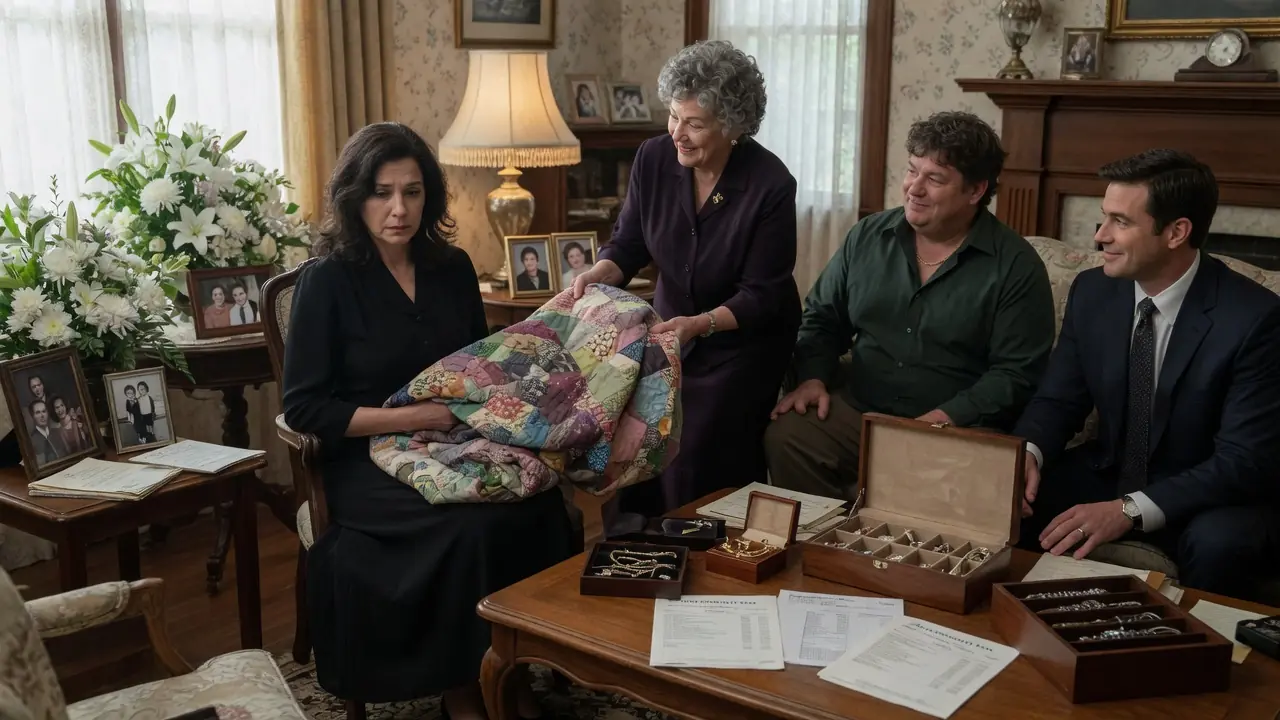
My dear Anna, if you are reading this, they gave you the quilt.
I covered my mouth with my hand. Even from beyond the grave, she knew exactly how the family meeting would unfold. Beneath that first sentence, she had written:
I knew they would choose the things that looked valuable. I also knew you would accept the thing that looked worthless because you were the only one who understood what it carried. People reveal themselves when they believe there is nothing left to gain.
My eyes filled with tears, but I kept reading. Grandma explained that the quilt had been started by her mother during the Depression. Every piece of fabric had come from someone or something connected to our family: a sleeve from my grandfather’s work shirt, a corner of Grandma’s wedding dress, pieces of my mother’s childhood curtains, scraps from baby clothes, school uniforms, and Sunday dresses.
I spread the quilt across the floor for the first time. There was the dark blue square I remembered from Grandpa’s jacket. Beside it was a faded yellow patch from the dress Grandma had worn to my high school graduation. Tiny initials were stitched into several corners, so small that no one would notice unless they knew to look.
At the bottom of her letter, Grandma instructed me to call the attorney whose card she had enclosed. The brass key belonged to a safe-deposit box, and the attorney would explain everything else. I barely slept that night. The next morning, I called the number as soon as the office opened.
The attorney, Margaret Hart, became quiet when I told her my name.
“I’ve been expecting your call,” she said.
Two hours later, I was sitting across from her in a small office that smelled of old books and coffee. She placed a thick folder on the desk but kept one hand resting on it. Before opening it, she asked me when I had last seen my grandmother.
“Three days before she died,” I answered. “I brought her soup and changed the bulb above the porch.”
Margaret smiled faintly. “She told me you would remember the porch light.”
She opened the folder. Eighteen months earlier, Grandma had signed and recorded a transfer-on-death deed leaving her house to me. She had also placed the proceeds from the sale of a small piece of land into an account with me named as the beneficiary. The account contained enough money to pay the property taxes and maintain the house for many years.
I stared at the papers without touching them.
“There must be some mistake.”
“There is no mistake,” Margaret said. “Your grandmother was very clear.”
The jewelry, silver, and money my relatives had divided were the assets Grandma had intentionally left in her probate estate. The house and separate account passed directly to me and were never theirs to distribute. Grandma had arranged everything legally long before she became ill.
“Why didn’t she tell me?” I asked.
“Because she didn’t want your kindness to become a transaction,” Margaret replied. “She wanted to know that you would continue visiting even when you believed there was nothing waiting for you.”
That hurt more deeply than I expected, because Grandma should never have needed such reassurance. I had visited her every Thursday for six years. We drank tea, worked on puzzles, and recorded family recipes in a notebook. I replaced loose cabinet handles, drove her to appointments, and listened to the same stories as many times as she needed to tell them.
The others called those visits “your special time with Grandma,” as though listening to an elderly woman were a hobby I had chosen. They rarely came unless it was a holiday or they needed something signed. Yet they were the first ones opening drawers after she died.
Margaret took me to the bank that afternoon. The brass key opened a narrow box containing the original deed, a bank ledger, several photographs, and twelve sealed envelopes. There was one envelope for every member of the family, including the people who had laughed when they gave me the quilt.
A final letter rested on top.
Anna, the house is yours because you never treated it like property. You knew which floorboard creaked outside my bedroom. You knew where your grandfather marked the children’s heights inside the pantry door. You understood that a home is not valuable because of what someone will pay for it. It is valuable because of what happened inside it.
The account is not payment for loving me. Love that expects payment is not love. It is simply my way of making sure you can keep the roof over the memories you protected when everyone else became too busy to remember them.
I cried in that little bank room until Margaret quietly handed me a box of tissues.
There was still one more surprise. Grandma had not left the others with nothing but objects. Each sealed envelope contained a personal letter and a small piece of family history connected to the quilt. My aunt’s envelope held a photograph of her as a child wearing the dress from which one of the patches had been cut. My brother’s contained the hospital bracelet from the day he was born and a note describing how proudly Grandma had held him.
Grandma had not used the quilt to punish them. She had used it to identify the person she could trust with everyone’s memories. She knew the others might sell the silver, reset the jewelry, and spend the money. She needed one person who would not sell the family’s story.
The following weekend, the family gathered again to discuss putting Grandma’s house on the market. My brother had already contacted a real estate agent. My cousin was talking about renovation costs, while my aunt complained that the furniture would need to be removed before photographs could be taken.
I carried the quilt into the living room and placed the folder from Margaret’s office on the coffee table.
“The house isn’t being sold,” I said.
My brother frowned. “We already agreed that selling is the fairest option.”
“You agreed without me.”
My aunt folded her arms. “You received the quilt. Everyone received something.”
“That is true,” I said. “And Grandma decided I should receive the house.”
At first, nobody spoke. Then everyone began speaking at once. My cousin accused me of manipulating Grandma. My brother demanded to see the documents. My aunt said an elderly woman could easily be pressured into signing things she did not understand.
I let them finish. Then I handed them copies of the recorded deed and the attorney’s letter confirming that Grandma had been independently represented and mentally competent. The anger slowly gave way to the humiliating realization that Grandma had anticipated every accusation they might make.
My cousin looked at the quilt lying across my lap.
“So she hid the deed inside that thing?”
“No,” I said. “She hid the key.”
His first question was whether the quilt itself might be valuable. That was when I finally understood that Grandma had been right about him. Some people could look directly at a lifetime of love and still wonder what it might bring at auction.
I did not argue. Instead, I placed the sealed envelopes on the table and called each person’s name. My aunt opened hers first. When the photograph of her childhood dress fell into her lap, her face changed.
She found the matching fabric in the quilt and pressed her fingers against it.
“I remember this dress,” she whispered. “Mama made it for my first piano recital.”
My brother read his letter in silence. Halfway through, he removed his glasses and wiped his eyes. Even my cousin stopped making jokes when he discovered that one square came from the blanket Grandma had wrapped around him during the months his parents were divorcing.
For the first time since Grandma died, nobody mentioned money.
I kept the house, just as she intended. I did not keep it to prove that I had won, because grief should never become a competition. I kept it because the pantry door still carried our childhood heights, the porch light still needed changing, and Grandma’s roses still returned every spring.
The quilt now hangs in the living room behind protective glass, but I take it down whenever the family visits. Some relationships never fully recovered from what happened after Grandma’s death. Forgiveness did not erase what people had revealed about themselves, and love did not require me to pretend it had never happened.
But every time I run my hand over those faded pieces of fabric, I hear Grandma’s voice reminding me that value and price are not the same thing. My relatives chose the objects they believed were worth the most. Grandma chose the person she believed would remember why any of those objects mattered.
They thought they had left me with the one thing nobody wanted.
In truth, they had handed me everything Grandma had been trying to save.