The water was rising. It came slowly at first, the way the tide always comes in the Solway: quiet, patient, impossible to stop. Cold, gray water slid across the sand of the Bladnoch Channel near the town of Wigtown, Scotland. It was May 11, 1685 and tied to a wooden stake driven deep into that sand stood a girl of eighteen years old.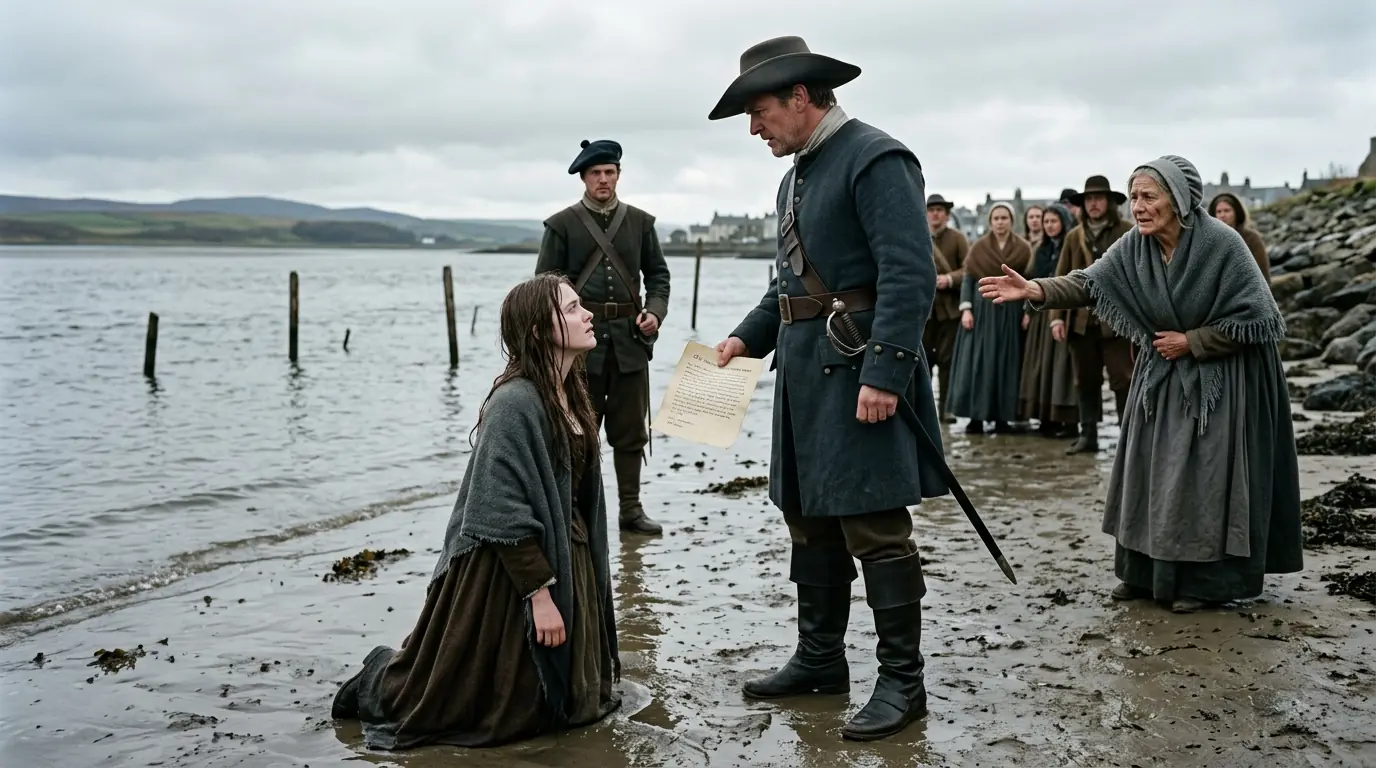
Her name was Margaret Wilson. Her hands were bound. Her feet were fastened to the stake. On the shore behind her, soldiers stood watching.
Townspeople had gathered, too. Some were weeping, some were silent, and some were too afraid to speak. And in front of her, farther out in the channel, tied to another stake closer to the deep water, stood an old woman of about sixty-three, a widow named Margaret McLachlan. The soldiers had planned it this way on purpose.
The old woman was placed farther out so that the young girl would be forced to watch her die first. They believed that when Margaret Wilson saw the sea swallow the older woman, when she heard her struggle, when she watched the water close over her gray head, the girl would break. She would scream out the oath they demanded. She would say the words that would save her life.
All she had to do was swear allegiance to the king as head of the church. All she had to do was abandon one simple conviction, that Jesus Christ and Christ alone is the king and head of his church. A few words, that was the price of her life. The tide kept rising. The water reached the old woman first, and as Margaret McLachlan began to drown before her eyes, one of the men on the shore called out to the young girl, mocking her, asking what she thought of the sight now.
This was Galloway, a land of green hills, cold rivers, wide moors, and hard-working farming families. Her father, Gilbert Wilson, was a farmer of decent standing. He raised cattle and sheep. He worked the land. And by all accounts, he was a man who tried to stay out of trouble because in the Scotland of Margaret's childhood, trouble was everywhere.
Her story requires an understanding of what was happening in that country. Decades earlier, the Scottish people had signed a document called the National Covenant, a solemn promise before God that the Church of Scotland would be governed not by kings, not by bishops appointed by the crown, but by Christ alone as its only head. Those who held to this promise were called Covenanters. But when King Charles II was restored to the throne in 1660, he tore that promise apart. He declared himself supreme over the church.
He forced bishops upon Scotland, and he demanded that every minister who would not accept royal authority over the church be cast out of his pulpit. Around three hundred ministers, some records say more, refused. They walked away from their churches, their homes, and their incomes rather than acknowledge any king but Christ over the Lord's house. And their people followed them. Since the churches were closed to them, they began to worship in the open air, in the hills, in the moors, in hidden glens.
These secret open-air services were called conventicles, and the crown declared them illegal. Attending a field preaching became a crime. Preaching at one became a capital offense. Soldiers were sent to hunt worshipers across the countryside. Fines crushed the families of those who refused to attend the official services.
And as the years passed, the punishments grew darker. The punishments included imprisonment, torture, banishment, and execution. The final and bloodiest years of this persecution, roughly 1680–1688, became known in Scottish memory by a chilling name, the killing time. This was the world Margaret Wilson grew up in. Her father, Gilbert, conformed.
He attended the official Episcopal services as the law demanded. Whatever he believed in his heart, he obeyed outwardly. Perhaps he did so to protect his farm and his family. But his children made a different choice. Margaret, her younger brother Thomas, and her little sister Agnes refused to attend the king's church.
While still very young, Margaret in her teens, Agnes just a child, they came to a conviction that would define and ultimately cost their lives, that no earthly king had the right to rule the church of Jesus Christ, and that they could not, in good conscience, worship in a system built on that claim. These were not hardened rebels. These were farm children. They had grown up gathering sheep on the hillsides, helping with the harvest, sitting by the fire on long winter nights. And yet somewhere in those young hearts, the word of God had taken such deep root that they were willing to lose everything for it.
The law did not treat them as children. The authorities demanded that everyone in the parish attend the official church and be ready to swear the required oaths. When the Wilson children refused, they became fugitives in their own homeland. The records tell us that Margaret, Thomas, and Agnes fled to the hills. They lived among the moors, the bogs, and the caves of Galloway.
They were hunted like criminals for worshipping God according to their conscience. And their father was forbidden to help them. The authorities fined Gilbert Wilson again and again, quartering soldiers on his farm, draining his livelihood, punishing him for the faith of his own children. They were children he was not even allowed to shelter under his own roof. It was a household shaped by fear and separation.
Their father lay awake at night, knowing his daughters were somewhere out on the cold moor, and knowing that if he opened his door to them, he could lose everything. And they could lose their lives. Out in those hills, the Covenanter fugitives found each other. They gathered in secret to pray, to sing the Psalms in low voices, and to hear the word of God preached by hunted ministers. They read the scriptures.
And among the passages that sustained the Covenanters in those years, few were more beloved than the words of the Apostle Paul in the eighth chapter of Romans. “Who shall separate us from the love of Christ? Shall tribulation, or distress, or persecution, or famine, or nakedness, or peril, or sword? As it is written, for thy sake we are killed all the day long. We are accounted as sheep for the slaughter.
Nay, in all these things we are more than conquerors through him that loved us. For I am persuaded that neither death, nor life, nor angels, nor principalities, nor powers, nor things present, nor things to come, nor height, nor depth, nor any other creature, shall be able to separate us from the love of God, which is in Christ Jesus our Lord.” Margaret carried those words in her heart. She would need them. In February of 1685, King Charles II died, and his brother James came to the throne.
Many hoped the persecution might ease. Instead, it intensified. A new demand spread across the land, the abjuration oath. Every person could be stopped on the road, in the market, at their own door, and commanded to swear this oath, which involved renouncing the more radical Covenanter declarations, and in the eyes of the strict Covenanters, acknowledging a spiritual authority in the king that belonged to Christ alone. Anyone who refused could be treated as a rebel.
In the worst cases, refusal could mean death on the spot without trial. It was in these very months, the most dangerous moment of the entire killing time, that Margaret Wilson, now about eighteen, made a decision that sealed her fate. After a period of hiding, Margaret and her thirteen-year-old sister Agnes came down from the hills and went quietly into the town of Wigtown to visit friends and fellow believers there. Among them, it is said, was the elderly widow Margaret McLachlan, a woman of Kirkinner parish known for her piety, who had also refused to conform. But there was an informer in Wigtown.
Accounts record that a man named Patrick Stewart, whom the sisters trusted, drew them into conversation and invited them to drink the king's health, a common test of loyalty in those days. As Covenanters, they gently declined. That was all he needed. He went straight to the authorities and betrayed them. Soldiers came.
The two sisters, eighteen and thirteen years old, were seized and thrown into prison. Around the same time, the old widow Margaret McLachlan was also arrested, reportedly while she was on her knees in prayer. They were locked in a place the townspeople called the Thieves Hole, a foul, dark cell reserved for the worst criminals. A sixty-three-year-old widow and two teenage girls were held among thieves in the cold and filth because they would not call the king the head of the church. On April 13, 1685, the prisoners were brought before a commission of judges.
Among the men who sat in judgment that day were some of the most feared names of the Killing Time, including Sir Robert Grierson of Lag, a man whose cruelty toward the Covenanters made his name a terror in Galloway for generations, along with Major Windram, Captain Strachan, and the provost of Wigtown. The charges were read. The women were accused of rebellion, of being present at the battles of Bothwell Bridge and Airds Moss, and of attending more than twenty forbidden field meetings. The accusations about the battles were absurd on their face. Margaret would have been a child of about twelve when Bothwell Bridge was fought, and Agnes barely seven.
But truth was not the point of this courtroom. Submission was. The judges offered them the abjuration oath. “Swear it and live.” The old widow refused.
Margaret refused. Even little Agnes refused. And so the sentence was pronounced. It was a sentence designed not just to kill, but to terrify an entire region into obedience. The court ordered that Margaret McLachlan and Margaret Wilson be tied to stakes fixed within the flood mark of the sea in the waters of the Bladnoch near Wigtown, there to be drowned by the incoming tide.
It was death by the sea itself. It would be slow, public, and inescapable. Thirteen-year-old Agnes was also condemned, but her father, Gilbert, was permitted to ransom her. He pledged the enormous sum of one hundred pounds sterling, a crushing amount for a Galloway farmer, to buy his youngest daughter back from death. The records tell us he then rode desperately to Edinburgh, pleading for the lives of the others.
And here, the story takes a turn that makes it even more painful, because the historical record shows that a reprieve was actually granted. On April 30, 1685, the Privy Council in Edinburgh recorded an order delaying the execution of the two women with a recommendation that they be pardoned. On paper, in the council books that still survive, mercy was extended, but the paper never saved them. Whether the reprieve was ignored, delayed, or deliberately buried by the men in Galloway who wanted these executions to happen, no one can say with certainty. What history records is this: On May 11, 1685, eleven days after the council's order of reprieve, the soldiers came for the two Margarets and marched them down to the sands of the Bladnoch as the tide was turning.
It was a harrowing walk through the narrow streets of Wigtown beneath the gray sky over the Solway as the crowd gathered. An old woman walked steadily toward the water, and beside her was a girl of eighteen who could still speak a few words at any moment and walk away free. The executioners drove two stakes into the sand, and as described at the beginning, they placed them with calculated cruelty. They placed the old woman farther out, where the tide would reach her first. They placed the young girl closer to shore, where she would have to watch every moment of the older woman's death and have time to change her mind.
The water came in. It rose around Margaret McLachlan's feet, her knees, her waist. The old widow did not cry out for mercy from men. Witnesses passed down that she endured with patience, committing her soul to God, until the waters of the Solway closed over her. And as the old woman was struggling in the rising sea, someone on the shore, the accounts point to one of her tormentors, called out to young Margaret Wilson, asking her what she thought now, seeing the sight before her.
And Margaret gave the answer that has never been forgotten. According to the testimony passed down from that shore, she said, “What do I see but Christ in one of his members wrestling there? Think you that we are the sufferers? No, it is Christ in us. For he sends none a warfare at their own charges.”
She was watching a woman drown, a preview of her own death minutes away. And where the soldiers wanted her to see terror, she saw her savior. She saw the promise of the Lord Jesus, who said in the Gospel of Matthew, “Lo, I am with you alway, even unto the end of the world.” She saw a suffering that Christ himself was carrying with his servant and through his servant. The tide reached Margaret now.
Cold salt water rose around her ankles and then her legs. Tied to a stake as the sea began to take her, this eighteen-year-old girl sang. Witnesses recorded that she sang from Psalm 25 in the old Scottish metrical version the Covenanters loved. The words of that psalm cry out: “Unto thee, O Lord, do I lift up my soul. O my God, I trust in thee.
Let me not be ashamed. Let not mine enemies triumph over me. Yea, let none that wait on thee be ashamed. Show me thy ways, O Lord. Teach me thy paths.
Lead me in thy truth and teach me, for thou art the God of my salvation. On thee do I wait all the day. Remember, O Lord, thy tender mercies and thy loving kindnesses, for they have been ever of old. Remember not the sins of my youth nor my transgressions. According to thy mercy, remember thou me for thy goodness' sake, O Lord.”
The sins of my youth. She was still in her youth. She would never leave it. And then, the accounts tell us, she recited from the eighth chapter of Romans, those same words that had sustained the hunted believers on the moors, that neither death nor life nor things present nor things to come shall be able to separate us from the love of God, which is in Christ Jesus our Lord. The water kept rising.
It reached her waist, her chest. And here, the record preserves one final act of cruelty and one final act of courage. Before the sea could finish its work, the soldiers pulled her up out of the water. They held her, coughing and gasping, half-drowned, and gave her one last chance. The crowd pressed in.
People who loved her cried out, begging her to say the words. “Just say it, Margaret. Just say it and live.” Major Windram stepped forward and demanded that she pray for the king and swear the abjuration oath. She was eighteen years old.
She was soaked, freezing, and moments from death. Every natural instinct in her body was screaming to live. She answered that she wished the salvation of all men and the damnation of none. Someone in the crowd, desperate to save her, shouted that she was willing to conform: “Say it, Margaret; say it—God save the king.”
The accounts tell us she responded, “God save him if he will, for it is his salvation I desire.” But it was not enough. They demanded the full oath, the oath that in her conscience would tear the crown from the head of Christ and place it on the head of a man. This teenage girl, standing in the sea that had already taken her friend, gave her final answer.
“I will not. I am one of Christ's children. Let me go. Let me go.” She did not say, “Let me live.”
The soldiers thrust her back down into the water. Tradition records the brutal words of one of the officers as he did it, telling her to take another drink. The tide of the Solway rolled in over Margaret Wilson, and she passed from the cold gray waters of Scotland into the presence of the king she would not deny. She was eighteen years old.
Margaret's courage was not the absence of fear. It was the presence of someone greater than fear. The bodies of the two Margarets were recovered and buried in the churchyard of Wigtown, where their graves remain to this day. The stone over Margaret Wilson's grave declares that she was murdered for owning Christ as the supreme head of his church and for refusing the oath. Those words were carved in stone so that no generation could forget why she died.
The men responsible carried the stain of that day for the rest of their lives. Sir Robert Grierson of Lag became a figure of horror in Scottish memory. His name passed down for centuries as a byword for cruelty. Within just three years of Margaret's death, the persecuting regime itself collapsed.
In 1688, King James was driven from the throne. The Killing Time ended. The Presbyterian Church of Scotland—the church of the Covenanters, the church Margaret died for—was reestablished. The cause that seemed crushed beneath the boots of soldiers and drowned beneath the tides of the Solway rose from the water victorious. Today, on Windy Hill above Wigtown, a monument stands to the martyrs of the town.
Down near the river, a stone pillar marks the traditional site of the drowning. Pilgrims and travelers still come from around the world to stand where Margaret stood. In 1871, the painter John Everett Millais captured her in a famous work known as The Martyr of the Solway. The painting shows a young woman bound at the wrist, her eyes lifted as she waits for the tide. And in Scotland's national memory, Margaret Wilson stands beside the greatest heroes of faith her land has ever produced.
She wrote no books, preached no sermons, and founded no missions. She lived only eighteen years, most of them in obscurity on a Galloway farm. Yet her few recorded words, “I see Christ wrestling there,” have strengthened more believers than a thousand volumes of theology. Margaret's story still speaks to the present generation. We live in a world that constantly asks us to make small compromises.
Rarely does anyone tie us to a stake. Instead, the tide comes in quietly. A conviction surrendered here, a truth softened there. A faith slowly diluted until nothing distinctive remains. Margaret's life asks us a piercing question.
Is Christ truly Lord of everything in my life or only of the parts that cost me nothing? She believed that Jesus Christ is king. He is not a king who shares his throne or one subject to the approval of governments, cultures, or crowds. He is the king. And she believed his own words in the Gospel of Matthew.
“Whosoever therefore shall confess me before men, him will I confess also before my Father who is in heaven. But whosoever shall deny me before men, him will I also deny before my Father who is in heaven.” The tide still rises in the Solway, twice a day, every day, just as it did on May 11, 1685. The sea that took Margaret's life could not touch her soul. Long before the water reached her, she had already given herself to someone the sea must obey.