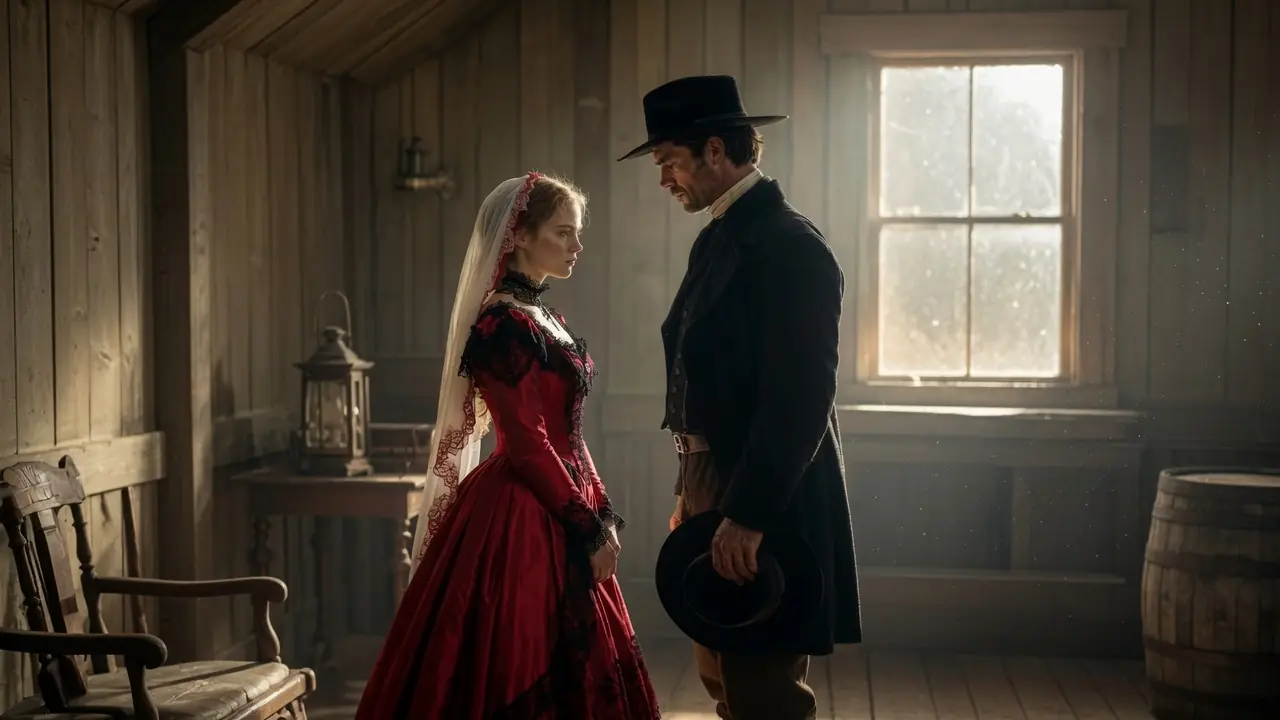
Charlotte May Whitmore stood inside Thomas Beckett’s wooden cabin with her wedding veil still pinned to her golden hair. The room was quiet except for the faint sound of wind pressing against the walls and the slow crackle of the small fire Thomas had built before bringing her home. Pale daylight came through the tall window, touching the lace sleeves of her old cream wedding dress and making her look almost like a ghost of the life she had lost. Across from her, Thomas stood with his black hat held respectfully in one hand, keeping enough distance that she understood he would not come closer unless she allowed it.
They had been married less than an hour, though it felt to Charlotte as if an entire lifetime had collapsed behind her. That morning, she had still been Charlotte Whitmore, the banker’s daughter of Prosperity Creek, admired by half the town and envied by the other half. By noon, she had been made a wife to a man everyone called a stable hand, a servant, a nobody who worked with horses and slept near hay more often than clean linen. The town had watched her leave the chapel as if they were watching punishment take human shape.
Thomas Beckett did not look like the men Charlotte had been raised to marry. He had no polished manners, no expensive watch chain, no soft hands, and no family name spoken with respect in drawing rooms. He was tall, broad-shouldered, and weathered by work, with dark hair that never lay flat and brown eyes that seemed to notice what people tried to hide. His coat was clean but worn, his collar plain, and his boots carried the dust of honest labor.
Charlotte kept her gloved hands folded in front of her because she did not trust them not to tremble. Her pride, the one thing she had clung to when Judge Harrison and her father cornered her in the parlor, felt useless now. She had refused Marcus Harrison because she would not marry a cruel man simply because he was powerful. For that refusal, Judge Harrison had demanded payment of her father’s debt or her hand given to someone meant to humble her.
“They married me to you to break me,” Charlotte said at last.
Thomas lowered his eyes for a moment, not with guilt exactly, but with sorrow. “I know,” he said. “And if I had known how it would look on your face when they said my name, I might have walked out before the preacher opened his book.”
Charlotte looked at him sharply. “But you did not.”
“No,” Thomas admitted. “I did not.”
That honesty unsettled her more than an excuse would have. She had expected him to defend himself, to remind her that a man with nothing could hardly refuse land, wages, and a lawful wife. She had expected resentment, perhaps even satisfaction that the proud banker’s daughter now stood inside his cabin with nowhere else to go. Instead, Thomas looked like a man who had accepted a bargain and regretted the cost the moment he saw who paid it.
“Judge Harrison promised you land,” Charlotte said.
“He did.”
“And that was enough?”
Charlotte hated that she understood. She had grown up surrounded by security, with walls and servants and accounts managed by men who spoke softly when she entered a room. Until that morning, she had not known how quickly comfort could vanish. Now she stood in a cabin that smelled of pine boards and firewood, and every breath reminded her that her old life had depended on debts she had never been told existed.
Thomas crossed the room only far enough to set his hat on a peg near the door. Then he stepped back again, careful as a man approaching a frightened horse. “You can take the bed,” he said. “I’ll sleep by the fire.”
Charlotte blinked. “You expect me to believe you mean that?”
“I do mean it.”
“We are married.”
“That does not make you less afraid,” Thomas said quietly. “And it does not make me the kind of man who mistakes a vow forced from your mouth for permission from your heart.”
For the first time since the chapel, Charlotte had no answer. The men she knew spoke often of honor, but most meant reputation. Thomas spoke of honor as if it were something done when no one was watching. She turned away before he could see the tears rising in her eyes.
The first night passed with Charlotte lying stiffly beneath a quilt that smelled of clean smoke and lavender. Thomas slept on a blanket near the fire, boots placed neatly by the hearth, one arm folded under his head. More than once she woke and watched him, waiting for him to move, waiting for the trap to reveal itself. He never did.
Morning came with the smell of coffee and biscuits. Charlotte opened her eyes to find sunlight across the floor and Thomas outside chopping wood. He had left a basin of warm water near the bed and a folded towel beside it. On the table, he had placed breakfast, two tin cups, and a small jar of blackberry preserves.
She sat down because hunger overcame pride. The biscuits were uneven but good, and the coffee was strong enough to remind her she was alive. Thomas came in carrying wood, then stopped at the doorway as if asking permission with his silence. Charlotte nodded once, and he entered.
“You cook?” she asked.
“Had to learn.”
“Servants usually cook for families like mine,” she said, then regretted the words the moment they left her mouth.
Thomas set the wood beside the hearth. “I know what people like your family think servants do. I also know what servants do when no one is polite enough to notice.”
Charlotte lowered her eyes. She had been raised to thank servants, but thanking was not the same as seeing. In Thomas’s quiet reply, she heard years of invisibility she had never bothered to imagine.
Days settled into a pattern neither of them named. Thomas woke before sunrise, tended the horses at Judge Harrison’s stable, repaired fences when hired, and returned before dusk with dust on his coat and calm in his manner. Charlotte kept the cabin, at first because she had nothing else to do, then because she found some small comfort in order. They spoke little, but the silence between them became less sharp.
On the fourth evening, Thomas brought home a small bundle wrapped in cloth. He placed it on the table and stepped back as if it might offend her. Inside were two books, both worn and missing pages at the edges. Charlotte recognized one as a primer for children.
“Where did you get these?” she asked.
“Traded for them.”
“With what?”
“A saddle strap I made.”
Charlotte ran her fingers over the primer’s cracked cover. “You want to learn to read.”
Thomas’s jaw tightened. “I want to try.”
The request changed something in her. She had been a banker’s daughter, educated by tutors, praised for her handwriting, corrected for speaking too sharply, and trained to quote scripture and poetry at the proper time. Reading had been given to her like air. For Thomas, it was a locked gate he had stood outside all his life.
“You should have said so earlier,” she murmured.
“I did not know if you would laugh.”
Charlotte looked up. “Have people laughed before?”
Thomas gave a small smile without humor. “Enough.”
That night, she wrote the alphabet on a slate board. Thomas sat across from her, his large hands awkward around the chalk, his brow furrowed with concentration. He repeated each letter slowly, sometimes wrong, sometimes right, always with a patience that made Charlotte ashamed of every careless assumption she had made about him. He did not lack intelligence; he had been denied tools.
The lessons became their evening ritual. Charlotte would light the lamp, Thomas would wash his hands carefully, and they would sit together at the table while the fire warmed the room. At first, he struggled to connect sounds to letters, his frustration showing only in the tightness of his mouth. But he never struck the table, never cursed her, never blamed the lesson for being difficult.
“You learn like you mend harness,” Charlotte said one night.
Thomas glanced up. “How is that?”
“Slowly, exactly, and as if the smallest stitch matters.”
He smiled then, a real smile that softened his whole face. Charlotte looked down quickly, startled by the warmth that moved through her chest. It was dangerous, that warmth. It asked questions her pride was not ready to answer.
In town, people still whispered. When Charlotte went to the mercantile, women paused mid-sentence and watched her choose flour and salt. Some smiled with pity, others with satisfaction. Marcus Harrison once tipped his hat to her with a smirk and asked whether married life had taught her proper humility.
Charlotte had answered before Thomas could. “It has taught me the difference between a man who owns power and a man who earns respect.”
Marcus’s smile fell. Thomas said nothing until they were in the wagon heading home, but Charlotte saw his hands tighten on the reins. After a long while, he said, “You should not make enemies for my sake.”
“I made that enemy before I knew your sake mattered,” she replied.
Thomas looked at her then, and the road seemed suddenly too narrow for the silence between them. Charlotte faced forward, her cheeks warm despite the cold air. She had not meant to speak so honestly. Yet once said, the words stayed with her.
Winter came early that year. Snow covered the fields and softened the roof of the cabin until the world outside seemed farther away. Thomas worked when work could be found, hunted when it could not, and brought home what little he could without complaint. Charlotte learned to bake bread properly, to mend wool, and to listen for the difference between ordinary wind and a storm.
She also learned Thomas’s kindness had limits, but not the limits she expected. He would not let cruelty pass simply because he was used to receiving it. When a trader tried to cheat an old woman at the market, Thomas corrected the account with such calm firmness that the trader returned the money without a word. When a boy laughed at Thomas reading a sign too slowly, Charlotte braced for shame, but Thomas only said, “I am learning today what you may never learn at all, son. Patience.”
Charlotte began to understand that dignity did not always wear silk. Sometimes it stood in worn boots, holding a hat in one hand, leaving room for a frightened woman to breathe. Sometimes it sat at a table sounding out words by lamplight after a full day of labor. Sometimes it refused to become bitter even when the world offered every reason.
One night, Thomas read a full paragraph from the primer without stopping. When he finished, he looked stunned, as if he had crossed a river he once believed impossible. Charlotte clapped before she could stop herself. He laughed, low and disbelieving, and the sound filled the cabin like a promise.
“I did it,” he said.
“You did.”
“I truly read it.”
“Yes, Thomas,” she said softly. “You truly did.”
He looked at her then with such open gratitude that Charlotte’s breath caught. No gentleman in Prosperity Creek had ever looked at her like that, not as a prize, not as a conquest, not as a decoration beside his future. Thomas looked at her as if she had handed him a piece of the sky. It frightened her how much she wanted to keep being worthy of that look.
By January, Charlotte no longer slept with dread. She still took the bed, and Thomas still slept near the fire, though the arrangement now felt less like defense and more like a question waiting to be answered. Some evenings they spoke of their childhoods. Charlotte told him about her mother, who had died when she was fifteen, leaving behind dresses, recipes, and an ache no one in the Whitmore house knew how to name.
Thomas listened without interruption. When she finished, he said, “My mother sang when she worked. I do not remember the songs whole, only pieces.” He hummed a few broken notes, embarrassed by the roughness of them. Charlotte thought it was the saddest and loveliest sound she had ever heard.
The first time she touched his hand by choice, it was after he cut his palm repairing a hinge. The wound was small, but she insisted on cleaning it. Thomas sat very still while she wrapped the cloth around his hand. His fingers were calloused, scarred, and strong, yet beneath her touch they trembled.
“Does it hurt?” she asked.
“Not much.”
“Then why are you shaking?”
Thomas looked at their joined hands. “Because you touched me like you meant to.”
Charlotte did not pull away. The fire popped softly, and outside the wind moved over the snow. She tied the bandage carefully, then let her fingertips rest against his for one extra breath. Neither of them spoke of it, but everything after that carried the memory.
Spring arrived with mud, thawing creeks, and the first green breaking through the hard earth. Charlotte found herself laughing more easily, sometimes at Thomas’s dry humor, sometimes at the goat that wandered onto their property and refused to leave. She began teaching two neighbor children letters on Saturday afternoons, and Thomas helped by building benches from scrap wood. Their cabin, once a place of exile, became a place people came to learn.
Prosperity Creek noticed. The same town that had called the marriage punishment began calling it surprising. Women who had pitied Charlotte now watched Thomas split wood or carry books to the cabin with interest. Men who had dismissed him as a servant began asking his advice on horses and repairs. Respect did not arrive all at once, but it arrived.
Then Judge Harrison’s rider came with a letter sealed in red wax. Charlotte saw the Harrison mark and felt old fear rise in her chest. Thomas stood beside her while she opened it, close enough that his presence steadied her. The message was brief: her father had collapsed at the bank and wanted to see her.
They rode to town in tense silence. Charlotte had not entered her father’s house since the wedding day. The familiar rooms looked smaller now, polished but lonely, every expensive object arranged like proof that comfort could still fail to bring peace. Her father lay in bed, pale and reduced by illness.
“Charlotte,” he whispered.
She took his hand, and for a moment she was a child again. Anger, grief, and longing tangled inside her until she did not know which one made her cry. He looked toward Thomas standing near the doorway. “Does he treat you well?”
“With more respect than anyone in this town did,” Charlotte said.
Her father closed his eyes. “Then he is a better man than I was.”
The apology came slowly over several visits. Her father admitted the debt, the fear, the cowardice that had made him trade her freedom for his own survival. Charlotte did not forgive him immediately, but she listened. Thomas never pushed her toward mercy, never used scripture or duty to make her smaller.
One evening, her father asked to speak with Thomas alone. Charlotte waited on the porch, twisting her gloves in her lap while the sun lowered over Prosperity Creek. When Thomas came out, his face was unreadable. He sat beside her and took off his hat.
“What did he say?” she asked.
“He asked me to promise that if he dies, I will never let this town make you feel alone.”
“And what did you say?”
Thomas looked at her. “I told him you are not a woman a man lets or does not let. You choose where you stand. But if you choose to stand beside me, I will not move.”
Charlotte’s heart opened so suddenly it hurt. All her life, men had spoken of protecting her as if protection meant possession. Thomas offered something different. He offered steadiness without ownership.
That night, back at the cabin, Charlotte found the note on the table. Thomas’s handwriting was still imperfect, but each word had been shaped with care. My dear wife, it read, I know our beginning was not kind, but every day with you has been a mercy I did not earn. I do not ask for your heart as a debt, only hope that one day you may give it freely.
Charlotte pressed the page to her chest. When Thomas entered carrying kindling, he stopped at the sight of her tears. “Did I write something wrong?”
“No,” she said. “You wrote something true.”
He set the wood down slowly. Charlotte crossed the room before fear could stop her. She stood in front of him, close enough to see the fine lines near his eyes and the soot on his sleeve. Then she reached for his bandaged hand and held it between both of hers.
“I thought marrying you was the end of my life,” she whispered. “But somehow, you gave me back a life that was mine.”
Thomas barely breathed. “Charlotte.”
“I am falling in love with you,” she said. “Not because they forced me here. Not because I have nowhere else to go. Because when the whole town tried to make me smaller, you gave me room to become myself.”
He closed his eyes as if the words struck too deep. When he opened them, they shone with tenderness. “May I hold you?”
The question itself was the final key to her heart. Charlotte nodded, and Thomas drew her into his arms with a care that made her feel not trapped, but treasured. For the first time since the wedding, she rested her cheek against him and let herself stop fighting.
Their marriage changed after that, not into some grand, loud romance, but into something steadier and more powerful. Thomas moved his blanket from the hearth, and Charlotte made room beside her not out of duty, but choice. They learned each other slowly, with patience and laughter and the occasional stumble that comes when two wounded people try to build trust. Love, Charlotte discovered, was not a lightning strike; it was a fire tended every morning.
By summer, Thomas could read letters from the newspaper. He began teaching other workers in the evenings, men who came embarrassed and left standing taller. Charlotte opened a small school near the cabin for children too poor or too far from town to attend regular lessons. Together, they turned a punishment into a refuge.
Judge Harrison eventually came to see them. He rode alone, older-looking than before, and dismounted without his usual air of command. Thomas met him in the yard while Charlotte stood on the porch, her hands steady now. The judge removed his hat.
“I did wrong,” he said. “To both of you.”
Charlotte studied him for a long moment. “Yes, you did.”
“I meant to humble you.”
“You failed,” she said. “You taught me to see.”
The judge bowed his head. It was not enough to undo the past, but it was enough to show that even powerful men could be made to look at what they had broken. Thomas did not shake his hand, but he did not turn him away. Charlotte understood that forgiveness, like love, could not be forced.
On their first anniversary, snow began falling just as it had the night she first realized the cabin no longer felt like a prison. Thomas gave her a handmade leather journal, the cover stitched with care. On the first page, he had written, For my beloved wife, who taught me letters and gave me a world. Charlotte took the pen and wrote beneath it, For my beloved husband, who taught me that the truest gentleman may be the one the world refuses to honor.
They sat by the fire afterward, Charlotte’s head resting on Thomas’s shoulder. Outside, Prosperity Creek was still full of whispers, debts, pride, and people measuring worth by names and clothes. Inside, the cabin held books, laughter, the smell of bread, and two hearts that had learned to choose each other. The life Charlotte once feared had become the life she would have fought the whole town to keep.
Years later, people still told the story of the banker’s daughter and the stable hand. Some told it as a scandal, some as justice, and some as a romance too strange to be believed. Charlotte never corrected them all. She knew the truth was simpler and more beautiful.
They had been forced into marriage by cruelty, but cruelty did not get to write the ending. Thomas had given her dignity before he asked for love, and Charlotte had given him words before she gave him her heart. Between them, they built something no judge, debt, or whispered insult could destroy. And in the wild country where pride often rode louder than kindness, their quiet love became the strongest legend Prosperity Creek ever knew.