For six straight days, rain had fallen over Milbrook Hollow without ever becoming dramatic enough to frighten anyone.
There was no tornado. No hail. No lightning splitting barns apart.
Just rain.
Cold, steady, patient rain that settled into the valley until the roads softened, the creeks climbed their banks, and every low pasture began holding more water than it could comfortably swallow.
At 5:17 on the sixth morning, Gideon Marsh stood beside the eastern fence of his cattle ground and watched something black move down the slope.
He knew immediately it was not ordinary runoff.
The water was too dark.
Too thick.
And when the wind shifted, the smell reached him.
Fertilizer.
Mud.
Something chemical beneath both.
Gideon did not shout.
He did not run toward the house or reach for his phone.
At sixty-seven, after more than forty years of farming the same ground, he had learned that panic rarely improved what a man saw.
He crouched.
His old canvas coat pulled tightly across his shoulders as he lowered one hand toward the edge of the spreading water.
Before his fingers touched it, a low bellow came from behind him.
Bruno.
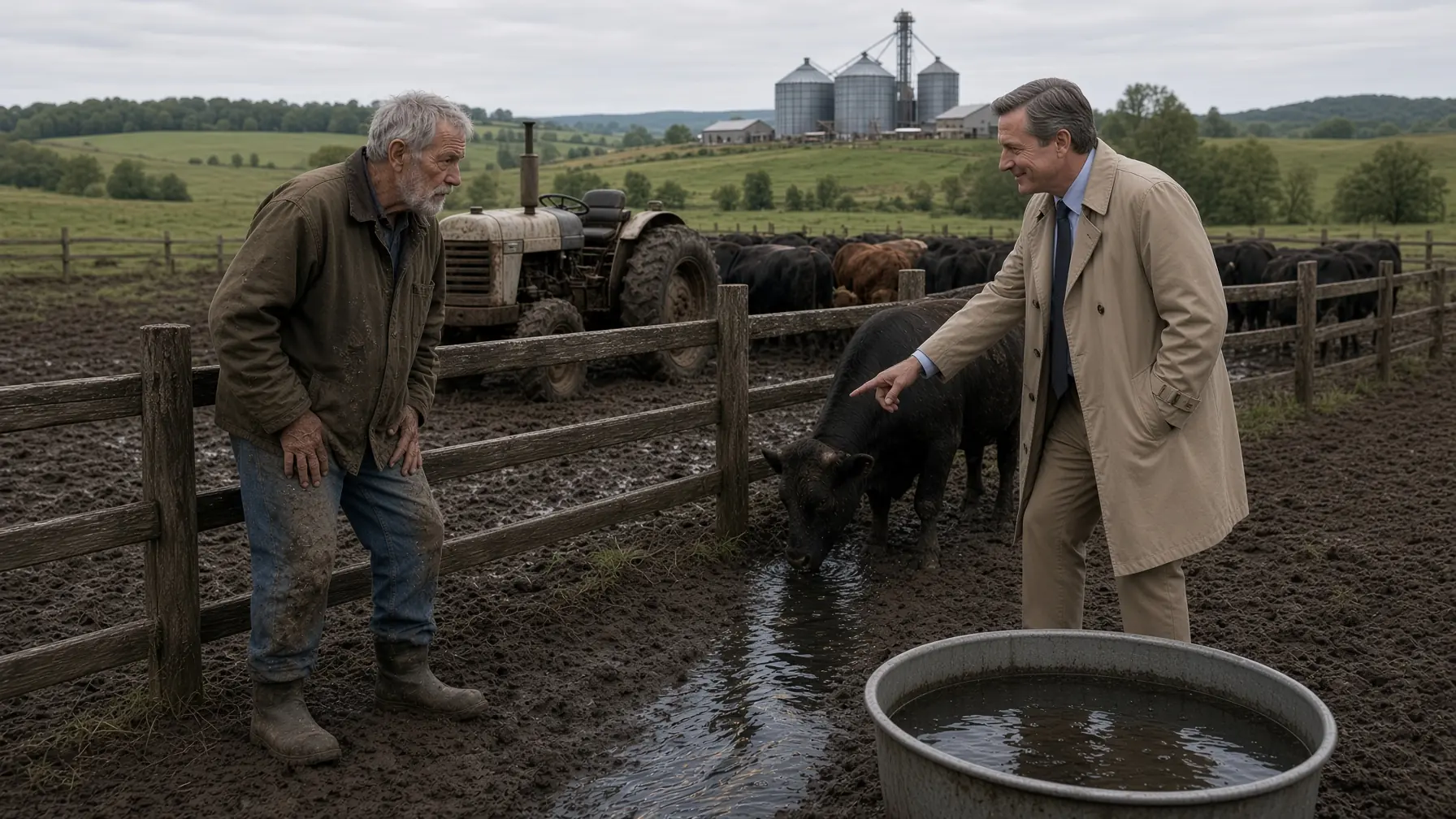
The twelve-hundred-pound Angus bull stood beside the watering trough with all four legs planted wide. His muzzle hovered inches above the surface, but he would not drink.
That concerned Gideon more than the smell.
Bruno drank from that trough every morning.
Summer.
Winter.
Rain.
Snow.
The bull was predictable enough that Gideon sometimes joked he kept better hours than the county bank.
Now Bruno backed away.
The other cattle followed.
Gideon touched the water, rubbed it between two fingers, then smelled his glove.
Oily.
Bitter.
Wrong.
He stood and looked toward the northern ridge.
Pharaoh Agra’s grain complex rose above the trees.
Five years earlier, there had been three family farms there.
Now there were silver silos, grain dryers, concrete pads, chemical tanks, and ten thousand acres controlled by one company.
At night, the lights from the complex glowed above Milbrook Hollow like a second town.
Gideon had never liked it.
But disliking a neighbor was different from accusing one.
So he went back to the farmhouse, found three clean mason jars, returned to the pasture, and filled them.
One from the incoming runoff.
One from the trough.
One from his well.
He labeled all three with the date and time.
Then he moved the cattle.
By sunrise, they were crowded into the upper pasture, irritated by the change but away from the water.
At 8:43, Gideon called veterinarian Thomas Bell.
At 9:10, he called Dorothy Cain.
Dorothy had handled his father’s estate, his mother’s will, and nearly every complicated land question the Marsh family had encountered since Gideon was thirty.
She answered on the second ring.
“What happened?”
Not hello.
Dorothy knew Gideon did not call before ten unless something had happened.
“Water came down from Pharaoh.”
“Flooding?”
“Something more.”
“How much more?”
“I took samples.”
“Good.”
“My cattle won’t drink it.”
There was silence.
Then Dorothy said, “Don’t confront anyone yet.”
“I wasn’t planning to.”
“Good.”
“I think Preston will save me the trouble.”
Gideon was right.
The black pickup arrived before eleven.
Preston Vale stepped out wearing tan khakis beneath a long waxed coat and boots so clean Gideon wondered whether the man had put them on in the truck.
Preston was forty-four, regional director for Pharaoh Agra, and carried himself with the relaxed confidence of somebody whose business cards contained more authority than most people in Cedarfield County would ever possess.
He walked to the fence.
“Morning, Gideon.”
Gideon remained on the other side.
“Preston.”
Preston looked toward the lower pasture.
“Bad week for drainage.”
Gideon said nothing.
“That’s what I came about.”
“I assumed.”
Pharaoh Agra had spent nearly eighteen months installing a new subsurface drainage network across its property. Gideon had watched excavators carve trenches through fields that had once belonged to the Redman and Keller families.
The company called the project precision water management.
Gideon called it moving rain faster than the ground wanted to.
Preston rested both forearms on the fence.
“We had more volume than projected.”
“So you sent it downhill.”
“That is generally where water goes.”
“Not black.”
Preston’s smile remained, but his eyes changed.
“The discoloration is soil.”
“And the chemical smell?”
“Fields contain agricultural inputs.”
“That water is entering my pasture.”
“The historic drainage runs that direction.”
“Historic drainage is rainwater.”
Preston shrugged slightly.
“We can argue terminology all day.”
Behind Gideon, Bruno let out another low bellow.
Preston glanced toward the cattle.
“That your breeding bull?”
“You know it is.”
“He looks uncomfortable.”
“He knows enough not to drink poison.”
The smile disappeared.
“Careful, Gideon.”
“About what?”
“That’s a serious word.”
“So is runoff.”
Preston studied him for several seconds before shifting his tone.
It became friendlier.
Which Gideon trusted even less.
“You’ve been having trouble with the low pasture anyway.”
“No.”
“It floods.”
“In wet years.”
“Your grass yield is poor compared with the upper ground.”
“It feeds cattle.”
“Barely.”
Gideon knew where the conversation was going before Preston reached it.
“Pharaoh has been interested in that strip for a while,” Preston continued. “The new drainage corridor would be easier if we controlled both sides of the boundary.”
“You want to buy it.”
“We’re prepared to.”
“You came here because your runoff entered my pasture, and now you want to buy the pasture.”
“I came because I’m trying to solve a problem before it becomes expensive.”
“For whom?”
“Everyone.”
Gideon looked toward the dark water.
Preston followed his eyes.
“We can pay fair market value.”
“For damaged pasture.”
“If you want to phrase it that way.”
“Damaged by you.”
Preston’s jaw shifted.
“I didn’t say that.”
“You didn’t need to.”
The rain struck the bill of Gideon’s cap.
Preston stepped closer to the fence.
“Think practically. You’re sixty-seven. You’re running cattle almost alone. That lower ground has always been your worst acreage. Pharaoh can absorb it into our drainage plan, remediate what needs remediating, and you walk away with cash instead of legal bills.”
Gideon looked at him.
“And if I don’t?”
Preston glanced toward Bruno.
“I’d be worried about livestock exposure if I were you.”
There it was.
Not quite a threat.
Too polished for that.
A sentence designed to be deniable later.
Gideon’s voice remained calm.
“You’re telling me to sell before your water hurts my herd.”
“I’m telling you accidents become expensive.”
“For both of us?”
Preston smiled again.
“Exactly.”
Gideon turned away from the fence.
“Where are you going?”
“Barn.”
“We’re not finished.”
“I am.”
Behind him, Preston called, “Think about the offer.”
Gideon kept walking.
“I already did.”
The old machinery barn had not been opened fully in almost four years.
Gideon used the newer equipment shed now. The barn had become a place for things too useful to discard but too old to need every season.
He pulled both doors apart.
Dust drifted through the gray morning light.
Against the rear wall, beneath a canvas tarp stiff with age, sat the machine his father had once called the ugliest useful thing in Cedarfield County.
A 1954 Buckeye trenching machine.
Steel tracks.
Open mechanical controls.
Heavy digging chain.
No cab.
No computer.
No hydraulic seat.
The paint had mostly surrendered.
Gideon pulled off the canvas.
He remembered being twelve years old and standing beside his father while that machine cut drainage through frozen ground.
Elias Marsh could repair almost anything with gears.
He believed machines became simple once a man stopped being intimidated by noise.
The Buckeye had laid field drains, repaired irrigation lines, and once cut nearly half a mile of trench after a spring flood isolated three neighboring farms.