They said Naomi Bell carried death in her eyes.
One green.
One gray.
Two colors in the same face, which in Pine Crossing, Wyoming Territory, was apparently enough to frighten people who considered themselves sensible.
Then came the scar.
A thin pale line running from the corner of Naomi’s left cheek toward her ear.
After that, the stories became worse.
Men claimed cattle sickened after she walked past them.
Women whispered that her first husband had nearly died after marrying her.
Children were warned not to stare at her too long.
And when that husband told everyone Naomi was dangerous, unstable, ungrateful, and cursed, most of Pine Crossing believed him because Calvin Reddick owned three cattle spreads, lent money to half the valley, and donated enough to the church that the preacher never seemed eager to disagree with him.
Nobody asked Naomi what had happened.
Nobody asked why the scar looked less like an accident and more like the edge of a knife.
Nobody asked why she had spent six months living again beneath her father’s roof after supposedly attempting to murder a wealthy husband.
People preferred stories that asked less of them.
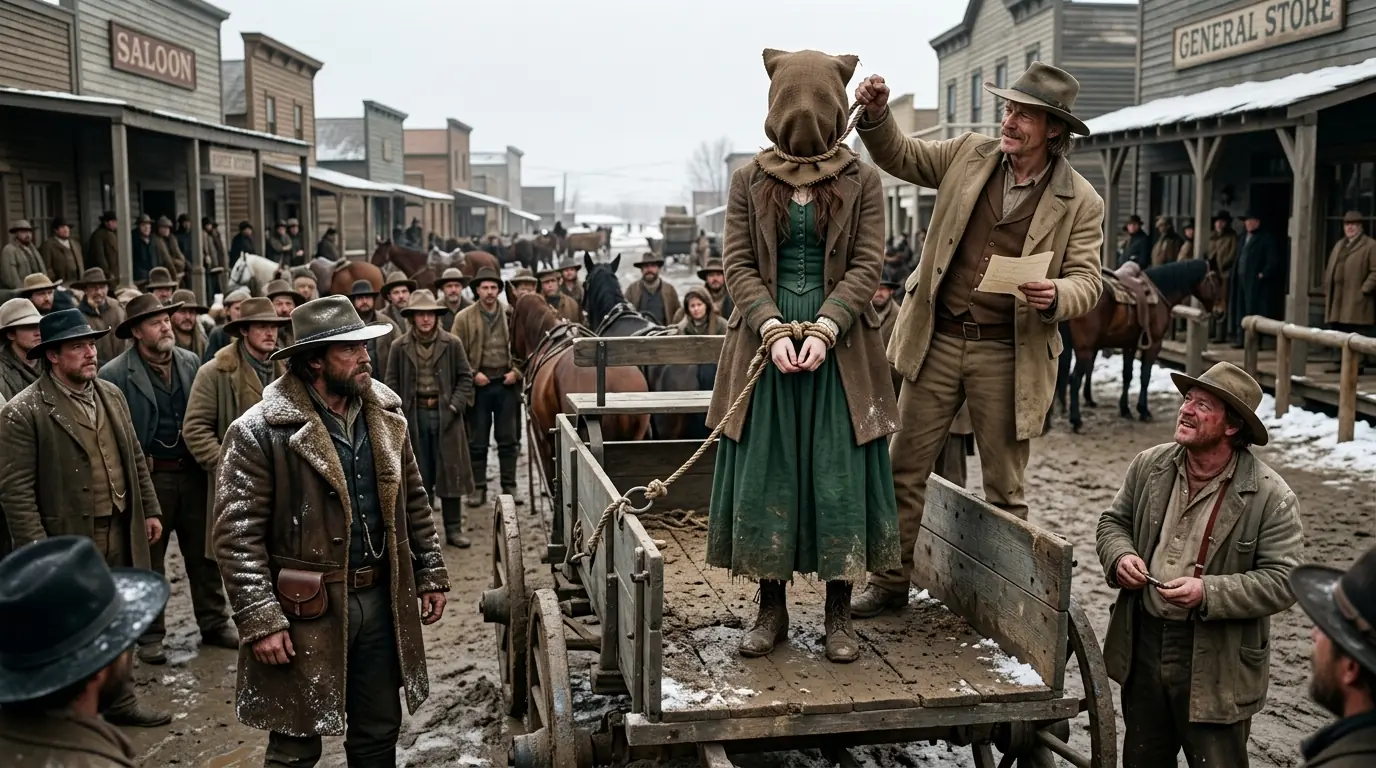
That was how Naomi ended up standing on a wagon bed in the town square during the first hard snow of November 1889 with her wrists tied loosely in front of her and a rough flour sack over her head.
It was not legally an auction.
Everyone knew that.
Wyoming Territory did not permit one free person to own another.
So the paper held by Clyde Mercer, the thin local broker standing beside her, used cleaner language.
Contracted domestic service.
Debt satisfaction.
Twelve-month labor placement.
The words made respectable men feel better.
But when Clyde lifted the document and shouted that Naomi Bell’s labor could be claimed by whoever paid thirty dollars against the debts accumulated by her father’s household, the difference became difficult to see.
“Strong girl,” Clyde announced.
“She cooks. Mends. Knows horses. Reads, too, though I don’t know what use that’ll be to most of you.”
Laughter.
Naomi stood straight beneath the sack.
She could hear every voice.
That was perhaps the cruelest part.
“Face included?” a ranch hand called.
More laughter.
Clyde smirked.
“Depends how brave you are.”
Someone shouted five dollars.
Another offered seven.
A third man joked that he would pay ten if the sack stayed on.
Naomi closed her fists until her fingernails hurt.
She had promised herself she would not cry.
Not here.
Not for them.
At the edge of the crowd stood Wyatt Harrow.
Thirty-nine years old.
Six feet two.
Broad-shouldered beneath a weathered buffalo coat.
A dark beard beginning to gray at the chin.
His left hand carried a bundle of fox pelts.
His right rested loosely beside his belt.
He had ridden down from a small ranch in the eastern foothills of the Bighorns to buy flour, lamp oil, salt, coffee, and horseshoe nails before winter closed the upper trails.
Wyatt did not like towns.
Towns stared.
Towns remembered.
Towns asked questions.
Ten years earlier, he had returned from military service with a damaged knee, a habit of waking at small sounds, and very little interest in explaining either.
He bought an isolated piece of mountain land.
Built a cabin.
Raised cattle.
Trapped in winter.
Came down only when he needed supplies.
Pine Crossing decided he was unfriendly.
Then dangerous.
Then probably violent.
Wyatt let the story grow.
A bad reputation could be useful when a man wanted silence.
But as he stood outside the mercantile that morning and listened to grown men bargain for the labor of a woman whose face they had covered as entertainment, something inside him hardened.
“Ten dollars!” someone shouted.
Clyde grinned.
“Ten! Do I hear twelve?”
“Thirty.”
The word was not loud.
It did not need to be.
The crowd turned.
Wyatt stepped forward.
Clyde blinked.
“Harrow?”
“Thirty.”
Someone whistled.
Clyde looked toward the mountain man as though unsure whether to laugh.
“You ain’t even seen her.”
Wyatt’s eyes shifted toward Naomi.
“No.”
“Then why thirty?”
Wyatt looked at the paper.
“For the contract.”
Clyde’s grin returned.
“Thirty buys the full year.”
“No.”
The grin faltered.
Wyatt walked closer.
“Thirty settles whatever debt you claim her labor is supposed to satisfy.”
A few people shifted.
Clyde lowered the paper.
“You planning to hire her or not?”
“I need winter help.”
“Then what difference does it make?”
“The difference,” Wyatt said, “is whether she works because she agrees or because a room full of men decided she belongs to whoever pays.”
Silence came slowly.
Clyde gave an uncomfortable laugh.
“Don’t start preaching, Harrow. Ain’t nobody buying anybody.”
“Good.”
Wyatt pulled a small leather pouch from his coat and tossed it onto the wagon.
Coins struck wood.
“Then we understand each other.”
Clyde picked it up.
“Thirty.”
He counted.
“All there.”
Then, loudly:
“Contract transferred to Wyatt Harrow!”
“No.”
Wyatt’s voice changed.
Clyde looked at him.
“You just said—”
“I paid the household obligation.”
Wyatt climbed onto the wagon.
“I didn’t buy her contract.”
He reached toward Naomi’s wrists.
Then stopped before touching her.
“Miss Bell?”
She said nothing.
“May I untie you?”
The crowd became quiet enough to hear snow land on wool coats.
Naomi slowly nodded beneath the sack.
“Yes.”
Wyatt removed the rope.
Then stepped back.
Clyde frowned.
“What are you doing?”
Wyatt ignored him.
“Miss Bell, I have a ranch about six hours north if the weather holds. I need help through winter.”
Naomi remained still.
“Cooking if you know it. Livestock. House work. Some bookkeeping, maybe, since apparently reading has no use.”
Someone near the store coughed to hide a laugh.
Wyatt continued.
“Five dollars a month.”
Naomi finally moved.
Her head turned toward him.
“That’s more than—”
“Cabin and meals included.”
“You already paid thirty.”
“That was your father’s debt.”
“My father made the arrangement.”
“I know.”
“Then I owe you.”
“No.”
The answer came immediately.
Naomi’s breathing changed.
Wyatt looked toward the sack.
“You owe me work only if you accept the work.”
She stood very still.
“And if I don’t?”
“I buy my flour and ride home alone.”
Clyde snapped:
“Harrow, don’t be ridiculous.”
Wyatt turned toward him.
“Did I ask you?”
Clyde stopped.
Wyatt looked again at Naomi.
“What do you want?”
Naomi could not remember the last time anyone had asked that question without already knowing the answer they expected.
Slowly she said:
“I want to leave Pine Crossing.”
“That can be arranged.”
“I don’t care where.”
“You may when you see my place.”
A tiny sound escaped her.
Almost a laugh.
Almost.
Wyatt stepped down from the wagon.
“My horses are across the street.”
He started walking.
Then stopped.
“You can leave the sack here.”
Naomi’s hands rose toward the cloth.
The crowd watched.
Her fingers touched the knot beneath her chin.
Then stopped.
“No.”
Wyatt turned.
“I’ll take it off later.”
A few men laughed.
Wyatt looked at them.
The laughter ended.
“All right,” he said.
And that was the first thing Naomi remembered about Wyatt Harrow.
Not that he paid the thirty dollars.
Not that he confronted Clyde Mercer.
That he accepted no without asking her to explain it.
They rode north beneath a sky the color of iron.
Wyatt gave Naomi his smaller mare, a steady bay named June.
He rode ahead rather than beside her.
Not far.
Just enough space that she never felt crowded.
For the first two hours they barely spoke.
Snow gathered on their shoulders.
The road narrowed.
Pine Crossing disappeared behind timber.
Finally Wyatt said:
“You warm enough?”
“Yes.”
“Tell me if that changes.”
Another mile.
Then Naomi asked:
“You aren’t going to ask?”
“About what?”
She touched the sack.
Wyatt looked forward.
“When you want me to know, I’ll know.”
“What if I never take it off?”
“Going to make supper difficult.”
Naomi laughed.
A real laugh this time.
It startled her so much she stopped.
Wyatt’s mouth moved slightly beneath his beard.
They continued climbing.
Near dusk, the trail opened toward a small valley protected on three sides by pine-covered slopes.
A cabin stood near a frozen creek.
Beyond it sat a barn, smokehouse, chicken shed, and fenced pasture.
Not wealthy.
Not poor.
Solid.
Cared for.
Wyatt dismounted awkwardly.
Naomi noticed the stiffness in his right knee.
He hid pain well.
But not well enough.
“You’re hurt.”
“Old.”
“What happened?”
“Long story.”
He helped her down only after holding out his hand and waiting for her to take it.
Inside, the cabin smelled of pinewood, coffee, leather, and smoke.
A stone fireplace occupied one wall.
Books filled two shelves.
A worn chair stood beside the hearth.
A small second room had a proper door.
Wyatt placed her bag—what little her father had allowed her to carry—inside.
“That room is yours.”
“And you?”
“Main room.”
“You sleep in the chair?”
“Cot folds out.”
Naomi looked at him.
“You own the cabin.”
“Yes.”
“Then why am I getting the room?”
“Because the door locks.”
She stared.
Wyatt removed his coat.
“You’ve known me six hours.”
That answer stayed with her.
He turned toward the stove.
“Hungry?”
“Yes.”
“I can make beans.”
“Can you make anything else?”
“No.”
“Then move.”
He almost smiled.
Naomi waited until after supper.
Wyatt washed the dishes while she stood near the fire.
Finally she reached beneath the sack.
Untied it.
Lifted it away.
Wyatt turned.
His hands stopped in the wash basin.
Naomi waited.
She knew the sequence.
People looked first at her eyes.
Green and gray.
Then the scar.
Then came pity.
Discomfort.
Fear.
Curiosity.
Wyatt only looked.
Not rudely.
Simply enough to understand what had been hidden.
“Well?”
Naomi’s voice came harder than she intended.
Wyatt dried his hands.
“Well what?”
“Do I look cursed?”
“No.”
Her certainty wavered.
“You stared.”
“I was looking.”
“At the scar.”
“Yes.”
She lifted her chin.
“Say it.”
Wyatt’s expression darkened.
“Who cut you?”
Naomi stopped.
Not what happened?
Not were you born like that?
Who.
Her eyes burned.
“My husband.”
Wyatt became very still.
“Former husband?”
“He doesn’t believe in former.”
Wyatt waited.
Naomi walked toward the fire.
“Calvin Reddick.”
Wyatt knew the name.
Everyone did.
“He owns cattle south of Pine Crossing.”
“Among other things.”
She touched her cheek.
“The first year wasn’t bad.”
Her fingers fell.
“Maybe I just didn’t understand what bad looked like yet.”
She told Wyatt slowly.
Calvin selected her when she was eighteen.
Her father had lost money after two poor harvests.
Calvin offered to settle part of the debt.
In return, marriage.
People called it fortunate.
Naomi called it what it became.
A cage.
Calvin decided which dresses she wore.
Which neighbors she spoke to.
What letters she sent.
How much food she ate when he was angry.
He wanted obedience more than companionship.
The first time Naomi threatened to leave, he broke two fingers on her left hand.
The second time, he locked her in a storage room for a night.
The third time she made it as far as the road.
Calvin caught her.
“He said if I wanted another man to look at me, he would make sure no man ever wanted to.”
Her voice became very quiet.
“He had a knife.”
Wyatt looked toward the scar.
Naomi nodded.
“He missed whatever damage he intended.”
Then gave a humorless smile.
“So he changed the story.”
“What story?”
“He told people I attacked him.”
Wyatt’s jaw tightened.
“Said I tried poisoning his coffee. Said the scar came when he defended himself.”
“And your father?”
“Believed what was easiest.”
Wyatt looked away.
Naomi continued.
“Calvin released me back to him eventually because having a ‘mad wife’ embarrassed him.”
“He didn’t divorce you?”
“No.”
“Then how did your father sign your labor?”
“He said Calvin gave permission.”
Wyatt swore quietly.
Naomi looked at him.
“You’re angry.”
“Yes.”
“At me?”
His head turned sharply.
“No.”
The force of it startled her.
Wyatt took a breath.
“I’m angry because everyone seems to have had an opinion about where you should live except you.”
Naomi looked into the fire.
“He’ll come.”
Wyatt leaned against the table.
“Reddick?”
“Yes.”
“Why?”
“Because I left.”
“He sent you away.”
“That doesn’t matter.”
Her mismatched eyes lifted.
“Men like Calvin don’t always want what they keep.”
“They want to decide whether anyone else gets it.”
Wyatt understood that immediately.
“How dangerous?”
Naomi did not hesitate.
“Very.”
Wyatt nodded.
“Then tomorrow I’ll show you where I keep the rifles.”
The next six days were almost peaceful.
That frightened Naomi more than danger.
Peace made hope possible.
Hope made loss possible.
Wyatt worked before dawn.
Naomi discovered the ranch had been neglected not through laziness but because one man could only maintain so much.
She reorganized the pantry.
Repaired torn curtains.
Balanced his account book.
Discovered he had overpaid a feed merchant for eight months because he hated arithmetic.
“You read contracts but can’t add columns?”
“I can add.”
“Apparently not accurately.”
Wyatt frowned.
Naomi smiled.
A day later he caught her reading one of his books.
A collection of Shakespeare.
“You read that?”
She looked up.
“My father taught school before farming.”
“Favorite?”
“The Tempest.”
Wyatt nodded.
“Haven’t read it.”
“You own it.”
“Owning and reading are separate crimes.”
She laughed again.
Gradually the sack remained folded on a shelf.
Then forgotten.
Wyatt never commented when she walked outside bare-faced.
Never praised her beauty.
Never told her the scar did not matter.
Naomi came to appreciate that.
He treated her face as a face.
Not a test of his goodness.
On the seventh evening she noticed three sets of hoofprints near the back fence.
Wyatt crouched beside them.
His expression changed.
“Fresh?”
“Last night.”
Naomi’s stomach tightened.
“He found us.”
“Maybe.”
“Wyatt.”
He stood.
“Yes.”
“He found us.”
Wyatt looked toward the timber.
“All right.”
Naomi stared at him.
“That’s all?”
“What would panic improve?”
She almost became angry.
Then understood.
Nothing.
Panic would improve nothing.
“What do we do?”
“Prepare.”
He showed her the rifles.
Escape trail.
Extra food stored in a small line shack half a mile west.
A whistle signal if they became separated.
He never said he would protect her.
Instead:
“We make sure both of us know what to do.”
That mattered.
It placed her beside him instead of behind him.
Calvin arrived two nights later.
Not alone.
Three riders.
Naomi recognized his voice before she saw him.
“Naomi!”
She froze beside the stove.
Wyatt stood from the table.
Outside, Calvin called again.
“You’ve embarrassed yourself enough.”
Naomi’s hands began shaking.
Wyatt noticed.
“Look at me.”
She did.
“Do you want to go outside?”
“No.”
“Then you don’t.”
Calvin pounded on the door.
“Harrow!”
Wyatt picked up his rifle but did not open the door.
“You’re harboring another man’s wife.”
Wyatt answered:
“I’m employing a free woman who asked to be left alone.”
“She belongs with me.”
Naomi closed her eyes.
Wyatt’s voice became colder.
“No person belongs with anybody who talks like that.”
A bullet struck the wall.
Naomi flinched.
Wyatt moved away from the window.
“Now we know where conversation ends.”
The second shot shattered a pane.
Cold air burst inside.
Wyatt fired through the open frame toward the tree beside the shooter.
Not at the man.
The bark exploded inches from him.
“Next one isn’t warning!”
Wyatt shouted.
Silence.
Then Calvin laughed.
“I’ll come back with the sheriff.”
“Bring him.”
“You think law protects mountain trash?”
“No.”
Wyatt glanced toward Naomi.
“But witnesses do.”
Calvin rode away before dawn.
No one died.
That was important to Wyatt.
And surprisingly, to Naomi too.
She had spent years imagining Calvin dead.
In the moment she could have wished Wyatt to kill him, what she wanted instead was something she had never had.
For Calvin to hear her say no and be unable to change it.
Morning brought another discovery.
One of Calvin’s riders had dropped a leather document case near the fence.
Inside were several papers.
A signed statement from Naomi’s father claiming she was mentally unsound.
Another from Clyde Mercer claiming Wyatt had illegally taken custody of a married woman.
And a partially completed arrest affidavit intended for the county sheriff.
Naomi read it twice.
“They were going to make it legal.”
Wyatt looked over her shoulder.
“Make it look legal.”
She lowered the paper.
“What happens if the sheriff believes them?”
“Then we need somebody above the sheriff.”
“Who?”
Wyatt considered.
“Federal marshal has an office in Casper.”
“That is days away.”
“Then we start riding tomorrow.”
Naomi stared at the snow.
“We abandon the ranch?”
“Temporarily.”
“Because of me.”
Wyatt looked at her.
“No.”
“Wyatt—”
“Because armed men fired into my house.”
He took the papers.
“And because somebody is preparing false testimony to take you by force.”
His eyes met hers.
“That is not your fault.”
Naomi nodded slowly.
It was the first time anyone had framed Calvin’s violence so plainly.
Not as something she caused.
As something he chose.
They never reached Casper.
Two days into the journey, they encountered Deputy U.S. Marshal Owen Fletcher traveling north with one other man.
Fletcher was in his forties, narrow-faced, patient-eyed, and cautious about every word.
Wyatt showed him the papers.
Naomi told her story.
Fletcher listened without interrupting.
Then asked:
“Do you want protection from your husband, Mrs. Reddick?”
Naomi looked at Wyatt.
Wyatt said nothing.
No answer hidden in his face.
No instruction.
She looked back at Fletcher.
“Yes.”
“Do you want to return to him?”
“No.”
“Has Mr. Harrow threatened or detained you?”
“No.”
“Do you receive wages?”
“Yes.”
“Can you leave his ranch freely?”
“Yes.”
Fletcher nodded.
“Then the story these documents tell and the woman standing in front of me are not the same.”
For the first time in years, a lawman believed her.
Not because Wyatt fought someone.
Because she spoke.
Fletcher rode back toward Pine Crossing with them.
Calvin had already prepared the town.
By the time Naomi returned, people gathered outside the sheriff’s office.
Some expected a rescue.
Some a scandal.
Some simply wanted entertainment.
Naomi dismounted without a sack.
That alone changed the square.
People stared openly at her two-colored eyes.
Her scar.
She let them.
Calvin emerged from the sheriff’s office wearing a heavy black coat.
For one second, genuine shock crossed his face.
Then possession replaced it.
“There you are.”
Naomi stood beside her horse.
Calvin approached.
“You’ve made enough trouble.”
Deputy Marshal Fletcher stepped between them.
“Stay there.”
Calvin stopped.
“And who are you?”
Fletcher displayed his badge.
Calvin’s confidence shifted.
Only slightly.
“My wife has been abducted.”
Naomi spoke.
“No.”
Everyone turned.
Her voice carried.
“I left you.”
Calvin smiled without warmth.
“She is ill.”
“No.”
“You see?”
He addressed the crowd.
“Defiant. Confused.”
Naomi walked forward.
Fletcher did not stop her.
“You cut my face.”
The square quieted.
Calvin’s smile vanished.
“You broke my hand.”
A woman near the mercantile whispered.
“You locked me in your tack room because I wrote my sister a letter.”
Calvin’s eyes hardened.
“Careful.”
Naomi heard the threat.
For years it had worked.
Now it sounded smaller.
“You told everyone I poisoned you.”
Calvin stepped toward her.
Fletcher’s hand moved toward his revolver.
Calvin stopped.
Naomi continued.
“If I poisoned you, show the complaint.”
No answer.
“Show the doctor.”
Nothing.
“Show the bottle.”
Silence.
She turned toward Pine Crossing.
“He had none.”
People shifted.
“He had money.”
Naomi looked at the preacher.
“He had reputation.”
Then Clyde Mercer.
“He had men willing to repeat whatever he needed.”
Finally her father, standing near the back of the crowd.
“And he had people who were more frightened of upsetting him than they were ashamed of what happened to me.”
Her father looked down.
Calvin’s face reddened.
“You ungrateful little—”
“Enough,” Fletcher said.
The marshal held up the recovered affidavit.
“This document claims Mrs. Reddick was taken against her will.”
He looked toward Clyde.
“You signed it.”
Clyde swallowed.
“Yes.”
“Did you see Mr. Harrow force her onto a horse?”
“No.”
“Did she ask for help?”
“No.”
“Did she say she did not wish to go?”
Clyde said nothing.
Fletcher’s voice hardened.
“Answer.”
“No.”
“Then why sign it?”
Clyde looked toward Calvin.
That was enough.
The crowd saw it.
Calvin saw them see it.
His hand moved toward his coat.
Wyatt saw it first.
He did not draw.
He stepped in front of Naomi.
Fletcher drew his revolver.
“Hands away from the coat.”
Calvin froze.
Everyone in Pine Crossing watched.
Slowly, Calvin raised both hands.
Fletcher searched him.
A pistol.
Then another surprise.
Inside Calvin’s coat was a folded letter.
Written to Sheriff Amos Tully.
It promised cancellation of two thousand dollars in cattle debt in exchange for helping “restore Naomi to lawful custody.”
The sheriff went white.
Fletcher unfolded it in the middle of the square.
Nobody laughed anymore.
Calvin Reddick did not go to prison for being cruel.
Cruelty alone was often difficult to prosecute in 1889, especially inside a marriage.
But bribery was different.
Perjury was different.
Conspiracy to falsify an arrest was different.
So were armed men shooting into another person’s dwelling.
Once the federal investigation began, other stories appeared.
A ranch worker beaten nearly to death.
A widow forced from leased land.
An immigrant family charged fictitious cattle losses.
Men who had remained quiet because Calvin owned their loans started speaking when they realized they were not alone.
The great Calvin Reddick became smaller with every witness.
Naomi’s father came to her before the hearing.
He looked older than she remembered.
“I thought I was helping.”
Naomi stared at him.
“No.”
He swallowed.
“I was frightened.”
“That I believe.”
“I owed money.”
“I know.”
“Calvin said—”
“I know what Calvin said.”
Her father lowered his head.
Naomi continued quietly.
“What I needed was for you to believe me more than you feared him.”
He began crying.
Naomi did not rush to comfort him.
She had done enough comforting of people who failed her.
“I am sorry,” he whispered.
“I know.”
“Can you forgive me?”
Naomi thought before answering.
“Maybe.”
He looked up.
“Not today.”
That was new too.
Not every wound needed an immediate noble ending.
Sometimes forgiveness came slowly.
Sometimes it never came completely.
Naomi was learning that healing did not require pretending.
She returned to Wyatt’s ranch after the hearing.
Not because she had nowhere else.
Deputy Marshal Fletcher personally told her that Calvin’s property had been seized during the investigation and that she could stay with relatives, work in town, or travel east if she wished.
Naomi had options.
For perhaps the first time in her adult life.
Wyatt knew that.
Which was why, when their horses reached the fork where the trail north led toward his ranch and the road east led toward Nebraska, he stopped.
Naomi looked at him.
“What?”
Wyatt nodded toward the east road.
“That one gets you to Cheyenne eventually.”
“I know.”
“You’ve got enough money now to travel.”
“Yes.”
“You could teach.”
“Yes.”
“Work in a hotel.”
“Yes.”
“Go back east.”
“Yes, Wyatt.”
He looked uncomfortable.
Naomi almost smiled.
“You trying to get rid of me?”
“No.”
“Then what are you doing?”
His eyes moved toward the mountain.
“Making sure the choice is real.”
Naomi understood.
She looked east.
A wide road.
No Calvin.
No father.
No Clyde.
No contract.
No Wyatt, if she did not want him.
Freedom.
Then she looked north.
Toward the cabin.
Toward books beside the fire.
Toward badly kept accounts.
Toward a man who asked permission before untying her wrists.
A man who had never once called her beautiful because he seemed to understand she had spent too long being defined by what men saw.
Naomi turned her horse north.
Wyatt did not move.
“You sure?”
“No.”
He frowned.
Naomi smiled.
“I’m terrified.”
“Of me?”
“No.”
She looked toward the mountains.
“Of wanting something enough that I could lose it.”
Wyatt understood that kind of fear.
His face softened.
“Me too.”
They rode home together.
Winter settled deeply.
Nothing romantic happened quickly.
That was important.
Naomi needed time to learn the difference between kindness and courtship.
Wyatt needed time to learn that protecting someone was not the same as loving them well.
She continued earning wages.
Continued keeping her own money.
Continued sleeping in her own room.
In December, she touched his hand voluntarily for the first time.
In January, he told her about the war.
How two friends died beside him.
How returning home felt less like survival than abandonment.
How he built the mountain ranch because loneliness seemed safer when chosen.
In February, Naomi stopped sleeping with a chair wedged beneath her doorknob.
Wyatt noticed.
Said nothing.
In March, snow began melting from the southern slopes.
Naomi found him repairing the fence.
“Wyatt.”
He looked up.
“I want to ask something.”
“All right.”
“Why haven’t you kissed me?”
The hammer slipped from his hand.
Naomi laughed.
He stared at her.
“You’re serious.”
“Yes.”
Wyatt recovered the hammer.
“Because wanting to isn’t enough.”
She stopped smiling.
He continued.
“You spent years with a man who treated wanting something as permission to take it.”
His eyes met hers.
“I won’t.”
Naomi walked closer.
“What if I want you to?”
Wyatt’s breathing changed.
“Then I’d probably ask you twice.”
“Ask.”
“Naomi.”
“Yes?”
“May I kiss you?”
“Yes.”
He did.
Slowly.
No claiming.
No performance.
No crowd.
When they separated, Naomi rested her forehead briefly against his chest.
Wyatt whispered:
“You all right?”
She began laughing.
“Stop asking me that every ten seconds.”
“Habit.”
“I’m more than all right.”
He smiled.
“Honest answer?”
“Yes.”
“Then I’ll take it.”
Spring brought Calvin’s trial.
The armed assault on Wyatt’s cabin, bribery letter, false affidavit, and testimony from former workers ruined him.
The court also granted Naomi legal separation from the marriage she had never freely chosen.
Her name became Naomi Bell again.
She stood outside the courthouse holding the document.
Wyatt waited several steps away.
She looked at him.
“It feels strange.”
“What?”
“Having my own name back.”
“You ever stopped having it?”
“Legally?”
He shrugged.
“I meant otherwise.”
Naomi smiled.
She folded the paper carefully.
Then did not burn it.
She kept it.
Not because a court made her free.
Because it was evidence that sometimes institutions could finally be forced to acknowledge what had always been true.
By summer, Pine Crossing had changed its story about Naomi.
People often do that when shame becomes inconvenient.
Now they called her brave.
Beautiful.
Strong.
Some claimed they had always suspected Calvin.
Naomi let most of it pass.
She no longer needed the town to tell the truth about her.
One afternoon she rode into Pine Crossing without a hat.
Sunlight fell across her scar.
A child stared at her mismatched eyes.
The child’s mother immediately whispered:
“Don’t stare.”
Naomi stopped her horse.
“It’s all right.”
The child looked embarrassed.
“Why are your eyes different?”
“Because they are.”
“Does it hurt?”
“No.”
“Is the scar from a bear?”
Naomi laughed.
“No.”
The child considered.
“I like the green one.”
“Thank you.”
Then Naomi rode on.
The world did not end.
No livestock died.
No thunder split the sky.
The curse remained exactly what it had always been.
A story cruel people told until enough frightened people repeated it.
Wyatt proposed that autumn.
Badly.
He had spent days preparing.
Naomi knew because he became increasingly strange.
Finally, beside the creek, he removed a small silver ring from his pocket.
Then dropped it.
Into the water.
Naomi stared.
Wyatt stared.
The ring vanished between stones.
Neither moved.
Finally Naomi said:
“That was impressive.”
Wyatt closed his eyes.
“I had a speech.”
“I’m sure it was excellent.”
“It was.”
“Should we find the ring?”
“I’m considering walking into the mountains and never returning.”
Naomi laughed so hard she had to sit down.
They searched for twenty minutes.
Found the ring caught beneath a shallow rock.
Wyatt rinsed it.
Then stood in front of her dripping wet to the knees.
“Naomi Bell.”
“Yes?”
“I don’t want to own your time.”
Her smile faded into something softer.
“I don’t want obedience.”
He held the ring.
“I don’t need you to promise you’ll never leave.”
His voice became rough.
“I need you to know you always can.”
Naomi’s eyes filled.
“And then I want to ask whether you might choose to stay anyway.”
He swallowed.
“With me.”
“Not because winter’s coming.”
“Not because you owe me.”
“Not because anybody thinks you should.”
He looked at her.
“Just because you want to.”
Naomi stared at the man Pine Crossing once called a dangerous hermit.
The man who had paid thirty dollars and then spent a year proving the money bought nothing except the chance for her to choose something different.
She held out her hand.
“Yes.”
Wyatt blinked.
“You sure?”
She laughed through tears.
“There it is again.”
“I have to ask.”
“I know.”
She stepped closer.
“Yes, Wyatt Harrow.”
Her voice steadied.
“I choose you.”
They married before the next snow.
Small ceremony.
No auction wagon.
No crowd of laughing men.
Naomi refused to cover her scar.
Wyatt refused a new coat because he hated the stiff collar.
Deputy Marshal Fletcher attended.
So did Naomi’s father.
He sat in the last row.
Their relationship was not fully repaired.
Maybe it never would be.
But when Naomi entered, he stood.
Not as the man responsible for giving her away.
As a man finally learning that loving his daughter meant respecting the life she chose even when he was not at the center of it.
After the ceremony, he approached Wyatt.
“I owe you.”
Wyatt shook his head.
“No.”
“I do.”
“You owe her.”
Naomi’s father looked toward his daughter.
Wyatt continued.
“Spend the rest of your life doing better.”
The older man nodded.
“I intend to.”
“That’s worth more than paying me.”
Years later, travelers through the Bighorn foothills sometimes stopped at Harrow Ranch.
They met a large, quiet rancher whose knee hurt when storms approached.
They met his wife, Naomi, who kept the books, treated injured horses, taught local children to read two afternoons each week, and could shoot better than most men who bragged about shooting.
People noticed her eyes.
One green.
One gray.
Some noticed the scar.
Most learned quickly not to stare.
Not because Wyatt frightened them.
Because Naomi herself no longer carried even a trace of shame.
A young girl once asked about it.
Naomi knelt beside her.
“Someone hurt me.”
The child looked frightened.
“Did you hurt him back?”
Naomi thought.
“No.”
“Then how did you win?”
Naomi looked across the yard.
Wyatt was repairing a wagon wheel badly.
Very badly.
He glanced toward her.
She smiled.
“By surviving long enough to make my own life.”
The child considered that.
Then nodded as though it made perfect sense.
Maybe it did.
That evening Naomi sat beside Wyatt outside the cabin.
The sunset turned the mountains copper.
“You know something?” she said.
“What?”
“People still tell the story wrong.”
“What story?”
“Us.”
Wyatt leaned back.
“How?”
“They say you bought the cursed woman in Pine Crossing.”
“I did pay thirty dollars.”
“You paid a debt.”
“Fair.”
“They say you rescued me.”
Wyatt was quiet.
Naomi continued.
“You helped.”
“Yes.”
“You protected me when I needed it.”
“Yes.”
“But you didn’t rescue me.”
“No.”
She looked toward the mountains.
“You gave me somewhere safe enough to rescue myself.”
Wyatt considered that.
“I like that version better.”
“So do I.”
He reached for her hand.
Naomi let him take it.
The scar remained on her face.
Her eyes remained two different colors.
The things Pine Crossing once used as evidence of something wrong with her had not disappeared.
Neither had Wyatt’s damaged knee.
Neither had the memories that sometimes woke both of them at night.
Healing had not erased anything.
It had changed what those things meant.
His limp was no longer proof he had been ruined by war.
Her scar was no longer proof Calvin had succeeded in making her unwanted.
They were simply parts of two people who had survived enough to understand that love was not the absence of damage.
It was the absence of ownership.
The absence of fear disguised as devotion.
The presence of choice.
Naomi squeezed Wyatt’s hand.
“You remember what you said that first day?”
“I say many intelligent things.”
“You said I could leave whenever I wanted.”
“That was intelligent.”
She smiled.
“I still can.”
Wyatt looked at her.
“Yes.”
“And that’s why I stay.”
Something in his expression softened every time she said it.
Even after years.
Maybe especially after years.
Below them, water moved over stones.
Pine trees whispered in the evening wind.
The ranch lights glowed behind them.
And Naomi Bell Harrow, once dragged into a town square with a sack over her head because cruel people had convinced everyone that her face carried a curse, sat beneath the open Wyoming sky completely uncovered.
No rope around her wrists.
No paper claiming her labor.
No husband deciding what she belonged to.
No crowd telling her who she was.
Only the man beside her.
And even he did not define her.
That had always been the difference.
Wyatt Harrow had never made Naomi free.
He had simply been the first man in her life who looked at her freedom and understood that loving her meant never trying to take it away.