They destroyed my wheelchair while I refused to give them my insurance money. But someone else was watching.
I had heard cruel words in my life. But nothing prepared me for the moment Monica leaned so close to my face. I could smell the bitterness on her breath.
“I wish you were lying in that grave with Amelia,” she hissed, her eyes blazing with a hatred she did not bother to hide. “So I would never have to look at that disgusting old face of yours again. You live only to stand in our way.”
She slapped the armrest of my wheelchair as if it offended her by existing. Before I could steady my breath, Jared walked behind me and kicked the back wheel so hard my body jerked forward.
“You should have died the day Amelia did,” he said. “Now you are just a corpse waiting for the dirt, and you cling to this house like it means something.” His voice was low, sharp, and familiar in the most painful way. That resentment had been marinating for decades.
I did not answer. I had learned that my silence often poured gasoline on their rage, but speaking poured even more. My tongue felt heavy with years of explanations Jared never wanted, and truths Monica would twist for sport.
Inside, I felt the sting of their words settle into the old wounds they always seemed to know how to find. Jared had hated me for a long time. He believed I loved his little sister more than I ever loved him.
He believed I abandoned him during his childhood, that I worked myself to exhaustion, not for him, but against him. He was six when Amelia’s heart began to fail, and I took every shift I could find, cleaning offices at night, waitressing in the morning, and sewing uniforms whenever my eyes could still stay open.
I did all of it to keep both my children fed, clothed, and safe, but especially to keep Amelia alive. I carried guilt for years that I could not save her longer than 16 years, though I extended her life far beyond what doctors predicted. Jared never understood that.
In his memory, I walked out the door each night to leave him behind, never to hold him, never to sit beside him, never to pick him first. I never blamed him for misunderstanding. He was a child, but he grew into a man who held on to that misunderstanding like a blade he could use against me forever.
Monica sharpened that blade. She knew exactly how to turn his insecurities into weapons. She whispered to him, “She destroyed your childhood, Jared. Do you remember how she left you to go help Amelia? A good mother would not disappear like that. A good mother would not choose one child over the other.”
She said these things with such certainty that Jared began to repeat them as if they were his own thoughts. I watched them both, now two adults whose cruelty no longer startled me. What startled me was how comfortable they were with it.
I wish I could tell you I felt anger then, but what I felt was something colder, something like recognition, because deep down I had always sensed this moment would come.
Their hatred was not born only from the past. It was fed by desperation. Jared had invested nearly all his savings and some of mine without permission into a cryptocurrency scheme pitched by a coworker. It crashed so fast he did not even have time to blink between losing thousands and owing $70,000 he had no means to repay.
His creditors threatened lawsuits. Monica’s dream of owning a large nail salon hung over their heads like a fading mirage. They needed collateral, and my house, my late husband’s house, a property protected under veteran special provisions, was the only asset valuable enough to rescue them.
They had convinced themselves that taking the house was justified, that I owed them, that my age erased my rights. Monica was the mastermind. She spoke of the house as if it were already hers.
“We could finally move forward if she would stop being selfish,” she said whenever Jared hesitated. “She is old, Jared. Old women do not need houses. They need to step aside.”
Jared echoed her words. “You should give us the house. Mother, you owe me that much after everything.” He said it like a man certain of his righteousness.
I kept quiet, but my chest tightened with a feeling that was not quite fear. It was grief, not for what they wanted to take, but for what they had lost long before this conversation: human decency, compassion, any trace of gratitude.
I looked at Jared and truly saw him. I saw the boy he once was, small, hurt, confused, buried deep under resentment he never let go of. Monica’s hand on his shoulder steered him away from me, as if she were guiding a weapon she had polished herself.
I could not say it then, but I knew their cruelty toward me was the product of their past, their failures, their greed, and their hunger for someone to blame. And I, broken and aging in a wheelchair, was the easiest target.
But they did not know what was coming. They did not know someone else was watching.
The days after that confrontation seemed to melt together into one long stretch of humiliation and quiet endurance. I had lived a lifetime learning how to hold pain without letting it spill. But their cruelty came in new forms every morning.
They started by hiding my medication. At first, I thought my memory was failing me. But then I heard Monica through the cracked doorway say to Jared, “Do not put them back until tonight. Old people do not need that much anyway.” And she laughed as if she had told a harmless joke.
Without the medication, my joints stiffened, my breathing grew shallow, and even small movements sent jolts up my back. When I asked where my pills were, Monica shrugged. “How am I supposed to know what you do with your things? Maybe you ate them,” she said, rolling her eyes.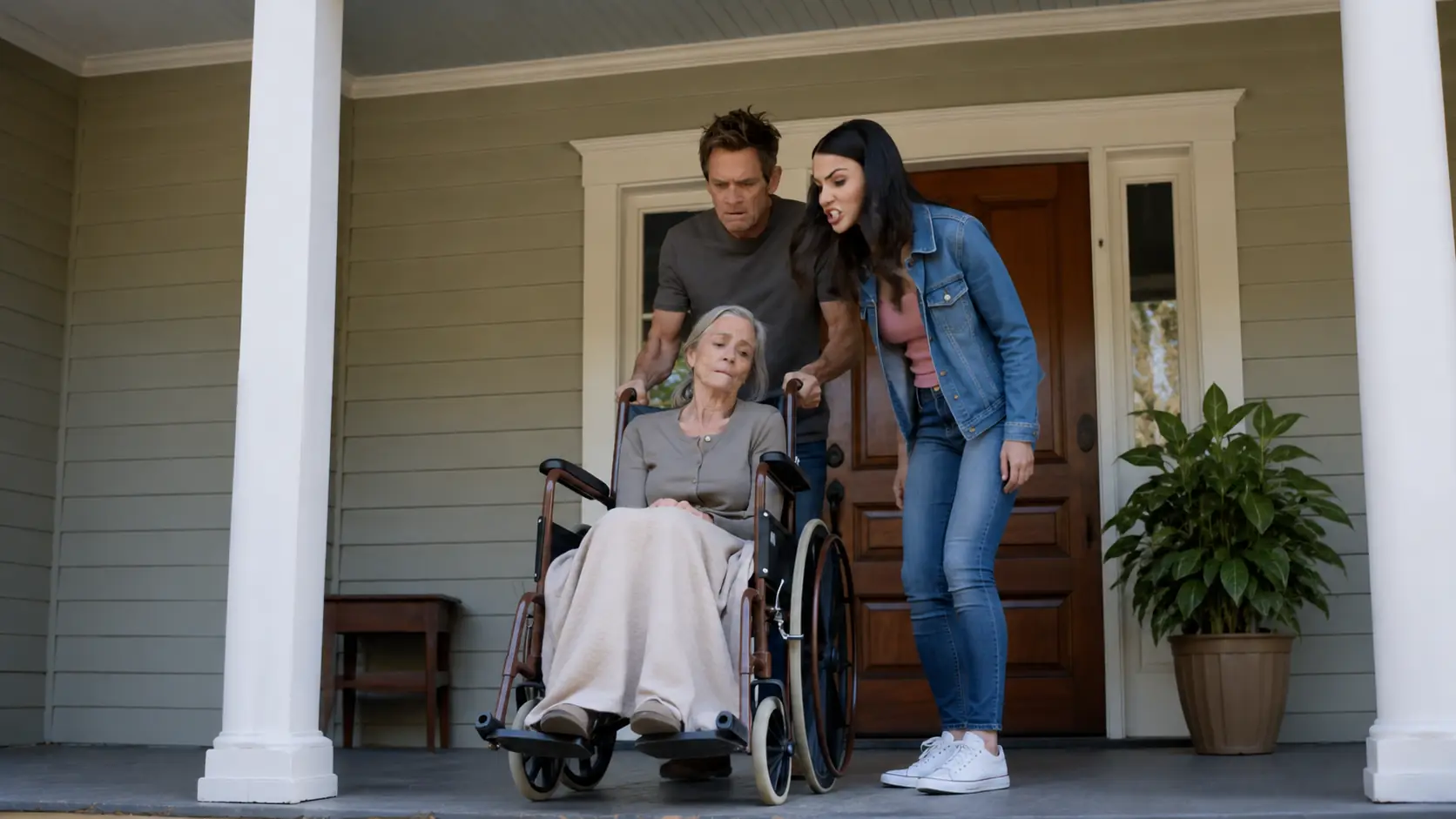
I knew better than to accuse her. Accusations only hardened her cruelty. My meals were the next thing to shrink. A half sandwich for the entire afternoon, sometimes just a small cup of broth poured from a can that had expired years ago.
“You are old,” Monica said. “Old people do not need to eat like children. You are not going to grow anymore.” She kept the good food for herself and Jared, storing entire containers in the back of the fridge where she thought I could not see them.
I learned to sleep through hunger, the way I once learned to sleep through grief. Then came the bathroom rules. They barred me from using the main bathroom, the one with the sturdy bars my late husband had installed for my safety.
Monica said I made it smell funny, even though she was the only one who ever left messes behind. Instead, they forced me into the cold, cramped guest bathroom, where the sink did not drain properly. I washed myself with trembling hands, afraid to slip without anything to hold on to.
Every simple task became a reminder of my dependence, of the power they believed they had over me. But the worst came when Jared brought out the paperwork he had printed. He dropped the stack on my lap as though he were dropping trash onto the floor.
“Sign it,” he said. “Think of it as paying me back for the childhood you stole from me.” My voice trembled. “You do not understand, Jared. I did everything.”
He cut me off, shouting so loud I felt it inside my bones. “You did everything for Amelia, not for me. It was always her. It was always that girl.” He paced like a man possessed.
“You think a child forgets being left behind every night? You think I do not remember watching you walk out the door while she got all the attention? You made me a shadow.”
I wanted to tell him that I had held him too, that I had loved him just as fiercely, but I had split myself in two trying to save a child who was fading away. There was no explaining that to a man who had grown his resentment into identity.
I knew the moment I opened my mouth, he would twist anything I said into evidence of his suffering. “Jared,” I whispered. “I worked because I needed money for…”
“For Amelia,” he snapped. “She died anyway, so what was the point?” His words struck deep. But even deeper was the realization that nothing I could say would remove the bitterness he clung to.
It had rooted itself into the way he saw me, the way he saw the world. And Monica, with her clever tongue and her unending need for more, nurtured that bitterness like a farmer tending poisoned soil.
The knock on the door that afternoon startled all of us. Monica walked to the entrance and opened it just a crack. “What?” she barked.
A man in a clean shirt and badge introduced himself calmly. “My name is Samuel Drayton. I am here from the insurance company. I received a request regarding a replacement wheelchair.”
Monica stiffened. “The old one broke,” she said quickly. “Wear and tear, nothing unusual.” She tried to block the doorway, but Samuel stepped slightly to the side, peering in with professional politeness.
Jared came down the hallway, playing the part of the concerned son. “Yes, the wheelchair is getting old,” he said. “It probably needs to be replaced before my mother gets hurt.”
The lie rolled off his tongue with practiced ease. Samuel asked to inspect the chair. Monica muttered under her breath and pointed him in my direction.
I watched him kneel beside the wheel. His fingers brushed the edges where the bolts had been loosened. His expression did not change much, but I saw a flicker, an almost imperceptible tightening around his eyes.
Then he looked at the bruises on my arm. They were deep, inconsistent with a simple slip. His gaze returned to the wheelchair, and I sensed his mind piecing things together.
“Ma’am,” he said gently, “May I take a few photos for documentation?” Jared nodded too quickly. “Of course, procedure is procedure.”
Samuel lifted a small company-issued camera. But as he aimed the lens, I saw something else settle into his demeanor: a quiet alertness, a readiness I recognized from the years I lived with a husband who served in the Marine Corps.
Samuel was not only assessing a wheelchair. He was assessing the truth.