Alexander Thorne arrived at JFK Terminal One three hours before his flight to London, carrying one black leather overnight bag and the kind of calm that made hurried people look careless. The terminal was already alive with rolling suitcases, boarding announcements, tired families, and executives moving through security as if the airport had been built around their schedules. Alexander moved quietly through all of it, dressed in a charcoal suit, black turtleneck, and dark overcoat that made no attempt to shout its price. He had learned a long time ago that people who needed wealth to announce itself often had very little power over anything real.
His flight was TransAtlantic Air 88, a flagship route from New York to Heathrow, and his seat was 2A. He had booked it two months earlier under his own name, paid full fare, and received three confirmation emails from the airline. He knew the route, the aircraft configuration, the crew assignment, and the backend scheduling system better than almost anyone standing in that terminal. That was because the system moving TransAtlantic Air’s aircraft, crews, gates, passenger loads, and maintenance alerts had been built by his company.
Nexus Logistics was not famous to ordinary travelers, but it was everywhere behind the scenes. Its software managed freight timing, aircraft utilization, crew legality, maintenance windows, fuel contracts, gate sequencing, and revenue modeling for dozens of airlines and shipping giants around the world. Alexander had built the first version of it at twenty-six, after seeing how fragile global movement became when one bad data feed touched a thousand decisions. At thirty-eight, he was the founder and CEO of a company that moved more wealth in silence than many banks moved in headlines.
TransAtlantic Air was one of Nexus’s largest clients. The airline’s own executives called the software their nervous system, which was flattering until they forgot nerves could also feel pain. Alexander was flying to London to finalize an acquisition that would make Nexus the dominant logistics intelligence platform in the aviation world. If all went well, by the end of the week, his company would control the operational backbone behind nearly a third of global premium air cargo and passenger scheduling.
He entered the first-class lounge without drama. The attendant at the reception desk glanced at his passport, scanned his boarding pass, and hesitated for half a second longer than necessary. Alexander noticed the hesitation, the quick look at his face, then his suit, then the screen, as if the system and the man standing before her were presenting conflicting evidence. She finally smiled and said, “Welcome, Mr. Thorne,” but the welcome arrived late.
Inside the lounge, everything was designed to soften money. Chrome edges, gray leather chairs, silent coffee machines, smoked glass partitions, and a wall of windows overlooking the rain-slicked tarmac created the illusion that travel could be made private if one paid enough. Alexander sat near the windows and opened a secure tablet, reviewing a data schematic from London. Around him, champagne was poured for men who laughed loudly into phones and women who carried handbags more recognizable than their faces.
A lounge attendant named Brenda passed his table three times without asking whether he needed anything. She refilled the coffee of a hedge fund manager nearby, offered pastries to a couple wearing matching cashmere, and adjusted a newspaper stack beside Alexander’s chair without meeting his eyes. He could have asked for service, but he did not. There were moments when a man grew tired of forcing people to acknowledge what a scan, a ticket, and common decency had already confirmed.
When the boarding call sounded, Alexander packed his tablet and walked toward Gate A17. A priority lane had formed beside the counter, marked by polished stanchions and a blue carpet strip. Carol Peterson, the gate agent, stood behind the counter with the stiff authority of someone who had spent years learning how much power lived in a keyboard. She greeted the older white couple ahead of him with a bright smile and said, “Good morning, Mr. and Mrs. Albright. Right this way.”
When Alexander stepped forward, the smile disappeared. Carol looked at him, then at his phone, then back at him with professional blankness. “May I see your boarding pass?” she asked, though he already held it out. He kept his voice even. “Of course.”
She scanned the code. A frown appeared almost instantly, too quickly to be technical and too practiced to be surprise. She tapped at the screen with red nails, then sighed in a way that suggested the problem was somehow his fault. “I’m sorry, sir. There seems to be an issue with your seat assignment.”
Alexander did not move from the counter. “My confirmed seat is 2A.” Carol kept looking at her monitor instead of his face. “The system shows a conflict. That seat is no longer available.” Her tone turned slightly softer and more insulting at the same time. “We can accommodate you in premium economy, seat 24B.”
Behind Alexander, someone in line shifted impatiently. Carol glanced past him toward the next passengers, then back at him as if hoping embarrassment would move him faster than policy. Alexander looked at the gate screen above her shoulder, then at the aircraft visible through the glass. “There was no equipment change,” he said quietly. “This aircraft is still operating with the same first-class configuration.”
Carol’s eyes narrowed. “Sir, I’m telling you what the system says.” Alexander’s expression remained calm. “I am familiar with what the system says.” That sentence made her pause, but only for a moment. She seemed to decide he was being difficult rather than precise.
“I understand this is disappointing,” she said, “but premium economy is a perfectly comfortable cabin.” The last word carried a faint edge, as if comfort should be more than enough for someone like him. Alexander saw the Albrights watching from the jet bridge entrance, their expressions carefully neutral. He also saw the man in seat 2A’s replacement record reflected on Carol’s monitor: Edward Voss, a last-minute corporate upgrade entered manually nine minutes ago.
“Who authorized the reassignment?” Alexander asked. Carol’s posture stiffened. “That information is internal.” Alexander held her gaze. “My seat was manually displaced after check-in, without notification, despite confirmed paid status and active boarding clearance.” Carol’s face tightened because he had named the process too accurately. “Sir, step aside or I’ll have to call security.”
The word security changed the air around them. People in the priority lane turned their heads, some curious, some uncomfortable, some already building a story from the shape of the people involved. A Black man in a tailored suit asking about first class had now become a disruption in Carol’s framing. Alexander had lived long enough to recognize when the script had been handed to the room.
He stepped one pace aside, not back. “Please call your supervisor,” he said. Carol gave him a thin smile. “I am the lead agent for this gate.” Alexander nodded once. “Then please call someone who understands data integrity.”
Carol’s cheeks flushed. “Sir, this is not a data integrity issue. This is an airline seat assignment issue.” Alexander glanced at his watch. Boarding was still open, but three connected processes had already begun to queue behind the false reassignment: catering finalization, passenger manifest lock, and premium revenue settlement. If one manual override had been entered incorrectly, it was a customer service problem. If it had been entered dishonestly, it was an operational integrity breach.
He opened his phone and called his chief operations officer, Serena Hale. She answered on the second ring. “Alexander?” He kept his eyes on Carol as he spoke. “Initiate a Level Three integrity hold on TransAtlantic Air’s passenger manifest and revenue-sync environments. Route it through contractual safety protocol twelve. Flag Flight 88, Gate A17, manual first-class reassignment conflict.”
Serena went silent for half a breath. “Do you want client notification automatic or executive only?” she asked. “Executive only for sixty seconds,” Alexander said. “Then systemwide compliance notification.” Carol’s face shifted from irritation to confusion. She looked down at her screen as the first alert appeared.
“What did you just do?” she asked. Alexander ended the call and slipped the phone into his coat pocket. “I asked the system to stop trusting corrupted input.” Behind her, one boarding monitor flickered from Boarding to Operational Hold. Then another screen in the terminal changed. Then the departure board behind the counter began lighting up with yellow delay notices across TransAtlantic Air routes.
At first, passengers only murmured. Then phones came out. Then airline staff at neighboring gates began receiving alerts, one after another, their faces changing as they read the same message. TransAtlantic Air’s internal network had not crashed; it had locked itself into a compliance hold because Nexus detected unauthorized manual manipulation of passenger and revenue data. That distinction mattered legally, operationally, and financially, though Carol did not understand it yet.
She stared at the screen in front of her as if it had betrayed her personally. “This can’t be right,” she whispered. Alexander remained standing at the counter, his carry-on beside him, his face composed. “It is doing exactly what it was designed to do,” he said. “It stops movement when the data can no longer be trusted.”
Within four minutes, the gate area filled with airline managers. Within seven, a regional operations director came running from the service corridor with his tie loose and a tablet in his hand. Within ten, the vice president of airport operations arrived with two security officers behind him, though the security officers quickly realized they were not there to remove Alexander. They were there because nobody in the airline knew how far the hold had spread.
The vice president, Malcolm Rhee, stopped when he saw Alexander. Recognition hit him so quickly that his entire posture changed. “Mr. Thorne,” he said, his voice suddenly careful. Carol looked from Malcolm to Alexander, and the color drained from her face. For the first time, she understood that the man she had threatened to remove was not simply a passenger with a complaint.
Alexander did not raise his voice. “Your gate manually reassigned my confirmed seat to Edward Voss after check-in, without notification and under a false configuration explanation.” Malcolm’s eyes flicked to Carol. “Carol?” She opened her mouth, closed it, then looked at the screen as if the right answer might still be hiding there. “There was a conflict,” she said weakly.
“No,” Alexander said. “There was an override.” The word landed hard. Malcolm pulled up the gate record on his tablet, his thumb moving fast across the screen. The audit trail appeared in clean, unforgiving lines: user ID, timestamp, manual premium reallocation, supervisor clearance bypass, false equipment-change notation. Carol’s face crumpled by inches as each entry made her lie smaller and more visible.
Malcolm turned to her. “Why was this done?” Carol swallowed. Around them, passengers had gone silent again, no longer watching a delay but a public unraveling. “Mr. Voss is connected to the board,” she said. “His assistant called. We were told to accommodate him.” Alexander’s eyes cooled. “By removing a confirmed first-class passenger who happened to be easier to dismiss?”
Carol looked at him then, and whatever defense she had prepared died before it left her mouth. “I didn’t know who you were,” she said. The sentence was meant to save her. Instead, it condemned her more completely than any accusation could. Alexander tilted his head slightly. “You should not have needed to.”
The first major operational report arrived on Malcolm’s tablet: 152 TransAtlantic Air flights were now in rolling hold review, not canceled, but frozen from departure clearance until manifest integrity checks completed. The financial exposure estimate was climbing by the minute: missed slots, crew overtime, passenger compensation, cargo disruption, gate congestion, premium customer refunds, market reaction. The number had already crossed hundreds of millions in projected revenue risk. It would grow.
Carol’s voice shook. “You stopped all of that over one seat?” Alexander looked past her to the departure boards, where TransAtlantic flights across continents now carried hold alerts. “No,” he said. “Your airline stopped it when it chose convenience over integrity. I only made sure the system noticed.” His calm made the words worse.
At that moment, Edward Voss appeared from the jet bridge entrance, red-faced and annoyed. “Why is everyone standing around?” he demanded. “I have a meeting in London.” Malcolm looked at him with a new kind of dread. Alexander watched quietly as Edward’s boarding pass was scanned and the audit trail linked his upgrade to the override.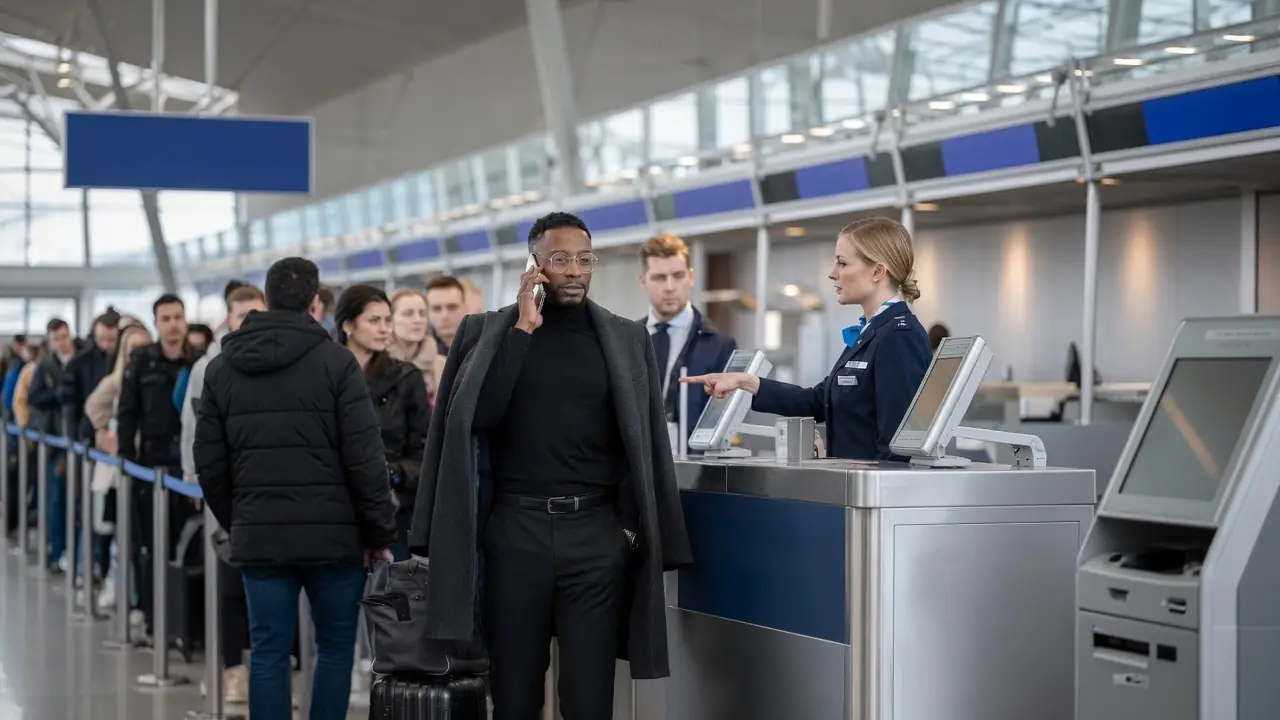
Edward looked at Alexander once and seemed to understand too late that this was not a normal airport inconvenience. “This is ridiculous,” he said. “Do you know who my father is?” Alexander’s expression did not change. Malcolm closed his tablet slowly, as if he wished the floor would open beneath him. “Mr. Voss, your boarding privileges are under review.”
The phrase was polite enough to sound almost harmless. It was not. Edward began protesting, but Malcolm signaled to airport staff to move him aside. Carol watched the exchange with growing terror, because the seat she had protected had become evidence. The premium world she believed she was defending had turned on itself under the light of its own data.
A call came through on Malcolm’s tablet from TransAtlantic Air’s chief executive officer. He answered, listened, and handed the device to Alexander with both hands. Alexander took it. The CEO’s voice came through tight and controlled. “Mr. Thorne, we need to resolve this immediately.”
“We can,” Alexander said. “Full audit of Gate A17 manual overrides, executive access review, written discrimination inquiry, and immediate restoration of paid passenger order on Flight 88.” There was silence on the other end. “And your network?” the CEO asked. Alexander looked at Carol. “The hold releases when Nexus confirms the system is no longer being fed corrupted priority data.”
Carol’s eyes filled, but Alexander did not soften. He had no interest in humiliation for its own sake. What he wanted was the one thing powerful systems resisted most: accountability with a record. He had been insulted, but the insult was only the doorway. Behind it was a structure that allowed the insult to become procedure.
The CEO agreed to the audit within three minutes. By then, the story had already begun moving through the terminal. Videos appeared online showing a Black passenger being denied first class, then airline screens freezing behind the agent who denied him. News desks picked it up before Flight 88 could resume boarding. TransAtlantic’s public relations team was writing statements before the network hold had even fully lifted.
Carol was removed from the gate by a senior manager. She did not fight. As she passed Alexander, she whispered, “I’m sorry.” He looked at her for a moment. “Be sorry for the next person who could not make the system stop,” he said. She lowered her eyes and kept walking.
Flight 88 boarded twenty-six minutes late. Alexander’s seat, 2A, was restored, and Edward Voss did not board. The Albrights avoided looking at him as he passed down the jet bridge. Inside the aircraft, the flight attendant greeted him with professional warmth strained by fear. Alexander took his seat, opened his tablet, and reviewed the first audit summary before the doors closed.
The hold lasted less than an hour, but the consequences lasted much longer. TransAtlantic Air lost its on-time departure rating for the day across multiple hubs, paid compensation to thousands of passengers, and saw its stock drop before the closing bell. The projected revenue exposure reached $2.1 billion once cargo penalties, client credits, contract risk, and market damage were calculated. It was not a crash, but it was a warning strong enough to shake the board.
By the time Alexander landed in London, the airline had issued a public apology. He read it in the car from Heathrow, noting every careful phrase and every omission. It mentioned customer experience, operational review, and individual misconduct. It did not mention what mattered most to him: a system had worked correctly only because the person being mistreated happened to own the system.
That afternoon, Alexander met with his executive team at Nexus’s London office. Some wanted to terminate the TransAtlantic contract immediately. Others wanted to renegotiate at punishing rates. Alexander listened, then asked for the data on how many manual overrides in the past year had disproportionately displaced passengers with no elite social tags, no corporate travel relationship, or no internal sponsor notes. The room went quiet when the numbers appeared.
It had not been one seat. It had been a pattern, hidden under thousands of small decisions too minor to trigger outrage by themselves. Passengers moved, downgraded, delayed, dismissed, and compensated with vouchers while preferred names and connected travelers floated upward. The bias was not always written in words. Sometimes it lived in who was considered easy to move.
Alexander sent TransAtlantic a revised compliance demand by the end of the day. No contract termination yet. Instead, Nexus required independent oversight, transparent override reporting, passenger notification rules, and mandatory review of premium displacement patterns. If the airline refused, Nexus would withdraw the platform in ninety days. If it accepted, it would have to become the first major airline to publish fairness metrics on manual passenger disruptions.
The board accepted before sunrise. They did not do it because they suddenly became noble. They did it because Alexander had forced them to understand that discrimination was not only immoral; it was operational risk. In a world moved by data, unfairness created noise, and noise could bring down systems faster than weather.
Weeks later, Alexander received a letter from a woman in Atlanta who had seen the story online. Her father had been downgraded from business class the previous year after being told there was an equipment change that never happened. He had accepted the downgrade because he was elderly, tired, and embarrassed. “He kept saying maybe he misunderstood,” she wrote. “Your story made him feel like maybe he didn’t.”
Alexander kept that letter in his desk longer than any press clipping. Public attention faded, as it always did, but the letter reminded him why the phone call had mattered. It had not been about proving he was rich, powerful, or important. It had been about proving that quiet disrespect often survives because systems are built to absorb the pain of people who cannot stop the machine.
Carol Peterson never returned to Gate A17. TransAtlantic announced disciplinary action without releasing every detail, and Alexander did not ask for her ruin by name. He wanted the record corrected, the process changed, and the next Carol prevented from hiding prejudice behind a screen. Personal revenge was too small for the scale of the problem.
Three months later, Nexus launched an integrity layer that flagged irregular passenger displacement patterns across all airline clients. It did not ask whether an agent meant harm. It asked whether the decision deviated from policy, whether the explanation matched aircraft data, and whether certain passengers were being moved more often than others. The software did not solve human bias, but it made the lie harder to hide.
Alexander flew TransAtlantic Air again the following year, deliberately and publicly. He boarded through first class, showed his pass, and waited while the agent scanned it. The screen turned green. The agent smiled and said, “Welcome aboard, Mr. Thorne,” without hesitation.
He nodded and walked down the jet bridge. Outside the window, aircraft moved across the tarmac with their usual power and grace, each one dependent on thousands of unseen decisions being honest enough to trust. Alexander knew most passengers would never understand how close a small lie could come to becoming a global failure. That was fine.
He had learned long ago that the most powerful systems were invisible until they stopped working. So were the people who built them. And at Gate A17, in front of a woman who thought first class had a look he did not match, Alexander Thorne had shown an airline, a terminal, and a watching world what happens when the invisible man owns the switch.