“We’ve tried everything.”
The words came from the youngest mechanic in the shop, but they sounded like defeat from the whole room. The modern tractor sat in the center of Mercer Farm Equipment’s repair workshop like an expensive animal that had decided it would not obey anyone. It was massive, polished, and nearly new, with digital screens in the cab, sensors along the frame, diagnostic ports under the side panel, and enough wiring to make the older workers avoid looking too closely.
Caleb Mercer stood beside it with his jaw locked and his arms folded across his chest. He was forty-eight, broad-shouldered, sharp-eyed, and used to getting results when he paid for something. This tractor had cost him more than some people paid for a house, and it had been delivered to his farm only the day before. Now it would crank, cough once like it had changed its mind, and go silent again.
Three mechanics surrounded the machine. One held a tablet with the diagnostic program still open. Another had grease on his hands and irritation on his face. The third stood near the exposed engine, staring into the open panel as though the wires might suddenly confess.
“No fault codes,” the one with the tablet said.
“Fuel lines are clear,” said the second.
“Battery’s full,” said the third, wiping his hands on a rag.
Caleb looked from one man to the next. “That’s what you told me an hour ago.”
No one answered.
The workshop was full of light and noise, but the space around the tractor felt strangely still. Red tool cabinets lined the wall. A welder buzzed faintly in the back bay. Two workers pretended to sort parts on a bench, but everyone’s attention kept drifting back to the dead tractor sitting in the middle of the floor.
Caleb stepped closer to the machine and tapped the side panel with two fingers. “This thing is supposed to be the smartest tractor on the market.”
The lead mechanic, Travis, shifted his weight. “Smart doesn’t mean simple.”
Caleb turned his head slowly. “I did not pay half a million dollars for a complicated paperweight.”
Travis flushed, but said nothing.
One of the older shop hands, a quiet man named Marlon, had been standing near the rear shelves with his cap in his hands. He had worked around machines longer than any of the young technicians, but lately no one asked his opinion unless something needed lifting or sweeping. He looked at the tractor, then at Caleb, then at the mechanics. Finally, he spoke.
“There is somebody else you could call.”
Travis gave a short laugh. “Unless he works for the manufacturer, save your breath.”
Marlon ignored him and looked at Caleb. “He doesn’t work for the company.”
Caleb’s patience was already thin. “Then why would I call him?”
“Because he knows machines,” Marlon said.
Travis smirked. “So do we.”
That quiet sentence annoyed Travis more than shouting would have. The other mechanics glanced at each other, half amused and half insulted. Caleb studied Marlon for a moment, searching his face for exaggeration. He did not find any.
“Who is he?” Caleb asked.
“Elias Boone.”
The name did not mean much to the young men. To Caleb, it stirred a memory from childhood, of an old farm west of town, a man who could fix a baler with wire and patience, a man other farmers used to call before they called anyone else. Elias had been old even when Caleb was young, or at least he had seemed old. If he was still alive, he had to be somewhere in his seventies by now.
Travis folded his arms. “You want to bring in an old barn relic to diagnose a fully electronic tractor?”
Marlon looked at him. “I want the tractor fixed.”
Caleb stared at the silent machine again. Every lost hour mattered. The north field was waiting, and the window for the first pass was tight. If he missed it, the season would start badly before it even had a chance to begin.
“Call him,” Caleb said.
The room quieted.
Travis looked at Caleb as if he had insulted the whole trade. “You’re serious?”
Caleb’s eyes hardened. “I am standing next to the most expensive dead machine I have ever owned. Yes, I am serious.”
An hour later, an old pickup rolled into the yard outside the workshop. Its engine rattled low and uneven, not broken, just worn in the way old things sounded when they refused to quit. The truck door opened, and Elias Boone stepped out slowly. He wore a faded brown cap, a dusty tan jacket, old jeans, and boots with dry mud along the soles.
He was lean, almost narrow, with shoulders that had not fully bent despite age. His face was deeply lined, carved by sun, wind, and years spent looking across fields before storms came. He did not walk fast, and he did not look impressed by the workshop, the workers, or the shining tractor waiting inside. He simply entered as if he had been invited to look at a sick horse.
Caleb stood near the open side panel.
Travis leaned against a cabinet with a grin that was not kind.
Elias stopped beside the tractor and looked at it for a long moment without touching anything. His eyes moved from the cab to the engine, from the engine to the rear assembly, then down toward the wiring near the sensor housing. No one spoke at first. The silence had changed from defeated to watchful.
Caleb broke it. “You’re Elias Boone?”
Elias nodded once.
Caleb looked him up and down, impatience pushing ahead of manners. “They pulled you out here because nobody else can start it.”
Elias glanced at the tractor, not Caleb. “That what you want?”
Caleb frowned. “I want the tractor running.”
“That is not the same thing.”
Travis laughed under his breath. Caleb heard it and chose not to respond. Instead, he looked hard at Elias. “Don’t waste my time, old man. Can you fix it or not?”
Elias turned his eyes to Caleb. They were calm, but there was nothing soft in them. “I can fix the start,” he said. “I cannot fix your impatience.”
The workshop went still.
Caleb’s jaw tightened. “I paid half a million for this machine to work.”
Elias looked back at the open panel. “Then listen carefully before it costs you more.”
Travis stepped forward, unable to keep quiet. “You do know this is not some rusty engine from your hay barn, right?”
Elias did not answer.
Travis continued, smirking now. “This is fully electronic. Sensors, modules, software, calibration. You cannot just lean in and feel your way through it.”
Elias placed one rough hand lightly on the tractor’s side frame. His fingers did not grab or pull. They rested there as if he were listening through metal. Then he looked at Travis and spoke in a low voice. “Careful, son. This relic still hears what you missed.”
Travis’s smile faded.
Caleb stepped closer. “Then tell me why it wants to start but won’t.”
Elias did not answer immediately. He walked around the tractor once, slowly. Everyone watched him. He stopped near the rear assembly, then moved back toward the side panel, his eyes narrowing slightly, not with confusion but with recognition.
“Who worked on it last?” he asked.
The question landed differently than Caleb expected. It was not “What code did it throw?” or “What part failed?” It was personal. It turned the problem away from the tractor and toward the hands that had touched it.
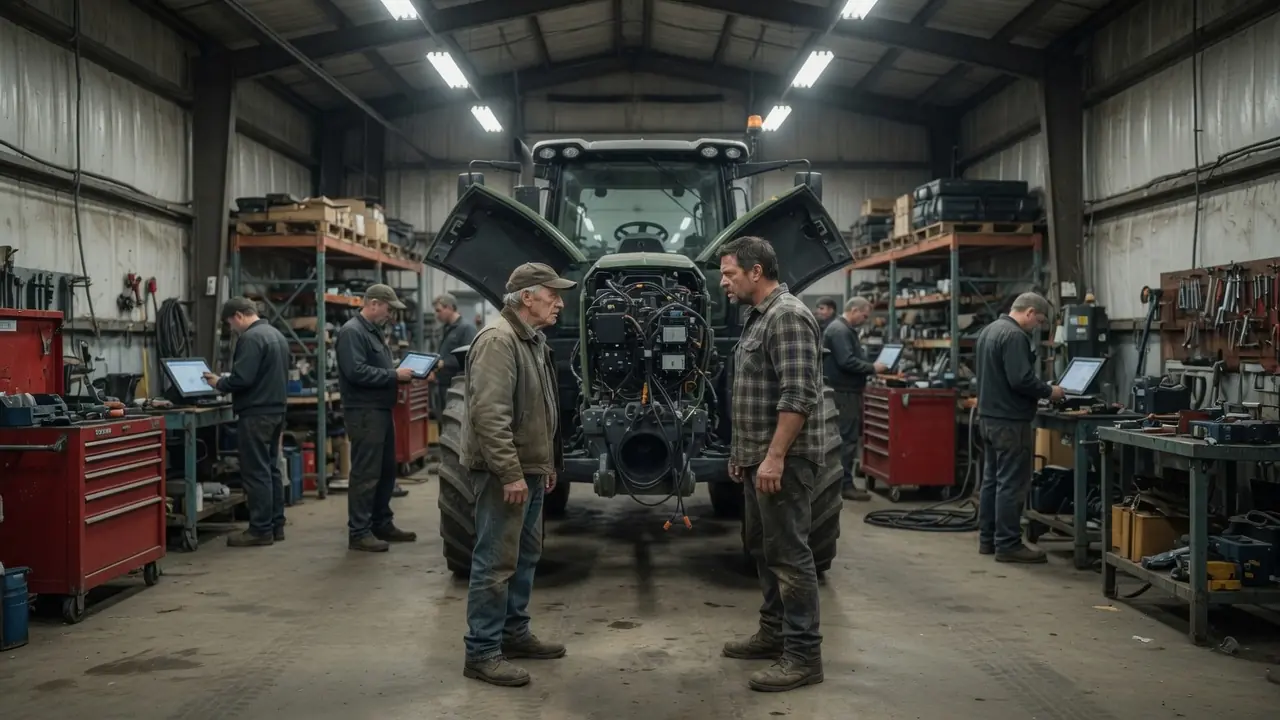
Travis straightened. “I did.”
Elias nodded. “Just you?”
“We all checked it,” Travis said.
“I did not ask who checked it,” Elias replied. “I asked who changed something.”
Travis’s face reddened. “I did not change anything.”
Elias looked at the open panel. “Show me.”
For a moment, Travis looked like he might refuse. Then Caleb gave him a sharp look, and the mechanic stepped forward. He pointed inside the open side compartment. “Fuel system there. Sensor line there. Harness is connected. Diagnostics clean. No error. No shutdown code.”
Elias leaned closer but still did not touch anything.
Travis tapped the tablet. “See? Nothing. The system says it’s fine.”
Elias nodded slowly. “That is the problem.”
Caleb’s expression tightened. “What does that mean?”
Elias straightened, still looking at the machine. “If something is wrong and the system says everything is fine, then you are looking where the system wants you to look.”
Travis scoffed. “That does not tell us anything.”
“It tells me enough,” Elias said.
Caleb rubbed his forehead. He wanted answers, not riddles, but something about the old farmer’s stillness kept him from interrupting. Elias climbed into the cab, sat in the driver’s seat, and looked over the display without pressing anything. Then he turned the key.
The tractor cranked hard.
For one second, it sounded as if it might start.
Then it stopped.
Travis crossed his arms, satisfied. “Same thing it’s been doing all morning.”
Elias turned the key again. The engine repeated the same strong crank, the same promise, the same refusal. Elias shut everything off and sat still for two seconds. When he climbed down, his face had not changed.
“It wants to start,” he said.
Travis rolled his eyes. “That is obvious.”
Elias looked at him. “No. It is being stopped.”
Caleb stepped closer before Travis could answer. “Stopped by what?”
Elias moved to the side panel and tapped the sensor housing with one finger. “This.”
Travis frowned. “That is a safety sensor.”
“Exactly.”
The word seemed to make the room colder.
Caleb looked from Elias to the sensor. “Explain.”
Elias pointed to the wiring and the mounting bracket. “It is reading load wrong. It thinks the tractor is already under pressure before it moves. So it blocks the start.”
Travis stepped in, irritation breaking through. “Then bypass it.”
Elias shook his head. “That is the easy part.”
The owner heard the warning in that sentence. “What is the hard part?”
Elias looked past the engine toward the rear linkage and the heavy system connected to the drive. “This tractor was not finished.”
“It came from the dealer yesterday,” Caleb said.
“That does not mean it was finished.”
Travis gave a hard laugh. “You are guessing.”
Elias did not raise his voice. “No.”
Travis stared at him. “Then what are you doing?”
Elias looked at the tractor like the question was simple. “Remembering.”
That stopped the room.
Caleb’s anger shifted into something more cautious. “Remembering what?”
“A tractor that behaved the same way in 2019,” Elias said. “Different brand, same mistake. It would start if forced. Then it pushed past the load because the system never learned the ground.”
Caleb looked at the rear assembly. “What happens if we run it like that?”
Elias’s answer came slowly. “You may not lose the tractor.”
That almost sounded reassuring.
Then Elias added, “You will lose whatever it is pulling.”
The workshop fell silent.
Caleb’s mind went to the north field, the tight soil, the heavy implement waiting there, the money already committed, the schedule already strained. His frustration had been about getting the tractor running. Now, for the first time, he realized that starting it might be the least dangerous part.
Travis shook his head. “Modern equipment protects itself.”
Elias nodded. “Yes.”
Caleb caught the meaning before Travis did. “It protects itself and sacrifices what is behind it.”
Elias looked at him. “That is what I am telling you.”
No one laughed now.
The young mechanic’s confidence had begun to slip, but pride kept him standing tall. “Then fix it properly.”
Elias looked at him. “Properly is not all in here.”
“Where is it?”
Elias pointed toward the open workshop door. “Out there.”
Caleb looked outside, toward the yard beyond the bay doors. “The field?”
“The setup,” Elias said. “Where are you using it?”
“The north field,” Caleb answered. “Heavy ground. Tight turns. First pass this week.”
Elias nodded as if that confirmed something he already feared. “This machine is tuned for open pull. Not resistance. In that field, it will keep pushing when it should ease back.”
Caleb swallowed, anger giving way to calculation. “And something else gives first.”
“Yes.”
Caleb looked toward the tractor again, no longer seeing a status symbol or a costly embarrassment. He saw a decision waiting to become a mistake. “What do we do?”
Elias stepped closer to the panel. “Reset the start correctly. Then test it under real ground. Slowly.”
Travis muttered, “That will take hours.”
Elias looked at him. “Breaking something will take longer.”
Caleb pointed at the tractor. “Do it.”
This time, no one rushed him.
Elias opened the panel wider and adjusted the sensor connection with careful, small movements. He did not tear through the machine or make a dramatic show of expertise. He worked like a man tying a knot he had tied ten thousand times, each move simple because he understood why it mattered. The mechanics watched closely, trying to follow his logic.
Caleb noticed that Elias did not rely on the tablet. He glanced at it once, then ignored it. He checked the sensor bracket, the wiring angle, the pressure reading, and the rear assembly in a chain of thought the others could not see. It was not guesswork. It was a language none of them had learned.
“Why that connection?” Caleb asked.
Elias kept working. “Because it was never seated right.”
Travis frowned. “It clicked in.”
“A click is a sound,” Elias said. “Not proof.”
Marlon smiled faintly from the back of the shop.
After several minutes, Elias closed the panel and climbed into the cab. He sat still, hands resting lightly on the controls. The room went quiet enough to hear the fluorescent lights hum. Then he turned the key.
The tractor started.
Not roughly.
Not halfway.
It started clean and strong, the engine settling into a smooth controlled idle as if it had been waiting for permission all along.
Nobody cheered. The silence was too deep for that. Travis stared at the machine, his face caught between anger and disbelief. Caleb released a breath he had not realized he was holding.
Elias let the tractor idle, then gently raised the throttle. The engine responded evenly. He listened, then lowered it again and shut the tractor off. When he climbed down, he looked at Caleb, not victorious, not proud, just serious.
“That is your start,” he said. “Not your solution.”
Caleb nodded slowly. “Then we take it outside.”
The tractor rolled out of the shop twenty minutes later. The mechanics followed, this time not mocking, not arguing, but watching. The yard behind the workshop had uneven ground, packed dirt, and a shallow grade that gave the machine something closer to real resistance. It was not the north field, but it was enough to tell a better truth than the shop floor.
Elias climbed into the cab again.
He started the tractor, let it settle, and moved slowly forward. He did not push it hard. He gave it small demands, one after another, watching how it responded. The machine moved smoothly at first, then hesitated under resistance.
Elias stopped immediately.
“There,” he said.
Caleb moved closer. “What happened?”
“Old setting still buried in it,” Elias said. “Start is fixed. Load memory is not.”
Travis looked toward the tablet. “It still says normal.”
Elias turned to him. “That tablet has lied to you twice today. Maybe stop treating it like a preacher.”
Caleb almost smiled despite himself.
They recalibrated the load response in stages. Elias had Travis perform some of the steps, not because he needed help, but because he wanted the younger man to see the difference between following a procedure and understanding a machine. Each time Travis rushed, Elias made him stop. Each time the tractor responded differently, Elias asked him what he noticed.
At first, Travis answered defensively.
Then he started answering honestly.
“It pulled too hard there,” Travis said once.
Elias nodded. “Why?”
Travis studied the rear response. “Because the system was catching up instead of adjusting ahead.”
Elias gave the smallest nod. “Now you are listening.”
By late afternoon, the tractor moved through the test yard with steady control. It adjusted to resistance instead of fighting it. The engine held power without forcing the rear system past its proper range. The mechanics could see the difference now, even without being told.
Caleb stood with his hands on his hips, watching the machine cross the uneven dirt.
“That was almost a very expensive lesson,” he said.
Elias climbed down from the cab. “Still was.”
Caleb looked at him. “How much do I owe you?”
Elias shook his head. “Nothing.”
Caleb frowned. “You came out here, fixed the start, saved the field setup, and kept me from tearing up equipment. I am paying you.”
Elias looked toward the tractor. “You already paid.”
“For what?”
“For almost learning the hard way.”
Caleb did not answer immediately.
The old farmer wiped his hands on a rag Marlon handed him. The mechanics stood nearby, quieter now, their confidence reshaped by the day. Travis looked as if he wanted to say something and did not know how. Finally, he stepped forward.
“I was out of line earlier,” Travis said.
Elias studied him. “Yes, you were.”
Travis swallowed. “I apologize.”
Elias nodded. “Good. Now remember why.”
Travis looked toward the tractor. “Because the machine mattered more than my pride.”
Elias’s face softened by half a degree. “That is a useful thing to learn young.”
Caleb stepped beside Elias and looked at the modern tractor, now standing ready instead of stubborn. The machine had not changed much on the outside. Same polished body, same screens, same sensors, same price. But Caleb understood it differently now.
“We had diagnostics,” Caleb said. “Software. Manuals. Three trained men.”
Elias looked at the tractor. “You were looking at numbers.”
Caleb turned to him. “And you?”
“I was looking at behavior.”
The words stayed with Caleb.
As the sun dropped lower outside the workshop, Elias walked back toward his old truck. No one laughed this time. No one smirked. The workers watched him with the kind of silence men give someone after realizing they underestimated the wrong person.
At the door of his truck, Caleb called after him. “Will it hold?”
Elias rested one hand on the open door and looked back. “If you use it right.”
Caleb nodded. “We will.”
Elias looked from Caleb to Travis, then to the tractor in the workshop yard. “Next time, finish the job before you start showing off.”
Then he climbed into his truck and drove away.
The old engine rattled down the road, rough and plain and reliable enough to get home. Behind him, the most expensive tractor in the county sat ready at last because an old farmer had understood what a room full of screens could not say. Caleb watched until the dust settled. For the first time all day, he was not thinking about what the tractor cost.
He was thinking about what arrogance almost cost.
The next morning, Caleb took the tractor to the north field, but he did not rush it. He tested the ground first. He let the machine respond. He remembered Elias’s warning every time impatience rose in his chest.
The tractor worked.
Not because it was expensive. Not because it was modern. Not because a tablet said it was ready. It worked because someone had finally listened to what it was trying to say.
By noon, Travis stood at the edge of the field with the diagnostic tablet under one arm and no smirk on his face. Caleb watched him study the machine, then glance toward the road where Elias had driven away the day before. The young mechanic did not say anything. He did not have to.
Some lessons start with a broken machine.
Some start with being humiliated by an old man in a dusty cap.
And sometimes, the person everyone calls a relic is the only one in the room who knows the difference between making something run and making sure it survives.