Amara Johnson learned on her first morning at Westbrook High that silence could be mistaken for weakness. She walked through the front doors with her books pressed tightly to her chest, her gray hoodie pulled close, and her eyes lowered just enough to avoid inviting attention. It was raining outside, and the wet footprints of hundreds of students marked the hallway like a warning. She had only been in the town for two weeks, and already she knew she did not want trouble.
Her mother, Denise Johnson, had said the same thing every morning before leaving for her diner shift. “Keep your head down, baby. We just need a clean start.” Amara understood what that meant. After her father passed, everything became harder: rent, groceries, gas, school supplies, and the quiet sadness that filled their small apartment when Denise came home too tired to speak.
So Amara promised herself she would be careful. She would get good grades, stay out of drama, and make life easier for the only parent she had left. She would not fight, no matter how many memories lived in her muscles. That promise lasted until Westbrook High decided quiet girls were easy targets.
By the third day, she noticed the group that controlled the hallways. Brandon Cole was tall, athletic, loud, and treated every room like it had been waiting for his entrance. Chelsea Miller walked beside him like a queen, with perfect blonde hair, glossy makeup, and a smile that always looked sweetest before it turned cruel. Mason and Luke followed behind them, laughing at everything Brandon said because that was how boys like them stayed protected.
At first, they only whispered when Amara passed. “New girl,” Chelsea murmured one morning, loud enough for Amara to hear. “Library mouse,” Brandon added when he saw the paperback novel tucked under her arm. Mason flicked a pencil at her shoe, and Luke laughed as if that were the funniest thing to happen all week.
Amara kept walking. She had trained herself to breathe through discomfort. Her father, Marcus Johnson, had taught her that before every match: breathe before you move, think before you react, never give anger the wheel. He had been an MMA trainer, and from the time Amara was six years old, he taught her discipline before he ever taught her power.
Most people thought fighting meant rage. Her father had taught her the opposite. Fighting was control, patience, timing, distance, and the ability to choose not to use what you knew unless you had no other choice. “The best fighter,” he used to say, wrapping her hands before practice, “is the one who can walk away while everyone else thinks they won.”
That was what Amara tried to do. When Brandon bumped her shoulder in the hallway and said, “Watch where you’re going,” she stepped around him. When Chelsea asked if her hoodie came from a donation bin, Amara did not answer. When Mason pulled her book from the cafeteria table and held it above his head, she only stood calmly and waited until a lunch monitor looked their way.
Her calm annoyed them more than fear would have. Bullies like reactions because reactions prove they have power. Amara gave them nothing. She did not cry, did not shout, and did not beg for her book back.
The cafeteria became their favorite stage. One rainy Thursday, Amara sat alone at the corner table eating a peanut butter sandwich Denise had made before sunrise. Brandon slammed his tray down beside her so hard her milk carton jumped. Chelsea slid into the seat across from her and looked over Amara’s clothes like she was inspecting something on sale.
“Where did you get that jacket?” Chelsea asked. “A thrift store dumpster?” Mason and Luke laughed at once. Amara kept her eyes on her sandwich and turned one page of her book.
Brandon leaned closer. “You always reading about warriors and dragons. You think you’re some kind of warrior princess?” His voice dropped. “I bet you’ve never even been in a real fight. I bet you’d cry if someone touched you.”
Amara’s fingers tightened under the table, but her face did not change. She could see his balance, the way he leaned too far forward, the way his shoulders rose when he wanted to look bigger than he was. Her father’s voice moved through her mind like a warning bell. Do not teach people what you can do unless they leave you no other option.
After lunch, the whispers got worse. By the next week, Brandon had decided that Amara’s silence was a challenge. In science class, he blocked her lab table and made jokes about her quiet voice while Chelsea pretended not to hear. When Amara tried to walk past, he stepped into her path.
“Look at me when I’m talking to you,” Brandon said. Amara looked at his chest instead of his eyes, not because she was afraid, but because she was measuring distance. Chelsea stood near the door, Mason and Luke behind her, all of them waiting for the scene to become entertainment. Brandon reached toward the collar of Amara’s hoodie and grabbed the fabric, trying to make her flinch.
For one sharp second, the room disappeared. Amara felt the tug at her collar, saw Brandon’s wrist position, and knew three ways to free herself before he finished his next breath. But she also saw the classroom camera in the corner. She saw Chelsea’s smile, Mason’s phone half-raised, and the future Denise had worked too hard to protect.
So Amara chose control. She trapped Brandon’s wrist with one hand, stepped to the side, and turned just enough to force him to release the hoodie without throwing him or hurting him. Brandon stumbled back, more shocked than harmed. Chelsea’s smile vanished.
“Touch me again,” Amara said quietly, “and you will regret making that choice.” She picked up her notebook and walked out before anyone could answer. Behind her, the room was silent.
The rumor spread before the final bell. Some students said Amara knew karate. Others said she broke Brandon’s wrist, which was not true. Someone else claimed she had trained in secret underground fights, which made Amara roll her eyes so hard she almost laughed. By Friday morning, half the school seemed to know something had happened, though nobody knew exactly what.
Brandon hated that most of all. He did not hate pain, because there had barely been any. He hated the fact that people looked at him differently after it happened. The boy who always made others feel small had been stopped by a girl who did not even raise her voice.
That Friday afternoon, the rain returned. Amara stayed after school to speak with her English teacher about an essay, then cut through the gym because it was the fastest way to the side exit. The gym was nearly empty, with folded bleachers, polished floors, blue-and-white banners, basketball hoops, and the distant sound of rain streaking the tall windows. Her shoes squeaked softly as she crossed the court with her books in her arms.
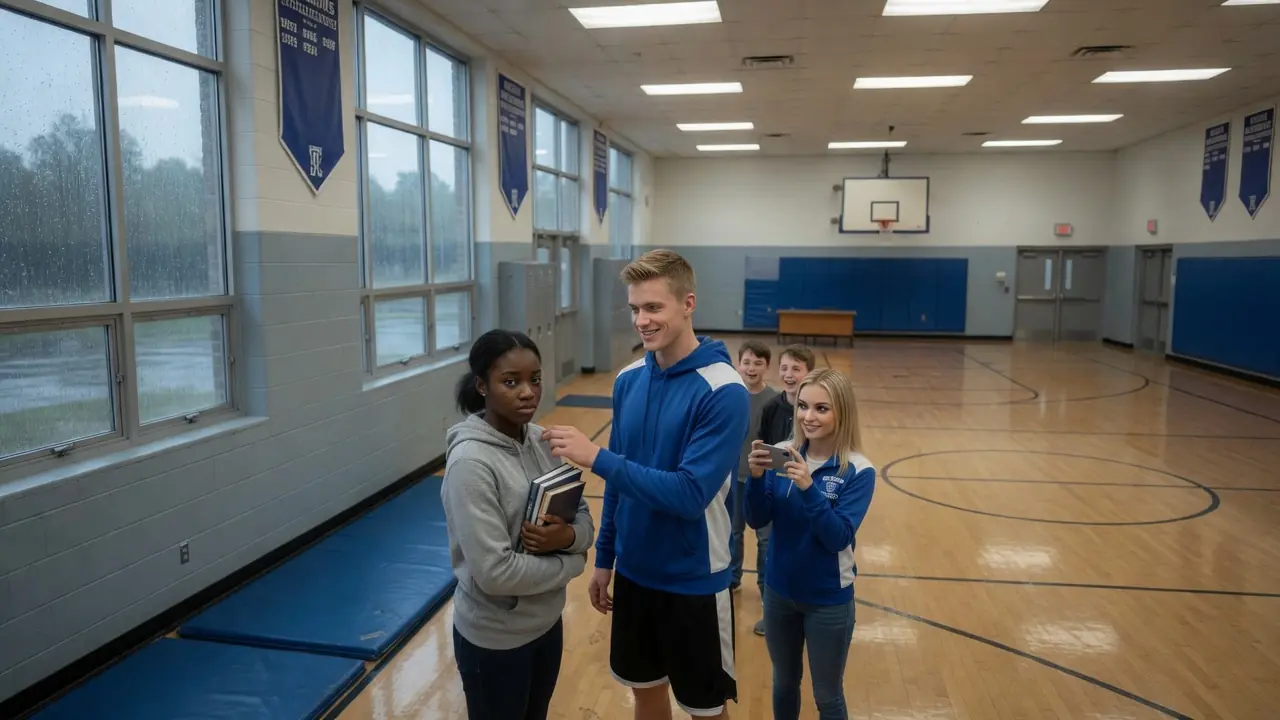
She heard footsteps behind her. Not one set. Several. Her shoulders tightened, but she did not run.
Brandon stepped out from near the folded bleachers, Mason and Luke spreading behind him while Chelsea leaned against the wall with her phone already lifted. The exit was only twenty feet away, but Mason drifted near it with a nervous grin. Amara stopped beside the gym mat and looked at all of them calmly. She understood then that they had planned this.
“What’s wrong, new girl?” Brandon asked, stepping closer. “You quiet because you’re scared?” Chelsea smiled at her phone screen. “Come on, Amara. Let’s see if the library mouse can do anything interesting.”
Amara held her books tighter for one breath, then slowly set them on the floor. That simple movement made Luke shift back. Brandon noticed and laughed loudly, trying to cover the sudden unease. “Look at that. She thinks this is a movie.”
“No,” Amara said. Her voice was steady. “I think you should back away while you still get to choose.” Chelsea’s eyebrows lifted, delighted by the line. “Oh, she talks now.”
Brandon’s face hardened. He stepped close enough that Amara could smell spearmint gum and cheap body spray. His hand lifted toward her collar again, slow and deliberate, as if he wanted Chelsea’s camera to capture the moment. “You embarrassed me,” he said. “Now you’re going to apologize.”
Amara looked at his hand, then at his eyes. “No.” The word was not loud, but it was final.
Brandon reached for her hoodie. This time, Amara moved before he could get a grip. She caught his wrist, stepped outside his reach, and redirected his momentum so he stumbled past her instead of into her. She did not strike him. She did not throw him hard. She simply made his own careless movement betray him.
Brandon turned red with anger. Mason laughed by mistake, then stopped when Brandon glared at him. “Don’t just stand there,” Brandon snapped. “Help me.”
Mason came forward, but not confidently. He reached out like he was testing a hot stove. Amara shifted her stance, turned her shoulder, and placed one palm on his chest—not a hit, just a firm stop. “You do not want this,” she said.
Something in her voice made Mason believe her. He stepped back. Luke raised both hands and muttered, “I’m good. I didn’t even want to be here.” Chelsea lowered her phone slightly, her excitement turning into uncertainty.
Brandon lunged again, faster this time, more embarrassed than strategic. Amara stepped in, trapped his arm against her side, and guided him down to one knee with clean control. There was no crash, no wild struggle, no dramatic violence. Just a controlled movement that made it painfully clear she had been trained for years while he had only been pretending to be dangerous.
“Let go,” Brandon hissed, his face twisted with humiliation. Amara leaned closer, her voice low enough that only he could hear. “You wanted everyone to see you scare me. Now everyone can see you had the chance to stop and refused.”
The gym doors opened at the far end. Coach Ramirez, the PE teacher, stepped in carrying a clipboard, then froze when he saw the scene. “What is going on here?” he shouted. Amara immediately released Brandon and stepped back with both hands visible. Brandon scrambled up, pointing at her.
“She attacked me,” he said. Chelsea quickly slipped her phone behind her back. Mason and Luke went silent.
Coach Ramirez looked at Amara, then at Brandon’s red face, then at the books on the floor and the group blocking the exit. His expression changed. “Everyone to the office. Now.”
The principal, Mrs. Elaine Carter, reviewed the hallway camera first. Then the gym camera. Then Chelsea’s phone, after Coach Ramirez ordered her to hand it over and she reluctantly admitted she had been recording. The video did not show what Chelsea wanted it to show. It showed Brandon blocking Amara’s path, reaching for her first, and Amara using only enough force to stop him.
Denise arrived forty minutes later in her diner uniform, hair pulled back, eyes tired and terrified. “Is my daughter okay?” she asked before even sitting down. Amara stood and hugged her mother tightly. Denise held her like she had been holding her breath all afternoon.
Mrs. Carter cleared her throat. “Ms. Johnson, Amara defended herself after being cornered and threatened. We are still reviewing the full situation, but I want you to know she is not being treated as the aggressor.” Denise closed her eyes for one second, relief crossing her face. Then she looked at Amara. “Baby, why didn’t you tell me it had gotten this bad?”
Amara looked down. “You already work so much. I didn’t want to make things harder.” Denise’s face broke with pain. She took Amara’s hands. “Nothing is harder than not knowing my child is hurting.”
The next week changed everything at Westbrook High. Brandon was suspended from the team pending review. Chelsea received consequences for recording and encouraging harassment. Mason and Luke tried to claim they were just watching, but the video showed enough to prove they had helped block Amara’s way. For the first time, the hallway group looked smaller without fear doing their work for them.
Students reacted in different ways. Some stared at Amara like she had turned into a legend overnight. Some whispered when she passed. A few asked if she could really fight. Amara hated that part because she had never wanted to be famous for what she could do when pushed too far.
Then a freshman girl named Tiana approached her outside the library. She was small, with braids and a backpack nearly as big as her torso. “How did you stay so calm?” Tiana asked. “When they were all around you, how did you not panic?”
Amara almost said she did not know. But that would have been a lie. “Training,” she said. “And breathing.” Tiana nodded slowly. “Can you teach me that?”
The question stayed with Amara all day. That evening, she told Denise about it while they washed dishes in their apartment kitchen. Denise listened quietly, then said, “Your father would have known exactly what to say.” Amara smiled sadly. “He would say the best fighter is the one who doesn’t have to fight.”
Denise touched her shoulder. “Then maybe you teach them that part first.” Amara looked at her mother and realized the idea no longer frightened her. Maybe what she knew did not have to stay hidden like a dangerous secret. Maybe it could become something useful.
Mrs. Carter approved the self-defense club two weeks later after Amara, Denise, and Coach Ramirez presented the plan. It would not be a fight club. It would not teach students how to hurt people. It would teach awareness, confidence, verbal boundaries, escape basics, reporting procedures, and how to stay calm under pressure.
At the first meeting, seven students came. Tiana was there, along with two sophomores who had been bullied in the locker room, a quiet boy from band, and three girls Amara barely recognized. Coach Ramirez stood near the wall as supervisor. Amara stood in front of them with her hands folded and felt more nervous than she had felt in the gym.
“I’m not here to teach you how to start fights,” she said. “I’m here to teach you how to avoid them, survive them, and never let anyone convince you that being scared means being weak.” The room grew still. “Courage is not being loud. Sometimes courage is asking for help. Sometimes it is walking away. Sometimes it is saying no before someone thinks they own your silence.”
They practiced stance first. Not punching. Not kicks. Just how to stand with balance, how to keep space, how to use a clear voice. Amara showed them how to say, “Back up,” without apologizing. Some students laughed at first because it felt strange, but by the end of the hour, their voices were stronger.
The club grew. Seven students became twelve, then twenty, then nearly forty. Mrs. Carter added a second weekly session and invited a counselor to speak about bullying, documentation, and asking adults for help early. For the first time since arriving at Westbrook, Amara walked the halls and saw students nod at her with respect that had nothing to do with fear.
Brandon returned after suspension, quieter and watched carefully. He did not apologize right away. Pride took time to loosen its grip on him. But one afternoon, he found Amara near the gym doors and stood several feet away with his hands at his sides.
“I was wrong,” he said. The words looked painful in his mouth. Amara studied him but did not answer at once. “I treated you like you were nothing,” he continued. “I’m sorry.”
Amara wanted to say something sharp. She wanted to remind him of the cafeteria, the science lab, the gym, the laughter, the fear he created because he enjoyed being powerful. But then she heard her father’s voice again. The best fighter is the one who does not need to win twice.
“I accept that you said it,” Amara replied. “Now act like you mean it.” Brandon nodded and walked away. It was not friendship. It was not forgiveness. But it was a beginning of accountability, and sometimes that was enough.
By spring, Westbrook High felt different. Not perfect. Schools are never perfect. But the worst behavior moved out of the open because people had learned that silence was not the same as permission. Students reported more, teachers watched more closely, and the self-defense club became one of the most attended after-school programs on campus.
At the end of the year, Mrs. Carter asked Amara to speak at a student assembly about courage. Amara almost refused. Then Denise reminded her that her father had spent his life teaching people to be strong without becoming cruel. So Amara stood on the auditorium stage with bright lights in her eyes and hundreds of students watching.
“I used to think staying quiet would keep me safe,” she said. “Sometimes quiet helps. Sometimes walking away is the smartest thing you can do. But if people keep using your silence against you, you have to tell someone, stand with someone, and remember that you are not less important just because someone else is louder.”
She looked out and saw Tiana in the front row, sitting taller than she had months before. She saw Coach Ramirez near the aisle. She saw Denise in the back, still in her diner uniform, wiping her eyes with a napkin. Amara’s voice steadied.
“My father taught me that strength is control,” she said. “Not anger. Not revenge. Control. You do not have to become a bully to stop one.”
The applause began slowly, then grew. Amara did not smile right away because the moment felt too heavy for that. Then she saw her mother standing, clapping with both hands, and the smile came despite everything.
That night, Denise took her to the small diner where she worked and ordered two slices of pie, even though money was still tight. “Your dad would have been proud,” Denise said. Amara looked down at the pie, her throat tightening. “I miss him.”
“I know,” Denise whispered. “But today, I heard him in you.” That was the first time Amara cried about the whole thing, not because she was weak, but because she had finally been strong long enough to feel safe.
Westbrook High never saw Amara as just the quiet new girl again. Some called her brave. Some called her dangerous. The ones who knew her best called her disciplined, which was the word she preferred. She had not wanted trouble, but when trouble blocked her path, she ended it without losing herself.
And in the months that followed, she learned the lesson her father had been teaching all along. Power is not what you do when everyone is watching. Power is what you refuse to become when someone tries to turn your pain into a performance.
The bullies thought they had cornered a helpless girl.
They were wrong.
They had cornered a fighter who knew the strongest move was control.