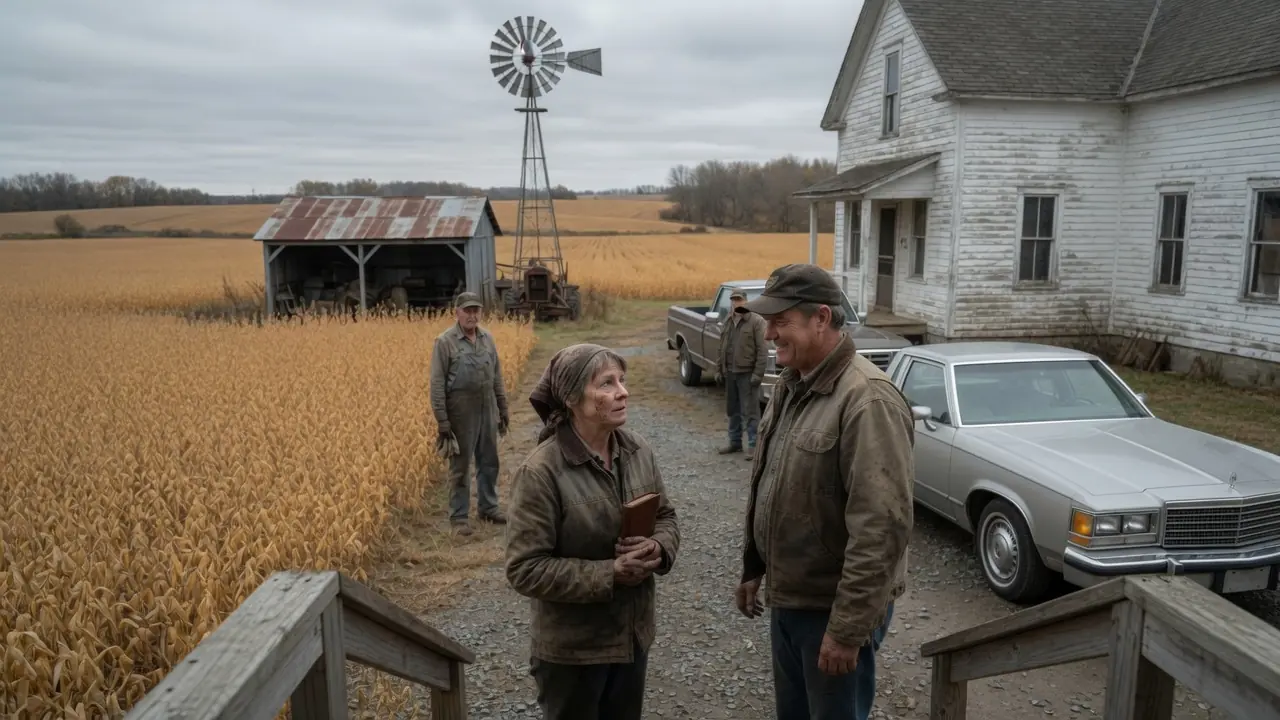
The windmill over the Hollis place creaked slowly in the October air, turning against a pale Missouri sky that looked tired before the day had even begun. Margaret Hollis stood at the kitchen window with both hands flat on the counter, staring out at four hundred acres of bottomland that had belonged to her husband on Sunday and belonged to her alone by Thursday. Thomas Hollis was three days in the ground, buried beneath a hackberry tree at Pleasant View Cemetery while half the county stood in silence and pretended grief made everyone kind. The house still smelled like casseroles from neighbors, diesel from his work shirts, and the empty side of the bed she had not been able to touch.
Margaret was fifty-two years old, with weathered hands, tired blue eyes, and a back that had bent over gardens, laundry, ledgers, and church suppers for more years than she cared to count. She had worked beside Thomas for thirty-one years, but beside did not mean equal in the eyes of the county. Men knew the grain contracts, men talked to bankers, men sat at the co-op counter and argued prices over burnt coffee. Women brought pies, kept books, mended jackets, and were expected to become grateful sellers when their husbands were gone.
But Thomas was gone, and the fields did not pause for grief.
The soybeans stood heavy in the north field, gold and ready, leaning into the wind as if impatient with her sorrow. The corn down near the creek was nearly ready too, and the grain bins needed checking before the weather turned. A bank note waited for March, machinery waited in the shed, and a harvest waited for hands that knew what to do. Margaret did not know enough yet, but she knew one thing with a clarity that made her straighten at the window.
She was not selling.
The phone had already rung four times that morning. Twice it was the funeral home asking about final paperwork, once it was her sister from Springfield asking if she needed help, and once it was a man named Duval she had never met. He spoke softly, offered condolences, then slid the words “if you ever consider selling” into the conversation like a knife wrapped in a napkin. Margaret hung up before he finished the sentence.
Thomas used to say land did not care who owned it, but it cared deeply who worked it. Margaret had smiled when he said it, mostly because he said such things when trying to explain why a tractor engine sounded wrong or why a field should not be disked too early. Now the phrase sat in her chest like a command. She poured cold coffee into the sink, pulled on Thomas’s old brown work jacket, and went outside.
The machinery shed smelled of grease, hay dust, and metal that had worked hard for decades. Cleat Riggsby was already there, bent over the header of the big International combine with a grease gun in his hand. Cleat was sixty-three, bow-legged, half deaf in one ear, and had worked the Hollis place for nineteen years. He looked up when Margaret entered, wiped his hands on a rag, and nodded once.
“Ma’am,” he said.
“Cleat,” Margaret replied, forcing her voice steady, “I need you to teach me how to run this harvest.”
His eyes narrowed slightly, not with doubt exactly, but with the weight of the request. He glanced toward the open shed door, where the fields stretched beyond the gravel drive. Then he looked back at her and took in Thomas’s jacket hanging loose over her shoulders. “You mean help you hire somebody?”
“No,” Margaret said. “Teach me. I need to know what Thomas knew.”
Cleat was quiet a long moment. Outside, a truck slowed near the mailbox, then continued down the road. “Harland Spence was by yesterday,” Cleat said. “Asked if you’d thought about leasing the ground. I told him you weren’t receiving visitors.”
“Harland can wait,” Margaret said. “Show me how to check the oil on this combine.”
For three hours, Margaret learned the language of machines Thomas had spoken fluently. Cleat showed her oil levels, belts, grease fittings, hydraulic lines, hour meters, and the way one small sound could mean a bearing was fixing to fail. She wrote everything in a kitchen notebook with a pencil worn down to half its length. By the time the sun rose higher, her hands were black with grease and her shoulders ached from leaning into places she had never looked before.
At noon, she walked back toward the house to make sandwiches.
Two vehicles waited in her driveway.
One was a silver Oldsmobile with a man in a tan suit leaning against it, smoking and looking across her fields like he was already dividing them into numbers. The other was a Ford pickup with a magnetic sign on the door for Tate Land and Cattle. A thick-shouldered man in a canvas jacket stood on the porch with his seed cap in both hands, wearing a practiced sorrow on his face. Margaret stopped at the bottom step and let him speak first.
“Mrs. Hollis,” he said, dipping his head. “Raymond Tate. I’m real sorry about Thomas. He was a good man.”
“Thank you,” Margaret said.
Raymond’s smile softened in the way men smile when they are about to take something and call it help. “I won’t take much of your time. I know this is a hard week, but if this place gets too much, I’d be interested in making a fair offer. Cash. You could stay in the house as long as you need, or I could help you find something in town.”
The man from the Oldsmobile walked up before Margaret answered. “Derek Lancing,” he said, extending a card she did not take. “I represent a farm management group out of Kansas City. We help families transition out of active farming while keeping steady lease income. No obligation, just smart planning.”
Margaret looked from one man to the other. Their voices were kind, but their eyes were already on the land. “Gentlemen,” she said, “I buried my husband three days ago. I am not selling anything, and I am not leasing anything. If that changes, I will let you know.”
Raymond’s smile tightened. “Ma’am, I respect that, but this ground is valuable. Come spring, seed, chemicals, repairs, bank payments, all of that costs real money. A lot of widows in your position find it easier to let someone else handle things.”
“I said I’m not interested.”
Derek lifted both hands. “We’re just trying to help.”
“No,” Margaret said, voice colder now. “You’re trying to get here before the next man does. You can leave.”
They left slowly, offended not by her answer but by her certainty. Raymond backed his truck around with too much gravel spin, and Derek slid behind the wheel of the Oldsmobile with his cigarette still pinched in his mouth. Margaret stood on the porch until both vehicles disappeared down the county road. Only then did she go inside and lock the door.
By evening, seven more calls had come.
Some were direct offers, some were condolences that turned into advice, and some were warnings dressed as concern. A co-op man said grain marketing could overwhelm a woman alone. A lawyer mentioned probate complications if she acted too quickly. Harland Spence called and said Thomas would never have wanted her to struggle with decisions beyond her experience.
Margaret unplugged the phone after supper.
She sat at the kitchen table with Thomas’s ledger open in front of her. His handwriting filled the pages in neat columns of fuel, seed, feed, parts, grain sold, payments due, rainfall, repairs, and notes only he fully understood. She ran her finger down the numbers, trying to find the rhythm beneath them. Farming was not just land and weather; it was math with consequences.
Friday morning came bright and sharp.
Margaret was up at five, dressed in jeans, boots, and Thomas’s jacket. She had made a decision sometime in the sleepless dark. She would run the harvest, not hire it out, not lease the ground, not sell to the first man who appeared with soft words and a checkbook. She would learn what she did not know and work until the land itself decided whether she belonged.
By eight, Cleat had the combine running.
Margaret climbed into the cab beside him and listened as the engine vibrated through the metal beneath her boots. Cleat explained the controls, the header height, the grain flow, the way the machine had to be listened to like a living thing. They made two slow passes through the north field with him at the wheel and her taking notes. Then Cleat stopped, climbed down, and looked up at her through the open cab door.
“Your turn.”
Margaret’s stomach tightened.
She hesitated only long enough to think of Thomas, slumped over a tractor wheel in the north forty with the engine still running and the sun going red behind him. Then she slid into the seat, put both hands on the wheel, and eased the combine forward. The header dropped, the machine roared, and soybeans began feeding into it in a golden rush. Margaret Hollis began her first harvest alone.
She made mistakes.
She moved too slow at first, then too fast. She let the header ride too high on one pass and had to circle back. Her hands cramped around the wheel, and her shoulders burned from the tension of trying not to ruin the machine or the crop. Cleat walked beside the field edge, signaling when she needed to adjust, never shouting unless he had to.
By noon, she had cut twenty acres.
When she climbed down, her legs shook so hard she had to hold the side rail before stepping into the dirt. Cleat stood beside the grain truck with a thermos of coffee and an expression almost like a smile. He looked at the cut rows, then at her. “Thomas would’ve fussed about your first pass,” he said.
Margaret swallowed. “And the rest?”
Cleat nodded once. “The rest would’ve made him proud.”
That compliment carried her through the afternoon.
Three more men arrived before sundown. Harland Spence came with his jaw set and his eyes narrowed, acting as if Margaret had personally insulted the county by running her own combine. A lawyer from the county seat brought a lease agreement already typed. A younger man from a corporate farm operation in Omaha arrived in a new Dodge and told her offers like his did not wait on sentiment.
Margaret met them in the driveway still filthy from the field.
Harland said Thomas would not have wanted her to wear herself down trying to prove something. The lawyer warned that pride could cost her the farm if she misunderstood the financial burden. The Omaha man said corporations had the equipment to do in days what she would fight for weeks. Margaret listened with her arms crossed and dust on her face.
When they finished, she said, “I cut twenty acres this morning. I’ll cut twenty more tomorrow. This farm is not for sale, and I am not interested in your help. Get off my property.”
Harland’s face hardened. “You’re being foolish.”
Margaret stepped closer. “Maybe. But I’m being foolish on my own land.”
They left angry.
After the last truck disappeared, Margaret sat on the porch steps and let her hands shake. Cleat came around from the barn and sat beside her without asking. For a while, neither of them spoke. The fields stretched gold in the cooling light, beautiful and terrifying.
“They’re going to keep coming,” Margaret said.
Cleat looked toward the road. “Probably.”
“I don’t know if I can do this.”
He rubbed both hands over his knees. “Maybe not all at once. But you did today.”
Saturday, she cut again.
Sunday, she cut more.
By Monday, one week after Thomas’s funeral, the north field was finished and the east section had begun. Word spread through Fairmont that the Hollis widow was running her own harvest, turning away offers, and climbing in and out of the combine like she had been born there. Some people admired it, some laughed at it, and some waited for her to fail.
Failure nearly came on Wednesday.
Margaret was halfway through the south field when the combine coughed, lurched, and died. She tried to restart it, but the engine only groaned. Cleat came running from the grain truck, opened the side panel, and disappeared into the machinery with a wrench and a curse. After ten minutes, he stepped back and shook his head.
“Fuel pump’s gone.”
“How long?”
“If Riggins has one, maybe tomorrow morning. If not, three days.”
Margaret looked west.
Clouds were building dark over the trees, heavy with rain. The beans still standing seemed to bend under the weight of time. “We don’t have three days,” she said.
They drove to Fairmont in Cleat’s truck, fifteen miles of county road and cold worry. At Riggins Implement, the owner checked the shelves, then shook his head. No new pump. Maybe a used one in the salvage yard, if the old machine out back had not been stripped clean. Margaret told him she would pay double.
While Cleat and Earl Riggins pulled parts behind the shop, Margaret waited in the truck and saw the men across the street at the co-op.
Harland Spence was there. So was Raymond Tate. Derek Lancing stood with them, hat tilted back, all three talking low and glancing toward her truck. She knew what they were saying without hearing it. They were counting her loss before the field was even wet.
The used pump worked.
Cleat had it installed by four, and Margaret was back in the cab by late afternoon, pushing through the field as the wind rose. The first drops started near seven, cold and scattered against the windshield. She cut until the rain blurred the rows and the tires began to slide. With thirty acres still standing, she shut the machine down and climbed out into mud.
The rain lasted all night.
It drummed on the roof, filled the ditches, softened the ground, and kept Margaret awake at the kitchen table with Thomas’s ledger open beneath the lamp. Thirty acres left. One contract to fill. A bank note due in March. A county full of men waiting.
Thursday was too wet.
Friday was worse.
Saturday dawned clear and cold, with the field firm enough to risk. Margaret started early and drove carefully, the combine straining through damp beans and soft places that tried to pull it sideways. Twice Cleat waved for her to slow down. Once the whole machine lurched, and the cab tilted hard enough to throw her against the door.
She gripped the wheel and kept going.
By noon, the last beans were cut.
The field behind her was stubble, mud, and proof. Margaret shut down the combine, climbed down, and stood there in Thomas’s jacket, filthy from boots to hairline, her hands blistered and her back screaming. Cleat parked the grain truck nearby and walked over slowly.
They stood side by side in silence.
“Harvest is done,” Cleat said finally.
Margaret nodded, unable to speak.
“Thomas would’ve been proud,” he added.
This time, she cried.
Not loudly. Not in a way anyone from the road could see. Tears slipped down her dirty face while she stood in the middle of the field she had saved. She cried for Thomas, for the work, for the fear, for the men who came circling, for the woman she had been before the funeral and the woman the land had forced her to become afterward.
That afternoon, she hauled the grain to the elevator.
The manager tested the moisture, weighed the load, and checked the paperwork. “This is the Hollis crop?” he asked, surprised. Margaret stood beside the truck in clean silence. He looked at the numbers again, then at her. “Good quality. Better than most I’ve seen this week.”
“I’ll take payment now,” Margaret said.
He wrote the check.
The following Monday, two weeks and a day after Thomas’s funeral, Margaret walked into Farmers Trust Bank in Fairmont. She wore clean jeans, a pressed shirt, and Thomas’s jacket, carrying the farm ledger under one arm and the grain check in her purse. Walt Krebs, the loan officer with a bow tie and a face made for doubt, looked up from his desk with visible surprise. “Mrs. Hollis,” he said, standing awkwardly. “I wasn’t expecting you.”
“I’m here to make a payment on the farm note,” Margaret said. “And to discuss spring planting.”
Walt blinked. “You’re planning to plant next spring?”
“I am.”
He sat slowly.
Margaret placed the ledger on his desk and opened it to the current page. Walt studied the numbers, then the grain check, then the payment history Thomas had kept with painful care. He tapped his pen against the desk, trying to make the figures fit his expectations. Finally, he looked at her with something like reluctant respect.
“You ran that harvest yourself.”
“I did.”
“That’s unusual.”
“So I’ve been told.”
Walt leaned back. “Most women in your position sell out or lease. Less risk. Farming next year means seed, fuel, chemicals, repairs, weather, prices. This year was one thing. Next year could put you under.”
Margaret met his eyes. “My husband spent thirty-one years working that land. I spent thirty-one years beside him. I learned more than most of you think.”
Walt looked down at the ledger again.
Then he reached into a drawer, pulled out a loan application, and slid it across the desk. “All right,” he said. “Let’s talk about spring.”
The calls slowed after that.
The visitors stopped.
Word moved through the county in the strange way truth sometimes does, first as gossip, then as disbelief, then as grudging acceptance. Margaret Hollis had harvested four hundred acres. She had paid the note. She had walked into the bank and planned the next crop before the men who wanted her land could finish predicting her collapse.
Winter was not easy.
She spent cold mornings in the machinery shed with Cleat, learning repairs that numbed her fingers. She studied soil reports, seed prices, chemical schedules, insurance papers, and grain marketing until her eyes burned. She made mistakes, asked questions, and endured the quiet smirks of men who still expected next year to humble her. But the more she learned, the less their opinions weighed.
Spring came late in 1973.
The fields stayed wet, and the calendar made everyone nervous. Margaret waited, watched, tested soil with Cleat, and moved when the ground was ready. She planted corn and soybeans in long, exhausting days, driving tractors until her arms trembled and her face burned from the sun through the cab glass.
By summer, the crops stood green and strong.
By fall, she ran the harvest again.
This time, fewer people laughed.
By the third year, no one came with sympathy offers.
By the fifth, men at the co-op stopped lowering their voices when she walked in. Walt Krebs called her a good risk and meant it. Harland Spence still wanted the Hollis ground, but he learned to ask only once a year and to expect the same answer.
Years later, Fairmont would still tell the story of that October in 1972.
Some said Margaret saved the farm because she was stubborn. Some said it was love for Thomas. Some said it was grit, pride, desperation, or plain luck. Margaret never cared what word they used.
She knew the truth was simpler.
She had stood in a kitchen three days after burying her husband while the phone rang and the fields waited. She had heard men tell her, in soft voices and hard ones, that a woman alone could not carry what had fallen to her. Then she climbed into the combine anyway.
Margaret ran the Hollis place for twenty-three more years.
When she finally sold it at seventy-five, she sold it to a young couple from Iowa who promised to keep it working ground, not carve it into weekend lots for people who liked the view but not the labor. She moved into town, into a small house near the courthouse square, and every October she drove out to the old place. She would stand at the fence line and watch the windmill turn slow and rusted over the fields.
Cleat stayed with her until he died in 1981.
At his funeral, Margaret told the county he had been the best hired man in Missouri and the only man who believed in her when belief mattered most. People nodded, some ashamed, some moved, all remembering what they had once assumed. The land remembered too, in its own quiet way, with every harvest that followed.
And the windmill kept turning.
It still stood over the Hollis place long after Margaret left the farm, a rusted landmark visible for miles. To most people, it was only old metal against a wide sky. But to those who knew the story, it meant something else.
It meant a woman had buried her husband on Monday.
It meant fifteen men came knocking before the week was done.
It meant every offer, every warning, every insult dressed as kindness failed.
And it meant Margaret Hollis looked out at four hundred acres everyone thought she would lose, pulled on her husband’s jacket, climbed into the machine, and harvested every acre alone.