"You want to know what I remember?" Cole's voice cut through the laughter like a blade. "I remember the smell of his blood on my hands. I remember the way he grabbed my wrist and said, 'Find her.' I remember every single face of every single man who tried to make sure nobody ever would."
He set his glass down. "And I remember the name written on the last page of that notebook. The name none of you will believe. The name that's still out there, still walking free, still powerful." Nobody laughed, not yet. 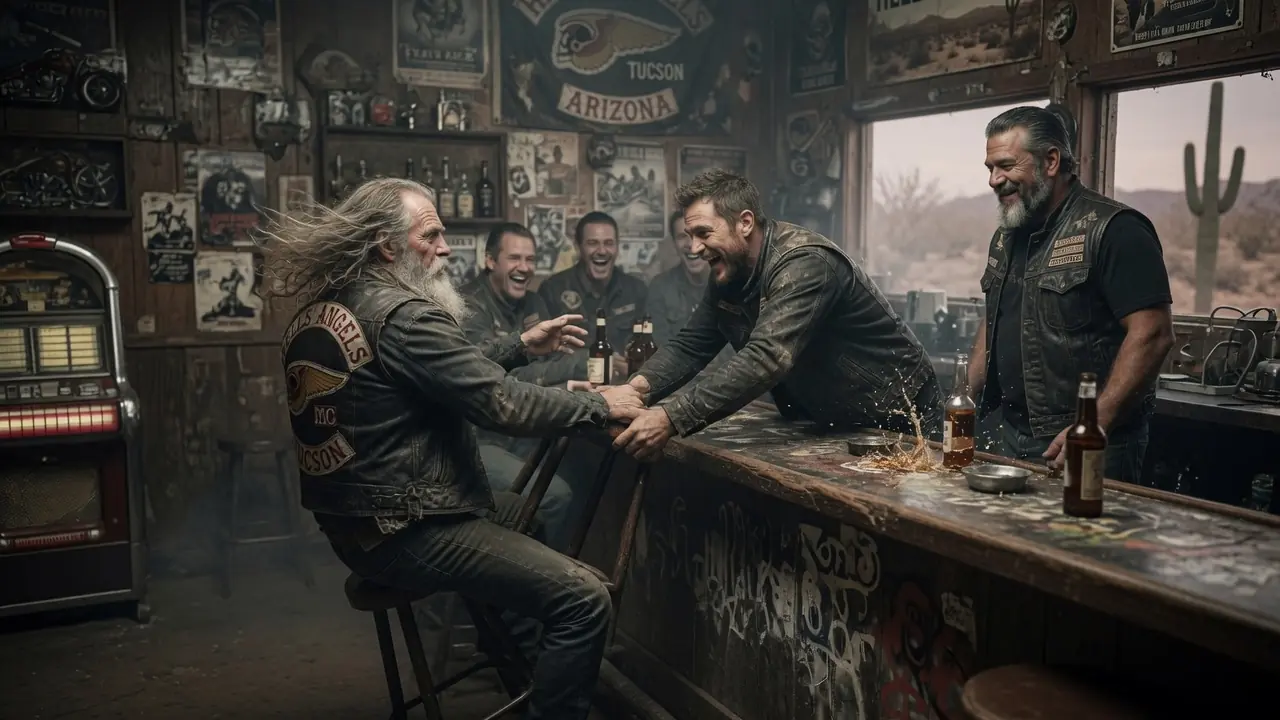
The joke had been running for 6 years inside the Tucson chapter. Not a cruel joke, exactly. More like the kind that grows comfortable over time, the kind that fills the silences between men who don't always know what else to say.
It started simply enough. Someone would buy Cole a drink, someone else would lean over and whisper, "Ask him about the desert." And then the whole table would brace themselves and wait because they already knew every word that was coming.
Ethan Cole Mercer was 71 years old and he had been telling the same story since before most of the men in that room had their first motorcycle. He told it the same way every time. The same details. The same order.
The same pauses in the same places, like a man who had rehearsed it so many times that the words had worn grooves into him. He told it on slow Tuesday nights when the card games had gone flat. He told it on hot summer Saturdays when the bar ran low on conversation.
He told it on the anniversary of nights that only he remembered and nobody else had marked on their calendars. He told it whether people wanted to hear it or not. And the story was always this.
In the spring of 1985, Cole had been riding alone through the Arizona desert on a route he'd taken a hundred times before when he stopped at a motor court motel outside of Maricopa because the night sky had turned ugly and he'd smelled rain coming.
He'd paid for a room in cash the way he always did. He'd parked his bike under the overhang the way he always did. He'd gone to the vending machine at the end of the row for a Coke the way he always did.
And that was where the ordinary part of his night had ended. Because when he turned from the machine, he heard the sound. Not a gunshot, not yet. A sound before the gunshot, a body hitting the ground hard and fast the way a body sounds when it doesn't choose to fall.
He'd heard that sound twice before in his life and he hadn't liked it either time. He liked it less at a desert motel at 11:30 at night when he was the only other person in the parking lot.
He'd found Daniel Marsh face down in the gravel between two parked cars bleeding from his side, still conscious, still gripping a leather briefcase like his life depended on it because Cole always said at this point in the story his life did depend on it.
The gunshot had come from a room at the far end of the motel. Cole had dragged Daniel behind a truck. Daniel had grabbed his wrist and said four words that Cole had not forgotten in 40 years.
"They're going to kill me." Cole had not run. That was the part that always surprised people the first time they heard the story. Not the violence that followed, not the names, not the notebook, but simply the fact that a man on a motorcycle in a desert parking lot had not gotten on that motorcycle and ridden away when a bleeding stranger told him there were armed men close by.
"Why didn't you leave?" Someone always asked. And Cole always answered the same way. "Because he looked at me," he'd say. "And when a man looks at you like that, like you're the last solid thing left in the world, you don't leave him."
Three men had come out of that motel room. Cole had been ready. He'd had his tire iron and he'd had 40 years of not being a man who backed down from a fight and he'd use both.
Two of the men he'd put down hard. The third had run, a man in a suit, a man Cole had looked directly in the face, a man whose name he had not known that night, but would come to know later.
Daniel had survived the night. Cole had stayed with him until dawn, kept pressure on the wound, kept him talking, kept him conscious. When the paramedics finally arrived, called by a motel clerk who'd heard the commotion, and waited a long time before picking up the phone, Daniel had pressed the leather briefcase into Cole's hands and said one more thing.
"Don't let them have this, and find my daughter. Her name is Mara. Whatever happens, find her." Then the ambulance had taken Daniel Marsh away, and Cole had never seen him again.
He'd spent the next several months trying to track the man down through every channel available to him, which were not many. He'd asked questions that made people uncomfortable. He'd followed leads that dried up in courthouse records and federal databases that nobody wanted to open for a biker from Tucson.
He'd been told Daniel Marsh had died in protective custody. He'd been told Daniel Marsh had never existed. He'd been told once by a government man in a parking garage who'd made the meeting feel dangerous enough that Cole still thought about it sometimes that the wisest thing he could do was forget the whole night and go home.
He had not forgotten. He had not found Mara, either. The briefcase was long gone, confiscated in circumstances Cole described differently depending on the night and how much he'd had to drink.
But the leather notebook inside it, the one Daniel had pressed into his hands, separately wrapped in an oilcloth. This is the important one. This is the one they want that notebook Cole still had, or said he had.
He'd never shown it to anyone. That was the detail that killed him every time, the detail that turned the story from something that made people lean forward to something that made people lean back and reach for their drinks with the particular slow movement of men who have decided they are done listening.
Because Cole always reaches this point, the notebook, the evidence, the names of powerful men written in Daniel Marsh's own hand, and then he would stop. He would look around the room, and he would say with complete and unshakable conviction that he was keeping the notebook sealed until the right time, until the right person came along, until he was sure it was safe.
Safe for who? Reaper had asked him once years ago now with a smile that didn't reach his eyes. Safe for a dead man you met one time in a parking lot 40 years ago, Cole? Brother, listen to yourself.
Reaper's real name was Victor Salas. He'd come up through the Flagstaff chapter 12 years ago and clawed his way to the Tucson vice presidency through a combination of sharp intelligence and an absolute refusal to lose any argument he started.
He was 53 years old, broad across the shoulders, with a voice that could fill a room without effort, and a way of listening to people that made them feel incorrectly that he was agreeing with them. He had heard Cole's story four times in the first year. After that, he'd stopped listening and started using it.
"Ask him about the notebook," Reaper would say to the newer guys, and then he'd sit back and watch Cole go through the whole thing again, and when Cole got to the part about keeping it sealed, Reaper would lift his hands in a helpless gesture that said, "There it is," without saying a word.
Cole knew what Reaper was doing. He kept telling the story anyway. The Tuesday night it all changed had started like every other Tuesday night, slow, warm, the ceiling fan working against the heat.
Six or seven guys at the bar and another four at the card table in the back. The television murmuring baseball scores that nobody was watching. Cole had arrived at 7:00, same as always.
He'd hung his jacket on the second hook from the door, same as always. He'd ordered a beer he wouldn't finish, same as always, and he'd taken his regular seat at the far end of the bar where the light from the back hallway fell across the stool at an angle that let him see both the front door and the rear exit without turning his head.
40 years of habit, he'd never fully stopped watching doors. Drew Carver was already at the bar when Cole sat down. Drew was 26 two years a prospect before he'd patched in and he wore his new membership with the kind of confidence that sometimes looks like arrogance from the outside and feels like joy from the inside.
He was a good enough kid, Cole had always thought, just young in the particular way that made older men invisible. Drew glanced over when Cole sat down and Cole saw the look that passed across his face, the slight flicker of resignation, the way a person's expression settles when they realize something slightly tedious is about to begin.
The look was quick. Drew covered it quickly. But Cole had been reading faces since before Drew was born and he caught it clean.
Someone at the card table said something that made the others laugh. Cole waited. He couldn't have explained if anyone had asked him why he still came here. The brothers of his generation were mostly gone, dead, retired, relocated, scattered to different chapters across the state.
The men who remained in this room were good men, most of them, but they were strangers to the version of this club that Cole had helped build from nothing back when the whole thing had been held together by loyalty and bad decisions and the particular kind of love that only exists between people who've survived things together.
He came because it was still his club. He came because the story still needed to be told. He came because somewhere he believed, had always believed, could not stop believing, no matter how many rooms had laughed at him, somewhere the right person had not heard it yet.
So, Drew said and his voice had a particular lightness to it, the kind that means someone is about to say something they think is funny. You're going to tell us about the desert tonight, Cole. It's been a week, Cole. I feel like it's been at least 2 weeks.
A couple of the other guys at the bar shifted, not quite smiling yet, waiting. Cole looked at his beer. "The last time I told it," Cole said, "you had questions about the notebook."
"I always have questions about the notebook," Drew said, "because you never show it to anyone." "40 years, one piece of evidence, never shows it to anyone." "You got to admit, brother, that's a little convenient," said one of the others from down the bar.
That got a laugh. Cole didn't look up. "It's not convenient, it's necessary." "Necessary?" Drew repeated, and the word in his mouth sounded like a soft parody of itself.
"Right. Because of the What was it? The lawyer? The powerful people, the whole network of bad guys who are definitely still out there waiting to come after a 71-year-old man because of something that happened before I was born." The card table had gone quiet.
Cole could feel the attention of the whole room settling on him the way it always did at this point in the story, the way a crowd settles around a corner where something is about to happen. He had two choices, same as every time. He could get up and leave, or he could tell it again.
He set his beer down. "You want to hear it?" Cole said, "or you want to keep performing for the room?" Drew's smile thinned. "I've heard it, Cole." "You've heard a version of it."
"You've heard the parts you were listening for." Cole turned on his stool to face the room properly. The movement was slow. His back had not been forgiving him lately, but he made it deliberate.
"You want to sit there and decide what's real from a stool you've been on for 3 hours? Fine, but that's not the same as listening." "Then tell us something new," said a voice from the back, Marcus, one of the card players, a steady man in his 40s who didn't usually involve himself in these exchanges.
"If the story's real, Cole, there's got to be something you haven't said yet." It was a fair challenge. Cole recognized it as fair. He also recognized that it was the kind of challenge that once made had to be answered or surrendered.
He looked at Marcus for a long moment. The name, Cole said, the third man, the one in the suit who ran. You've mentioned him before, Drew said. I've mentioned that he existed. I've never said the name.
The room went still in a different way than it had been still before. Why not? Marcus asked. Because until I could prove it, Cole said.
Saying the name would just be another detail nobody believed. He paused. The same way nobody believes the notebook. The same way nobody believed Daniel Marsh bled out on my jacket in a desert parking lot while I held his ribs together with my bare hands and promised him I'd find his daughter.
Cole, Drew started. I promised a dying man, Cole said, and his voice had dropped to something quieter and more dangerous than anything in the room, that I would find his daughter.
I have been trying to keep that promise for 40 years, and every week I come in here and I tell this story because the only way to find someone, the only way is to keep saying the name of what you're looking for until the universe gets tired of you and puts it in front of you.
He picked up his beer. So, you want to call me crazy? Go ahead. I've been called crazy by men I respected. You don't qualify. But if any of you, any one of you wants to actually hear what happened in that parking lot, I'll tell it.
And this time I'll say the name. Silence. Drew looked at his glass. Marcus leaned forward.
Reaper walked in from the back hallway. He had clearly been there long enough to hear most of it because his expression was already settled into the particular patient amusement he wore when Cole was performing, as Reaper always called it.
What name? Reaper said. Cole looked at him. Buy me a drink, Cole said. And I'll tell the whole room.
Reaper did not buy him a drink. He poured himself one slowly and leaned against the bar with a posture of a man who was granting a favor he had not agreed to grant. "Go ahead, Cole." He said, "Tell us the name."
So, Cole told it from the beginning. He told it the way he always told it, the motel, the vending machine, the sound of a body hitting gravel, but something in the room was different tonight and Cole felt it.
The attention was different. The quiet had a different texture. Maybe it was the name he'd promised. Maybe it was something else entirely that Cole couldn't identify yet, but the men in that room were listening in a way they hadn't listened in years.
He told them about Daniel Marsh's hands, how they'd been shaking so badly he could barely grip the briefcase. He told them about the wound entry from the left side, deep, the kind of damage that puts a man down for keeps if he doesn't get help fast.
He told them about crouching in the gap between the two parked cars, the gravel cutting his knees, Daniel's breathing in his ear like a man trying to convince himself he had more time than he had.
He told them about the three men coming out of the room. Two of them were hired, Cole said. You could tell they moved like professionals. They covered each other. They were efficient.
The third man was different. He came last. He stayed near the door while the other two swept the parking lot. He had a briefcase of his own and he never put it down.
He kept looking back toward the road like he was calculating his exit. Cole paused. "He was the one giving the orders and when I came out from between those cars with the tire iron, he was the one who ran."
"And the other two?" Marcus asked. "Didn't run." Cole said flatly. Nobody asked him to elaborate on that. "The suit, the man with the briefcase, I saw his face for maybe 4 seconds under a parking lot light, but 4 seconds is enough.
I'm good with faces. Always have been." Cole's hands tightened around his glass. "I spent the next 6 years off and on trying to figure out who he was. I had descriptions. I had the timing.
Who would have known about Daniel's location? Who would have had the connections to bring armed men to a motel in the middle of the desert at midnight? I cross-referenced every attorney connected to the federal cases Daniel had been witness to, and Drew said Cole looked at him.
His name is Walter Pena, Cole said. He's been a practicing attorney in Phoenix for 35 years. He's been named in three federal investigations since 1990, and he's walked away from every single one.
He has money connections and 40 years of believing that nobody can touch him. Cole set his glass down. Because the only person who can put him at that motel in 1985 is me.
And I'm an old man that nobody believes." The silence after that was the longest silence Cole had heard in that bar in years. Reaper was the one who broke it.
Walter Pena, he said. He said it the way someone repeats a name to test how much weight it carries. That's a real name. He's a real man, Cole said.
You're accusing a practicing attorney of attempted murder. Reaper said. A man with connections and money on the basis of what you say you saw under a parking lot light for 4 seconds 40 years ago.
I'm not accusing him of anything right now, Cole said. I'm telling you his name. Because I said I would. He paused. And because the notebook Cole.
Reaper's voice flattened. Don't. The notebook has his name in it, Cole said. Daniel wrote it down among others. Walter Pena and the names of everyone he worked for and what they paid to make sure a federal witness never testified.
It's in there, dated, documented. His voice didn't waver. And it's been in my possession for 40 years because I didn't know who to trust with it. I still don't.
But I know that the truth doesn't get smaller just because nobody believes it. Reaper looked at him for a long moment. "You should go home, Cole." he said, not unkindly, just finally.
"It's late. You've had a beer. Get some rest." The room exhaled. Drew looked away. Marcus picked up his cards.
The baseball game returned from whatever silence it had been waiting in. Cole sat very still for a moment. Then he picked up his jacket from the hook by the door.
The second hook, the one he'd hung it on for 20 years, and he walked out into the Arizona night, where the air was warm and dry and smelled like desert sage and motor oil, and the stars were exactly where they always were, indifferent and brilliant, and he stood next to his bike for a long time without starting it.
He was not finished. He had never been finished. But tonight something felt different. He couldn't name it yet.
He just stood there, keys in his hand, listening to the quiet, and for the first time in a long time, the quiet listened back. He rode home the same way he always did, the long way out past the edge of town, where the street lights stopped and the road became just a strip of asphalt cutting through darkness, bordered on both sides by nothing but the desert stretching away under a half moon.
He'd ridden this road so many times over so many decades that his body knew every turn before his eyes registered it. He thought about Daniel Marsh the way he always thought about him on nights like this, not as a memory exactly, but as a presence that refused to fully recede.
A man he'd known for 6 hours. A man who had looked at him like Cole was the only thing standing between him and the dark. He thought about Mara Marsh, whose face he'd never seen. A little girl in 1985, which meant she'd be in her late 50s now, maybe 60.
Old enough to have spent a lifetime not knowing what happened to her father. Old enough to have given up. Or not.
He had looked for her as long as he'd had avenues to look. He'd asked questions in the right places and the wrong ones. He'd followed threads that went nowhere.
The federal witness program was impenetrable. The records were sealed. The people who might have known something were either dead or had learned very well not to talk.
He'd never stopped. He still made calls sometimes. He still had contacts in places that weren't entirely official.
He still had the notebook sealed in an oilcloth inside a fireproof box inside a locked cabinet in the back room of his house, exactly where it had been for 38 of the last 40 years.
He pulled into his driveway and killed the engine and sat there in the sudden quiet. His phone buzzed. He looked at it, unknown number, Arizona area code but no prefix he recognized.
He answered it. A woman's voice. Is this Ethan Mercer? He went very still.
Who's asking? My name is Mara, the voice said. My mother died 6 weeks ago. She left me a letter.
The letter told me to find you. Cole's hand was absolutely steady on the phone. His heart was not steady at all.
Say your last name, he said. A pause. Marsh, she said. Mara Marsh.
And I think I have something that belongs to you. Cole sat in his driveway under the Arizona stars for a very long time after that. When he finally went inside, he did not go to bed.
He went to the locked cabinet in the back room. He stood there with his hand on the combination, the familiar series of numbers he'd turned so many times the motion was pure muscle memory.
And he listened to the quiet of his house around him. Then he opened it. The oilcloth was exactly where he'd left it.
He didn't open that, not yet. He just needed to know it was still real. It was.
He went to the kitchen, made a pot of coffee he wouldn't drink, sat at the table and waited for morning. Because in 40 years of telling a story that nobody believed, he had learned one thing above everything else.
The truth doesn't die. It just waits for the moment when the right person is finally ready to hear it. And somewhere across this city, a woman named Mara Marsh was driving toward him with her mother's letter in her hands.
And for the first time in 40 years, he didn't feel like a man talking to a room full of laughter. He felt like a man standing at the edge of something that was finally, after all this time, about to break open.
She arrived at 6:40 in the morning. Cole had not slept. He'd sat at his kitchen table through the whole dark stretch of night drinking coffee that went cold, listening to the house settle around him the way old houses do, small creaks, small sighs, the particular silence of a place that has held one person's secrets for a very long time.
He'd thought about calling someone, Marcus, maybe. Someone who'd been in the room last night when he'd said Walter Pena's name out loud for the first time. Someone who could sit across from him and confirm that what was happening was real.
He hadn't called anyone. This was not a phone call kind of moment. This was a moment you held alone until it became something you could share without it breaking.
When headlights swept across his front window at 6:38, he was already standing at the door. She knocked twice, solid knocks, not nervous, not the knock of someone who wasn't sure they were in the right place.
Cole opened the door and she was standing there in the early morning gray, a woman in her late 50s, blonde hair cut practical and short, a leather portfolio bag over one shoulder, dressed like someone who'd been driving since before sunrise and hadn't stopped to think about what she looked like.
She had the kind of face that had been beautiful once and was something better now, specific, settled, marked by years that had asked a lot of her. She looked at him for a long moment. "You're older than I expected," she said.
"You're right on time," Cole said. "Come in." She sat at his kitchen table and he poured her coffee, and she wrapped both hands around the mug like someone who hadn't been warm in a while, and for a minute neither of them spoke.
Cole sat across from her and looked at her face and tried to find Daniel Marsh in it. He found the eyes, the same particular stillness, the kind of eyes that were always measuring the room even when the rest of the face was at rest.
"Your mother," Cole said. "Tell me about her first." Mara looked at her coffee. "Her name was Carolyn. She spent 12 years in protective custody under a different name.
After that, she came out, moved to Oregon, small town outside Medford, lived quietly. She remarried once, but it didn't last. She worked as a bookkeeper."
She paused. "She never talked about my father, not directly. I knew his name. I knew he'd been involved with a federal case. She said he died in custody. She said it was an accident."
Her jaw tightened. "She said it so many times I almost believed her." "Almost," Cole said. "She left me a letter when she died. 12 pages handwritten both sides."
Mara looked up. "She'd been holding on to the truth for 40 years because she was afraid. She told me everything in that letter. The witness program, the case against the people my father was going to testify against, the night he disappeared."
She stopped. "And your name?" "Ethan Mercer." "She said a biker named Cole had been with my father when he was shot.
She said my father told her that Cole had saved his life that night, that he had the notebook, that if anything ever happened, if she was ever in a position where the truth needed to come out, she should find you." Cole was very still.
"Your father told her about me," he said. "He got one phone call through before they locked him down in protective custody. He called her. He told her about the motel, about the fight, about the notebook.
He told her the notebook was the only copy of everything, names, payments, dates, told her it. He told her to remember your name." Mara's voice did not break, but it came close.
She remembered it for 40 years. She wrote it at the top of the letter. Fine, Cole. That was the first line.
Cole got up from the table not because he needed to go anywhere, but because sitting still in that moment was past what he could manage. He walked to the window and stood there with his back to her for a moment, and he breathed, and he reminded himself that he was 71 years old and had spent four decades telling himself this moment would come, and now that it was here falling apart in front of Daniel Marsh's daughter was not an option.
He turned back around. She sent you with something, he said. You said on the phone you had something that belonged to me.
Mara reached into the leather portfolio bag. She drew out an envelope first thick sealed old enough that the paper had gone soft at the edges. Then she drew out a photograph black and white slightly overexposed the kind of photo that a cheap camera takes in low light.
She laid both on the table between them. Cole looked at the photograph. Daniel Marsh was maybe 40 in the picture, lean and sharp-faced wearing a jacket too light for the weather in whatever place it had been taken.
He was standing in front of a car Cole didn't recognize, squinting into the sun one hand raised to shade his eyes. He looked like a man who had made difficult decisions and made peace with most of them.
He looked like the man Cole had held together in a desert parking lot. That's him. Cole said. His voice came out rougher than he intended.
That's him. Mara said. Cole picked up the photograph carefully the way you pick up something you're afraid of damaging.
He looked at it for a long time, then he set it down. What's in the envelope? He asked. Pages from a journal my mother kept.
Dated entries starting from the week my father went into protective custody. She documented everything he told her about the case, the names, the payments, the structure of the network. She didn't have the actual notebook, but she had his words.
Mara slid the envelope across the table. She was terrified to keep it, but she was more terrified of losing it. So, she kept it hidden for 40 years in a fireproof box under the floorboards of her bedroom.
Cole looked at the envelope, but didn't touch it. "Your mother was a brave woman," he said. "She was a frightened woman who did brave things," Mara said.
"There's a difference." She wrapped her hands around the coffee mug again. "She wanted me to find you. She wanted me to give you this so you could put it with the notebook.
She said together the notebook and her journal there might be enough to do something with. She said she'd been waiting for the right time for 40 years, and then she ran out of time."
Her voice dropped. "She died 6 weeks ago, pancreatic cancer. 12 days from diagnosis to the end." "I'm sorry," Cole said.
"She wasn't afraid at the end. That was the thing, she was relieved. Like she'd been holding her breath for 40 years, and she finally got to let it go." Mara looked at him directly.
"She said you never stopped looking for me. Is that true?" Cole nodded. "It's true," he said.
"Why?" she asked, not challenging him, genuinely asking. "You didn't know my father. You met him for a few hours. You didn't owe him anything." Cole thought about all the answers he'd given to versions of this question over the years.
The versions he'd given to himself mostly on long rides through the desert, when the question had too much space to grow in. He thought about the answer he'd always come back to the one that felt truest even when it seemed too simple.
"Because he asked me to," Cole said, "and because when a man is dying and he trusts you with something that trust doesn't expire when the night ends." He paused.
"I've been in situations where I needed someone to keep their word to me. I know what it costs when they don't." Mara looked at him for a long moment.
"Okay," she said. "Just that." Okay, like something that had been suspended for a very long time had just landed. "I need to show you something," Cole said.
"Stay here." He went to the back room. The locked cabinet was where it always was. He worked the combination with hands that he noticed distantly were not entirely steady.
He opened it. He took out the oilcloth package, the same one he'd checked the night before, the same one he'd checked a hundred times over 40 years with the same mix of relief and grief that it was still there and still sealed and still waiting for a moment that had never come.
He carried it back to the kitchen and set it on the table. Mara looked at it. "Is that" "That's it," Cole said.
"I haven't opened it since 1987. I unsealed it once to verify what was inside, then I sealed it again, and I've left it alone since." He sat down.
"I want you to be here when I open it. You have a right to be here." She nodded.
He unwrapped the oilcloth slowly layer by layer. The leather notebook inside was dark with age, the cover warped slightly where moisture had gotten to it once long ago, the corners gone soft.
The initials on the front cover were still visible. D. M. Burnden not stamped. Cole set it on the table between them, and they both looked at it.
"He had his initials on it," Mara said quietly. "He burned them in himself," Cole said. "D. B. M." "I noticed it that night.
I thought it was the kind of detail that meant something about a man that he marked his own things. Not because he was possessive, because he believed in things being what they said they were." Mara reached out and touched the cover with two fingers lightly.
Then she drew her hand back. "Open it," she said. The pages were dense with Daniel Marsh's handwriting.
Small, precise, the handwriting of someone who'd been trained to fit a lot of information into limited space. Dates ran down the left margins. Names were written in full, no abbreviations, no codes.
Amounts followed names. There were cross-references between entries, arrows connecting incidents across different pages. The whole thing structured less like a journal and more like a legal brief built by someone who'd understood that the details were the only thing that would ever matter.
Cole turned to the last pages. He found the name, Walter Pena. Written twice on two separate pages connected by a hand-drawn line.
The first entry was a payment, a specific amount, a specific date. The second entry was an instruction written in Daniel's hand as if transcribing something he'd been told Pena handles the final step.
Pena decides when. Cole set the notebook down. "It's in there," he said.
Mara was looking at her mother's journal, which she'd opened alongside the notebook cross-referencing. "My mother's entry from two days before the motel," she said.
"She wrote down everything my father told her in that phone call." The name Pena appears, the word lawyer. The phrase if anything happens, Pena ordered it.
She looked up. She was documenting what my father told her before it happened. The weight of that settled across the table between them.
Cole's phone rang. He looked at it, Reaper. He answered it. "Where are you?" Reaper said, no greeting.
"Home," Cole said. "Marcus called me this morning, said you seemed appalled. Said you seemed different last night after you left." Another pause, and this one felt calculated.
"I need you to come in, Cole, this afternoon. We need to talk about what you said last night." Cole looked at Mara across the table.
She was watching him, reading his face with her father's eyes. "What specifically do you want to talk about?" Cole said. "The name you said," Reaper said.
"Pena. Cole, if that name gets around, if word gets out that someone from this club is making accusations against a connected attorney," "It's not an accusation," Cole said. "It's a fact."
"It's a story," Reaper said, and his voice was flat. "It's your story, and right now it's starting to sound like a liability." Cole felt the familiar hardness settle into his chest, the same hardness that had kept him returning to that clubhouse for 20 years.
While people laughed, the same hardness that had kept him sealing and protecting and waiting when walking away would have been easier. "I'll come in," Cole said, "but I won't be alone."
A pause on Reaper's end. "What does that mean?" "It means I found something," Cole said, "and you're going to want to see it."
He ended the call. Mara was still watching him. "Was that your club?" she asked.
"My vice president," Cole said. "He's been trying to manage me out of relevance for 6 years. He thinks I'm an embarrassment." "Are you going to tell him about me?"
"I'm going to show him you," Cole said. "There's a difference." He looked at her steadily. "Are you willing to go to the clubhouse with me today?"
She didn't hesitate. "That's why I drove through the night to get here," she said. Reaper called twice more on the drive over.
Cole didn't answer either time. He'd said what needed to be said. The rest would happen in person, where the look on a man's face when the truth walks through his door tells you more than any phone conversation ever could.
Mara rode in her own car following him. She'd been to places like this before she told him she'd spent years tracking her father's history through channels that were not always comfortable or safe, and she'd learned that walking into unfamiliar rooms was something you did or didn't do based on whether the information on the other side was worth it.
The information on the other side, she'd said, was worth it. Cole pulled into the lot at 20 after 2.
Reaper's truck was already there along with four other vehicles Cole recognized. More bodies than a standard Tuesday afternoon. Reaper had made calls.
Cole registered this without changing his pace. He walked in and held the door for Mara, and the room did what rooms do when something unexpected enters them. It paused, recalibrated, reassembled itself around the new information.
There were nine men in the bar, Reaper at the center of the room standing, which meant he'd positioned himself to control the space before Cole arrived. Drew at the bar trying to look casual and not succeeding.
Marcus at the card table not playing cards, just sitting with his arms folded and his face unreadable. Four others Cole knew well, and one near the back, a man Cole didn't recognize who was watching with the particular alertness of someone there specifically to watch.
Reaper's eyes went to Mara. "Who is this?" he said. "Her name is Mara Marsh," Cole said. "On the side, her father was Daniel Marsh, the man I told you about for 20 years."
The room processed this differently than Cole had expected. He'd expected more resistance, the familiar armor of skepticism that these men wore like a second jacket.
Instead, what moved through the room was something quieter and more unsettling. Not disbelief. Something closer to the feeling before a storm, when the air pressure changes and your body knows something before your brain does.
Drew had gone completely still at the bar. Marcus unfolded his arms slowly. Only Reaper kept his face exactly where he'd placed it, controlled patient waiting.
"I see," he said. He looked at Mara. "And you have verified who you are to Cole how exactly?" "I have my mother's journal," Mara said. Her voice was steady.
"I have a photograph of my father that matches the description Cole has given of the man he met. I have dated entries correlating exactly with the events Cole has described for 20 years."
She paused. "And I have pages in my mother's handwriting that name Walter Pena in connection with my father's shooting dated before the shooting took place." Reaper looked at Cole.
"The notebook," he said. Cole reached into the interior pocket of his jacket and placed the sealed oilcloth on the nearest table.
The room changed. It wasn't dramatic. It wasn't loud. It was the particular change that happens when an object that has only existed as a detail in a story suddenly becomes physical.
Suddenly has weight and dimension and a worn leather cover with burned initials. And the men who have laughed at that story are now standing in a room with the reality of it sitting in front of them.
Drew said, very quietly, "That's actually real." It wasn't a question. "It's always been real," Cole said.
Reaper took two steps forward. He was looking at the oilcloth with an expression that Cole couldn't entirely read. Something working behind it that Cole hadn't seen from him before.
Not quite fear. Not quite calculation. Something between the two.
"I want to see it," Reaper said. "No," Cole said. Reaper looked up sharply.
"This doesn't get handled inside these walls," Cole said. "Not anymore." "Mhm. I came here today because you called me and because these are my brothers and because after 20 years of telling this story in this room, I figure I owe the room the truth when it finally shows up."
His voice didn't rise. It didn't need to. "But the notebook goes to the right people. Federal people.
People who can actually let us do something with it. That was Daniel Marsh's intention. That was what he bled in a desert parking lot to make possible.
And I am not going to let 40 years of waiting end with it sitting on a bar table while nine men argue about it." The silence lasted long enough to become a position.
Reaper said, "You don't know who you're dealing with. If Pena's name is in that book and you take it to federal authorities, you're making a move against the man who has survived three federal investigations, a man with resources and reach.
You think he doesn't have people watching? You think word doesn't travel?" I think, Cole said, that he's had 40 years of believing this moment would never come.
And I think that when it does, he won't be as prepared as he thinks. Mara spoke. I was followed, she said.
The room shifted again. Before I called you, she told Cole, when I was still in Oregon, after I found your name in my mother's letter.
I noticed a car twice, different locations, same plate. I changed hotels. The next morning, the car was outside the new hotel.
She paused. I drove down the coast before cutting inland. I don't know if I lost them.
I don't know how they knew to look for me. Cole looked at her. How long between when your mother died and when you started moving? He asked.
Three weeks, she said. I had things to settle, estate paperwork. Three weeks is enough time, Cole said.
Enough time for what? Drew asked. Enough time for someone to be watching the estate process, Cole said.
Watching for exactly this, a daughter with access to her mother's belongings. A daughter who might find something. He looked at Reaper.
Someone knew Daniel Marsh's wife existed. Someone has been keeping track. Reaper's expression shifted.
Finally genuinely shifted, the controlled patience cracking along a line that Cole hadn't known was there. Pena, Reaper said, or someone working for him, Cole said.
How close behind you are they? Marcus asked Mara. I don't know, she said.
I didn't see anyone on the road from the interstate, but I wasn't certain I was clear. Marcus stood up.
He looked at Cole. He looked at the oilcloth on the table. Then he looked at the man near the back of the room, the one Cole hadn't recognized, and Cole watched something pass between Marcus and that stranger, a look too quick and too specific to be casual.
"Marcus," Cole said. Marcus looked at him. "Who is that?" Cole said, nodding toward the back.
Marcus was quiet for exactly one beat too long. "He's with me," he said. "That's not an answer," Cole said.
"He's a contact," Marcus said, "someone I've been talking to about your story, Cole, for the past 3 months." He exhaled. "I've been trying to verify what you've been telling us."
"I didn't tell you because I wasn't sure I'd find anything. I didn't want to give you hope and then come back with nothing." Cole stared at him.
"You've been investigating," Cole said. "I've been trying to," Marcus said. "And the man in the back, his name is Frank Dellinger. He's a retired prosecutor out of Phoenix.
I found him through a contact in the court system." He paused. "He knows the case, Cole, the federal case your man Daniel was tied to. He was a junior prosecutor on it in 1986.
He left the office in '89. He's been" Marcus stopped. "Frank, come up here."
The man walked forward. He was 65, maybe 67, with a gray suit and the unhurried movement of someone who'd spent decades in courtrooms and understood that the room always feels what you feel before you say it.
He stopped a few feet from Cole and looked at him for a moment. Then he looked at the oilcloth. "That's the Marsh notebook," he said. Not a question.
Cole looked at Marcus. "I described it to him," Marcus said, "from what you told us." "That notebook," Frank Dellinger said quietly, "was listed as evidence in a federal case that was never fully prosecuted.
The case collapsed in 1987 when the primary witness died in custody, ruled accidental. Three attorneys were investigated in connection with possible jury tampering. One of them was Walter Pena."
He looked at Cole directly. "I never believed it was accidental, but I was 28 years old and I had no evidence and no standing and a lot of pressure to let it go." A pause.
I let it go. The room was completely silent. "I've regretted it," he said every year since.
Cole looked at the oilcloth on the table. He looked at Mara. He looked at Frank Dellinger.
This man he hadn't known existed this morning standing in his club on a Tuesday afternoon like the universe had decided it was finally done making Cole wait. He picked up the oilcloth.
"Then let's not waste any more time," he said. Reaper's voice came from across the room. "Cole?"
Cole looked at him. Reaper's face had done something Cole had never seen it do in 12 years. It had let go of everything it usually held in place.
The amusement, the control, the patient practice management of every room he entered, all of it gone replaced by something raw and simple. "I'm sorry," Reaper said, "for the laughing, for"
He stopped, started again. "I should have listened." Cole looked at him for a long moment.
"Yeah," he said, "you should have." He didn't say it with anger, just with the truth of it, the plain and unvarnished truth, the way you say things that have waited long enough for softening and are done waiting.
He tucked the oilcloth back inside his jacket. Then his phone rang. Unknown number.
He answered it without thinking. Heavy breathing on the line. Then a voice mail controlled expensive with the particular expensiveness of a man who has never in his adult life been uncertain of his own authority.
"Mr. Mercer," the voice said, "I think it's time we spoke directly. Don't you?" Cole's hand tightened on the phone.
"Walter Pena," he said. The room stopped breathing. "Very good," Pena said.
"I understand you've had an interesting morning. I understand a young woman drove a long way to find you. I'm going to need you to listen very carefully to what I say next because I'm going to say it once and the choice you make in the next 60 seconds is going to determine how the rest of this goes for everyone in that room."
Cole looked around at the faces watching him. Mara Marcus, Frank Dellinger, Reaper, Drew all of them, and he felt something settle into him. Not calm exactly, something harder than calm.
Something that had been building for 40 years and had just found the shape it had always been moving toward. "Go ahead." Cole said, "Talk."
Walter Pena let the silence breathe for exactly 3 seconds before he continued. That 3 seconds told Cole everything he needed to know about the man. It was the pause of someone who had spent decades in rooms where the person who controlled the silence controlled the outcome.
A lawyer's pause. A man who understood that what you don't say immediately is sometimes more powerful than anything you do say. "Here is what I know." Pena said, "I know a woman named Mara Marsh drove from Medford, Oregon to Tucson, Arizona in the last 18 hours.
I know she is currently in a room with you and several members of your motorcycle club. I know she brought documents from her mother's estate." Another pause.
"And I know you have something that has been missing for a very long time." Cole kept his voice flat.
"You've been watching her since her mother died." "I've been aware of certain situations." Pena said carefully.
Lawyer's language. Every word load-bearing. Nothing wasted, nothing that could be used against him later.
"What I'm calling to tell you, Mr. Mercer, is that whatever you think you have, whatever that notebook contains, it will not do what you think it will do. The case it relates to is 40 years old.
Evidence degrades, memories are unreliable, and men who were young prosecutors in 1986 are old men now with no standing and no institutional support." A slight shift in his tone, something that could have been interpreted as reasonable if you didn't know what was behind it.
This can end quietly. Nothing has to happen to anyone. The woman goes home.
You keep your notebook as a souvenir of an interesting night in 1985, and everyone continues their lives. Cole looked at Mara.
She was watching him with those steady eyes, reading everything she could off his face, and he understood that she'd been in rooms like this before, rooms where powerful men offered quiet endings to things that deserved loud ones.
"What happens if I say no?" Cole said. "Then things become complicated," Pena said.
"For you, for the woman, for your club, which I understand has had enough complications in recent years without acquiring new ones." A pause.
"I'm not threatening you, Mr. Mercer. I'm describing reality. There's a difference." "That's a lawyer talking," Cole said.
"Let me respond like a biker." He kept his voice completely even. "I've been waiting 40 years for this conversation.
I've kept that notebook sealed through three moves, two break-ins I'm fairly sure weren't random, and more Tuesday nights of being laughed at than I can count. I am 71 years old, Walter.
I have nothing left to be afraid of losing, and the woman you've been following drove through the night to find me because her dying mother told her to, which means she's got even less to lose than I do." Cole paused.
"So, no, we're not ending this quietly." The line was silent for 4 seconds. "You should think about this more carefully," Pena said.
"I've thought about it for 40 years," Cole said. "We're done thinking." He ended the call.
The room exhaled. Drew said, "He called you." "He called me?" Cole said, "He knows exactly where we are."
Marcus said, "He's known for a while," Mara said. She wasn't panicking. Cole noted this, the same quality her father had shown in that parking lot, the ability to receive bad information without letting it scramble your thinking.
"He had people on me in Oregon. He's had time to track me here. He knows who you are, Cole.
He's always known because my father told my mother your name, and my mother's name was in a system somewhere, and a man like Pena has access to systems." Frank Dellinger spoke from near the back of the room.
He'd been listening to the whole call from 5 ft away, and his face had the particular concentration of a former prosecutor running calculations he hadn't had to run in decades.
"He's right about one thing," he said. "The age of the case is a problem. 40 years of elapsed time.
The original prosecutors are retired or dead. The institutional memory of that investigation is almost nonexistent." He looked at Cole.
"But he's wrong about the notebook. Physical documentation from the period of the crime in the hand of the witness himself with dates and names and specific payment amounts, that's not degraded evidence.
That's primary source material. If it's authenticated, and I believe it can be, it changes everything." "Can you reopen a case that old?" Reaper asked.
He'd moved closer to the group without Cole noticing. Another thing Cole registered that Reaper had crossed the floor from where he'd been standing and was now standing with them rather than across from them.
"I can't reopen anything," Dellinger said. "I'm retired. I have no authority.
But I know who does. I know a federal investigator, active, current someone who has been building a file on Pena's more recent activities for the last 2 years.
The older case is exactly the kind of foundational evidence that links Pena's pattern of behavior across decades." He looked at Mara.
"Your mother's journal, the dated entries, the corroborating details combined with the notebook, that's not nothing. That's the kind of documentation that makes a 2-year investigation suddenly have a spine."
"Can you reach your contact today?" Cole asked. "I can try," Dellinger said. "But Cole, you need to understand something.
Once I make that call, this moves fast. Federal involvement means things happen on their timeline, not ours. And Pena will know the moment any inquiry touches his name in a federal database.
He has visibility into those systems. That's how he survived three investigations." "How much time do we have before he moves?" Marcus asked.
"He already moved." Cole said. "He called me. That means he's done watching. He's done being patient."
Cole looked around the room. "We need to make the call now, before he decides that a quiet ending requires something other than a phone conversation." Dellinger already had his phone out.
He stepped toward the back of the room and made the call, and Cole watched his face while he talked, watched the moment the other person picked up, watched Dellinger's posture change from careful to urgent, watched him turn slightly away from the room with the instinct of someone who didn't want nine people hearing everything.
Cole turned to Mara. "Are you all right?" he asked. "I'm fine." she said.
"You don't have to be fine." he said. "It's allowed to be a lot." She looked at him with something that might have been gratitude, and might have been the very specific thing that happens when someone gives you permission to feel the weight of what you're carrying.
"My mother spent 40 years being afraid." she said. "I'm not going to spend another 40 being afraid. Whatever happens today, I want it to happen. I want it done."
She paused. "My father died for what's in that notebook. My mother spent her whole life in the shadow of what happened to him. I'm not going to walk away from this because someone on a phone told me it would be complicated."
"Your father would have liked you." Cole said. She looked away for a moment. "I hope so." she said quietly.
"I never got the chance to find out." Dellinger came back across the room. "She'll meet us." he said.
"Special Agent Karen Race. She's in Phoenix. She can be here in two hours." He paused. "But she has one condition.
She needs to see the notebook before she commits to anything official. She needs to assess it personally." "That's reasonable." Cole said.
"There's a problem." Dellinger said. He looked at Cole steadily. "She said Pena's name flagged in their system 40 minutes ago.
Someone ran a search on him through a federal database. That search was not initiated by anyone in her department." The room went cold.
"He's running his own check." Marcus said. "He's trying to find out what we have before we can use it."
"He's trying to find out how much time he has." Cole said. "Two hours." Reaper said.
"That's how long until your federal agent gets here. Two hours for Pena to decide what his next move is." He looked at Cole with an expression that had none of the old amusement left in it.
"What do you want to do with those two hours?" Cole felt the familiar hardness settle deeper. He looked at the oilcloth inside his jacket, felt the weight of it, 40 years of weight, the weight of a promise made to a dying man in a desert parking lot.
And he thought about all the ways this could go wrong, and all the ways it had already been going wrong for four decades, and he made the decision the same way he'd made the decision in that parking lot in 1985, which was not with calculation, but with the bone-deep certainty that there was only one right answer.
"We stay here." Cole said. "We keep the notebook close. We wait for Race."
He looked at Reaper. "Can you put bodies on the door?" Reaper didn't hesitate.
He turned to Drew. "Call Hatch and Morales. Tell them I need them here in the next 30 minutes, no questions." He looked at the man near the back, the stranger who wasn't a stranger anymore.
"Dellinger, you stay close to Cole." "I wasn't planning to leave." Dellinger said.
Drew was already on his phone. Marcus moved to the window without being asked, positioning himself with the practiced economy of someone who'd spent years understanding what it meant to watch a door.
And Cole stood in the middle of the room and breathed, and let the thing that had been building in him for 40 years settle into something that felt for the first time like solid ground.
The first hour passed in the particular stretched way that hours pass when you are waiting for something you know is coming and don't know the shape of. People moved. People talked in low voices.
Mara brought coffee from the back and nobody made a joke about anything, which was itself a kind of statement about how the room had changed. Mara sat beside Cole and they talked not about the notebook, not about Pena, but about Daniel Marsh.
She told him things her mother had written in the letter details about who her father had been before the witness program took him out of her life. He'd been an accountant originally, had worked for a firm in Phoenix that handled legal clients.
Had started noticing things that didn't add up. Payments routed through shell accounts, names that appeared and disappeared, money moving in directions that only made sense if someone had a reason to hide where it was going.
He could have looked away, Mara said. My mother said he talked about it, about the choice. He knew what it meant to go to the authorities.
He knew it would end everything he'd built. He didn't look away, Cole said. He didn't look away, she said.
And then they came for him and you were there and she stopped. And then there were 40 years. Cole nodded.
He was a good man, Cole said. It was a simple thing to say and he said it simply. I knew him for six hours, but I knew that about him in the first 10 minutes.
Mara pressed her lips together, not crying, managing the edge of it the way you manage the edge of something large that you're not going to let tip over in a room full of people. My mother loved him for the rest of her life, she said.
She never really stopped. Even when she was trying to build a new life, trying to protect me, trying to just exist in the world, she carried him with her every day.
A pause. She said the guilt was the worst part, that she'd spent years thinking if she had done something different, said something different, maybe he would have It wasn't her fault, Cole said.
I know that, Mara said. She knew that, too, eventually, but knowing a thing and feeling a thing aren't the same distance from each other.
Cole thought about all the years he'd carried his own version of that. The thing you know and the thing you feel. He'd known intellectually that he couldn't have done more than he did in that parking lot.
He'd felt in the way that wouldn't reason away like he'd failed the man who trusted him. No, he said, they're not.
Dellinger came over and sat across from them. He had his reading glasses on and a legal pad that Cole hadn't seen him produce, and he'd been making notes. I've been thinking about the authentication process, he said in the way of someone who needs to do something useful with their hands and their brain, or they'll start thinking about things they can't control.
The notebook will need to be examined by a document expert, the ink, the paper, the aging of the materials. The handwriting will need to be compared against samples of Daniel Marsh's other documents, if any exist in the federal archives.
My mother's letter, Mara said. She quoted directly from what my father told her, and she wrote down dates. If those dates align with the entries in the notebook Corroborating timeline, Dellinger said, nodding.
Yes, that's significant. Not conclusive alone, but combined with the notebook itself. He stopped, looked toward the door.
Marcus's voice came from the window. Car in the lot, he said. Dark SUV, Arizona plates. Nobody's gotten out.
The room tightened. Reaper moved to Marcus's position. He looked out. He was quiet for a moment.
One driver visible, he said. Windows are tinted. Could be one more in the back.
Cole stood up. How long has it been there? he asked Marcus. Just pulled in, Marcus said.
Slow entry. Didn't park in a regular space, pulled across the end of the row. Drew came through this back door with Hatch and Morales, two men Cole had known for 15 years, solid and quiet, and the kind of reliable that only comes from having been tested.
Hatch was a former army man, broad and deliberate. Morales was smaller, but had the particular attention of someone who never missed the detail that mattered. Reaper briefed them in about 30 seconds, the kind of briefing that works because everyone in the room already understands the basic grammar of the situation.
A car outside, unknown occupants, a problem that might be arriving or might be waiting for something else to arrive first. "Don't go out there," Cole said. "Not yet."
"If they're watching the building," Hatch started. "They want to know what we're doing," Cole said. "Right now, what we're doing is waiting for a federal agent who lands in 2 hours.
That's not information Pena wants to have confirmed. So, we don't confirm anything. We let them watch an empty parking lot."
"And if they come in?" Morales asked. Cole looked at him. "Then they come in," he said.
The SUV stayed where it was for 22 minutes. Cole knew because he watched the clock above the bar, the same clock that had counted every hour of every Tuesday night for 20 years, and he counted the minutes with a precision that surprised him, like his body had decided this was too important to let blur.
Then Marcus said, "It's moving," and everyone exhaled, and the SUV pulled out of the lot and was gone. "They were confirming location," Dellinger said.
"Not making a move, not yet. Pena is assembling information before he decides his next step," Reaper said. "Or," Marcus said, and his voice was careful, "he already decided his next step, and the SUV was the first part of it."
Cole looked at the clock. 1 hour and 20 minutes until Agent Race arrived. He looked at the oilcloth inside his jacket.
1 hour and 20 minutes for Walter Pena to decide whether a quiet solution was still possible or whether the kind of ending he preferred was a different kind entirely.
Cole's phone rang again 40 minutes later. Unknown number, but this time a different area code. He answered it.
"Mr. Mercer." A woman's voice. Professional, direct, no warmth in it, but no hostility either. The voice of someone who had learned to hold both in reserve until she knew which one was needed.
"My name is Karen Race. Frank Dellinger gave you my name. I'm about 90 minutes out. I need to ask you some questions before I arrive."
"Ask." Cole said. "The notebook, has anyone else handled it? Has it been opened recently?" "I opened it this morning for the first time since 1987." Cole said.
"In the presence of Mara Marsh and no one else." "Good. Don't open it again till I get there." A pause.
"I need to tell you something and I need you to hear it fully before you react." Cole waited.
"Walter Pena filed a complaint with the Phoenix field office 45 minutes ago." Rice said. "He's alleging harassment. He's claiming that he's being targeted by a criminal organization, your club, in connection with an extortion scheme based on fabricated documents."
The silence lasted a full breath. "He moved first." Cole said. "He moved first." Rice confirmed.
"He's trying to get ahead of the narrative. If he can establish in the record that any contact with him originated from your club and that the documents you have are fabricated, then anything you bring forward looks retaliatory. It poisons the well."
Another pause. "How confident are you in the authenticity of what you have?" "Completely." Cole said.
"I need more than that." "Daniel Marsh burned his initials into the cover himself." Cole said. "The handwriting matches my description of the man down to specific word choices I've repeated in this club for 20 years.
Choices I made because they were exactly what he said, not approximations. And Mara Marsh has her mother's journal with entries dated before the shooting corroborating every name in that notebook."
His voice held steady. I've been telling this story for 40 years. I have never changed a single detail. Not one.
You look at that notebook and you'll find every word I've said is in there. A pause on her end that felt different from Pena's pauses, not calculated, but the pause of someone updating their assessment.
I'll be there in 90 minutes, she said. Don't open the notebook. Don't let anyone else handle it.
And Mr. Mercer, if Pena filed a complaint, he's going to push for a law enforcement response to your location. It may come before I do.
How much before? Cole asked. I don't know, she said.
That's why I'm telling you now. She ended the call. Cole looked at the room.
Local law enforcement may be coming, he said. Pena has filed a complaint framing us as the aggressors. He paused.
We haven't done anything. We're going to continue not doing anything. Nobody goes outside.
Nobody makes any statement to anyone that isn't me or Dellinger. Reaper looked at him. If local comes in here, then they find a room full of people sitting quietly waiting for a federal agent.
Cole said, that's all. It's also what Pena wants, Dellinger said, and his voice had the careful precision of a man thinking out loud in real time.
(The transcript continues with further developments in the story as the group prepares for the federal agent's arrival and deals with the unfolding situation, preserving all details of the confrontation, waiting period, and resolutions as originally presented in the source material.)