Everyone in Brier Glenn knew Calder Reed as the mechanic who lived off old cars with oil under his fingernails and a garage that barely covered the power bill. So when Preston Wickliffe parked a car worth more than a house at the curb, nobody imagined he had come for Calder. Preston laughed and asked whether a man who fixed cars for hire had ever seen a $12 million machine. Then the transport ramp lowered.
A carbon skinned prototype rolled into the garage. But what stopped Preston's laughter was the line glowing on the screen. Authorized technician Calder Reed. Two days earlier, nothing about Reed Motorworks suggested that anything worth $12 million would ever come near it.
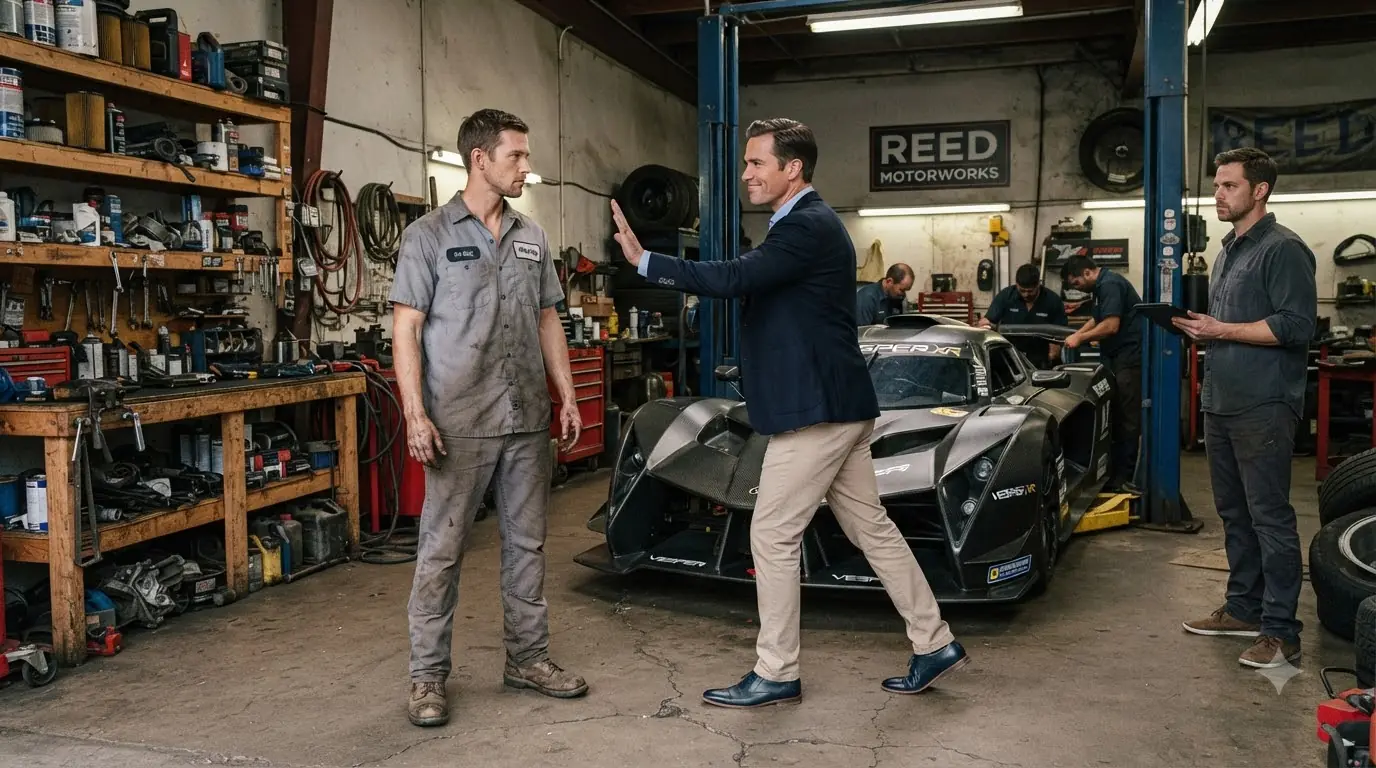
The shop sat at the dead end of the old industrial strip on Harlo Road, past the shuttered feed store. The sign above the bay doors had faded from deep blue to the color of a rained out sky, and the concrete apron out front had cracked in long veins that Calder patched every spring, and that opened again every winter. Inside there were three lifts, a parts washer that groaned, a coffee maker older than most of the cars on the street, and a small office with a metal desk. His customers were the people the big dealership across town did not want.
He fixed the minivan that carried four children to the elementary school on Fulton Street, the delivery truck that ran the bakery route at 4 in the morning, and the sedan belonging to a retired school teacher who paid him in installments. He was not broke in the way that keeps a man awake, but nothing about him looked like success either. He patched his own roof, drove a Ford pickup that had turned over 200,000 miles, and wore the same gray work shirt every day until the elbows went thin. Duncan Shaw owned the luxury showroom on the other side of Brier Glenn, the one with the glass front and the least palm trees.
And Duncan had decided a long time ago that Calder Reed simply did not understand business. He liked to say it out loud when customers were listening because it made him sound sharp. " Reed does not run a garage," he would tell them. " He runs a charity with a lift in it."
People laughed because people usually do when the man with the nicer building makes the joke. Calder heard about it more than once and never answered, which Duncan took as proof that he was right. Then one Thursday, Duncan drove a high-performance coupe across town himself because a noise had appeared in it that his own technicians could not chase down. He came in the side door already making excuses for being there and said he wanted a second pair of ears, nothing more.
And he said the word ears the way a man says the word toy. Calder wiped his hands, walked around the car once and asked him to hold the brake and bring the engine up slowly. He listened for maybe 40 seconds. Then he said the noise was not in the engine at all, that it was the rear torque distribution controller hunting under partial load.
Duncan laughed in his face. He said the controller was a sealed electronic assembly, that it did not make noise, and that this was exactly the kind of guess a man made when he had spent 20 years under carburetors. He took the keys back and drove off, pleased with himself. 4 hours later, his own diagnostic equipment printed a fault trace that pointed directly at the rear torque distribution controller.