The iron skillet flew across the general store so fast that Sheriff Dalton Hollard barely had time to duck.
It missed his head by inches, struck the front window, and burst through the glass with a crash that sent half of La Veta, Colorado, running toward the boardwalk. Shards scattered across the dusty street, and a woman screamed as if the whole town had been attacked. Inside the store, Sienna Pierce stood with both hands clenched, her chest rising and falling, her auburn braid slipping loose over one shoulder. Her green eyes burned toward the counter where Mr. Henderson hid behind a sack of flour, one hand pressed to the scratch across his cheek.
“That is the third window this month,” Sheriff Hollard said, raising both hands as if approaching a loaded pistol. “Miss Pierce, you cannot keep destroying property every time someone says something you do not like.”
Sienna’s jaw tightened.
“Then perhaps you should tell Mr. Henderson to keep his filthy hands off women.”
A murmur rose outside the broken window.
Henderson’s face went red.
“She’s lying,” he wheezed. “Crazy as a bedbug, that one. All I did was compliment her dress.”
Sienna stepped forward so sharply that Henderson flinched.
“You put your hand on my backside,” she said, each word cold and clear. “There is a considerable difference between a compliment and an assault, you contemptible toad.”
The crowd outside grew larger.
Women whispered behind their hands, some shocked, some quietly pleased. Men leaned against porch posts, pretending disapproval while keeping a careful distance from the woman who had just sent a skillet through the front window. La Veta had seen drunken miners brawl in the street, ranch hands shoot at bottles, and gamblers dragged from the saloon by their collars. But nothing drew a crowd faster than Sienna Pierce refusing to behave the way men expected.
She had come to town three months earlier with a worn carpet bag, a Boston accent, and more fury than anyone knew what to do with.
At first, people assumed she would settle down.
They thought hunger, gossip, and hard frontier life would bend her into something quieter. They thought a young woman alone would learn quickly that survival required smiles, lowered eyes, and silence when men crossed lines. But Sienna did not lower her eyes. She did not smile when insulted, did not laugh at crude jokes, and did not forgive hands that wandered where they had no right to be.
That made her dangerous.
At least, that was what La Veta called women who defended themselves.
Old Timothy McCrea from the saloon leaned toward the blacksmith and chuckled. “That’s the fourth man this month who forgot Miss Pierce has claws.”
Frank Morrison shook his head with a mixture of admiration and concern.
“She’s got a temper like a wildcat,” he said. “Beautiful as a sunrise, sure enough, but Lord help the fool who crosses her.”
Henderson, still hiding behind his counter, spat into a rag and glared. “No decent man will ever want a wife who acts like that. She needs someone to tame her.”
Sienna turned toward the window.
The crowd fell silent.
“If any man believes I was placed on this earth to be tamed,” she said, her voice carrying clear to the boardwalk, “he is welcome to try and leave with fewer teeth.”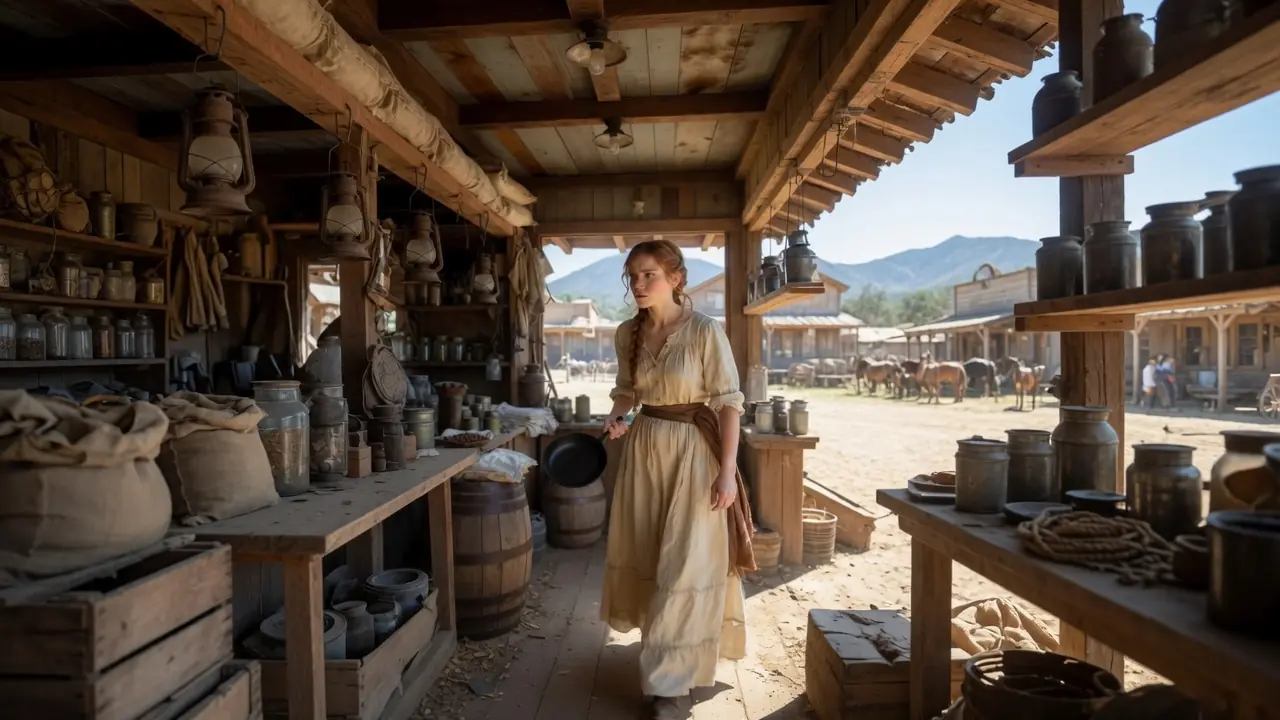
Someone gasped.
Someone else laughed before quickly covering it with a cough.
Sheriff Hollard rubbed his forehead like a man who wanted to be anywhere else.
“Miss Pierce,” he said, “you will still need to pay for that window.”
Sienna picked up her reticule from the counter.
“Send the bill to Henderson.”
The storekeeper sputtered.
“If he wishes to assault women in his establishment,” she continued, “he may pay the consequences in glass.”
She stepped over the broken window frame and walked onto the boardwalk with her spine straight as a rifle barrel.
Her dress was plain and slightly worn, but she carried herself like someone who had once been taught to enter parlors, not frontier general stores filled with flour dust and tobacco smoke. That was part of why La Veta did not understand her. Sienna Pierce spoke like an educated lady but fought like a trapped bobcat. She could hem a sleeve with perfect stitches in the morning and bloody a man’s nose by supper if he gave her cause.
She had not always lived this way.
Back in Boston, she had been Professor Henry Pierce’s daughter, a girl raised around books, music, polished floors, and long conversations about ideas. Her mother had died when Sienna was sixteen, leaving behind a few pieces of jewelry and the memory of a woman who had smiled too often to hide sadness. Her father had loved her, but he had also buried debts under manners and hope. When he died, creditors came before mourners had finished offering condolences.
Her relatives did not offer comfort.
They offered arrangements.
A cousin told her that a woman without fortune had no time to be proud. An aunt suggested marriage to a widower twice her age who needed someone to raise his children and maintain his household. Another relative said Sienna’s spirit would “settle” once a husband taught her discipline. Sienna listened to them all with a still face, then sold what little she could, packed her carpet bag, and bought passage west.
Freedom had seemed worth any hardship.
La Veta had promised a teaching position, but by the time she arrived, the school board had already given the job to a preacher’s niece. With no money to travel farther, Sienna took work as a seamstress and laundress, renting a narrow room above Mrs. Garrison’s boarding house. She learned to mend ranch shirts, wash miners’ socks, alter dresses for women who looked down on her, and stretch coins until they squeaked. What she had not learned was how to accept disrespect politely.
The town called that pride.
Sienna called it survival.
As she walked down the boardwalk away from the shattered store window, a commotion rose near the far end of the street.
Three riders entered town through a haze of dust and sun.
The lead rider drew every eye.
He was enormous, broad across the shoulders, with dark hair tied back by a strip of leather and a heavy beard covering the lower half of his face. He wore buckskin pants, a weathered shirt, and a coat tied behind his saddle despite the August heat. A rifle rested across his lap, and a long knife hung at his belt. He rode with the stillness of a man who watched everything and feared nothing.
“Vincent Outlaw,” someone whispered.
The name moved through the crowd like wind through dry grass.
Sienna had heard of him.
Everyone had.
Vincent Outlaw was the mountain man who lived somewhere above La Veta in the shadow of the Spanish Peaks. He came down twice a year to trade furs, buy coffee, powder, salt, and tobacco, then vanished back into the high country before the town could decide what to make of him. Some said he had killed a grizzly with a knife. Others said he had fought in the war and returned with too much death in his eyes to live among ordinary people.
No one called him safe.
But no one called him weak.
He dismounted in front of Patterson’s trading post with two rough-looking trappers beside him. The trading post owner came out smiling, rubbing his hands together as if the sight of Vincent meant profit. Vincent’s voice rumbled low as he spoke of pelts, supplies, and prices. He did not appear to notice the crowd still whispering about Sienna.
Sienna forced herself to look away.
The last thing she needed was another man to think she was impressed by size, silence, or reputation.
She stepped off the boardwalk, intending to cross toward the boarding house, but nearly collided with one of Vincent’s companions. The trapper was shorter than Vincent but thick-bodied, with tobacco-stained teeth and whiskey already souring his breath though it was not yet noon. He blocked her path and glared. “Watch yourself, woman.”
Sienna’s eyes narrowed.
“Perhaps you should watch where you are standing.”
She moved to step around him.
His hand shot out and grabbed her arm.
“Perhaps you should show respect when speaking to your betters, little miss fancy pants.”
The words had barely left his mouth before Sienna struck him.
Her palm cracked across his face so hard the nearest horses startled. Then her boot came down on his instep with the full force of her anger behind it. The trapper yelped and released her, stumbling backward into the street.
“Do not ever put your hands on me again,” she hissed.
His surprise turned to rage.
He lunged forward with one hand raised.
He never reached her.
A massive hand caught his wrist in midair.
Vincent Outlaw stood between them.
He had crossed the street so quickly that Sienna had not seen him move. His grip closed around the trapper’s wrist like an iron shackle, and his face remained unreadable behind his beard. The trapper twisted once, then stopped when pain flashed across his face. Vincent looked down at him with cold blue eyes.
“What did I tell you about drinking before noon, Cole?”
Cole tried to pull free.
“She hit me.”
Vincent’s gaze moved to Sienna.
“That what happened?”
“He grabbed my arm,” Sienna said, lifting her chin. “I defended myself, as is my right.”
Vincent looked back at Cole.
“Did she ask you to touch her?”
Cole swallowed.
“No, but—”
“Then she had every right to hit you.”
The street went quiet.
Sienna stared at him.
Men had laughed at her, scolded her, warned her, and called her impossible. Some women had told her to endure more quietly. Even the sheriff treated her anger like a greater offense than the behavior that caused it. But Vincent Outlaw, feared mountain savage of the Spanish Peaks, had just stated the truth as if it were the simplest thing in the world.
He released Cole with a shove.
“Go sober up,” he said. “We leave at dawn, and if you are not ready, we leave without you.”
Cole glared at Sienna but stumbled away toward the saloon.
Vincent turned fully toward her.
Up close, he was even larger than he had appeared from the boardwalk. Sienna barely reached his chest, but she refused to step back. His blue eyes studied her not like a man measuring a woman for weakness, but like a hunter studying a storm he respected. That unsettled her more than threat would have.
“Thank you for your intervention,” she said formally. “Though I was quite capable of handling the situation myself.”
A hint of amusement moved through his eyes.
“Looked like you were handling it fine.”
She blinked.
He glanced toward the shattered store window.
“You Miss Pierce?”
“The one who threw the skillet, yes.”
“Heard Henderson grabbed you where he shouldn’t.”
“Your companion seems to have similar difficulty understanding boundaries.”
“He is not my companion,” Vincent said. “Just a trapper who follows when safety suits him.”
Sienna folded her arms.
“That distinction may comfort you more than it comforts me.”
This time, one corner of his mouth truly did move beneath the beard.
“You always this fierce?”
“Only when provoked.”
“Sounds like this town provokes you often.”
“Several times a week.”
Vincent nodded toward the general store.
“Then this town needs better manners.”
That should not have made Sienna want to smile.
But it did.
Before she could answer, Mrs. Garrison appeared beside her like a judgmental thundercloud. “That man is trouble, Miss Pierce. Mountain men are not civilized. You stay clear of him.”
Vincent heard every word.
He only touched the brim of his hat.
“Ma’am.”
Then he turned back to Patterson’s trading post.
Sienna watched him go despite herself.
Mrs. Garrison huffed. “Do not look at him like that. A man like Vincent Outlaw would eat a girl like you alive.”
Sienna kept her eyes on the broad figure entering the trading post.
“No,” she said quietly. “I suspect he would ask before biting.”
Mrs. Garrison nearly choked.
That evening, Sienna sat alone on the boarding house porch, watching the sun sink behind the Spanish Peaks.
The mountains rose purple and blue against the fading sky, wild and untamed in a way that made her chest ache. Somewhere up there, Vincent Outlaw lived without neighbors, gossip, church committees, or men like Henderson deciding where their hands belonged. Sienna tried to imagine such a life. Hard, certainly. Lonely, probably. But honest.
Behind her, the boarding house dining room buzzed with whispers.
She had eaten in silence while women glanced at her torn sleeve and men pretended they were not afraid of her. Only Clara Jennings, a young widow who worked at the milliner’s shop, had leaned close and whispered, “Henderson had it coming.” That small kindness had warmed Sienna more than the meal. Still, by sunset, she needed air before the walls closed around her.
“Evening, Miss Pierce.”
She turned.
Vincent stood at the bottom of the porch steps, hat in hand, making no move to come closer without permission.
“Mr. Outlaw,” she said. “Finished frightening the trading post owner into fair prices?”
“Patterson fears losing profit more than he fears me.”
Sienna almost smiled.
“A wise man, then.”
Vincent’s eyes moved over her face, not rudely, but carefully.
“Wanted to make sure Cole did not trouble you again.”
“He has not.”
“Good.”
An awkward silence fell, though not an unpleasant one.
Vincent looked toward the mountains.
“They tell me you’ve got a temper like a wildcat.”
Sienna stiffened.
“Do they?”
“Mrs. Garrison mostly. McCrea from the saloon too.”
“And what do you think?”
Vincent considered that as if the answer mattered.
“I think a wildcat only scratches when some fool corners it.”
Sienna’s throat tightened unexpectedly.
She looked away before he could see what his words had done.
“Most men say I need taming.”
“Most men talk too much.”
This time, she did smile.
Vincent saw it, and something in his expression softened.
“Good,” he said.
“What is good?”
“Your smile. Suits you better than anger, though I reckon anger has its uses.”
Sienna leaned one hand against the porch rail.
“Are you always this direct?”
“Easier than lying.”
“There is a difference between directness and rudeness.”
“I am learning.”
A laugh escaped her before she could stop it.
Vincent looked pleased, almost startled by the sound.
They spoke for nearly half an hour.
He told her the mountains were quiet but never empty, that animals made more sense than people, and that hard work felt clean when no one tried to own your spirit. She told him Boston had felt like a cage made of lace and expectations. She told him her father died in debt and her relatives tried to sell her future in the name of practicality. He listened without interrupting, without pity, without telling her she should have accepted what was offered.
When she finished, he said, “Takes courage to leave everything.”
Sienna looked at him sharply.
Most people had called her decision foolish.
No one had called it brave.
“Thank you,” she said, and her voice came out softer than intended.
Vincent put his hat back on.
“I leave tomorrow at dawn. Back to the mountains.”
“That must be lonely.”
“Lonely in the mountains is cleaner than lonely in a crowd.”
Sienna understood that too well.
He hesitated.
“If anyone troubles you before I leave, send word.”
“I can handle myself.”
“I saw.”
“Then why offer?”
His eyes held hers.
“Because even the fiercest woman should not have to stand alone every time.”
He turned and walked away before she could answer.
That night, Sienna lay awake for hours.
She listened to the boarding house settle around her, to Mrs. Garrison’s footsteps, to distant laughter from the saloon, and to the wind moving softly outside her window. She thought of Boston relatives who wanted her obedient, La Veta men who wanted her quiet, and Vincent Outlaw who had looked at her fire and not flinched. The thought was dangerous. More dangerous than mountain lions, snowstorms, or any story told about Black Feather Ridge.
Because it sounded like freedom.
The next morning, Clara burst into Sienna’s room before breakfast, breathless and wide-eyed.
“Vincent Outlaw is fighting the Morrison brothers in the street.”
Sienna grabbed her shawl and ran.
The main street was already crowded.
Tom and Jack Morrison stood in the dirt, both bloodied, both furious. Vincent stood across from them, calm but tense, his fists low at his sides. Tom had a split lip, and Jack clutched his ribs while swaying like a man too drunk to know when to stop. The crowd circled them at a careful distance.
“You take it back,” Tom snarled.
Vincent’s voice stayed level.
“I said your sister deserves better than drunk hands at the saloon.”
“She’s our sister.”
“Then act like it.”
Jack lunged.
Vincent sidestepped, caught him by the shirt, and set him down hard enough to knock the breath from him. Tom swung wildly, but Vincent caught his arm and turned him into the dirt without appearing to try. It was not a brawl. It was a lesson. The Morrison brothers had mistaken size for violence, but Vincent used only enough force to end the matter.
Then he looked around the street.
“Anyone else have a problem with women being treated with respect?”
No one spoke.
Sheriff Hollard arrived late, red-faced and panting.
“What happened here?”
“Misunderstanding,” Vincent said.
Sienna covered her smile with one hand.
The sheriff looked suspicious, but he clearly did not want to arrest a man who had just defeated two Morrison brothers without breathing hard.
“Keep it settled,” he muttered.
Vincent nodded.
Sienna found herself walking beside him after the crowd dispersed.
“Getting to be a habit,” she said.
“What is?”
“You defending women.”
“Shouldn’t have to be.”
“But you do it anyway.”
He glanced down at her.
“So do you.”
She looked ahead, her boots tapping against the boardwalk.
“I usually get called crazy for it.”
“Then folks need better words.”
They stopped near the trading post, where Vincent’s horse waited saddled for the next morning’s departure.
For the first time, Vincent seemed uncertain.
His large hands adjusted a saddle strap that did not need adjusting.
“Miss Pierce,” he said.
“Yes?”
“I do not know your situation exactly, but I know you are not happy here.”
“That is politely stated.”
His mouth twitched.
“I have a cabin up in the mountains. Decent size. Hard life, but honest. If you ever wanted to leave town, you could come.”
Sienna stared at him.
“Come with you?”
“As a partner,” he said quickly. “I could teach you to hunt, trap, track, survive. You would have your own space. No expectations.”
He looked almost pained now, as if each word had to be dragged from some private place.
“Or as a wife, if you wanted that someday. Not now. Not unless you chose it. I am not asking to own you.”
Sienna’s breath caught.
He continued, misreading her silence.
“I know I am rough. I know I am not polished, not educated like you, not fit for parlors or fancy talk. But I can offer safety. Freedom. A roof. Work that means something. And I would never try to put out that fire in you.”
Her eyes burned.
Vincent looked straight at her.
“They say you have a temper like a wildcat. Good. I like a woman with fire.”
Something inside Sienna broke open.
Not sorrow.
Not even joy.
Recognition.
All her life, people had treated her strength as something to apologize for. Her temper was a flaw, her pride a problem, her refusal to submit an embarrassment. Yet this mountain man, feared by the town, saw the very thing others wanted crushed and called it worthy.
“I need time to think,” she whispered.
“Course.”
“When do you leave?”
“Dawn.”
He pointed toward the mountains.
“If you come, pack light. Wear practical clothes. If you do not, I will understand. I come down again in spring.”
“Would you bring me back if I regretted it?”
“On my honor.”
“And if I never agree to marry you?”
“Then you never agree.”
The simplicity of his answer nearly undid her.
Sienna nodded.
“I will think.”
Vincent touched the brim of his hat.
“Easy to see you, Miss Pierce. You shine brighter than most.”
He mounted and rode toward the livery.
Sienna stood in the street long after he disappeared.
That night, she did not sleep.
She stood in her small room above the boarding house and looked at everything she owned. A few dresses. A sewing basket. A photograph of her parents. Her mother’s small brooch. Some coins hidden beneath a loose floorboard. It was not much, yet it was more than she had arrived with.
But what did she truly have in La Veta?
A bed she paid too much for.
Work that barely kept her fed.
Men who tested how much disrespect she would swallow.
Women who watched her with fear or pity.
A town that wanted to turn her into a warning.
In the mountains, she might find hardship, hunger, cold, danger, and loneliness.
But she might also find room to breathe.
Just before dawn, Sienna dressed in her plainest cotton dress, sturdy boots, and warmest shawl. She braided her hair tightly, packed her carpet bag, and left money on the dresser for Henderson’s broken window with a note that read: For the glass, not the apology. He is still owed none.
Then she walked out before Mrs. Garrison woke.
The trading post was just opening when she arrived.
Vincent stood beside his horse, tightening a strap.
A smaller paint mare waited nearby.
He turned when he heard her footsteps.
The expression on his face made every fear in her chest pause.
“You came,” he said.
“I came.”
He smiled slowly, and for the first time she saw how handsome he was beneath the beard, scars, and mountain-worn severity.
“I have conditions,” she said.
“Name them.”
“I want to learn everything. Hunting, trapping, tracking, shooting, preserving food. I refuse to become useless.”
“Done.”
“I keep my own sleeping space until I decide otherwise.”
“Already planned.”
“If I want to return, you bring me back safely.”
“On my honor.”
“And no man, including you, tells me my temper makes me less worthy of respect.”
Vincent stepped closer, his face solemn.
“Sienna Pierce, your temper is just your soul refusing chains.”
Her throat tightened.
“Then let us go before I cry in the street and ruin my reputation for terror.”
He laughed.
That sound followed them out of La Veta as the sun rose over the Spanish Peaks.
The ride into the high country was longer and harder than Sienna expected.
At first, the trail passed through open land dotted with scrub, grass, and scattered pines. Then the mountains drew closer, and the world sharpened. The air grew cooler. The path narrowed. Streams cut through stone, and the horses picked their way over rocks while hawks circled above them.
Vincent rode ahead but checked often to make sure she was steady.
He did not fuss.
He did not treat her like glass.
He pointed out bear scratches on trees, deer tracks in mud, edible plants near water, and clouds that warned of sudden mountain weather. Sienna listened fiercely, determined not to miss a word. If she was going to claim this life, she would not do it halfway.
By late afternoon, her legs ached, her back throbbed, and her hands were sore from gripping the reins.
Then the trail opened into a hidden valley.
Sienna forgot her pain.
The cabin sat beneath towering pines beside a clear stream that tumbled down from the rocks. Beyond it, the Spanish Peaks rose enormous and blue against the sky, their slopes striped with forest and late summer light. The valley was quiet, but not empty. Wind moved through grass. Water sang over stones. Somewhere nearby, a bird called once, then again.
Vincent dismounted.
“Home,” he said.
Sienna slid awkwardly from the mare, nearly stumbling when her boots hit the ground.
Vincent caught her elbow with one large hand, then released her immediately when she steadied.
The cabin was larger than she expected, built of heavy logs with a stone chimney and a covered porch. Inside, it was simple but clean: a hearth, a table, shelves of supplies, tools hung neatly, a bed tucked into one corner, and a smaller storage room that Vincent said he would clear for himself. There were also books. More books than she expected.
“You read?” she asked, unable to hide surprise.
“When snow keeps a man indoors, he needs something to keep his mind from chewing itself.”
Sienna walked to the shelf.
Shakespeare.
A Bible.
A medical guide.
A collection of poetry.
A trapping manual.
Several worn novels.
She looked back at him.
“You are not what La Veta says you are.”
His face closed slightly.
“Neither are you.”
That was when Sienna knew she would try to stay.
The first weeks humbled her.
Mountain life had no patience for pride without practice.
She burned bread, tangled snares, slipped into a stream while collecting water, startled at every unfamiliar night sound, and bruised her shoulder learning to shoot. Once, while trying to chop kindling, she missed the wood entirely and buried the hatchet in the dirt. Vincent said nothing. He only waited until she glared at him and dared him to laugh.
Then he laughed.
She threw a pinecone at him.
He caught it.
After that, she laughed too.
But Sienna improved.
Her hands grew calloused. Her arms strengthened. Her feet learned the trail. She learned to skin rabbits without turning pale, gather herbs, mend leather, clean a rifle, set traps, and read the sky. She learned that silence had different shapes: peaceful silence, warning silence, snowfall silence, predator silence. Vincent taught patiently, never mocking her failures, never praising falsely, always trusting she could learn.
That trust mattered more than praise.
In La Veta, every mistake had been proof she was unfit.
In the mountains, mistakes were simply part of learning to live.
At night, they sat by the fire and talked.
Vincent told her little at first, then more. He had grown up poor in Kentucky, one of six children. He had gone to war at eighteen and returned carrying memories he did not know how to set down. His parents died while he was gone, his siblings scattered, and towns felt too full of noise, pity, and careless cruelty. The mountains gave him work that made sense and solitude that did not ask questions.
Sienna told him about Boston.
About her father’s library.
About relatives who called control “protection.”
About the awful fear that maybe she truly was too difficult to be loved.
Vincent looked offended by that.
“Too difficult for weak men,” he said.
She smiled into her coffee.
“And you are not weak?”
“No.”
He said it simply, not boastfully.
She believed him.
As summer faded toward autumn, the partnership between them deepened into something neither rushed to name.
Sienna took over more of the cooking and preserving, though Vincent remained better at bread, which annoyed her. He built shelves for her sewing supplies and cleared a corner near the window where she could read in daylight. She mended his shirts and pretended not to notice how his eyes followed her hands. He pretended not to notice when she found excuses to stand near him while he worked.
One evening, a storm rolled over the peaks.
Rain struck the roof, and thunder shook the valley.
Sienna sat by the hearth repairing a tear in Vincent’s coat while he oiled a leather harness. The room smelled of smoke, rain, and coffee. Outside, the world disappeared behind darkness and water. Inside, the fire turned everything gold.
Vincent stopped working.
“Sienna.”
She looked up.
His tone made her heart beat harder.
“Yes?”
“I am falling in love with you.”
The needle stilled in her hand.
He looked terrified.
More terrified than he had looked facing two angry ranch hands.
“I know we agreed there would be no pressure,” he continued. “I will honor that. You owe me nothing. You can stay as partner, friend, whatever you choose. But I cannot keep carrying the truth around like a stone in my mouth.”
Sienna set the coat aside.
“Vincent—”
“You do not have to answer.”
“Vincent.”
“I just needed you to know.”
“Stop talking and let me finish.”
He closed his mouth.
She stood and crossed the room.
“I am falling in love with you too.”
His eyes widened.
“I have been for weeks,” she said, voice trembling now. “Maybe from the moment you said a wildcat only scratches when cornered. You are the first man who ever looked at my fire and did not reach for water.”
Vincent rose slowly.
He seemed afraid to move too quickly.
“May I kiss you?”
Sienna smiled.
“Yes.”
The kiss was careful at first, almost reverent.
Then Sienna stepped closer, wound her arms around his neck, and kissed him with all the fire La Veta had feared. Vincent made a low sound and wrapped one arm around her waist, holding her like something precious but not fragile. That difference mattered. He did not hold her as if she might break. He held her as if she mattered.
When they parted, their foreheads rested together.
“Marry me,” Vincent whispered. “Not because you need shelter. Not because the town expects it. Marry me because you choose it.”
Sienna looked into his eyes.
“Yes.”
His breath caught.
“Yes?”
“Yes, Vincent Outlaw. I will marry you.”
They went down to La Veta two weeks later.
The town’s reaction was exactly what Sienna expected.
Mrs. Garrison nearly dropped her teacup. Sheriff Hollard looked at Vincent as if he might carry Sienna off under one arm. Henderson avoided both of them. Clara Jennings hugged Sienna tightly and whispered, “I knew you would find somewhere that wanted all of you.”
They found a traveling preacher passing through town.
The ceremony was simple, held in the church with Clara as witness and Patterson from the trading post standing near the door, grinning like he had secretly hoped for this outcome. Vincent wore his cleanest shirt. Sienna wore a blue dress she had altered herself. When the preacher pronounced them husband and wife, Vincent looked at her as if the whole mountain had come down into the room and chosen him.
He kissed her gently.
Then she grabbed his shirtfront and kissed him properly.
Clara laughed.
The preacher blushed.
Mrs. Garrison, who had come only to disapprove, looked ready to faint.
Sienna left La Veta that afternoon with her husband, her head high, and no regret in her heart.
Winter arrived early.
Snow sealed the valley in white and cut them off from the town for months.
Sienna discovered that winter in the mountains was both brutal and beautiful. The cold bit through walls, chores doubled, water froze, and every task required planning. But the world also became quiet in a way she had never known. Pines bowed beneath snow, stars burned brighter than lamps, and the cabin glowed at night like the only warm place left on earth.
She and Vincent learned married life in that silence.
They worked, argued, laughed, made up, read aloud, burned stew, improved stew, and created rituals without meaning to. In the mornings, Vincent brought in wood while Sienna made coffee. In the afternoons, they checked nearby snares when weather allowed. At night, they sat by the fire, her feet tucked under his leg, his hand resting over hers.
He called her his wildcat.
She called him her mountain.
Spring came with snowmelt, birdsong, and green shoots pushing through the earth.
They planted a larger garden, repaired traps, cleaned the cabin, and rode farther through the valley now that the trails had opened. Sienna moved through the wilderness with confidence that would have shocked the women of Boston and scandalized La Veta. She could shoot straight, track deer, start a fire in damp weather, and tell by smell when snow was coming. She was still fierce, still sharp-tongued, still unwilling to bow.
Only now, no one called those things flaws.
By late summer, Sienna realized she was with child.
At first, fear overwhelmed her.
The nearest midwife was hours away. The nearest doctor farther. The mountain that had become freedom now seemed suddenly full of risks. She worried about birth, winter, illness, and whether she could be both mother and the woman she had fought so hard to remain.
When she told Vincent, his face transformed.
Joy broke across it so openly that her fear softened.
“We are having a child?” he whispered.
“Yes.”
He knelt before her and pressed his forehead gently against her middle though there was nothing to see yet.
“This child,” he said, voice thick, “will never be taught to fear your fire.”
Sienna cried then.
Their son, Samuel Outlaw, was born in February during a storm that buried the cabin door halfway in snow.
Mrs. Fletcher, the midwife from La Veta, could not reach them. Vincent delivered the child himself, steady and pale, repeating every instruction he had memorized from books and the midwife’s advice. Sienna screamed, cursed, prayed, and nearly broke his hand. Then a sharp cry filled the cabin.
Vincent held the baby like he held sunlight.
“A boy,” he whispered.
Sienna reached for him with trembling arms.
Samuel had dark hair, fierce lungs, and his father’s blue eyes. Sienna looked at him and felt a love so violent it frightened her. Vincent sat beside her on the bed, one arm around her shoulders, tears running silently into his beard. Outside, the storm raged. Inside, the world had changed.
Years passed in seasons instead of dates.
Samuel grew strong and curious, stumbling through the cabin, chasing chickens they later acquired, and demanding stories by the fire. Sienna taught him letters before he could sit still long enough to hold a book properly. Vincent taught him animal tracks by pressing tiny fingers into snow beside deer prints. The boy became a child of both worlds: his mother’s words and his father’s wilderness.
Their daughter Elina arrived three years later in spring, red-haired and furious from her first breath.
Vincent laughed when the newborn screamed at the world.
“She has your temper.”
“Poor child,” Sienna said weakly.
“Lucky child,” Vincent corrected. “She will need it.”
Elina proved him right.
She climbed before she walked steadily, bit her brother once for taking her wooden horse, and refused to be left behind in anything. She followed Vincent to the woodpile, Sienna to the garden, Samuel to the creek, and trouble wherever it could be found. Sienna loved her ferocity. She also apologized silently to everyone who had once tried to raise her.
The Outlaw cabin became a place of work, laughter, and fierce belonging.
They were not rich.
They owned few luxuries.
But they had land beneath their feet, food earned by their hands, and a love that made even hard days worth surviving. Vincent still went to La Veta twice a year for supplies, and sometimes Sienna went with him. The town changed slowly, but its people changed faster when they saw what she had become.
Sienna was no longer the scandalous seamstress with the wildcat temper.
She was Mrs. Outlaw of the high valley.
The woman who had survived winters, birthed children, hunted, trapped, read Latin, quoted Shakespeare, and could still make grown men step back with one look. Some townspeople admired her openly now. Others still whispered. Sienna no longer cared either way.
One summer, Clara Jennings pulled her aside outside the trading post.
“You look happy,” Clara said.
“I am.”
“Truly?”
Sienna looked toward Vincent, who was lifting Elina onto his horse while Samuel argued about being old enough to ride alone.
“Truly.”
Clara smiled sadly.
“I used to think happiness meant being approved of.”
“So did I.”
“And now?”
Sienna’s eyes softened.
“Now I think happiness is being seen clearly and loved anyway.”
Clara squeezed her hand.
“That sounds rare.”
“It is.”
By 1889, a third child came, a quiet son named James who seemed born thoughtful.
He preferred books to wrestling, questions to shouting, and often sat beside Sienna while she read, his small hand resting on her skirt. Vincent adored him as much as the others, though he laughed that James would likely become a scholar and shame them all by using grammar correctly. Sienna taught all three children at the table by the window. Reading, sums, history, poetry, scripture, maps, manners, and the most important lesson of all: never confuse obedience with goodness.
Vincent taught them how to live.
Sienna taught them why.
Their children grew wild but not cruel, strong but not careless, free but not selfish. Samuel learned patience from tracking. Elina learned aim from shooting bottles off fence posts. James learned wonder from books and moss, stars and stories. Together, they learned that respect was not weakness and kindness was not surrender.
As the years stretched, Vincent’s beard silvered.
Sienna’s auburn hair gathered white at the temples.
Their bodies ached more in winter, and some mornings Vincent rose slowly from bed, one hand pressed to his back. Sienna’s hands, once soft enough for Boston parlors, became scarred from years of work. She wore those scars proudly. They were proof she had not been ornamental. She had lived.
One evening, long after the children had grown, Vincent and Sienna sat on the porch watching sunset burn across the peaks.
Samuel had gone north to trap.
Elina was studying medicine in Denver, determined to become a doctor despite every man who told her she could not.
James had left for California with a notebook full of stories.
The cabin was quiet again.
Vincent reached for Sienna’s hand.
“Do you ever regret it?”
She knew what he meant.
Leaving town.
Choosing the mountains.
Choosing him.
“Not for a single moment.”
His thumb moved over her knuckles.
“It was a hard life.”
“It was mine.”
He looked at her.
“And yours,” she added softly.
He smiled.
“You saved me, Sienna.”
She leaned against him.
“We saved each other.”
Years later, when Vincent’s heart finally gave out in his sleep, Sienna woke to find his hand still holding hers.
The grief nearly split her open.
Their children came, begged her to leave the mountain, offered rooms, comfort, easier living. She thanked them and refused. The cabin was not empty to her. Vincent lived in every carved beam, every trail, every book he had touched, every tree he had split for firewood. Leaving would have felt like burying him twice.
So Sienna stayed.
She lived another fifteen years in the valley.
She taught grandchildren to track rabbits, identify herbs, read poetry, and never apologize for being strong. She told them stories of La Veta, of Henderson’s window, of Cole’s wrist caught in Vincent’s hand, of the morning she packed her carpet bag and rode toward freedom. They begged most often for the story of how their grandfather proposed. Sienna always smiled before telling it.
“He said I had fire,” she would say.
“And did he tame it?” one grandchild once asked.
Sienna laughed so loudly the pines seemed to answer.
“No, child. He warmed his hands by it.”
When Sienna Outlaw died at seventy-one, she was sitting in the rocking chair on the cabin porch, watching sunset paint the Spanish Peaks.
Her grandchildren buried her beside Vincent on the hillside above the valley.
Wildflowers grew over both graves by the next spring.
The cabin remained in the family, cared for by generations who inherited their grandmother’s fire and their grandfather’s steadiness. Above the door, carved into a beam in Vincent’s careful hand, were the words he had added on their tenth anniversary.
She is fierce.
She is mine.
She is free.
And that was the truth La Veta had never understood.
Sienna Pierce had not needed taming.
She had needed room.
She had needed respect.
She had needed a love strong enough not to fear her strength.
The world had called her wild because she would not bow.
Vincent Outlaw had called her fire because he knew the difference between destruction and warmth.
Together, they built a life no gossip could reach, no window glass could measure, and no small-minded town could understand.
A life in the mountains.
A life of danger, work, laughter, children, storms, and devotion.
A life where a woman with a wildcat temper was never asked to become less.
Only loved, fully and fiercely, for everything she was.