By the last week of March, almost everyone who drove County Road 18 had seen Clara Whitlock’s truck.
The old white Chevrolet was impossible to mistake.
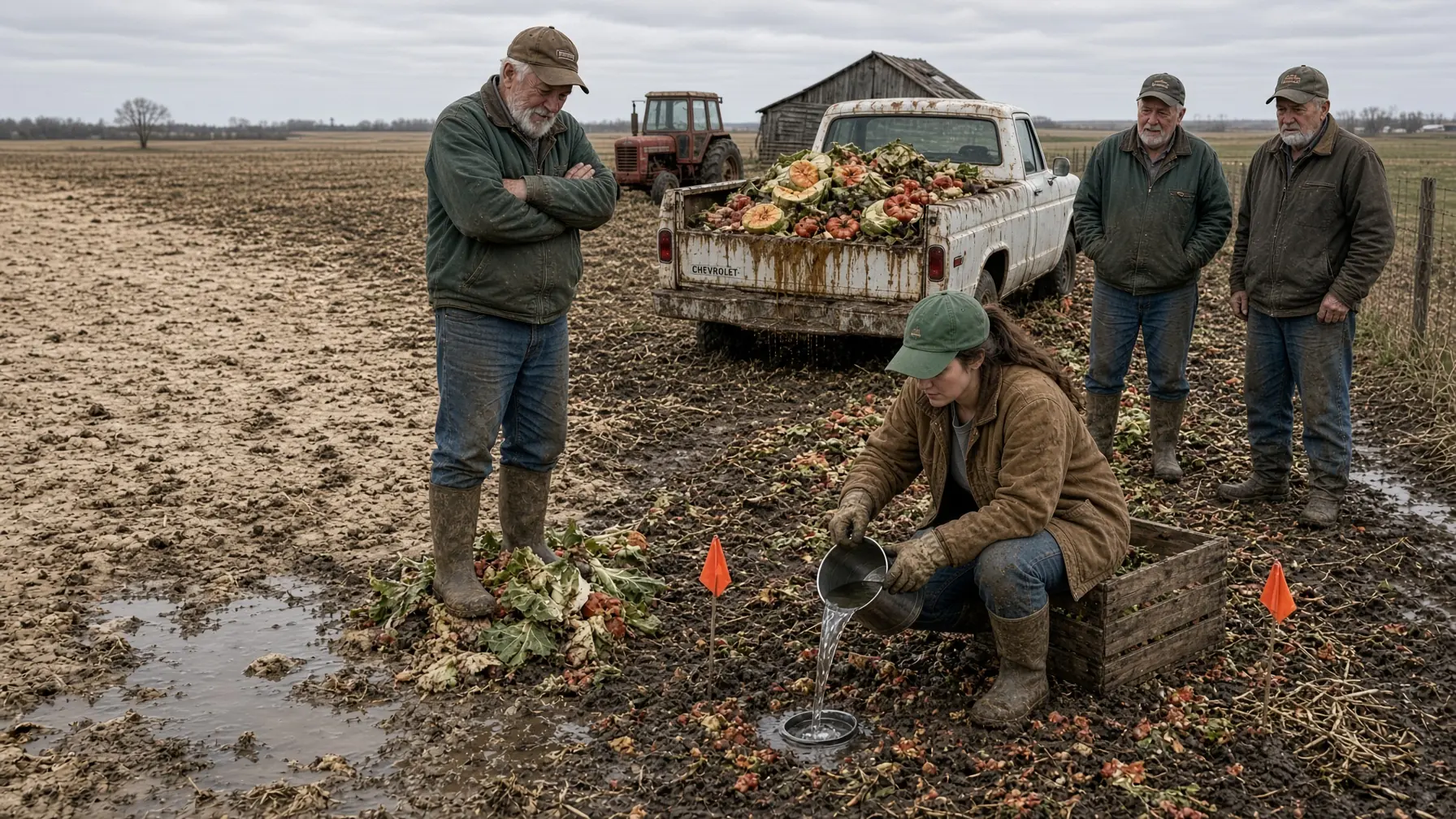
Rust had eaten through the paint above both rear wheels. The passenger-side mirror was held together with black electrical tape. The tailgate had not latched correctly since Clara was sixteen, when her father fixed it with a piece of baling wire and promised to replace the hardware after harvest.
He never did.
Eight years later, the same twisted piece of wire still held the tailgate shut.
Before sunrise three or four mornings a week, Clara drove fourteen miles into town, turned behind the produce market, and returned with the truck bed piled higher than the cab with food nobody wanted.
Bruised tomatoes collapsed inside cracked cardboard boxes.
Split cantaloupes leaked sticky juice.
Lettuce browned along the edges.
Soft apples rolled against cabbage leaves.
Wrinkled peppers, damaged squash, carrot tops, melon rinds, and produce too ugly or too ripe for store shelves filled every remaining space.
By the time Clara reached the farm, the smell followed the Chevrolet like another exhaust pipe.
Sweet.
Fermented.
Sour.
Alive in a way that made people wrinkle their noses when she drove past.
Then she spread it across eighteen acres.
Not behind the barn.
Not inside a hidden compost pile.
Across a field visible from the county road.
By April, the eastern acreage of the Whitlock farm looked as though a garbage truck had overturned and kept driving.
Tomato pulp glistened between pale furrows.
Cabbage leaves blew against old corn stalks.
Cantaloupe rinds shone orange beneath layers of straw.
On warm afternoons, small clouds of flies hovered over the wetter patches.
When the wind blew from the east, the smell crossed the drainage ditch and reached passing trucks.
People slowed down.
Some nearly stopped.
Then they drove on.
Clara rarely looked toward them.
She worked in an oversized gray canvas coat that had belonged to her father, sorting plastic bands, produce stickers, twist ties, and pieces of packaging before anything touched the soil.
The wet material went down in thin layers.
Then came chopped wheat straw.
Weathered hay.
Shredded stalks left from the previous season.
She never dumped one huge mound and walked away.
Every strip was measured.
Every application marked.
When she finished a section, Clara pushed an orange flag into the ground, drove a steel probe beside it, checked resistance and moisture depth, then wrote numbers into a brown notebook with a leather cover softened by years of use.
By early April, the eighteen acres had acquired a name.
Clara never used it.
Everyone else did.
The garbage field.
It was easy to laugh at from forty miles an hour.
What nobody passing on County Road 18 could see was that the garbage field might be the last piece of land standing between Clara Whitlock and the sale of the farm her family had owned for seventy-three years.
Clara was twenty-four when Daniel Whitlock died.
His heart had been weakening for years.
Everyone knew it.
That did not make November easier.
For weeks after the funeral, Clara kept seeing evidence of him everywhere.
His coffee mug stayed on a shelf inside the machine shed because she could not bring herself to move it.
His work gloves remained folded in the cab of the tractor.
His old gray canvas coat still hung behind the kitchen door.
When Clara was little, that coat smelled like diesel, cold air, sun-warmed dust, and the faint salt of her father’s sweat.
By January, the smell was disappearing.
Sometimes Clara caught herself setting two coffee mugs on the kitchen counter before dawn.
She would stand there looking at the second cup, confused for a moment.
Then she would put it away with both hands.
Eventually she started wearing Daniel’s coat.
The sleeves were too long.
One elbow had been patched twice.
But in the darkness before sunrise, pulling it around her shoulders gave Clara something practical to do with grief.
Daniel left her 119 acres.
A leaning barn.
An aging Ford tractor.
A strained irrigation system.
Two miles of fencing that needed repair.
And almost eighty-six thousand dollars in operating debt.
He also left her soil that had stopped behaving like the soil Clara remembered from childhood.
The eastern eighteen acres were the worst.
During heavy summer rain, water hit the surface and stayed there.
It formed shallow brown sheets between rows.
Then, instead of moving downward, it ran toward the county ditch carrying fine topsoil with it.
Three days later, the same ground could become hard enough that Clara’s shovel scraped against the surface.
The topsoil looked pale.
In places it broke into dust.
Roots stayed shallow.
Below them was a dense layer that seemed to resist everything trying to pass through it.
Two dry seasons had already reduced yields.
Medical bills consumed what little cushion remained.
Fertilizer went on credit.
Diesel went on credit.
A tractor repair went onto a credit card Daniel had refused to use for years.
After the funeral, Clara spent winter evenings sitting beneath the yellow kitchen light with envelopes arranged across the table.
She always opened the bank statement last.
The numbers left room for one more season.
Not two.
One.
In February, a developer from Wichita sent an offer for twenty-two acres bordering County Road 18.
The paper was thick.
Bright white.
Perfectly clean.
Clara had opened it after coming inside from repairing a broken fence.
Mud had dried in the creases of her fingers.
A fresh cut crossed one knuckle.
Her dirty thumb rested beside the printed purchase price.
For several minutes, that contrast seemed to contain the whole decision.
Sell the road frontage.
Pay down debt.
Repair the tractor.
Breathe.
Or keep the land and risk losing more of it later.
Clara folded the offer along its original crease.
Placed it beneath the bank papers.
Then started looking for another way.
Her first thought was compost.
Real compost.
Finished material.
Something stable enough to improve soil structure.
Then she priced it.
The numbers ended that idea quickly.
Buying enough for eighteen acres would cost more than she could justify.
Manure was cheaper.
Hauling was not.
Commercial soil amendments might help nutrient levels, but Clara increasingly believed nutrients were only part of the problem.
The soil could receive fertilizer.
What it could not do well anymore was absorb and hold water.
The clue came from Daniel’s notebook.
Clara found it in the bottom drawer of an old desk beneath seed receipts, cattle vaccination records, machinery manuals, and invoices dating back fifteen years.
Most of the notebook contained ordinary farm arithmetic.
Rainfall totals.
Planting dates.
Fuel use.
Repair notes.
Fertilizer rates.
Daniel wrote in square, practical letters.