In the spring of 1988, Norah Hess stood in the front yard of her small Appalachian mountain farm with a glossy letter in her hand and a quiet anger settling behind her ribs. The letter had arrived that morning in the rusted mailbox her grandfather Jedediah had planted beside the gravel lane half a century earlier. It was printed on thick paper, too smooth and too bright for a place where most things were made of wood, stone, mud, and work. It spoke of progress, opportunity, local partnership, and the coming construction of a luxury resort called the Summit at Whisper Wind Peak.
Norah read the letter twice, standing between the whitewashed farmhouse and the unpainted barn where her goats had begun calling for morning feed. Beyond the western tree line, five hundred acres of old timberland had recently been sold to developers, and now the polite words in her hand told her exactly what was coming. The resort would bring blasting, road crews, surveyors, heavy machines, visitors, money, and noise. It would bring the world to the edge of her pasture and expect her to step aside.
The townspeople called it good news. At the general store, men leaned against counters and talked about jobs, tourism, and how important their little mountain community was about to become. Women who had known Norah since she wore braids and muddy boots told her maybe this was a blessing in disguise. Old man Hemphill cornered her near the feed sacks and said the developers would surely pay her a handsome price if she had sense enough to take it. He meant well, and that almost made it worse.
Norah was twenty-four years old and had been alone on the farm for three years since her grandfather died. People looked at her and saw youth, grief, stubbornness, and one hundred acres of land she could not possibly protect from a project that big. They saw a young woman clinging to goats, bees, and memory while a golden tide of money rolled toward her. They thought she needed saving from her own attachment.
They did not understand that the farm was not only land to her. It was language. It spoke in goat bells along the ridge, in the low steady hum of honeybees working the clover, in creek water over stone, and in wind coming down through the gaps carrying pine, damp earth, and wildflower scent. Her grandfather had taught her to hear that language before she was old enough to write her name properly.
Jedediah Hess had been quiet, patient, and stubborn in the old mountain way. He had farmed through lean years, wet years, market collapses, bad winters, and times when neighbors took loans they never escaped. He believed debt was a chain a person forged with their own hands, and he taught Norah to live small enough that no bank could put its boot on her throat. He taught her to read a sick goat by the look in its eye, a coming storm by the pressure in the air, and soil health by the way earth crumbled in her palm.
The farm produced two things people in the region respected in a modest way: artisan goat cheese and mountain wildflower honey. Her Nubian goats grazed clean pasture along the ridge, and the milk they gave was rich, sweet, and shaped by the herbs and clover that grew under the mountain sun. Her bees worked wildflowers that changed by the season, making honey that tasted different in spring, summer, and fall. Norah did not produce much, but what she produced tasted unmistakably of the place it came from.
A month after the letter arrived, Arthur Caldwell came down her gravel lane in a long dark car that looked strange and shiny against the farm dust. He did not come to the porch. He stepped out beside the lane, careful to keep his polished shoes away from the soft places in the yard, and looked over her house, barn, goats, beehives, and pasture as if he were inspecting stains on a wall he intended to repaint. Norah met him near the fence with work gloves in one hand and mud on her boots.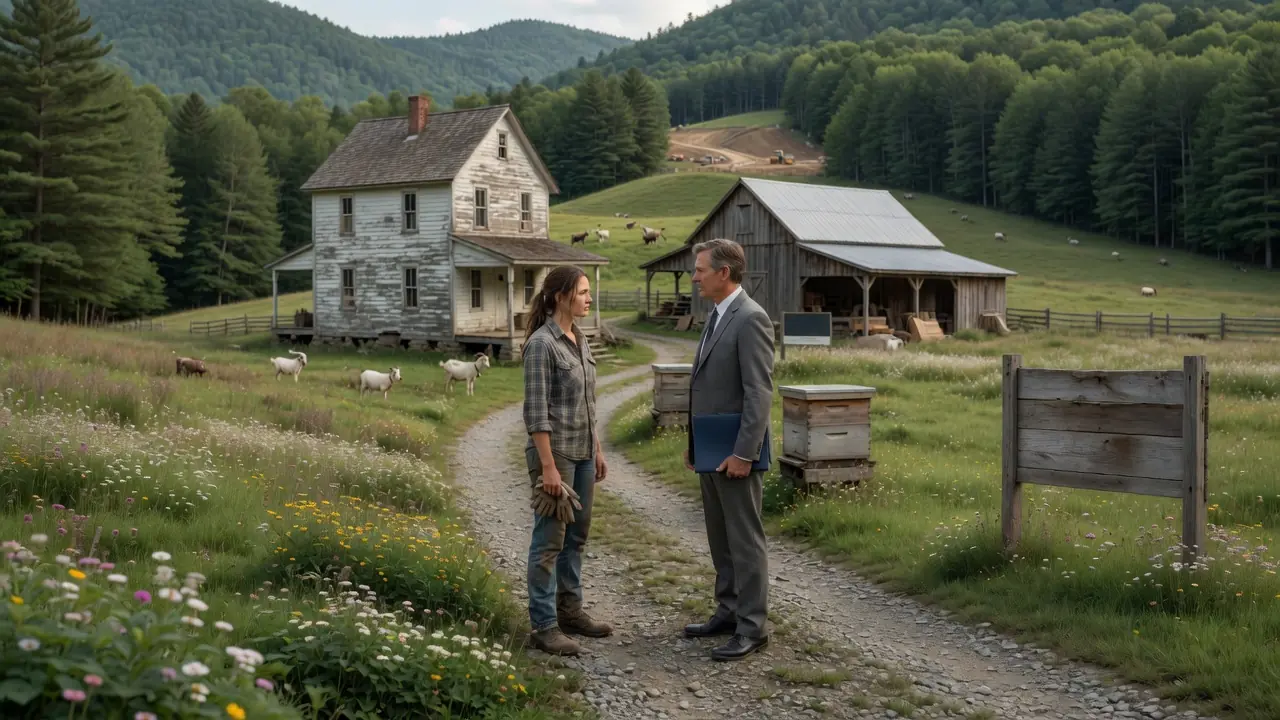
“Miss Hess,” he said smoothly, “I am the project manager for the Summit at Whisper Wind Peak.”
Norah nodded once.
He smiled the kind of smile men use when they have already decided the conversation’s ending. “I am sure you understand the incompatibility of our ventures. Our guests will be paying for a pristine mountain experience. A small agricultural operation, however quaint, does not fit that vision.”
Norah looked past him toward the western tree line where the resort would rise. The bees moved behind her in the clover. The goats grazed steadily, their brass bells tapping softly against the afternoon. Everything alive on the farm continued working, which gave her more comfort than Caldwell’s polished voice could take away.
“My farm was here before your vision,” she said.
His smile tightened. “We are prepared to make a generous offer.”
He opened the glossy folder and named a number. It was more money than Norah had ever seen written in one place. Enough to buy a house in the valley, enough to stop worrying about feed costs and roof repairs, enough to live for years without milking goats before dawn or hauling honey supers until her shoulders ached. For a moment, she understood why everyone in town thought selling was the sensible thing.
“The farm is not for sale, Mr. Caldwell.”
He studied her as if she had answered in a foreign language. “Perhaps you do not understand the scale of what is happening. There will be blasting, dust, heavy machinery, road expansion, floodlights, construction noise, and guests who expect peace. That is not an ideal environment for livestock.”
“The farm is not for sale.”
His eyes cooled. “Take the money before the noise makes this place impossible to run.”
Norah gripped her gloves. “Try to bury this farm under your progress, Mr. Caldwell, and you’ll learn these mountains don’t move for men in clean shoes.”
For the first time, Caldwell looked angry. It passed quickly, hidden beneath manners and professional polish, but Norah saw it. He was not used to being refused by someone who had more mud than money. He closed the folder, gave a stiff nod, and returned to his car without looking back.
The following year became a slow punishment. Blasting began beyond the ridge, and each explosion shook the jars on Norah’s kitchen shelves. Heavy machinery groaned from dawn until dusk, grinding through timber and stone, opening roads, pouring foundations, and reshaping the mountain as if it were clay in a rich man’s hand. Red dust drifted across the fence line and settled on leaves, porch rails, buckets, and the backs of goats.
The goats suffered first. They were sensitive animals, and the noise made them restless, skittish, and hard to settle. Milk production fell by nearly a third, and every lost gallon felt like a nail driven into Norah’s future. She changed feeding routines, moved them deeper into the eastern pasture, and spoke to them gently while their ears twitched toward the machines beyond the ridge.
The bees suffered differently. The construction site stayed lit at night by massive floodlights that cast an artificial glare over the ridge and into the valley. Bees navigated by light and rhythm, and the false brightness confused their cycles. Strong hives weakened, honey production dropped, and Norah sometimes stood beside the boxes at night with a lantern in her hand, feeling as if the resort had reached invisible fingers into the most delicate part of her farm.
People in town told her again to sell. They said no one could expect one young woman with goats and bees to stand against a five-star resort backed by investors, lawyers, and construction money. They said Caldwell had been right. They said she should take what she could before the farm became worthless.
Norah did not answer them.
Instead, she went into her grandfather’s study.
The room still smelled of old paper, leather, pipe smoke, and the cedar chest where Jedediah had kept seed packets, maps, records, and things he believed might matter someday. Norah searched the shelves until she found the thick leatherbound journal he had kept for decades. It was not a diary in the sentimental sense. It was a record of work: rainfall, breeding notes, soil observations, tree plantings, equipment repairs, frost dates, creek levels, and ideas he had considered but never needed to use.
In a section from the 1950s, she found a plan.
Jedediah had once considered planting a living barrier when the state talked about widening a highway miles away. He had sketched a multi-layered tree line designed to soften sound, block light, hold soil, shelter wildlife, and guide wind around the farm instead of letting it tear through. Fast-growing Lombardy poplars would create the first tall screen. Behind them, Norway spruce and white pine would build a dense year-round wall. Inside the barrier, native hardwoods like oak, maple, and hickory would grow slowly for permanence.
Norah sat at the desk until the daylight faded, reading every note.
“The world will always press in on you, Nora girl,” her grandfather had told her once while they repaired a stone wall. “You cannot build a wall high enough to stop it. But you can plant one. A living wall does not fight the world. It persuades it to go around.”
That fall, Norah spent nearly every dollar she had saved on trees.
The nursery man who delivered them looked at the hundreds of saplings in the truck bed and shook his head with pity. They were thin, no thicker than her thumb, bundled by root and variety. “That is a mighty ambitious planting for one person,” he said. Norah looked at the ridge, then at the saplings. “I have time,” she replied.
For two years, she worked like someone building a church no one else believed in. She dug holes by hand until her palms blistered and hardened. She hauled water in five-gallon buckets from the creek, carrying them up the line one by one, giving each sapling enough to survive. She planted in staggered rows according to her grandfather’s sketch, measuring distance with twine and stakes, working while the resort roared beyond the ridge.
The townspeople watched and whispered. They saw the thin line of sticks she planted and laughed quietly at the idea that saplings could stop engines, lights, guests, and money. Some called it sad. Some called it stubborn. Some said poor Norah Hess had finally lost sense under the pressure.
Caldwell drove by once in a clean car and slowed near the lane.
Norah was kneeling in the mud, packing soil around a white pine sapling. He looked at the long row of fragile trees, then at her bent shoulders, and his face showed something almost like amusement. He did not stop. He did not have to.
Late in the second year, doubt nearly took her.
A cold rain had been falling for days, turning the planting line into mud and the pasture into slick brown tracks. Norah was soaked through, her arms trembling from exhaustion, her knees aching, her fingers numb around the shovel handle. Across the ridge, the resort’s half-built lodge glowed under construction lights like a monument to everything too powerful to resist. For one terrible moment, she wondered if everyone was right.
Maybe she was wasting her youth.
Maybe the farm was already lost.
Maybe her grandfather’s wisdom belonged to a slower world that no longer existed.
She sat down on a wet rock and let the shovel fall beside her. Rain ran down her face, mixing with tears she had not meant to shed. She thought of Caldwell’s offer and the life it could have bought: dry rooms, clean hands, easy heat, no goats startled by blasts, no bees confused by light, no people watching for her failure. She thought of how tired she was.
Then she remembered Jedediah’s hands.
The deep cracks in his knuckles. The dirt permanently etched into his skin. The way he had stood through drought, sickness, blight, and lean markets without once speaking of quitting. He had never promised her the land would be easy. He had only taught her that land rewards the ones who keep listening after everyone else starts shouting.
Norah picked up the shovel.
The doubt passed.
She had work to do.
The Summit at Whisper Wind Peak opened years later as a monument of glass, stone, wealth, and expensive taste. It had a spa, a championship golf course, private chalets, imported food, helicopter tours, curated hiking trails, and lobby fireplaces large enough to roast half a steer. Guests arrived in luxury cars and private shuttles, wearing hiking clothes that cost more than Norah’s monthly feed bill. Caldwell’s vision had become real.
But so had Norah’s wall.
The poplars rose first, quick and tall, creating a visual screen within three years. Behind them, the spruces and pines thickened, branch by branch, until they formed a dark green barrier that held its color even in winter. The hardwoods grew slower, patient and deep-rooted, preparing to outlast everything hurried. The resort’s noise did not vanish, but it changed into a dull murmur. Its lights softened into a distant glow filtered through needles and leaves.
Behind the living wall, the farm began to heal.
The goats calmed. Milk production rose, and the cheese regained its clean, rich taste. The bees recovered their rhythm, working clover, wild thyme, goldenrod, blackberry blossom, and mountain laurel in their proper seasons. The honey deepened in color and flavor, becoming more complex than it had been before the resort came.
Norah sold what she made from a small honor-system stand at the end of her lane. There were no polished signs, no marketing, no luxury packaging. Just jars of honey, wrapped cheese, a tin cash box, and a handwritten note explaining what was available that week. Her income was modest, but she had no debt, few expenses, and a farm that answered her patience with life.
Then Eleanor Vance found the stand.
She was a celebrated food writer staying at the resort, tired of meals that were beautiful but hollow. She wandered down the lane one morning, past the tree wall, and discovered the sudden quiet of Norah’s farm. She bought a small wheel of goat cheese and a jar of wildflower honey, left more money than required in the cash box, and disappeared. Norah thought little of it.
Two months later, the article appeared.
It was a love letter to everything the resort had failed to understand. Eleanor wrote about cheese that tasted of wild thyme, clean mountain air, and honest pasture. She described honey so layered it felt like tasting an entire season in one spoonful. She contrasted Norah’s farm stand with the resort’s polished perfection and called it “an accidental outpost of authenticity in a world of curated experiences.”
The first visitors came quietly.
A couple from the resort walked down the lane and bought honey. Then a family came and asked for the goat cheese from the article. Then more guests arrived, sometimes in hiking shoes, sometimes in linen resort clothes, sometimes carrying cameras they forgot to use because the quiet surprised them. They asked questions. They bought everything. They told the resort concierge they wanted Hess Farm cheese at dinner.
The resort did not serve it.
The resort served imported goat cheese and commercial clover honey.
The guests were not impressed.
The concierge calls increased. The restaurant received complaints. The gift shop manager asked the culinary director why they did not stock the products from the famous little farm next door. The answer, of course, was that nobody had asked Norah. Not properly. Not since Caldwell had stood beside her lane and told her she did not fit his vision.
Ten years after that first visit, Arthur Caldwell returned.
His car was newer, darker, and more expensive. His hair had more gray in it, and his confidence had thinned around the edges. This time, he did not stand by the gravel lane. He walked all the way to the porch, where Norah sat shelling beans into a metal bowl. The beans clicked softly in the quiet.
“Miss Hess,” he said.
“Mr. Caldwell.”
He cleared his throat. “We have a supply chain issue.”
Norah dropped another bean into the bowl. “Do you?”
“Our guests have developed a very specific interest in local products. Your products, to be precise.”
She did not smile.
“We would like to discuss the possibility of you supplying the resort’s restaurants and gift shop.”
Norah finally paused. She looked past him toward the living wall of trees, now deep green and strong, then back at the man who had once called her farm incompatible. “I am not sure my small operation fits your vision, Mr. Caldwell.”
He flushed.
“Our vision has evolved,” he said.
“I see.”
Norah stood, wiped her hands on her apron, and looked him in the eye. “My lawyer will contact your office.”
The meeting happened one week later at Norah’s kitchen table. Caldwell brought two lawyers who looked deeply uncomfortable drinking coffee from thick ceramic mugs in a farmhouse kitchen. Norah’s lawyer, a quiet man from the county seat, sat beside her with a yellow legal pad and a stack of notes. Through the window, goats moved calmly in the pasture, and the living wall stood beyond them like an army that had learned to grow roots.
It was not really a negotiation.
Norah named the price for her cheese and honey. It was not wholesale. It was retail plus delivery. She set the weekly quantity at what the farm could produce without stressing the animals, the bees, or the land. If the resort wanted more, the answer would still be no.
Caldwell’s lawyers shifted in their chairs.
Norah did not move.
Then came the exclusivity clause. The Summit at Whisper Wind Peak could serve her products, but it could not serve or stock any other goat cheese or artisan honey from competing producers. If its guests wanted the real thing, they would get the real thing from Hess Farm. If they wanted abundance, they would have to learn the discipline of limits.
Finally, her lawyer slid a map across the table.
A red line circled the farm in a two-mile buffer. Helicopter tours would no longer cross it. The noise disturbed livestock, bees, and business operations. Caldwell’s lawyers began speaking about airspace, regulations, and feasibility, but Norah simply waited until they finished.
“Those are my terms,” she said. “All of them.”
Caldwell looked through the window at the farm he had tried to erase. The goats were calm, the bees were thriving, the trees had swallowed the resort’s noise, and wealthy guests were asking for the very products he once dismissed as incompatible. He had tried to make Norah disappear. Instead, she had become essential.
He picked up the pen.
“We’ll sign,” he said.
Norah never became a tycoon, because becoming big had never been her dream. The resort contract gave her steady income, and she used it to reinforce the farm instead of expanding beyond its soul. She bought two hundred acres of adjoining woodland and placed it into a conservation trust so no one could build on her borders again. She improved the barn, repaired the farmhouse, strengthened the apiary, and kept the goat herd at a size the land could support.
Years passed.
The Summit changed owners twice. Caldwell retired. New managers arrived and learned on their first day that Hess Farm products were not optional, not negotiable, and not replaceable. The resort eventually began advertising its exclusive partnership with the iconic local farm, turning Norah’s stubborn survival into part of its own luxury story.
Norah found the irony satisfying, but she did not let it rule her.
She remained what she had always been: a farmer. She rose early, worked carefully, listened to the land, and trusted patience more than noise. Young farmers began visiting her, asking how to resist pressure to sell, expand, consolidate, or become something larger but less true.
Norah would walk them along the living wall, now a mature forest thick with birds, shade, needles, roots, and quiet. She would place one hand on the bark of a white pine and repeat what her grandfather had taught her. “The world will always press in on you. It will offer money. It will make noise. It will threaten to make you small.”
Then she would look toward the resort hidden beyond the trees.
“Most people think the only choices are to fight or run,” she would say. “But there is a third way. You can plant. You can build something quiet and alive. What is patient will outlast what is merely powerful.”
In the end, Arthur Caldwell had been wrong about almost everything.
The farm had not been incompatible with the resort’s vision.
The resort’s vision had been too small for the farm.
Norah Hess kept her land, her goats, her bees, her grandfather’s wisdom, and the quiet everyone else had mistaken for weakness. The world pressed in on her, and she did not move. She planted a living wall, waited, worked, and let time speak for her.
And when the rich guests finally crossed the ridge asking for her cheese and honey, Norah understood what Jedediah had known all along.
The land does not answer the loudest person.
It answers the one who stays.