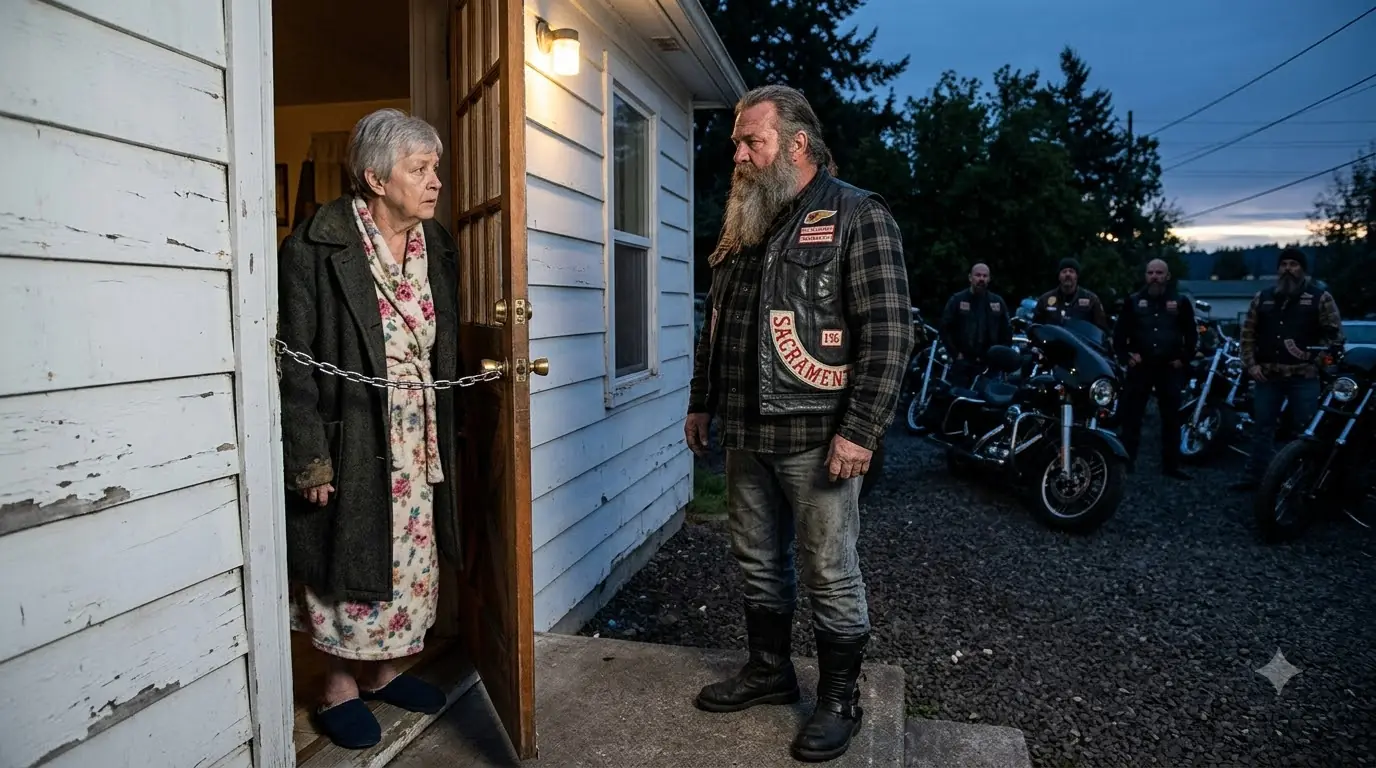
The fist came down on the door three times slow, then three times harder. The whole frame shook on its hinges. The sound moved through the walls of the small white house the way thunder moves through old wood. Not loud exactly, but total. The kind of sound that does not leave room for anything else while it is happening.
Vera Callaway stood at the top of the stairs in the dark. She had been awake for 40 minutes before the knocking came. She did not know why she had woken. There was no sound that preceded it, no dream that ended badly, no particular anxiety that had pulled her up out of sleep. She had simply opened her eyes at 5:00 in the morning and lain there in the dark of her bedroom for a while and then gotten up and put on her robe and her slippers and gone to stand at the window and look at the road the way she had done on many mornings since Henry died.
The road was empty. The town of Mil Haven, Oregon, was a place that did not begin its day. Early 2,000 people scattered along a river valley between hills that stayed green most of the year. And froze solid every February. One stoplight, one diner, a hardware store that had been run by the same family since 1958 and smelled like machine oil and sawdust and something older than both.
Vera had lived here for 31 years and had taught in its school for 26 of them and knew the rhythms of it the way you know the rhythms of a place you have decided is the last place you will ever live. The fog was in the valley this morning. That was the first thing she noticed. Not the two shapes she would see later, not the movement behind the hedge, but the fog. The way it sat in the lower parts of the road and made the street light look like something underwater.
The way it softened the edges of everything until the town outside her window looked like a place she was remembering rather than a place she was looking at. Henry used to say the fog made him feel like the world was giving him one more morning before it decided to be difficult. She had never told anyone that. It seemed like the kind of thing that was only meant for the person it had been said to. She stood at the window for a while.
Then she went downstairs and put the kettle on and looked in the refrigerator and decided on soup. She had a habit of making soup when she could not sleep, which Henry had thought was both practical and strange, and she had been doing it for 9 years now without him, and had not yet decided whether to stop. The soup was a beef and potato. She had the potatoes from a bag she had bought three days ago, and the beef from a cut she had portioned herself and kept in the freezer the way her mother had taught her. She put everything in the pot and set the heat low and moved around the kitchen in the way of a person who has cooked in the same kitchen for 30 years and has stopped needing to think about where anything is.
It was around 8:00 in the evening when she saw the movement behind the hedge. She was standing at the kitchen window watching the soup. The light above the stove cast a yellow cone over the counter and the window was dark beyond it. But the street light at the corner of her lot was enough to show her the top of the hedge and the faint movement there. Low, close together.
Two shapes tucked in against the base of the privet where it grew thickest near the old gate post. The bigger one had its arm around the smaller one. The smaller one was shaking so hard Vera could see it through the glass. She stood very still. Her first thought was the word dear, which was the word that came to her when something needed tending.
Her second thought was raccoons, which was wrong. And she knew it was wrong before the thought had finished forming. Her third thought was, "Children, which was correct," and she turned off the stove and took Henry's old wool coat from the hook by the back door and put it on over her robe and went outside into the sleet. The sleet had been falling since midafternoon, not heavy, but steady, the kind that coats everything in a thin skin of ice by morning. She felt it on her face when she came out.
She walked slowly along the path to the gate and pushed it open and stood at the corner of the hedge and did not try to approach. "Honey," she said. Just that one word softly, the bigger child whipped around like something cornered. She moved in front of the smaller one in the same motion of protective repositioning so practiced. It had the quality of instinct, the body doing what it had been trained to do before the mind could weigh in.
They were both prepared to run. She could see it in the way they held themselves. Vera did not move. She did not step forward. She did not reach out.
She had spent 37 years in classrooms. And she knew the difference between a child who was afraid of a person and a child who was afraid of the world. You could not close the distance with the second kind. You could only keep still and let them decide. I have soup on, she said.
Beef with potatoes. There's plenty. The bigger girl went very still. She was perhaps 9 years old. Dark hair soaked flat against her head, jaw set with the particular hardness of a child who has learned to control her face.
But her eyes moved between Vera and the road behind her and back again, calculating, assessing, doing something behind that controlled expression that was older than any 9-year-old had the right to be doing. The smaller one made a sound. It was somewhere between a cough and a sob. And it came out of her without permission. The kind of sound that happens when a body has been holding too much for too long and let some of it slip.
She was perhaps five or six, a sweatshirt with no coat, bare arms. She was shaking the way a person shakes when the cold has gotten into the bones rather than just the surface. The deep involuntary shaking of a body trying to generate heat. It cannot generate. You don't have to come in, Vera said.
But you can't stand out here. The bigger girl looked at her for a long time. Long enough that Vera understood the assessment was real. The girl was not a child deciding whether to trust a kindly stranger. She was something closer to a small soldier, deciding whether a tactical retreat was safe.
Then she nodded once. Just once. Vera took them inside she did not ask questions in the kitchen. She had learned a long time ago that questions at the wrong moment were their own kind of unkindness. She sat the smaller one at the table and wrapped her in the quilt from the back of the sitting room sofa and ladled soup into two bowls.
She poured hot chocolate from a packet which she kept in the cabinet for the grandchildren of neighbors who sometimes came to visit. The smaller one ate with both hands shaking. She held the spoon in her right hand and kept her left hand touching the bowl as though the warmth of it was something she wanted to be in contact with rather than just adjacent to. The bigger girl ate more carefully. She watched the door while she ate.
After a while, Vera asked the smaller one what her name was. "Rosie," the girl said. "Girl. " Then she looked at the bigger girl with a flash of something in her eyes. The quick worried look of someone who has given information they were not supposed to give. The bigger girl did not react.
Her face stayed still. She was somewhere else for a moment. Then she came back. "My name is Dela," she said. It was not the name that mattered.
It was the way she said it with deliberateness, as if she had made a decision about whether to say it and had decided that this particular woman in this particular kitchen had earned it. Vera nodded. She poured more hot chocolate. She refilled the bowls without asking. They ate.
The sleep tapped at the window. The pot on the stove made its low sounds. Vera sat with her own soup and did not press and did not perform and did not do anything except be a person sitting in a kitchen with two children at the end of a bad night. May had fallen asleep with her cheek on her arm before the bowl was empty. Vera had started calling the smaller one May in her head somewhere around the second cup of hot chocolate which was probably foolish but which felt accurate in some way she could not have explained.
Dela watched the sleeping girl for a moment. Something in her face changed. The soldierness of it went somewhere and what was underneath was still 9 years old after all. Then she looked at Vera. Are there any bikes outside?
She said motorcycles. Vera set her cup down. She did it carefully. No, honey. There's nothing outside but my truck in the rain.
The girl's face did something complicated. There was disappointment in it. There was relief. And underneath both of those things, there was something that was not quiet either. Mom said if I couldn't find her, I should find the bikes, Dela said.
She said, "Find the bikes and they'll know what to do. " She said, "Find Uncle Wade. " Vera looked at the girl. She had taught for 37 years. She had heard children say things that mattered, things that were the tips of large and serious situations. And she had learned not to treat those moments with either panic or excessive gravity. Because both of those responses were about the adult and not the child.
"Where is your mom? " she said. Dela looked at the table. She looked at May. She looked at the door. She didn't come back.