Sawyer Hale stood on the wooden platform of Dry Stone station with his hat held between both hands. The Nevada wind moved dust across the tracks, and the afternoon train hissed beside him like a great tired animal. He had arrived forty minutes early, though he told himself it was only because the road from the ranch could be unpredictable. The truth was simpler and harder to admit: he was nervous.
For eight months, he had written letters to Eliza Rowan, a woman from Boston whom he had never seen. Forty-three letters had passed between them, each one more honest than the last. They had begun with practical things, such as the size of his ranch, the condition of the house, the number of cattle, and the distance to town. But somewhere along the way, the letters had stopped being an arrangement and had become something dangerously close to hope.
Eliza had asked questions no other woman had ever asked him. She had asked what he did when the work was finished, whether he read by lamplight, whether the desert made him feel peaceful or alone. Sawyer had answered honestly because he did not know how to answer any other way. He had told her about sitting on the porch at sundown, watching the sky grow wide and quiet until the stars appeared like lanterns hung by God himself.
In return, Eliza had written about loneliness without using the word. She wrote about a house where silence was never peaceful, only warning. She wrote about wanting to study mathematics and being laughed at for it. She wrote as if she had spent her life folding pieces of herself away and was only now daring to unfold them one page at a time.
That was why Sawyer had prepared the east room before she arrived. He had swept the floor, bought a new quilt, cleaned the window, and placed a small jar of dried desert flowers on the sill. Then he had removed the flowers because they seemed foolish. Then he put them back because the room looked lonely without them.
Now the train doors opened, and passengers began stepping down. A family came first, then two miners, then an elderly couple moving slowly with each other’s help. Sawyer searched every face, trying to match a living woman to the voice he knew from paper. Then he saw her.
Eliza Rowan stepped down from the train wearing a blue Western dress that looked carefully mended but beautiful in its simplicity. She was young, much younger-looking than Sawyer had imagined, with dark hair pinned loosely and a carpet bag gripped tightly in both hands. Her face was delicate and tired, but her eyes were sharp, steady, and far too guarded for someone beginning a happy future. Sawyer took one step backward before he could stop himself.
Across the platform, Eliza saw him notice. She saw the surprise in his face, saw the quick uncertainty he tried to hide, and lifted her chin as if she had expected disappointment. Sawyer hated himself for that step backward the moment it happened. He had imagined a woman formed from courage and intelligence, yet the first thing his body had done was react to how young she looked.
She walked toward him without waiting to be called. Her blue dress moved with the dust around her boots, and the carpet bag looked heavy enough to pull her shoulder down. Sawyer put his hat back on because his hands needed something to do. When she stopped in front of him, they stood facing each other in the middle of the platform while the train steamed behind her.
“Miss Rowan,” he said.
“Mr. Hale,” she replied.
Her voice was calm, but he could see her fingers tightening around the bag handle. She looked at him directly, not shyly, not sweetly, but like someone who had learned to measure danger before accepting kindness. Sawyer understood then that whatever she had escaped back east had taught her to read men quickly. He also understood that she was reading him now.
“How was the journey?” he asked.
“Long,” Eliza said. “There was a delay in Salt Lake City. Seven hours.”
Sawyer nodded because the answer seemed to require some acknowledgment. Then silence opened between them. Eliza looked him over in the same careful way he had looked at her. Her expression shifted slightly, not with disappointment, but with the guarded surprise of a person discovering that reality never matched letters.
“You look different than I imagined,” she said.
“So do you,” Sawyer replied before he could stop himself.
The moment the words left his mouth, he regretted them. Eliza’s face did not crumble, but something in her eyes hardened as if a door had quietly closed. She gave a small nod. It was not agreement so much as confirmation.
“Younger,” she said. “That is what you mean.”
Sawyer did not deny it. “Yes,” he said, because lying would insult both of them. Her mouth pressed into a thin line, and for a second she looked less like a bride and more like a traveler ready to buy another ticket. Sawyer held her gaze and forced himself not to explain too quickly.
“I am twenty-two, Mr. Hale,” she said. “I know I do not always look it, and I am not interested in debating it.”
“All right,” Sawyer said.
She blinked. “All right?”
“All right,” he repeated. “You are twenty-two. I believe you.”
Eliza stared at him as if that simple acceptance had been the one answer she had not prepared for. Her hands still gripped the bag, but the tension around her mouth changed. It did not soften exactly. It merely stopped bracing for impact.
“Most men would send me back already,” she said.
Sawyer looked past her toward the train, then back to her face. “I wrote to you, not an age on paper,” he said. “And I am not putting you back on any train unless you ask me to.” Her eyes flickered, and this time he saw something vulnerable before she hid it. The sound of the station moved around them, but neither of them stepped away.
He cleared his throat and gestured toward the street. “The ride to the ranch takes about two hours,” he said. “There is a diner here that serves decent pie, and you look like you have not eaten properly in days.” Eliza’s expression sharpened. “Is that pity?” she asked. Sawyer shook his head. “No, ma’am. That is observation.”
For the first time, the corner of her mouth almost moved. “Observation,” she repeated. “You use that word like a shield.” Sawyer looked down at his hat, then back up. “Sometimes it is useful to call things what they are.” Eliza seemed to consider that, and then she nodded once.
The diner was called Mabel’s, and it sat across from the station with a painted sign, two dusty windows, and the smell of coffee drifting through the open door. Sawyer held the door for Eliza but did not reach for her arm. She noticed that small restraint immediately, just as she noticed the four people inside who began pretending not to stare. Sawyer noticed her noticing.
Mabel herself stood behind the counter, broad-shouldered, silver-haired, and impossible to fool. Her eyes landed on Eliza’s blue dress, then on the carpet bag, then on Sawyer’s face. “This her?” Mabel asked loudly. Sawyer sighed. “Mabel.” The older woman shrugged. “I am only asking what everyone else wants to know.”
“This is Miss Eliza Rowan,” Sawyer said. “Eliza, this is Mabel Briggs. She owns the diner and half the opinions in town.” Mabel leaned on the counter. “The other half are borrowed from me.” Eliza looked at her for a moment, then said, “That sounds efficient.”
Mabel laughed once, sharp and approving. “Sit down, girl. You look like a train dragged you across four states.” Eliza’s shoulders stiffened at the word girl, but Mabel was already reaching for cups. Sawyer glanced at Eliza, ready to intervene. Eliza sat down instead, choosing the window table with her back to the wall.
Sawyer sat across from her. Mabel brought coffee and two slices of peach pie neither of them had ordered. Eliza wrapped both hands around the coffee cup and inhaled slowly. Her fingers trembled once, and she pressed them harder against the ceramic until they steadied.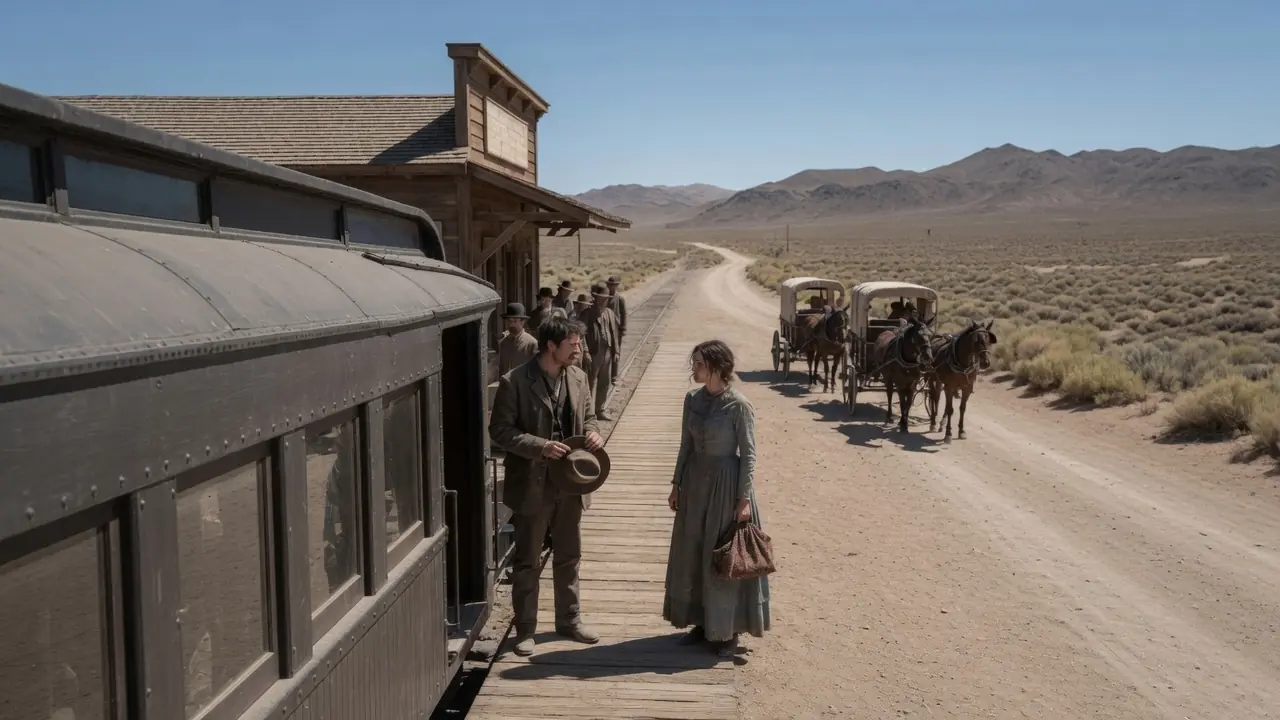
“How many people know why I am here?” she asked.
Sawyer did not pretend to misunderstand. “Most of town,” he said.
Eliza nodded as if adding the fact to a ledger. “And what do they think?” Sawyer looked toward the counter, where Mabel was pretending to polish a glass. “Probably that you are too young, I am too stubborn, and the whole thing will go sideways before winter.” Eliza looked down at the pie. “That is the generous version.”
Sawyer almost smiled. “The less generous version is that you are after the ranch and I have gone soft in the head.” Eliza studied him over the rim of her cup. “And what do you think?” she asked. Sawyer leaned back slowly. “I think I wrote forty-three letters to a woman who answered with forty-three honest letters, and that woman is sitting across from me.”
Eliza looked away first. Not because she was weak, but because something in the answer had reached too close. She took one careful bite of pie and seemed surprised by it. “This is good,” she said. Mabel called from behind the counter, “Of course it is.”
After a few minutes, Eliza set down her fork. “I need to tell you something before we go any farther.” Sawyer placed both hands on the table. “All right.” She looked at the coffee instead of him. “I did not leave Boston for adventure.”
Sawyer stayed silent. Eliza seemed to appreciate that, because she continued. “My father arranged for me to marry a man named Gerald Pratt. He is fifty-one, owns a mill, and has already buried two wives.” Her voice remained level, but her fingers tightened around the cup again. “I refused him three times, and my father moved the wedding date forward twice without telling me.”
Sawyer’s jaw tightened, but he forced himself not to interrupt. Eliza looked up then, testing whether anger in a man meant danger. He kept his hands still on the table. She saw the effort and continued.
“I found the agency myself,” she said. “I saved money from tutoring children, five cents at a lesson. I paid for my own ticket, packed what I could carry, and left before anyone could stop me.” Her voice wavered only on the last word. “So if you decide this is too much trouble, I understand, but I needed you to know the truth before you took me anywhere.”
Sawyer looked at her for a long moment. He thought about the forty-three letters, the guarded woman before him, and the courage it took to cross half the country with no promise except a man’s handwriting. Then he picked up his fork. “I am not sending you back to a man you ran from.”
Eliza stared at him. “Mr. Hale.”
“Sawyer,” he said gently. “And eat your pie. Mabel takes it personally when people leave it behind.” From the counter, Mabel said, “Smartest thing you have said all year.” Eliza almost smiled again, and this time the almost reached her eyes.
They left Dry Stone after noon, with the wagon rolling west under clean daylight and the station shrinking behind them. Eliza sat beside Sawyer with her carpet bag tucked at her feet. The land opened wide around them, dry and pale and enormous in a way no letter could have explained. She looked at the horizon like she was trying to calculate its size.
“It is bigger than I thought,” she said after twenty minutes.
“Most things out here are,” Sawyer replied.
“You wrote about the acreage and the elevation,” she said. “You wrote about the road and the distance to town.” She looked toward the distant hills. “But I could not picture the space.” Sawyer kept his eyes on the horses. “Nobody can until they see it.”
Eliza was quiet for another mile. Then she asked, “Do you find it lonely?” Sawyer thought about giving her a clean answer, something a man might say to sound stronger than he felt. Instead, he chose the answer that belonged to him. “Yes. Some days very much.”
She turned toward him. “That is honest.”
“You asked an honest question,” he said.
The wagon wheels creaked over the dry road. Eliza looked ahead again, but her posture changed slightly, less like someone preparing to flee and more like someone willing to listen. Sawyer felt that small shift and did not comment on it. He was learning already that Eliza did not like being watched too loudly.
“The ranch is not fancy,” he said after a while. “It is a working place, and it needs paint on the south side. The stove has a slow burner, the stairs need a railing, and the garden is mostly dead this time of year.” He paused, realizing he was talking too much. “I do not expect you to become anything you do not want to become there.”
Eliza watched his profile. “What do you expect?”
“Honesty,” Sawyer said. “That is all I know how to ask for.”
She absorbed the answer carefully. “The room will be mine?” she asked. “Yes,” he said. “With a lock.” Her eyes moved to his hands on the reins. “You thought of that?” Sawyer nodded. “I thought you might need a door that only opened when you chose.”
Eliza looked away quickly. The wind pulled loose strands of dark hair against her cheek. Sawyer did not know what memory had crossed her face, but he knew better than to chase it. Some wounds had to be approached like skittish horses, slowly and without demanding trust.
The ranch appeared nearly half an hour before they reached it. A modest house stood near a low rise, with a barn behind it, a bunkhouse farther off, and a windmill turning lazily over a water tank. Eliza leaned forward slightly. “That is it?” she asked. Sawyer nodded. “That is it.”
As they drew closer, Sawyer became aware of every flaw. The porch boards needed sanding, the house needed paint, and the garden fence leaned in one corner. He wanted to explain each problem before she could judge it. But Eliza was looking at the ranch with an expression he could not read.
“It needs paint,” he said.
“Mr. Hale,” she interrupted.
He stopped talking.
“It is real,” she said softly.
Sawyer looked at her. “Of course it is real.” Eliza shook her head slightly, still staring at the house. “When something exists only in letters, part of you wonders whether you made it up.” She swallowed. “This is real.”
Sawyer climbed down and came around to her side, but Eliza stepped down before he could offer his hand. He did not take offense. She stood in front of the house with the carpet bag in her hand and the desert behind her. In her blue dress, she looked both fragile and stubborn enough to outlast any storm.
Inside, the house was spare but clean. The sitting room had two chairs, a small table, a lamp, and a stack of books with broken spines. Eliza noticed the books immediately. Sawyer saw her fingers hover near one before she pulled her hand back, as if reminding herself not to assume permission.
“You may read any of them,” Sawyer said.
Eliza turned. “All of them?”
“All of them,” he said.
She nodded once, but there was a brightness in her eyes he had not seen before. He led her upstairs, apologizing for the missing railing before she could notice it. She noticed anyway, but not with criticism. She filed it away silently, the way she seemed to file everything.
The east room waited at the end of the hall. Sawyer opened the door and stepped aside so Eliza could enter first. The room held a bed with a new quilt, a washstand, a chest of drawers, and the jar of dried desert flowers on the windowsill. Morning light would come through that window, though afternoon light now rested across the floor.
Eliza stepped into the middle of the room and stopped. She looked at the quilt, then the empty drawers, then the flowers. Her fingers loosened around the carpet bag for the first time since leaving the train. Sawyer stayed in the doorway with his hat in his hands.
“I was not sure about the flowers,” he said. “I can take them out.”
“Leave them,” Eliza said.
Something in Sawyer’s chest shifted. “The key is on the dresser,” he said. “The lock works.” Eliza turned slowly. “You built this room before the rest of the house,” she said.
Sawyer went still. “How do you know that?”
“You wrote it in the seventh letter,” she said. “You said you built the east room first before you even had a proper kitchen.” Her gaze held his. “You wrote that you supposed you had always known someone might come along who needed it.”
Sawyer looked down at the hat in his hands. He had forgotten how much truth he had placed in those letters. Or maybe he had not forgotten, only failed to understand that she had carried those truths with her. “I did write that,” he said.
“I thought about that sentence many times,” Eliza said.
He looked up. Her face was still guarded, but something gentler had entered it. Not trust, not yet, but the first fragile possibility of it. Sawyer knew enough not to reach for it too quickly.
“Supper is at six,” he said. “Rest as long as you need.”
“Mr. Hale,” she said as he turned to leave.
He looked back.
“Thank you,” she said.
Not warmly, not sweetly, but directly. Sawyer was beginning to understand that directness was the closest thing to warmth she could safely offer. “You are welcome,” he said, and closed the door softly behind him.
That evening, Eliza came downstairs with her hair pinned more neatly and her face washed clean from travel dust. Cord, Sawyer’s ranch hand, sat at the kitchen table pretending not to study her. He was fifty-four, weathered as saddle leather, and loyal in the quiet, stubborn way of men who had chosen their place and stayed. He introduced himself, and Eliza answered that Sawyer had mentioned him in the letters.
Cord blinked. “Did he?”
“Yes,” she said. “You have worked here seven years, you dislike boiled carrots, and you believe most broken gates are the result of laziness.” Cord slowly looked at Sawyer. Sawyer stirred the pot on the stove as if he had nothing to do with it. Eliza glanced at the pot and frowned slightly.
“What is that?” she asked.
“Beef stew,” Sawyer said.
“It smells like it has been there too long.”
“It has,” Cord muttered.
Sawyer shot him a look, but Eliza was already crossing the kitchen. “May I?” she asked, holding out a hand for the spoon. Sawyer hesitated, then gave it to her. She stirred once, scraped the bottom, and looked at him with calm disappointment.
“You were letting it stick,” she said.
“I was watching it.”
“You were standing near it,” Eliza replied. “That is not the same thing.”
Cord covered his mouth, his shoulders shaking. Sawyer tried to look offended and failed. Eliza added salt, adjusted the heat, and rescued the stew with a seriousness usually reserved for court testimony. By supper, the meal was better than Sawyer deserved.
The first week was not easy. Eliza woke too early because the silence frightened her, though she would not admit it in those exact words. She made biscuits that came out dense enough to challenge teeth. She tried to help with the chickens and accidentally released six of them into the yard, where Cord spent half an hour muttering about city women and feathered fools.
Sawyer never laughed at her mistakes. That irritated her more than laughter might have. When she fell from Dust, the gentle gray mare he had chosen for her first riding lesson, he crouched nearby but did not touch her. “You have been here eight days,” he said when she demanded he say she was hopeless. “You are not behind. You are right on schedule.”
Eliza stared at him from the dirt. Then she stood, brushed off her blue skirt, and pointed back at the horse. “Show me again,” she said. Sawyer nodded, hiding the respect that moved through him. “This time, use your knee more than the stirrup.”
By the third week, Dry Stone had begun forming opinions about her. The women outside Halverson’s Dry Goods watched when Sawyer helped Eliza down from the wagon. Eliza noticed every glance, every whisper, every lifted brow. She walked into the store with her spine straight and her chin lifted.
Mrs. Calhoun, the sharpest-tongued woman in town, approached them near the wagon afterward. “You must be the young lady Sawyer sent for,” she said, making young sound like accusation. Eliza looked at her calmly. “I am Eliza Rowan.” Mrs. Calhoun smiled thinly. “And has the arrangement been formalized?”
Sawyer’s expression cooled. “Mrs. Calhoun.”
But Eliza spoke first. “My arrangement with Mr. Hale is mine to discuss or not discuss,” she said. “I traveled here alone, by choice, and I will decide what parts of my life become public conversation.” Her voice remained even, but her eyes did not bend. “As for Sawyer, he seems like someone worth caring about, which is more than gossip usually proves.”
Mrs. Calhoun went silent. Sawyer looked at Eliza as she lifted her side of the supply box and carried it to the wagon. Something warm and painful moved through him. She had defended herself, but she had defended him too.
On the ride home, he said, “You did not have to say that.”
Eliza looked at the road. “I said it because it was true.”
Sawyer did not answer immediately. The horses moved steadily, and the wind carried dust low across the open land. Finally, he said, “I am glad you came.”
Eliza was quiet for a long time. “I am still deciding whether I am glad,” she said. Her voice was not unkind. “But I am not unhappy I came.” Sawyer nodded. “That is honest.” Eliza looked ahead. “I am trying to be.”
The weeks settled into a rhythm. Eliza learned the stove, the horse, the household accounts, and the way the desert changed color at different hours. Sawyer learned that she noticed everything, including the slow left burner, the loose stair board, and the way Cord hid worry behind jokes. Cord learned that Eliza could silence him with one look and that he did not mind it as much as he pretended to.
One night in December, Sawyer’s old horse Rex fell sick. Eliza woke to the barn door opening and Sawyer’s low voice carrying through the cold. She found him kneeling beside the horse, one hand moving over Rex’s neck, fear visible in the tightness of his jaw. For the first time, she saw the man from the letters stripped of steadiness.
“What do we need to do?” she asked.
Sawyer looked up sharply. Not “what can I do,” not “do you need help,” but “what do we need to do.” He heard the difference. “We need to keep him walking if he can stand,” he said. “And someone has to ride for the vet.”
Eliza turned at once. “Cord can ride. You stay with Rex.” Sawyer began to protest, but she looked back from the stall door. “I know I do not have to help,” she said. “That is why it matters that I choose to.”
They walked Rex for two hours under lantern light. Eliza’s feet went numb, but she did not complain. Sawyer told her how he had bought Rex in Colorado when he was twenty and too poor to be sensible. He talked because she had given him a place to put his fear.
By morning, the vet had come, Rex had survived the worst, and the kitchen was warm because Eliza had remembered to feed the fire. Sawyer sat at the table with both hands around a coffee cup, looking exhausted. Eliza placed herself across from him and waited. For once, he seemed to need words more than work.
“I built this place because I wanted something real,” Sawyer said quietly. “Not just land, not just cattle. A life that was honest from the boards up.” He looked toward the stairs. “That is why I built your room first.”
Eliza held his gaze. “I know.”
“I am better at doing things than saying them,” he admitted.
“I know,” she said again. “I have noticed.”
Sawyer breathed out slowly. “Is that enough?” he asked. Eliza thought of the key on the dresser, the flowers on the sill, the distance he kept because he respected her fear, and the way he never turned her mistakes into shame. “I grew up around speeches,” she said. “Speeches were what people gave when they did not intend to give the actual thing.” She set down her cup. “You give the actual thing.”
The words changed something between them. Not suddenly, not loudly, but in the way sunrise changes a room before anyone speaks. Eliza did not promise love that morning. Sawyer did not ask for it. But from then on, the distance between them had a name, and named things could be crossed.
By spring, Eliza had planted a garden along the south wall, corrected Sawyer’s water channel calculations, and begun taking sewing work from women in town. She insisted on a household account with her name on it, not because she distrusted him, but because honesty required structure. Sawyer agreed without argument. That mattered to her more than he knew.
Her father’s letter arrived in April. He demanded she return to Boston, accused her of disgrace, and never once asked whether she was safe. Eliza read it twice upstairs, then came down with a face too composed to be peaceful. Sawyer looked up from the table but did not ask until she spoke.
“He wants me to come home,” she said. “But he does not ask if I am well.” Her hands flattened on the table. “That was never a home.” Sawyer nodded slowly. “Then you do not owe it your return.”
Eliza wrote to her mother instead. She wrote that she was in Nevada, that she was safe, and that there was a man who had built a room before he built a kitchen. When she came back to the table, Sawyer was still there. She reached across and placed her hand over his.
It was brief. It was quiet. It was not a declaration, but it carried more truth than many declarations did. Sawyer turned his hand beneath hers and held it until she let go.
In late April, Cord found them in the barn after supper, arguing about whether the eastern water channel needed more reinforcement. Eliza held a brush in one hand, Sawyer held a piece of tack, and Dust stood between them looking unimpressed. Cord watched for a moment. Then he said, “I have been on this ranch seven years, and I have never once told Sawyer what to do when he already knew.”
Eliza looked at him. “That is a very indirect statement.”
Cord nodded. “I am an indirect man.”
“You are not,” Sawyer said.
Cord smiled and left. The barn went quiet behind him. Eliza set the brush down and turned to Sawyer with a steadiness that made him forget whatever he had been about to say.
“Ask me,” she said.
Sawyer went still. “Eliza.”
“I know what you have been waiting for,” she said. “You are afraid that asking too soon will take away my choice.” Her voice softened, but her eyes stayed direct. “But I made my choice already. I have been waiting for you to trust that I made it freely.”
Sawyer set down the tack. He removed his hat, because apparently his hands still needed it when his heart had too much to carry. “Will you marry me?” he asked. No performance, no grand speech, just the true words.
“Yes,” Eliza said.
Dust made a low sound from the stall. Eliza and Sawyer both looked at the horse, then at each other. Sawyer almost smiled. “She has witnessed enough,” Eliza said. “She has,” Sawyer agreed.
They married in June at the small church in Dry Stone. Eliza wore a deep blue dress she had made with help from Ruth Halverson, Mabel, and two women who had once whispered about her on the store porch. The ceremony was simple, and Eliza paused before her vows, not from doubt but because she wanted to feel the moment fully. Sawyer waited, as he had promised without ever promising, until she was ready.
Years later, people would tell the story as if it had begun with a mail-order bride stepping off a train and a cowboy choosing not to send her away. Eliza knew better. It had begun with forty-three letters, a locked room, a man who told the truth when lies would have been easier, and a woman brave enough to keep deciding one day at a time.
The ranch grew. Eliza’s sewing became a proper shop in Dry Stone, her garden fed more families than she expected, and Sawyer’s water channel finally worked because she had corrected his numbers. They argued over fence posts, laughed over burned stew, and built a life made less from certainty than from honesty. Whenever someone asked Eliza when she knew she loved him, she never gave the answer they expected.
She always thought of the station first. Sawyer standing there with his hat in both hands, startled and uncertain, but choosing respect before comfort. She thought of the diner, the pie, the wagon ride, and the first time he said she could take all the time she needed. Love had not rushed toward her like a storm.
It had waited.
And because it waited, Eliza finally believed it was real.