The Girl Who Bought Summer Turkeys — The Town That Laughed Too Soon
“How much?”
Clara Wren’s voice was not loud.
It did not need to be.
Every farmer beneath the tin awning had already gone quiet.
Auctioneer Amos Pike looked from Clara to the three hundred turkey poults crowded inside the wire crates.
The birds had arrived four days earlier after a commercial grower in Missouri canceled an order. Merritt Feed Cooperative had taken them at a discount, expecting local farmers to divide the shipment.
Then a heat wave settled over Buck Hollow.
Temperatures climbed above one hundred degrees.
Feed prices rose.
Two poultry farms reported disease outbreaks in neighboring counties.
One by one, every interested buyer withdrew.
By Friday, the poults had become a problem nobody wanted.
Amos removed his hat and wiped his forehead.
“The cooperative paid fifty cents each.”
Reuben Vale laughed.
“Then the cooperative made its first mistake.”
Amos ignored him.
“We’ve already lost money keeping them alive.”
Clara looked toward the crates.
Several birds had stopped peeping.
They stood with wings hanging slightly away from their bodies, trying to release heat.
“What would you take?” she asked.
Amos studied her clothes.
Her patched trousers.
The old canvas purse hanging from one shoulder.
He knew the Wren farm.
Everyone did.
Eighty-six acres of tired pasture and rocky soil three miles beyond the creek. A leaning chicken house. One red barn with a roof repaired in three different colors of tin.
Clara lived there with her grandmother, Evelyn.
They owned fourteen cattle, six laying hens, one stubborn mule, and machinery old enough to remember President Eisenhower.
Buying three hundred birds would be difficult for a successful operation.
For Clara, it looked impossible.
“Twenty dollars,” Amos said finally.
The crowd reacted.
Reuben stepped forward.
“For all of them?”
Amos nodded.
“If nobody takes them today, the cooperative will have to dispose of them.”
A woman near the wall covered her mouth.
Clara looked down at the poult whose beak still rested between the wires.
“How much feed comes with them?”
The laughter returned.
Amos shook his head.
“None.”
“Waterers?”
“No.”
“Heat lamps?”
“In this weather?”
A few men laughed harder.
Clara looked toward him.
“They’ll still need warmth at night while they’re small.”
Amos’s amusement disappeared.
She was right.
Daytime heat did not change the needs of young poults after sunset.
“Two old brooders are behind the storage shed,” he said. “One may work.”
“I’ll take them.”
Reuben stared at her.
“You don’t even have a truck.”
“I’ll find one.”
“You have a poultry house?”
“I have a barn.”
“That barn leaks.”
“Only when it rains.”
Several people laughed again.
Clara reached into her purse.
She removed two ten-dollar bills.
The money had been folded beneath an envelope marked TRUCK REPAIR.
It represented nearly everything she had saved since March.
She placed it in Amos’s hand.
“I’ll take all three hundred.”
Nobody cheered.
Nobody congratulated her.
The farmers looked at Clara the way people looked at someone stepping onto thin ice after being warned.
Reuben put his cap back on.
“Twenty dollars is only the beginning.”
“I know.”
“Feed will cost hundreds.”
“I know.”
“Half will die in this heat.”
“Maybe.”
“Maybe all of them.”
Clara met his eyes.
“Then they’ll die on my farm instead of behind a feed store while everyone watches.”
The words removed the smiles from several faces.
Reuben recovered first.
“Kindness doesn’t pay bills.”
“No.”
Clara looked toward the poults.
“But waste doesn’t either.”
She turned toward Amos.
“I’ll return before sundown.”
“With what?”
“A truck.”
Clara walked out into the heat.
The crowd watched her cross the auction yard and disappear along the road beneath a sky bleached almost white.
Only after she was gone did Reuben speak.
“Twenty dollars says she brings back fewer than fifty live birds by August.”
A farmer beside him laughed.
“Fifty? I’ll say twenty.”
Another man raised his hand.
“None by Labor Day.”
Within minutes, informal bets spread through the crowd.
Nobody asked whether Clara might succeed.
They argued only about how quickly she would fail.
Four miles away, Evelyn Wren stood on the farmhouse porch cleaning green beans when Clara returned.
At seventy-one, Evelyn was small, sharp-eyed, and stronger than people expected. Her silver hair was pinned tightly behind her head, and she wore an apron over a plain cotton dress despite the heat.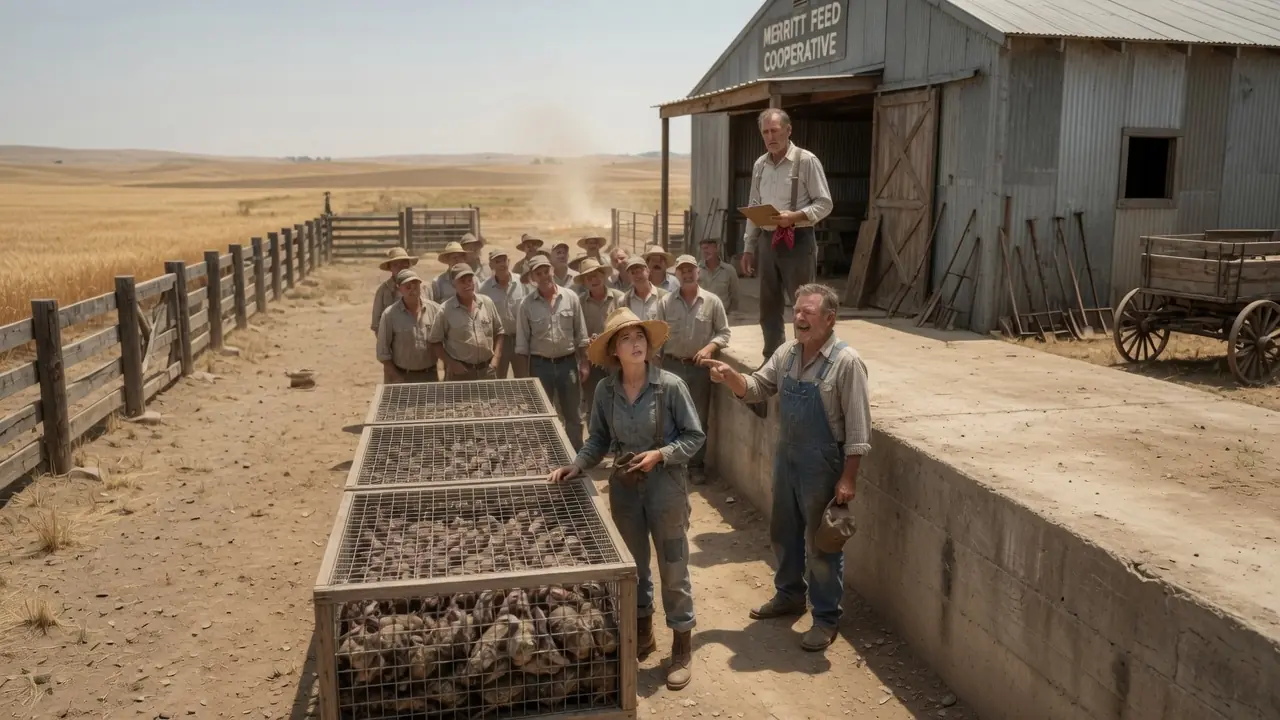
She watched Clara enter the yard on foot.
“You didn’t get the truck started?”
“No.”
“Did you buy the distributor cap?”
“No.”
Evelyn looked toward the empty road behind her.
“What did you buy?”
Clara stopped at the porch steps.
“Turkeys.”
“How many?”
Clara hesitated.
Evelyn placed the bowl of beans down.
“How many?”
“Three hundred.”
The old woman stared.
A cicada buzzed from the oak tree.
“Say that again slowly so I can decide whether my hearing or your judgment has failed.”
“Three hundred turkey poults.”
“In June?”
“Yes.”
“During the hottest week since 1954?”
“Yes.”
“With what money?”
“The truck money.”
“So we now have no working truck and three hundred birds that require transportation.”
“Yes.”
The old woman closed her eyes.
Clara waited.
Then Evelyn asked, “How long before they die if we leave them?”
“Not long.”
“How much did you pay?”
“Twenty dollars.”
“All of them?”
“Yes.”
Evelyn opened her eyes.
“That was cheap.”
Clara nodded cautiously.
“Feed won’t be.”
“No.”
“Medicine?”
“Possibly.”
“Shelter?”
“We can use the lower barn.”
“It has rats.”
“I’ll fix the gaps.”
“The roof leaks.”
“You said rain hasn’t come in six weeks.”
“That is not how roof repair works.”
Clara looked down.
“I couldn’t leave them.”
Evelyn studied her granddaughter.
Clara had been that way as a child.
She brought home injured birds.
Half-starved cats.
A fox pup once, though Evelyn made her return it to the edge of the woods before its mother found the porch.
But Clara was no longer a child.
Compassion carried consequences when money was scarce.
Evelyn stepped from the porch.
“Who can lend us a truck?”
Clara looked up.
“You’re helping?”
“I am preventing you from making your first bad decision worse through poor transportation.”
They borrowed a cattle trailer from Amos Pike and a pickup from Evelyn’s cousin.
By five that afternoon, the three hundred poults arrived at the Wren farm.
The lower barn had not held animals in years.
Dust lay thick across the floor.
Old harnesses hung from pegs.
Two windows had broken panes, and the back wall contained gaps wide enough for snakes.
Clara and Evelyn worked without stopping.
They swept.
Patched holes with wire mesh.
Covered the windows with cloth to control drafts.
Built circular brooder guards from scrap metal and cardboard.
The two old heat lamps from the cooperative were rusted but functional.
Evelyn found three additional lamps inside a box left from Clara’s childhood chickens.
Waterers became the first serious problem.
They owned only two.
Three hundred poults could crowd and drown around inadequate water.
Clara cut shallow containers from clean gallon jugs, placed stones inside to prevent birds from falling, then positioned them throughout the brooder area.
Feed trays were made from old baking sheets and lengths of split gutter.
By sunset, the barn floor moved with tiny bodies.
The poults peeped continuously.
Some explored.
Others stood weakly beneath the lamps.
Several had pasted droppings blocking their vents from stress and dehydration.
Clara cleaned them carefully with warm water.
One died in her hands.
Then another.
By midnight, six were dead.
Clara sat on an overturned bucket.
Her shirt clung to her back.
Evelyn placed a cup of water beside her.
“You expected losses.”
“Not this soon.”
“They were in poor condition before you bought them.”
“That doesn’t help them.”
“No.”
Evelyn sat beside her.
“But it matters if you plan to blame yourself.”
Clara looked across the brooder.
“What if Reuben was right?”
“About what?”
“That kindness doesn’t pay bills.”
Evelyn watched one poult settle beneath the lamp.
“Kindness alone doesn’t.”
“That’s what I have.”
“No.”
The old woman looked toward her.
“You have hands. A brain. Land. Time. And a grandmother who has apparently lost the sense to stop you.”
Clara smiled weakly.
“That last one may be important.”
“It usually is.”
The first week nearly broke them.
The heat remained brutal.
Temperatures inside the barn climbed dangerously by midday despite open windows and fans made from old machinery belts.
Turkey poults were more fragile than chickens.
They failed to find food even when standing beside it.
They crowded into corners.
They panicked at shadows.
One loud noise could send dozens piling together until those beneath suffocated.
Clara slept in the barn.
She woke every two hours.
Checked water.
Adjusted lamps.
Separated crowds.
Watched droppings for signs of illness.
By the fourth day, nineteen birds had died.
By the seventh, the number reached thirty-one.
News traveled quickly.
People drove slowly past the Wren farm hoping to see disaster.
At Merritt Feed, Reuben announced that Clara would lose half before July.
Amos Pike did not participate in the betting, but he heard every number.
One afternoon, he brought two bags of starter feed to the farm.
Clara met him beside the barn.
“I didn’t order this.”
“I know.”
“I can’t pay today.”
“Didn’t ask you to.”
She looked at him.
“Why?”
Amos glanced toward the road.
“Because I sold you dying birds.”
“You sold them for twenty dollars.”
“That doesn’t make them your problem alone.”
Clara touched the feed sack.
“I’ll pay when I can.”
Amos nodded.
“Don’t tell Reuben.”
“Why?”
“He’ll think I’ve become soft.”
Inside the barn, Amos watched the poults.
More were active than he expected.
Clara had separated the weakest birds into a smaller section where food and water remained within inches.
She had hung wet burlap near the windows. Air moving through it lowered the temperature slightly.
Small mirrors rested beside several feed trays.
“What are those for?” Amos asked.
“Turkeys peck where they see another bird pecking.”
“That’s their own reflection.”
“They don’t know that.”
Amos smiled.
“You learn that from a book?”
“No.”
“I watched them.”
The poults followed reflected movement and discovered the feed more quickly.
Amos looked toward Clara.
“Maybe you’re not entirely crazy.”
“That’s the nicest thing anyone has said this week.”
The real trouble began after a thunderstorm.
Rain finally broke the heat on July 2.
The first drops struck the metal roof at dusk.
The poults had never heard rain inside a barn.
The noise began as a scattered tapping.
Then became a roar.
Birds raced toward the walls.
Clara shouted for Evelyn.
By the time they reached the lower pen, dozens had piled into one corner.
Clara dropped to her knees and pulled them apart.
Wings beat against her face.
Tiny claws scratched her arms.
Evelyn blocked the corner with boards while Clara spread the birds across the floor.
Two died.
Nine others lay weak and flattened.
Clara held one against her chest until it began breathing normally.
The storm continued for forty minutes.
Water leaked through three places in the roof.
Mud formed near the eastern wall.
The old lamps flickered.
Then the electricity failed.
Darkness swallowed the barn.
The poults screamed.
Evelyn lit a kerosene lantern.
“We need heat.”
“It’s seventy-eight degrees.”
“Not the weak ones.”
Clara carried them into the farmhouse.
They filled boxes with towels and placed warm jars of water beneath cloth.
For the rest of the night, twenty-seven turkey poults occupied Evelyn’s kitchen.
One sat inside the bread basket.
Another climbed beneath the stove.
At four in the morning, Evelyn found Clara asleep at the table with a poult resting against her neck.
She covered both with a towel.
By sunrise, all but one had survived.
The storm damaged the barn roof badly enough that Clara could no longer ignore it.
Repair materials cost money they did not have.
She went to town and asked Pete Warren, the lumberyard owner, for credit.
He looked toward her from behind the counter.
“Your account is already ninety-three dollars behind.”
“I know.”
“What do you need?”
“Roofing felt. Six sheets of plywood. Tin if you have damaged pieces.”
“For the turkey barn?”
“Yes.”
Pete leaned back.
“I heard about that.”
“Everyone has.”
“You expect those birds to live?”
“Yes.”
“Most people don’t.”
“I know.”
He studied her.
“Why should I extend credit on birds everyone says are doomed?”
Clara placed her notebook on the counter.
Inside were records.
Deaths by date.
Feed consumption.
Weight samples.
Temperature.
Water use.
Projected growth.
She had calculated that if two hundred birds reached market weight, the farm could repay every expense and still profit.
If one hundred survived, they might break even.
Below seventy, the project failed.
Pete flipped through the pages.
“You made all this?”
“Yes.”
“You weigh them?”
“Ten birds every four days.”
“Why?”
“To know whether they’re growing.”
Pete looked again.
The birds gained more slowly than spring poults, but they were gaining.
He closed the notebook.
“You can have the damaged tin free.”
Clara waited.
“Plywood at cost. Felt on thirty days.”
“I’ll need longer.”
“Sixty.”
“Ninety.”
Pete frowned.
“Seventy-five.”
“Deal.”
She repaired the roof with Evelyn and Amos.
Even with their help, Clara spent two days on a ladder beneath the sun.
Reuben Vale stopped along the road during the second afternoon.
He leaned from his truck window.
“You building a palace for twenty-dollar birds?”
Clara held a hammer.
“Roof needed fixing.”
“Barn will still be empty by fall.”
“Then it won’t leak while empty.”
Reuben laughed.
“You always have an answer.”
“No.”
She drove another nail.
“I usually just have work.”
His smile faded.
August arrived.
The poults began resembling actual turkeys.
Their soft down gave way to uneven feathers.
Long necks appeared.
Their legs strengthened.
They ate constantly.
That created a new problem.
Feed costs tripled.
The two free bags from Amos lasted only days.
Clara spent every dollar earned from selling eggs and repairing neighbors’ fences.
She sold an old saddle.
Then her mother’s silver bracelet.
Evelyn noticed the empty jewelry box.
“You sold it?”
“Yes.”
“That was your mother’s.”
“She left it.”
“It still belonged to you.”
“So do the turkeys.”
Evelyn studied her.
“You’re not responsible for saving everything abandoned.”
Clara looked toward the barn.
“I know.”
“Do you?”
The question followed her for days.
Clara’s parents left Buck Hollow when she was nine.
Her father disappeared first after debts and alcohol hollowed him into someone unpredictable.
Her mother remained another year.
Then one morning, she packed a suitcase and promised to return after finding work in St. Louis.
She sent two letters.
Then nothing.
Evelyn raised Clara without speaking badly of either parent.
The town did that for her.
People called Clara unlucky.
Abandoned.
Troubled.
Some believed buying the poults was another attempt to save something because nobody had saved her.
They were not entirely wrong.
But saving the birds required more than emotion.
Clara knew that too.
She began searching for cheaper feed sources.
Corn alone would not provide enough protein.
She visited the dairy outside town and collected surplus skim milk.
A restaurant allowed her to take clean vegetable trimmings.
She planted fast-growing forage in an unused garden plot.
Evelyn taught her how farmers once mixed feed before commercial rations became common.
Clara balanced grain, soybean meal, minerals, and greens carefully.
She did not replace the starter ration entirely.
She stretched it.
The turkeys continued growing.
By the end of August, two hundred fifty-eight remained.
The survival rate surprised everyone.
Reuben changed his prediction.
“They’ll live,” he said at the feed store. “But they won’t finish by Thanksgiving.”
That concern was real.
The birds were weeks behind the usual growing schedule.
Summer heat reduced early growth.
If they failed to reach market size by November, Clara would face another month of feeding without buyers.
She weighed them again.
Average weight: 6.8 pounds.
They needed to more than double.
Clara adjusted the ration.
Extended daylight slightly using lamps to encourage feeding.
Moved birds onto fresh pasture in portable pens to reduce disease and provide insects.
She built the pens from scrap lumber and fencing.
Each morning, she moved them to clean grass.
Neighbors stopped along the road.
Some still laughed.
Others watched with curiosity.
The turkeys followed Clara wherever she walked.
She trained them to respond to a whistle.
The first time Reuben saw two hundred birds running behind her across the pasture, he nearly drove into the ditch.
“You’ve turned them into dogs.”
“They’re easier than cattle.”
“They’re uglier.”
“They don’t know.”
By September, Clara had become part of the town’s conversation.
Not everyone mocked her now.
Some admired the work but expected economics to defeat her.
Feed bills kept growing.
Pete’s lumber account came due.
The farm’s property tax deadline approached.
Then the old Chevrolet finally stopped running completely.
Its engine seized while Evelyn drove to town.
The repair estimate exceeded the truck’s value.
Without transportation, Clara could not carry feed or eventually deliver turkeys.
Langford Poultry Processors operated forty miles away.
They required birds delivered live and would not collect from small farms.
Clara needed a truck.
She approached the bank.
Mr. Howard Densmore, the loan officer, listened while she explained.
“How much?”
“Eight hundred dollars.”
“For a vehicle?”
“A used farm truck.”
“What collateral?”
“The turkeys.”
He removed his glasses.
“You want me to secure a loan with late-season poultry?”
“Yes.”
“No.”
“You haven’t seen my records.”
“I don’t need to.”
Clara placed the notebook on his desk.
He pushed it back.
“You’re twenty-three with no regular income and an agricultural experiment everyone expects to fail.”
“It hasn’t failed.”
“Not yet.”
“Two hundred fifty-one birds are alive.”
“How many are market-ready?”
“None.”
“Then you have no product.”
“I have growing inventory.”
“You have animals consuming money.”
Clara stood.
“So does every cattle farm in the county.”
“Cattle have predictable value.”
“So will the turkeys.”
“At Thanksgiving?”
“Yes.”
“Assuming they grow. Assuming disease doesn’t strike. Assuming processing capacity remains available. Assuming buyers choose yours over established farms.”
Mr. Densmore folded his hands.
“Banks do not lend on assumptions.”
Clara picked up the notebook.
“Every loan is an assumption about tomorrow.”
He looked toward the door.
“Good afternoon, Miss Wren.”
Clara left without eight hundred dollars.
By evening, half the town knew the bank refused her.
Reuben stopped at the farm the following day.
Clara expected another joke.
Instead, he inspected the broken truck.
“Engine’s finished.”
“I know.”
“What did Densmore say?”
“No.”
“He usually does.”
Clara looked toward him.
“You need something?”
Reuben shifted his weight.
“My brother has an old Ford sitting behind his machine shed.”
“Does it run?”
“Sometimes.”
“How much?”
“Five hundred.”
“I don’t have five hundred.”
“He might take two hundred now.”
“I don’t have that either.”
Reuben looked toward the pasture.
Turkeys moved through green forage behind wire fencing.
“How many are left?”
“Two hundred forty-eight.”
“What happened to the others?”
“Coyotes got three last night.”
“You need a dog.”
“I need a truck.”
Reuben nodded.
“What if I bought fifty birds in advance?”
Clara stared.
“For Thanksgiving?”
“If they make weight.”
“At what price?”
“Market price minus twenty percent.”
“No.”
He looked offended.
“You have no truck.”
“You also said they’d all die.”
“That was before.”
“Before what?”
“Before they didn’t.”
Clara almost smiled.
“I’ll sell you twenty at full market price. Ten-dollar deposit each.”
Reuben laughed.
“You negotiate like you own something valuable.”
“I do.”
They settled at thirty birds, eight dollars deposit each, remaining balance based on dressed weight.
Reuben counted out two hundred forty dollars.
Clara accepted it.
“Why are you doing this?”
He placed the receipt inside his wallet.
“My daughter is bringing her family for Thanksgiving.”
“That doesn’t answer.”
Reuben looked toward the turkeys.
“You made me curious.”
They bought the old Ford.
It started only when cold.
The driver’s door was tied shut with rope.
The brakes pulled right.
Clara loved it.
October arrived with cold nights.
The birds benefited.
Their appetite increased.
Weight gain improved.
But new danger came from disease.
One morning, Clara found three turkeys sitting apart with ruffled feathers.
Their droppings were loose and yellow.
By noon, seven showed symptoms.
Evelyn looked toward her.
“What is it?”
“I don’t know.”
Clara separated them immediately.
She drove two hours to the state agricultural office with a dead bird wrapped in ice.
The veterinarian suspected blackhead disease, a parasitic infection particularly dangerous to turkeys.
There was no simple cure.
Prevention depended on sanitation, separation from chickens, and reducing exposure to contaminated soil.
The Wren farm had kept chickens near the barn for years.
Earthworms could carry the parasite.
If the flock was infected widely, Clara might lose everything.
The veterinarian examined the bird.
Results would take two days.
Clara returned home and found twelve more sick.
She moved the healthy flock onto ground never used by poultry.
Disinfected equipment.
Changed boots between pens.
Burned contaminated bedding.
She slept little.
By the second night, nine birds were dead.
Evelyn found Clara sitting beside the isolation pen before dawn.
“This may be it,” Clara said.
“May be.”
“All summer. All that feed.”
“Not wasted.”
“If they die?”
“You learned.”
“I didn’t do this to learn.”
“No.”
Evelyn sat beside her.
“You did it because something alive needed a chance.”
Clara looked toward the sick birds.
“What if the chance wasn’t enough?”
“Then you gave what you could.”
“That sounds like something people say when they lose.”
“It is.”
The old woman placed a hand over Clara’s.
“Winning is not the only time truth matters.”
The laboratory called that afternoon.
Not blackhead.
Bacterial enteritis likely caused by contaminated standing water after recent rain.
Treatable.
Clara nearly dropped the receiver.
She obtained medication on credit.
Cleaned every waterer.
Moved the birds again.
The outbreak stopped after claiming seventeen.
Two hundred twenty-eight remained.
They were thinner from illness.
Thanksgiving stood six weeks away.
Clara needed buyers.
She wrote a simple advertisement by hand.
PASTURE-RAISED THANKSGIVING TURKEYS
WREN FARM
LIMITED NUMBER
RESERVE WITH DEPOSIT
Pete posted one at the lumberyard.
Amos placed another at Merritt Feed.
The diner allowed one near the register.
For three days, nobody called.
Most families already ordered birds from supermarkets or established poultry farms.
Clara reduced nothing.
Did not lower the price.
Did not pretend the birds were something they were not.
Then Mrs. Helen Parker from the elementary school called.
She wanted one for her family.
The pastor reserved two for a church dinner.
Amos ordered one.
Pete ordered three.
A nurse at the county clinic ordered one after hearing the story.
By the end of the week, Clara had twenty-six reservations.
Better than none.
Far from enough.
The turning point came through someone Clara did not know.
A food columnist from Louisville named Margaret Bell stopped at the Buck Hollow diner after her car overheated.
She saw Clara’s handwritten advertisement.
The waitress told her the story.
Three hundred summer poults.
The laughter.
The homemade brooders.
The storm.
The disease.
The girl who moved the flock across pastures by whistle.
Margaret asked to visit.
Clara refused at first.
“I’m working.”
“I can walk while you work.”
“I don’t want an article making me look foolish.”
Margaret smiled.
“The town already did that for free.”
Clara allowed her to come.
The columnist spent an entire afternoon at the farm.
She watched Clara move fencing.
Mix feed.
Check birds.
Record weights.
She spoke with Evelyn, who described the first night in the kitchen.
She photographed the turkeys running behind Clara across the pasture.
The article appeared on a Sunday.
Its title read:
THE TURKEYS WHO ARRIVED TOO LATE — AND THE FARMER WHO REFUSED TO AGREE
Margaret did not call Clara heroic.
She described the work.
The costs.
The losses.
The uncertainty.
She explained that the birds were still not guaranteed to reach market weight.
Readers responded.
Calls began Monday morning.
Louisville families wanted reservations.
A farm-to-table restaurant requested twenty-five.
A veteran’s organization asked whether Clara could provide birds for a community meal.
Within four days, every surviving turkey had a potential buyer.
Clara kept ten unreserved in case some failed to finish.
Then another problem arrived.
Langford Poultry Processors called.
A mechanical fire had closed part of its facility.
All small-farm appointments during Thanksgiving week were canceled.
Clara stood beside the kitchen phone in silence.
“When can they take them?” Evelyn asked.
“December.”
“That’s too late.”
“Yes.”
“Another processor?”
“Booked.”
“Could we do it ourselves?”
“Not legally for retail sales.”
Clara had buyers.
Birds.
Deposits.
No way to process them.
Word spread again.
The laughter returned more quietly.
Reuben came to the farm.
“What are you going to do?”
“I don’t know.”
“Refund everyone?”
“If I must.”
“That will ruin you.”
“I know.”
He looked toward the flock.
Average weight now exceeded fifteen pounds.
Some toms approached twenty.
The impossible birds were ready.
Only the final step had disappeared.
Reuben removed his cap.
“My cousin owns a processing shed in Jefferson County.”
“Licensed?”
“Used to be.”
“Used to be doesn’t help.”
“It could pass inspection.”
“By Thanksgiving?”
“If people worked.”
Clara looked at him.
“What people?”
Reuben turned toward the road.
Three trucks approached.
Amos drove the first.
Pete followed.
Behind them came farmers who had laughed in June.
Some had placed bets on how quickly the poults would die.
They parked near the barn.
Reuben looked uncomfortable.
“I may have mentioned the problem.”
Pete stepped from his truck carrying tools.
“The old Jefferson facility needs repairs.”
Amos held a clipboard.
“The county inspector can come Monday if we finish by Sunday.”
A farmer named Dale Mercer brought electrical wire.
Another had pressure-washing equipment.
Mrs. Parker organized meals.
Miguel Santos, who operated the diner kitchen, offered stainless-steel tables.
Clara stared at them.
“Why?”
Nobody answered immediately.
Then Amos said, “Because we laughed.”
Pete nodded.
“And because you were right.”
Clara looked toward Reuben.
“About what?”
He glanced at the turkeys.
“That they weren’t doomed.”
She shook her head.
“They still could have been.”
“That isn’t the point.”
“What is?”
Reuben took a breath.
“You worked while we stood around predicting.”
The men spent four days restoring the processing building.
They repaired plumbing.
Replaced damaged wiring.
Installed washable wall panels.
Serviced refrigeration.
Cleaned every surface.
The county inspector rejected three items on Monday morning.
They corrected them by afternoon.
At five-thirty, the facility received temporary approval for supervised seasonal operation.
Clara covered the inspection fee with deposits.
The farm finally had a path to Thanksgiving.
Processing began the following week.
Clara attended every day.
She insisted the birds be handled quietly.
No overcrowded crates.
No unnecessary waiting.
She had kept them alive for five months.
She would not allow carelessness at the end.
Some people found that sentimental.
Others understood.
The final count was two hundred eleven marketable turkeys.
Seventeen birds remained too small or had physical problems.
Clara kept them.
They would live on the farm.
Average dressed weight reached fourteen pounds.
The largest tom weighed twenty-three.
The restaurant paid a premium for pasture-raised birds.
Most families paid the agreed price.
Several added extra money after hearing about the processing crisis.
Clara refused donations.
She accepted only payment.
By Thanksgiving week, the Wren farm had earned enough to cover feed, medication, roof repairs, processing, the truck, and every outstanding account.
After expenses, Clara’s profit was larger than anything the farm had made in four years.
But money was not the most visible change.
On Thanksgiving morning, vehicles began lining the county road before sunrise.
Families arrived to collect reserved birds.
Clara had expected a few at a time.
Instead, dozens came early.
Some wanted to avoid the holiday rush.
Others came because they heard people planned to apologize.
The same farmers who laughed beneath the feed-store awning stood near the gate holding envelopes and empty coolers.
Amos Pike arrived first.
Then Pete.
Mrs. Parker.
The pastor.
Reuben Vale came with his daughter and three grandchildren.
Behind them stood men who had bet on the birds’ deaths.
One carried the small notebook in which he recorded the wagers.
He handed it to Clara.
“What is this?”
“Our stupidity.”
She opened it.
Names.
Numbers.
Predictions.
None by Labor Day.
Twenty by August.
Fifty if she was lucky.
At the bottom, someone had written:
FINAL SURVIVING TOTAL: 211 MARKET BIRDS, 17 KEPT.
The man removed his cap.
“We collected the betting money.”
Clara’s face hardened.
“I don’t want it.”
“We know.”
“Then why bring it?”
He pointed toward the barn.
“We want it used for a new roof on the poultry shed.”
“The roof is repaired.”
“Then equipment.”
“No.”
Evelyn stepped beside Clara.
“How much?”
“Seven hundred eighty dollars.”
Clara looked toward her grandmother.
Evelyn ignored her.
“What would you do with it otherwise?”
The man looked ashamed.
“Probably drink it.”
Evelyn nodded.
“Then give it to the school lunch fund.”
Clara turned.
“Grandma.”
“You said you don’t want it.”
“I don’t.”
“Children will eat.”
The money went to the county school meal program.
The townspeople remained at the gate.
Clara looked across their faces.
Some embarrassed.
Some proud.
Some simply curious.
Reuben stepped forward.
He held the receipt for the thirty birds purchased months earlier.
“You charged me full price.”
“You agreed.”
“I did.”
He handed her the remaining balance.
Then added another envelope.
“What is that?”
“Payment for the two hundred forty dollars I gave you.”
“That was a deposit.”
“It bought the truck.”
“And you received thirty birds.”
“I know.”
“Then we’re even.”
Reuben shifted.
“No.”
Clara waited.
“I spent all summer telling people you’d fail.”
“That didn’t cost me anything.”
“It cost you respect.”
She looked toward him.
“Respect you didn’t have for me cannot be stolen from me.”
The old farmer lowered his eyes.
“You talk like Evelyn.”
“Occupational hazard.”
A small smile appeared.
Reuben looked toward the barn.
“You need help repairing the north fence?”
“Yes.”
“I’ll come Saturday.”
“That isn’t an apology.”
“No.”
He placed his cap back on.
“It’s work.”
Clara accepted.
Thanksgiving dinner at the Wren farmhouse was small.
Evelyn.
Clara.
Amos.
Mrs. Parker, whose husband had died in spring.
They cooked one of the smaller turkeys.
The meat was rich and slightly firmer than store-bought birds.
Evelyn tasted it.
“Well?”
Clara asked.
The old woman chewed carefully.
“Expensive.”
Amos laughed.
“That isn’t what she asked.”
“It is good.”
Clara looked toward the window.
Beyond it, seventeen turkeys wandered inside a fenced pasture.
The birds too small to sell had survived the season.
One pecked at the porch steps.
“What will you do with those?” Mrs. Parker asked.
“Keep some for breeding.”
“You’re doing this again?”
Clara considered.
“Not three hundred.”
Evelyn pointed her fork.
“Write that down.”
The following spring, Clara ordered poults early.
One hundred twenty.
She selected breeds suited for pasture and local conditions.
She repaired the barn properly.
Installed better ventilation.
Built movable shelters.
Used records from the summer flock to design a feeding program.
The second year produced fewer losses and better weights.
By the third, Wren Farm turkeys were reserved months before Thanksgiving.
Clara did not become wealthy overnight.
The farm still struggled.
Tractors broke.
Drought returned.
Feed prices rose.
But the turkey operation provided dependable income.
She sold directly to families, restaurants, and community organizations.
She refused to expand beyond what the land and her labor could support.
A poultry company offered a contract requiring thousands of birds raised indoors.
She declined.
A businessman proposed using her story in advertising.
He wanted photographs of Clara holding a poult beneath the words:
SHE BELIEVED WHEN EVERYONE LAUGHED.
She read the contract.
“They own my name forever?”
Her attorney nodded.
“They could use the story widely.”
“No.”
“You could make good money.”
“They’d turn the birds into a miracle.”
“Isn’t that what happened?”
“No.”
Clara looked toward her record books.
“A miracle would have been easier.”
The truth was work.
Dead birds buried before breakfast.
Feed mixed after dark.
Roof repairs in heat.
Fear during disease.
A processing plant repaired by people willing to admit they had judged too quickly.
That story mattered more to her.
Five years after the first flock, Clara purchased forty acres beside the Wren farm.
She paid in cash.
The bank officer who once refused the truck loan had retired.
His replacement approved a line of credit Clara never needed to use.
Pete Warren’s lumber account was paid in full before the second Thanksgiving.
The old Ford remained unreliable.
Clara kept it anyway.
The rope on the driver’s door became part of its reputation.
Children visiting the farm asked why she did not buy a better truck.
“It starts when I need it.”
“That door is tied shut.”
“I rarely need both doors.”
Evelyn lived long enough to see the operation become successful.
At eighty-two, she no longer worked full days but still inspected the books.
One autumn afternoon, she sat near the pasture watching several hundred healthy turkeys move across green grass.
Clara brought her tea.
“You were right,” Evelyn said.
“About what?”
“The first three hundred.”
Clara sat beside her.
“I lost eighty-nine.”
“That wasn’t what I meant.”
“What did you mean?”
Evelyn looked toward the birds.
“You needed something everyone else had already decided was hopeless.”
Clara became still.
Her grandmother continued.
“Not because you thought you could save every one.”
“No.”
“Because nobody had stayed when people decided that about you.”
Clara looked across the pasture.
She had spent years avoiding that thought.
“You think I bought them because of my mother?”
“Partly.”
Clara picked at a loose thread on her sleeve.
“Was that foolish?”
“No.”
Evelyn touched her hand.
“It would have been foolish if you believed love alone kept them alive.”
Clara looked toward the feed sheds, water lines, brooder house, and record books.
“It didn’t.”
“No.”
The old woman smiled.
“You made love learn the work.”
Evelyn died the following winter.
She passed quietly inside the farmhouse while snow covered the Wren fields.
Clara buried her beside her husband on a hill overlooking the barn.
For the first time in her life, Clara lived alone.
People worried she would leave.
She did not.
The farm felt empty.
Not abandoned.
There was a difference.
Each evening, Clara walked to the turkey house and checked waterers.
The routine helped.
She found Evelyn everywhere.
In labels written across feed bins.
In the repaired kitchen curtains.
In warnings penciled inside account books.
DO NOT LET CLARA BUY MORE THAN SHE CAN FEED.
Below that, Clara later added:
SHE DID ANYWAY.
The town changed around Wren Farm.
Young families moved away.
Some old farms were sold.
Merritt Feed Cooperative closed after a larger chain store opened near the highway.
Before the building was demolished, Amos saved the auctioneer’s clipboard from the June sale.
He brought it to Clara.
The original lot number remained faintly visible.
TURKEY POULTS — 300
FINAL BID: $20
BUYER: CLARA WREN
She hung it inside the poultry barn.
Not as proof she outsmarted the town.
As proof that value changed depending on what someone was willing to do after buying it.
Reuben Vale became one of Clara’s closest friends.
He repaired fences.
Helped during processing week.
Never stopped complaining about her prices.
At eighty, he sat beside the farm store and told visitors he had supported the turkey idea from the beginning.
Clara corrected him every time.
“You bet they’d all die.”
“I was encouraging you through opposition.”
“You laughed.”
“Motivational laughter.”
He bought six birds every Thanksgiving.
His grandchildren grew up helping on the farm.
One, Emily Vale, later studied veterinary medicine and returned to Buck Hollow.
She helped Clara improve disease prevention and flock health.
The farm established a small training program for young farmers.
Clara taught them to keep records.
Not only expenses and sales.
Observations.
Temperature.
Behavior.
Feed changes.
Water use.
Mortality.
“People call good farming instinct,” she told them.
“Most instinct is memory that somebody bothered to organize.”
A student once asked whether she recommended buying distressed summer poults.
“No.”
The class laughed.
“But that’s how you started.”
“Yes.”
“Then why not?”
“Because surviving one bad gamble does not make it a good business model.”
“What should we learn from it?”
Clara thought.
“Do not confuse something being difficult with it being impossible.”
She looked toward the old clipboard.
“And do not confuse something being cheap with it costing little.”
By the twentieth anniversary of the first flock, Wren Farm had become known throughout the state.
Not enormous.
Not industrial.
Respected.
Families reserved birds a year in advance.
Restaurants listed the farm by name.
Clara employed eight people seasonally and three full-time.
The original lower barn became a visitor center.
Inside, photographs showed the summer of 1986.
Tiny poults in wire crates.
Wet burlap hanging across windows.
Birds inside Evelyn’s kitchen.
The old Ford with its tied door.
The Jefferson County processing shed before and after repair.
One photograph showed farmers standing at the Wren gate on Thanksgiving morning with their caps in their hands.
Visitors often assumed it was staged.
Clara told them it was not.
“What were they doing?” a child asked.
“Waiting for turkeys.”
“Why do they look sad?”
“They had been wrong.”
“Did you tell them?”
“They knew.”
“Were you mad?”
“Yes.”
“Did you forgive them?”
Clara looked toward Reuben, usually sitting nearby.
“Eventually.”
He raised one hand.
“She made me fix fence first.”
“Forgiveness and free labor can coexist.”
The child did not understand.
Reuben did.
Clara never married.
Not because no one asked.
Because her life became full in ways she had not expected.
She had friends.
Employees.
Young farmers who called for advice.
Children who visited every fall.
A farm that no longer looked temporary.
Her mother wrote once when Clara was forty-six.
The letter came from Arizona.
It contained an apology.
An explanation involving fear, poverty, depression, and a second family.
Clara read it twice.
Then placed it inside a drawer.
She answered after three months.
She did not offer immediate forgiveness.
She did not refuse contact.
They exchanged letters for two years before meeting.
The reunion was quiet.
Painful.
Incomplete.
Her mother asked about the turkey story.
“I heard you saved three hundred.”
“No.”
Clara looked toward her.
“I saved two hundred eleven for market. Seventeen more stayed.”
Her mother smiled nervously.
“That’s still remarkable.”
“It wasn’t all me.”
“I know.”
Clara studied the woman who had once disappeared.
She was smaller than memory.
Older.
Human.
That did not erase the absence.
But it changed its shape.
Her mother visited the farm twice before dying.
On the second visit, she stood beside the pasture as turkeys followed Clara.
“They trust you.”
“They trust the feed bucket.”
“Is there a difference?”
“Yes.”
Clara looked toward her mother.
“But trust often begins with someone returning at the same time every day.”
Neither spoke after that.
Clara continued returning.
Every morning.
Every evening.
Year after year.
When she turned seventy, the county held a dinner in her honor.
The event took place inside the new agricultural hall.
More than four hundred people attended.
Farmers.
Teachers.
Restaurant owners.
Former students.
Families who had purchased Wren turkeys for generations.
A large photograph of twenty-three-year-old Clara stood near the stage.
Frayed hat.
Patched trousers.
One poult held carefully between both hands.
Clara disliked the attention.
She sat beside Emily Vale and whispered, “I look exhausted.”
“You were.”
“My shirt is buttoned wrong.”
“We considered correcting the photograph.”
“That would be dishonest.”
During the ceremony, the county commissioner announced that the road leading to Wren Farm would be renamed Clara Wren Lane.
Clara objected.
“People already know where the farm is.”
The commissioner continued anyway.
Then Amos Pike’s grandson brought out the original auction clipboard.
Beside it stood a small bronze plaque.
THE WHOLE COUNTY LAUGHED TOO SOON.
Clara looked toward the audience.
Some of the oldest faces had been beneath the feed-store awning that June afternoon.
Reuben was gone by then.
Pete too.
Amos had died years earlier.
Their children and grandchildren sat in their places.
Clara approached the microphone.
“I don’t want this remembered as a story where I was wise and everyone else was foolish.”
A few people shifted.
“I was frightened from the first night.”
She looked toward the photograph.
“I used money meant for a truck. Bought birds without enough feed. Put three hundred living creatures inside a barn that was not ready.”
Soft laughter moved through the hall.
“The people who doubted me had good reasons.”
She paused.
“They were wrong about one thing.”
The room became quiet.
“They thought the outcome had already been decided.”
Clara rested one hand on the old clipboard.
“Sometimes experience protects us from repeating mistakes.”
She looked across the young farmers.
“Sometimes it protects us from trying anything experience has not seen work before.”
She smiled faintly.
“The difference is difficult to know.”
“What saved those birds?” someone called.
Clara considered.
“Work.”
Another voice asked, “What else?”
She looked toward Emily.
“Help.”
Then toward the faded photograph of Evelyn projected on the wall.
“And somebody who complained while helping anyway.”
The audience laughed.
Clara died eleven years later in the farmhouse where she had grown up.
She was eighty-one.
Her final flock had already been moved to winter pasture.
Emily Vale took over management of the farm through the agricultural trust Clara established.
The operation continued under the Wren name.
Every third Friday of June, the farm hosted an open day for young farmers.
Not to celebrate buying summer poults.
To discuss risk.
Compassion.
Planning.
And how communities treated people attempting something unfamiliar.
The original lower barn remained.
Its roof no longer leaked.
Inside, one section had been recreated exactly as it appeared in 1986.
Homemade waterers.
Split gutter feed trays.
A rusted heat lamp.
Wet burlap.
The bread basket where one poult spent a stormy night.
Visitors often expected a dramatic treasure.
There was none.
Only ordinary objects made useful by necessity.
Above the entrance hung Evelyn’s handwritten warning:
DO NOT LET CLARA BUY MORE THAN SHE CAN FEED.
Below it remained Clara’s answer:
SHE DID ANYWAY.
The farm never hid the losses.
A plaque listed the numbers.
300 purchased.
89 lost before market.
211 sold.
17 retained.
The totals confused visitors.
“How can two hundred eleven be sold and seventeen kept if eighty-nine died?” a child once asked.
Emily smiled.
“Some of the retained birds came from those not initially counted as market-ready after recovery. Clara’s records changed as birds recovered, and the final historical figures came from separate stages.”
The child frowned.
“That sounds complicated.”
“It was farming.”
The story grew simpler outside Buck Hollow.
People said a poor girl bought doomed turkeys for twenty dollars and became rich by Thanksgiving.
That was not true.
She did not become rich.
Not that year.
The birds were not magically transformed.
The town did not instantly become kind.
Some people helped only after success seemed possible.
Others apologized because public opinion changed.
The processing crisis nearly destroyed everything even after the birds survived.
Clara carried anger long after Thanksgiving.
Reality was less perfect than legend.
It was also more valuable.
A young woman saw three hundred unwanted lives inside wire crates.
She made a reckless decision.
Then spent five months becoming responsible enough to justify it.
She learned what she did not know.
Accepted help.
Kept records.
Changed plans.
Buried losses.
Negotiated.
Refused to sell too cheaply.
And kept working when compassion stopped feeling noble and began feeling expensive.
The townspeople laughed because they believed the ending could be seen from the beginning.
Late birds.
Poor farm.
Young woman.
No truck.
No money.
Doomed.
They mistook probability for certainty.
Clara never believed success was guaranteed.
She believed the birds deserved effort before everyone declared failure.
That difference carried them through summer.
By Thanksgiving morning, the people of Buck Hollow stood at her gate.
Some came for food.
Some to apologize.
Some because they wanted to witness the moment their certainty became embarrassment.
Clara did not humiliate them.
She handed out orders.
Checked names.
Counted money.
Sent birds home to family tables.
Then she returned to the barn.
One of the seventeen remaining turkeys followed her inside.
She looked down at it.
“You were late,” she said.
The bird made a soft, questioning sound.
Clara smiled.
“So was I.”
Outside, engines started along the county road.
Families drove toward Thanksgiving dinners.
Inside the barn, sunlight fell across empty pens, repaired boards, and the tools that had carried impossible birds through one unforgiving summer.
The county had laughed early.
Clara had worked late.
And by the time the ending finally arrived, nobody in Buck Hollow would ever look at an unwanted beginning quite the same way again.