“This land’s dead, old man.”
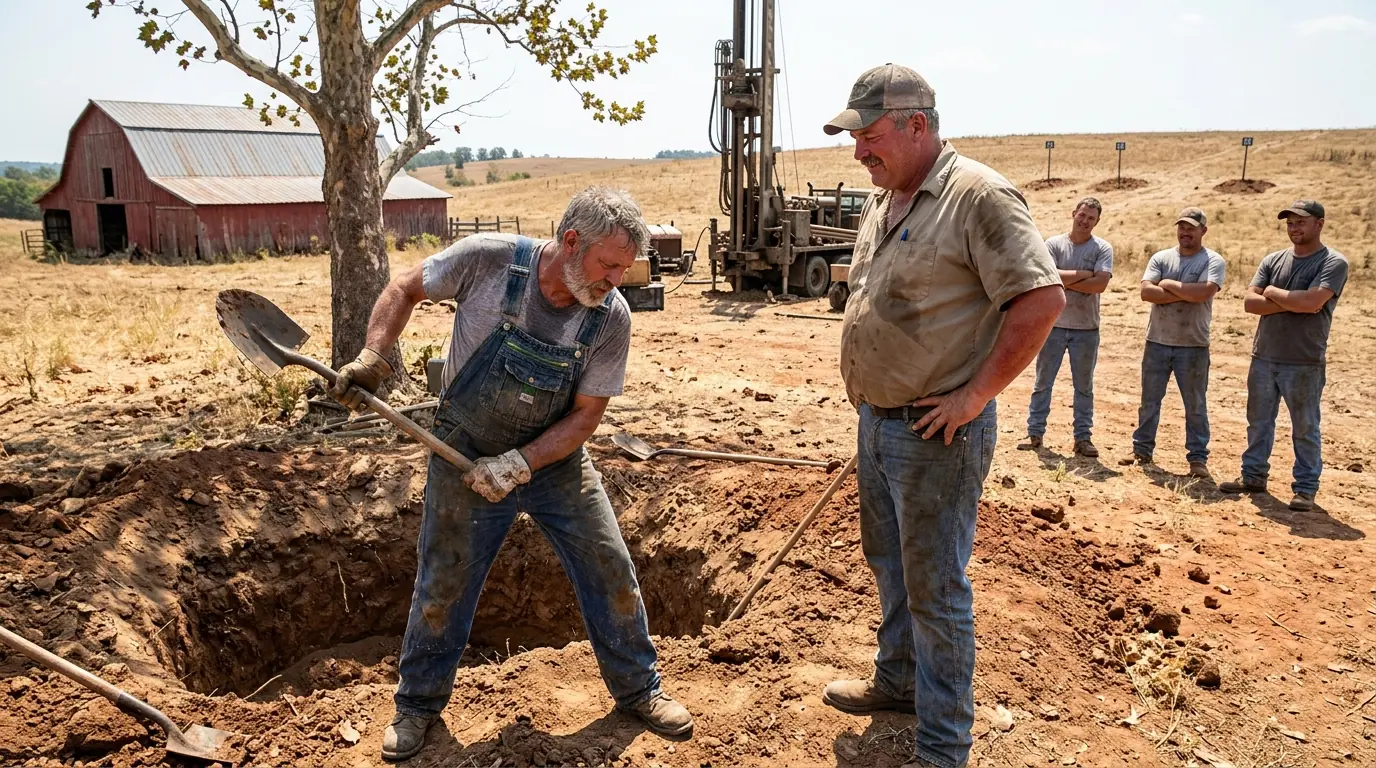
Kenneth Pace wiped red dust from his palms and swept one hand toward the three dark boreholes scattered across Coy Gentry’s farmyard. Behind him, the drilling rig stood silent beneath the brutal Missouri sun, its steel mast rising over the barn like a monument to everything Coy had already paid for and failed to find. Three holes. Three invoices. Hundreds of feet of limestone, shale, fractured rock, and dust. Not enough dependable water to fill a cattle trough.
Coy stood in faded denim overalls with his jaw locked and both fists hanging at his sides. At fifty-eight, he had the weathered build of a man who had spent his entire life lifting things heavier than he should have and waking before his body was ready. Sweat darkened the collar of his work shirt, but he made no effort to wipe it away. “You drilled holes,” he said. “That isn’t the same as knowing everything under this farm.”
Kenneth gave him a hard look. He was fifty-two, broad through the chest, twenty-five years into a profession where customers often mistook desperation for geological insight. Most of the time, Kenneth was the one forced to tell them what they did not want to hear. He knew how much hope could cost when attached to diesel fuel and drill steel.
“We went two hundred eighty feet by the barn,” Kenneth said. “Three hundred twenty at the shed. Four hundred and six right here. The first was dry, the second gave you a seep that wouldn’t supply a bathtub, and this one is nothing but fractured limestone with no sustained yield. I can move the rig again if you insist, but I’d be taking money I know you can’t afford to lose.”
Coy looked toward the nearest borehole.
“How much farther would you try if this were your farm?”
Kenneth’s answer came slowly.
“I wouldn’t.”
The words landed harder than the others.
Kenneth softened his voice. “Coy, sell enough cattle to reduce demand. Keep the house. Lease the pasture if the rain comes back. But stop chasing a well because you think quitting on the well means quitting on Martha.”
Coy’s head turned.
Kenneth immediately knew he had crossed somewhere he should not have gone.
“Don’t.”
“I didn’t mean—”
“You knew my wife three Sundays a year at church.”
Kenneth removed his cap.
“I’m sorry.”
Coy reached for the old shovel leaning against the barn wall.
Kenneth stared at it.
“What are you doing?”
“Looking somewhere you didn’t.”
“With a shovel?”
Coy started walking toward the south pasture.
Kenneth followed him several steps. “Where?”
Coy pointed toward a line of sycamores growing below the lower ridge.
“There.”
Kenneth squinted.
“That’s almost four hundred yards from the nearest bore.”
“Exactly.”
“You want me to move the rig?”
“No.”
“Then what exactly are you planning?”
Coy rested the shovel across his shoulder.
“My wife’s grandmother used to talk about a spring near those trees. Said people watered horses there before the old slide changed the slope.”
Kenneth stared.
“You’re betting your farm on a family story?”
“No.”
Coy looked toward the strange strip of green grass beneath the sycamores, surrounded by pasture that had burned brown weeks earlier.
“I’m betting a few days and one old shovel.”
Kenneth laughed once, sharply. “Coy, if there were useful water five feet below that pasture, somebody would have found it.”
“Maybe.”
Coy started walking again.
Kenneth called after him.
“Keep digging like a fool and this place will bury you before the drought does.”
Coy stopped.
He turned.
“Then stand back.”
Kenneth folded his arms.
“And watch me pull water out of the ground you gave up on.”
The Gentry farm occupied one hundred twenty acres outside Cedar Ridge, Missouri, where the Ozarks folded into limestone hills, hardwood ridges, narrow bottoms, and land that seemed capable of hiding a different answer every fifty yards. Coy’s grandfather, Samuel Gentry, had purchased the first sixty acres in 1938. The family added another sixty after the war, cleared enough bottom ground for hay, built a stone-root cellar into the hillside, and learned which fields rewarded work and which punished optimism.
Coy had been born in the farmhouse.
He knew the property the way some men knew scripture.
He knew where deer crossed the north fence at dawn. He knew the patch near the west ridge where frost settled first in October. He knew which hickory had survived lightning twice and which low meadow could support a tractor in June but swallow one to the axle after three wet March days. He knew the farm intimately.
But knowing land did not make a man its master.
The drought had begun quietly.
April rains came thin.
May turned hot.
June brought three storms that broke apart before reaching Cedar Ridge.
By July the shallow creek had become disconnected puddles beneath exposed stones. The pond shrank until cattle had to walk down cracked banks toward a black center pool where the water smelled warm and muddy. Coy reduced the herd from fifty-two head to thirty-eight before prices collapsed under the number of farmers making the same decision.
Then he began hauling water.
Every second morning, he pulled a borrowed thousand-gallon tank fifteen miles to a municipal fill station. Diesel cost money. Water cost money. Time cost something too, though farmers rarely put that line in a ledger.
Martha would have.
Coy’s wife had kept the farm books for thirty-three years.
Three years after her death, her handwriting remained inside every old ledger.
Coy still found notes.
Replace south-gate chain before winter.
Aaron’s birthday — call before 8.
Coy thinks we need another tractor. Coy is wrong.
That one still made him smile.
Cancer had taken eighteen months to kill her.
The medical bills took considerably less time to erase their savings.
By the time Martha died, Coy owned the land outright but had little cash, old equipment, a modest cattle herd, and the stubborn conviction that the farm should remain in the family even if nothing else did.
Their son Aaron disagreed.
Not completely.
Aaron loved the place. He simply did not believe love required dying beside it.
He lived in Springfield with his wife Emily and their seven-year-old daughter Lucy. He worked as a project estimator for a commercial construction company, wore clean boots more often than dirty ones, and called his father every Tuesday and Friday whether Coy answered pleasantly or not.
During the drought, the calls changed.
“You could stay with us for a while.”
“No.”
“You could sell half.”
“Already sold fourteen.”
“The farm, Dad.”
“No.”
“You haven’t even thought about it.”
“I have.”
“For how long?”
“Long enough to know the answer.”
Aaron usually sighed.
“You’re impossible.”
“So was your mother.”
“She agreed with me sometimes.”
“She had bad days.”
Coy missed the sound of Aaron laughing before hanging up.
The first drilling company had selected a site close to the house where topography and accessibility made sense. They reached two hundred eighty feet, encountered fractured limestone, and found little water.
The second contractor tried lower ground near the equipment shed.
Weak seep.
Too much suspended sediment.
Estimated sustained yield so poor it would not support the farm’s needs without an enormous storage system and constant recovery time.
Then a neighbor recommended Kenneth Pace.
Kenneth was not a fraud.
That mattered later.
He was very good at his job.
He studied state well records, geological maps, nearby well depths, ridge orientation, and accessible drilling positions. He spent half a day walking the Gentry property. He selected a third site that, based on everything normally available to him, had a reasonable chance.
The rig drilled two days.
Nothing.
When Kenneth stopped at four hundred six feet, it was because continuing would have been dishonest.
Coy respected him for that.
He simply did not believe the conclusion extended to all one hundred twenty acres.
Especially not the sycamores.
Martha had mentioned them during their first summer as husband and wife.
They had been twenty-three.
She was hanging sheets on the line when Coy complained that his grandfather’s stories made every ordinary hill sound historical.
Martha pointed toward the south pasture.
“My grandmother said there used to be a spring below those sycamores.”
“Your grandmother also said lightning spoiled milk.”
“She was right about the spring.”
“How would she know?”
“Her father watered horses there.”
Coy had laughed.
Martha threw a clothespin at him.
Thirty-five years later, while cattle clustered around a dying pond, Coy remembered.
The grass beneath those trees remained green.
Not lush.
Not miraculous.
Just greener.
Enough to bother him.
He began digging the afternoon Kenneth left.
The first foot was ordinary Ozark soil: reddish, powder-dry, full of small limestone fragments. Coy widened the hole beyond what was necessary because even a desperate man should not climb into a narrow unsupported shaft if he intended to come back out.
At two feet he hit packed clay.
At three, flat stones.
At four, his back began giving him warnings.
He ignored the first several.
Around sunset he climbed out, sat beneath the sycamore, and drank the last warm water from his jug.
The excavation was completely dry.
Looking into it, Coy felt foolish.
Kenneth had arrived with a diesel rig, professional records, and twenty-five years of experience.
Coy had arrived with folklore.
He nearly filled the hole.
Then he noticed something.
The bottom soil was dry.
The north wall was dry.
The west wall was dry.
But the soil immediately beneath one pale sycamore root felt noticeably cooler.
Coy pushed two fingers into it.
Not wet.
Cool.
That was all.
He covered the excavation with heavy boards, marked the area, and went home.
The next morning he returned.
By the third day Calvin Reed found him.
Calvin owned eighty acres across County Route H and had known Coy long enough to insult him without damaging the friendship. He leaned over the fence and watched Coy lift a bucket of clay from a six-foot excavation.
“You digging your own grave?”
“Too wide.”
“Planning a family plot?”
Coy looked up.
“You come to help or practice comedy?”
Calvin climbed the fence.
“Neither. Your son called me.”
“Traitor.”
“He said check whether you’ve gone stupid.”
“And?”
Calvin crouched near the edge.
“Undecided.”
He looked into the hole and lost some of his humor.
“You’re bracing this?”
“Planning to.”
“That means no.”
“I’ve got lumber.”
“You’ve got scraps.”
Coy stared at him.
Calvin stared back.
“Get out.”
“I’m working.”
“You’ll work after we brace it properly.”
Coy considered arguing.
Calvin pointed down.
“Your wife would crawl out of heaven and kill both of us if I watched this wall cave in.”
“That’s emotional manipulation.”
“Yes.”
It worked.
Calvin returned an hour later with heavier timber, a better ladder, rope, and his sixteen-year-old grandson Noah. Together they widened the excavation and installed rough shoring appropriate for the shallow depth they had reached. Coy hated losing half a day.
He also understood Calvin was right.
By the sixth day the excavation reached pale limestone.
Coy struck it with a pick and listened.
Solid.
He moved several feet sideways, following the dampest soil.
Still limestone.
Calvin stood above.
“You going through that?”
“Trying.”
“That rock’s older than your attitude.”
“Not harder.”
It was harder.