“Put the money back in your pocket.”
The old man froze with three quarters and two nickels trembling in his open palm.
Across the counter, Emily Carter kept her voice low enough that the manager near the cash register would not hear. She slid a steaming bowl of chicken-and-rice soup onto a tray, added two warm rolls, and covered the price printed on the ticket with her thumb.
“I can’t take charity,” the man whispered.
“Good,” Emily said. “Because this isn’t charity. It’s dinner.”
For a moment, he simply stared at her.
His coat was too thin for the January cold, its brown fabric polished smooth at the elbows and frayed around the cuffs. Melted snow clung to his gray hair. A faint scar ran from his left temple toward the corner of his eye, and his hands carried the deep, dark lines of someone who had spent decades working with tools, soil, or machinery.
Around them, Harrington’s Grill moved through the busiest hour of the evening.
Plates clattered beneath pendant lights. Families crowded into red leather booths. Businessmen loosened their ties over steaks and bourbon. Near the front windows, snow drifted across Main Street in Cedar Falls, Ohio, softening the glow of traffic signals and storefront signs.
The old man looked again at the soup.
“How much?” he asked.
Emily tucked the ticket into her apron.
“You’ve already paid.”
“I haven’t.”
“You came inside instead of freezing outside. That’s enough for tonight.”
A trace of amusement moved through his tired eyes.
“That how this restaurant does business?”
Emily glanced toward the manager.
“No,” she said. “That’s how I do.”
The man lifted the tray carefully, almost formally, as though accepting something far more valuable than soup.
“My name is Walter,” he said.
“Emily.”
“I’ll remember that.”
She smiled. “Just eat before it gets cold.”
Walter carried the tray toward a small table near the kitchen doors. He chose the least desirable seat in the restaurant, beside a swinging door that released bursts of noise, heat, and impatient cooks every few seconds.
Emily watched him sit.
He did not attack the food like a starving man. He broke one roll in half, inhaled its warmth, and ate slowly. Between spoonfuls, he observed the restaurant with quiet attention.
He studied the cracked tile near the salad bar.
He noticed the server station where a leaking coffee machine had stained the counter.
He watched a teenage dishwasher push through the kitchen door with a load of clean glasses, then nearly slip on grease that had seeped beneath a rubber mat.
Most customers would not have seen those things.
Walter saw all of them.
Emily had just picked up an order for table twelve when a sharp voice stopped her.
“Why is there no ticket for that meal?”
Douglas Vance stood beside the register with his arms folded.
At forty-eight, Douglas dressed like a man who believed expensive clothing could disguise an inexpensive character. His charcoal suit was tailored too tightly across his middle. His silver tie pin carried the Harrington’s Grill crest, although everyone knew he had purchased it for himself.
Emily felt her stomach tighten.
“There is a ticket,” she said.
“Then why isn’t it in the system?”
“I was about to handle it.”
Douglas looked toward Walter’s table.
His upper lip curled.
“Handle it how?”
Emily set down the plates she was carrying before her hands could betray her.
“I’m paying for his meal.”
“With what?”
“My tips.”
Douglas gave a dry laugh.
“Your tips are supposed to come after customers pay, Emily. They are not a fund for feeding every drifter who wanders through the door.”
Several nearby conversations quieted.
Walter stopped eating.
Emily lowered her voice. “He was hungry.”
“So are half the people in this town. Should we open the kitchen doors and let them empty the pantry?”
“He ordered soup, Douglas. Not the pantry.”
A young busboy named Noah glanced over from the next table. His eyes widened at Emily’s tone. Employees at Harrington’s did not challenge Douglas Vance. Not if they wanted to stay employed.
Douglas stepped closer.
“You think this is your restaurant?”
“No.”
“Then you don’t decide who eats for free.”
“I said I would pay.”
“That isn’t the point.”
Emily knew it was exactly the point.
Douglas liked rules only when they allowed him to remind someone that he had power. During the past year, he had cut employees’ meal discounts, canceled the kitchen’s health insurance contribution, and replaced two experienced cooks with teenagers earning minimum wage. He had also installed a camera above the office door, not because theft had occurred, but because he enjoyed telling people he was watching them.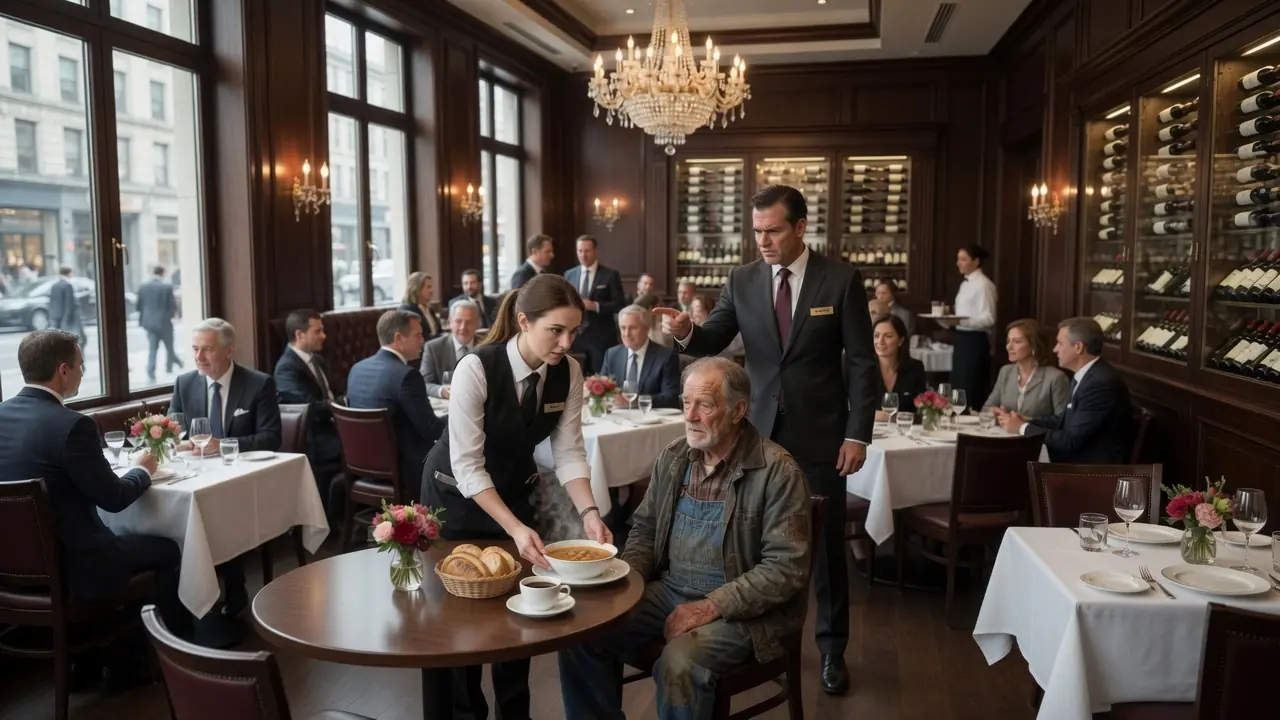
Emily had endured it because she needed the job.
Her father’s medical bills had consumed what little savings she had. Her younger brother was completing his final semester at community college, and Emily had promised their father before he died that she would help him finish.
Promises were expensive.
Douglas pointed at Walter.
“Take the bowl away.”
Emily did not move.
Walter laid his spoon beside the bowl.
“I’ll leave,” he said.
“No,” Emily replied.
Douglas turned sharply toward him. “You should have never come in.”
Walter’s expression remained calm.
“I saw a sign that said everyone was welcome.”
“Paying customers are welcome.”
“I have money.”
Douglas looked at the coins still resting near the old man’s hand and laughed loudly enough for the room to hear.
“That wouldn’t cover the napkin.”
A few diners looked away.
Others watched with the uncomfortable fascination people often mistook for helplessness.
Emily felt heat rise into her face.
“That’s enough,” she said.
Douglas stared at her.
“What did you say?”
“I said that’s enough.”
His smile disappeared.
Emily walked to Walter’s table, picked up his ticket, and carried it to the register. She removed eight dollars from the tips in her apron and placed the bills beside the screen.
“Paid in full.”
Douglas looked down at the money.
Then he looked at Emily.
“Take off your apron.”
The room seemed to contract around her.
“Douglas—”
“You are insubordinate, disrespectful, and apparently too emotional to understand basic business. Take off your apron and leave.”
Noah stopped wiping the table.
Emily’s fingers went cold.
She had worked at Harrington’s Grill for six years. She had covered double shifts, missed birthdays, endured burns, insults, and customers who snapped their fingers at her as though summoning a dog. She had never been written up. She had never arrived late.
Douglas knew all of that.
He also knew she needed the paycheck.
“That isn’t a lawful reason to fire someone,” she said quietly.
“It’s my reason.”
“Harrington’s has an employee policy.”
“I run Harrington’s.”
“No,” Walter said from behind them. “You manage it.”
Douglas turned.
The old man had risen from the table. He stood slightly stooped, but something in his posture had changed. The weakness Emily had first noticed seemed less certain now, as though it belonged partly to exhaustion and partly to a decision not to reveal his full strength.
Douglas stepped toward him.
“Get out before I call the police.”
Walter’s eyes moved to the framed black-and-white photograph behind the register.
It showed Harrington’s Grill on opening day in 1968. A smiling young couple stood beneath the original sign, surrounded by cooks, waitresses, and townspeople. The man wore a white apron. The woman held an enormous pair of ceremonial scissors.
Walter looked at the photograph for several seconds.
Then he turned to Emily.
“I’m sorry.”
“You didn’t do anything wrong.”
“That remains to be seen.”
Douglas grabbed Emily’s apron tie and yanked it loose.
Gasps moved through the dining room.
The apron fell to the floor.
“Now you’re fired,” he said. “And if you ever come back, I’ll have you arrested for trespassing.”
Emily looked down at the apron, then at the customers who had watched everything.
No one spoke.
Walter bent and picked it up.
He folded it carefully, smoothing the fabric across his forearm.
Douglas pointed toward the door.
“Both of you. Out.”
Walter handed Emily the apron.
When his fingers touched hers, he pressed a small brass object into her palm.
She looked down.
It was an old key attached to a faded leather tag. A number had been stamped into the leather: 17.
“What is this?” she whispered.
“A debt,” Walter said.
Before she could ask what he meant, he walked toward the exit.
The bell above the door rang as cold air swept into the restaurant.
Emily stood motionless for another moment. Then she picked up her coat from the employee hook, walked past Douglas without looking at him, and followed Walter into the snow.
Outside, the wind bit through her uniform.
Walter stood beneath the awning, staring across the street.
“You have somewhere to go?” Emily asked.
“Yes.”
“Somewhere warm?”
He nodded.
She did not believe him.
“There’s a shelter three blocks east.”
“I know.”
“I could walk with you.”
Walter glanced at her.
“You just lost your job because of me.”
“I lost my job because Douglas Vance is cruel.”
“That distinction won’t pay your rent.”
Emily closed her fingers around the brass key.
“What does this open?”
Walter looked at the key, and the tiredness returned to his face.
“Something I should have opened a long time ago.”
Then he stepped away from the awning.
Emily caught his sleeve.
“Wait.”
He stopped.
She pulled a twenty-dollar bill from her purse, nearly half the cash she had left until payday, and held it out.
Walter’s gaze hardened.
“I told you. I don’t take charity.”
“And I told you this isn’t charity.”
“What is it?”
“A loan.”
“For what?”
“Breakfast.”
The corner of his mouth lifted.
“Interest rate?”
“One honest answer when I see you again.”
He accepted the bill.
“You may not like the answer.”
“I’ll take that chance.”
Walter placed the money in his coat pocket and disappeared into the blowing snow.
Emily remained beneath the awning until she could no longer see him.
When she finally turned toward the employee parking lot, she noticed Douglas watching through the restaurant window.
He was smiling.
By the time Emily reached her apartment, the snow had become heavy enough to erase the tire tracks behind her car.
She lived on the second floor of a converted house near the edge of town, in two rooms with sloping ceilings and radiators that knocked through the night. Her brother, Luke, sat at the kitchen table surrounded by engineering textbooks and empty coffee cups.
He looked up when she entered.
“You’re early.”
Emily removed her wet coat.
“I got fired.”
Luke stared at her.
“What?”
She told him what had happened.
As the story unfolded, anger sharpened his features. At twenty-two, Luke carried their father’s dark hair and their mother’s inability to hide what he felt.
“I’m going back there,” he said.
“To do what?”
“Talk to him.”
“Douglas doesn’t listen. He waits for people to stop speaking.”
“Then I’ll give him something else to think about.”
Emily pointed at his books.
“You have a final design presentation Monday. That’s what you’re thinking about.”
“You paid for my tuition because Dad asked you to. You’ve been carrying everything for three years.”
“I haven’t been carrying everything.”
“You sold your car.”
“It was unreliable.”
“You moved out of your apartment.”
“The rent was ridiculous.”
“You work sixty-hour weeks.”
“Worked.”
Luke pushed away from the table.
“This isn’t funny.”
“I know.”
For several seconds, neither spoke.
Their father, Thomas Carter, had died eighteen months earlier after a long struggle with kidney disease. Before his health failed, he had worked as a maintenance mechanic at Harrington’s Grill for almost twenty years.
He could repair ovens, refrigerators, dishwashers, and furnaces with the patience of a surgeon. Emily still remembered him returning home after midnight smelling of metal, grease, and coffee, his hands cracked but his voice cheerful.
Harrington’s had once been more than a restaurant to the Carter family.
It had been where Emily learned to carry three plates on one arm. It had been where Luke did homework in a corner booth while their father repaired the freezer. It had been where their mother celebrated her final birthday before cancer took her.
But the restaurant had changed after Douglas became manager.
So had their father.
During the final months before his illness forced him to stop working, Thomas had often come home silent. Twice, Emily had found him examining old paperwork at the kitchen table. Once, he had burned a letter in the sink before she could read it.
She had assumed he was ashamed of losing his strength.
Now she wondered whether something else had been troubling him.
Luke noticed the key in her hand.
“What’s that?”
“The old man gave it to me.”
He turned it over.
“Seventeen.”
“He said it opened something he should have opened a long time ago.”
“That doesn’t sound ominous at all.”
Emily took it back.
“He was strange.”
“Strange how?”
“He noticed things.”
“What things?”
“Everything.”
She thought of Walter studying the restaurant, the photograph, Douglas, and the kitchen doors. She remembered the way he had corrected Douglas.
You manage it.
“He didn’t seem homeless,” she said.
Luke raised an eyebrow.
“You said he had ten coins and a coat held together by hope.”
“I said he looked poor. That isn’t the same thing.”
“Did he tell you where he lives?”
“No.”
“Full name?”
“Just Walter.”
Luke returned the key.
“Maybe number seventeen is a locker.”
“At a bus station?”
“Or a bank.”
Emily shook her head.
“Banks don’t use keys like this anymore.”
Their father’s old wooden toolbox sat beneath a shelf near the refrigerator. Emily’s eyes moved toward it.
Thomas had given away most of his tools during his final illness, but he had asked Emily to keep the box.
She pulled it into the light.
Luke knelt beside her as she lifted the lid.
Inside lay a socket set, measuring tape, voltage tester, several worn screwdrivers, and a stack of folded shop towels. Beneath the towels was a shallow tray containing screws, washers, and keys.
Emily emptied them onto the floor.
There were house keys, padlock keys, and two small keys labeled in her father’s handwriting.
Neither carried the number seventeen.
Luke searched the lower compartment.
His fingers struck something beneath a false wooden panel.
“What’s this?”
Together they lifted the panel.
A sealed envelope lay beneath it.
Emily recognized her father’s handwriting immediately.
For Emily, when Harrington’s changes hands.
Her pulse quickened.
Luke looked at her.
“Did you know about this?”
“No.”
She opened the envelope carefully.
Inside was a single sheet of paper and a photograph.
The photograph showed Thomas Carter as a young man standing beside another mechanic in front of Harrington’s Grill. The other man was taller, with thick dark hair and a pale scar near his left temple.
Emily brought the picture closer.
Even forty years younger, Walter’s eyes were unmistakable.
On the back, Thomas had written two names.
Thomas Carter and Walter Harrington, 1979.
Luke read over her shoulder.
“Harrington?”
Emily unfolded the letter.
Em,
If you are reading this, then something has happened that I hoped I would live long enough to prevent.
Harrington’s Grill was founded by Arthur and Margaret Harrington. Their son, Walter, was my closest friend. He left Cedar Falls after a terrible accident in 1981, and most people believed he died years ago. I learned otherwise.
Walter still owns part of the restaurant.
Not a symbolic share. A controlling interest protected by the original partnership agreement.
Someone has been trying to erase that fact.
The proof is in Box 17 at Cedar Falls Community Bank. The key belongs to Walter, but if he returns and gives it to you, it means he trusts you.
Do not give the contents to Douglas Vance.
Do not take them to the local attorney named Philip Grant.
And before you believe anything you are told about the fire, ask who locked the basement door.
Dad
Emily read the letter twice.
Luke’s voice came quietly.
“What fire?”
She looked at the photograph again.
In the background, a young Arthur Harrington stood beneath the restaurant sign, smiling with one hand raised.
Emily remembered the old framed newspaper clipping in the hallway near the restrooms.
LOCAL RESTAURATEUR’S SON MISSING AFTER WAREHOUSE BLAZE.
The article had been there for years.
Most customers passed without reading it.
According to the story, Walter Harrington had vanished after a fire destroyed a supply warehouse owned by the family. One employee died. Walter, who had been working there that night, was presumed responsible for faulty equipment and suspected of fleeing before investigators could question him.
Emily felt the brass key grow heavy in her palm.
“Dad knew him,” she said.
“And Douglas knows something about him.”
Luke stood.
“We need to go to the bank.”
“It’s nearly ten.”
“Tomorrow.”
Emily looked toward the window.
Snow pressed against the glass.
Somewhere in Cedar Falls, an old man in a thin coat carried twenty borrowed dollars and a past her father had hidden for decades.
The following morning, Emily awoke to pounding on the apartment door.
She opened it to find Noah, the busboy from Harrington’s, standing in the hallway.
His cheeks were red from the cold.
“You need to see this.”
He held out his phone.
A video filled the screen.
Douglas stood in the restaurant dining room, speaking directly to someone recording him.
“Last night, an employee was terminated after giving away food and creating a disturbance with an intoxicated vagrant. Harrington’s Grill remains committed to the safety of its customers and staff.”
The video had been posted to the restaurant’s social media page.
Below it were hundreds of comments.
Some defended Emily.
Others accused her of staging the incident for attention.
Several claimed Walter had threatened Douglas.
“He edited the security footage,” Noah said. “He posted a clip that starts after you paid. It makes it look like the old man was yelling.”
“Walter never raised his voice.”
“I know.”
“Why are you here?”
Noah looked down the hallway.
“Because Mr. Vance spent half the night in his office making calls. He told someone named Grant that ‘the old ghost finally walked through the door.’”
Emily’s breath caught.
“Philip Grant?”
“I don’t know. Then he said, ‘The Carter girl has the key.’”
Luke appeared behind Emily.
“How would he know about the key?”
Noah swallowed.
“There’s a camera above the register. It recorded the old man handing it to you.”
Emily grabbed her coat.
“Where’s Douglas now?”
“At the restaurant. But he sent two men to your father’s old house.”
The Carter family home had been empty since Thomas died. Emily had delayed selling it because the roof needed repairs and the mortgage balance was nearly equal to the property’s value.
She drove there with Luke and Noah following in Luke’s truck.
When they arrived, the back door stood open.
Drawers had been pulled from cabinets. Closets had been emptied. Thomas’s bedroom was torn apart, the mattress slashed and the floorboards pried loose.
Luke moved through the damage with clenched fists.
“They were looking for the letter.”
Emily held the envelope inside her coat.
“And they didn’t find it.”
A car door closed outside.
She turned.
A black sedan waited at the curb.
Philip Grant climbed out.
He was in his early sixties, silver-haired and broad-shouldered, with the careful smile of a man accustomed to being trusted before he earned it. Emily recognized him from local charity banquets and newspaper photographs.
Grant had served as Harrington’s corporate attorney for more than thirty years.
He surveyed the broken door.
“This is unfortunate.”
Luke stepped toward him.
“You did this.”
Grant’s smile remained.
“That is a serious accusation.”
“What do you want?” Emily asked.
“To prevent you from making a mistake.”
“You mean opening Box 17?”
For the first time, his expression changed.
Only slightly.
But enough.
“Your father filled your head with stories,” Grant said. “Thomas was a loyal employee, but near the end, his medication affected his judgment.”
“My father wrote that before he became sick.”
“You don’t know when he wrote it.”
“I know his handwriting.”
Grant adjusted one glove.
“Walter Harrington is unstable. He has spent decades blaming others for a tragedy he caused. If he approached you, it was because he wants access to documents that do not belong to him.”
“Then why did he have the key?”
“He stole it.”
“Forty-five years ago?”
Grant sighed.
“Emily, you are unemployed. Your family has debts. I can persuade Douglas to withdraw the statement he made about you and provide a generous severance payment.”
“How generous?”
“Fifty thousand dollars.”
Luke stared at him.
“For a key?”
“For your cooperation.”
Emily studied Grant’s face.
A man did not offer fifty thousand dollars for a meaningless piece of brass.
“What’s in the box?”
“Old records that could be misunderstood.”
“By whom?”
“People who don’t understand business law.”
“Or people who understand it too well?”
Grant’s smile vanished.
“Your father made the mistake of believing loyalty could excuse theft. Do not repeat it.”
He returned to his sedan.
Before getting in, he looked back at her.
“Box 17 cannot be opened without Walter Harrington present. And if he enters that bank, he will be arrested.”
“For what?”
Grant closed the car door without answering.
At eleven fifteen, Emily walked into Cedar Falls Community Bank with Luke beside her and the key hidden inside her glove.
The lobby was quiet.
A security guard nodded politely. Two tellers worked behind a marble counter beneath a clock that ticked loudly in the winter stillness.
Emily asked to speak with the vault manager.
A woman named Mrs. Alvarez led them into a private office.
When Emily placed the key on the desk, Mrs. Alvarez examined the leather tag.
“Box 17,” she said. “This is one of our original safe-deposit boxes.”
“Who owns it?”
The woman typed into her computer.
Her eyebrows lifted.
“The ownership record is restricted.”
“Restricted by whom?”
“Our legal department.”
Emily slid her father’s letter across the desk.
Mrs. Alvarez read it, then looked at Emily differently.
“Please wait here.”
She left the office.
Ten minutes passed.
Then twenty.
Luke paced near the door.
“She’s calling Grant.”
“Or the police,” Emily said.
At the thirty-minute mark, the office door opened.
Walter entered.
He no longer wore the frayed brown coat.
He wore a dark wool overcoat over a navy suit, polished black shoes, and a white shirt fastened at the throat. His gray hair had been combed back. The transformation was startling, but not because he suddenly looked wealthy.
He looked authoritative.
Behind him stood Mrs. Alvarez and a younger man carrying a leather briefcase.
Emily rose.
“You owe me an honest answer.”
Walter nodded.
“I do.”
“Are you Walter Harrington?”
“Yes.”
“The owner of Harrington’s Grill?”
“Possibly.”
Luke frowned.
“That isn’t an answer.”
Walter removed his gloves.
“My parents founded the restaurant. When my mother died, her shares passed to me. When my father died, his will divided the remaining ownership between me and a family trust. But the documents proving that were supposedly destroyed.”
“In the warehouse fire,” Emily said.
Walter’s gaze sharpened.
“You found Thomas’s letter.”
“He said the proof is in Box 17.”
“He believed it was.”
“You don’t know?”
“I have not opened that box in forty-five years.”
The younger man placed his briefcase on the desk.
Walter introduced him as Daniel Ruiz, an attorney from Chicago.
“Not one of Grant’s friends,” Walter added.
Emily held out the key.
“Why did you give this to me?”
“Because Thomas said you would know what to do.”
“My father knew you were alive.”
“He saved my life.”
The room fell silent.
Walter sat slowly.
“In 1981, Harrington’s had begun expanding. My father trusted Philip Grant, who was then a young accountant working for the company. Grant convinced him to purchase a distribution warehouse outside town.”
Walter’s fingers tightened around his gloves.
“I discovered invoices for equipment that had never been delivered. Money was disappearing through shell companies. I confronted Grant at the warehouse. He denied everything. That night, a fire started in the basement.”
“Who locked the basement door?” Emily asked.
Walter looked at her.
“Grant.”
Luke stopped pacing.
Walter continued.
“He struck me from behind and left me there. Thomas was working late at the restaurant when he smelled smoke from three blocks away. He ran to the warehouse and broke a window. He pulled me out.”
“But someone died,” Emily said.
“Samuel Reed, the night watchman. Grant told investigators I had caused the fire while stealing company money. By the time I regained consciousness, Samuel was dead, my father believed the evidence, and a warrant had been issued for me.”
“Why did you run?”
“I didn’t. Thomas took me to a hospital in another county under a false name because Grant had threatened him. Then my father suffered a heart attack.”
Walter looked toward the office window.
“When Arthur Harrington died, Grant produced documents showing that my shares had been transferred before the fire. Thomas suspected forgery, but he had no proof. He told me to stay away until he could find it.”
“And then?” Emily asked.
“I left Ohio. I changed my name for a time. I worked in factories, then construction. Eventually, I built a logistics company in Illinois. I hired investigators. Every trail led back to Grant, but the original records were gone.”
“Until Box 17.”
Walter nodded.
“Thomas found something fifteen years ago. He refused to tell me what. He said the fewer people who knew, the safer it would be. We agreed that if Grant ever tried to sell the restaurant or destroy it, Thomas would contact me.”
Emily thought of her father’s final months.
“He was trying to contact you before he died.”
“I was overseas. By the time I returned, he was gone.”
Pain flickered across Walter’s face.
“I failed him.”
“No,” Emily said. “Grant isolated him.”
Walter looked at her.
“That is a kind interpretation.”
“It’s the true one.”
Mrs. Alvarez cleared her throat.
“The bank requires both registered parties for Box 17.”
“Both?” Emily asked.
Mrs. Alvarez turned the computer screen.
Two names appeared on the account.
Walter Harrington.
Thomas Carter.
Emily stared.
“My father owned the box?”
“As joint custodian.”
“Then his legal heir can authorize access,” Daniel Ruiz said.
Mrs. Alvarez nodded. “With proper identification and the death certificate.”
Emily had both in the document folder she carried for matters involving the house.
Twenty minutes later, they stood inside the vault.
Box 17 was longer than Emily expected, a narrow steel drawer nearly three feet deep.
Walter inserted the brass key.
Mrs. Alvarez inserted the bank’s master key beside it.
They turned them together.
The lock opened with a heavy metallic click.
Mrs. Alvarez left them in a private viewing room.
Walter placed the box on a table.
For several seconds, no one moved.
Then Emily lifted the lid.
Inside lay a stack of ledgers wrapped in oilcloth, a reel of magnetic tape, several notarized agreements, and a sealed red envelope.
Daniel examined the top document.
“This is the original Harrington partnership agreement.”
Walter leaned closer.
The signatures of Arthur Harrington, Margaret Harrington, and Walter Harrington appeared at the bottom.
A clause on the second page stated that no ownership shares could be transferred without unanimous written consent from all three partners or their legal heirs.
Grant’s alleged transfer was invalid.
Luke opened one ledger.
“These are payments.”
Daniel studied the entries.
“Payments to companies controlled by Grant.”
Emily reached for the red envelope.
Her name was written on it.
Emily Carter.
She opened it.
Inside was a letter from her father and a small cassette tape.
Emily,
If Walter is beside you, then the truth survived longer than I did.
The ledgers prove Philip Grant stole from the Harrington family. The tape proves he set the fire.
But there is something Walter does not know.
I was not merely a witness who rescued him.
I helped Grant falsify the first set of invoices.
Emily’s breath stopped.
Luke read over her shoulder, his face paling.
Walter remained still.
Thomas’s letter continued.
I was twenty-four, newly married, and desperate for money. Grant promised me two thousand dollars to approve deliveries that never arrived. I told myself no one would be hurt.
When Walter discovered the theft, Grant panicked.
I followed him to the warehouse because I intended to confess. I arrived after the fire began. I heard Walter pounding behind the basement door.
I broke the window and pulled him out, but Samuel Reed was already trapped on the second floor.
For forty-five years, Walter believed I saved his life.
The truth is that my cowardice helped place him in danger.
The cassette contains a recording I made during my final meeting with Grant. He believed I was asking for money. I was gathering proof.
I could not undo the fire.
I could not bring Samuel back.
But I tried to protect what remained.
Emily, your kindness has always been stronger than my fear. Do what I could not.
Tell the truth, even if it changes how you remember me.
Dad
Luke sat down hard.
“No.”
Emily’s vision blurred.
Walter took the letter from her trembling hand and read it.
The silence that followed felt almost physical.
“My father was part of it,” Emily whispered.
Walter folded the letter carefully.
“He was twenty-four.”
“He took the money.”
“Yes.”
“Samuel Reed died.”
“Yes.”
“And Dad let everyone believe he was innocent.”
Walter looked at the cassette.
“Then he spent forty-five years trying to repair what he had done.”
“That doesn’t erase it.”
“No.”
His answer was gentle but absolute.
“It doesn’t.”
Emily wiped her face.
She had expected the box to expose Douglas and Grant. She had not expected it to fracture the memory of the man she loved most.
Luke stood abruptly.
“We don’t have to release that part.”
Emily looked at him.
“The ledgers are enough.”
“The tape might be enough,” Luke said. “Dad’s letter is private.”
“Samuel Reed had a family.”
“And Dad is dead.”
“So is Samuel.”
Luke’s jaw tightened.
“You want everyone in this town to remember Dad as a criminal?”
“I want them to remember the truth.”
“Easy for you to say. You’re not finishing school under his name.”
Emily flinched.
Walter stepped between them.
“Thomas expected this argument.”
Luke glared at him.
“You don’t know anything about our family.”
“I know guilt. And I know what it costs when truth is delayed because someone fears shame.”
Walter placed the letter beside the cassette.
“Your father did something wrong. Then he did something courageous. Both are true.”
Daniel located an old cassette player through a bank employee.
When the tape began, Thomas Carter’s voice filled the room.
It was weaker than Emily remembered, but unmistakable.
“Tell me again why Walter had to disappear.”
Grant’s younger voice answered.
“Because he found the invoices.”
“And the fire?”
“A solution that became untidy.”
“You locked him in.”
“I locked a problem in a basement. You chose to pull it out.”
“What about Samuel?”
A pause followed.
“Collateral damage.”
Luke covered his mouth.
The recording continued for eleven minutes.
Grant admitted forging Walter’s transfer documents. He described paying investigators, bribing a county records clerk, and using the Harrington family trust to seize control of the restaurant.
Then Thomas asked about Douglas.
Grant laughed.
“Vance is useful. He signs what I put in front of him and thinks the restaurant will become his once we sell the property.”
“Sell it to whom?”
“Marston Development. Condominiums, retail space, parking garage. Harrington’s will be rubble by summer.”
The tape ended.
Emily looked at Walter.
“When is the sale?”
Daniel checked his phone.
“According to county filings, the property transfer is scheduled for today at three.”
It was already twelve forty.
Walter closed the box.
“Then we have two hours.”
At one fifteen, Douglas Vance stood inside Harrington’s Grill directing employees to hang a banner for the restaurant’s upcoming sixtieth anniversary.
He had slept little, but triumph kept him upright.
By evening, the sale agreement would be signed. Grant had promised him a management position in the new development and a payment large enough to buy a house in Florida.
Harrington’s Grill, with its cracked floors, aging pipes, and sentimental regulars, would no longer be his problem.
Neither would Emily Carter.
Douglas was rehearsing a statement for the local newspaper when a server approached.
“There are police outside.”
His stomach tightened.
“Why?”
“I don’t know.”
Through the front windows, he saw two patrol cars pull to the curb.
Then came a black luxury SUV.
Another SUV stopped behind it.
Walter Harrington stepped out first.
He wore the dark suit Douglas had never imagined him owning.
Daniel Ruiz emerged beside him carrying a briefcase. Emily and Luke followed. Behind them came Mrs. Alvarez from the bank and two state investigators.
Customers began turning in their seats.
Douglas hurried toward the entrance.
“You’re banned from this property.”
Walter opened the door.
“No,” he said. “You are.”
The room went silent.
Douglas looked toward the officers.
“This man is trespassing.”
One investigator displayed a badge.
“We have a warrant to search the management office and seize financial records.”
“For what?”
“Fraud, conspiracy, evidence tampering, and obstruction connected to the 1981 Harrington warehouse fire.”
Color drained from Douglas’s face.
He reached for his phone.
Emily noticed.
“Calling Grant?”
Douglas glared at her.
“You caused this.”
“No. You just fired the person who finally opened the box.”
A murmur moved through the restaurant.
Noah stood near the kitchen doors, watching with open satisfaction.
Walter walked to the framed opening-day photograph.
For the first time since entering, his composure cracked.
He touched the glass over his mother’s face.
“I haven’t stood in this room since I was thirty-one years old.”
One of the older customers rose from a booth.
“Walter?”
The voice belonged to Ruth Mason, a retired schoolteacher who had lived in Cedar Falls her entire life.
She approached slowly.
“My God. It is you.”
Walter turned.
Ruth’s eyes filled with tears.
“They said you ran.”
“I know.”
“They said you killed Samuel.”
“I know.”
Ruth reached for his hand.
“I never believed it.”
Douglas backed toward the office.
An investigator blocked him.
“You need to remain here.”
“This is absurd. Philip Grant owns this restaurant.”
“No,” Daniel said. “Philip Grant controls a trust through documents that have now been demonstrated to be fraudulent.”
Douglas looked at Walter.
“You think you can walk in here after forty-five years and take everything?”
Walter’s gaze settled on him.
“I walked in here last night with ten coins.”
Several customers shifted uncomfortably.
“You saw an old man who could not afford soup, and you decided his hunger made him less human. That told me more about how you run this restaurant than any financial report could.”
Douglas pointed at Emily.
“She violated policy.”
“She paid for the meal.”
“She embarrassed management.”
“You embarrassed yourself.”
The front door opened again.
Philip Grant entered with two attorneys.
He stopped when he saw the investigators.
For one second, fear showed clearly on his face.
Then the polished smile returned.
“This appears to be a misunderstanding.”
Daniel placed certified copies of the partnership agreement on a table.
Grant scanned the first page.
His smile faded.
“Where did you find this?”
“Box 17,” Emily said.
Grant looked at her with naked hatred.
“Your father was a thief.”
Emily’s throat tightened.
“Yes,” she said. “For one night, he was.”
Luke turned toward her, startled.
The entire restaurant listened.
Emily continued.
“He helped falsify invoices. His actions helped create the situation that led to Samuel Reed’s death. Then he rescued Walter, preserved the evidence, and spent the rest of his life trying to expose what he had done.”
Grant laughed sharply.
“You think confessing for a dead man makes you brave?”
“No. Standing here while you’re still alive does.”
One of the investigators held up a sealed evidence bag containing the cassette.
Grant’s expression changed.
“We also have your recorded confession,” the investigator said.
“That tape is illegal.”
“Admissibility will be decided by a judge.”
“You have no proof it is authentic.”
“We have ledgers, bank records, original contracts, handwriting samples, and a recording currently undergoing verification.”
Grant looked toward the exit.
A second officer stepped in front of it.
Douglas moved closer to him.
“Philip, tell them.”
Grant ignored him.
“You said the documents were destroyed,” Douglas whispered.
Grant’s eyes remained on Walter.
“I should have made sure you died in that basement.”
The words escaped before he could stop them.
No one moved.
Then Daniel looked at the investigator.
“I believe everyone heard that.”
Grant’s face collapsed.
Douglas stepped away from him.
“No,” Douglas said. “You told me Walter was a fraud.”
Grant turned on him.
“And you believed it because you are an idiot.”
“You said the sale was legal.”
“You signed every document.”
“Because you told me to.”
“Then perhaps prison will teach you to read.”
Douglas lunged.
The officers restrained him before he reached Grant.
Chairs scraped as customers stood.
Grant was handcuffed first.
Douglas followed after investigators found shredded trust documents in the office and copies of payments from Marston Development deposited into an account under his wife’s maiden name.
As the officers led him past Emily, Douglas stopped.
“You think this makes you important?”
Emily met his eyes.
“No.”
She looked toward Walter.
“But it reminded me that you never were.”
By sunset, the news had spread across Cedar Falls.
Walter Harrington had returned.
Philip Grant had been arrested.
The Harrington’s property sale had been blocked by court order.
And Emily Carter’s father, long remembered as a quiet mechanic who could repair anything, had left behind both a confession and the evidence that dismantled a forty-five-year lie.
For the next several weeks, the restaurant remained closed.
Investigators searched the office, basement, and storage areas. Reporters gathered outside. Old employees came forward with stories of missing pension contributions, altered payroll records, and threats from Douglas.
The town argued about Thomas Carter.
Some called him a criminal.
Some called him a hero.
Emily resisted both descriptions.
He had been her father.
A frightened young man who made a terrible choice.
A loyal friend who ran into a burning building.
A guilty man who waited too long to confess.
A dying man who trusted his daughter to finish what he could not.
All of those truths belonged to him.
Walter stayed in Cedar Falls.
He rented a modest room at the Riverside Hotel, although Emily later learned he owned homes in Chicago and Arizona. Most mornings, he visited Harrington’s Grill and stood alone inside the dining room.
Emily joined him one morning in February.
Dust floated through the sunlight. Chairs had been turned upside down on the tables. The opening-day photograph remained behind the counter.
“You could tear it down,” Emily said.
“The restaurant?”
“Yes.”
Walter looked around.
“Grant nearly did.”
“I mean you. You could sell the land, demolish the building, and be finished with it.”
“That would be easy.”
“Easy isn’t always wrong.”
“No. But it often leaves the important work undone.”
He walked toward the kitchen.
Engineers had found outdated wiring, damaged ventilation, leaking pipes, and floor supports weakened by years of neglect.
“Restoring this place will cost a fortune,” Emily said.
“I have one.”
She smiled.
“I noticed.”
Walter leaned against the counter.
“My parents believed a restaurant should do more than sell food. During the steel strike in 1974, my mother served hundreds of meals without charging. My father nearly had a nervous breakdown over the accounts.”
“Was he angry?”
“He pretended to be. Then he doubled the soup order.”
Walter looked toward the table where Emily had served him.
“When I came in that night, I did not intend to reveal who I was.”
“Why did you come?”
“To see whether anything worth saving remained.”
“And?”
“You fed me.”
“One bowl of soup is a low standard for a multimillion-dollar investment.”
“It wasn’t the soup.”
Emily folded her arms.
“What was it?”
“You acted when everyone else watched.”
He handed her a folder.
Inside was a business proposal.
The first page carried the Harrington’s Grill logo.
Below it were two names.
Walter Harrington, Owner.
Emily Carter, Operating Partner.
She stared at him.
“No.”
“You haven’t read it.”
“I don’t need to.”
“That is not a responsible business practice.”
“I’m a waitress.”
“You managed every crisis in this building for six years while Douglas took credit.”
“I carried plates.”
“You trained staff, handled customer complaints, corrected inventory errors, scheduled shifts when Douglas disappeared, and knew which customers needed extra time to pay.”
Emily looked up.
“How do you know all that?”
“I asked.”
“Who?”
“Everyone.”
She turned the pages.
The proposal gave her a salary, profit sharing, and ten percent ownership after five years. It also included health insurance for employees, paid training, a community meal program, and a scholarship fund in Thomas Carter’s name.
Emily stopped reading.
“You shouldn’t name it after him.”
“Why?”
“Because of what he did.”
Walter considered that.
“Then we will name it the Carter-Reed Fund.”
“For Samuel?”
“For both families. It will support apprentices in restaurant maintenance, fire safety, and emergency systems.”
Emily closed the folder.
“Samuel’s family might not want that.”
“Then we will ask them.”
Walter nodded toward the proposal.
“I am not offering you a reward for kindness. Rewards are temporary. I am offering responsibility.”
“What happens if I fail?”
“You will.”
Emily blinked.
Walter smiled.
“Every owner fails. The important question is whether you fail honestly and repair what you damage.”
She looked around the empty restaurant.
For years, Harrington’s had carried the memory of her childhood, her parents, and all the choices that had shaped them.
Now it felt like an unfinished sentence.
“When do we start?” she asked.
Walter’s smile deepened.
“Yesterday.”
Renovations began in March.
Walter refused to replace the original red booths, although he agreed to have them repaired. The kitchen was rebuilt. The cracked tile disappeared. New fire doors, alarms, sprinklers, and ventilation systems were installed throughout the building.
Emily rehired every employee Douglas had dismissed for questioning him.
Noah returned as a full-time server while attending college.
The head cook, Mrs. Bell, came back under the condition that no manager would ever again purchase frozen gravy.
Luke designed an energy-efficient refrigeration system as his final engineering project. Walter paid him as a consultant and insisted he negotiate the fee himself.
The most difficult meeting took place with Samuel Reed’s granddaughter, Claire.
She was a fifty-two-year-old librarian living in Dayton. She arrived carrying a folder of newspaper clippings and a photograph of the grandfather she had never met.
Emily told her everything.
She did not soften Thomas’s role.
When she finished, Claire remained silent for a long time.
“My grandmother spent her life believing Walter killed him,” she said.
Walter lowered his eyes.
“I’m sorry.”
Claire looked at him.
“You were locked in a basement.”
“I survived.”
“My grandfather didn’t.”
“No.”
She turned to Emily.
“And your father knew?”
“Yes.”
“Why didn’t he come forward sooner?”
“Fear. Shame. Cowardice. I don’t know which mattered most.”
Claire’s mouth tightened.
“At least you’re honest.”
“I’m trying to be.”
Claire studied the proposal for the scholarship fund.
Finally, she touched the photograph of Samuel.
“He repaired radios,” she said. “People brought broken ones to the warehouse, and he fixed them during his night shifts.”
Emily smiled faintly.
“My father repaired everything.”
“Maybe that was their problem.”
“What?”
“They thought everything could be repaired.”
Claire closed the folder.
“Some things can’t.”
“No.”
“But some things can be made useful after they break.”
She agreed to the fund.
Harrington’s Grill reopened on the first Saturday in June.
A line formed before sunrise.
The restored sign glowed above the entrance. The windows had been widened, but the old lettering remained. Inside, the opening-day photograph hung beside a new display containing portraits of Arthur and Margaret Harrington, Samuel Reed, and Thomas Carter.
Beneath them was a simple inscription.
A place is not defined by the worst thing that happened inside it, but by what people choose to do afterward.
Emily wore a dark blue dress instead of a uniform. Walter stood beside her holding the same pair of ceremonial scissors his mother had used in 1968.
“Speech,” Noah whispered.
Emily shook her head.
“You’re the owner,” he said.
“Operating partner.”
“Still counts.”
The crowd quieted.
Emily looked at the employees gathered behind her, then at Claire Reed, Luke, Walter, and the townspeople waiting outside.
“I used to think Harrington’s was only a building,” she said. “Then I thought it was a memory. Now I know it’s a promise.”
She paused.
“A promise that no one who enters hungry will be humiliated. A promise that workers will be treated like people, not expenses. And a promise that the truth will always matter more than the reputation we are trying to protect.”
Walter handed her the scissors.
“You do it.”
Together, she and Claire cut the ribbon.
Applause filled the street.
For the first month, the restaurant lost money.
Walter appeared delighted.
“We are failing honestly,” he reminded Emily.
By the third month, every evening table was booked.
The community meal program served food after closing each night. Customers could purchase suspended meals for strangers, but Emily established one strict rule.
No recipient would ever be asked to prove need.
One rainy evening in October, an elderly woman entered wearing a wet coat and carrying a handful of coins.
She stood near the counter, studying the menu with growing embarrassment.
Emily approached.
Before she could speak, Walter appeared from a corner booth.
He had become a regular presence, although he insisted he was retired. He still noticed cracked tiles before anyone else, tested the coffee without permission, and questioned every invoice over fifty dollars.
The woman counted her coins.
“I think I have enough for tea.”
Walter looked at Emily.
She looked back at him.
Then she placed a bowl of soup, two rolls, and a cup of tea on a tray.
The woman shook her head.
“I can’t pay for all that.”
Emily covered the ticket with her thumb.
“You’ve already paid.”
Walter’s eyes warmed.
The woman glanced between them.
“How?”
Emily set the tray gently into her hands.
“You came inside.”
After she sat down, Walter reached into his pocket and placed something on the counter.
Three quarters and two nickels.
Emily laughed.
“You kept them?”
“I told you I remembered.”
She pushed the coins back toward him.
“Put the money back in your pocket.”
Walter looked toward the old photograph behind the register.
For a moment, Emily imagined all the people missing from the room.
Arthur and Margaret beneath the original sign.
Samuel repairing a radio on his night shift.
Thomas bent over a broken oven, grease on his hands, trying to repair more than machinery.
Their choices could not be changed.
But the restaurant was alive.
The truth had not destroyed it.
The truth had given it a chance to become something better.
Walter closed his fingers around the coins.
“Breakfast tomorrow?” he asked.
Emily smiled.
“Only if you can afford it.”
He glanced around the crowded dining room he had once entered wearing a frayed coat.
“I think I can manage.”