Danielle James stepped out of the private elevator on the fifty-second floor of Jameson Global headquarters at 7:48 on a Monday morning, wearing a dark navy suit, black heels, and no visible badge. She carried a small leather handbag in one hand and a slim folder in the other, moving quietly into the executive corridor before most of the senior staff had finished their first coffee. The floor was all glass walls, polished stone, steel accents, and silent conference rooms built to impress investors before they ever heard a number. It was also messier than it should have been.
A small trash bin sat tipped sideways near the elevator entrance, blocking part of the walkway with crumpled papers scattered across the floor. Danielle stopped, looked at it, and waited for one of the nearby employees to notice. A junior analyst hurried past, eyes fixed on her phone, stepping around the mess as if it belonged to someone invisible. Two assistants walked by next, glanced at the bin, and kept moving because someone else was probably supposed to handle it.
Danielle set her folder on a nearby console table and picked up the trash bin herself. She did not do it because she wanted to test anyone, at least not at first. She did it because she had built the company from twelve employees in a rented office, and she still believed leadership meant noticing what everyone else had learned to ignore. A company that stepped around small messes long enough eventually stepped around bigger ones too.
She had come that morning for an unannounced executive culture review. Jameson Global had grown fast over the last seven years, expanding into logistics, technology services, and corporate consulting across five states. Revenue was strong, profits were rising, and investors loved the clean reports coming from the executive team. Yet anonymous complaints had also begun reaching Danielle’s private office, and every one of them mentioned the same floor.
The complaints spoke of arrogance, retaliation, fear, and a vice president who treated junior staff like furniture. His name was Philip Grant, vice president of operations, and on paper he was brilliant. He cut costs, moved projects quickly, and delivered quarterly targets with the cold efficiency investors applauded. But the employee comments described something uglier beneath the numbers, a culture where people stayed silent because Philip had taught them silence was safer than honesty.
Danielle had not told anyone she was coming. She wanted to see the floor before it rearranged itself for her arrival, before assistants rushed to straighten chairs and executives practiced humility for the person who signed their bonuses. She wanted the morning as it really was. That was why she entered alone, without her chief of staff, without security beside her, and without the gold executive badge most employees recognized before they recognized her face.
She was near the central conference area when Philip Grant turned the corner in a red blazer, black trousers, and the aggressive confidence of a man already angry before anyone had spoken to him. He had a phone in one hand and a coffee in the other, but his eyes fixed immediately on the trash bin in Danielle’s grip. He did not look at her face first. He looked at the bin, then at her suit, then at her skin, and something sharp formed in his expression.
“Put the trash down, dirt woman,” Philip snapped. The words cut through the glass office like a slap, and every conversation on the executive floor stopped mid-sentence. A woman by the printer froze with documents in her hand. An assistant near the conference room lowered a coffee mug slowly, as if sudden movement might make the moment worse.
Danielle stood still, her hand resting on the rim of the bin. Her face did not change, but the air around her seemed to tighten. Philip stepped closer, pointing one finger inches from her face, his polished shoes clicking against the stone floor. “This floor is for executives,” he said. “Not janitors wandering around with trash.”
Danielle lowered the bin gently to the floor without breaking eye contact. “You should be careful how you speak on this floor,” she said. Her voice was calm, almost soft, but it reached every corner of the open space. The calm seemed to irritate Philip more than resistance would have.
Philip laughed once, loud and ugly. “Do not lecture me about this floor,” he said. “I run operations here.” He looked around, expecting agreement from employees who had learned to survive him by nodding at the right moments. No one nodded this time.
Danielle watched his face carefully. She was not surprised by the insult, though part of her still wished she could be. There had been boardrooms where men asked whose assistant she was, hotel lobbies where clerks spoke to the white man beside her instead of her, and investor dinners where someone complimented her “confidence” before learning she controlled the meeting. Success had changed her access, but it had not always changed what people assumed before she spoke.
“What department do you believe hired me?” Danielle asked. Philip narrowed his eyes. “Maintenance, custodial, whatever label they put on people who carry bins.” He flicked his fingers toward the floor. “Pick it up and go where you belong.”
A visible flinch passed through the room. Maya’s lips parted, but no sound came out. A senior analyst looked down at his shoes. One of the security guards shifted his weight, his face tightening because he understood the line had been crossed, but Philip’s title held him in place like a chain.
Danielle tilted her head slightly. “And where do I belong, Philip?” Hearing his name from her mouth made him blink, but only for a second. He mistook recognition for something harmless. He assumed every employee knew him because important people expected to be known.
“You belong off this floor,” Philip said. “And if you embarrass yourself further, I will have security drag you out.” He stepped forward and struck the side of the trash bin with his hand, knocking it over. Papers slid across the polished floor, spreading around Danielle’s feet while employees stared in stunned silence.
Danielle looked down at the scattered papers, then slowly back at Philip. She did not bend to pick them up. That refusal, small as it was, changed the temperature of the room. Philip had expected her to scramble, apologize, gather the mess, and disappear beneath the weight of his voice.
Instead, she stood taller. “Interesting,” she said. “You made the mess, and still expected me to clean it.” Philip’s face reddened. His finger rose again, sharper this time, almost touching her shoulder.
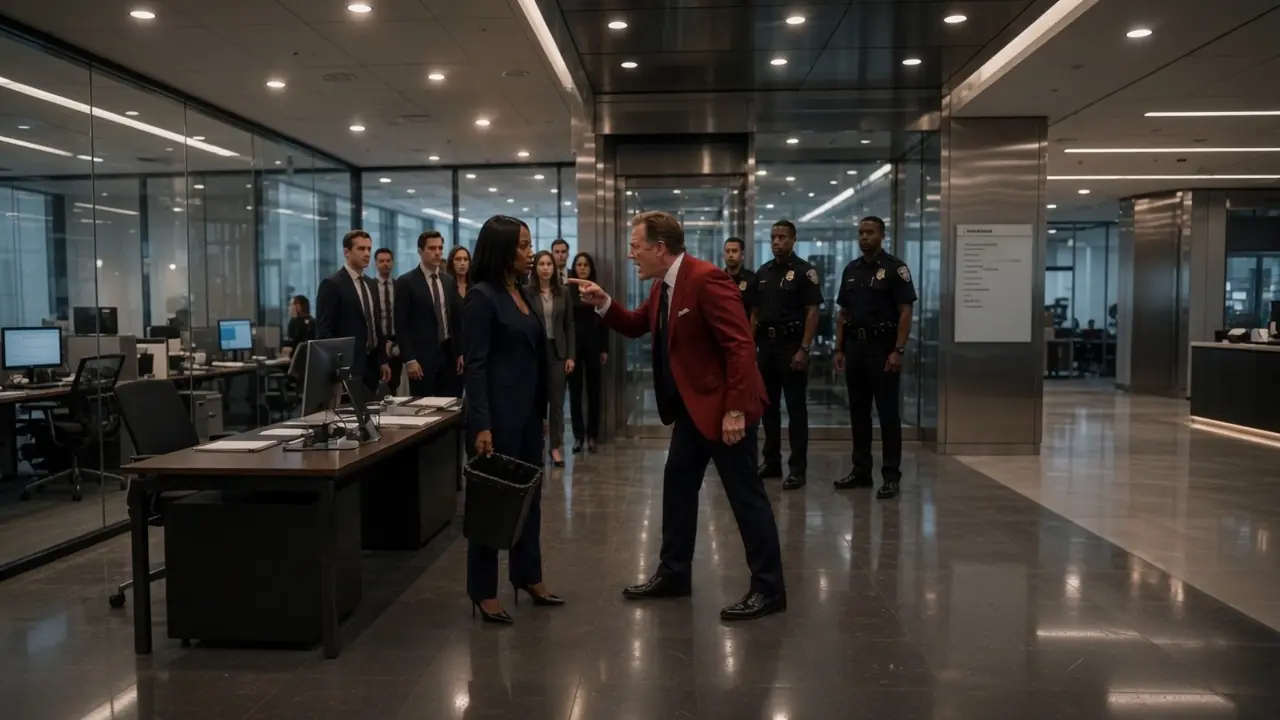
“You people always come in here acting like someone owes you patience,” he said. The words landed like poison, and this time several employees reacted openly. Maya whispered, “Oh my God,” before she could stop herself. The senior analyst finally lifted his head, shame visible across his face because he knew silence had helped Philip become this bold.
The elevator behind Danielle opened. Two corporate security officers stepped out in navy suits, holding tablets and wearing the focused expressions of people responding to a direct alert. Philip turned toward them immediately, relief flashing across his face. “Good,” he snapped. “That is her. She does not belong here.”
The taller officer glanced at his tablet, then at Danielle. His face changed instantly. The second officer stopped beside him, reading the same screen, and the blood seemed to drain from both their expressions at once. The taller one looked at Philip carefully. “Sir, her name is Danielle James.”
Philip cut him off before he could continue. “I don’t care who she is,” he barked. “Remove her from this floor now.” The sentence hung in the air, large and final, and several employees closed their eyes as if they already knew the next sound would be the collapse of a career.
Danielle reached into her handbag and removed a slim black access card. She held it between two fingers, not toward Philip, but toward the security officer. The officer looked at the card, then straightened immediately. “Ms. James,” he said, his voice tight with respect. “We were not aware you had arrived.”
Philip froze. “Ms. James?” he repeated. Danielle placed the access card on the nearby console table beside her folder. Her face remained unreadable. “Danielle James,” she said. “Founder, majority owner, and chief executive officer of Jameson Global.”
The office went completely silent. Someone near the glass wall inhaled sharply. Maya lowered her tablet to her side and stared at Philip with an expression that mixed fear, relief, and something close to vindication. Philip’s raised finger slowly lowered, as if his hand had finally realized what his mouth had done.
For several seconds, nobody spoke. Danielle allowed the silence to remain because silence often did what speeches could not. It forced the room to sit inside the truth without decoration. Philip Grant had insulted the woman who owned the company, spilled papers at her feet, and ordered security to remove her from the floor that existed because she had built it.
Philip swallowed and tried to recover. “Ms. James, I did not recognize you,” he said. His voice had changed entirely, becoming smaller, smoother, and suddenly respectful. Danielle studied him as if he were a document she had already decided to reject. “That is not an apology,” she said.
Philip’s eyes flicked toward the employees watching. Public humiliation had found him faster than remorse. “I apologize if my tone came across too strongly,” he said. Danielle’s expression hardened. “If?”
The word struck him in the chest. The taller security officer looked down at his tablet to avoid showing a reaction. Maya pressed her lips together, no longer afraid enough to hide her anger completely. Philip looked around again, but the room that once protected him was no longer offering cover.
Danielle stepped over the scattered papers and walked toward him. Philip did not move back, but his shoulders tightened. “You called me a dirt woman,” she said. “You assumed I was custodial because I held a trash bin. You knocked it out of my hand, threatened me with security, and said you did not care who I was.”
Philip’s mouth opened, then closed. Danielle continued, her voice still controlled. “The only thing that changed your tone was learning my title.” She looked around the room, letting every employee hear the next sentence. “That tells me the problem is not ignorance. It is character.”
The private elevator opened again. This time, three members of the executive leadership team stepped out, followed by Danielle’s chief of staff, Lena Morris, who had clearly been alerted by security. Lena saw the papers on the floor, Danielle standing in front of Philip, and the stunned faces across the office. Her jaw tightened.
“Ms. James,” Lena said, walking quickly to her side. “Are you all right?” Danielle did not look away from Philip. “I am fine.” Lena glanced at the red blazer, the spilled papers, and the officers near the elevator. “What happened?”
Danielle finally turned to the room. “I would like witnesses to answer that.” For a long moment, no one moved. Then Maya stepped forward, trembling but determined. “He called you a dirt woman,” she said. “He said this floor was for executives, not janitors, and he told security to remove you.”
Philip snapped his head toward her. “Maya, be very careful.” Danielle’s eyes turned cold. “No, Philip. You be careful.” The warning silenced him immediately.
The senior analyst stepped forward next. “He knocked the bin over,” he said. “And he said he did not care who you were after security identified you.” Another employee added, “He does this to people all the time.” The sentence opened something in the room, and once one person said it, fear began losing its grip.
A woman from compliance spoke next. “There have been complaints.” Lena turned sharply toward her. “How many?” The compliance employee swallowed. “At least six formal ones this year, maybe more informal reports.” Danielle looked at Lena, and Lena’s face revealed that she had not been given those numbers.
Philip rushed in. “Those were performance disputes,” he said. “Disgruntled employees trying to avoid accountability.” Danielle turned back to him slowly. “Every abuser calls accountability resentment when it comes from beneath them.” The sentence landed with enough force that even the executives behind her looked down.
Lena opened her tablet. “I want every complaint involving Mr. Grant pulled immediately,” she said. The compliance employee nodded and hurried toward her office. Philip’s panic became visible now, moving across his face in sharp lines. “Danielle, please, this is being blown out of proportion.”
The use of her first name made the entire room stiffen. Danielle’s eyes narrowed. “You do not call me Danielle.” Philip’s face twitched. “Ms. James,” he corrected quickly. “I have delivered results for this company for eight years.”
“Yes,” Danielle said. “You delivered numbers.” She stepped closer, her voice lowering. “But if your numbers were built on fear, silence, and humiliation, then they are not results. They are liabilities.”
One of the executives, Harold Price, cleared his throat carefully. “Ms. James, perhaps we should move this conversation into a private conference room.” Danielle looked at him, and Harold immediately regretted speaking. “Philip made his insult public,” she said. “The correction will not be hidden.”
No one argued. Philip stared at Harold, desperate for someone to rescue him with procedure. But procedure had arrived too late to save a man who had exposed himself in front of the people he thought would never speak. Danielle turned to the taller security officer.
“Remove Mr. Grant’s building access,” she said. Philip’s face went white. “Wait.” Danielle did not stop. “Disable his executive credentials, secure his office, and escort him to collect personal items under supervision.”
Philip took a step forward. “You cannot fire me on the spot.” Danielle looked at him with absolute calm. “I own the company. I can remove you from my building while legal completes the paperwork.” She picked up her folder from the console table. “And I am removing you.”
The words struck the room like a gavel. Philip’s mouth worked soundlessly for a moment. Then anger surged up again, reckless and frightened. “You are making a mistake,” he said. “Operations will collapse without me.”
Danielle’s face did not move. “A company that depends on one cruel man is already broken.” She looked toward Lena. “Appoint interim operations leadership by noon.” Lena nodded. “Already in motion.”
Philip looked around at the employees he had intimidated for years. None stepped forward. Some stared openly. Others looked away, not out of loyalty, but because watching consequences arrive can be difficult even when they are deserved.
Security moved to either side of him. Philip straightened his red blazer with shaking hands, trying to rebuild dignity from fabric. He looked at Danielle one last time. “I did not know who you were,” he said again, quieter this time.
Danielle’s expression softened only enough to become sad. “No,” she said. “You showed me exactly who you are.” The security officers guided him toward the elevator, and the crowd parted in silence.
As he passed Maya, Philip stopped. “You will regret this,” he muttered. Before Maya could respond, Danielle spoke from behind him. “No, Philip. Retaliation is what people feared from you. It will not survive me.” The officers moved him forward, and the elevator doors closed on his red blazer, his rage, and the authority he had mistaken for ownership.
The office remained frozen after he disappeared. The spilled papers still lay around Danielle’s feet. No one moved to pick them up until Danielle bent down herself, lifted one sheet, and handed it to Maya. Maya stared at it, confused.
“Help me clean this,” Danielle said. Her voice was gentle now. “Not because he ordered anyone to. Because this is our floor, and we do not leave messes for invisible people.” Maya nodded quickly, tears shining in her eyes, and knelt to gather the papers with her.
One by one, other employees joined. The senior analyst picked up scattered reports. The compliance employee returned with her tablet and paused, then bent to help too. Even Harold Price crouched awkwardly in his expensive suit, and the sight changed something in the room more than any memo could have.
When the floor was clean, Danielle stood and looked at the gathered staff. “What happened here is not only about Philip Grant,” she said. “It is about everyone who learned to stay quiet because speaking up felt dangerous.” Her eyes moved across the room, and several people lowered their gazes.
“I want honesty,” Danielle continued. “How many of you have seen behavior like this from him or anyone else in leadership?” At first, no hands rose. Then Maya lifted hers.
Another hand followed. Then another. Within seconds, nearly half the floor had raised their hands, and the executives behind Danielle looked visibly shaken. Lena’s face hardened as she took in the number.
Danielle nodded slowly. “That ends today.” Her voice was not loud, but no one missed a word. “No title in this company protects cruelty. No revenue number excuses humiliation. No executive will be rewarded for making employees afraid to speak.”
The compliance employee wiped at her eyes with the back of her hand. Danielle looked toward her. “Your name?” “Priya,” the woman answered. Danielle nodded. “Priya, you will send me every complaint, formal or informal, involving executive misconduct by five this evening.”
Priya straightened. “Yes, Ms. James.” Danielle turned to Lena. “Create an independent reporting channel outside the management chain by the end of the week.” Lena typed quickly. “Done.”
Harold Price spoke carefully. “We may face disruption in operations.” Danielle looked at him. “Good.” He blinked, surprised. She continued, “Some disruption is what happens when rot stops being ignored.”
The employees listened differently now. Danielle could see it in their faces, the cautious beginning of belief. They had seen leaders give speeches before, but speeches were cheap when the bully returned to his office afterward. This time, the bully had been escorted into the elevator he once used like a throne.
Danielle walked to the center of the floor, where everyone could see her. “I started this company because I was tired of rooms where people smiled upward and kicked downward,” she said. “Somewhere along the way, parts of this company became the kind of room I built it to replace.” She took a slow breath, and for the first time that morning, sadness crossed her face.
“That is my responsibility,” she said. The admission startled the executives most of all. “Philip chose his behavior, but leadership allowed his pattern to survive. I allowed reports to be filtered before they reached me, and that changes today.”
Maya’s hand tightened around her tablet. She looked like someone hearing a leader apologize without turning the apology into theater. Danielle noticed and met her eyes briefly. Maya stood taller.
By noon, Philip Grant’s office was sealed, his access revoked, and his termination review officially underway. By three, Danielle had spoken privately with twelve employees who had been insulted, threatened, dismissed, or punished for challenging him. By six, she had canceled the executive retreat scheduled for the following week and replaced it with a full leadership accountability audit.
News traveled through Jameson Global faster than any official memo. By the next morning, employees in other offices were sending messages to the independent inbox Lena had created overnight. Some reports involved Philip. Others named managers Danielle had never suspected.
It hurt to read them. Danielle sat alone in her office after midnight, scrolling through stories of people ignored, mocked, overworked, and silenced by leaders who looked impressive on quarterly charts. Her reflection in the dark window looked tired, but not defeated. Painful truth was still more useful than polished lies.
Three weeks later, Danielle held a company-wide meeting. Philip’s name was mentioned only once, as part of a larger pattern the company would no longer tolerate. She spoke about dignity, reporting power, and leadership accountability. Then she said something that became repeated across the company for years.
“If someone treats the lowest-paid person in the room with contempt,” Danielle said, “they are not ready to lead the highest-level meeting.” The sentence spread across internal chats before the meeting ended. It appeared later on training slides, manager evaluations, and finally on a framed sign near the executive elevators.
Maya was promoted within six months to a role in organizational ethics. Priya was given authority to redesign complaint intake across all divisions. Harold Price resigned after the audit found that he had ignored several reports because Philip’s results made him “difficult to challenge.” Danielle accepted the resignation without anger, because accountability did not need rage to be real.
As for Philip Grant, he tried to tell people he had been sacrificed for politics. But too many witnesses had heard his words, seen the papers scatter, and watched Danielle stand still while he destroyed himself. His reputation did not collapse because Danielle was powerful. It collapsed because the truth finally had witnesses brave enough to speak.
A year later, Danielle returned to the fifty-second floor for another surprise inspection. The floor was cleaner, but more importantly, quieter in a different way. It was no longer the silence of fear. It was the focused quiet of people working without constantly measuring the mood of the most dangerous person in the room.
Near the elevator, Danielle saw a new employee accidentally drop a stack of folders. Before she could bend, two senior managers helped her gather them. No one laughed. No one sighed. No one acted as if helping was beneath their title.
Danielle watched for a moment, then smiled faintly. The young employee thanked them, embarrassed but relieved. One manager replied, “It is our floor too.” Danielle heard the echo of her own words and kept walking.
When she reached her office, Lena was waiting with the morning brief. “Everything all right?” Lena asked. Danielle looked back toward the corridor where the folders had fallen. “Better,” she said.
She knew the company would never be perfect. No company was. But perfection had never been the goal. The goal was to build a place where cruelty lost protection faster than fear could grow roots.
Sometimes, Danielle still thought about the trash bin. She thought about Philip’s finger in her face, the insult, the spilled papers, and the office holding its breath. She did not think of it as the day she proved who she was. She thought of it as the day the company finally showed her what it had become.
And because she saw it, she could change it. That was the real power of ownership, not the ability to fire someone on the spot, not the authority to command a room, not even the money behind the title. Real power was looking at the mess everyone had stepped around and deciding, at last, that it would not stay there.