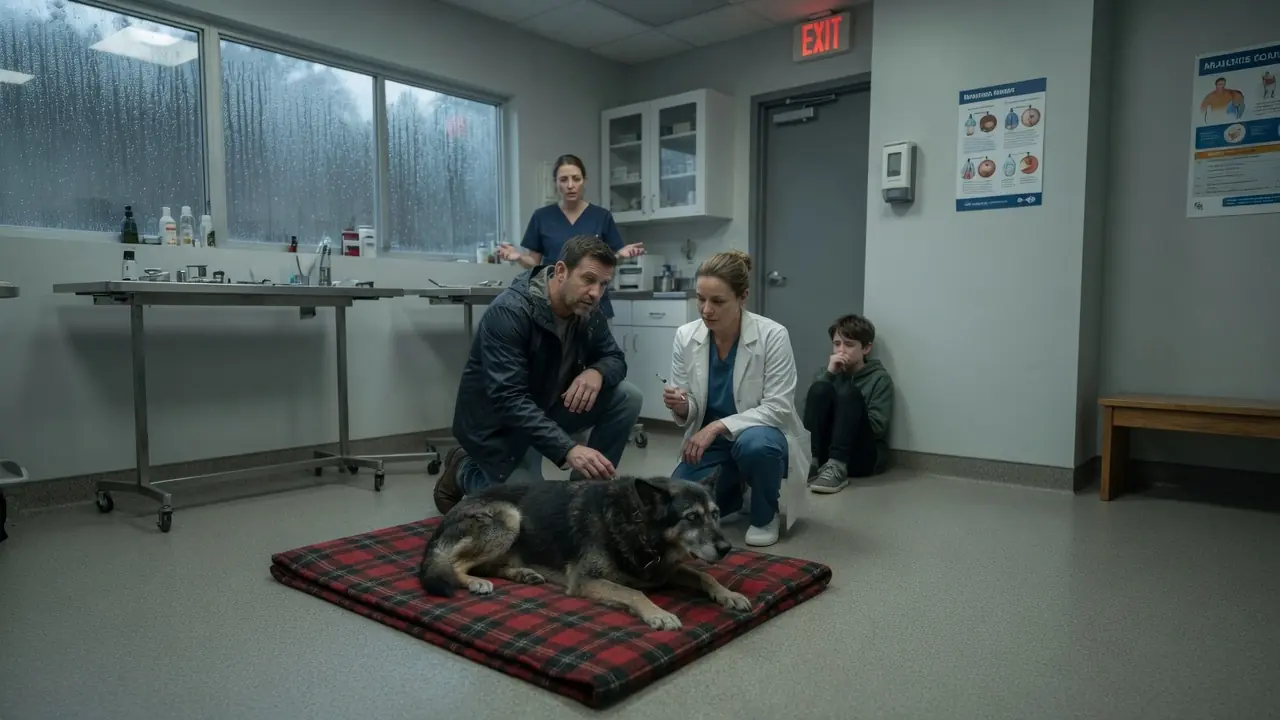
The stainless-steel examination table was too cold, so I laid the heavy winter blanket on the floor.
Dr. Evans knelt beside it, her stethoscope pressed against Duke’s ribs, and she did not look up when she finally spoke.
“His lungs are almost completely full.”
Her voice was so quiet that, for one foolish second, I pretended I had misunderstood her.
Outside the small square window, rain struck the glass in hard, slanting lines. The gutters rattled. Water hissed beneath tires on the road beyond the parking lot.
Duke lay on his side on the red-and-black plaid blanket, his chest rising and falling in short, wet movements.
Every breath sounded as if it had to force its way through something heavy.
For three days, he had barely lifted his head from the living-room rug.
That morning, he refused food.
By evening, he could no longer walk to the back door.
When I carried him through the rain to the truck, his eighty-pound body felt both impossibly heavy and frighteningly fragile. His graying fur soaked through my jacket. His chin rested against my shoulder, and each breath came with a faint rattle I could feel against my chest.
I knew before we reached the clinic that we would not be bringing him home.
My fourteen-year-old son, Leo, sat in a plastic chair in the corner of the examination room.
He had not spoken since we arrived at eleven o’clock.
His knees were pulled tightly against his chest. His face looked pale beneath the fluorescent lights, and his eyes remained fixed on Duke.
The blanket beneath our old dog had come from the foot of Leo’s bed.
It was thick wool, frayed along the edges, and carried the familiar mixture of laundry detergent, teenage boy, and the cedar smell of Leo’s room. I had grabbed it without thinking before we left the house, believing only that Duke needed something warm beneath him during the drive.
When we entered the clinic, Duke refused to be lifted onto the metal table.
His back legs folded beneath him.
Dr. Evans suggested we make him comfortable on the floor.
Now she folded her stethoscope and slipped it into the pocket of her white coat.
“His heart is working far too hard,” she said. “The fluid built up very quickly. He’s drowning from the inside, Mark.”
I nodded.
A hard knot formed in my throat.
I looked toward Leo.
My son’s eyes had dropped to the floor. His shoulders trembled, but he made no sound.
“Is he in pain?” I asked.
“He’s exhausted,” Dr. Evans answered gently. “And frightened because he can’t breathe normally.”
She walked to the metal counter and prepared two syringes.
I knew the procedure.
I had dreaded it for years.
The first injection would be a heavy sedative. Duke would become sleepy. His breathing would slow. He would no longer feel afraid.
The second injection would stop his heart.
Dr. Evans returned and knelt beside the blanket.
Duke’s cloudy eyes followed her hand.
“I’ll give him the sedative first,” she whispered. “It will feel like falling asleep.”
She looked toward Leo.
“You should both sit with him.”
I turned to my son.
“Buddy.”
Leo did not lift his head.
“Come over here. Come say goodbye.”
He shook his head sharply and buried his face against his knees.
His shoulders began shaking harder.
He could not bear to watch the needle.
He could not bear to sit beside the dog who had slept at the foot of his bed for more than a decade and feel that body become still.
I swallowed and lowered myself beside Duke.
My knees struck the linoleum.
I placed one hand against his ribs and felt the frantic beating of his heart.
I rubbed the base of his ears, the way I had done when he was a clumsy young stray with paws too large for his body.
“It’s all right, buddy,” I whispered. “You did good.”
My voice broke.
“You did so good.”
Dr. Evans uncapped the first syringe.
She moved slowly, reaching for the vein in Duke’s front leg.
Duke did not look at the needle.
He did not look at me.
His head lifted.
The movement was slow, visibly painful, and so unexpected that Dr. Evans stopped.
His ears turned toward the corner of the room.
Toward Leo.
“Easy,” she whispered. “Lie still, handsome.”
Duke ignored her.
With a sudden surge of strength that seemed impossible for a dog whose lungs were failing, he planted his front paws against the floor.
His back legs trembled violently.
I reached to support him, afraid he would fall and injure himself, but he pushed past my hands.
His claws slipped against the linoleum.
“Mark, hold him,” Dr. Evans warned. “He should not be standing. His oxygen level is dangerously low.”
Duke stood anyway.
His body swayed.
His sides heaved.
His eyes, clouded with age and exhaustion only seconds earlier, were now focused with complete determination.
He looked down at the heavy plaid blanket.
Then he lowered his head and closed his teeth around the thickest folded edge.
“Duke, what are you doing?”
I reached toward him.
“Drop it. Lie down.”
He tightened his jaw.
Then, ignoring me, ignoring Dr. Evans, and fighting against his own failing body, Duke began dragging the blanket across the clinic floor.
His claws scraped against the linoleum.
The wool bunched beneath his front legs.
Each backward step required an enormous effort.
He pulled.
Stopped to breathe.
Pulled again.
“Duke,” I said, following him. “Please stop.”
Dr. Evans stood with the uncapped syringe still in her hand.
“He could collapse.”
I placed both hands beneath his chest.
Duke turned his head and released a low warning sound.
It was not anger.
It was refusal.
He did not want me to carry him.
He did not want the blanket taken away.
His eyes returned to Leo.
That was when I understood where he was going.
Duke dragged the blanket toward the plastic chair in the corner.
Toward my son.
Leo lifted his head.
Tears covered his face.
The old dog pulled again.
The blanket moved another few inches.
“Dad,” Leo whispered.
It was the first word he had spoken since we arrived.
Duke heard him.
His tail moved once.
Barely.
Then his front legs buckled.
He fell onto his chest with the blanket still clamped between his teeth.
“Duke!”
Leo dropped from the chair.
He reached the dog before I did.
Duke released the blanket and struggled to lift his head.
Leo knelt beside him.
“What are you doing, old man?”
His voice shook.
Duke pressed his nose against Leo’s knee.
Then he nudged the blanket toward him.
Leo looked at me.
I could not speak.
Dr. Evans lowered the syringe.
“He brought it to you,” she said.
Leo stared at the blanket.
It had always belonged to him, but for most of Duke’s life it had belonged to both of them.
When Leo was four, he dragged that same blanket from his bed into the living room during a thunderstorm.
Duke had been with us for only three weeks.
He was not yet called Duke.
At the county shelter, he had been listed as Dog 417.
He was thin, silent, and covered in scars beneath his coat. The shelter staff believed he had spent part of his life chained outside. He flinched when men moved too quickly and refused to enter small rooms.
I had not gone there intending to adopt a dog.
My wife, Anna, had died eight months earlier.
Leo had stopped speaking after the funeral.
Not completely.
He answered direct questions with one or two words.
But the boy who once sang loudly in the bathtub and asked questions until bedtime had vanished.
Our house became quiet.
Too quiet.
A counselor suggested an animal might help.
So one Saturday, I took Leo to the county shelter.
We walked past barking terriers, jumping Labradors, and puppies pressing their noses through metal bars.
Leo showed no interest.
At the final kennel, a large shepherd mix lay with his back against the wall.
He did not bark.
He did not approach us.
He simply watched.
The card outside the kennel said he was approximately three years old. Found abandoned. Fearful. No children under twelve recommended.
Leo was four.
We should have kept walking.
Instead, my son sat on the concrete floor outside the kennel.
The dog stared at him.
Leo took a small yellow toy truck from his pocket and pushed it beneath the gate.
The shelter worker reached to retrieve it.
“Leave it,” Leo whispered.
The dog stood.
He approached slowly.
He smelled the truck.
Then he lay down beside it.
Leo placed his small hand against the wire.
The dog pressed his nose to the same place from the other side.
It was the longest interaction Leo had initiated with anyone since his mother died.
We visited five more times.
The dog never approached me first.
He always went to Leo.
The shelter manager warned me that Dog 417 was not an easy adoption.
“He may never become affectionate,” she said. “He may always be frightened.”
I looked through the office window.
Leo sat on the floor of the visiting room.
The dog lay beside him with one paw resting on the yellow truck.
“I don’t need him to be easy,” I said.
We brought him home and named him Duke because Leo said he looked like a guard at a castle.
The first thunderstorm came three weeks later.
The rain began after midnight.
Lightning flashed across the bedroom walls.
Duke panicked.
He ran through the house looking for somewhere to hide. He knocked over a lamp, scratched the back door, and wedged himself beneath the dining-room table.
I tried to approach.
He growled.
Then Leo appeared in the doorway holding the red-and-black plaid blanket.
He had dragged it from his bed.
Without saying anything, he crawled beneath the table.
“Leo, come out,” I whispered.
He ignored me.
He spread the blanket across the floor and lay beside Duke.
The dog’s breathing slowed.
Leo placed one hand on his shoulder.
“It’s loud,” he told him. “But it goes away.”
Those were the most words my son had spoken in months.
They remained beneath the table until the storm passed.
After that night, Duke slept at the end of Leo’s bed.
The blanket stayed there too.
For eleven years, it absorbed every part of their life together.
Leo wrapped himself in it when he had the flu.
Duke lay on it after surgery.
They used it during camping trips, backyard sleepovers, winter movies, and the long nights when Leo missed his mother.
Whenever thunder came, Duke climbed onto the blanket.
Whenever Leo cried, Duke brought part of it in his mouth and dropped it at the boy’s feet.
Now, in the clinic, Duke had done it one final time.
He had not been trying to escape the needle.
He had not been confused by the lack of oxygen.
He had been bringing Leo the place where they had always found each other.
Leo pulled the blanket across the floor and sat on it.
Duke tried to follow.
His back legs did not respond.
Leo placed both arms beneath his chest.
“Help me, Dad.”
Together, we moved Duke onto the blanket in front of him.
Leo stretched out on the floor.
The fluorescent lights hummed overhead.
Rain hammered the clinic window.
He wrapped one side of the blanket around Duke’s body and drew the dog’s head into his lap.
Duke exhaled.
His eyes closed for a moment.
Then opened again.
Leo stroked the gray fur between his ears.
“You didn’t have to come get me.”
Duke’s tail moved faintly against the floor.
“I was scared.”
My son pressed his face into the old dog’s neck.
“I’m still scared.”
Duke turned his muzzle toward him and licked the wet line beneath his eye.
Dr. Evans looked away.
I sat beside them.
For several minutes, no one spoke.
The clinic no longer felt sterile.
The blanket covered the cold floor.
Leo’s hand moved slowly along Duke’s side.
The dog’s breathing remained terrible, but the panic had left his eyes.
Dr. Evans knelt near us again.
“Are you ready?”
Leo looked at the syringe.
His face tightened.
Then he shook his head.
“Not yet.”
“That’s all right.”
She placed the syringe back on the tray.
“We have time.”
Duke’s breathing grew louder.
Leo listened to it.
“Is he suffering?”
Dr. Evans answered honestly.
“He is working very hard for every breath.”
“Can you fix him?”
“No.”
“Not even for one more day?”
“I’m sorry.”
Leo looked down at Duke.
The old dog’s eyes remained on him.
“He knew we weren’t going home.”
I placed a hand on my son’s shoulder.
“Maybe.”
“That’s why he brought the blanket.”
“Maybe he knew you needed it.”
Leo’s lower lip trembled.
“He always knows.”
He pulled the blanket higher over Duke’s chest.
Then he began talking.
At first, he spoke about ordinary things.
The time Duke stole an entire loaf of bread from the kitchen and hid it beneath Leo’s bed.
The afternoon he chased a garden hose in circles until he became dizzy and fell into the flower bed.
The Christmas morning he opened three presents that were not his.
Leo laughed once through his tears.
Duke’s ears moved at the sound.
Then Leo spoke about things I had nearly forgotten.
“You used to sleep beside the bathroom door when I was little.”
Duke blinked slowly.
“You waited for me outside school when Dad came to pick me up.”
His fingers moved along Duke’s ear.
“You scared away that stray dog at the park.”
I remembered that day.
Leo had been seven.
A loose dog charged across the playground, barking and snapping. Duke placed himself between it and Leo without hesitation.
He did not attack.
He stood his ground until the other dog retreated.
“You were there when I broke my arm,” Leo continued. “You wouldn’t leave the couch for three days.”
His voice weakened.
“You were there when I forgot Mom’s voice.”
The room became very still.
Leo rarely mentioned Anna.
I looked toward him.
He kept his eyes on Duke.
“I used to think forgetting meant I didn’t love her enough.”
My throat tightened.
“Leo—”
“But Duke remembered everything.”
My son touched the dog’s forehead.
“He remembered her chair. He waited beside it for years.”
Duke gave a faint sigh.
Leo looked at me.
“Do you think he remembers Mom?”
“Yes.”
The answer came without hesitation.
“I do.”
Leo rested his forehead against Duke’s.
“Then maybe he won’t be alone.”
Dr. Evans sat back on her heels.
Her eyes were wet.
“I think animals carry love longer than we understand,” she said.
Leo nodded.
He looked at the syringe again.
Then he took a long, shaking breath.
“Will the first medicine hurt?”
“Just a small pinch.”
“Will he know what’s happening?”
“He’ll feel sleepy. He may hear your voice for a while.”
“Can I hold him?”
“Yes.”
Leo adjusted himself beneath the blanket.
He placed Duke’s head against his chest.
The old dog’s muzzle rested over Leo’s heart.
“Okay,” my son whispered.
Dr. Evans moved closer.
Duke’s eyes followed her hand.
Leo covered the dog’s ear with his palm.
“Don’t look at that.”
Then he whispered, “Look at me.”
Duke did.
The needle entered his leg.
He barely reacted.
Dr. Evans administered the sedative slowly.
Duke’s breathing began to change.
Not better.
But softer.
The effort in his chest eased.
His body grew heavier against Leo.
For the first time in three days, he seemed comfortable.
Leo continued speaking.
“You’re home.”
His tears fell into Duke’s fur.
“You’re on the blanket. I’m right here.”
Duke’s eyes began to close.
“I’m not leaving.”
His breathing slowed.
“You can stop looking for me.”
The words broke something inside me.
I lowered my head.
For eleven years, Duke had watched every doorway Leo passed through.
He waited outside bathrooms, classrooms, doctor’s offices, and bedrooms.
When Leo rode his bicycle, Duke stood at the front window until he returned.
When my son began high school and stayed late for practice, the old dog refused dinner until he heard the garage door.
Duke had spent his life keeping track of Leo.
Even while dying, he had looked across the examination room and seen that the boy was too far away.
He dragged the blanket because Leo was not beside him.
Because, until they were together, Duke could not let go.
His eyes closed fully.
Dr. Evans touched his leg and checked his reflexes.
“He’s asleep.”
Leo looked frightened.
“He can still hear me?”
“Possibly.”
Leo tightened his arms around him.
“Then don’t do the second one yet.”
Dr. Evans nodded.
She waited.
We sat on the clinic floor while rain pressed against the windows.
Leo told Duke every secret he had never said aloud.
He admitted that he sometimes pretended to be asleep so Duke would stay on his bed longer.
He admitted giving him pieces of bacon behind my back.
He apologized for shouting at him when Duke knocked over his school project.
Then he apologized for growing up.
“I stopped taking you on long walks.”
His voice broke.
“I got busy.”
I touched Leo’s back.
Duke did not need the apology.
Dogs rarely keep accounts of our failures.
They remember the door opening.
The hand reaching down.
The voice returning.
The place beside the bed.
Leo understood that eventually.
“You never got mad at me,” he whispered.
He smiled through tears.
“Except when I tried to move the blanket.”
Dr. Evans looked toward the clock.
Duke’s sleeping breaths had become shallow.
“Leo,” she said gently.
My son nodded.
He knew.
He kissed Duke between the ears.
“You found me at the shelter.”
I almost corrected him.
Technically, Leo had found Duke.
But perhaps both things were true.
“You found me when I didn’t talk,” Leo continued. “You found me when I was scared. You found me tonight.”
He took another breath.
“I’ll be okay.”
Duke remained still.
“I promise.”
Dr. Evans reached for the second syringe.
Leo looked at me.
“Dad?”
“I’m here.”
“Hold his paw.”
I wrapped one hand around Duke’s front paw.
Leo kept the dog’s head against his chest.
Dr. Evans inserted the needle into the catheter.
She looked at us.
“Are you ready?”
No one could ever be ready.
But Leo nodded.
“Goodbye, Duke.”
Dr. Evans pressed the plunger.
The medicine entered slowly.
Duke’s chest rose.
Fell.
Rose once more.
Then became still.
The rain continued.
The fluorescent lights continued humming.
Somewhere in another part of the clinic, a telephone rang.
But inside that room, the world changed.
Dr. Evans placed her stethoscope against Duke’s ribs.
She listened for several seconds.
Then she removed it.
“He’s gone.”
Leo did not move.
He held Duke beneath the blanket as though warmth and love might still reach wherever the old dog had gone.
I placed one arm around my son.
For a long time, the three of us remained on the floor.
Eventually, Leo whispered, “His breathing doesn’t sound bad anymore.”
“No.”
“He’s quiet.”
“Yes.”
“I thought quiet would feel worse.”
I looked at Duke.
His face was peaceful.
The strain had disappeared from around his eyes.
“The hard part stopped,” I said.
Leo nodded.
He continued holding him.
Dr. Evans gave us as much time as we needed.
Near one in the morning, she returned carrying a small clay impression kit.
“Would you like his paw print?”
Leo looked at Duke’s paw inside my hand.
“Yes.”
Dr. Evans pressed it carefully into the soft clay.
She clipped a small lock of fur from behind his ear and placed it inside an envelope.
Then she asked what we wanted to do with the blanket.
Leo looked surprised.
“It goes with us.”
“Of course.”
He loosened it around Duke.
Then stopped.
A small portion remained beneath the dog’s chest.
Leo held the fabric for several seconds.
“Can I cut off a piece?”
Dr. Evans brought scissors.
Leo cut a square from the frayed corner.
He tucked it beneath Duke’s front paw.
“He should have some too.”
We left the clinic carrying the blanket between us.
The rain had softened to a drizzle.
The truck’s back seat was empty.
Leo climbed in and wrapped the blanket around his shoulders.
On the drive home, he did not speak.
I watched him in the rearview mirror.
He rested his head against the window with Duke’s collar held in one hand.
When we entered the house, the silence met us immediately.
No nails clicking across the kitchen floor.
No slow body rising from the rug.
No gray muzzle appearing around the doorway.
Duke’s water bowl remained beside the refrigerator.
His leash hung near the back door.
A few pieces of food sat untouched in his dish.
Leo stood in the living room.
Then he walked to his bedroom.
I expected him to close the door.
Instead, he returned carrying Duke’s old bed.
“Help me move it.”
“Where?”
“To my room.”
We placed the empty bed at the foot of his mattress.
Leo spread the plaid blanket across it.
The missing square from the corner was visible.
He set Duke’s collar in the center.
Then he lay on his own bed and stared at the empty place.
I sat beside him.
“I don’t know how to sleep without hearing him,” he said.
“Neither do I.”
“Do you think he knew I loved him?”
“Yes.”
“How?”
“He spent eleven years beside you.”
Leo looked toward the blanket.
“But tonight I wouldn’t go to him.”
“You were afraid.”
“He had to come get me.”
“He wanted you close.”
“I should have gone when you asked.”
I shook my head.
“Duke didn’t care how long it took.”
Leo’s eyes filled again.
“He just kept pulling.”
“Yes.”
That night, I slept in the chair beside Leo’s bed.
At some point near dawn, I woke and saw my son curled on Duke’s blanket with the collar pressed against his chest.
For the next several weeks, grief lived inside every routine.
I opened the back door in the morning before remembering there was no dog to let outside.
Leo set aside pieces of chicken at dinner.
We heard imagined footsteps in the hallway.
Once, I woke convinced Duke was scratching at the bedroom door.
Leo struggled most after school.
For years, Duke had been waiting when he came home.
Now Leo entered a silent house.
He began spending extra time at the veterinary clinic after classes.
Dr. Evans allowed him to help clean examination rooms, fold towels, and fill water bowls.
One afternoon, she called me.
“There’s something you should see.”
When I arrived, Leo was sitting on the floor of a recovery kennel.
Beside him lay a thin, frightened shepherd mix with one torn ear.
The dog had been rescued from a property where several animals were kept outside without shelter.
He would not approach the staff.
But he had placed his head on Leo’s knee.
A folded towel lay between them.
Dr. Evans stood beside me.
“He’s been there for forty minutes.”
Leo looked up.
“He doesn’t like loud noises.”
The resemblance was not in the dog’s face.
It was in the silence between them.
The patient waiting.
The refusal to force trust.
“What’s his name?” I asked.
“He doesn’t have one yet.”
Leo rubbed the dog’s ear.
“We’re not adopting him.”
I almost smiled.
“I didn’t say we were.”
“I’m just sitting with him.”
“All right.”
Two weeks later, the clinic transferred the dog to a local rescue.
Leo visited every day.
He brought a familiar red-and-black plaid blanket.
Not Duke’s entire blanket.
He had cut a second small piece from the corner and sewn it into the edge of a new one.
The frightened shepherd began sleeping on it.
Leo named him Scout.
We adopted him three months after Duke died.
Scout was not Duke.
That mattered.
He did not sleep at the end of Leo’s bed at first.
He hated trucks.
He barked at men wearing hats.
He refused to enter the kitchen.
Leo never expected him to replace anyone.
He gave Scout time.
During the first thunderstorm, Scout hid beneath the desk.
Leo crawled underneath with the blanket.
“It’s loud,” he whispered. “But it goes away.”
I stood in the hallway and heard the words he had spoken to Duke eleven years earlier.
The circle did not close.
Grief rarely closes.
It widened enough to hold something new.
On the first anniversary of Duke’s death, Leo and I returned to Dr. Evans’s clinic.
We brought a framed photograph.
It showed Duke standing in our backyard during his younger years, ears raised, tongue hanging from the side of his mouth.
Beneath the picture, Leo had written:
DUKE
HE ALWAYS CAME BACK FOR ME
Dr. Evans hung it inside the examination room where he died.
The stainless-steel table remained.
The fluorescent lights remained.
But beside the wall sat a low wooden bench covered with thick blankets.
Dr. Evans explained that, after Duke, she began keeping a comfort area for elderly animals who could not climb onto the table.
One blanket was red-and-black plaid.
“Families ask about the photograph,” she said.
“What do you tell them?” Leo asked.
“That an old dog once used the last of his strength to make sure his boy wasn’t alone.”
Leo looked at the picture.
“He wasn’t making sure I wasn’t alone.”
Dr. Evans waited.
“He was making sure he wasn’t alone either.”
She nodded.
“Maybe that’s what love is.”
Years later, when Leo applied to veterinary school, he wrote his admissions essay about Duke.
Not about the moment he died.
About the blanket.
He wrote that medicine often measures the body in numbers.
Oxygen level.
Heart rate.
Fluid volume.
Temperature.
Those numbers matter.
But animals are more than the failing parts of their bodies.
Even when Duke’s lungs could no longer carry enough air, he still had a decision to make.
Someone he loved was sitting too far away.
So he stood.
He took hold of the heaviest thing in the room.
And he dragged home across the floor.
The admissions committee accepted Leo.
He became a veterinarian nine years after that stormy night.
In his clinic, no elderly dog was ever placed on a cold metal table unless necessary.
There was always a padded corner.
Always a blanket.
Always enough room for a family to lie beside their animal.
Above the door to the comfort room hung Duke’s old photograph.
The plaid blanket remained in Leo’s home.
It became thinner over the years.
The colors faded.
Scout slept on it until his own muzzle turned gray.
Whenever someone suggested replacing it, Leo refused.
Some things did not need to remain whole to remain useful.
The missing corners told their own story.
One piece had gone with Duke.
One had comforted Scout.
The rest stayed with the boy who had once been too afraid to cross a small examination room.
People sometimes asked Leo when he knew he wanted to become a veterinarian.
They expected him to mention rescuing Duke from the shelter.
Or caring for Scout.
He always described that final night.
“The vet said Duke’s lungs were failing,” he would say. “She was right. His body was finished.”
Then he would pause.
“But he still saw me sitting in the corner.”
He remembered the claws slipping.
The blanket bunching.
The old dog’s body shaking with every step.
“He could barely breathe, but he dragged that blanket until I understood what he needed.”
“What did he need?” people asked.
Leo’s answer never changed.
“He needed me to stop being afraid of losing him long enough to be with him while he left.”
That was Duke’s final gift.
Not the dramatic strength to stand.
Not the impossible journey across a clinic floor.
He gave a frightened fourteen-year-old boy one last lesson.
Goodbyes are not betrayals.
Staying does not mean refusing to let someone go.
Sometimes staying means kneeling on a cold floor, wrapping an old friend in the blanket that smells like home, and saying the words both of you need to hear.
I’m here.
You did enough.
You can rest now.
Duke had spent eleven years following Leo from room to room.
On the last night of his life, when Leo could not come to him, Duke followed him one final time.
He carried the blanket between his teeth.
He dragged it across the floor.
And he did not stop until his boy came home to him.