The Magnolia Morning Bake House opened every day at six, and by six-thirty the place usually smelled like butter, coffee, pepper gravy, and fresh biscuits. On that Wednesday morning in Birmingham, the smell was almost right, but not completely. Under the sweetness of baked dough and cinnamon, something sour lingered in the air like a secret trying to hide. Most customers did not notice it because morning hunger makes people forgiving.
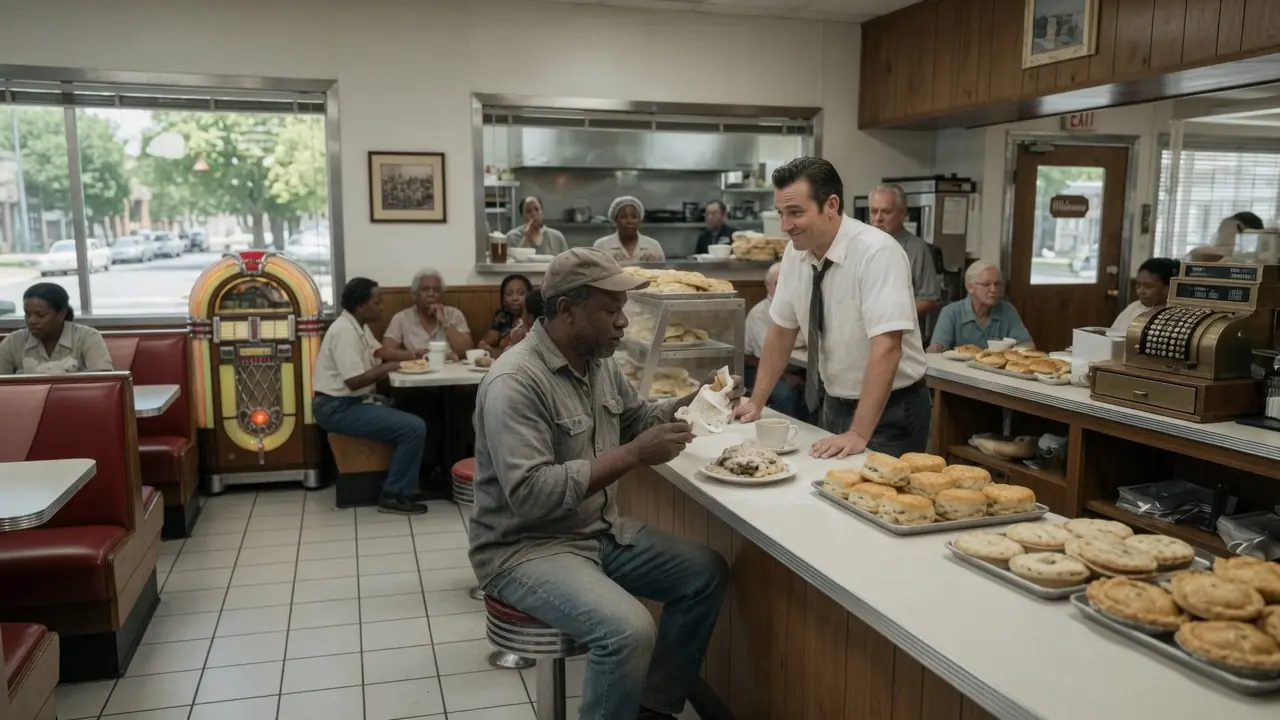
Otis Lawrence noticed it before he reached booth seven. He stepped through the glass door wearing faded jeans, a worn gray flannel shirt, scuffed work boots, and a ball cap low enough to make him look like any working man stopping in before a long day. Nobody greeted him with special attention. Nobody knew that he was the chief executive officer of the company that owned the building, the recipes, the signs, and the name above the door.
He had owned Magnolia Morning Bake House for sixteen months. The company had grown from one family bakery into a chain with nearly two hundred locations, but Otis knew growth could rot from the inside if the wrong people were allowed to manage quietly. Over the past six weeks, three customer complaints from this Birmingham branch had disappeared from the company portal. All three came from women of color, and all three mentioned food that had made someone sick.
Otis had printed every deleted complaint and placed the copies in the glove compartment of his red pickup truck. He had also asked compliance to wait in two unmarked vans four miles away, ready for a full inspection if his suspicions proved true. He did not bring a camera crew. He did not bring a lawyer beside him. He brought his grandfather’s old biscuit recipe card, folded in his wallet like a small piece of family history.
He sat at booth seven because it gave him a clean view of the kitchen pass-through. The waitress brought him coffee, and Otis held the cup with both hands while his eyes moved across the room. The front counter was clean, the pastry displays were polished, and the biscuits cooling on the rack looked beautiful from a distance. But beautiful food could still hide an ugly kitchen.
Behind the counter, the shift manager, Donnie Pike, laughed too loudly at his own joke. Donnie was a white man in his late thirties with slicked-back hair, a cheap tie, and the kind of smile that changed depending on who stood in front of him. He refilled coffee twice for an older white customer at booth six, then walked past Otis without looking at his cup. Otis filed that away.
Through the pass-through, Otis saw Loretta Hayes working at the prep station. She was a Black woman in her late forties, steady-handed and focused, with the tired posture of someone who had held a kitchen together longer than management deserved. Loretta looked up once and caught Otis watching the back line instead of the menu. Her face changed slightly, not with recognition, but with suspicion. She turned to a younger cook beside her and murmured something too low for the dining room to hear.
The younger cook was Juny Mosley, seventeen years old, thin, quiet, and quick with her eyes. Otis noticed how she looked toward the back cooler every time someone walked near it. He noticed the brass padlock on the storage door. He noticed the strip of tape over the wall thermometer near the cooler. Little things told the truth long before people admitted it.
At 7:15, the bell above the door rang and a young Black mother entered with a small child on her hip. The girl had neat cornrows, pink leggings, and her face buried against her mother’s shoulder. The mother, Charelle Whitman, walked straight to the counter with a folded receipt in one hand. She looked like someone who had rehearsed her courage in the parking lot.
Donnie approached her with the same smile he had given Otis from a distance. “Help you, ma’am?” he asked, though his tone suggested she was already a problem. Charelle unfolded the receipt and placed it on the counter. “I was here last Tuesday,” she said. “My daughter ate one of your sausage biscuits, and two days later she was in the hospital for three days.”
The dining room quieted just enough for people to listen without admitting they were listening. Donnie did not write anything down. He did not ask for the child’s name. He did not call the kitchen or request a manager above him. Instead, he reached behind the counter and took out a five-dollar voucher.
“I’m sure your daughter’s fine now,” Donnie said. “Here’s something for your trouble.”
Donnie lowered his voice in a way meant to make her feel unreasonable. “Ma’am, if you keep disturbing customers, I’ll have to ask you to leave.” An older Black woman near the window set down her coffee and said clearly, “Make him put it in writing, honey.” Donnie’s smile vanished.
“If you don’t calm down,” he said, “I’ll call the police.”
The words hit the room with a cold weight. Otis watched the customers lower their eyes to their plates, choosing breakfast over decency. Loretta stopped working in the kitchen window. Juny froze near the grill. Charelle folded the voucher into her fist, turned with her child still on her hip, and walked toward the door.
As she passed booth seven, Otis gave her one quiet nod. It was not enough, and he knew it. But she saw him. She nodded back once, the small recognition of two people the room had tried to make invisible, then stepped outside into the morning.
Otis set his coffee down. His hand was steady, but anger moved slowly through him, not hot and reckless, but controlled and gathering weight. A white customer with cold coffee had been given a month of free meals in one of the deleted reports. A Black mother with a hospitalized child had been given five dollars and a threat. Otis understood now that this was not only about food.
He stood and walked from booth seven to the front counter. The movement was deliberate, and several people watched him take the stool nearest the kitchen pass-through. Donnie noticed immediately. His eyes flicked toward the back line, then toward the biscuits, then back to Otis.
“What can I get you, partner?” Donnie asked.
Otis took the laminated recipe card from his wallet and placed it on the counter. The card was old, soft around the edges, and written in his grandfather’s careful hand. It listed four ingredients and one line at the bottom: Feed people the way you’d feed your own child. May Pritchard, an older white server three seats down, leaned slightly and read it upside down.
“Pop’s recipe,” May whispered. “Haven’t seen the original in years.”
Otis gave her a small smile. “Family,” he said.
Donnie’s smile tightened. “You ordering or just decorating my counter?”
“I’ll have two country sausage biscuits,” Otis said evenly. “Fresh, with a side of gravy.”
The order moved through the air to the kitchen. Wallace, a line cook with careful hands and tired eyes, repeated it back. Loretta watched him assemble the plate. Juny looked at Donnie, then at the brass padlock, then down at her station.
The plate came out hot and heavy. Two biscuits sat split around sausage patties, with a small bowl of cream gravy on the side. Steam rose from the plate, but underneath the pepper and fat, Otis smelled the wrongness again. He picked up his fork.
The diner seemed to hold its breath without knowing why. May stopped pretending to work her crossword. Loretta stood near the kitchen window, one hand on the counter. Donnie leaned against the register, waiting with a smug little smile.
Otis cut one corner from the biscuit and lifted it to his mouth. He chewed once. The texture was wrong immediately, soft in one place, firm in another, carrying a taste that should never have touched food served to paying customers. He raised his napkin slowly and spit the bite into it.
When he opened the folded napkin, something pale moved against the white cloth.
His body reacted before his mind did. His elbow struck the counter, the gravy bowl tipped, and the cooling rack behind him shook hard enough to disturb a tray of flour-dusted biscuits. A soft cloud rose into the air, caught the light, and drifted down across his shirt, his collar, his hair, and his face. In three seconds, Otis Lawrence sat at the counter of his own restaurant with his face completely white with flour.
The room stared.
Someone near booth four whispered, “Lord, his face just went completely white.”
Two phones came up. May Pritchard stood slowly, her eyes not on the flour, but on the napkin. Donnie stopped smiling. Loretta moved first, stepping through the kitchen door and into the dining room.
Otis did not panic. He did not shout. He folded the napkin again, placed it beside the untouched second biscuit, and stood. “I need to speak to whoever runs this kitchen,” he said. “Now.”
Donnie rushed forward, hands raised in false calm. “Sir, let’s not make a scene.”
“I ate something that was alive,” Otis said. “The scene already happened.”
Donnie reached toward his elbow. Loretta stepped between them before contact could happen. She did not push Donnie. She did not raise her voice. She simply planted herself between the manager and the customer and said, “He has a right to see the back.”
The room went silent again. Donnie looked at her as if she had slapped him. For eleven years, Loretta had worked in that building. For eleven years, she had obeyed enough to keep her job. But that morning, she looked at Donnie Pike with a calm that said something had changed.
May picked up the untouched biscuit plate and covered it with an inverted bowl. “This stays here,” she said. “This is evidence.”
Donnie’s face reddened. “May, you do not have authority—”
“I have eyes,” May snapped.
Then she walked to the front door and flipped the sign to closed.
Loretta led Otis into the back hallway. The smell grew stronger with every step toward the locked storage cooler. The brass padlock caught the fluorescent light. Loretta looked once over her shoulder to make sure Donnie had not followed, then reached into her shoe and removed a small brass key tied to a yellow ribbon.
Otis looked at the key. “How long have you had that?”
“Long enough to know I’d need it,” she said.
The lock opened smoothly. When the cooler door swung wide, the smell pressed into the hallway like a confession. Otis covered his nose with his sleeve and took pictures before he stepped inside. Boxes of meat sat stacked under newer boxes, some slick with moisture, some carrying labels months out of date. The taped thermometer near the door read safe, but the second thermometer in the back told the truth.
Fifty-eight degrees.
Otis photographed everything: the labels, the tape, the floor, the boxes, the second thermometer. Loretta stood in the doorway, face tight, arms folded. Juny appeared behind her with her phone in both hands. Wallace stood farther back, keeping watch.
“I sent emails,” Loretta said. “April, May, June, July. They disappeared.”
“Show me.”
She opened her phone and scrolled through photos: wet cooler floors, service tickets marked “monitoring,” taped dials, spoiled deliveries, and screenshots of complaints that had vanished from the official system. Juny stepped forward next and played a voice memo. Donnie’s voice came from the small speaker, telling staff to “hit the gravy harder with spice” and “keep complaints off the front floor.”
Wallace added text messages from an off-the-books repairman who had been paid in cash to avoid official service reports. Loretta pulled out one more document: a homemade nondisclosure agreement Donnie had offered her with two hundred dollars, asking for “understanding” about the backroom situation. Otis read it once and felt his grandfather’s recipe card burning like a weight in his pocket.
“You kept all this,” he said.
Loretta looked at him. “I was waiting for somebody who could afford to listen.”
Otis removed his ball cap. His face was still dusted with flour, his sleeve stained with gravy, but his voice became quiet and exact. “My name is Otis Lawrence,” he said. “I own this company.”
Nobody spoke for three seconds.
Loretta’s face did not break. She did not cry or gasp. She only nodded once, as if the last piece of the morning had finally clicked into place. “Then you need to know it’s not only this store,” she said.
Otis already suspected that. He called corporate from the hallway and ordered all one hundred seventy-eight locations into controlled close by 9:30. Compliance teams were activated. Legal was instructed to subpoena work orders, inspection records, deleted complaints, repair invoices, and regional approval logs. He did not ask whether it would be expensive.
It would be.
That was the cost of finally listening.
The bell over the front door rang again at 8:40. Brett Howerin, the regional director, walked in wearing a navy blazer and the kind of smile men wear when they are used to rooms bending around them. He went straight to Donnie and clapped him on the shoulder. “What’s the situation, partner? Some old guy causing a problem?”
Otis stepped out of the hallway.
He placed the evidence on the counter one item at a time: the highlighted compressor order, Loretta’s phone, Juny’s recordings, Wallace’s texts, the fake nondisclosure agreement, the sealed biscuit, the napkin, and Charelle Whitman’s five-dollar voucher. Then he looked directly at Brett.
“Mr. Howerin.”
Brett turned toward him, still smiling. “Sir, do I know you?”
“We’ve met twice,” Otis said. “I signed your bonus letter last quarter. You shook my hand at the regional summit in May.” He paused. “You called me sir then. You called me old guy just now.”
The smile slid from Brett’s face.
May, still standing near the door, gave one short humorless laugh. “Now his face is going white.”
Otis turned to the dining room. Customers were standing now, phones raised, plates pushed away. Some looked frightened. Some looked ashamed. Some looked sick.
“My name is Otis Lawrence,” he said. “I am the chief executive officer of Magnolia Morning Bake House. I came here because complaints were deleted, customers were ignored, and workers were punished for telling the truth.” He lifted the sealed plate, split the second biscuit open, and showed the room the same pale movement inside. Gasps moved through the dining room.
“This is what one bite revealed,” Otis said. “But one bite did not create this. Months of neglect created this. Managers hiding reports created this. Executives rewarding silence created this.”
Brett found his voice. “That is a serious accusation.”
“No,” Otis said. “It is a documented fact.”
He read the evidence aloud. Compressor failure deferred. Repairs hidden. Complaints deleted. Workers threatened. Food overspiced to cover smell. Customers of color dismissed or intimidated. A mother whose child had been hospitalized handed a five-dollar voucher and threatened with police.
Charelle Whitman returned twenty minutes later because Otis had asked his assistant to call her. She entered carefully, daughter on her hip, unsure why she had been summoned back to the place that had humiliated her. Otis walked to her himself and handed her an envelope. Inside was a written apology and a payment covering her daughter’s medical bills.
He did not make a speech over her pain. He simply said, “We should have listened the first time.”
Charelle looked around the room, then back at him. “Thank you for listening now.”
The little girl reached toward Otis’s flour-dusted sleeve. Charelle did not stop her. The small hand touched his arm, and for the first time that morning, Otis had to look away.
Then he turned back to work.
Donnie Pike was suspended on the spot. Brett Howerin was escorted out after Otis revealed bank records connecting him to hidden repair payments and service deferrals across multiple stores. Legal complaints were prepared before noon. Compliance teams shut down unsafe locations across the chain, and customers who had eaten at affected stores were contacted directly.
Otis set up a command post at the prep counter. Laptop open, three phones ringing, yellow legal pad filling with names and instructions. The diner watched its owner work not from a distant office, but from the exact counter where the truth had landed in a folded napkin. He did not leave the staff to clean up the mess alone.
By that afternoon, Otis announced six reforms to the company. Refrigeration units would report live temperature data to corporate. Complaints could no longer be deleted at store or regional level. Worker reports would bypass managers and reach an independent ethics panel. Hour cuts after safety complaints would trigger automatic review. Inspection documents would be verified against third-party logs. And any veteran employee with documented safety concerns could escalate directly to the CEO.
He named the last rule the Hayes Standard.
Loretta did not smile when he said it. She stood behind the counter, arms folded, absorbing eleven years of being ignored and one morning of being named. “I need time to think about that,” she said. “I have not been allowed to think on company time in months.”
“Take a week,” Otis answered.
He offered Juny a paid apprenticeship and education pathway. He asked Wallace to train other workers on reporting safety concerns. He made May Pritchard interim store lead, and she accepted on the condition that she could bring back the employees Donnie had pushed out. Otis agreed without hesitation.
Two weeks later, the same diner smelled clean again. The cooler hummed at a safe temperature, and nobody had taped over the dial. The brass padlock from the storage door hung on a small plaque in the back hallway with a handwritten sign above it: This door stays open. Beside it hung a copy of Pop’s 1968 recipe card.
Feed people the way you’d feed your own child.
A photograph from that morning appeared in the Birmingham Post Herald: Otis Lawrence at the counter, face completely white with flour, holding a folded napkin. The headline read, Undercover Black Boss Orders Breakfast - One Bite Later, His Face Goes Completely White. Otis looked at the paper for a long time and did not smile.
Loretta stood beside him. “It’s the truth,” she said.
“One bite,” Otis murmured.
“One bite,” Loretta said. “But eleven years behind it.”
Months passed. The Hayes Standard became part of every Magnolia Morning kitchen. Loretta became the national director of kitchen safety after refusing the title three times and finally accepting because May told her, “Child, stop arguing with destiny when it brings benefits.” Juny passed her GED and started culinary training. Wallace traveled store to store, teaching workers how to speak up without going through the very managers they feared.
One year later, Otis visited the Birmingham store again without announcement. He wore a gray apron and cleared tables at the front of the room. Two new hires did not recognize him, and he enjoyed that more than he admitted. The bell over the door rang at 6:30, and Charelle Whitman entered with her daughter, now stronger, taller, and brave enough to look around the room instead of hide in her mother’s collar.
They ordered two country sausage biscuits with gravy.
May brought the plates out herself.
The little girl took the first bite, chewed, and smiled.
Otis stood near the counter, watching quietly. Nobody applauded. Nobody made a speech. The moment did not need one.
Near the entrance hung a small sign now, painted by Juny in careful letters: If you see something wrong here, tell us. We will listen.
Otis looked at that sign, then at Loretta moving through the kitchen with authority no one could question anymore. He thought about the morning when Donnie Pike told a customer where he could and could not sit. He thought about Charelle’s five-dollar voucher. He thought about one bite, one napkin, one cloud of flour, and the way truth sometimes arrives wearing humiliation before it becomes power.
Later, reporters would ask Otis what he remembered most from that day. Most expected him to mention the food, the photograph, or Brett Howerin’s face when recognition arrived too late. Otis always gave the same answer. He remembered Loretta stepping between him and Donnie before she knew who he was.
“That was the moment,” he said. “Not when I revealed myself. Not when I opened the cooler. The moment was when someone with no guarantee of protection still chose the truth.”
And that was why Magnolia Morning changed.
Not because a boss went undercover.
Because the people who had been ignored finally had someone in power willing to listen.