The first thing Mason did after turning eighteen was slide a legal notice across my kitchen table and tell me I had stolen from him.
The birthday candles were still smoking in the sink.
Chocolate frosting streaked the counter, paper plates sagged beneath half-eaten slices of cake, and the last of their friends had left only ten minutes earlier. The house still carried the warmth of teenage laughter, but the silence that fell between my nephews and me felt colder than any room I had ever entered.
“What is this?” I asked.
Noah sat beside his twin, both of them wearing expressions that did not belong to the boys I had raised. Mason’s jaw was tight. Noah’s hands were clasped beneath the table as though he were afraid they might betray him.
“Our attorney says we have grounds to sue you,” Mason said.
I stared at him.
“For what?”
“Mismanagement of our inheritance.”
The sentence sounded rehearsed.
Not teenage anger. Not confusion. Language placed carefully into his mouth by someone older.
I looked down at the envelope. The letterhead read Miller, Vance & Associates, one of the most expensive estate firms in the county.
My name appeared at the top of the first page.
Sarah Whitmore, guardian and former fiduciary.
Former.
That word struck almost as hard as the accusation.
I raised my eyes.
“Who took you to a lawyer?”
Noah answered this time.
“Uncle Mark.”
A cold sensation spread through my stomach.
My brother Mark had not attended their birthday party. He had sent a text that morning saying a business emergency kept him in Cincinnati, though I had seen a photograph online of him standing beside Mason and Noah three days earlier.
They had all been smiling.
“What exactly did Mark tell you?”
“He didn’t have to tell us anything,” Mason said. “He showed us the records.”
“What records?”
“The trust Dad and Mom left.”
My fingers stopped against the paper.
David and Clara had been dead for thirteen years. After the accident, the probate court told me their estate had been consumed by funeral costs, medical debts, the remaining mortgage, and a business loan David had guaranteed for a friend.
There had been a modest life insurance payment, but most of it went toward settling the estate and covering the boys’ immediate care.
At least, that was what I had been told.
“There was no trust,” I said.
Mason laughed without humor.
“Three hundred thousand dollars says otherwise.”
The kitchen seemed to tilt.
“What?”
“Our parents left nearly three hundred thousand dollars between life insurance, home equity, and a memorial account Grandma and Grandpa created.”
“No.”
Noah pushed another document toward me.
“The original amount is here.”
I read the first page.
The numbers were real.
$192,000 from two life insurance policies.
$71,400 from the sale of David and Clara’s house.
$34,600 from a family memorial fund.
My vision blurred.
I had spent thirteen years believing there was almost nothing.
I had worked as a dental receptionist from seven-thirty until four, then cleaned offices until midnight three nights a week. I had sold my grandmother’s wedding ring when Noah needed emergency dental surgery. I had slept on a pullout couch for four years so the boys could have separate bedrooms.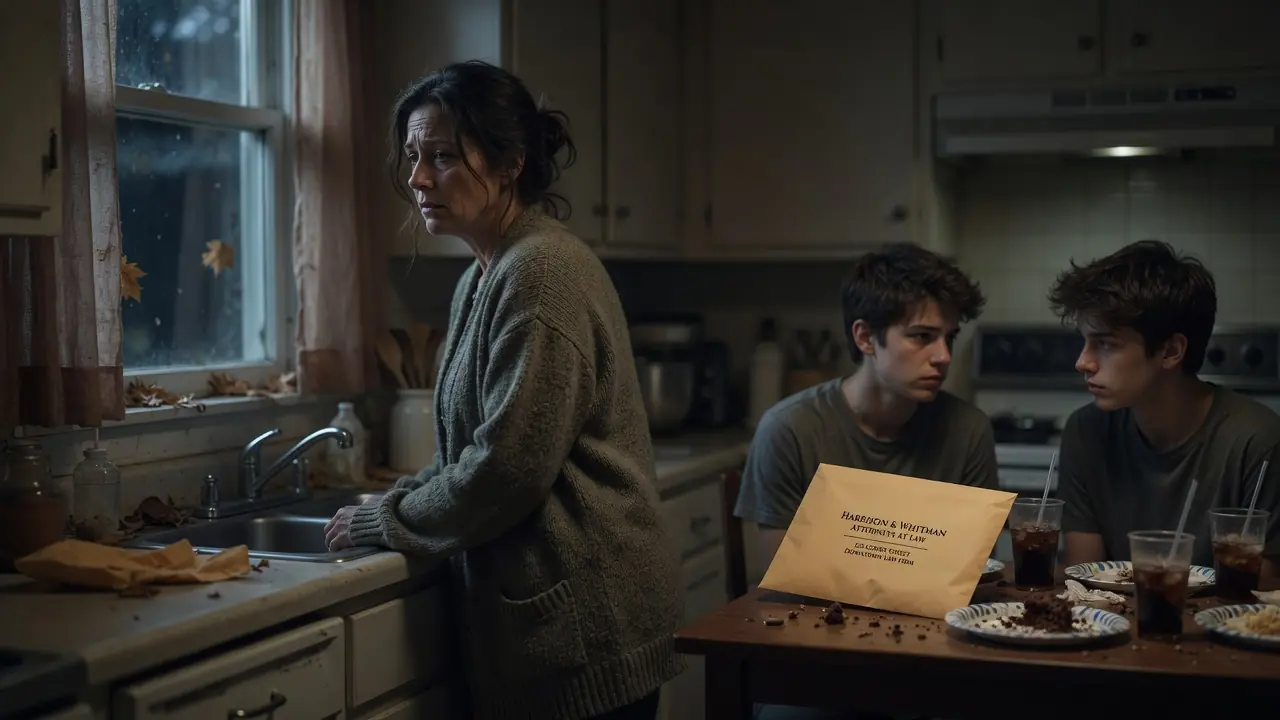
Three hundred thousand dollars had existed somewhere while I washed blood from my knuckles after scrubbing corporate bathrooms at one in the morning.
“Where was this money?” I whispered.
“In a guardianship trust,” Mason said. “Under your control.”
“No.”
“Your name is all over it.”
“I was never given access to anything except the state support account.”
“Then explain these.”
He turned to a page containing a list of withdrawals.
Five hundred dollars every month.
The payments began three years earlier.
Each transfer carried my name.
Sarah Whitmore, guardian.
Noah leaned toward me.
“You took almost twenty thousand dollars.”
“I did not.”
“The money went into your checking account.”
“I never touched your trust.”
“You bought a car.”
“My old car died.”
“With our money.”
“No. I financed that car through the credit union.”
Mason stood abruptly.
“Stop lying.”
The chair legs scraped across the floor.
I looked up at him, stunned by the contempt in his face.
He had David’s eyes. That was the cruelest part. My older brother had once looked at me with those same dark eyes and made me promise that if anything ever happened, I would watch over his boys.
It had been a casual promise then.
He was thirty-two, healthy, laughing, and carrying Noah on his shoulders at a summer barbecue.
“Nothing’s going to happen,” I had told him.
“Promise anyway.”
“I promise.”
Two months later, he and Clara died on Route 40 when a tractor-trailer crossed the center line in the rain.
Now his son looked at me as if I had betrayed them all.
“I am not lying,” I said.
“Uncle Mark said you’d deny it,” Noah replied.
“Of course he did.”
Mason’s expression hardened.
“What does that mean?”
“It means Mark has not paid for one school lunch, one soccer uniform, or one bottle of medicine in thirteen years. Now he appears with a lawyer and suddenly he’s your protector?”
“He said he tried to help.”
“He disappeared.”
“He said you kept us away from the family because you didn’t want anyone examining the accounts.”
I stood.
“That is not true.”
“Did you ever invite him over?”
“Hundreds of times.”
“He said you stopped calling.”
“After he stopped answering.”
Mason shook his head.
“This is exactly what he warned us about. You always make yourself the victim.”
The words tore through me.
I looked from one twin to the other.
“Do you believe I raised you for money?”
Neither answered.
That silence hurt more than a shouted yes.
I placed both hands on the table to steady myself.
“When you were five, Noah screamed every night because he thought your parents would come back if he stayed awake. I sat beside his bed until sunrise for four months.”
Noah looked away.
“When Mason broke his arm, I slept in a hospital chair for two nights because he panicked whenever I left the room.”
Mason’s face tightened.
“I cleaned offices after working all day so you could stay in the same school district. I turned down a job in Raleigh because moving would have separated you from your friends.”
“You didn’t have to do any of that,” Mason said.
“I know.”
“Then stop using it against us.”
I stared at him.
“I’m not.”
“You always remind us how much you sacrificed.”
“You didn’t have to. You made sure we knew.”
A memory surfaced.
Two years earlier, after an argument about a school trip I could not afford, I had said, “Do you know how hard I work to keep this family going?”
I had been exhausted.
I had not intended it as a debt.
But perhaps they had heard it that way.
“I’m sorry if I ever made you feel like a burden,” I said. “But I did not steal from you.”
Noah wiped his palms on his jeans.
“We’re taking control of the accounts.”
“You should.”
“And we’re moving out.”
The room went completely still.
“What?”
“Uncle Mark rented an apartment near campus,” Mason said. “We’re leaving tonight.”
“You start college next fall.”
“We can stay there until then.”
“You have school Monday.”
“We’ll drive.”
I looked toward the hallway.
Two duffel bags sat near the front door.
Already packed.
The conversation had never been a discussion.
It was an announcement.
“You planned this before the party.”
Mason said nothing.
I turned toward Noah.
“You ate cake with me while those bags were packed?”
His eyes filled briefly, but he looked away.
I walked to the living room window.
A black SUV waited across the street with its lights off.
Mark’s vehicle.
“He’s outside.”
“Yes,” Mason said.
My anger arrived so suddenly that my hands stopped shaking.
“Tell him to come in.”
“He doesn’t want drama.”
“He created it.”
“Aunt Sarah—”
“Tell him to come into this house and accuse me to my face.”
Mason took out his phone.
A minute later, the front door opened.
Mark entered wearing a camel-colored coat and the expression of a man arriving to manage an unfortunate situation.
He was forty-five, seven years older than me, with silver beginning at his temples and the polished ease of someone who sold commercial real estate for a living.
He had always looked respectable.
Even when he lied.
“Sarah,” he said gently.
“Do not use that voice.”
“What voice?”
“The one you use when you want everyone to believe you’re the calm person in the room.”
He glanced toward the twins.
“Maybe we should keep this civil.”
“Where were you when they needed braces?”
Mark sighed.
“This isn’t about me.”
“Where were you when Noah had pneumonia?”
“Sarah.”
“Where were you when the basement flooded and we slept in one room for two weeks?”
“I offered help.”
“You offered advice.”
“I had my own family.”
“So did I.”
“You chose guardianship.”
“No one else would.”
His eyes flickered.
“You always enjoyed saying that.”
My chest tightened.
“What does that mean?”
“You made sure everyone knew you were the one who stepped up.”
“I was the one who stepped up.”
Mark looked at Mason and Noah.
“This is what I warned you about.”
I moved toward him.
“What have you done?”
“I helped them understand their rights.”
“By telling them I stole from them?”
“The records speak for themselves.”
“You prepared those papers three years ago.”
His face changed for less than a second.
It was enough.
“What papers?” Mason asked.
I pointed at Mark.
“He came here three years ago with forms. He said there was a family education grant.”
Mark smiled sadly.
“She’s confused.”
“No.”
I turned toward the twins.
“My car broke down during the ice storm. Mark suddenly appeared and said he had arranged five hundred dollars a month through a family foundation. He told me it was meant to help guardians caring for orphaned relatives.”
“There was no foundation,” Noah said.
“I know that now.”
“You signed trust withdrawal forms,” Mason replied.
“I signed what he placed in front of me.”
Mark shook his head.
“You were thirty-six years old, Sarah. Not a child.”
“You told me the forms were grant applications.”
“Do you have proof?”
The question was too quick.
Too prepared.
“No.”
“Exactly.”
He faced the boys.
“She is trying to shift responsibility.”
I looked at the twins.
“Where did the rest of the withdrawals go?”
“What rest?” Noah asked.
“The trust was worth three hundred thousand dollars. If I took twenty thousand, what remains?”
Mason hesitated.
“About a hundred seventy-eight.”
I stared at him.
“More than a hundred thousand dollars is missing.”
“Investment losses,” Mark said.
“Who managed the investments?”
“The court-appointed trustee.”
“Who?”
Mark’s jaw tightened.
“Dad’s former financial adviser.”
“Name him.”
“Peter Alden.”
I knew the name.
Peter had worked with Mark on several real estate transactions.
“Who introduced David to him?”
Mark looked away.
“You did.”
“That doesn’t prove anything.”
“No.”
I stepped closer.
“But it explains why you are standing here.”
Mark’s calm expression disappeared.
“Enough.”
The twins looked between us.
He turned to them.
“Get your things.”
Mason lifted his duffel.
Noah remained still.
I saw uncertainty enter his face.
“Noah,” I said.
Mark interrupted.
“Do not manipulate him.”
“I am asking him to think.”
“He has thought.”
“Have you seen original bank records?”
Noah swallowed.
“Mr. Miller showed us copies.”
“Provided by whom?”
“Uncle Mark.”
“Have you spoken to the probate court?”
“No.”
“Have you contacted the bank directly?”
Mason grabbed Noah’s bag.
“We’re done.”
I moved aside from the door.
Not because I wanted them to leave.
Because I could not force them to stay.
They were eighteen.
That legal threshold had transformed my authority into memory overnight.
Mason walked out first.
Noah stopped beside me.
For one second, I thought he might hug me.
Instead, he whispered, “Why didn’t you tell us about the money?”
“Because I did not know.”
He searched my face.
Then Mark called his name.
Noah left.
The front door closed.
Through the window, I watched the SUV pull away with the two people I had built my entire adult life around.
The half-eaten cake remained on the kitchen counter.
The frosting said Happy Birthday Mason & Noah.
One of the candles had fallen sideways and left a streak of blue wax across the icing.
I sat at the table until morning.
The house made unfamiliar sounds without them.
The refrigerator clicked.
Pipes shifted inside the walls.
A branch scraped the roof.
For thirteen years, silence had been something I wished for after homework, arguments, television, and doors opening every six minutes.
Now it felt alive.
At six, I walked into their bedrooms.
Mason had taken almost everything.
Noah left three shirts hanging in his closet and the stuffed bear he slept with after the accident.
Its left ear had been repaired with brown thread.
I had sewn it at two in the morning while he cried beside me.
I sat on his bed holding the bear and allowed myself to break.
I missed work that Monday for the first time in four years.
My supervisor, Dr. Kaplan, called at nine.
“Sarah, are you sick?”
“No.”
“Is one of the boys sick?”
“They left.”
Silence.
“What do you mean?”
I told her enough.
She asked whether I wanted company.
“No.”
“That was not the question.”
Dr. Kaplan arrived an hour later with coffee and a legal pad.
She was sixty-one, divorced twice, and incapable of offering sympathy without a plan.
“First, you need your own lawyer.”
“I cannot afford one.”
“You cannot afford not to.”
“I have forty-three dollars until Friday.”
“I know someone.”
Her attorney was named Janice Bell, a former probate litigator who had left a large firm to work with elder abuse and guardianship cases.
Janice listened without interrupting.
Then she asked me to sign authorization forms so she could obtain the complete probate file.
“Do you still have the paperwork Mark gave you?”
“I may.”
“Find it.”
“Will the boys come home if we prove I didn’t steal?”
Janice looked at me over her glasses.
“We prove the truth because it is the truth. What they do afterward is not something a court can order.”
I hated that answer.
It was also the first honest one anyone had given me.
I searched the house that night.
The papers were not in the file cabinet, the kitchen drawer, or the storage box where I kept tax documents.
Then I remembered Mark asking to use my printer after I signed them.
He had placed the originals inside his briefcase.
But I had scanned one page because Dr. Kaplan’s office required documentation before allowing a schedule adjustment.
I found the scan inside an old email.
FAMILY CARE SUPPORT APPLICATION appeared at the top.
The logo belonged to the Alden Family Foundation.
Janice called the foundation registry the next morning.
No organization by that name existed.
The bank account listed at the bottom belonged to Alden Fiduciary Services.
Peter Alden.
“What did the monthly deposits look like in your bank?” Janice asked.
“Family support stipend.”
“Not trust disbursement?”
“No.”
“Then someone deliberately disguised the source.”
Within two weeks, Janice petitioned the probate court for a full accounting.
Mark attempted to block it.
His attorney argued that because Mason and Noah were adults, I lacked standing to challenge their trust management.
Janice found another path.
The withdrawal documents carried my signature. That made me a potential victim of forgery or a potential participant in fraud.
Either way, I had standing to request verification.
The court appointed a forensic accountant named Malcolm Hayes.
He was a quiet man with thick glasses and no interest in family drama.
“Numbers do not care who raised whom,” he told me.
“Good.”
“They also do not care who cries.”
“I understand.”
“Most people say that before crying.”
He was right.
The first audit meeting showed that the original trust had been managed legitimately for ten years.
The money grew from $298,000 to nearly $374,000.
Then, three years earlier, management changed.
Peter Alden transferred the assets into several private investment partnerships.
Those partnerships purchased interests in commercial properties.
All of the properties were connected to Mark.
My five-hundred-dollar monthly payments were real, but they were a small part of a much larger scheme.
More than $136,000 had been removed through “management fees,” “maintenance reimbursements,” and “emergency capital calls.”
Most went to companies owned by Mark and Peter.
“Why would they send money to me?” I asked.
Malcolm adjusted his glasses.
“To create a visible beneficiary.”
“A scapegoat.”
“Possibly.”
Janice leaned forward.
“If the boys noticed losses, Sarah’s monthly payments made an easy explanation.”
My stomach turned.
“They planned to blame me.”
“For at least three years,” she said.
The realization hurt differently from the twins’ accusation.
Mark had not simply stolen money.
He had watched me raise the boys, understood exactly how much their trust mattered, and used my devotion as camouflage.
I called Mason.
He declined the call.
I sent a message.
The court has ordered an independent audit. Please do not sign anything for Mark or Peter Alden until it is complete.
He replied ten minutes later.
Stop harassing us.
Noah did not reply at all.
At school, their attendance began slipping.
The principal called because my number remained listed as emergency guardian.
“They are legally adults,” he said, “but we are concerned.”
“Have they been absent together?”
“Seven days this month.”
I drove to the apartment Mark rented.
The building stood near the university district, four floors of renovated brick with a gym and rooftop lounge.
I knocked.
Mason opened the door wearing sweatpants at two in the afternoon.
His eyes were bloodshot.
“What are you doing here?”
“Your school called.”
“They shouldn’t.”
“You’ve missed seven days.”
“We’re eighteen.”
“That does not make failing senior year intelligent.”
He tried to close the door.
I blocked it with my foot.
“Audit records show Mark and Peter removed more than a hundred thousand dollars from your trust.”
Mason’s face hardened.
“Your lawyer is making things up.”
“The accountant was appointed by the court.”
“Uncle Mark said you requested someone who would blame him.”
“You think I control a probate judge?”
“I think you know how to look innocent.”
The accusation exhausted me more than it angered me.
“Where is Noah?”
“Out.”
“With Mark?”
“No.”
“Does he know where the trust money went?”
“We know enough.”
A voice spoke behind him.
“You should leave.”
A woman stepped from the hallway.
She was perhaps twenty-three, with blond hair and one of Mark’s company sweatshirts.
“Who are you?” I asked.
“Brianna.”
Mason looked embarrassed.
“She’s a friend.”
Brianna folded her arms.
“They don’t need you controlling them.”
I looked at the beer cans on the coffee table.
“Are you living here?”
“That’s none of your business.”
“Who pays the rent?”
“Uncle Mark.”
Of course.
I turned toward Mason.
“Mark is isolating you.”
“He gave us freedom.”
“No. He gave you dependence with better furniture.”
Mason slammed the door against my foot.
Pain shot through my ankle.
“Go home,” he said.
“This is my home.”
The words came out before I could stop them.
His face changed.
Not softened.
Closed.
“This was never our home,” he said. “It was yours.”
The door shut.
I stood in the hallway holding the wall until my breathing steadied.
That night, Noah called.
He said nothing at first.
I heard traffic behind him.
“Noah?”
“Did you really not know about the trust?”
“No.”
“Not any of it?”
“I knew your parents had insurance, but I was told the estate used almost everything. I never knew how much remained.”
“Uncle Mark says that’s impossible.”
“Mark says what protects Mark.”
“He showed us your signatures.”
“Some were copied from the grant form. Others may be forged.”
A car horn sounded.
“Where are you?”
“Walking.”
“At midnight?”
“I needed air.”
“Is everything okay at the apartment?”
He became silent.
“Noah.”
“Mason’s different.”
“How?”
“He keeps spending money.”
“What money?”
“Mark gave us trust cards.”
My chest tightened.
“Do not use them.”
“They’re ours.”
“You do not know which accounts they draw from.”
“He says the audit froze most of it.”
“Then where does the card money come from?”
“I don’t know.”
“Mark may be creating debt in your names.”
Noah swore quietly.
“Did you sign anything?”
“No.”
“Did Mason?”
“I think so.”
“What?”
“Something about a business.”
I closed my eyes.
“Come home.”
“I can’t.”
“Why?”
“Mason would think I betrayed him.”
“You are allowed to think differently from your brother.”
“We always stay together.”
That had been true since the accident.
At five, they slept holding hands in the same bed because separation terrified them.
Even as teenagers, they attended the same school, joined the same soccer team, and planned to attend the same college.
Mark understood that bond.
He only needed to control one twin to keep the other.
“You can come without choosing against Mason,” I said. “Your room is still here.”
“I miss home.”
The words nearly broke me.
“I miss you.”
He began crying quietly.
Then another voice called his name.
Noah whispered, “I have to go.”
The call ended.
The audit uncovered the next layer one week later.
Mark had not rented the apartment.
The trust had purchased it.
Mason and Noah were listed as owners, but the mortgage exceeded the property’s value. Mark’s company received a $40,000 “acquisition fee,” and the twins were responsible for monthly payments beginning after graduation.
“He turned them into debt holders,” Janice said.
“Can we reverse it?”
“If we prove fraud.”
“How long?”
“Months.”
“They do not have months.”
Malcolm found three additional documents carrying Mason’s signature.
One made him a junior partner in a failing shopping-center project.
Another guaranteed a $220,000 commercial loan.
The third appointed Mark as his financial representative.
Noah had signed nothing.
“Mason is exposed,” Janice said.
“What happens if the project defaults?”
“The lender can pursue him.”
“He is eighteen.”
“The law treats eighteen-year-olds as adults.”
“Mark targeted him the week he became legal.”
“Yes.”
My hands shook with rage.
“Call the police.”
“We need prosecutors willing to treat this as criminal fraud rather than a family investment dispute.”
“What more do they need?”
“Evidence of intent.”
“Blaming me was intent.”
“It helps.”
Janice filed a report with the state financial crimes unit.
Mark responded by petitioning for a restraining order against me on Mason’s behalf.
The complaint claimed I had harassed the twins, appeared uninvited at their residence, and attempted to manipulate them into surrendering financial control.
At the hearing, Mason sat beside Mark.
Noah sat in the back row alone.
I had not seen either of them in six weeks.
Mason looked thinner.
He avoided my eyes.
Mark wore a dark suit and the solemn expression of a concerned uncle.
His attorney described me as “an emotionally unstable former guardian struggling to accept the twins’ independence.”
Janice stood.
“My client has communicated three times in six weeks. One message warned them not to sign documents during an active fiduciary investigation.”
The judge looked toward Mason.
“Do you fear Ms. Whitmore?”
Mason hesitated.
Mark whispered something.
“Yes,” Mason said.
The word emptied the room of air.
The judge asked, “Has she threatened physical harm?”
“No.”
“Has she entered your residence without permission?”
“No.”
“Has she followed you?”
“No.”
“Then what causes fear?”
Mason looked toward me for the first time.
“She makes me feel guilty.”
Even the judge appeared surprised.
“Guilt is not grounds for a protective order.”
Mark’s attorney attempted to redirect.
The judge denied the petition.
Outside court, I approached Noah.
Mark stepped between us.
“Stay away.”
“Noah called me.”
Noah looked at the ground.
Mark turned.
“Did you?”
“Noah swallowed.
“No.”
The lie was barely audible.
I stared at him.
He could not meet my eyes.
Mark smiled.
“They’ve made their decision.”
“You’re destroying them.”
“I’m giving them what you never did.”
“What is that?”
“Ownership.”
“You gave Mason debt.”
His smile disappeared.
“You should be careful making accusations.”
“The audit is almost complete.”
“Then wait for it.”
“I am.”
For the first time, uncertainty appeared in his eyes.
He had expected the audit to remain a civil dispute.
He did not know the financial crimes unit had opened an investigation.
That uncertainty kept me alive through the next month.
The boys graduated without me.
The school sent a generic livestream link after I requested one.
I watched from my living room.
Mason and Noah crossed the stage twenty-three names apart.
Noah looked toward the audience after receiving his diploma.
For one irrational moment, I believed he was searching for me.
Then the camera moved.
Their empty rooms remained unchanged.
I had stopped entering them every day, but I still washed the bedding once a month.
Dr. Kaplan found me doing it one Sunday.
She stood in the doorway holding groceries.
“You need to stop preserving this house like a crime scene.”
“They may come back.”
“They can come back to clean sheets without you washing them every four weeks.”
“I don’t know what else to do.”
“Live.”
“I have lived for them.”
“That is the problem.”
I turned toward her.
“You think I regret raising them?”
“No. I think you erased yourself so completely that their rejection feels like proof you never existed.”
The statement hurt because it was true.
“What am I supposed to do now?”
“Remember what Sarah liked before she became Aunt Sarah.”
“I don’t know.”
“Then start badly.”
She made me join a community gardening group.
I hated it.
The first meeting consisted of seven retirees arguing about tomato cages.
I returned the following week anyway.
One member, a widower named James, helped me repair a broken planter without asking why my hands shook whenever my phone rang.
We became friends slowly.
I did not tell the boys.
There was no one to tell.
Three months after the birthday, Malcolm completed the audit.
Mark and Peter had removed $148,600 from the trust.
Another $62,000 had been pledged as collateral for failing investments.
My monthly five-hundred-dollar payments totaled $18,000 and had been deliberately labeled as guardian reimbursements.
Every dollar was used for documented household expenses.
Car payments.
Utilities.
Groceries.
Medical copays.
None constituted theft.
More importantly, handwriting analysis showed that fifteen withdrawal forms contained traced versions of my signature.
My original signature had been taken from the false grant application.
Malcolm placed the evidence before the probate judge.
The judge froze every account connected to Mark and Peter.
A criminal warrant followed two days later.
Peter Alden was arrested at his office.
Mark disappeared.
His SUV was found at the airport.
Records showed he purchased a ticket to Mexico using an alias but never boarded the flight.
The police believed he drove west.
I called Mason.
His phone was disconnected.
Noah’s went directly to voicemail.
I drove to the apartment.
The front door was unlocked.
Inside, the rooms had been stripped.
Furniture, televisions, and electronics were gone.
Beer bottles covered the kitchen.
A foreclosure notice lay on the counter.
On the floor of Mason’s bedroom, I found his graduation gown and a broken picture frame.
The photograph inside showed the three of us at their eighth-grade ceremony.
Someone had cracked the glass directly across my face.
I sat on the floor and called their names though I knew they were gone.
A neighbor appeared in the doorway.
“You looking for the twins?”
“Yes.”
“They left yesterday.”
“With Mark?”
“No. Some girl took them.”
“Brianna?”
“Blond?”
“Yes.”
“She was screaming at one of them in the parking lot. The quieter one.”
“Noah.”
“She hit him.”
My entire body went cold.
“Did you call police?”
“I didn’t know their names.”
I drove to Brianna’s address, obtained through the apartment lease application.
Her mother answered.
“Brianna doesn’t live here.”
“Do you know where she is?”
“No.”
“She is with my nephews.”
The woman’s expression changed.
“Are you Sarah?”
“Yes.”
She began crying.
“Brianna told us you stole their money.”
“She was wrong.”
The woman opened the door wider.
“My daughter has problems.”
“What kind?”
“Drugs. Men. Money.”
“Where would she take them?”
“There’s a motel near the highway.”
I called police and drove there before they arrived.
The Cedar Rest Motel consisted of one-story rooms around a cracked parking lot.
Brianna’s car sat outside room seventeen.
I knocked.
No answer.
I knocked harder.
“Brianna.”
Movement sounded inside.
Then Mason opened the door.
He looked terrible.
His face was pale, his hair unwashed, and a bruise darkened one cheek.
“Aunt Sarah?”
I pushed inside.
Noah lay on the bed with blood dried beneath his nose.
Brianna stood near the bathroom holding a lamp.
“Get out,” she said.
“What happened to Noah?”
“He fell.”
Mason looked at the floor.
“She hit him.”
Brianna turned on him.
“You liar.”
She raised the lamp.
I moved between them.
“Put it down.”
“This isn’t your family anymore.”
Police sirens approached.
Brianna ran toward the back window.
An officer entered before she reached it.
Within minutes, she was handcuffed.
Paramedics examined Noah.
He had a concussion and a fractured nose.
Mason sat on the curb shaking.
I knelt in front of him.
“Where is Mark?”
“We don’t know.”
“What happened?”
Mason covered his face.
“He took everything.”
“The trust?”
“The cards stopped working. Then the lender called. The apartment payments were late. Brianna said she knew someone who could help.”
“She used you.”
He began crying.
“I thought you were lying.”
“I know.”
“I told everyone you stole from us.”
“I know.”
“I signed whatever Mark gave me.”
“We will deal with that.”
“I ruined everything.”
“No.”
“I almost got Noah killed.”
“Noah is alive.”
“Because you came.”
The words entered me painfully.
For thirteen years, that had been my role.
Come when they called.
Fix what broke.
Hold what hurt.
But something inside me had changed.
“I came because you were in danger,” I said. “That does not erase what happened.”
Mason looked up.
“I’m sorry.”
“I know you are.”
“Can we come home?”
I wanted to say yes immediately.
Every part of my old life reached for that answer.
Then Dr. Kaplan’s voice returned.
You erased yourself.
I looked at the boys.
“Yes,” I said. “Temporarily.”
Mason blinked.
“What does that mean?”
“It means you can recover there while we make a plan.”
“A plan?”
“You are adults now. Home is not permission to avoid the consequences.”
His face fell.
Noah sat inside the ambulance listening.
“You don’t want us,” Mason whispered.
The old guilt rose.
I let it pass through me.
“I love you,” I said. “But love is not the same as pretending you did not accuse me, lie in court, and sign dangerous contracts.”
Noah began crying.
“I’m sorry too.”
“I believe you.”
“Will you forgive us?”
“Eventually, I hope.”
The answer frightened them.
It frightened me too.
But it was honest.
They returned to the house that night.
Mason entered first, carrying the same duffel bag he had taken on their birthday.
Noah stood inside the doorway staring toward the kitchen.
The cake was long gone.
The blue wax stain remained faintly visible on the counter.
“I thought you’d change everything,” he said.
“I started to.”
They noticed the guest room had become my bedroom.
For thirteen years, I had slept in the smallest room.
During their absence, I moved into the larger one and turned Mason’s old room into a sewing and reading space.
Mason stared at the shelves.
“My room.”
“Was your room.”
His face tightened.
“Where do I sleep?”
“The guest room.”
“There’s one bed.”
“James is bringing another tomorrow.”
“Who is James?”
“A friend.”
Both twins looked surprised.
Noah almost smiled.
“You have a boyfriend?”
“No.”
Mason looked toward the changed room again.
I saw him understanding that the house had continued without them.
That realization hurt him.
It also needed to.
The criminal case against Mark expanded.
Federal agents found him six months later in Nevada, living under the name Martin Wallace and attempting to sell another fraudulent investment.
He was returned in handcuffs.
Peter accepted a plea agreement and testified against him.
Mark’s trial became the final fracture in our family.
Aunt Linda defended him.
Grandma insisted he had made “financial mistakes” but remained family.
Several relatives suggested I should avoid testifying to protect the family name.
I looked around Grandma’s living room, the same room where everyone had promised to help thirteen years earlier.
“Which family name are we protecting?” I asked. “The one that disappeared when two five-year-olds needed homes? Or the one Mark used to steal from them?”
Linda crossed her arms.
“He is your brother.”
“So was David.”
The room went silent.
“He stole from David’s children.”
“Mark says he intended to repay it.”
“After blaming me?”
“He panicked.”
“So did Mason and Noah. They are still facing consequences.”
Grandma began crying.
“Your father would hate this.”
“My father hated cowardice.”
The words felt final.
I testified.
Mark watched me from the defense table with no expression.
His attorney portrayed me as bitter, financially unstable, and motivated by resentment.
He questioned every payment from the trust into my account.
“What did you purchase with the five hundred dollars in March?” he asked.
“Groceries, heating oil, and Mason’s asthma medication.”
“And in April?”
“A transmission repair.”
“For your personal vehicle.”
“The vehicle I used to take the boys to school and work two jobs.”
“Did the trust agreement authorize personal transportation?”
Janice objected.
The judge allowed the question.
I looked at the jury.
“I believed the money came from a guardian-support grant. Every dollar kept the household caring for those boys functioning.”
Mark’s attorney held up a receipt.
“You purchased a winter coat.”
“Yes.”
“For yourself.”
“Yes.”
“Using their money.”
“My coat had holes. I walked from the clinic to the office building at night in January. Without a coat, I could not work the second job paying for their home.”
He smiled as though he had trapped me.
“So you benefited.”
“Yes.”
The answer surprised him.
“I benefited by not freezing. They benefited because their guardian remained employed.”
The jury listened.
Malcolm explained the forged documents.
Peter described Mark’s plan.
Then Mason testified.
He looked older than eighteen.
He admitted Mark had coached him before the confrontation.
“He told me Aunt Sarah would cry,” Mason said. “He said tears were how she controlled us.”
“Did you believe him?” the prosecutor asked.
“Yes.”
“Why?”
“Because I wanted the money to mean I had choices.”
“What choices?”
“To leave. To go to school without worrying. To stop feeling like everything Aunt Sarah did for us had to be repaid.”
I looked down.
That truth belonged partly to me.
The prosecutor asked, “Did Ms. Whitmore ever ask you to repay her?”
“No.”
“Then why did you feel that way?”
Mason looked toward me.
“Because everyone called her a saint. When people say someone gave up their life for you, you start wondering whether your own life belongs to them.”
The courtroom became quiet.
I cried.
Not because he had betrayed me.
Because I finally understood part of why.
Mark saw that resentment and shaped it into a weapon.
But he had not invented it from nothing.
Noah testified next.
He described the apartment, the debt, Brianna, and Mark’s disappearance.
The defense attorney asked whether I pressured him to change his story.
“No.”
“Did she ask you to forgive her?”
“No.”
“Did she allow you to return home?”
“Yes.”
“Then she benefited from your dependence again.”
Noah stared at him.
“My aunt gave us rules.”
“What rules?”
“Therapy. Jobs. School. We pay part of our expenses. We cannot use family money without the court supervisor.”
“Sounds controlling.”
“No.”
Noah looked at Mark.
“Control is when someone gives you everything you want so you won’t notice what they’re taking.”
Mark lowered his eyes.
The jury convicted him on fraud, embezzlement, forgery, and identity theft.
At sentencing, he asked to speak.
He turned toward Mason and Noah.
“I did love you.”
Mason sat rigidly beside me.
Mark continued.
“When David died, everyone looked at Sarah like she was brave. No one looked at me.”
The courtroom remained silent.
“I had debts. The trust money was sitting there. I told myself I was borrowing it, that the investments would grow, and that the boys would never know.”
He looked at me.
“Then the investments failed.”
“So you blamed me,” I said.
The judge warned me not to interrupt.
Mark nodded.
“I knew they trusted you. I knew if they believed you stole from them, they would come to me.”
His voice broke.
“I wanted to matter.”
Mason began crying silently.
Mark received nine years in prison and was ordered to pay restitution.
Not all the money was recovered.
The boys’ trust retained enough for community college and part of a university transfer, but not the debt-free future their parents had intended.
They both took jobs.
Mason worked at a hardware store and began business classes.
Noah studied nursing while working weekends in assisted living.
They lived at home for another year.
The reconciliation was not a single emotional conversation.
It was awkward breakfasts, therapy sessions, arguments over rent, and Sundays when one twin apologized while the other remained angry.
Sometimes Mason accused me of becoming cold.
Sometimes I accused him of expecting forgiveness on demand.
We learned to stop using pain as proof that the other person was wrong.
One evening, Mason found me packing old soccer trophies into a donation box.
“You’re getting rid of these?”
“You said you didn’t want them.”
“I said that when I was sixteen.”
“Do you want them now?”
He picked up a small gold-colored trophy from age nine.
“You drove four hours for this tournament.”
“Yes.”
“You worked the night before.”
“Yes.”
“Were you angry?”
“I was tired.”
“Did you resent us?”
“Sometimes.”
His eyes widened.
I had never admitted that before.
“You did?”
“Yes.”
“Then why stay?”
“Because resentment is a feeling, not a decision.”
He sat beside the box.
“I thought love meant never regretting anything.”
“No. Love can include exhaustion, anger, and wishing life were easier.”
“Uncle Mark said you only kept us because you wanted people to admire you.”
“Part of me liked being needed.”
The truth surprised him again.
“I built my identity around raising you. That was not your fault, but it made your independence frightening.”
Mason looked down.
“So both things were true.”
“What things?”
“You loved us. And you needed us.”
“Yes.”
“Was that bad?”
“It became unhealthy when I forgot I needed a life that belonged to me too.”
He handed me the trophy.
“Keep this one.”
I did.
James remained in my life.
He was patient with the twins but did not attempt to become their father or my rescuer. After two years of friendship, we began dating.
Noah approved immediately.
Mason took longer.
One night, he asked whether James intended to move in.
“I don’t know.”
“This is our home.”
“It is my home.”
The sentence would once have filled me with guilt.
It did not anymore.
“You are welcome here,” I continued. “But you will eventually build homes of your own.”
Mason looked hurt.
Then thoughtful.
“I don’t like that.”
“I know.”
“But it’s probably true.”
“Yes.”
Three years after their eighteenth birthday, Mason and Noah moved into separate apartments.
Separate.
That was a victory neither understood at five.
Mason’s place stood near his university.
Noah rented a small apartment beside the hospital where he completed clinical training.
On moving day, they argued over a lamp.
Then each drove in a different direction.
I cried in the driveway.
James stood beside me.
“Want me to say the house will feel full again?”
“No.”
“Good. It would be a lie.”
I laughed through tears.
The house did become quieter.
But this time, silence did not mean abandonment.
It meant room.
Room for books.
Room for gardening tools.
Room for James’s terrible music.
Room for the woman I had postponed becoming.
Mason and Noah visited every Sunday.
Not because I demanded it.
Because we chose it.
Some dinners were warm.
Others contained old tension.
The scar never vanished completely.
Years later, when Noah became engaged, he asked me to sit in the front row beside the empty chairs reserved for David and Clara.
“You raised me,” he said.
I looked at him.
“Yes.”
He smiled faintly.
“You don’t have to say it like evidence.”
“I’m practicing receiving credit without turning it into debt.”
“That sounds like therapy.”
“It is.”
At Mason’s college graduation, he handed me his diploma after the ceremony.
“This belongs to you too.”
“No.”
His smile faded.
I continued.
“You earned it.”
“You helped.”
“Yes.”
“Then take some credit.”
“I will. But I won’t take ownership.”
He hugged me.
That was the lesson our family learned too late and then spent years practicing.
Love can support a life without owning it.
Sacrifice can be real without becoming a weapon.
Gratitude can exist without lifelong repayment.
And betrayal can be forgiven without pretending trust was never broken.
Mark wrote from prison twice.
The first letter defended himself.
The second apologized.
I answered neither.
Mason visited him once.
Noah never did.
I did not tell either twin what forgiveness should look like.
Mark would remain their uncle.
He would also remain the man who stole from them and nearly turned them against the person who stayed.
Both truths belonged to them.
On the twins’ twenty-fifth birthday, we gathered in my kitchen again.
The laminate counters had been replaced, but a faint blue mark remained on the wooden trim near the sink where candle wax had dripped seven years earlier.
Noah brought his fiancée.
Mason brought a woman he had been dating for six months.
James baked the cake and misspelled Mason’s name.
We laughed until he threatened to throw it away.
After dinner, Mason placed a manila envelope on the table.
For one terrible second, my body remembered the first one.
He saw my face.
“It’s not legal paperwork.”
“What is it?”
“Open it.”
Inside were two airline tickets to Maine.
“You always wanted to see the coast,” Noah said.
“I cannot accept this.”
Mason groaned.
“Aunt Sarah.”
“It is too expensive.”
“We paid for it.”
“You have loans.”
“We budgeted.”
“I don’t need repayment.”
Noah took my hand.
“It isn’t repayment.”
“Then what is it?”
“A gift.”
I looked at both of them.
No debt.
No obligation.
No hidden contract.
Just a gift.
I allowed myself to accept it.
“Thank you.”
Mason smiled.
“You’re welcome.”
The moment was small.
No dramatic music.
No perfect restoration.
But it mattered because years earlier, a thick envelope had crossed that same table and nearly destroyed us.
This one opened something instead.
I once believed raising Mason and Noah was the entire meaning of my life.
Then I believed their betrayal proved those thirteen years had been wasted.
Both ideas were wrong.
Love is not wasted because someone misunderstands it.
Sacrifice is not erased because gratitude arrives late.
But love should not require a person to disappear.
I was twenty-six when I took in two frightened five-year-olds.
I became their guardian, provider, nurse, tutor, driver, and the person they called when nightmares returned.
For years, I treated those roles as the whole of me.
When they walked out at eighteen, I thought they had taken my identity with them.
They had not.
They had only forced me to discover that I still existed beneath it.
Now, when people praise me for raising my brother’s children, I do not call myself a saint.
I tell the truth.
I was tired.
I was sometimes resentful.
I made mistakes.
I loved them fiercely.
I stayed.
And when they returned, I did not open the door because nothing had happened.
I opened it because something had happened, and because rebuilding required all of us to enter differently.
The boys came back believing home meant immediate forgiveness.
I learned to teach them that home could also mean accountability.
I had believed motherhood meant giving until nothing remained.
They taught me, painfully, that love survives better when the person giving it remains whole.
On Sunday evenings, Mason still arrives first.
Noah is always late.
James complains about both of them while cooking enough food for ten people.
Sometimes I look around the table and see David in their eyes.
Not as a ghost.
As continuation.
His sons grew into men.
Not perfect men.
Men capable of being manipulated, making cruel decisions, facing shame, and doing the harder work of returning to the truth.
That is what family became for us.
Not the people who promise to help during the funeral.
Not the people who invoke blood while stealing from children.
Family is the person who tells the truth after the truth has become costly.
The person who remains when apologies are not immediately accepted.
The person who does not confuse access with entitlement.
The person who returns, not demanding the old home, but willing to help build a new one.
The night the twins turned eighteen, they left me beside a half-eaten birthday cake and drove away believing I had stolen their future.
For months, I thought the worst part was that they believed Mark.
It was not.
The worst part was realizing how completely I had placed my worth in their hands.
The best part came later.
Not when the audit cleared my name.
Not when Mark was convicted.
Not even when the boys came home.
It came when I understood that their love could return without becoming the sole reason I existed.
That was the inheritance none of us knew we needed.
And unlike the money Mark stole, it was something no one could take from us again.