Autumn of 1987 came early to Miller County, with cold mornings, dry cornfields, and combines already crawling across the horizon before sunrise. At Miller Equipment, every working machine mattered, because harvest did not wait for perfect weather or perfect timing. Farmers came in with worn belts, cracked hoses, broken bearings, and the kind of emergencies that could cost a man a season if they were not handled before dark. But for three weeks, one tractor had embarrassed the whole shop.
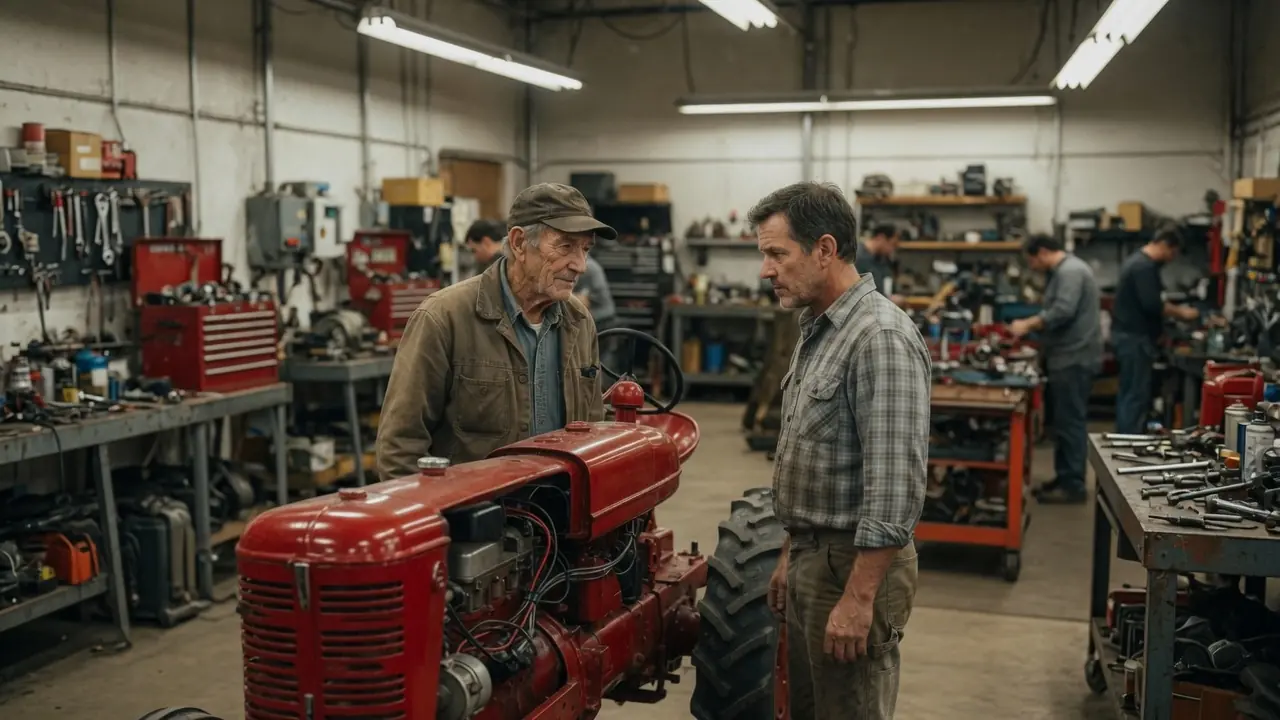
It was a 1948 Farmall M, restored so beautifully that strangers stopped at the open workshop door just to look at it. The red paint was deep and clean, the sheet metal straight, the wiring neat, and the fuel system looked as if it had been assembled by a man who cared about every inch. It should have been the pride of the shop, the kind of old machine that reminded farmers why they trusted iron that had already survived forty years. Instead, it sat in the center of the workshop like a stubborn red monument to failure.
Five mechanics had tried to start it. One checked the carburetor, one checked the distributor, one tested compression, one replaced ignition parts, and one tore through the wiring because he was certain the problem had to be electrical. The starter turned, the fuel reached the carburetor, the spark reached the plugs, and every test said the engine ought to run. But every time someone pressed the starter, the tractor only cranked and cranked until the whole shop grew tired of hearing it.
By Friday morning, the Farmall had become a local joke. Farmers who came in for parts would pause near the office and ask, “That old red thing still dead?” Mechanics smiled through clenched teeth and pretended the joke did not bother them. Frank Miller, the owner of the shop, bothered most of all, because his name was painted on the sign outside and the tractor was beginning to make that name look foolish.
Frank was in his late forties, broad-faced, practical, and proud of the shop his father had started. He had good mechanics working for him, men who understood modern engines, wiring diagrams, and service manuals. They were not fools, and Frank knew it. That was exactly why the Farmall made him so angry.
On that Friday, the shop gathered for one more attempt. Daniel, the youngest mechanic, climbed onto the seat and pressed the starter while the rest of the men stood around with their arms folded. The old engine turned over with the same tired rhythm they all knew too well. Crank, crank, crank, nothing. Daniel let off the switch and stared at the steering wheel as if the tractor had personally insulted him.
That was when Walter Hayes walked through the open shop door. He was seventy-nine years old, a retired farmer with a faded brown work jacket, a cap that had lost its shape years ago, and a small notebook in his shirt pocket. His face was lined from weather, harvests, winters, and decades of repairing machines because buying new ones had not always been possible. He did not look like a man arriving to solve a mystery. He looked like a man who had stopped by because the road had brought him there.
He did not touch the tractor at first. That was the first thing Frank noticed. Walter walked around it once, studying the paint, the wiring, the fuel line, the battery cables, the pulleys, and even the rear wheels. Then he stood beside the engine, tilted his head slightly, and listened to the silence.
Frank wiped his hands on a rag. “You want to hear it crank, Walter?” Walter looked at him and nodded once. Daniel pressed the starter again. The Farmall turned over, steady but lifeless, and Walter closed his eyes.
Ten seconds passed. Maybe less. Walter raised one hand. Daniel stopped. The workshop fell quiet, and Frank could feel a dozen men waiting for the old farmer to say something foolish.
Walter opened his eyes and looked at the tractor, then at Frank. “Problem isn’t inside the engine,” he said. A couple of mechanics shifted. One snorted. Frank folded his arms. “We checked everything else.” Walter’s expression did not change. “Then you checked everything except what matters.”
That landed harder than Frank expected. “Five trained mechanics tore through this machine for three weeks, Walter. Don’t tell me you’re fixing it by standing there like a fence post.” The room went still, because Frank’s irritation had finally stepped into the open. Walter looked back at the Farmall. “That’s the trouble, Frank. You all kept tearing into it before you ever listened.”
Daniel’s cheeks reddened. Another mechanic muttered something under his breath. Frank pointed toward the tractor. “The engine has fuel, spark, and compression. So unless you’ve got magic in that old coat, say something useful.” Walter turned his head slowly and met Frank’s eyes. “Useful? Fine. The engine ain’t the liar in this shop. The men guessing at it are.”
Nobody laughed after that. Even Frank had no answer ready. Walter did not raise his voice, and somehow that made the words hit harder. He was not trying to win an argument. He was simply saying what he believed to be true.
Frank took him into the office and spread the repair records across the desk. Walter read every page, not quickly, but carefully. Battery replaced. Starter rebuilt. Distributor checked. Carburetor rebuilt. Compression tested. Timing adjusted. Fuel verified. Spark verified.
Walter turned the pages and frowned. “When did it last run?” Frank leaned back in the chair. “Almost two years ago, according to the owner. It was restored by a collector in Iowa, then stored most of the time.” Walter tapped the page lightly. “Stored inside?” “Climate-controlled building,” Frank said. “Collector never really worked it.”
Walter nodded as though that mattered more than anyone understood. “Machines don’t like sitting pretty,” he said. “They were built to work.” Frank wanted to dismiss it as old farmer poetry, but something about Walter’s tone stopped him. The old man was not being sentimental. He was building a map.
Later that afternoon, Walter asked for another test. No tools, no disassembly, no parts. He climbed carefully onto the tractor seat and placed one hand on the steering wheel. “Turn it over,” he said. Daniel pressed the starter while Walter sat still, listening not just to the engine, but to everything around it.
The starter sounded strong. The battery had power. The fan moved. The belts turned. Yet Walter heard something uneven in the rhythm, a drag hidden inside what everyone else had accepted as normal. He raised his hand. Daniel stopped.
Walter climbed down and walked to the workbench. He picked up a pencil and wrote three words on a scrap of paper. Not turning fast. Frank stared at the note. “That’s it?” Walter nodded. “The engine’s too slow.”
Daniel stepped forward. “The starter is new.” “I know,” Walter said. “Battery’s new too.” “I know.” “Voltage is perfect.” Walter slipped the pencil back onto the bench. “I know.” Daniel threw up his hands. “Then how can it be too slow?” Walter smiled faintly. “That is the first good question anyone asked.”
For the next two days, Walter became a regular presence at Miller Equipment. He did not carry a toolbox. He did not take anything apart unless he had a reason. Mostly, he watched, listened, and wrote little notes that made the younger mechanics exchange looks behind his back. Frank noticed those looks but did not stop Walter.
Outside, the county harvest rolled forward. Combines moved through corn, grain trucks rattled down the road, and farmers arrived with their own urgent problems. Still, word spread that Walter Hayes had taken an interest in the dead Farmall. By Monday morning, men were stopping by the shop just to see whether the old farmer had made a fool of himself yet.
Walter did not care. He stood beside the tractor with his notebook open, writing observations most men would never bother to record. Temperature. Sound of starter under load. Belt rhythm. Slight vibration near the front pulley. The way the crankshaft seemed to resist smooth acceleration.
At midmorning, he asked Frank to crank the engine while he crouched near the front of the tractor. Frank hesitated. “You want to be down there while it’s turning?” “I have been closer to worse,” Walter said. Frank nodded to Daniel, and the engine turned over again. Walter watched the pulley, then closed his eyes. He raised his hand after ten seconds.
“There is drag somewhere,” Walter said. “Not enough to stop it. Enough to steal speed.” Daniel shook his head. “We checked the bearings.” “Engine bearings,” Walter said. “Not everything that turns is inside the engine.” That quiet sentence changed the direction of the room.
By Tuesday morning, they had started inspecting parts outside the engine. Belts. Fan hub. Generator. Accessory pulleys. At first, nothing seemed bad enough to matter. Then Daniel spun the generator pulley by hand and frowned. “This feels stiff.” Walter looked over from the bench. “Take the belt off.”
The belt came off in ten minutes. The crowd gathered again, less mocking now, more curious. The Farmall sat under the shop lights with one drive belt removed, looking almost exactly the same. Walter climbed onto the seat and looked at Frank. “Try it.”
The starter engaged. This time, everyone heard the difference. The engine turned just a little faster, smoother, freer. It still did not start, but the rhythm had changed. The room filled with a strange, reluctant excitement.
Daniel looked at Walter. “Generator bearing?” Walter nodded. “One of them.” Frank let out a breath he had been holding. “So that was it.” Walter stepped down slowly and looked at the tractor. “That was part of it.”
The generator came apart that afternoon. Inside, one bearing showed corrosion from sitting too long. It was not seized, not broken, not obvious. It simply resisted enough to drag the system down during starting. A small fault, barely visible, stealing just enough speed to keep the old tractor from waking.
When the replacement bearing arrived, everyone expected the Farmall to finally run. The generator went back together, the belt was installed, and Frank himself stood beside the tractor as Daniel pressed the starter. The engine cranked faster now. It coughed once, almost fired, then died back into silence.
The disappointment hit the room like bad weather. Daniel stared at the starter switch. Frank took off his cap and rubbed his forehead. Someone near the door muttered, “You have got to be kidding me.” Walter only stood with his hands in his coat pockets, looking more certain than ever.
That irritated Frank all over again. “Why do you look pleased?” Walter turned to him. “Because it tried.” “It still didn’t start.” “No,” Walter said. “But now it is telling the truth louder.”
That evening, after most of the mechanics left, Walter stayed in the workshop alone. The building felt different without the voices, with only cooling metal ticking and distant trucks passing on the road outside. Walter sat on an overturned bucket near the Farmall, notebook open on his knee. He replayed the sound in his head.
The starter was right now. The cranking speed had improved. Fuel was present. Spark was present. Compression was present. So why had the engine only coughed and quit?
Walter closed his eyes and imagined a Farmall M starting on a cold morning. He had heard that sound thousands of times in his life. The starter grind, the first pull of air, the tiny intake whistle, the sudden catch. His eyes opened. Intake whistle.
He stood and walked slowly toward the air cleaner. It had been cleaned on the outside and painted properly, but he saw no note in the records showing anyone had opened the oil bath assembly and inspected the hidden passages. Why would they? Everyone had assumed air was too simple to be the problem. Engines needed fuel and spark, so that was where they had looked.
The next morning, Walter stood beside the air cleaner while the mechanics gathered. Frank watched him with narrowed eyes. “You found something.” Walter rested one hand on the tractor. “I found what I did not hear.” Daniel frowned. “What does that mean?” Walter looked at him. “This engine is not breathing right.”
They removed the air cleaner assembly carefully. At first, it looked normal. Then Daniel shone a light into the lower chamber and went quiet. “No way,” he whispered. Packed deep inside the passage was the remains of an old mouse nest, dry and compacted, hidden beyond casual view.
It had not blocked the air completely. That was why the problem had survived so many tests. It had restricted flow just enough to weaken the engine during starting. Combined with the dragging generator bearing, the Farmall never had a fair chance.
Frank stood staring into the assembly, his face unreadable. Daniel leaned over it, then looked at Walter. “Two small problems.” Walter nodded. “Two small problems can stop a big machine.” Frank said nothing for several seconds. Then he looked at the repair records in his hand and quietly folded them.
The intake was cleaned. The bearing was replaced. The fuel system was checked one more time. Spark was tested again. By noon, everything was ready.
No one joked now. Farmers had gathered near the open doors. Mechanics stood along the walls. Frank remained near the front tire with his arms folded, but his expression had changed from pride to something closer to hope.
Walter climbed onto the Farmall’s seat because everyone asked him to. He settled behind the steering wheel and placed one weathered hand on the starter. The shop fell quiet. Outside, a grain truck rolled past, then faded down the road.
Walter pressed the starter. The engine turned once, twice, then caught with a deep, steady roar. The sound filled the workshop, bounced against the rafters, rattled dust loose from the lights, and sent a cheer through the crowd before anyone had time to decide whether cheering was proper. The Farmall M was alive.
Daniel laughed out loud, not with embarrassment, but relief. Frank removed his cap slowly. The tractor settled into an even idle, strong and confident, as if it had been waiting for someone to stop accusing the wrong parts. Walter sat still for a moment, listening. Then he shut it down and climbed off.
Frank walked toward him. For a second, Walter thought the owner might make a speech, but Frank only held out his hand. Walter took it. “I owe you an apology,” Frank said. Walter gave a slight shrug. “No, you owe that tractor one.”
Later that afternoon, they drove the Farmall out into a harvested cornfield behind the shop. Nothing grand happened. No banners, no contests, no newspaper man taking pictures. The old tractor simply moved across American farmland again, its tires pressing clean tracks into the stubble, its engine steady under the autumn sky.
Walter watched from the fence line with his notebook in his pocket. Daniel came to stand beside him. For a while, neither spoke. Then Daniel asked the question everyone had been holding. “What did you hear the first day?”
Walter looked at the Farmall moving across the field. “I heard what was not there.” Daniel waited. “The whistle?” Walter nodded. “The engine was telling us it could not breathe. But everyone was too busy proving the engine was wrong.” Daniel looked embarrassed. “We replaced half the tractor.” “That is easy,” Walter said. “Listening is harder.”
Frank joined them at the fence. He watched the tractor for a long time before speaking. “I thought you were guessing.” Walter smiled faintly. “Most people call it guessing when they do not understand the steps.” Frank accepted that without argument. “You made us look foolish.” Walter shook his head. “No. The tractor did. I just let it talk long enough.”
The Farmall ran through the rest of the season. It was not the biggest machine in the county and not the fastest. But every time farmers saw it pulling a wagon or idling near Miller Equipment, they remembered the three weeks when no one could start it. They remembered five mechanics, a rebuilt starter, a clean fuel system, perfect spark, good compression, and one old man who listened for ten seconds.
Months later, Frank framed a small note and hung it near the service counter. It contained a sentence Walter had said while sipping coffee in the office after the repair was done. The loudest problems are not always the real ones. Mechanics began pointing to it whenever a job stopped making sense.
Daniel took the lesson hardest and best. He stopped reaching for parts before understanding the pattern. He learned to stand beside a machine for a minute before touching a wrench. He learned that a clean repair record did not mean the truth had been found. It only meant someone had written down what they already believed.
As for Walter, he returned to his quiet life. He still came by Miller Equipment sometimes, buying oil, belts, or nothing at all. Men no longer joked when he walked through the door. They stepped aside, nodded, and let him listen.
The 1948 Farmall M became more than a tractor in that county. It became a story about pride, patience, and the danger of assuming the biggest problem must be the loudest one. It reminded every man in that shop that machines rarely lie. People lie. Records miss things. Assumptions dress themselves up as certainty.
But old iron tells the truth in its own language. Sometimes it speaks in a cough. Sometimes in a drag. Sometimes in the faint absence of a whistle no one has heard since they were young.
And sometimes, all it takes to hear it is an old farmer who knows when to stop guessing.