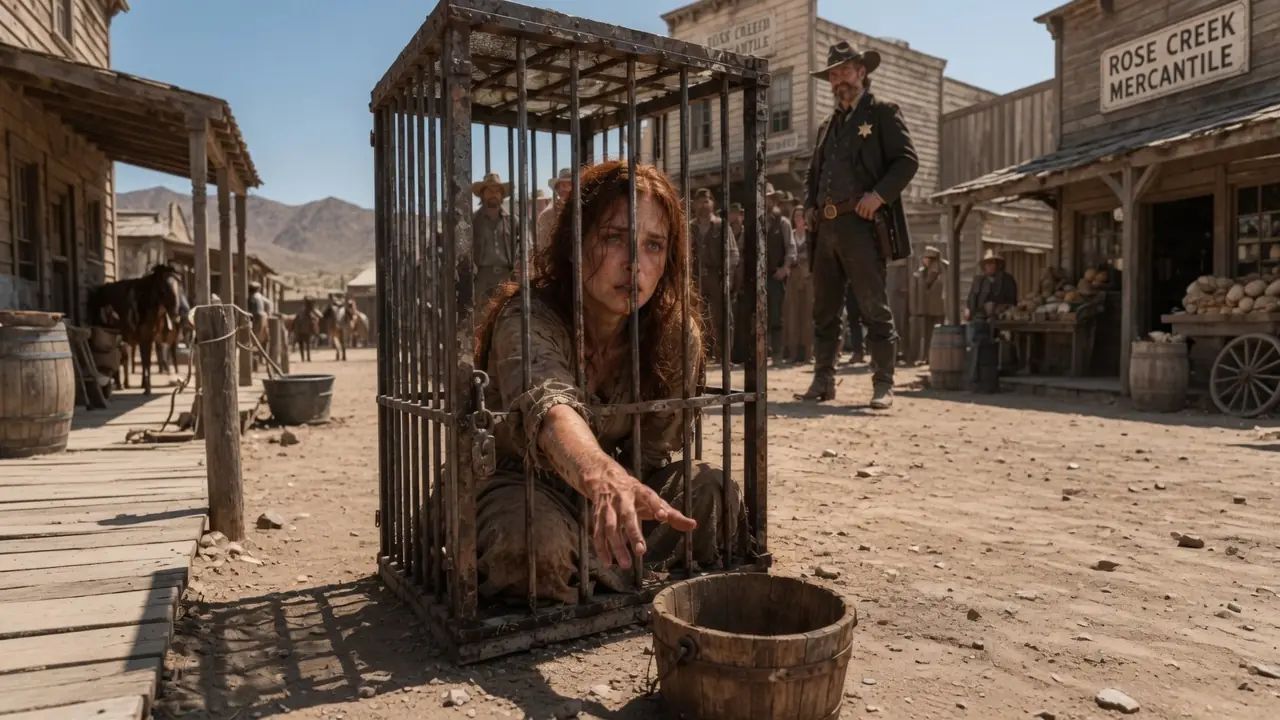
The town of Dusk Creek sat under a burning Colorado sun that seemed to punish everything equally—wood, stone, and human skin alike. At the center of the dusty main square stood a rusted iron cage, half-buried in the dirt as if the earth itself was trying to swallow what it contained.
Inside it, Hannah Brennan knelt on cracked ground, her body weakened by days without proper water, her hair tangled and damp with sweat and dust. The entire town had turned the cage into a public fixture, something to pass by, glance at, and forget without ever asking why it existed.
Hannah’s fingers trembled as she slowly reached toward a small wooden bucket placed just outside the bars. It had been positioned deliberately, always just far enough to make hope feel like punishment. Her lips were cracked, her breathing shallow, and every movement cost her more strength than she could afford to lose. Still, she tried again and again, because stopping meant accepting that no one was coming.
Sheriff Dolan stood nearby, leaning against a post with his badge catching the sunlight like a piece of polished arrogance. He didn’t rush, didn’t intervene, didn’t care to hide the satisfaction in his expression as he watched the crowd observe her suffering. For him, law wasn’t protection—it was demonstration, a tool to show who controlled the town and who did not. And Hannah Brennan had become his clearest example.
“Still alive?” Dolan called out casually, as if commenting on the weather. A few men nearby chuckled, shifting their weight as they watched the cage like it was entertainment rather than cruelty. Hannah didn’t answer, not because she refused, but because her voice no longer obeyed her. Silence had become her only remaining form of resistance.
Five days earlier, she had walked into Dusk Creek looking for work, not trouble, not sympathy, just survival. She had asked at the mercantile for anything honest—sweeping floors, washing dishes, carrying crates from wagons. Instead, she was met with disgust, suspicion, and a quick decision that she did not belong in their version of order. By nightfall, Sheriff Dolan had decided that punishment would speak louder than explanation.
By the third day, children were throwing small stones, not out of hatred at first, but imitation. By the fourth day, some people stopped looking at her entirely, as if ignoring her made them innocent. The sun became her judge, the dust her witness, and the cage her only constant reality. And Sheriff Dolan became the man who made it all legal by simply calling it necessary.
On the fifth morning, Hannah no longer tried to stand. She stayed low in the cage, conserving what little strength remained in her body, listening to the town move around her like she was invisible. Her mind drifted between clarity and fading awareness, caught between survival and surrender. Then came the sound of wagon wheels approaching from the western road.
At first, no one paid attention. Wagons came and went through Dusk Creek all the time, carrying goods, people, and trouble in equal measure. But something about this one was different—it didn’t rush, didn’t avoid attention, didn’t behave like it feared the town. It stopped directly in front of the square.
A man stepped down first, followed by five young girls ranging from childhood to early adolescence. The man moved with quiet control, his presence neither loud nor aggressive, but impossible to ignore. The girls stayed close behind him, their expressions shifting between curiosity and discomfort as they took in the scene. And then they saw Hannah in the cage.
One of the younger girls stepped forward slightly, confusion overtaking her hesitation. “Why is that lady inside there?” she asked softly. Her voice carried farther than she intended in the stillness of the square. And for the first time in days, someone had asked a question the town could not easily ignore.
The man did not answer immediately. His eyes remained fixed on Hannah, taking in the condition of her body, the emptiness of the bucket, the burns on her skin, and the exhaustion in her posture. Something in his expression hardened—not with anger yet, but with recognition. Like he had seen this kind of cruelty before.
Sheriff Dolan stepped forward slowly, adjusting his posture as if preparing for an audience rather than confrontation. “You folks lost?” he asked with a faint grin. The man didn’t respond to the tone, only to the reality in front of him. “How long has she been there?” he asked instead.
Dolan shrugged casually. “Long enough to learn respect.” A few townsmen shifted uncomfortably, but none spoke. Silence was still safer than opposition in Dusk Creek.
The man took one step closer to the cage. Hannah lifted her head slightly, her eyes struggling to focus on him through heat and exhaustion. For a moment, she thought he might just be another observer who would leave without acting. But his gaze did not move away.
“How much?” the man asked suddenly.
The question confused the crowd more than anything else that had happened so far.
Dolan frowned slightly, unsure if he had heard correctly.
“Excuse me?” he replied.
“How much to open it,” the man repeated calmly.
A ripple of laughter spread through the crowd, nervous and uncertain.
Dolan’s grin widened, sensing control returning to him.
“You can’t buy law here, stranger.”
The man reached into his coat slowly. Not dramatically, not threateningly, just deliberately. He pulled out a worn leather fold and opened it just enough for bills to be visible. The square fell into a tighter silence.
“I’m not buying law,” he said quietly. “I’m ending a mistake.” The wind shifted slightly, moving dust across the ground in thin waves.
Even the town seemed to pause to listen.
Dolan’s expression hardened.
“You think you’re better than this town?”
The man finally looked at him directly.
“No,” he said. “I think this town forgot what better looks like.”
For the first time, Dolan’s confidence faltered slightly.
Not enough for him to step back, but enough for those watching to notice.
He reached casually toward his belt, where his authority usually felt most secure.
But the man did not react.
Instead, he turned back toward the cage.
Hannah’s hand moved weakly again toward the bucket, failing once more before collapsing back into the dirt.
The man’s jaw tightened, a controlled emotion held carefully in place.
Then he spoke again without looking at Dolan.
“Open it.”
Dolan laughed again, louder this time, forcing it into performance for the crowd.
“And if I don’t?” he asked.
The man’s voice didn’t rise.
It didn’t need to.
“Then you will explain to everyone here why she matters less than your pride.”
That sentence changed something in the air.
Not loudly, not visibly, but undeniably.
The crowd stopped shifting and started watching.
Dolan realized, perhaps too late, that this was no longer about one prisoner.
It was about whether anyone in the town still believed they were allowed to question what they saw.
And for the first time, the sheriff’s certainty began to crack.
Hannah, barely conscious, looked between them.
She didn’t understand who the man was, only that he was different from the others.
Different in a way that did not look away.
And in that moment, hope became something dangerous again.
The wind grew stronger across the square.
Dust circled around boots, cage bars, and silence.
The town held its breath without realizing it.
And everything waited for the next decision.
The silence in Dusk Creek stretched longer than anyone was comfortable with, as if even the wind was waiting to see which side would break first.
Sheriff Dolan finally exhaled through his nose, forcing a smirk that no longer looked fully confident as he glanced at the watching townspeople.
“You’re making a mistake,” he said slowly, his hand still hovering near his belt.
But his voice no longer carried the same control it had when this began.
The man stepped one pace closer to the cage, ignoring Dolan completely now as if the sheriff had already been reduced to background noise.
Hannah’s eyes followed him weakly, her lips parting as if she wanted to speak but had nothing left to give.
He knelt slightly so he was level with her, studying her condition with a stillness that felt heavier than anger.
“You’re not a lesson,” he said quietly, more to himself than to anyone else.
Dolan’s expression tightened.
“You don’t get to decide that,” he snapped, stepping forward now to reclaim authority.
The crowd shifted again, sensing escalation but unsure where to place their loyalty.
One wrong movement here felt like it could fracture everything.
The man finally looked at the sheriff again.
For the first time, his calm had edges to it—controlled, deliberate, and absolute.
“I already have,” he said.
And then he stood.
He didn’t reach for a weapon.
He didn’t raise his voice.
But something about the way he stood made the distance between him and Dolan feel smaller and more dangerous at the same time.
Even the cage behind him felt less important in that moment.
Dolan forced a laugh, but it came out strained.
“You think you can walk into my town and rewrite it?”
The man’s eyes didn’t move.
“I think you already rewrote it the moment you stopped seeing her as human.”
A sharp silence followed.
Somewhere behind the crowd, a woman pulled her child slightly closer without realizing why.
The town was no longer just watching a prisoner—it was watching its own reflection.
And not everyone liked what they saw.
Dolan finally snapped.
“Open the cage? Fine. But she doesn’t walk out without consequences.”
Two deputies moved forward hesitantly, unlocking the rusted gate with slow, uncertain hands.
The sound of metal scraping metal echoed like a verdict being reversed too late.
Hannah flinched instinctively as the door creaked open, not fully believing it was real.
Her body trembled as she tried to move, but weakness pinned her in place.
The man stepped closer immediately, placing one steady hand near her arm—not forcing, just offering stability.
“I’ve got you,” he said simply.
Dolan watched this with growing irritation.
“This doesn’t change anything,” he muttered.
But no one responded to him this time.
Even his own deputies avoided eye contact.
Slowly, carefully, Hannah was lifted from the cage.
Her legs buckled the moment they touched the ground, and the man adjusted instantly to support her weight.
For the first time in days, she was not alone in trying to survive standing up.
The bucket of water remained untouched behind them, forgotten.
As they turned away from the cage, Dolan spoke again, louder this time.
“This is still my town,” he declared.
The man paused without turning around.
“No,” he said calmly. “It’s just where you’ve been left unchecked.”
That sentence landed harder than anything before it.
Not loud, not dramatic—but final in a way that could not be argued with.
The crowd began to shift, uncertainty spreading like cracks through glass.
For the first time, people stopped looking at Hannah—and started looking at Dolan.
The sheriff realized it too late.
His control was no longer absolute; it was being questioned in real time.
And once people start questioning, fear stops working the same way.
The man gently guided Hannah forward, away from the cage and into open space.
Hannah looked up at him weakly as they moved. “Why…?” she whispered. He didn’t answer immediately. Then, quietly, he said, “Because no one should need permission to exist.”
Behind them, Dusk Creek began to feel unfamiliar to itself. Not yet changed—but no longer stable. And Sheriff Dolan stood in the center of it all, realizing for the first time that authority without belief is only noise. The cage was open, but something far larger had just been unlocked.