Jacob Walker had learned to expect very little from winter except cold hands, stiff knees, and another morning of feeding cattle before the sun rose over the Montana peaks. At fifty-eight, he moved with the steady weight of a man who had survived more seasons than he cared to count, his boots worn down by frozen ground and dry summer dust. The ranch behind him had once felt like a promise, then a home, then after his wife Margaret died, a quiet place where memories stayed louder than living people. He told himself that was enough.
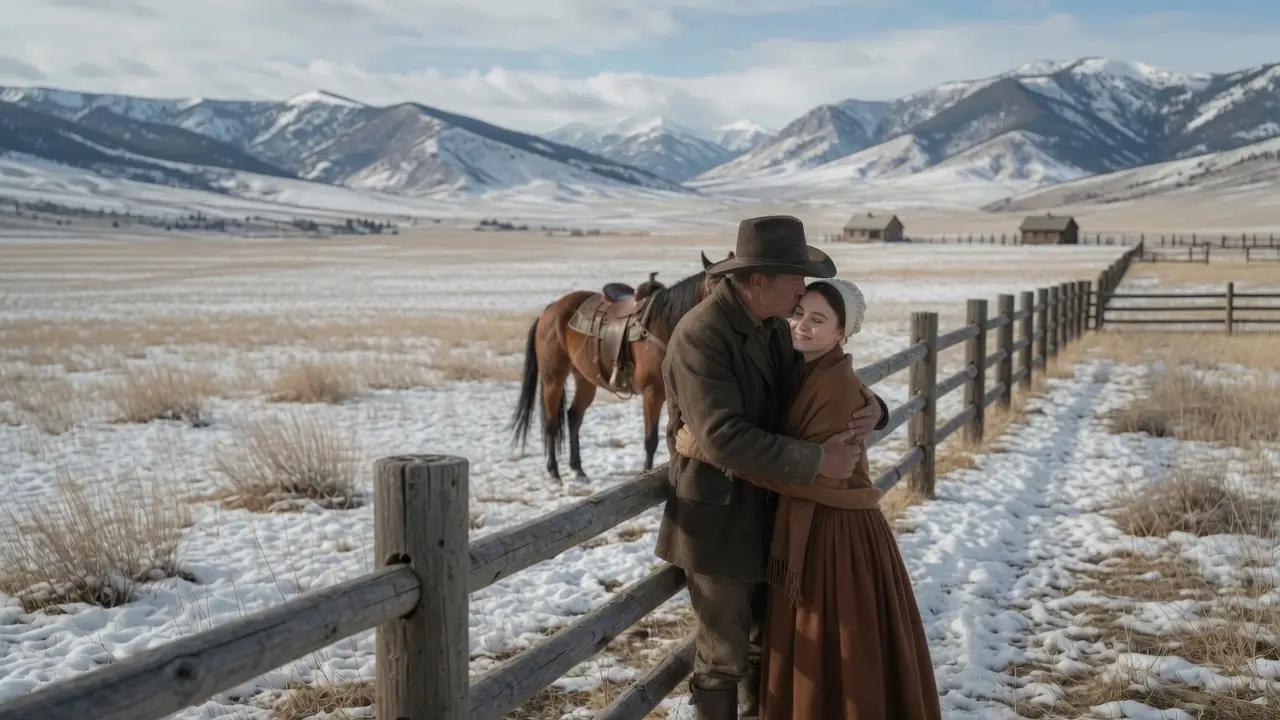
On the morning Clara Bennett first touched his arm by the fence, the whole valley seemed to hold its breath. Snow lay in thin patches across the pasture, the mountains stood white in the distance, and Jacob’s brown horse waited near the rails with the patient stillness of an animal used to his silence. Clara stood beside him in a deep blue frontier dress and cream shawl, her dark hair pinned beneath a simple bonnet, her face young enough to make every whisper in Grover feel crueler. She closed her eyes when he leaned close and kissed her forehead, as if that small tenderness was worth more than all the town’s approval.
Jacob had tried to stop that moment before it happened. For weeks, he had told himself that Clara was only being kind, that young women with bright eyes and soft hands often mistook pity for affection. She was twenty-nine, a schoolteacher, admired by children, respected by mothers, and quietly pursued by men who still had youth in their faces and certainty in their steps. Jacob was an old rancher with rough hands, weathered skin, and a heart that had been shut so long it creaked at the idea of opening.
Clara did not see him the way he saw himself. The first day she came to his ranch, she arrived on a chestnut mare because one of her students had missed lessons and lived near his eastern pasture. Jacob had offered coffee only because manners were easier than feelings, but when he poured two cups, his hand froze. Two cups on his kitchen table had once belonged to marriage, not company, and the sight of steam rising from both made something inside him ache.
Clara noticed, but she did not point at the pain. She removed her gloves, sat across from him, and asked about the ranch as if his life still had value beyond work. Jacob answered slowly at first, then more than he meant to. He told her about the winter of seventy-nine, the mare who had once broken through an ice creek, the old shepherd dog Porter who slept by the stove and disliked nearly everyone except Clara on sight.
After that, she came on Tuesdays. At first, there was always a reason: a student’s family, a book about grazing methods, a question about the old road east of town. Then reasons became unnecessary, and coffee became routine. Jacob found himself sweeping the kitchen before she arrived, warming the pot twice, and setting two cups on the table before he admitted he was waiting for her.
Franklin Pierce Jr. frowned the hardest. He was twenty-six, clean-shaven, well-dressed, and employed at the bank, with the sort of future parents liked to imagine for daughters. He brought flowers to Clara’s classroom, paid for new slates when the school needed them, and laughed too loudly when Jacob’s name came up. “A young woman ought to be careful,” he said once at the general store, loud enough for half the town to hear. “An old rancher may mistake kindness for courtship.”
Jacob heard it. He was standing near the sacks of flour, pretending to read a label he had known by heart for twenty years. He did not answer because answering would make the words matter, but they followed him home anyway. That evening, he sat on the porch with Porter at his boots and watched the valley darken, thinking that perhaps Franklin was right.
The next Tuesday, when Clara arrived, Jacob was shorter with his words than usual. He kept his hands busy fixing a latch that did not need fixing and avoided looking directly at her face. Clara stood near the fence, watching him with the patient expression she used on stubborn schoolboys. At last she said, “If you are trying to make me leave, Jacob Walker, you are doing a poor job of pretending you do not care.”
His hammer stopped in midair. “You should not come here so often,” he said. Clara did not flinch, though the wind tugged at her shawl. “Why not?” He set the hammer down carefully, because the truth felt too heavy to hold with iron in his hand. “Because people are talking.”
Clara stepped closer to the fence. “People talk when crops fail, when babies are born, when dresses are too fine, and when pies are too dry. If I lived by talk, I would never leave my room.” Jacob looked toward the mountains instead of her. “They are not wrong to wonder.”
“Then let them wonder,” she said. Jacob’s jaw tightened. “You are young, Clara. You are beautiful. You have a life ahead of you that should not be tied to a man who has already lived most of his.” Her face changed then, not with hurt, but with a fierce sadness that made him feel more exposed than anger would have.
“You speak of my life as if it belongs to the town,” she said. Jacob forced himself to look at her. Her cheeks were pink from cold, her eyes steady, her hand resting on the top rail between them. “I speak of what is sensible,” he said. Clara gave a small, wounded smile. “No, Jacob. You speak of fear and call it sense.”
He turned away because she was right. Margaret’s death had taught him that love could be taken slowly, cruelly, and with no bargain offered in return. He had buried his wife under a gray sky eleven years earlier and gone home to a kitchen so quiet he thought sound itself had left the house. Since then, he had kept life narrow, believing narrow things were safer.
Clara’s voice softened. “I know you loved Margaret.” Jacob closed his eyes at the sound of his wife’s name. Clara did not say it like a rival, or like a shadow she wanted removed. She said it with respect, as if Margaret’s place in his heart did not threaten her own.
“I still do,” he said roughly. “I know.” Clara’s hand moved from the rail to his sleeve. “That does not frighten me.” He looked down at her gloved fingers against his old coat, stunned by how gentle the touch felt. “It should,” he whispered.
“No,” she said. “It tells me you know how to love deeply.” The words struck him harder than any insult from town. For years, Jacob had thought his grief made him unfit for love, like a field too burned to grow again. Clara looked at the same ashes and saw proof that something had once burned bright.
A few days later, Grover made the matter uglier. The school held a winter gathering, with parents bringing pies, children reciting verses, and half the town crowded inside the little building to escape the cold. Jacob came only because Clara had asked him to repair a broken stove pipe before the event, and he had planned to leave before anyone noticed him. But Clara caught him near the door and thanked him in front of everyone.
Franklin Pierce smiled from across the room. “Careful, Miss Bennett,” he said. “If you praise a lonely old bachelor too much, he may start thinking he has a chance.” A few people laughed before they realized Clara was not smiling. Jacob felt heat rise beneath his collar, but he stood still, his hat in his hand, every year of age suddenly weighing on his shoulders.
Clara turned slowly toward Franklin. “A gentleman does not use a man’s loneliness for entertainment.” The room went quiet. Franklin’s smile stiffened. “I meant no harm.” Clara’s voice stayed calm, but her eyes were clear as winter water. “Then mean better next time.”
Jacob left soon after, not because he was angry with her, but because her defense had made his hope more dangerous. Riding home beneath falling snow, he cursed himself for wanting what he had no right to want. He was old enough to be judged, old enough to know better, old enough to fear becoming a burden in the eyes of someone he cherished. By the time he reached the ranch, he had decided he would tell Clara not to come again.
He failed the moment he saw her two days later at the fence. She had ridden through bad weather, cheeks cold, lashes wet with snow, hands tucked beneath her shawl. “You were going to send me away,” she said before he could speak. Jacob stared at her, defeated by how well she already knew him.
“Yes,” he admitted. “And will you?” she asked. Porter sat between them as if waiting for the answer. Jacob looked at the dog, then at Clara, then beyond her toward the mountains where snow clouds gathered like witnesses. “I should.”
Clara stepped close enough that he could see the small tremble in her lower lip. “That is not what I asked.” He swallowed. “No. I do not want to.” Her eyes softened, but she did not smile yet. “Then stop punishing me for choosing you.”
Those words broke the last weak wall he had built. Jacob reached for her arm, slowly, giving her time to move away. She did not. Instead, she leaned toward him, and he bent his head and pressed a kiss to her forehead, careful, reverent, trembling with all the feeling he had been fighting.
Clara closed her eyes. Her hands tightened around his sleeve, not clinging, but choosing. In that moment, the years between them did not vanish; they became part of the truth standing there by the fence. He was older, weathered, scarred by grief and labor. She was young, beautiful, full of brave tenderness. Yet her face beneath his kiss held no shame, only peace.
“People will laugh,” he said against her hair. “Let them,” she whispered. “They will say I stole your future.” Clara opened her eyes and looked up at him. “Jacob, before you, everyone else kept trying to give me a future that did not fit.”
He could hardly breathe. “You deserve youth and beauty.” She smiled then, soft and certain. “I have seen youth with empty hands, and beauty with a selfish heart. Do not offer me things I never asked for.” He shook his head as if arguing with himself. “I am not easy.”
“No,” she agreed. “You are honest.” A laugh almost escaped him, rough and disbelieving. Clara touched his cheek, her glove brushing the lines age had carved there. “And I am not a child who wandered into affection by mistake.”
The tenderness between them deepened after that, but the town did not soften. Some people accepted it quietly, especially those who had known loneliness themselves. Others grew sharper. Franklin stopped pretending to be gracious and told Clara she was throwing away her life on a man who would need a nurse before he needed a wife.
Jacob still struggled. Love did not turn him young, nor did it erase the mirror. Some mornings, he saw his gray hair, stiff fingers, and tired eyes, then imagined Clara years later regretting the choice she defended so fiercely. On those mornings, he worked harder, spoke less, and let fear make him distant until Clara found him and drew him back with patient hands.
One evening in January, she found him in the barn, brushing down his horse long after the animal was already clean. “You are thinking too hard again,” she said. Jacob kept brushing. “A man should think before making a woman’s life difficult.” Clara leaned against the stall door. “A man should also listen when the woman tells him what life she wants.”
He stopped. “I cannot give you children, Clara. Not likely. Not at my age.” The sentence seemed to hurt him more than he expected, and she saw it. She entered the stall and stood beside him. “I did not come to you with a list of what you lack.”
“You may want them later.” “Then later will be honest too,” she said. “But I will not abandon what I know for fear of what I might feel someday.” He looked at her, humbled by a courage that felt both young and ancient.
By February, Jacob knew he could not keep standing at the edge of his own happiness. He rode into town on a Saturday morning, wearing his cleanest coat, with Porter following despite being told twice to stay home. The streets were bright with snow, and the church bell rang once as if marking the hour of his surrender. Clara was alone in the schoolhouse, writing lessons on the slate board.
She turned when he entered. “Jacob?” He removed his hat and held it in both hands. His voice nearly failed before the first word. “I have spent eleven years believing the best part of my life was behind me.”
Clara set down the chalk. He took one step forward. “Then you came to my gate, and I started making coffee for two before I admitted I was hoping you would come.” Tears gathered in her eyes, but she remained still. Jacob reached into his coat pocket and pulled out a simple gold ring.
“It was Margaret’s,” he said. “I asked myself whether that made it wrong to offer you.” Clara’s breath caught, but her face held no jealousy. He continued, voice rough. “Then I thought maybe love does not ask us to bury everything that came before. Maybe it asks us to carry it honestly into whatever mercy comes next.”
He held the ring out with trembling fingers. “Clara Bennett, I am too old to pretend I can give you an easy life. The ranch is hard, winter is cruel, and I will likely worry too much over every kindness you give me. But if you can bear an old rancher’s slow heart, I would be honored beyond words if you became my wife.”
For one terrible second, she did not answer. Then she laughed through tears, and the sound filled the classroom like spring entering through a broken window. “Jacob Walker,” she said, holding out her hand, “I have been waiting for you to stop arguing with my answer.”
He slipped the ring onto her finger. It fit imperfectly, a little loose, but Clara closed her hand around it as if nothing had ever belonged there more truly. Porter barked from the doorway, startling them both, then wagged his tail with grave satisfaction. Clara wiped her cheek and whispered, “Even your dog knew before you did.”
They married in the little church at the edge of Grover with snow still piled against the steps. Clara wore deep blue instead of white, because she said she wanted to look like herself, not like a girl from someone else’s expectation. Jacob stood at the altar with his hat in his hands and his heart pounding like a young man’s. When Clara walked toward him, every whisper in town became smaller than the sound of her footsteps.
Franklin Pierce attended from the back pew. To his credit, he said nothing unkind. Martha Holt cried openly, Tom Briggs grinned like he had personally arranged the match, and the schoolchildren decorated the church door with winter branches and paper stars. When Jacob kissed Clara after the vows, it was brief and respectful, but her hand stayed on his chest afterward as if reminding the town that the choice was hers.
Spring changed the ranch in ways Jacob had forgotten a home could change. Clara’s books appeared on shelves beside his ledgers. Her shawl hung near his coat by the door. Her laughter moved through the kitchen in the mornings, and sometimes Jacob stopped in the hallway just to listen because the sound still startled him with gratitude.
They did not have an easy life, but they had a true one. Clara rose early to teach, and Jacob rode out before dawn. At night, they sat on the porch when weather allowed, her hand tucked into his, Porter sleeping at their feet. Sometimes she read aloud, and sometimes he told stories about cattle drives, storms, and Margaret, whose name no longer filled the room with pain alone.
One evening, months after the wedding, they stood at the same fence where he had first kissed her forehead. The mountains were green now at the base, white still at the peaks, and the pasture stretched wide under the clean Montana sky. Clara leaned against his arm. “Do you still think I chose wrong?”
Jacob looked at her, then at the valley, then at the house where smoke rose from their chimney. “Some mornings,” he admitted. Clara smiled. “And by evening?” His weathered hand closed over hers. “By evening, I thank God you did not listen to me.”
She turned toward him, her face still young, still beautiful, but now familiar in a way that beauty alone could never explain. He bent and kissed her, not on the forehead this time, but softly on the mouth, with the tenderness of a man who had finally stopped apologizing for being loved. She held his coat and kissed him back beneath the open sky.
The town had called them mismatched. They had called him too old, her too young, his face too weathered, her beauty too bright, his past too heavy, her future too open. But standing together beside that fence, with the ranch behind them and the mountains watching, Jacob understood that love was not always made from equal years or matching appearances.
Sometimes love was a young schoolteacher seeing the gentleness in an old rancher’s silence. Sometimes it was a lonely man learning that grief and hope could sit at the same table. Sometimes it was a kiss by a fence that did not erase the difference between two people, but made the difference honest, tender, and strong enough to withstand the whole town’s noise.
Jacob Walker had believed fifty-eight was the quiet ending of his story. Clara Bennett had proven it was only the chapter before the door opened. And every morning after, when he set two cups of coffee on the kitchen table, he no longer pretended it meant nothing. It meant she had come home.