Mara Bell stepped off the noon train in Mercy Hollow with dried blood on one sleeve and a cracked leather satchel clutched in her right hand. Steam rolled across the wooden platform, wrapping her brown traveling dress in pale clouds while every person waiting near the depot turned to stare. The town had expected Abel Stone’s mail-order bride to arrive pale, trembling, and grateful. Instead, Mara looked like she had fought half the railroad and was still deciding whether the other half deserved a warning.
Abel Stone stood near the freight office, taller than every man around him by nearly a head. His long dark coat hung heavy from shoulders built by mountain winters, axe work, and years of silence. He had placed the advertisement months earlier because Wolfjaw Mountain was too lonely for one man and too hard for a woman who wanted comfort. What he had not asked for was the fierce-eyed woman now walking straight toward him as if the whole platform belonged under her boots.
“You Abel Stone?” Mara asked, stopping directly in front of him. Abel looked down at the blood on her sleeve before meeting her eyes. “Yes, ma’am,” he said. Mara lifted her chin and said, “Good. I’m your wife, unless you plan on fainting.”
A sharp gasp came from beside the ticket window, followed by a nervous cough from the stationmaster. Abel did not laugh, but one corner of his mouth moved like it wanted to. “Are you hurt?” he asked. Mara glanced at her sleeve with visible boredom. “No.”
“Whose blood is that?” Abel asked. Mara shifted the satchel in her hand. “A man on the train thought my seat belonged to him because I was a woman traveling alone.” She looked past Abel at the staring townspeople. “His nose disagreed.”
The platform went completely still. Abel’s expression changed, not loudly, but deeply enough for Mara to notice. “He put hands on you?” he asked. “He tried,” Mara said. “He is now sitting two cars back, reconsidering his manners, his theology, and possibly the structure of his nose.”
For half a second, Abel smiled. Mara saw it before he could hide it, and something in her chest loosened against her will. He did not look like a man who smiled often, which made the brief glimpse matter more than it should have. Still, she had traveled too far to be charmed before making sure the truth stood solid under her feet.
“Your advertisement said you wanted a steady wife,” Mara said. Abel nodded once. “I wrote steady.” Mara narrowed her eyes. “The town seems to think steady means quiet, obedient, and half-dead.” Abel looked toward the whispering crowd. “The town has always had a gift for adding foolishness to plain words.”
Mara studied him carefully. She had answered the advertisement because she needed somewhere new, not because she believed marriage was rescue. Denver had taught her that survival required a locked door, a sharp tongue, and the courage to disappoint people who wanted you manageable. If Abel Stone wanted a servant with a wedding ring, she would sleep in the depot and take the next train east.
“Answer me plain,” she said. “Are you afraid of women?” Abel lowered his eyes to hers. “Not afraid.” “Then what are you?” Mara asked. Abel paused. “Careful.”
That answer surprised her. Men usually said brave things when they wanted to impress a woman, especially in front of an audience. Abel Stone said careful like it was a virtue earned through pain. Mara looked at his massive hands, the way they hung relaxed at his sides, controlled but not threatening. A man that large had probably learned early that one careless movement could make people flinch.
A woman near the freight cart whispered, “Lord help him.” Mara turned her head with a smile sharp enough to cut rope. “Ma’am, the Lord has had twenty-eight years to improve me and seems to have declined.” Abel coughed into his fist. This time Mara knew he was hiding laughter.
By dusk, the road to Wolfjaw Mountain had narrowed from wagon track to argument. Pine branches scraped the wagon sides, granite rocks pushed through the dirt, and the ravine below opened black and deep. Abel drove with one steady hand on the reins while Mara sat beside him refusing to clutch the bench. The mountain air smelled of sap, dust, and the cold warning of night.
“Rock on the left,” Mara said. “I see it,” Abel replied. “Washout ahead.” “I see that too.” “Low branch,” she added.
Abel ducked just in time as the branch snapped over his hat brim. “Do you intend to drive from the passenger seat the whole way?” he asked. Mara opened her mouth to answer, but the left wheel dropped hard into a rut. The wagon lurched toward the ravine, and Abel’s arm shot across her waist as the whole mountain seemed to tilt.
Mara grabbed the bench with one hand and the side rail with the other. Abel pulled the reins hard, shifting his weight with frightening control as the horses fought the slope. The wagon groaned, the wheel lifted, and loose stones tumbled into the black drop below. Then everything slammed back level.
For several seconds, neither of them moved. Abel’s arm remained across her, solid as a timber beam. Mara could feel his breathing, controlled but heavy, and her own heart hammering against her ribs. Slowly, he removed his arm and looked straight ahead.
“You all right?” he asked. Mara swallowed before answering. “I have survived worse transportation.” Abel looked at her sideways. “That was meant to be a yes or no question.” She smoothed her skirt with shaking fingers. “Yes.”
Abel nodded and snapped the reins gently. “Good.” Mara glanced at him, annoyed that her voice had trembled. “You may remove that look from your face.” Abel kept his eyes on the road. “What look?”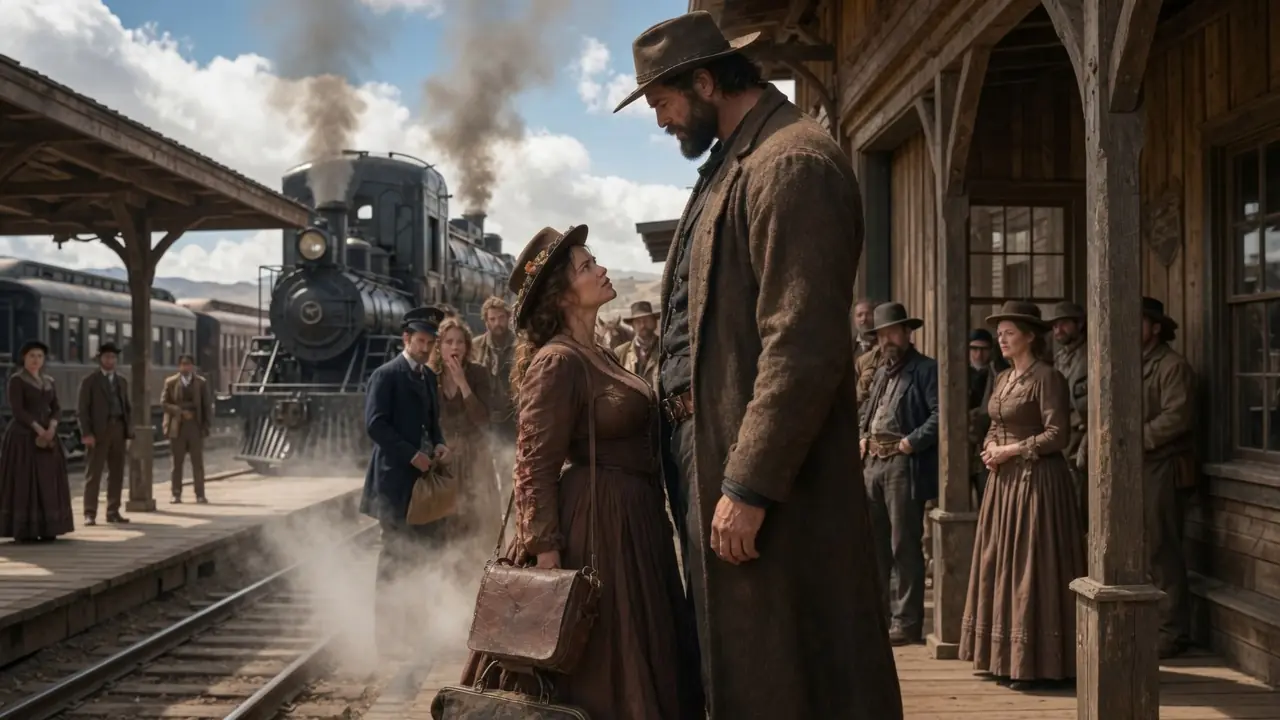
“The one that says I’m fragile.” Abel’s jaw tightened slightly. “That look says I nearly sent my wife into a ravine before supper.” Mara turned toward him. “Your wife?” Abel’s ears reddened beneath his hat brim. “That is what you came here to be.”
The words settled between them strangely. Mara had told herself the marriage was practical, a contract between two lonely people who needed different things. Yet hearing Abel say wife did something quiet and inconvenient inside her. She looked away toward the darkening pines before he could see it.
Wolfjaw Mountain came into view just before nightfall. Abel’s home stood against the slope, built of dark timber and stone, with smoke rising from the chimney and lantern light glowing in the windows. It was not soft, not pretty, and not welcoming in the way town houses tried to be. But it looked strong enough to survive winter, and Mara respected strong things.
Inside, the house smelled of cedar, iron, old coffee, and loneliness. Everything was clean, but too clean, as if no one had stayed long enough in any room to leave comfort behind. Abel carried her satchel upstairs and showed her a small bedroom with a quilt folded across the bed. “You’ll sleep here,” he said. “Door locks from inside.”
Mara looked at the lock, then at him. “You thought of that.” Abel’s gaze did not waver. “A woman traveling alone learns to measure doors.” Mara’s throat tightened unexpectedly. “So does a man who expects her to stay?” Abel nodded once. “If he has any sense.”
They were married the next morning by Reverend Pike in the small Mercy Hollow chapel. The town came to watch, not out of kindness, but because people wanted to see whether the blood-sleeved bride would behave. Mara wore the same brown dress, brushed clean, and Abel wore a black coat that made him look even larger. When the reverend asked if anyone objected, Mara slowly turned and looked at the pews until everyone lowered their eyes.
After the wedding, gossip grew like weeds. Some said Mara had trapped Abel. Others said Abel had ordered a wife and received a storm. The more imaginative ladies claimed she had killed a man on the train and hidden the body in Nebraska. Mara heard all of it and decided Mercy Hollow had too little work and too many tongues.
Life on Wolfjaw Mountain was harsher than she expected. The stove smoked when the wind shifted, the water pump froze twice before breakfast, and the pantry held enough beans to make any sane woman question marriage. Abel was not cruel, but he was quiet enough to make silence feel like a third person in every room. Mara filled it when necessary and challenged it when it grew too heavy.
Within two weeks, she had reorganized the kitchen, corrected the store account, and discovered the ranch hands were cheating Abel out of supplies because they thought he was too big and too silent to notice. She did not accuse them at first. She made breakfast, served coffee, and listened. By the third morning, she knew exactly who was stealing sugar, who was hiding tobacco under the flour sack, and who was selling nails in town.
At supper, she placed the ledger on the table. “Mr. Stone,” she said, loud enough for the hands to hear. Abel looked up from his plate. “Yes, ma’am?” Mara tapped the page. “You are missing twelve pounds of sugar, five tins of tobacco, and enough nails to build a guilty man a coffin.”
The room froze. Abel looked at the men, then back at Mara. “Is that so?” “It is,” she said. One hand named Pierce stood quickly. “You calling us thieves?” Mara looked at him calmly. “Only the ones stealing.”
Pierce stepped toward her, but Abel stood. The room changed instantly. Abel did not raise his voice, did not reach for a weapon, and did not threaten anyone. He simply stood at his full height, and every man remembered the laws of nature. Pierce stopped where he was.
Mara glanced up at Abel. “I don’t need you to scare him.” Abel kept his eyes on Pierce. “I’m not scaring him.” Pierce took one step back. Abel added, “I’m reminding him this is still my table.”
By the end of the week, three hands were gone and the ranch ran cleaner. Mara expected Abel to resent her interference, but he only handed her the ranch account book and said, “You read numbers better than I do.” It was not flattery. It was trust, offered without ceremony. Mara accepted it because trust, unlike charm, could be weighed.
The real trouble came in the third week. A man named Silas Crow arrived from the valley with two riders and a smile full of bad intentions. He owned the neighboring timber claim and had spent years pushing Abel to sell the north ridge. Abel had refused every offer. Silas apparently decided a new wife might make the mountain man easier to corner.
Silas found Mara alone near the barn while Abel was checking fences. “Mrs. Stone,” he said, tipping his hat too slowly. “Town says you’ve made quite an entrance.” Mara kept brushing mud from a saddle blanket. “Town says many things. Most of them should be buried before they breed.” His smile thinned.
Silas stepped closer. “A mountain can be lonely for a woman.” Mara finally looked at him. “So can a shallow conversation.” One rider laughed before hiding it behind a cough. Silas’s eyes hardened, and Mara knew then he was not only rude, but dangerous.
That evening, she told Abel what happened. He listened without interrupting, one hand resting on the back of a chair. “Silas wants the north ridge,” Abel said. “He has wanted it since before my father died.” Mara folded her arms. “Then why is he speaking to your wife like she came with the land?” Abel’s face went still.
The next day, Abel rode to town. Mara rode with him, despite his obvious belief that it was a poor idea. Silas was standing outside the mercantile when they arrived. Abel dismounted slowly, and Mara stepped down beside him before he could offer help. The entire street grew interested at once.
“Crow,” Abel said. Silas smiled. “Stone.” Abel’s voice stayed calm. “You spoke to my wife yesterday.” Silas shrugged. “I was being friendly.” Mara said, “You were being oily, but I admire your optimism.”
Several men laughed. Silas flushed. Abel looked at Mara for one second, then back at Silas. “You will not speak to her again unless she speaks first.” Silas’s smile vanished. “And if I do?” Abel stepped closer, his shadow falling across the man’s boots. “Then you will wish I were only large.”
Silas did not challenge him there. Men like him rarely fought where witnesses were inconvenient. Instead, he waited two nights and sent riders toward Wolfjaw Mountain to open the cattle gate. They meant to scatter Abel’s herd into the ravine and ruin him slowly. They did not know Mara slept lightly.
She heard the gate chain at midnight. Instead of screaming, she lit no lamp, put on boots, and took Abel’s rifle from the wall. She had never fired at a man and did not intend to start unless forced, but she knew how to make a sound count. From the porch, she fired one shot into the air.
The riders panicked. One horse reared, another bolted, and Abel burst from the barn with a lantern in one hand and fury in his face. Mara stood barefoot on the porch in her nightdress and boots, rifle steady against her shoulder. “They were opening the east gate,” she called. Abel looked at her, then toward the fleeing riders. “I see that.”
By morning, tracks showed exactly where they came from. Abel wanted to ride to Silas immediately, but Mara stopped him at the stable door. “If you go angry, he wins twice,” she said. Abel turned on her, eyes sharp. “He came at my land.” Mara stepped closer. “He came at our land.”
That stopped him. The word our stood between them like a lantern. Abel looked at her for a long moment, and the anger in him shifted into something steadier. “All right,” he said. “What do you suggest?”
Mara suggested law, witnesses, and humiliation. They gathered tracks, broken wire, and testimony from a ranch hand who had seen Silas’s riders buying whiskey in town. Then they rode into Mercy Hollow together and placed every piece of evidence in front of Sheriff Wade. By noon, Silas Crow was answering questions in front of half the town.
Silas tried to laugh it off until Mara placed the broken gate chain on the sheriff’s desk. “This was cut last night,” she said. “Two riders crossed from Crow land, and one of them dropped a spur with the same mark Mr. Crow’s men wear.” Sheriff Wade lifted the spur and looked at Silas. “That true?”
Silas glared at Mara. “You mouthy little—” Abel took one step forward. Mara raised a hand without looking at him. “Finish that sentence, Mr. Crow, and do it with confidence.” The sheriff’s mouth twitched. Silas did not finish.
Charges followed. Not enough to destroy Silas, but enough to break his easy power. Men who had feared him began speaking openly. Land deals were questioned, forged claims reviewed, and favors he had purchased began turning sour. Mercy Hollow discovered, slowly and with embarrassment, that Mara Bell Stone was not trouble. She was what trouble feared when it had been comfortable too long.
Winter came hard to Wolfjaw Mountain. Snow sealed the road, winds screamed against the walls, and nights seemed endless. Yet the house no longer felt empty. Mara filled the pantry with preserved peaches, beans, flour, and dried beef, while Abel repaired the roof, cut firewood, and learned to speak before silence swallowed the room.
They argued often. Mara accused Abel of hiding feelings like stolen silver. Abel accused Mara of using sharp words as a fence. Both were right. That, strangely, helped.
One night in January, the storm trapped them inside for three days. Abel sat by the fire sharpening a knife he had already sharpened enough, while Mara mended a tear in his coat. “Why did you really place that advertisement?” she asked. Abel’s hand stilled. “Loneliness.”
Mara looked up. “That plain?” He nodded. “That plain.” She returned to the coat. “Most men would have said they needed help with cooking.” Abel’s voice was low. “I needed someone who would not vanish from the house before morning.”
Mara’s fingers stopped on the thread. She understood that kind of loneliness, the kind that made a person ashamed of wanting company. “I answered because I was tired of fighting every battle alone,” she said. Abel looked at her. “And are you still?” Mara pulled the thread tight. “No.”
By spring, Mercy Hollow had changed its tone. Women who once whispered now asked Mara for advice about accounts, property disputes, and husbands who needed firmer handling. Men who once laughed now tipped hats and moved aside. Abel watched it happen with quiet satisfaction. Mara pretended not to notice, but noticed everything.
On the anniversary of her arrival, the noon train pulled into Mercy Hollow again. Steam rolled across the platform, just as it had the year before. Mara stood beside Abel, wearing a dark green dress she had sewn herself, her satchel replaced by a fine leather bag Abel had bought and she had argued about for three days before accepting. The stationmaster nodded respectfully when she passed.
A young woman stepped off the train clutching a paper and looking terrified. Two men near the baggage cart snickered at her plain coat. Mara’s eyes narrowed. Abel saw it and sighed softly. “You’re about to interfere.”
Mara handed him her bag. “I am about to welcome someone properly.” She crossed the platform, stopped in front of the young woman, and smiled. “You looking for Mercy Hollow?” The girl nodded. Mara glanced at the laughing men. “Then stand tall. This town behaves better when women arrive unwilling to apologize.”
Abel watched from behind, his face softer than anyone in town was used to seeing. The woman he had married was still not quiet. She was steady, fierce, impossible, and entirely herself. He had asked for a wife for a mountain home and received a storm with a heartbeat.
That evening, as they rode home, Mara looked toward the ravine road where the wagon had nearly tipped a year earlier. “You saved me there,” she said. Abel shook his head. “You saved yourself plenty before me.” Mara smiled. “Yes, but you had excellent timing.”
At the top of Wolfjaw Mountain, their house waited with smoke in the chimney and light in the windows. Mara stepped down from the wagon before Abel could help her, then turned and offered him her hand anyway. He took it carefully, as he always did. Together they walked inside.
Mercy Hollow had expected a trembling bride. It received Mara Bell with blood on her sleeve, fire in her eyes, and no intention of being owned. Abel Stone had expected a steady wife. He received a woman who made his mountain louder, warmer, more difficult, and more alive than he had believed possible.
And in time, the town understood what Abel had known from the platform. Some women are not sent west to be softened. Some arrive to teach the west how to stand straighter.