The first thing Bradford Cross heard after the touchscreen went black was water striking metal beneath his feet. It was not a dramatic crash, only a slow hollow slapping from the incoming Atlantic tide pushing around a vehicle that had stopped moving fifty yards from solid ground. Five minutes earlier, his Aegis Gladiator EV had been displaying wheel-slip percentages, suspension height, battery temperature, and a three-dimensional map of the tidal crossing. Now the dashboard showed nothing at all.
Bradford pressed the start control again and received no response. The four-ton electric truck sat tilted slightly toward the passenger side, its enormous tires buried almost halfway into blue-gray marsh mud that behaved less like soil than cold grease. He tried shifting into reverse, then forward, then restarting the vehicle through the manual procedure he remembered from the owner’s guide. Nothing changed except the water, which continued rising.
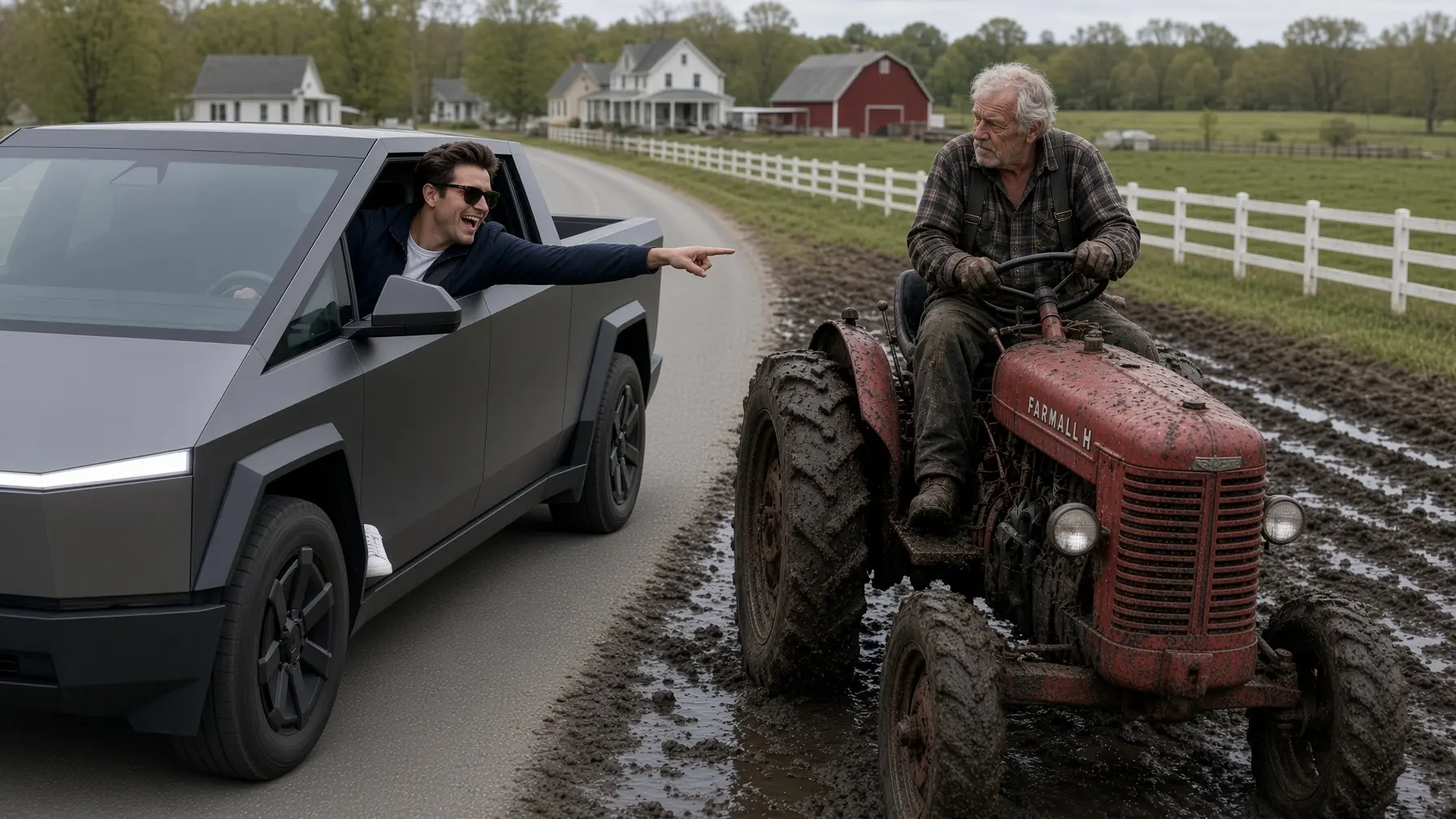
He looked through the windshield toward shore. On the gravel bank stood a red tractor built before television reached most homes in Pelican County, and beside it stood seventy-two-year-old Abner Hale with both hands resting on a weathered fence post. Bradford had laughed when Abner warned him not to cross. The old farmer was not laughing now.
Pelican County occupied a thin stretch of Atlantic coast where salt grass, tidal creeks, oyster beds, small farms, and expensive new vacation houses existed within a few miles of one another. Outsiders described the landscape as empty because they saw flat gray water and grass where locals saw channels, soil changes, tidal timing, bird habitat, drainage patterns, and old roads that existed only during certain hours. Abner had spent his entire life learning which parts of the marsh merely looked firm. Bradford had spent eleven months believing maps could teach him the same thing.
The property dispute between them had begun before either man intended it to become personal. Bradford, thirty-five, founder of NovaGrid Dynamics, had purchased nearly two hundred acres of coastal upland adjacent to Abner’s farm for what local newspapers described as a future “net-zero private research retreat.” The drawings showed a low glass-and-steel residence, geothermal systems, battery storage, a solar canopy, a private laboratory, and enough landscaping to make the building appear less like a house than a corporate headquarters designed for one family. Bradford called it proof that luxury and environmental responsibility could coexist.
Abner called it expensive glass. He did not object to the house because it was modern, and he had no romantic attachment to poverty disguised as virtue. His own farmhouse had heat pumps, a new well pump, and solar panels on the machine shed because Abner liked anything that reduced bills without requiring him to admire it. What bothered him was Bradford’s certainty that every inconvenience around the property represented an engineering defect waiting to be corrected.
The two parcels touched along a narrow tidal marsh containing an old farm track locally called the Black Mud Road. The name was generous because during high tide there was no road at all, only a slightly raised crown of crushed shell and old gravel disappearing beneath water. Abner’s father had reinforced parts of it for moving small tractors and wagons between grazing fields decades earlier. Nobody with sense treated it as an all-weather crossing.
Bradford’s parcel had legal road access from the inland side. That route added nearly four miles, passed through a narrow pine corridor, and would require considerable improvement before heavy construction vehicles could use it regularly. The Black Mud Road would have shortened the distance dramatically. Bradford began referring to it as “the coastal access” before anyone had actually granted him the right to use it.
Abner corrected him the first time. “That track is on my property,” he said while they stood beside the boundary fence in early spring. Bradford looked at his tablet and answered that his survey map showed a historic path connecting both tracts. Abner said a path existing on a map did not make it a public road.
Bradford’s attorney later confirmed Abner was right. No recorded public right-of-way crossed the marsh, and the agricultural access language associated with older deeds did not give Bradford unrestricted construction use over Abner’s land. Bradford could negotiate an easement if Abner agreed. Abner had not agreed.
That should have ended the argument. Instead, Bradford became convinced that enough money would eventually convert refusal into negotiation. He offered Abner twenty-five thousand dollars for a permanent access easement, then fifty thousand, then one hundred thousand. Abner declined every offer.
Bradford assumed the old man was bargaining. “Everybody has a number,” he said during their third conversation. Abner replied, “That sentence tells me more about you than you think.” Bradford laughed because he believed people often said philosophical things shortly before increasing their price.
Abner’s reason was less dramatic than Bradford imagined. The Black Mud Road crossed the most fragile section of marsh on his property, and repeated heavy traffic would require grading, fill, culverts, or some other improvement that would change how tidal water moved through the grass. Abner had watched neighbors solve drainage problems on one field by creating worse ones somewhere else. He did not intend to turn a seasonal farm path into the driveway of a private estate.
The county planning office was already reviewing Bradford’s preliminary development application. Officials had not rejected the house, but they made clear that any permanent access through protected tidal wetlands would require permits Bradford did not yet possess and might never receive. His engineers therefore designed a more expensive inland access road. Bradford disliked the cost enough to keep looking at the marsh as a problem the right vehicle could temporarily ignore.
That September morning, he arrived at Abner’s fence in the Aegis Gladiator. The truck was an experimental limited-production luxury electric vehicle built by a company NovaGrid had invested in, and its price approached half a million dollars after custom armor, communications equipment, active suspension, and off-road modifications. Bradford had used it in desert terrain, mountain snow, and controlled water-crossing demonstrations. He believed those experiences meant the Black Mud Road was trivial.
Abner was replacing cedar fence posts when he heard the truck approaching. He finished driving one post before turning because the synthetic electric hum sounded strangely clean against gulls, wind, and the distant slap of water through grass. Bradford stopped beside him, lowered the window, and asked whether the track was passable. Abner looked toward the creek instead of the vehicle.
“Not for long,” he said. Bradford asked how long, and Abner answered, “Maybe twenty minutes before water starts covering the low section.” Bradford checked the tide display on his vehicle and said he only needed ten.
Abner shook his head. “That screen knows when high tide is predicted at the inlet.” Bradford smiled and asked what else mattered. Abner pointed toward the marsh and said, “Wind has been pushing water in all morning, and yesterday’s rain softened the crown.”
Bradford looked at the road. The first hundred feet appeared firm and dry. Beyond that, shallow water covered only patches of track.
“My truck has adjustable ride height and water-crossing protection,” he said. Abner answered, “Your truck weighs about four tons.” Bradford smiled. “It also has more torque than your tractor makes in a lifetime.”
Abner looked toward the Farmall sitting beside his barn. It was a 1948 Farmall H he used mostly for light chores, fence work, and powering an old mechanical winch mounted beneath the equipment shed. The tractor produced nothing close to the performance figures Bradford quoted. Abner said, “Torque doesn’t make the bottom harder.”
Bradford laughed. Not cruelly at first, but with the impatient amusement of someone hearing resistance from a person he considered technologically outdated. He told Abner that computer-controlled traction could adjust power faster than any human driver. Abner replied that the mud did not know it was being calculated.
Bradford rolled up the window. The truck’s suspension lifted as he selected its water-crossing setting, and the vehicle moved toward the old track. Abner set down his hammer.
He did not chase the truck. He had warned Bradford clearly, and a seventy-two-year-old man waving both arms would not create judgment where money and confidence had already removed it. Instead, Abner watched the rear tires enter the first shallow water. Then he looked at his watch.
For the first minute, Bradford’s confidence appeared justified. The Gladiator moved smoothly through six inches of water while torque shifted between wheels and the suspension maintained impressive clearance. Bradford watched the display show wheel load, estimated depth, and traction conditions in reassuring shades of green. He smiled.
The second minute felt different. The left rear tire dropped unexpectedly, then climbed again as the control system redistributed power. Bradford reduced speed and continued. The screen warned of increased slip.
He had crossed muddy trails before. The correct response, he believed, was maintaining controlled momentum. He pressed the accelerator slightly.
The front tires reached a section Abner called the false crown. From above, it looked like the same track, but years of tidal flow had washed fine gravel away beneath a thin cap of compacted silt. A lighter farm tractor could sometimes cross by staying precisely on the remaining shell base. Bradford’s truck pressed through it.
The front sank six inches almost instantly. Bradford felt the body pitch downward while the system increased torque to the rear axle. The rear tires spun once, stopped, then spun again under computer control.
Mud climbed the sidewalls. The truck moved another five feet.
Bradford swore and selected reverse. The tires turned slowly, then faster, polishing the saturated clay beneath them until the tread had nothing firm enough to grip. The vehicle moved backward perhaps two inches.
Then it stopped completely. Bradford stared at the screen.
A warning advised him to avoid excessive wheel spin. Another reported that the vehicle had detected an abnormal underbody condition. Bradford dismissed both and tried a different terrain program.
Outside, the tide continued rising. Water that had been ankle-deep beside the truck reached the lower portion of the wheels. Bradford could still see the gravel bank behind him.
He opened the window and shouted toward Abner. “You have a tow strap?” Abner answered, “I have equipment.” Bradford said, “Then bring it.”
Abner did not move. “Turn the truck off and stay in it until we decide how to get you out safely.” Bradford shouted that he did not need instructions.
Abner stared at him. “Then you don’t need my tractor.” Bradford closed his eyes, took one breath, and said, “Fine.”
Abner walked toward the barn. He was not preparing to charge directly into the water and drag the Gladiator out like some competition between old iron and new technology. He had been around stuck machinery too long to confuse courage with stupidity. A four-ton vehicle buried in tidal mud could roll, shift, damage recovery equipment, or injure someone who attached a line carelessly.
He called the county emergency dispatcher first. Abner explained that one person was stranded in a vehicle on a tidal farm track, water was rising, and the vehicle was electric. He emphasized that Bradford was not injured and the cab remained above water.
The dispatcher sent a volunteer fire unit and a sheriff’s deputy. She also asked Abner whether the occupant could safely reach dry ground without entering deep mud. Abner said no.
Then he called Earl Mercer, who operated the nearest heavy recovery company. Earl listened to the location and immediately said he would not send a wrecker into the marsh while the tide was rising. He could bring equipment to the bank, but the actual vehicle recovery might have to wait until water receded and the electrical condition was assessed.
Abner expected that. “I mostly need the man out,” he said. Earl replied that fire rescue should handle the person first.
When Abner returned outside, Bradford was standing on the running board. The water reached near the lower door seam. He shouted that the truck had displayed several system warnings and then shut down automatically.
“Get back inside,” Abner called. Bradford said the cabin smelled strange.
That changed things. Abner did not speculate about battery fires or tell Bradford to touch anything electrical. He told him to move carefully to the highest safe part of the vehicle and wait for the fire crew’s instructions.
Bradford climbed onto the roof through the open door. He looked ridiculous and frightened, which were two conditions Abner had learned not to confuse. Fear could make even arrogant people deserve help.
The volunteer fire unit arrived eleven minutes later. Chief Raymond Sloan stepped out, evaluated the water, spoke with Bradford from the bank, and decided against sending anyone wading directly toward the vehicle. The mud was too uncertain.
Abner pointed toward an old flat-bottomed aluminum work skiff behind his barn. He normally used it in the shallow creek for fence repairs after storms. Raymond looked at the boat, then at the tractor.
“You can get that down here?” he asked. Abner nodded.
The Farmall H started on the second attempt with its familiar uneven cough before settling into a steady mechanical rhythm. Abner had rebuilt the ignition several years earlier and converted some consumable components to modern replacements because he preferred maintaining old machines to worshiping them. The tractor was simple, but it was not magical.
He backed toward the skiff. Two firefighters helped load safety equipment and secure the boat for the short move down the firm portion of the track. The Farmall towed it to the water’s edge where the crew could launch without driving a modern emergency vehicle into the marsh.
Bradford watched from the roof. He had spent the previous twenty minutes treating Abner’s tractor as a joke. Now the sight of the red machine moving slowly down the bank made him feel something he had not experienced often since becoming wealthy.
Relief. Not admiration yet. Relief came first.
The rescue itself took only minutes once the skiff launched. Two trained responders poled and paddled along the submerged road crown while maintaining distance from the vehicle until they reached Bradford. They helped him move from the truck roof into the boat without entering the mud.
Bradford shivered violently on the trip back. His expensive jacket was wet to the waist and one white sneaker had disappeared somewhere in the estuary. When the boat reached shore, Abner stood beside the idling Farmall with a wool blanket.
Bradford accepted it without speaking. Raymond checked him for cold stress and asked whether he wanted medical evaluation. Bradford refused at first.
Abner said, “Take the evaluation.” Bradford looked at him.
Abner added, “You’ve already ignored one good suggestion today.” Bradford almost argued, then allowed the EMT to examine him.
The Gladiator remained in the water. By then the tide had reached midway up the doors, and nobody wanted to improvise a recovery around a disabled high-voltage vehicle without understanding its condition. Earl Mercer arrived with a heavy wrecker but parked on the gravel.
He studied the scene through binoculars. “That thing isn’t coming out until the water backs off,” he said. Bradford insisted that every minute of saltwater immersion would increase the damage.
Earl answered, “Probably.” Bradford demanded to know why that did not create urgency. Earl looked at him and said, “Urgency is not the same thing as permission to injure my crew.”
Bradford opened his mouth, then stopped. It was the second time that morning someone had refused to let his money change physical reality.
The vehicle manufacturer’s emergency assistance line joined the conversation by phone. Their representative recommended treating the immersed vehicle cautiously, avoiding unauthorized attempts to re-energize it, and arranging professional transport once safely accessible. Nobody declared the battery certain to explode, and nobody claimed the truck was harmless either.
It was simply a damaged electric vehicle sitting in saltwater. That was enough reason to proceed carefully.
The tide peaked just after eleven. Bradford stood beneath Abner’s machine-shed roof wearing borrowed work boots and an old coat while watching water surround the vehicle he had once described in interviews as nearly unstoppable. Abner brought him coffee.
Bradford took the cup. “You enjoy this?” he asked.
Abner looked toward the marsh. “Enjoy what?”
“Being right.”
Abner considered the question. “Not enough to want your truck ruined.”
Bradford studied him because he expected sarcasm and heard none. “You warned me.” Abner nodded.
“That all you’re going to say?”
“No point repeating information after the water proves it.”
Bradford looked away. “That may be the most irritating thing anyone has ever said to me.”
Abner drank his coffee. “You’ve had an easy life.”
Bradford laughed once despite himself. The sound surprised both of them.
By early afternoon the water began receding. Earl’s crew coordinated with the manufacturer, the fire department, and Bradford’s insurer before approaching the vehicle. They determined it could be recovered once enough of the track reappeared and no immediate hazard was detected.
The Farmall returned to work, but not in the heroic way Bradford later described when telling the story. Abner did not simply hook a chain to the eight-thousand-pound truck and drag it through two feet of mud. The physics would have been absurd and the risk unnecessary.
Instead, Abner used the Farmall to power an old low-speed farm winch positioned on firm ground. Earl’s crew used professional recovery equipment, proper attachment points, and their heavy wrecker as the primary recovery system while Abner’s winch helped control the angle from the side. The little red tractor contributed because it was already there, mechanical, familiar, and useful.
That mattered more than brute strength. The Aegis had hundreds of kilowatts of available electric power when healthy, but none of that power mattered while it sat disabled and buried. The Farmall had less power than some modern lawn equipment yet could still turn a gearbox and tension a recovery line.
Abner understood machines as systems. Bradford had spent the morning thinking performance specifications were identity.
The recovery lasted nearly two hours. Mud suction released slowly, and the truck moved only inches at first. Earl stopped the pull repeatedly to reposition equipment rather than forcing anything.
Bradford paced behind the safety line. Every pause seemed to cost another ten thousand dollars in his imagination.
Abner finally told him, “You can ruin it faster if that helps.” Bradford stopped pacing.
The Gladiator came free shortly before three. Gray water poured from the lower cabin when the crew opened access under controlled conditions, and mud covered body panels that had never encountered anything harsher than demonstration trails. The vehicle did not burst into flames.
It also did not restart. Bradford’s insurer later determined saltwater exposure had affected enough electrical, interior, and safety systems that a conventional repair estimate made little economic sense.
The final decision was not immediate. Engineers inspected the vehicle, the battery assembly was handled according to manufacturer guidance, and the truck remained isolated while the insurer evaluated it. Several weeks later, Bradford learned that the vehicle would be treated as a total loss.
He was angry. Not because anyone had promised otherwise, but because wealthy people sometimes experience preventable loss as a betrayal by reality. Bradford looked for someone besides himself who might absorb part of the responsibility.
His first target was Abner. One section of front trim had been damaged during recovery, and a recovery attachment area showed additional scratches. Bradford photographed everything.
“You damaged the truck,” he told Abner. Abner said, “Recovery damaged parts of it.”
“That’s what I said.”
“No.”
Bradford folded his arms. “What’s the difference?”
Abner looked toward Earl’s crew. “They pulled a flooded truck out of mud after you asked them to save it. Damage during recovery isn’t the same as somebody walking over and hitting it with a hammer.”
Bradford’s jaw tightened. “My attorneys can decide.”
“Good.”
The answer irritated Bradford more than fear would have. He had used attorneys effectively for years because most people became nervous when legal costs entered a conversation.
Abner had owned land for five decades. Property disputes, boundary surveys, drainage disagreements, easements, insurance claims, and contracts were not foreign mysteries to him. He did not enjoy lawyers.
He simply understood that they existed. “Have yours call mine,” he said.
Bradford stared. “You have a lawyer?”
Abner smiled faintly. “I also have electricity.”
That ended the conversation.
Bradford’s counsel called three days later. Abner’s attorney, Margaret Cole, responded with the documentation Abner had kept throughout the incident. There was Bradford’s previous written acknowledgment that the Black Mud Road belonged to Abner, emails regarding his rejected easement proposals, photographs of signs identifying the track as private farm access, and witness statements confirming Abner warned him that morning.
There was also the recovery paperwork. Bradford had verbally authorized emergency assistance and later signed Earl Mercer’s recovery agreement. His insurer had been involved before the truck was moved.
Margaret did not claim Bradford had no conceivable argument about damage. She said any such claim would have to be evaluated alongside his unauthorized entry onto private property and the damage his four-ton truck had caused to the marsh track.
Bradford’s attorney asked what damage. Margaret sent photographs taken after the tide receded.
The ruts were deep. Where the truck sank, its tires had torn through the shell-and-gravel crown and churned saturated soil across the edges. Recovery equipment remained on the firmest available surfaces, but even careful work had left disturbed areas requiring repair.
Then the county environmental officer became involved. The estuary bordered regulated tidal wetlands, and although the old agricultural track predated many modern rules, substantial new disturbance could not simply be filled, graded, widened, or reinforced without review. Bradford had unintentionally created the exact regulatory attention he hoped to avoid.
He blamed Abner at first. “You called the county.” Abner answered, “The fire department did.”
Bradford said, “Same difference.”
“No.”
Abner had begun noticing how often Bradford used that phrase when distinctions became inconvenient. “Different is usually where the expensive part lives,” he said.
The county did not fine Bradford hundreds of thousands of dollars or seize his property. Officials required an assessment of the disturbed area and a restoration plan appropriate to the existing farm track. Bradford’s insurer and legal team negotiated responsibility for certain costs.
Abner paid for none of the damage caused directly by Bradford’s decision to enter without permission. Bradford disliked that outcome.
He disliked the development consequences more.
The county planning department had already been skeptical of treating the Black Mud Road as potential access for Bradford’s proposed estate. The incident gave officials visual evidence of what repeated heavy traffic could do during ordinary tidal conditions.
The planning director was careful not to treat one stuck vehicle as a substitute for engineering analysis. She simply told Bradford’s design team that any proposal requiring expanded access across Abner’s marsh remained unsupported by a legal easement and faced substantial environmental review. The inland entrance remained the realistic route.
Bradford ordered his engineers to price it. Their revised estimate was ugly.
The road itself was manageable. The expensive portions involved drainage, a small bridge over a freshwater swale, utility routing, tree removal, emergency-vehicle access, and maintaining grades suitable for year-round use.
Bradford could afford it. The question was whether he still wanted to.
His original concept relied on a dramatic approach from the coast. Visitors would have passed through low marsh, crossed a narrow rise, and emerged beside a glass house facing the Atlantic.
Using the inland road changed the project. It also exposed other weaknesses in his plan.
Storm-surge modeling required the main occupied floor to be higher than Bradford preferred. The glass walls needed more substantial wind protection. Insurance estimates rose.
Several sections of landscaping shown in promotional renderings could not extend into protected marsh as depicted. A dock required separate review.
None of these issues was caused by Abner. Bradford had hired excellent architects and engineers, but he had pushed them toward a vision before forcing himself to understand every constraint.
The estuary incident simply concentrated all those constraints into one humiliating afternoon.
NovaGrid’s board did not collapse. The company’s stock did not plunge because a founder got his truck stuck.
A photograph did circulate locally. Someone passing on a county road captured the matte-gray Gladiator being recovered while Abner’s red Farmall sat nearby attached to the auxiliary winch system.
The image reached social media. The caption read, WHEN SOFTWARE MEETS PELICAN COUNTY MUD.
Bradford hated it.
His communications director advised him not to respond. “It will disappear in two days if you don’t make it a story,” she said. Bradford asked whether he should explain that the Farmall had not actually towed the truck by itself.
She stared at him. “Do you want the internet to spend a week debating your tractor rescue?”
“No.”
“Then congratulations on your silence.”
The photograph did disappear.
Abner never saw most of the jokes. Lucas, his seventeen-year-old great-nephew, showed him several. Abner read one saying the Farmall had “downloaded the traction update Bradford forgot.”
He smiled. “That one’s decent.”
Lucas asked whether Abner wanted to post something. Abner answered, “Why would strangers need my opinion about a morning they weren’t at?”
Bradford’s life resumed. Meetings returned, investors called, NovaGrid announced a battery-management partnership, and the ruined Gladiator became an insurance file.
Yet the marsh stayed in his mind.
Three weeks after the accident, Bradford returned in a rented gasoline pickup. He stopped on the gravel rather than entering Abner’s farm road and walked toward the fence.
Abner was repairing the same section he had been working on before the incident. Bradford noticed that somehow annoyed him.
“You always fixing this fence?”
“Fence keeps meeting people.”
Bradford looked toward the marsh. The restored track was narrower than he remembered.
“My lawyer says your attorney is reasonable.”
Abner drove another staple into the cedar post. “Margaret will be devastated to hear that.”
Bradford smiled faintly. “I came to talk about the easement.”
“No.”
“You haven’t heard the number.”
“That hasn’t been the problem.”
Bradford opened a folder anyway. He offered four hundred thousand dollars for a limited permanent easement designed by engineers, including elevated sections intended to reduce direct ground disturbance.
Abner did not look at the papers.
Bradford said, “That is more than some people around here paid for their entire farms.”
“Probably.”
“I could structure annual payments.”
“No.”
Bradford’s patience slipped. “You refuse before hearing anything.”
Abner rested both hands on the fence.
“I heard the part where your house needs my marsh to become the house you drew.”
“That’s not what I said.”
“That’s what you keep asking.”
Bradford stared at him.
Abner continued, “If your project works only after somebody else gives up the thing they already own, maybe the design isn’t finished.”
Bradford wanted to dismiss the sentence as rural philosophy. The problem was that his engineers had started saying a more technical version of the same thing.
He closed the folder. “You dislike me.”
Abner considered it.
“Sometimes.”
Bradford almost laughed. “At least you’re honest.”
“I don’t know you well enough to dislike all of you.”
That answer followed Bradford back to his hotel.
The development team redesigned the estate. They reduced the footprint, moved the main building farther inland, simplified the coastal approach, and abandoned several visual features that relied on manipulating marsh edges.
The new proposal cost less in some areas and more in others. It also looked less like the architectural render that first made Bradford fall in love with the property.
He hated the revision for a month.
Then something unexpected happened. Bradford spent enough time studying the site that he began seeing the marsh rather than the empty space around his house.
An environmental consultant named Dr. Lena Ortiz walked the property with him. She explained how tidal creeks moved nutrients, why salt grass appeared in bands, where nesting birds concentrated, and how a road only a foot higher in one location could change water behavior somewhere else.
Bradford asked more questions than he answered. That was unusual enough that Lena noticed.
“You’re quieter than during our first meeting,” she said.
“I drove a half-million-dollar truck into mud after a farmer told me not to.”
Lena smiled. “Education takes many forms.”
Bradford looked toward the water.
“Was he right about everything?”
“No.”
That surprised him.
Lena explained that local knowledge could be excellent and still incomplete, just as modeling could be sophisticated and still depend on assumptions. Abner understood decades of observable behavior on his land. Engineers could measure conditions he could not see.
“The useful part is when they stop treating each other as enemies,” she said.
Bradford looked toward Abner’s farmhouse in the distance.
“That sounds inconvenient.”
“Most useful things are.”
Winter arrived. The development project slowed for additional studies, permitting, and redesign.
Abner returned to ordinary work.
The Farmall H sat beneath a shed roof with its faded red paint and patched seat. Abner used it to pull a small manure spreader, run the old winch, and tow wagons around the farm.
He did not treat it like a monument to victory. The tractor leaked slightly from a seal near the transmission and needed ignition work twice that winter.
Lucas once said, “I thought old machines were supposed to be indestructible.” Abner gave him a wrench.
“Old machines break constantly.”
Lucas frowned.
“Then why do you like them?”
“I know where they break.”
That was the real advantage.
Abner understood the Farmall because he had repaired nearly every system on it at least once. He knew which noises could wait, which leaks could not, what jobs exceeded its ability, and when sentiment was trying to make him foolish.
He also owned modern equipment.
His main field tractor had GPS guidance. His combine contained more electronics than Bradford would have guessed.
When Lucas pointed out the contradiction, Abner said, “I’m old, not stupid.”
Bradford heard about that comment from Lena and laughed.
The two men did not become friends quickly.
For several months their contact consisted mostly of planning notices, restoration updates, and occasional meetings involving the shared boundary.
Bradford paid his portion of the marsh-track restoration without another argument. The costs were significant but nowhere near the fantastic sums local gossip invented.
The first genuine conversation happened in February.
A coastal storm pushed unusually high water across the low fields. Bradford drove to inspect his property after the worst passed and found Abner moving debris away from a drainage ditch.
The Farmall was parked nearby.
Bradford walked toward it. “Can I ask you something?”
Abner said, “You just did.”
Bradford sighed.
“Why did your tractor work near the water when mine didn’t?”
Abner rested the shovel against a post.
“It didn’t do what your truck was trying to do.”
Bradford waited.
“My tractor stayed on the firm ground where I knew the bottom.”