“Ma’am, the thrift store is three blocks down.”
The young tailor did not bother lowering his voice.
Everyone inside Bellamy & Crane heard him.
The elderly woman standing near the entrance paused with one hand still resting on the brass door handle. Rainwater clung to the shoulders of her faded gray coat, and the hem of her long navy skirt was damp from the storm outside. Her silver hair had been twisted into a loose bun, held together by two plain wooden pins, while a worn brown handbag hung from her arm.
She looked past the young man toward the rows of hand-stitched jackets displayed beneath crystal lights.
“I believe I’m in the right place,” she said.
The tailor glanced at the mud on her sensible black shoes.
“Bellamy & Crane makes custom clothing. We don’t repair secondhand garments.”
“I didn’t ask for a repair.”
Several employees exchanged amused looks.
At the far end of the showroom, a woman in a cream silk blouse stopped arranging fabric samples and watched with a faint smile. Her name was Vanessa Pike, the store’s senior consultant, although she introduced herself to wealthy customers as a personal stylist.
The old woman stepped farther inside.
“I’d like to order a navy-blue suit.”
The silence lasted only a second.
Then someone near the fitting rooms laughed.
The young tailor covered his mouth, but his shoulders still shook. Vanessa looked down at the woman’s coat, handbag, and damp shoes as though assessing damaged merchandise.
“A suit?” she repeated.
“Yes.”
“For yourself?”
The elderly woman nodded.
“A three-piece suit. Dark navy. Single-breasted jacket, lightly structured shoulders, high-waisted trousers, and a matching vest.”
The laughter stopped.
Her request was too precise to sound accidental.
Vanessa approached slowly.
“A women’s three-piece suit with traditional men’s tailoring?”
“That’s correct.”
“What fabric?”
“Super 150s wool. Nothing too glossy. Horn buttons, not plastic. A half-canvas construction, hand-finished buttonholes, and enough room through the right shoulder to accommodate an old injury.”
The young tailor stared at her.
Vanessa’s smile tightened.
“Those specifications would begin at eight thousand dollars.”
“I expected more.”
A customer sitting near the window turned in his chair.
Vanessa crossed her arms.
“More?”
“With a second pair of trousers and handwork at the lapels.”
The old woman’s eyes moved toward a locked display containing the shop’s rarest fabrics.
“I would also like to see the midnight navy worsted from Huddersfield. The bolt with the thin silver selvage.”
Vanessa’s expression changed.
That fabric was not advertised.
Only the store’s oldest employees knew it existed.
Before she could respond, the young tailor laughed again.
“Maybe she saw it through the window.”
The old woman looked at him.
“What is your name?”
He straightened.
“Ethan.”
“Ethan what?”
“Cole.”
“Are you an apprentice?”
His face colored.
“I’m a junior cutter.”
“Then you should know the difference between worsted wool and a window reflection.”
A customer coughed to hide a smile.
Vanessa stepped between them.
“Mrs...?”
“Hale.”
“Mrs. Hale, this is a private atelier. We work by appointment, and we require a fifty-percent deposit before measurements are taken.”
“That won’t be a problem.”
Vanessa glanced at the old handbag.
“I’m sure.”
Mrs. Hale opened it.
Ethan leaned forward, perhaps expecting a stack of coupons or a handful of loose bills.
Instead, she removed a small ivory business card.
She placed it on the glass counter.
Vanessa did not pick it up.
There was no logo on the card, only a name embossed in dark blue letters.
Eleanor Hale.
Below it was a telephone number and a single line.
Hale Maritime Holdings.
Ethan read it and smirked.
“Anyone can print a business card.”
Eleanor looked at him calmly.
“Yes. Even someone with no business.”
The customer near the window laughed openly this time.
Vanessa’s cheeks tightened.
“Mrs. Hale, we have important clients arriving this afternoon. I’m going to ask you not to disturb them.”
“I am not disturbing anyone.”
“You walked in without an appointment during a private consultation period.”
“The door was unlocked.”
“That does not mean everyone who enters belongs here.”
Eleanor’s fingers rested beside the business card.
She did not argue.
She did not raise her voice.
She simply looked around the showroom as though memorizing it.
Bellamy & Crane occupied the ground floor of a restored stone building on Madison Avenue in New York City. The shop had polished walnut walls, handwoven rugs, and mirrors framed in antique brass. Jackets costing more than most people’s monthly salaries stood beneath soft lighting. A pair of hand-finished shoes rested on a pedestal like museum pieces.
For fifty-seven years, the atelier had dressed diplomats, actors, judges, and business leaders.
Eleanor seemed to know exactly where she stood.
Vanessa picked up the card at last.
She turned it over.
Blank.
“No account number,” she said.
“I wasn’t aware business cards required one.”
“No assistant’s contact.”
“I answer my own phone.”
“No office address.”
“People who need it already have it.”
Ethan leaned against the counter.
“Maybe her office is a bus stop.”
Vanessa laughed despite herself.
Eleanor looked toward him.
“How long have you worked here?”
“Six months.”
“That explains it.”
“Explains what?”
“Why you haven’t yet learned that the most expensive thing in this room is not the fabric.”
Ethan frowned.
“What is it, then?”
“Discretion.”
The front door opened before he could answer.
Vanessa’s entire manner changed.
“Mr. Hale.”
Every employee in the showroom straightened.
Ethan moved away from the counter.
The man handed his umbrella to the doorman and scanned the room. When he saw Eleanor, worry flashed across his face.
He crossed the showroom quickly.
“Mom.”
Vanessa’s smile vanished.
The man embraced Eleanor with both arms.
“I’m sorry I’m late,” he said. “The board meeting ran over, and traffic was impossible.”
Eleanor patted his back.
“You’re eleven minutes late, Daniel.”
“I know.”
“You’re improving.”
Daniel Hale laughed, then looked at the employees around them.
The warmth left his face.
“Has someone taken your measurements?”
“No.”
“Have they shown you the fabrics?”
“No.”
He looked at Vanessa.
“Why not?”
Vanessa’s lips parted.
“We didn’t realize Mrs. Hale was your mother.”
Daniel glanced at the ivory card on the counter.
“She gave you her name.”
“Yes, but—”
“And told you what she wanted.”
“She arrived without an appointment.”
“So did I.”
“You’re one of our most valued clients.”
Daniel’s gaze sharpened.
“My mother was waiting for me.”
Ethan looked at the floor.
Vanessa forced a professional smile.
“There was simply a misunderstanding.”
Eleanor closed her handbag.
“No,” she said. “There was no misunderstanding.”
The words landed quietly.
That made them worse.
Daniel turned to her.
“What happened?”
“Nothing that needs to be discussed here.”
“Mom.”
She met his eyes.
For a moment, something passed between them—an old pattern, perhaps, in which Daniel recognized that his mother’s silence did not mean forgiveness.
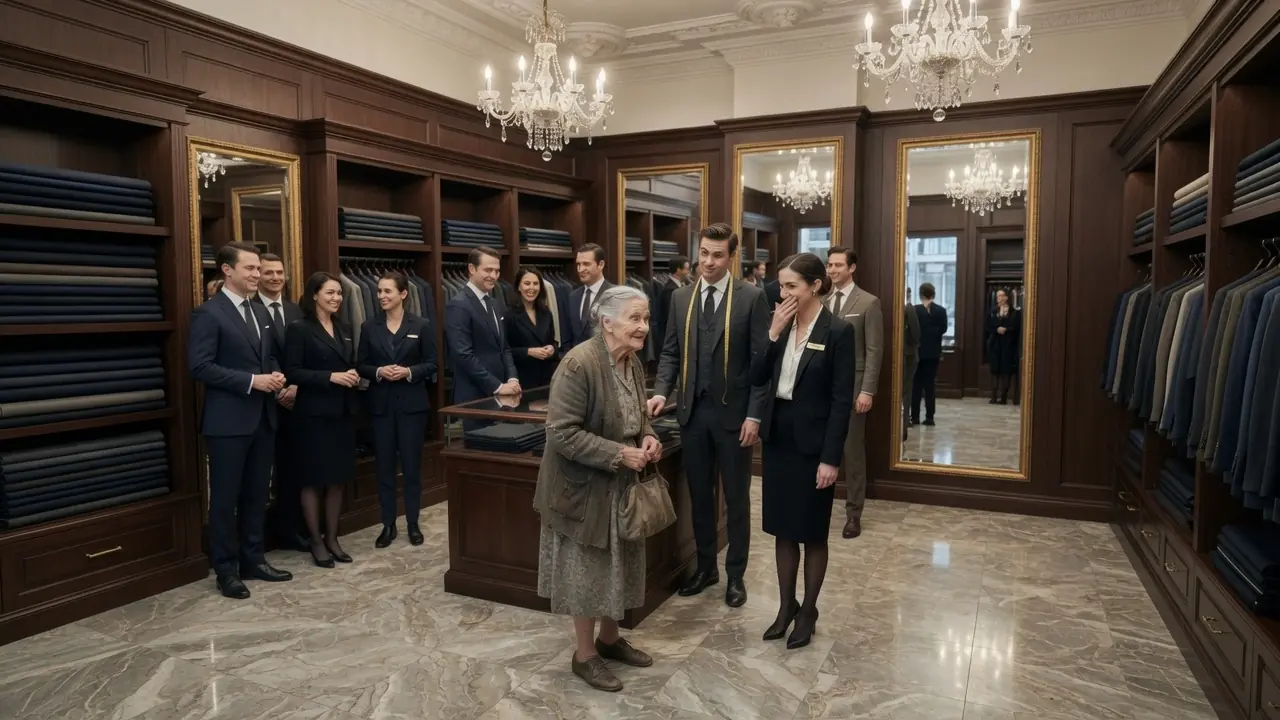
Vanessa stepped forward.
“We would be honored to assist Mrs. Hale. I’ll personally arrange the fitting.”
Eleanor looked toward the locked fabric display.
“The midnight navy worsted with the silver selvage.”
Vanessa hesitated.
“Of course.”
“And Mr. Bellamy will cut it.”
The showroom became still again.
Arthur Bellamy had not worked on the main floor in nearly eight years. At seventy-nine, he remained the atelier’s chairman and master cutter, but he accepted only a handful of commissions. Most customers never met him.
Vanessa gave a careful laugh.
“Mr. Bellamy is semiretired.”
“I know.”
“He no longer takes new clients.”
“I’m not new.”
Daniel looked at his mother.
“You’ve been here before?”
Eleanor did not answer.
Instead, she picked up her business card and placed it back inside her handbag.
“Come,” she said to Daniel. “We’re leaving.”
Vanessa moved quickly.
“Mrs. Hale, please allow us to correct this.”
“There is nothing to correct.”
“At least let me apologize.”
“An apology offered after learning my son’s name is not an apology.”
Ethan’s face burned.
Daniel looked at him, then at Vanessa.
“My company has placed more than two hundred thousand dollars in orders here over the last six years.”
Vanessa nodded.
“We value that relationship enormously.”
“My executives wear Bellamy & Crane because I recommended you.”
“We are deeply grateful.”
“That recommendation ended five minutes ago.”
Vanessa went pale.
Daniel held the door for his mother.
Before Eleanor stepped outside, she turned toward the back of the showroom.
A narrow staircase rose behind a velvet rope. At the top hung a small brass plaque.
PRIVATE WORKROOMS.
Her eyes rested there for several seconds.
Then she walked into the rain.
Daniel followed.
Neither saw the elderly man standing halfway down the staircase.
Arthur Bellamy gripped the railing with one hand.
His white hair was neatly combed, and a measuring tape hung around his neck. He had heard the laughter. He had heard the name.
More importantly, he had seen Eleanor Hale’s face.
He had not seen her in forty-one years.
But he recognized her immediately.
Arthur descended slowly.
Vanessa turned toward him.
“Mr. Bellamy.”
He walked past her and picked up the fabric request form she had left blank on the counter.
“Who laughed first?” he asked.
No one answered.
Arthur looked at Ethan.
“Was it you?”
Ethan swallowed.
“It was only a misunderstanding.”
Arthur’s hand tightened around the paper.
“That phrase is becoming very popular today.”
Vanessa approached him.
“Mr. Hale overreacted. His mother arrived dressed like—”
Arthur raised one finger.
She stopped.
“Finish that sentence carefully.”
Vanessa’s face changed.
Arthur looked toward the rain-streaked windows.
“What did she ask for?”
“A navy three-piece suit.”
“Details.”
Vanessa repeated Eleanor’s specifications.
When she mentioned the right shoulder, Arthur closed his eyes.
“Did she ask for the Huddersfield worsted?”
“Yes.”
“With the silver selvage?”
“Yes.”
Arthur sat down heavily in the nearest chair.
Ethan stared at him.
“Sir?”
Arthur removed his glasses.
“That bolt was woven in 1984.”
Vanessa folded her arms.
“She could have heard about it from someone.”
“No.”
“How can you be sure?”
“Because it was never entered into inventory.”
The employees looked at one another.
Arthur rubbed the bridge of his nose.
“I bought it for Eleanor Quinn.”
Vanessa frowned.
“Who?”
Arthur’s eyes opened.
“Before she became Eleanor Hale.”
Rain hammered the windows while Daniel’s car moved south through Manhattan traffic.
Eleanor sat in the back seat with her hands folded over her handbag. She watched pedestrians hurry beneath umbrellas, their reflections breaking across wet pavement.
Daniel sat beside her.
“You’re not going to tell me?”
“There’s nothing to tell.”
“They humiliated you.”
“I’ve survived worse.”
“That doesn’t make it acceptable.”
“No.”
“Then why won’t you let me deal with it?”
Eleanor turned from the window.
“You already did.”
“I canceled an account.”
“You announced how much money you spent there.”
“They needed to understand who you are.”
Her expression hardened.
“They understood who you are. That is not the same thing.”
Daniel leaned back.
He knew that tone.
It was the same tone she had used when he was sixteen and tried to avoid responsibility for damaging a neighbor’s car. The same tone she used when his company first became profitable and he began treating exhaustion as proof of importance.
“I wasn’t trying to impress them,” he said.
“You told them what you had spent.”
“To show them what their arrogance cost.”
“You believed money was the only language they understood.”
“It may be.”
“Then you should not speak it for me.”
Daniel looked down at his hands.
The driver turned onto Park Avenue.
After a moment, he asked, “How did you know about that fabric?”
Eleanor’s fingers tightened slightly.
“I saw it many years ago.”
“At Bellamy & Crane?”
“Yes.”
“When?”
“Before you were born.”
Daniel waited.
She said nothing more.
“You knew Arthur Bellamy?”
“I knew several people once.”
“That isn’t an answer.”
“It’s the answer I’m giving.”
Daniel studied her profile.
His mother had always guarded her past in strange ways. She spoke freely about growing up in Queens, leaving school at seventeen, and working in a garment factory. But whenever he asked about the years before she married his father, her memories became brief and carefully arranged.
Daniel knew she had been injured in a factory accident.
He knew she had stopped sewing professionally afterward.
He knew she had met his father, Michael Hale, at a church fundraiser in Brooklyn.
Everything else was a closed door.
“Why do you need the suit?” he asked.
“For a dinner.”
“What dinner?”
“The Mariners’ Foundation gala.”
Daniel stared.
“That’s next Friday.”
“I know.”
“You hate galas.”
“I dislike people who confuse charity with being photographed.”
“Then why are you going?”
“Because they are presenting an award in your father’s name.”
Daniel’s expression softened.
Michael Hale had died six months earlier after fifty-four years of marriage. He had spent most of his life building tugboats, repairing harbor equipment, and eventually creating Hale Maritime with Eleanor beside him.
The company had grown from one rented workshop into an international shipping and engineering firm.
Michael had been its public face.
Eleanor had preferred remaining invisible.
“You didn’t tell me,” Daniel said.
“I’m telling you now.”
“You were going to wear a suit.”
“Your father hated formal gowns.”
A small smile touched her face.
“He said they made every woman look as though she were attending someone else’s wedding.”
Daniel smiled too.
“He would have liked the navy suit.”
“He chose the color.”
“When?”
“Forty-one years ago.”
The smile left Daniel’s face.
Eleanor looked back toward the rain.
“At Bellamy & Crane.”
Arthur Bellamy locked himself inside his private workroom shortly after Eleanor left.
The room had changed little since the 1970s. Heavy shears hung above an oak cutting table. Paper patterns filled labeled drawers. Spools of thread stood in wooden racks, and an old black sewing machine rested beneath the north window.
Arthur opened a cabinet near the wall.
Behind several rolls of muslin, he found a narrow wooden box.
Dust covered the lid.
He carried it to the table and opened it.
Inside lay a bundle of yellowed pattern paper tied with navy ribbon.
The label read:
ELEANOR QUINN
JACKET AND TROUSERS
OCTOBER 1984
Beneath the pattern was a photograph.
A younger Arthur stood in the original Bellamy & Crane workshop beside a woman in her thirties. She had dark hair, clear gray eyes, and a measuring tape looped around her neck. Her left hand rested on the cutting table while her right arm hung stiffly at her side.
Eleanor.
Beside her stood Arthur’s older brother, Charles Crane.
Charles smiled at the camera.
Arthur did not.
Someone knocked.
Arthur covered the photograph.
“Come in.”
His daughter, Margaret Bellamy, entered. At fifty-two, Margaret handled the atelier’s finances and operations, though she rarely interfered with the showroom staff.
She closed the door behind her.
“Vanessa told me what happened.”
“Did she tell you accurately?”
“Probably not.”
Arthur sat near the cutting table.
Margaret noticed the wooden box.
“What is that?”
“A mistake.”
“Whose?”
“Mine.”
She waited.
Arthur picked up the old photograph and handed it to her.
Margaret studied it.
“That’s Uncle Charles.”
“Yes.”
“Who is the woman?”
“Eleanor Quinn.”
“Hale?”
Arthur nodded.
Margaret looked again.
“She worked here?”
“She did more than work here.”
He turned toward the north window.
“In 1982, your uncle and I were trying to keep the shop alive. We had skill, a good address, and no money. Eleanor came from a factory in Queens where she had learned cutting, pattern drafting, and hand construction.”
“She was a tailor?”
“She was the best cutter I ever knew.”
Margaret looked toward the photograph.
“Better than you?”
“Yes.”
Arthur said it without hesitation.
“She could look at a person once and understand where a garment would pull, collapse, or resist. She knew that bodies carried history. Old injuries. Habits. Pride. Shame.”
“What happened?”
Arthur took the photograph back.
“Charles happened.”
Eleanor’s apartment overlooked the East River from the twelfth floor of an old brick building she had refused to leave even after becoming wealthy.
Daniel stood in her living room while she opened a cedar wardrobe.
Inside hung Michael’s coats, shirts, and work jackets, untouched since his death.
Eleanor reached behind them and removed a garment bag.
The zipper resisted.
When it opened, Daniel saw a navy jacket with one unfinished sleeve.
The cloth was beautiful even after four decades, dark enough to appear black until the light touched it.
He lifted the lapel carefully.
“This is from Bellamy & Crane?”
“It was supposed to be.”
“Why wasn’t it finished?”
Eleanor sat on the edge of the bed.
“Because the woman making it was told she no longer worked there.”
“You?”
She nodded.
Daniel remained still.
“My name was Eleanor Quinn. I began working in sewing factories when I was seventeen. By thirty, I could draft almost any pattern placed in front of me, but factory work was repetitive. You were paid for speed, not thought.”
She touched the unfinished sleeve.
“Arthur Bellamy saw one of my jackets at a union exhibition. He offered me work in the back room of his shop.”
“As a cutter?”
“At first, as an assistant. Customers were not supposed to know a woman was cutting their suits.”
Daniel frowned.
“Why?”
“Because rich men trusted women to sew buttons, not shape their shoulders.”
She smiled without humor.
“Arthur disagreed, but his brother Charles controlled the accounts and the clients.”
“What did Grandpa have to do with the suit?”
“Your father was a marine mechanic then. We were engaged. He saved for fourteen months to buy me enough fabric to make something for our wedding dinner.”
“A suit?”
“I didn’t want a white dress.”
Daniel smiled faintly.
“That sounds like you.”
“Michael wanted navy. He said it looked like deep water before sunrise.”
She ran her fingers over the cloth.
“Arthur ordered the fabric. I drafted the pattern. Then, three days before I planned to cut it, Charles accused me of stealing.”
“What?”
“A client’s diamond cuff links disappeared from a fitting room. Charles said he found them in my locker.”
Daniel’s jaw tightened.
“Did he put them there?”
“I never proved it.”
“Why would he do that?”
“Because I had found irregularities in the shop’s accounts. Fabric was being billed twice. Deposits were disappearing. Charles had borrowed against the building without telling Arthur.”
“And you confronted him.”
“I told him I would.”
Daniel sat across from her.
“What happened next?”
“Charles called the police. Arthur believed him.”
The words came quietly.
That made Daniel hear the wound inside them.
“He didn’t ask for your side?”
“He asked whether the cuff links were found in my locker.”
“That isn’t the same question.”
“No.”
“What about the accident?”
Eleanor looked toward her right shoulder.
“Two weeks after I was fired, I took temporary work in a factory in Queens. A cutting machine jammed. The guard had been removed to increase production speed.”
Daniel already knew the rest.
The blade had torn through muscle and tendon near her shoulder. Surgeons saved her arm, but she never regained the strength or precision needed for professional cutting.
“What did Arthur do?” he asked.
“He sent flowers.”
Daniel stood abruptly.
“That’s all?”
“He came to the hospital once. I refused to see him.”
“Did he ever learn the truth?”
“I don’t know.”
“And the cuff links?”
“Returned anonymously to the client six months later.”
Daniel paced toward the window.
“You should have told me.”
“Why?”
“Because I spent years praising that shop. I gave them contracts.”
“My history is not a weapon for you to use.”
“It became my history the moment they hurt you.”
“No.”
Eleanor’s voice sharpened.
“It became my history when I lived through it. Do not take ownership of someone else’s pain because you love them.”
Daniel stopped.
The river moved beyond the window, gray beneath the storm.
“What do you want to do?” he asked.
“Find another tailor.”
“No.”
She raised an eyebrow.
“You asked what I wanted.”
“You waited forty-one years to finish this suit.”
“I waited forty-one years to have a reason.”
“Then let Arthur Bellamy explain himself.”
“I don’t need an explanation.”
“Maybe he does.”
Eleanor looked at the unfinished jacket.
The right sleeve had been basted but never shaped. White thread marked the shoulder line, still waiting for a hand that had changed long ago.
“My award dinner is in seven days,” she said.
Daniel understood that was not permission.
But it was not refusal either.
The following morning, Arthur Bellamy arrived at Eleanor’s apartment carrying the wooden pattern box and the bolt of midnight navy wool.
Daniel had called Margaret, not Arthur. Yet when the elevator doors opened, Arthur stood there alone.
Eleanor opened the apartment door.
Neither spoke.
Arthur appeared older outside the controlled elegance of his shop. His shoulders bent slightly beneath a dark overcoat, and his hands trembled around the wooden box.
“You kept the fabric,” Eleanor said.
“Yes.”
“Why?”
“I told myself I was preserving it for you.”
“And the true reason?”
“I was preserving evidence that I had once been a better man than I became.”
Eleanor studied him.
“That sounds rehearsed.”
“I practiced it in the elevator.”
Despite herself, she almost smiled.
Almost.
Daniel stood behind her.
Arthur looked at him.
“You resemble Michael.”
“You knew my father?”
“Briefly.”
“My mother said he bought the fabric.”
“He arrived with an envelope of cash and a drawing of a navy suit made on the back of a shipyard invoice.”
Eleanor’s expression softened at the memory.
Arthur held out the box.
“I brought your pattern.”
She did not take it.
“You believed Charles.”
“Yes.”
“Why?”
“Because he was my brother.”
“That is an explanation, not a reason.”
Arthur lowered his eyes.
“I was afraid.”
“Of what?”
“Losing the shop. Losing our clients. Learning that the person I trusted most had been stealing from me.”
“So you chose to believe the woman with no money had stolen from the man who controlled it.”
“Yes.”
Daniel’s face hardened.
Arthur did not defend himself.
“I found proof six months later,” he continued. “Charles had pawned the cuff links, then recovered them when the client threatened legal action. He hid the transaction under another name.”
Eleanor stared at him.
“You knew.”
“I learned after your accident.”
“And you never came to me.”
“I tried.”
“You sent letters through an attorney.”
“I was ashamed.”
“You were protecting the shop.”
“Yes.”
Again, no defense.
Arthur opened the wooden box.
Inside lay the pattern, photograph, and an old envelope.
“I also found this after Charles died.”
Eleanor recognized the handwriting immediately.
Her own name was written across the front.
Arthur handed it to her.
The envelope had never been opened.
Inside was a three-page letter from Charles Crane.
Eleanor read the first paragraph, then sat down.
Charles admitted planting the cuff links.
He admitted falsifying invoices and stealing client deposits. He wrote that Eleanor had threatened not only his income but the authority he believed belonged to him.
The final page was dated three days before his death.
I told myself that removing you saved the business. The truth is that you made me feel small because your skill was real, while my position came from inheritance. I destroyed your name to preserve mine.
Eleanor stopped reading.
Daniel looked toward Arthur.
“When did Charles die?”
“Nine years ago.”
“And you waited until now?”
“I found the letter two days after his funeral.”
Daniel stepped forward.
“You had nine years.”
Arthur nodded.
“I did.”
“Why didn’t you deliver it?”
“Because it proved what I had allowed.”
Eleanor folded the letter.
“So you protected yourself.”
“Yes.”
Daniel’s hand struck the back of a chair.
“You don’t get credit for admitting it after being caught.”
“No,” Arthur said. “I don’t.”
Eleanor watched him.
He had once been lean, confident, and restless, always moving around the cutting table with chalk between his fingers. Now he stood in her living room like a defendant who had finally stopped searching for a favorable judge.
“Why are you here?” she asked.
“To finish the suit.”
“You believe sewing a sleeve will repair forty-one years?”
“No.”
“Then why?”
“Because I should have finished it when your hands still could.”
Silence filled the room.
Arthur opened the bolt of wool.
The silver selvage caught the light.
“I will cut it from your original pattern and adjust it for your body now. I will do every stitch myself.”
“I don’t need your charity.”
“It isn’t charity.”
“What is it?”
“The work I owe.”
Eleanor looked toward Daniel.
He said nothing.
For once, he let the decision remain hers.
“The gala is Friday,” she said.
Arthur nodded.
“I know.”
“That gives you six days.”
“I will need two fittings.”
“You will have one.”
“Two.”
“One.”
Arthur almost smiled.
“You still negotiate like a cutter.”
“And you still waste time arguing.”
He placed the fabric on her dining table.
“Tomorrow at nine?”
“Eight.”
Arthur nodded.
“Eight.”
Back at Bellamy & Crane, Vanessa Pike watched Arthur’s private workroom remain locked for two days.
Customers were told he was unavailable.
Margaret handled appointments personally.
Ethan was removed from the showroom and assigned to inventory in the basement. He complained until Margaret showed him a recording from the security cameras.
The laughter sounded uglier on video.
By Wednesday afternoon, the clip had reached Daniel Hale.
Vanessa knew because three corporate accounts canceled within an hour.
At four, she entered Margaret’s office.
“You need to stop this.”
Margaret looked up from her computer.
“Stop what?”
“Daniel Hale is telling people we mistreated his mother.”
“You did.”
“It was one incident.”
“It was one incident caught on camera.”
Vanessa closed the door.
“We cannot allow Arthur’s guilt to destroy this business.”
Margaret’s eyes narrowed.
“What do you know about his guilt?”
“Enough.”
Vanessa placed a folder on the desk.
Inside were photocopies of old financial records, newspaper clippings, and a faded police report involving Eleanor Quinn.
Margaret stared at them.
“Where did you get these?”
“Your uncle kept more than one private archive.”
“You searched Charles’s files?”
“I manage high-value client histories.”
“You manage the showroom.”
“And I protected this shop while Arthur disappeared upstairs and you pretended the numbers would fix themselves.”
Margaret stood.
“What do you want?”
Vanessa’s composure returned.
“The Hale contracts restored. A written statement saying Mrs. Hale refused normal appointment procedures. And authority to dismiss Ethan publicly so the blame ends with him.”
“You laughed too.”
“The recording is unclear.”
“It isn’t.”
Vanessa leaned closer.
“This business is carrying six million dollars in debt.”
Margaret froze.
“You knew?”
“I know everything that matters.”
The atelier had struggled for years as rents rose and younger clients shifted toward less formal clothing. Margaret had refinanced the building twice to keep the workrooms open and preserve jobs.
Only Arthur and the bank knew the full amount.
Or so she had believed.
Vanessa tapped the folder.
“If Hale Maritime leaves, other corporate clients will follow. If this scandal spreads, the bank will call the loan.”
“What are you suggesting?”
“That we control the story.”
“By lying?”
“By presenting facts selectively.”
Margaret looked at the old police report.
Eleanor’s name appeared beneath the accusation of theft, though the charges had been dropped.
Vanessa smiled.
“Reputation is not truth. It is what people see first.”
The words sounded practiced.
Perhaps because Charles Crane had once believed the same thing.
Thursday morning, Eleanor stood on a small fitting platform in Arthur’s private workroom.
The shop was closed to customers.
Only Daniel, Margaret, and Arthur were present.
The navy trousers fit cleanly through the waist and fell in a straight line toward her shoes. The vest remained unbuttoned while Arthur adjusted the side seams.
The jacket rested across his arm.
Eleanor looked around the workroom.
“The machine is still here.”
Arthur followed her gaze.
“It hasn’t worked in twenty years.”
“It never worked properly.”
“You always said that.”
“Because it was true.”
Arthur helped her into the jacket.
The unfinished right shoulder settled awkwardly at first. He moved behind her and adjusted the padding, working carefully around the old injury.
Eleanor watched him in the mirror.
His hands still understood cloth.
They moved more slowly now, but they had not forgotten.
Daniel stood near the window.
He had seen his mother in business dresses, work coats, funeral black, and the old cardigans she wore at home. He had never seen her in a suit shaped specifically around who she was.
The jacket did not disguise her age.
It honored it.
The high waist lengthened her posture. The vest gave structure without stiffness. The navy cloth deepened the silver of her hair and the clear gray of her eyes.
Arthur pinned the right sleeve.
“Lift your arm.”
“I can’t lift it higher.”
“I know.”
His voice changed.
Eleanor looked at him in the mirror.
He lowered his hands.
“I visited the factory after your accident.”
She remained still.
“I saw the machine,” he continued. “The guard had been removed. There was blood on the floor.”
Daniel looked toward him.
Arthur’s mouth tightened.
“I understood then that my fear had not merely cost you a job. It had placed you in that room.”
“The factory owner removed the guard,” Eleanor said.
“But I sent you back to factory work.”
“You did not control every choice after yours.”
“No.”
Arthur met her eyes in the mirror.
“But I controlled mine.”
He finished pinning the sleeve.
“I am sorry.”
Eleanor looked away.
For decades, she had imagined that apology.
In some versions, she shouted.
In others, she walked away before he could finish.
Now that it had arrived, it felt smaller than the years between them.
Yet it was not meaningless.
“Finish the shoulder,” she said.
Arthur nodded.
Margaret’s phone buzzed.
She stepped outside to answer it.
When she returned, her face had changed.
“The police are downstairs.”
Arthur removed his glasses.
“Why?”
“They have a warrant.”
“For what?”
“Possession of stolen property and financial fraud.”
Eleanor stepped down from the platform.
Daniel moved toward the door.
Two detectives entered with Vanessa behind them.
Vanessa wore a dark green suit and an expression of controlled concern.
“I’m sorry,” she said. “I tried to handle this privately.”
Arthur looked at her.
“Handle what?”
She pointed toward the midnight navy fabric.
“That bolt was purchased with funds stolen from a former client account.”
Margaret stared.
“That’s impossible.”
Vanessa handed documents to one detective.
“Charles Crane recorded the fabric as part of an order for Ambassador Louis Mercer. The ambassador’s estate reported several missing items after his death, including rare cloth and personal accessories.”
Eleanor’s eyes narrowed.
“The cuff links.”
Vanessa looked at her.
“Yes.”
Daniel stepped between them.
“What are you doing?”
“Protecting the atelier from an attempted fraud.”
Vanessa faced the detectives.
“Mrs. Hale entered the shop claiming knowledge of private inventory, then demanded goods connected to a decades-old theft investigation. Mr. Bellamy removed those goods without authorization.”
Arthur looked toward Margaret.
“Did you call them?”
“No.”
Vanessa continued.
“We also discovered that Hale Maritime may have used its business relationship with the shop to conceal personal payments.”
Daniel laughed once.
“You think my company needs to steal fabric?”
“Need is not the legal question.”
The detectives looked uncomfortable.
One of them examined the documents.
“Mr. Bellamy, we need to secure the cloth and review the related records.”
Arthur stepped in front of the cutting table.
“No.”
“Sir, don’t make this difficult.”
“The records are false.”
Vanessa folded her arms.
“Do you have proof?”
Arthur looked toward Charles’s old confession letter.
It rested inside Eleanor’s handbag.
Eleanor saw the decision before he made it.
Arthur could expose Charles, clear himself, and end the investigation.
But the letter alone would not prove who altered the current records.
Vanessa had prepared carefully.
Eleanor approached the fabric.
She examined the silver selvage.
Then she turned it over.
Near the inner edge, barely visible beneath forty years of dust, were three tiny stitches in red thread.
She smiled.
“What?” Daniel asked.
Eleanor looked at Arthur.
“You never noticed.”
He stared at the stitches.
Then his eyes widened.
Eleanor addressed the detective.
“This fabric was not purchased for Ambassador Mercer.”
Vanessa scoffed.
“You cannot know that.”
“I marked it.”
“With three stitches?”
“It was how cutters identified personal commissions before digital inventory.”
Arthur came closer.
Eleanor continued.
“Red, red, blue was Arthur’s mark. Two green stitches belonged to Charles. Three red stitches were mine.”
Vanessa’s face tightened.
“That proves only that you handled it.”
“No.”
Eleanor reached into the folds and found another mark, a tiny hand-sewn letter M near the edge.
“Michael Hale paid for this cloth. I stitched his initial into the selvage the day it arrived.”
Daniel touched the small letter.
His father’s initial.
Eleanor looked toward the detectives.
“The original receipt may still exist.”
Vanessa smiled again.
“According to our archive, it does not.”
Arthur turned toward the old black sewing machine.
“Not in the archive.”
He crossed the room and pulled open its lowest drawer.
Inside lay broken bobbins, chalk fragments, and bundles of old receipts.
Arthur emptied them onto the cutting table.
“You hid cash receipts here,” Eleanor said.
“So Charles wouldn’t alter them before I balanced the books.”
They searched together.
After several minutes, Arthur found a narrow carbon copy dated October 4, 1984.
Received from Michael Hale: $1,240.
Special-order midnight navy worsted for Eleanor Quinn.
The detective read it twice.
Vanessa’s confidence faltered.
Margaret looked at her.
“You knew the archive copy was missing because you removed it.”
“That is absurd.”
“Then how did you know which client account to connect to the fabric?”
Vanessa stepped backward.
“The records show—”
“The records you brought,” Daniel said.
The second detective opened the folder more carefully.
Several pages carried a modern printer code at the bottom.
“These aren’t original copies,” he said.
Vanessa’s face went still.
Margaret moved toward her office.
“Stay away from the computers,” Vanessa said sharply.
Everyone turned.
It was the wrong command.
Too quick.
Too revealing.
Margaret looked at the detective.
“The financial system is in my office.”
Vanessa ran.
She shoved past Ethan, who had been standing outside the workroom, and rushed toward the staircase.
Daniel caught the velvet rope as she pulled it behind her, but she reached the showroom first.
By the time the detectives followed, Vanessa had locked herself inside the accounting office.
Margaret entered the emergency code.
The door opened.
Vanessa stood beside a computer with a portable drive in one hand. Smoke rose from a small metal wastebasket where several documents had begun to burn.
A detective pulled the fire alarm and used an extinguisher.
The other took the drive.
Vanessa did not resist when they handcuffed her.
She looked toward Margaret.
“You should thank me.”
“For what?”
“For keeping this place alive.”
“You forged records.”
“I moved money between accounts.”
“You stole from clients.”
“I borrowed against deposits.”
Margaret’s face drained of color.
“How much?”
Vanessa laughed bitterly.
“Enough that the doors stayed open.”
Arthur came down the stairs slowly.
He looked around the showroom built from his family’s name, his labor, and years of compromises.
“Charles said the same thing,” he murmured.
Vanessa turned toward him.
“Charles understood business.”
“Charles understood fear.”
“And you think honesty will save you?”
Arthur looked at Eleanor standing at the top of the staircase in the unfinished navy suit.
“No,” he said. “But lies have had enough time.”
The investigation continued through the night.
Vanessa had embezzled nearly two million dollars over seven years, using new client deposits to cover older obligations while diverting smaller amounts into shell accounts. She had discovered Charles Crane’s records and copied his methods, believing the atelier’s reputation would protect her.
When Eleanor entered asking for the old fabric, Vanessa feared the buried financial history would be reopened.
She had mocked Eleanor partly from arrogance.
She had tried to frame her from panic.
The police found altered documents, deleted account files, and a draft statement accusing Eleanor and Daniel of extortion.
By Friday morning, reporters surrounded Bellamy & Crane.
The bank froze the atelier’s credit line.
Three major clients canceled.
Margaret called a staff meeting and told everyone the shop might close within days.
Arthur remained upstairs.
The gala began at seven that evening.
At six forty-five, Eleanor stood in her bedroom while Daniel fastened the final button of her vest.
Arthur had finished the suit at four that morning.
The navy wool followed her body without restricting it. The right shoulder sat slightly lower than the left, not hidden but balanced. The trousers fell cleanly over polished black shoes, and the silver selvage had been sewn into the inside pocket.
Eleanor touched the lapel.
“Your father would complain about the price.”
Daniel smiled.
“He would secretly tell everyone.”
A car waited downstairs.
Before they left, the doorbell rang.
Arthur stood outside.
He wore an old tuxedo and carried a narrow envelope.
“I won’t stay,” he said.
Eleanor let him enter.
He handed her the envelope.
Inside was a legal document transferring ownership of the original midnight navy fabric, the pattern, and all related design rights to Eleanor Hale.
She looked up.
“I already paid for the cloth.”
“I know.”
“Then this is unnecessary.”
“The second page is not.”
She turned it.
Arthur had signed over forty-nine percent of Bellamy & Crane to her.
Daniel read over her shoulder.
“This must be a mistake.”
“It is not,” Arthur said.
Eleanor closed the folder.
“I don’t want your shop.”
“I’m not giving you the shop.”
“What are you giving me?”
“The part that was always yours.”
Arthur looked toward the suit.
“Charles and I built the name. You built the method that made it respected.”
Eleanor shook her head.
“I worked there for two years.”
“You created the shoulder system we still use. You redesigned our women’s tailoring block. You trained the cutters who trained the next generation.”
“That does not make me an owner.”
“No. This does.”
Arthur handed her another document.
It was a partnership draft from 1984.
Her name appeared beside his and Charles’s.
Unsigned.
“I planned to offer it to you after the wedding,” he said. “Charles found out. Three days later, the cuff links appeared in your locker.”
Eleanor stared at the paper.
The final piece settled into place.
Charles had not removed her merely because she discovered the theft.
He had removed her because she was about to become equal.
Arthur continued.
“The shop has debt. Vanessa’s theft may destroy it. These shares may be worthless.”
“Then why transfer them?”
“Because value and worth are not the same.”
Eleanor looked at him for a long time.
“You waited forty-one years to become brave.”
Arthur’s eyes lowered.
“Yes.”
“That is an expensive delay.”
“I know.”
She placed the documents on the table.
“We are late for the gala.”
Arthur nodded.
“Of course.”
Daniel offered his mother his arm.
Eleanor ignored it and walked toward the door.
Then she stopped.
“Arthur.”
He looked up.
“The car has room.”
The Mariners’ Foundation gala filled the grand ballroom of a hotel overlooking New York Harbor.
Shipbuilders, engineers, union leaders, and business executives sat beneath enormous chandeliers. A photograph of Michael Hale stood beside the stage, showing him in work clothes with one boot resting on the hull of an unfinished tugboat.
When Eleanor entered, conversations softened.
Some recognized Daniel.
Others recognized the suit.
Arthur walked several steps behind them, uncomfortable beneath the attention.
At their table sat retired mechanics, former captains, and men who had known Michael before Hale Maritime became powerful.
One of them touched Eleanor’s sleeve.
“Deep water before sunrise,” he said.
She smiled.
“That’s what Michael called it.”
After dinner, Daniel presented the Michael Hale Award for Maritime Service.
Then the foundation chairman invited Eleanor to speak.
She had prepared three sentences.
Standing at the podium, she looked toward Michael’s photograph, then at Arthur seated near the back.
She abandoned the card in her hand.
“My husband believed a good vessel should be judged in bad weather,” she began. “He said calm water made every builder look honest.”
The room quieted.
“People are not so different. Neither are businesses. We learn what they are made of when reputation, money, or survival is threatened.”
She looked toward Daniel.
“This week, I entered a luxury tailor shop wearing an old coat. The staff decided the coat told them everything they needed to know about me.”
A murmur passed through the audience.
“One person laughed. Another remained silent. Both choices mattered.”
Arthur lowered his head.
“Forty-one years ago, that same shop accused me of theft. A man I trusted believed the accusation because believing me would have cost him more.”
She paused.
“Today, he finally told the truth.”
Arthur looked up.
“Truth did not return my career. It did not restore the strength in my shoulder. It did not give me back the years when I believed my work had been forgotten.”
Her fingers rested against the navy lapel.
“But truth did something else. It ended the lie.”
She turned toward Michael’s photograph.
“My husband never asked me to forgive quickly. He only asked me not to let bitterness choose my future.”
Daniel watched her carefully.
Eleanor drew a breath.
“Bellamy & Crane is facing closure. Its reputation was used to hide theft twice—once by an owner and once by an employee who believed survival justified deception.”
Several reporters near the rear lifted their phones.
“I have accepted a forty-nine-percent stake in the atelier.”
Daniel’s head turned sharply.
Arthur stared at her.
“I am also purchasing its outstanding bank debt through the Eleanor and Michael Hale Trust.”
The ballroom erupted in whispers.
Daniel leaned forward.
He had not known.
Neither had Arthur.
Eleanor continued.
“The shop will not survive because wealthy clients need expensive suits. It will survive only if it becomes worthy of the hands that built it.”
She outlined the changes.
Bellamy & Crane would establish paid apprenticeships for cutters and tailors from working-class backgrounds. Employee ownership would begin after three years of service. Pricing would remain premium, but the shop would create a separate line of durable professional clothing for people entering public service, teaching, skilled trades, and nonprofit work.
Every worker, from doorman to master cutter, would receive the same written dignity policy.
No customer would be judged by appearance.
No employee would be permitted to hide cruelty behind the word misunderstanding.
Eleanor looked directly at Arthur.
“And the first suit created under the new partnership will carry three names inside the jacket.”
The ballroom waited.
“Bellamy. Crane. Hale.”
Arthur closed his eyes.
Charles’s name would remain—not to honor his deception, but to refuse the temptation to erase history.
After the speech, Daniel found his mother near the harbor windows.
“You bought the debt without telling me.”
“You were busy.”
“You decided this yesterday?”
“This afternoon.”
“You said you wanted another tailor.”
“I changed my mind.”
Daniel looked toward Arthur, surrounded by former clients and reporters.
“Do you trust him?”
“No.”
The answer surprised him.
“Then why become his partner?”
“Trust is not the price of accountability.”
“What does that mean?”
“It means he does not receive forgiveness in exchange for telling the truth. He receives the opportunity to behave differently.”
Daniel smiled faintly.
“You planned that sentence.”
“In the car.”
He looked at her suit.
“Dad would be proud.”
Eleanor’s eyes moved toward Michael’s photograph.
“He would ask whether I negotiated the debt.”
“Did you?”
“Of course.”
Within three months, Bellamy & Crane reopened under a new structure.
Vanessa Pike pleaded guilty to fraud, forgery, and attempted destruction of evidence. Ethan Cole was not fired. Eleanor insisted that humiliation should not be answered with disposability.
Instead, he returned to apprenticeship under strict supervision.
On his first day back, he stood before Eleanor in the cutting room.
“I’m sorry,” he said.
“For laughing?”
“Yes.”
“Why did you laugh?”
He hesitated.
“Because everyone else did.”
“That is not why.”
He looked down.
“Because I wanted Vanessa to like me.”
“Better.”
Ethan’s face reddened.
“I thought looking down on someone would make me look as though I belonged.”
Eleanor nodded.
“That is the most honest thing you have said.”
She handed him a seam ripper and placed a badly stitched jacket on the table.
“Remove every stitch.”
“How long will that take?”
“As long as the mistake requires.”
Arthur worked fewer hours, but he returned to the cutting table every morning.
He and Eleanor argued about shoulder lines, lapel width, staffing, prices, and whether coffee belonged near unfinished garments.
Their disagreements were sharp.
Their work became better because of them.
Margaret remained managing director and opened the company books to all employee partners. No account could be altered without two signatures. No private archive could be sealed by one person.
The old showroom changed too.
The crystal lights remained, as did the walnut walls and antique mirrors. But the locked display case was removed.
In its place stood a long worktable where apprentices demonstrated hand stitching in full view of customers.
Near the entrance hung Eleanor’s faded gray coat.
A small plaque beneath it read:
A garment reveals how a person wishes to be seen.
Character reveals how we choose to see them.
One year after the gala, an elderly woman entered the shop wearing worn sneakers and carrying a grocery bag.
Ethan was the first employee to approach her.
“Good morning,” he said. “How may I help you?”
She looked uncertain.
“I need something for my granddaughter’s wedding.”
“We’d be honored to help.”
“I don’t have much money.”
“That only tells me what budget to work within.”
Eleanor watched from the cutting room doorway.
Arthur stood beside her, leaning on a cane.
“He has improved,” he said.
“He still cuts the left sleeve too long.”
“He’ll learn.”
The woman removed a photograph of her granddaughter and began explaining the wedding colors. Ethan listened without interrupting, then brought fabric samples from the shop’s new accessible collection.
Arthur glanced at Eleanor’s navy suit, displayed in a glass case near the staircase.
“You never wore it again.”
“It served its purpose.”
“A good suit should serve more than one.”
“I’m saving it.”
“For what?”
Eleanor looked toward the showroom.
Daniel had just entered with his twelve-year-old daughter, Lily, who carried a sketchbook beneath her arm.
Lily ran toward Eleanor.
“Grandma, I finished the jacket design.”
She opened the sketchbook.
The drawing showed a navy suit with a high waist, wide lapels, and three red stitches hidden inside the pocket.
Eleanor studied it.
“The shoulder is wrong.”
Lily groaned.
“You always say that.”
“Because it is always wrong.”
Arthur laughed.
Lily looked at him.
“Will you teach me?”
Arthur glanced at Eleanor.
“That depends on whether your grandmother believes I’m qualified.”
Eleanor considered him with exaggerated seriousness.
“He is occasionally useful.”
Lily smiled and pulled both of them toward the cutting table.
Daniel remained near the entrance, watching his mother place chalk into his daughter’s hand.
For most of his life, he had believed Eleanor’s greatest achievement was helping build Hale Maritime.
He had been wrong.
Her real gift was not building companies.
It was seeing what things might become after they had been damaged.
Not pretending the damage never happened.
Not hiding the scar.
Measuring around it.
Cutting honestly.
Leaving enough room for the body to move.
Eleanor guided Lily’s hand across the pattern paper.
“Never cut before you understand the person who will wear it,” she said.
Lily looked up.
“How do I understand them?”
“Listen when they tell you who they are.”
“And if they don’t?”
Eleanor glanced toward the faded gray coat by the door, then toward Arthur, Ethan, Daniel, and the elderly customer choosing fabric for her granddaughter’s wedding.
“Then make sure you haven’t already decided for them.”