Silas Callaway arrived at the Everhart farm with a hammer in one hand, forty-three dollars in his wallet, and a seven-year-old son waiting back at the rented house with a peanut butter sandwich for dinner.
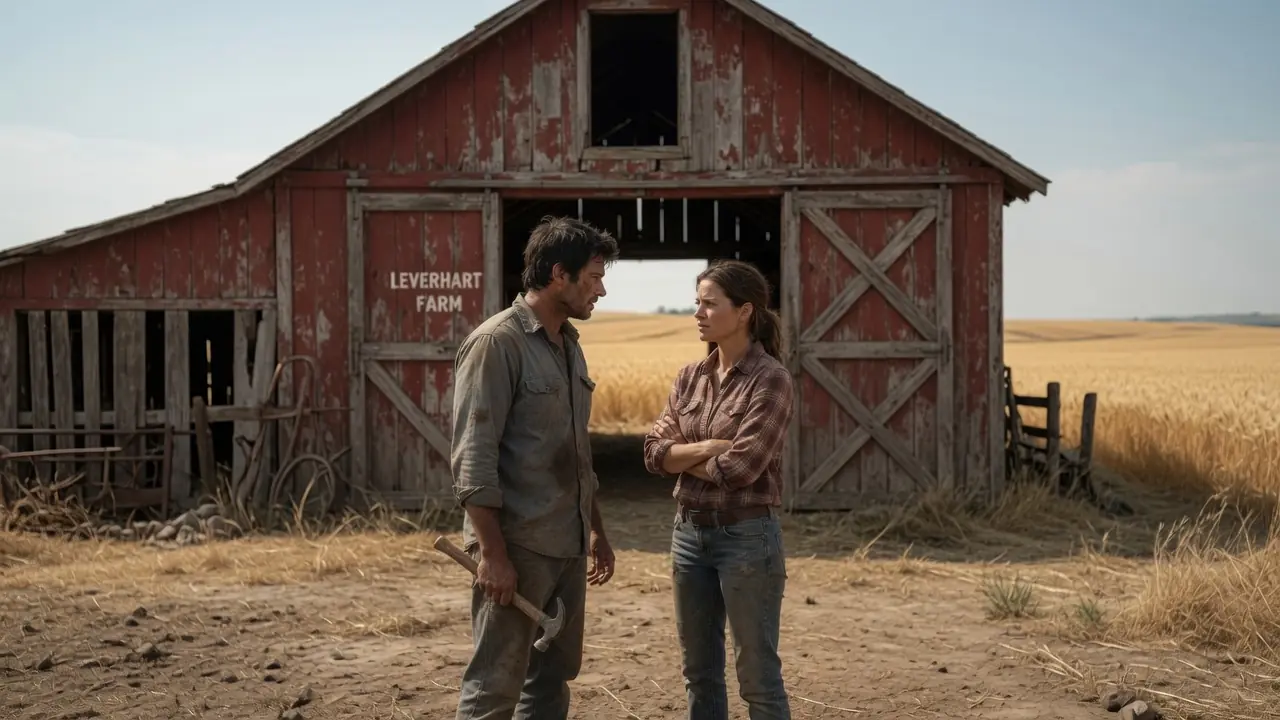
The red barn stood at the end of a gravel drive, leaning slightly beneath years of weather, its paint faded, its roof sagging in two places. Behind it stretched wheat fields, pasture fences, rolling tree lines, and land so wide Silas could not see where it ended. He had fixed barns before, but this one felt different, not because it was grand, but because someone had loved it long after it stopped being useful.
Then he saw Marigold Everhart standing in front of the open barn door.
She wore a red plaid shirt, fitted jeans, worn boots, and no jewelry except a small silver ring on a chain around her neck. Her chestnut hair was tied back, and her face held the kind of calm that did not come from peace, but from practice. She looked at Silas like she had already decided how much of him she trusted.
“Silas Callaway?” she asked.
“That’s me.”
“Marigold Everhart.”
Her handshake was firm, her palm rougher than he expected. Silas had worked for plenty of landowners who gave orders from porches and checked progress from a safe distance. Marigold looked like she had carried feed sacks, fixed fences, and fought weather with her own hands.
“You said the roof was the worst part,” Silas said, glancing at the barn.
“It is,” she answered. “Unless you count the men trying to take the land under it.”
Silas looked back at her.
Her expression did not change.
He could not tell whether she had meant to say that much or whether the truth had simply escaped before she could stop it. Either way, she turned toward the barn, ending the moment. Silas followed her inside, where the smell of old hay, damp wood, dust, and animal warmth filled the air.
The structure was tired, but not ruined.
He ran his hand along one support beam, tapped it with his knuckles, then crouched to inspect the lower boards. The roof needed bracing, several boards needed replacing, and the north wall had begun to pull slightly away from its frame. Still, the bones were strong.
“This barn can stand,” Silas said. “It just needs someone patient enough to repair what’s weak before winter gets mean.”
Marigold’s eyes moved over the beams.
“My grandfather built it,” she said quietly. “My father kept saying he would restore it before he died.”
Silas heard the weight in that last word.
Died.
He knew that kind of word. It never landed softly, no matter how many years passed. His wife, Elena, had died in a car accident four years earlier, and people still said “passed away” as if softer language could make the loss gentler. It never did.
“I can start today,” he said.
Marigold looked at him. “You don’t need more time to think?”
“I’ve got a son who eats like a hired hand and rent due Friday. Thinking doesn’t pay either one.”
For the first time, the corner of her mouth moved.
“Fair enough.”
Silas worked until late afternoon. Sweat darkened his gray work shirt, dust clung to his arms, and every swing of the hammer sent the sound echoing through the hollow barn. He liked work that answered. Hit a nail right, it sank. Cut a board straight, it fit. Life had not been that simple for years.
At four o’clock, a small boy came racing across the yard with a scruffy brown dog at his heels.
Silas turned just in time for Finn to slam into his leg.
“Slow down, partner.”
Finn ignored that and pointed at the dog. “Miss Marigold said his name is Rusty, and he doesn’t belong to anybody. Can he belong to us?”
Silas looked at Marigold, who stood near the barn door with a faint smile.
“Rusty belongs to himself,” she said. “But he seems willing to negotiate.”
Finn wrapped both arms around the dog’s neck. Rusty accepted this with a heroic amount of patience and licked the boy’s chin. Silas wanted to say no. They were barely settled in Hopewell, barely holding things together, and a dog meant food, vet bills, responsibility.
Then Finn laughed.
It was the kind of laugh Silas had not heard from his son in months.
So he sighed and said, “We’ll discuss it.”
Finn looked at Marigold. “That means yes eventually.”
Marigold laughed, and the sound changed her whole face.
For one brief moment, she looked less guarded. Less like a woman holding a battlefield alone. Silas saw it and looked away before she noticed him noticing.
That evening, as Silas loaded his tools into the back of the truck, Marigold stood beside the barn with her arms crossed.
“You did good work today.”
“I usually do.”
“Modest.”
“Hungry,” he corrected.
She studied him for a moment. “You and Finn could come by Saturday for dinner, if you want. I make decent stew.”
Silas should have refused.
He did not like owing people. He did not like his son getting attached to places that might not last. He especially did not like the way the farm already felt calmer than the rented house at the edge of town.
But Finn was sitting in the truck with Rusty’s head in his lap, looking happier than he had in weeks.
“We’d like that,” Silas said.
Marigold nodded once, almost as if she had not expected him to accept.
As Silas drove away, he saw her in the rearview mirror, standing alone in front of the red barn while the fields stretched behind her like an inheritance too heavy for one person to carry.
Over the next week, the barn began to change.
Silas replaced broken boards, reinforced the sagging roof, repaired the side gate, and patched leaks where rain had been slipping through for years. Marigold worked beside him more than he expected. She held planks, fetched tools, swept debris, lifted what she could, and argued whenever he tried to make her rest.
“You hired me,” he said one morning after she nearly dropped a beam on her boot.
“I hired help,” she replied. “Not a replacement.”
“Stubborn woman.”
“Careful man.”
He looked at her. “That an insult?”
“Observation.”
They worked in silence after that, but it was not an angry silence. It was the kind that let two people measure each other honestly. Silas learned that Marigold did not waste words, hated weak coffee, could carry a feed sack nearly as far as he could, and knew every inch of the farm by memory.
Marigold learned that Silas never cut corners, always checked his work twice, spoke gently to Finn even when tired, and carried grief like a tool he could not set down.
Saturday dinner changed something.
The Everhart farmhouse was warm, filled with old photographs, heavy wooden furniture, shelves of books, jars of preserves, and the smell of stew and fresh biscuits. Finn ate like a starving ranch hand and asked questions about every picture on the wall. Marigold answered patiently, even when the questions grew personal.
“Is that your dad?” Finn asked, pointing to a framed photo of a tall man in a field hat.
Marigold looked at the photograph.
“Yes. Elijah Everhart.”
“Is he still alive?”
Silas opened his mouth to stop him, but Marigold shook her head slightly.
“No,” she said. “He died three years ago.”
Finn lowered his spoon. “My mom died too.”
The room went quiet.
Silas stared at his bowl.
Marigold’s eyes softened as she looked at Finn. “I’m sorry.”
Finn nodded, accepting the condolence with the strange directness of children.
“Dad says people we love don’t disappear all the way. They just stop sitting where we can see them.”
Marigold looked at Silas then.
He wished she had not.
After dinner, Finn played outside with Rusty while Silas and Marigold stood on the porch. The sunset spread across the fields, and the repaired side of the barn glowed red beneath the fading light. For a while, neither of them spoke.
“You said something the first day,” Silas said finally. “About men trying to take the land.”
Marigold’s shoulders tightened.
“I wondered when you’d ask.”
“I wasn’t sure I should.”
She leaned against the railing. “A man named Damon Caldwell wants to buy the farm.”
“This farm?”
“All of it.”
Silas looked out over the fields. “How much land are we talking?”
“About three thousand acres.”
He turned to her slowly.
Three thousand acres.
Silas had thought she owned a farmhouse, a barn, and some fields. He had not realized that the quiet woman standing beside him owned half the horizon.
Marigold smiled without humor. “People usually react like that.”
“I’m not judging.”
“No. Just recalculating.”
“Maybe a little.”
She looked toward the barn. “My father expanded the land over thirty years. Wheat, cattle, orchard acreage, timber parcels, water rights. He believed land should be worked, not carved into luxury subdivisions.”
“And Caldwell?”
“He believes everything has a price.”
Silas heard the bitterness beneath her calm.
“Does he have any claim?”
“Not legally. But my father made investment deals with him before he got sick. Caldwell knows how to use pressure. Suppliers stopped returning my calls. The bank became suddenly cautious. Permits slowed. Repairs became harder. Every week, he makes the farm more expensive to keep.”
Silas looked toward the golden fields, then at the woman who had been trying to defend all of it alone.
“You should have told me.”
She gave him a sideways look. “You came to fix a barn, Silas. Not fight a war.”
He rested both hands on the porch railing.
“I’ve fixed enough barns to know when the roof isn’t the only thing about to collapse.”
She did not answer.
But she did not leave either.
The next trouble arrived in a black sedan.
It came two days later, rolling up the gravel drive while Silas and Marigold stood near the barn measuring roof boards. Damon Caldwell stepped out in a dark suit and polished shoes that looked offended by the dirt. He was handsome in a cold, expensive way, with smooth hair, a controlled smile, and eyes that never rested where kindness lived.
“Marigold,” he called. “Still playing farmer?”
Her jaw tightened.
Silas set his hammer down.
Caldwell glanced at him. “And you are?”
“Working.”
“How charming.”
Marigold stepped forward. “Say what you came to say, Damon.”
Caldwell smiled. “The county board is moving faster than you think. Development brings jobs. Housing. Roads. Progress. A decaying family farm does not.”
“The farm feeds this town.”
“The farm feeds your pride.”
Silas moved before he decided to.
He stepped between them, not touching Marigold, but close enough that Caldwell had to look at him instead.
“You should leave.”
Caldwell’s smile thinned. “The handyman speaks.”
Silas held his stare. “The handyman repeats himself if needed.”
For a second, the air tightened.
Then Caldwell laughed softly.
“This is touching. Truly. But sentiment does not stop paperwork.” He turned back to Marigold. “You have weeks, not months. Think carefully before your pride leaves you with nothing.”
He drove away in a cloud of dust.
Marigold stood still until the car disappeared.
Then she exhaled, and Silas heard the fear she had been hiding.
“He’s not bluffing,” she said.
“No.”
“What do I do?”
That question cost her something.
Silas could see it in the way her hands curled into fists at her sides. Marigold Everhart did not ask for help easily. Maybe she never had.
He picked up his hammer.
“We make the farm too important to take.”
She frowned. “What does that mean?”
“It means Caldwell wants the county to see unused land. So we show them a living farm. A community farm. A place this town needs.”
“You have a plan?”
“Not a polished one.”
“That’s not reassuring.”
“Good plans usually start ugly.”
By sundown, the ugly plan had taken shape.
They would host a weekly farm market on Everhart land. Local vendors, produce tables, baked goods, crafts, livestock demonstrations, children’s activities, and a public petition against the development proposal. Marigold thought it sounded impossible. Silas thought impossible was better than waiting for Caldwell to win.
The next morning, he took Finn into town and started asking people for help.
Some refused.
Some hesitated.
Some surprised him.
Mrs. Thompson from the bakery offered bread and pies. Henry Logan, a large landowner who had stayed neutral for years, agreed to bring fencing supplies and speak against Caldwell if the board hearing came. The schoolteacher offered to bring children for an agricultural lesson. The church ladies offered preserves, quilts, and enough opinions to fill three wagons.
By Saturday, the Everhart farm looked alive in a way Silas had never seen.
Tents lined the field beside the barn. Tables held apples, honey, bread, beans, eggs, candles, flowers, handmade soap, and baskets. Children ran across the grass with Rusty leading them like a proud general. Finn stood beside a hand-painted sign that read Save Everhart Farm and told every visitor his dad had fixed the barn.
Marigold stood near the red doors, overwhelmed.
Silas came up beside her.
“You breathing?”
“I forgot.”
“Try it. Helps.”
She let out a shaky laugh.
“They came.”
“They did.”
“I thought everyone had forgotten what this place meant.”
Silas looked around at the families, farmers, workers, vendors, and neighbors filling the field.
“Maybe they just needed you to remind them.”
She turned toward him.
“I didn’t do this alone.”
“No,” he said. “You didn’t.”
Her eyes held his for a long moment, and for once she did not look away first.
Then the black sedan arrived.
Conversations faded as Damon Caldwell stepped from the car. His polished shoes crossed the grass, his smile fixed, but his eyes moved over the market with irritation he could not fully hide. He had expected an isolated woman, tired land, and quiet defeat.
He found a town.
Marigold walked toward him before Silas could stop her.
“What are you doing here?” she asked.
“Admiring the performance.”
“This is not a performance.”
“No?” Caldwell gestured toward the stalls. “A few pies, some jars of jam, children running loose, and suddenly you believe you’ve saved three thousand acres?”
Silas came up beside her. “Looks like more than a few jars to me.”
Caldwell’s gaze flicked to him. “Still here, handyman?”
“Still repeating myself if needed.”
Caldwell’s mouth tightened.
“You don’t understand what you’re standing in front of. I have board members, investors, lawyers, and county officials who see a future here.”
Marigold’s voice was cold. “So do I.”
He leaned closer. “Your father was a dreamer. His dream died with him.”
Silas saw Marigold flinch, just slightly.
That was enough.
He stepped forward, but Marigold lifted a hand, stopping him.
Then she looked Caldwell in the eye.
“My father’s dream is standing behind me,” she said. “Families. Food. Work. Land that gives back instead of being carved up for profit.”
Caldwell laughed. “Pretty speech.”
Marigold turned to the crowd.
Her voice shook at first, but only for a second.
“Everyone here should know that Damon Caldwell intends to use county pressure to take this farm and turn it into private development. He will call it progress. He will call it jobs. He will call it growth. But what he wants is control of land my family spent generations building.”
The crowd went silent.
Then Henry Logan stepped forward.
“And I’ll testify against him.”
Mrs. Thompson raised her hand. “So will I.”
The schoolteacher added, “So will the parents.”
One by one, voices rose.
Farmers. Neighbors. Vendors. Families. People who had been quiet for too long began choosing a side in daylight.
Caldwell’s face hardened.
“This isn’t over.”
Marigold held his stare.
“No. But now it isn’t hidden.”
That was the turning point.
Two weeks later, the county board hearing filled beyond capacity. Silas stood in the back with Finn, watching Marigold sit at the front table with files, maps, petitions, tax records, market revenue numbers, community statements, and more courage than anyone in that room. Caldwell arrived with lawyers and a presentation about economic development.
Marigold arrived with Hopewell.
The vote was not even close.
The board rejected Caldwell’s proposal and declined any eminent domain petition tied to private development interests. The Everhart farm remained hers. The public record now showed community use, agricultural value, economic activity, and overwhelming local opposition to forced sale.
When the decision was announced, Marigold sat perfectly still.
Silas thought she had not heard.
Then her shoulders began to shake.
He crossed the room, knelt beside her chair, and saw tears running down her face.
“It’s safe,” he said quietly.
She looked at him like she was afraid to believe it.
“For now?”
“For real.”
She pressed one hand over her mouth and cried harder.
Silas did not touch her until she reached for him.
Then he took her hand, and she held on like someone finally allowed to stop standing alone.
That evening, they returned to the farm near sunset.
Finn and Rusty ran ahead toward the barn. The market tables were stacked neatly along the wall. The repaired roof held firm in the wind. The fields stretched behind the red boards, not lost, not sold, not surrendered.
Marigold stood in front of the barn beside Silas.
“You finished the job,” she said.
“Barn’s not falling down.”
“I didn’t mean the barn.”
He looked at her.
She folded her arms, but this time it was not a wall. It was something closer to shyness.
“When I hired you, I thought you were just a man who needed work.”
“I was.”
“And now?”
Silas looked toward Finn, who was laughing as Rusty jumped through tall grass.
“Now I think I found work worth staying for.”
Marigold’s eyes softened.
“Because of the farm?”
Silas looked back at her.
“Because of you.”
For once, neither of them joked.
Neither turned away.
The wind moved through the barn, carrying the smell of hay, wood, and coming rain. Marigold reached for his hand slowly, as if giving him time to refuse. Silas did not.
His fingers closed around hers.
Months later, the Everhart farm became the heart of Hopewell again.
The weekly market grew into a permanent tradition. Families came every Saturday. Children learned to plant seeds, bake bread, feed chickens, and understand where food came from. Farmers sold directly to neighbors. The old barn Silas repaired became a gathering hall, its red walls strong again beneath the sky.
Finn called himself Assistant Farm Manager.
Rusty accepted the title of Security Dog.
Silas never left.
He and Finn moved into the small guest cottage near the orchard first, just until they found something permanent. Then the cottage became permanent. Then permanence became something no one needed to explain.
One spring morning, Marigold found Silas in the barn doorway, watching Finn help plant wildflowers along the fence.
“He’s happy here,” she said.
Silas nodded. “So am I.”
She leaned against the barn beside him. “Do you ever miss drifting?”
“No.”
“That was quick.”
“I’m a carpenter,” he said. “I know when something has good bones.”
Marigold smiled, looking at the barn, the fields, the boy, the dog, and the man who had arrived with a hammer and accidentally helped rebuild her whole life.
“And this place?”
Silas took her hand.
“This place is stronger than it looks.”
Marigold looked at him then, her eyes bright.
“So are we.”
The barn stood behind them, repaired plank by plank, scarred but steady. The land stretched wide and alive, no longer waiting for someone to take it. And for the first time in years, Marigold Everhart did not feel like the last person guarding a fading legacy.
She felt like the first person building what came next.
Silas Callaway had come for a paycheck.
He found a home.
Marigold Everhart had hired a man to repair an old barn.
She found someone willing to stand beside her, acre by acre, until the whole world learned that some land is not for sale because it is not just land.
It is memory.
It is family.
It is the place where broken people learn they can still take root.