The coffee hit Marcus Reed hard enough that the paper cup bounced off his shoulder and landed upside down on the tile.
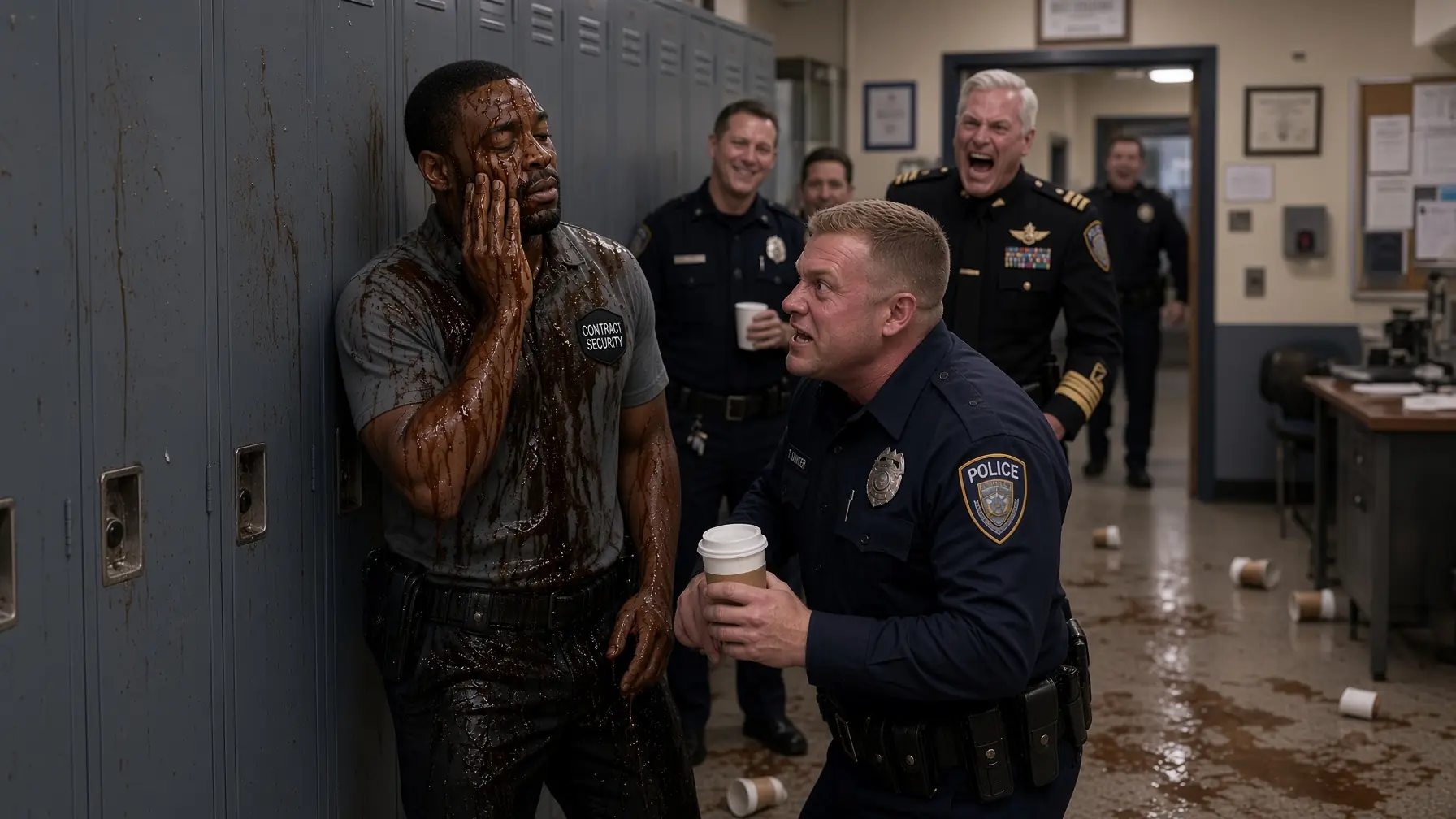
For half a second, Ninth Division went quiet.
Then someone laughed.
Another officer joined in. A detective near the vending machines slapped the counter with one hand. Two patrolmen standing beside the roll-call room exchanged grins, and somewhere behind the front desk a woman said, “Oh, come on, Sawyer,” in the tone people used when something was inappropriate but still entertaining enough to watch.
Marcus did not move.
Brown coffee ran from his forehead along his left cheek, collecting briefly at his jaw before dripping onto the gray polo shirt issued by Sentinel Facility Services. A dark stain spread over the embroidered SECURITY patch on his chest. More coffee soaked into his collar and the front of his black work pants.
Officer Trent Sawyer stood six feet away holding the empty cup.
He was thirty-eight, broad through the shoulders, close-cropped sandy hair, thick forearms, and the sort of permanent half-smile that seemed to assume the room was already on his side. He was not wearing a full patrol uniform that afternoon. His dark department quarter-zip was unmarked except for a badge clipped near his belt, and there was no visible nameplate.
That was probably why Sawyer’s smile lasted until Marcus spoke.
Marcus lifted a paper napkin from the counter.
He wiped coffee from his right eye.
Then only part of his cheek.
He deliberately left the stains across his collar, chest, and jaw exactly where they were.
Across the lobby, Sergeant Calvin Rourke stopped eating.
Rourke had been sitting at the far table with a turkey sandwich in one hand and a report folder open beside him. He was fifty-three, lean, gray beginning at both temples, with twenty-seven years inside the Riverton Police Department and enough experience to know the difference between officers laughing because something was funny and officers laughing because nobody wanted to be the first person who refused.
Rourke did not laugh.
He watched Marcus.
Marcus folded the wet napkin once.
Then he looked directly at Trent Sawyer.
“Enjoy your lunch, Officer Sawyer.”
Sawyer’s grin disappeared.
It happened quickly.
So quickly that most of the room missed it.
But Rourke did not.
Sawyer looked down at his own clothes, almost as though checking whether he had forgotten a name tag.
He had not.
“You know me?” he asked.
Marcus picked up the crushed coffee cup from the floor.
“You work here.”
“That’s not what I asked.”
Marcus dropped the cup into the trash.
“Enjoy your lunch.”
Then he walked toward the security desk.
The laughter did not return.
Three weeks earlier, almost nobody at Ninth Division had noticed Marcus Reed arrive.
Sentinel Facility Services handled overnight access control at several municipal buildings across Riverton, Virginia. Budget cuts and staffing shortages had pushed the police department to use civilian security contractors for certain administrative posts, especially after-hours reception, visitor screening, maintenance access, and door-monitoring duties.
To most officers, the contractor at the front entrance was furniture with a heartbeat.
Marcus understood that by the end of his first shift.
The station itself was an aging three-story brick building between a tire warehouse and an elevated rail line on the city’s south side. Ninth Division handled several rough neighborhoods, an industrial corridor, two public housing developments, and the entertainment district surrounding the old riverfront.
The officers who worked there were busy.
Many were exhausted.
Most were ordinary people trying to finish a shift and go home.
Marcus learned their routines quickly.
Officer Lydia Chen always carried two pens because her partner never had one.
Detective Harold Mills complained about his knees before climbing stairs but refused to use the elevator.
Officer Devin Carter bought microwave burritos from the same gas station every night and insisted they were “basically meal prep.”
Sergeant Rourke arrived twenty minutes early even when he was not supervising roll call.
And Trent Sawyer never walked through a door quietly.
He slapped people on the shoulder.
Interrupted conversations.
Told stories loudly enough for three rooms to hear.
He had eleven years on the department and had spent the last five assigned to Ninth Division’s Street Crimes Detail, a small proactive unit focused on narcotics, guns, repeat offenders, and high-crime areas.
Sawyer liked having an audience.
Marcus learned that too.
During Marcus’s first week, Sawyer walked through the lobby carrying two pizza boxes.
He stopped at the security desk.
“Contract guy.”
Marcus looked up.
“My name’s Marcus.”
Sawyer placed both pizzas on the desk.
For one hopeful second Marcus thought he was offering him food.
Then Sawyer pointed toward the back hallway.
“Hold these.”
Marcus stared at him.
Sawyer laughed.
“I’m messing with you.”
He picked them up again.
“Guy looks like he was about to call corporate.”
Two officers behind him laughed.
Marcus smiled slightly.
“No problem.”
The next day Sawyer passed the desk and dropped a set of vehicle keys in front of Marcus.
“Park it for me.”
Marcus looked at the keys.
“I’m building security.”
“Same thing.”
“I don’t think your department wants me driving a city vehicle.”
Sawyer grinned.
“You scared?”
“No.”
Marcus pushed the keys back.
“I just like keeping jobs.”
Sawyer took them.
“See? Smart man.”
That became the pattern.
Small things.
Never serious enough alone to justify a confrontation.
Sawyer called him “Door Man.”
Someone else called him “Paul Blart.”
A detective once asked whether Marcus’s flashlight came with “special mall-cop batteries.”
Marcus laughed when the joke was harmless.
Ignored it when it was not.
And every morning, he signed the same access sheet, checked the same visitor doors, logged the same maintenance workers, and sat at the same desk.
After several days, people stopped lowering their voices around him.
That was when Marcus began hearing things.
Not secrets.
Not at first.
Mostly complaints.
Which prosecutor was difficult.
Which lieutenant was applying for promotion.
Who had called in sick after drinking until two in the morning.
Which squad car had transmission trouble.
Which officer’s divorce was getting ugly.
Who was sleeping with whom.
Who hated Internal Affairs.
Who had received a citizen complaint.
Nobody thought about Marcus when they talked.
That was the strange privilege of being treated as invisible.
People forgot invisibility could listen.
One Monday afternoon, Sawyer came through the lobby with Officer Brett Nolan and Detective Wesley Pike.
Nolan was younger than Sawyer and laughed too quickly whenever Sawyer spoke.
Pike was different.
Forty-six, narrow face, thinning hair, expensive watch. He worked narcotics investigations and had a reputation for producing good arrests with remarkably clean paperwork.
Sawyer was telling a story.
“She actually counted it in front of me.”
Nolan laughed.
“No way.”
“Swear to God.”
Pike said, “Keep your voice down.”
Sawyer glanced toward Marcus.
Then smiled.
“What? Him?”
Marcus continued reading the visitor log.
Sawyer leaned closer to Pike.
“He’s security.”
Pike’s face tightened.
“That’s still a person with ears.”
Sawyer laughed.
“Barely.”
They disappeared through the secured interior door.
Marcus did not look up until the door closed.
Across the lobby, Sergeant Rourke had heard it too.
Their eyes met.
Only briefly.
Neither said anything.
The first unusual thing Marcus noticed happened two days later.
At 12:14 p.m., Sawyer entered the hallway leading toward Property and Evidence.
He was carrying no evidence bag.
No paperwork.
No prisoner property envelope.
Just a white plastic takeout bag.
Nine minutes later, he returned without it.
At 12:31, Detective Pike used the same hallway.
Then Nolan.
Marcus thought nothing of it.
There were offices back there.
Storage rooms.
A copy room.
Evidence processing.
People moved through constantly.
But the same thing happened Friday.
Then Tuesday.
Always around lunch.
Sawyer.
Pike.
Sometimes Nolan.
Occasionally civilian property technician Darren Cole.
Marcus had been given a list of doors he was responsible for monitoring after a ventilation contractor accidentally wandered into a restricted hallway months earlier.
The evidence corridor was one of them.
He did what any security guard should do.
He paid attention.
The officers rarely badged into the hallway together.
One would enter.
Then another several minutes later.
Sometimes somebody would prop the interior service door with a rubber wedge while bringing in food.
Marcus reported the propped door twice.
The first time, Nolan laughed.
“Relax, Fort Knox.”
The second time, Sawyer removed the wedge, handed it to Marcus, and said, “Congratulations. You saved America.”
Marcus put the wedge beneath the desk.
“Just doing my job.”
Sawyer leaned on the counter.
“You ever have a real job?”
Marcus looked up.
“Couple.”
“Like what?”
“Warehouse security. Transportation.”
“Military?”
“Why?”
“You stand like military.”
Marcus smiled.
“My mother used to yell if I slouched.”
Sawyer laughed and walked away.
Rourke had been signing a report nearby.
After Sawyer left, he looked at Marcus.