The first thing Garrett Morrison saw through the blizzard was a pair of red taillights buried in white.
They appeared for less than a second at the edge of his headlights, vanished behind windblown snow, then returned as two dim red circles near the guardrail.
Garrett slowed his pickup.
The road climbing through Vermont’s Black Pine Pass had nearly disappeared beneath six inches of fresh snow. Wind rushed across the mountain hard enough to shake the old truck, and the temperature had fallen eleven degrees since sunset.
It was New Year’s Eve.
The county had already advised drivers to stay off the mountain.
Garrett should have continued home.
His eight-year-old daughter, Emma, was waiting at the garage with his sister. They had promised to eat frozen pizza, drink hot chocolate, and watch the town fireworks from the apartment above the repair bays.
Instead, Garrett eased onto the shoulder.
A silver luxury SUV sat at an angle near the guardrail. Its hazard lights flashed weakly. Snow had gathered along the hood and roof, suggesting it had been there for some time.
Garrett stopped twenty feet behind it and left his engine running.
The wind struck him the moment he opened the door.
Snow found the gap beneath his collar. Ice stung his cheeks, and his boots sank nearly to the ankles as he approached the disabled vehicle.
A woman sat behind the wheel.
She wore a dark wool coat and held a phone toward the windshield, searching for a signal that did not exist.
Garrett knocked lightly on the glass.
She startled, then lowered the window less than an inch.
“Are you all right?” he shouted over the wind.
“I’ve called roadside assistance.”
“You don’t have service up here.”
“They said someone was coming before the call dropped.”
Garrett looked down the road.
“From where?”
“Burlington.”
He almost laughed.
Burlington was more than an hour away in good weather.
No tow truck was climbing Black Pine Pass that night.
“How long has the vehicle been dead?”
“Forty minutes.”
“Does the heat work?”
“It stopped ten minutes ago.”
Garrett looked at the snow covering the lane behind them.
A plow might pass eventually.
It might not.
“You need to come sit in my truck.”
The woman’s eyes narrowed.
“I’m fine here.”
“No, you’re not.”
Her expression hardened.
“I don’t know you.”
“My name is Garrett Morrison. I own Morrison Auto and Farm Repair in Bellweather.”
“That doesn’t help me verify who you are.”
Garrett pulled his wallet from inside his coat and pressed his driver’s license against the window.
She studied it through the glass.
His photograph was five years old. His beard had grown longer, and fatigue had carved deeper lines around his eyes, but the name was visible.
“Morrison Auto?” she asked.
“Yes.”
“You repair tractors.”
“And cars.”
“This is not a tractor.”
Garrett looked at the emblem on the grille.
The SUV was a Norland Aurum X9, an electric luxury model that cost more than his garage and the apartment above it combined.
“No,” he said. “It’s currently a very expensive snowbank.”
The woman did not smile.
“I was told only a certified Norland technician should open the vehicle.”
“Then keep waiting.”
Garrett turned toward his truck.
A gust of wind pushed him sideways.
Behind him, the woman called through the narrow window.
“Wait.”
He stopped.
“What?”
“If I sit in your truck, can you remain here until assistance arrives?”
“I can do better than that.”
“You can repair this?”
“I can look.”
Her eyes moved over his worn insulated coveralls, faded knit cap, and the toolbox in the pickup bed.
The doubt on her face was immediate.
Garrett had seen it before.
People from cities often assumed that a mechanic working in a Vermont mountain town repaired only rusty pickups and snowplows held together by wire.
“Do you have diagnostic equipment for a Norland?”
“Not the manufacturer’s system.”
“Then how could you possibly know what is wrong?”
Garrett stared at her.
“Machines usually fail before they read the logo on my jacket.”
She looked away first.
A new warning tone sounded inside the SUV.
The interior lights flickered.
That settled the argument.
The woman opened the door.
Garrett helped her across the snow to his pickup. She carried a leather briefcase and a handbag but no hat or gloves.
He turned the heater to its highest setting.
The old Ford responded with a roar.
The passenger-side vent produced enough heat to warm a barn, while the driver’s side released only a faint stream.
The woman held her hands toward the working vent.
“This vehicle sounds dangerous.”
“It’s been threatening to die for twelve years.”
“And you trust it?”
“I know what’s wrong with it.”
She looked toward the disabled SUV.
“That appears to be a valuable quality.”
Garrett removed a thermal blanket from behind the seat and handed it to her.
“What’s your name?”
“Claire Whitmore.”
The name seemed familiar, but Garrett could not place it.
“Were there warning messages before the shutdown?”
“Several.”
“What did they say?”
“Electrical system fault. Reduced propulsion. Then something about battery temperature.”
“Did you smell anything?”
“No.”
“Any flickering lights before the car stopped?”
“Yes.”
“Was it charging outside before you left?”
“At the hotel.”
“Snowing then?”
“Lightly.”
Garrett reached for his portable work light.
“Stay here. Keep the doors locked.”
“You’re going back outside?”
“That’s where the car is.”
“You could freeze.”
“I’ll try not to.”
Claire watched him climb out.
Garrett opened the SUV’s hood using the emergency mechanical release. The vehicle’s low-voltage system was nearly dead, but the high-voltage battery remained charged.
That combination mattered.
Electric vehicles still depended on an ordinary twelve-volt circuit to operate contactors, computers, locks, and control systems. If the small battery or its connections failed, the larger battery could become inaccessible even when it held hundreds of miles of energy.
Garrett inspected the terminals.
The twelve-volt battery was not the problem.
Voltage remained adequate.
He followed the main cables toward the forward power-distribution unit. Snow had packed beneath the cowl where the windshield met the hood.
He cleared it away.
Under the work light, he saw a faint line of frost surrounding a sealed connector.
Garrett touched it carefully.
The connector housing moved.
It should not have moved at all.
He returned to the pickup.
“Did anyone service the vehicle recently?”
“It had a software update three days ago.”
“Anything physical?”
“I don’t know.”
“Is it company-owned?”
Claire hesitated.
“Yes.”
“Do you have service records?”
She opened her briefcase and removed a tablet.
The device had a weak signal but stored recent documents locally.
Garrett scanned the final service invoice.
The vehicle had received a recall inspection involving the front junction harness. The dealership marked the connector as secure.
Garrett looked toward the SUV.
“What is it?” Claire asked.
“Possibly a ground fault caused by moisture entering a connector that was not seated correctly.”
“Can you repair it here?”
“I can dry it, reseat it, and see whether the control system resets.”
“Will that damage the warranty?”
“Being frozen on a mountain may damage you first.”
Claire’s mouth tightened.
“You don’t need to be rude.”
“I stopped in a blizzard and offered you my heater. I’m allowed one sentence.”
She almost smiled.
Almost.
Garrett returned to the SUV with a heat gun connected to the power inverter in his truck. He set it to low temperature, avoiding direct heat near high-voltage components.
After clearing ice from the connection, he released the secondary lock.
The connector came free too easily.
Inside, one terminal showed green discoloration and a faint burned mark.
Moisture had entered around a damaged seal.
As temperature dropped, resistance increased. The resulting voltage irregularity caused the vehicle’s control modules to shut down.
Garrett cleaned the terminal, dried the housing, treated it with dielectric compound, and carefully reseated the connector.
The damaged seal would need replacement.
For the moment, he reinforced the housing against further water intrusion and reset the low-voltage system.
Nearly an hour had passed when he returned to Claire.
“Try it.”
She climbed back into the SUV.
The dashboard illuminated.
A sequence of warnings appeared, then disappeared one by one.
The heating system began blowing warm air.
Claire stared at the display.
“You fixed it.”
“I made it safe enough to leave the mountain.”
“Is it safe to drive?”
“Slowly, directly to town. No fast charging. No washing the vehicle. No pretending the problem is gone.”
She nodded.
“How much?”
“Nothing.”
Claire looked at him as if he had misunderstood.
“I asked what I owe you.”
“I heard you.”
“You spent an hour outside in a blizzard.”
“Yes.”
“You used equipment and materials.”
“About four dollars’ worth.”
“I can pay for your time.”
Garrett closed his toolbox.
“Keep the car running.”
“Mr. Morrison.”
He looked up.
Claire had removed her wallet.
“I don’t accept charity.”
“Neither do I.”
“Then send me an invoice.”
“No.”
Her frustration returned.
“Why?”
Garrett looked at the empty child seat mounted inside his pickup.
“My daughter is eight.”
Claire followed his gaze.
“If she were stranded on this mountain, I’d want someone to stop before asking whether she could afford them.”
The answer removed something from Claire’s face.
Not suspicion.
Something deeper.
She lowered the wallet.
“At least take my card.”
He accepted the business card she offered.
The letters were embossed in silver.
CLAIRE WHITMORE
CHIEF EXECUTIVE OFFICER
WHITMORE TRANSIT AND LOGISTICS
Garrett finally recognized the name.
Whitmore Transit operated one of the largest private delivery fleets in the Northeast. Its trucks, vans, and service vehicles moved medical equipment, food, and industrial supplies through six states.
The company had recently announced a major transition to electric and hybrid vehicles.
“You’re that Claire Whitmore.”
Her eyebrows rose.
“Is there another one?”
“Probably.”
Garrett looked at the disabled SUV again.
“That’s a preproduction fleet evaluation vehicle.”
Claire’s expression changed.
“How do you know that?”
“The connector carries an engineering revision mark that isn’t on the retail service diagrams.”
“You saw that in the storm?”
“It was in front of me.”
She studied him more carefully.
“You’re not only a small-town mechanic.”
“I never said only.”
Headlights appeared through the snow.
A county plow rounded the bend.
Garrett pointed toward it.
“Follow the plow down the mountain. My garage is twelve miles after the Bellweather exit. Stop there so I can check the connection properly.”
“I have a meeting in Albany tomorrow morning.”
“No, you don’t.”
“I beg your pardon?”
“You spent forty minutes in a freezing vehicle and another hour watching me repair it. You’re exhausted, the interstate is closing, and your car needs work.”
Claire looked toward the road.
For perhaps the first time that evening, she accepted that authority did not change the weather.
“Fine.”
She followed him down the mountain.
Morrison Auto and Farm Repair stood beside an old dairy road at the edge of Bellweather.
The building had three service bays, a fading red sign, and a roof that leaked near the alignment machine whenever snow melted too quickly.
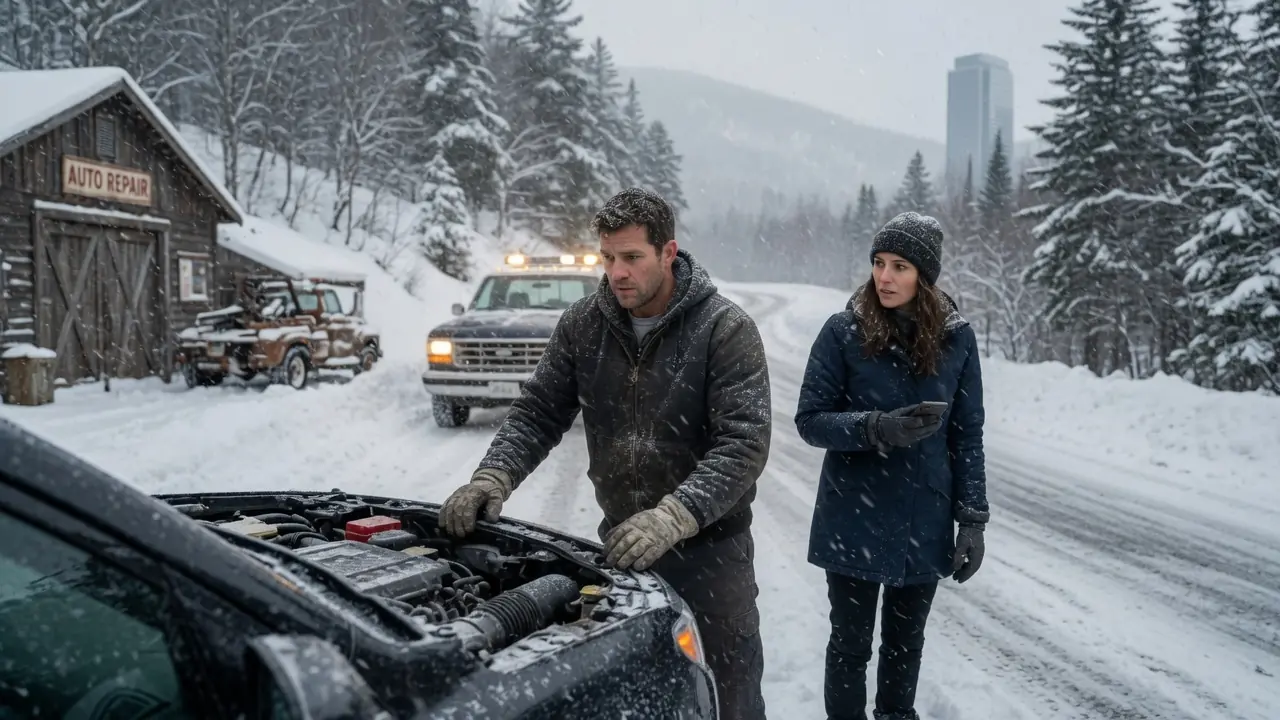
A small apartment occupied the second floor.
When Garrett arrived, light glowed from the upstairs windows.
Emma ran into the service bay before he fully opened the door.
She wore pink pajamas beneath winter boots and carried a plate covered in aluminum foil.
“You missed pizza.”
“I know.”
“You promised before nine.”
“I know that too.”
Then Emma saw Claire step from the silver SUV.
Her eyes widened.
“Is she lost?”
“She had car trouble.”
Emma looked at Claire’s coat and expensive boots.
“Did she know how to open the hood?”
Claire glanced at Garrett.
“Your daughter is direct.”
“She gets that from her mother.”
The words made Emma quiet.
Garrett immediately regretted the tone.
His wife, Rachel, had died two years earlier after a long illness. Emma spoke about her often, but certain moments still arrived without warning and changed the air in the room.
Garrett touched his daughter’s shoulder.
“Did Aunt Molly go home?”
“She’s upstairs. She said she was waiting until you came back because the weather is horrible and you make irresponsible choices.”
“That sounds like Molly.”
Emma lifted the covered plate.
“I saved you two slices.”
Garrett looked toward Claire.
“Would you like pizza?”
Claire had eaten dinner at a hotel restaurant three hours earlier.
Still, she looked at the child offering the plate.
“Yes. Thank you.”
While Claire and Emma sat inside the small office, Garrett moved the Norland into the first bay.
Under better lighting, he examined the connector and surrounding harness.
The damage was worse than he initially believed.
The rubber seal had been pinched during assembly. Cold-weather contraction opened a narrow channel that allowed water and road salt into the housing.
One terminal had overheated.
A few more cycles could have melted the connector.
In the wrong circumstances, the fault might have damaged the control module or triggered a thermal incident near the high-voltage distribution unit.
Garrett photographed everything.
Claire watched from the office doorway.
“Is it serious?”
“Yes.”
“The dashboard showed only a battery-temperature warning.”
“Control systems report what sensors can recognize. They don’t always name the original cause.”
“Could this affect other vehicles?”
Garrett looked at the revision number.
“If the same seal and assembly process were used, yes.”
“How many?”
“That depends on the production batch.”
Claire entered the bay.
“Can you document it?”
“I already am.”
“What qualifies you to evaluate a high-voltage distribution fault?”
The question was not insulting this time.
Garrett wiped his hands.
“I spent nine years at Colburn Automotive’s cold-weather engineering center.”
Claire stared.
Colburn was one of the country’s largest vehicle manufacturers. Its Vermont facility tested electric systems in extreme temperatures.
“What did you do there?”
“Electrical diagnostics. Failure analysis. Later, field-reliability engineering.”
“Why did you leave?”
“My wife became ill.”
Claire looked through the office window at Emma.
Garrett continued.
“Rachel needed treatment in Boston. Emma was five. The company offered unpaid leave, then a transfer that still required travel. My father owned this garage and was ready to retire, so I came home.”
“And after your wife…”
“I stayed.”
“Why?”
“Emma had already lost enough.”
Claire looked around the garage.
Tools were organized carefully, but the building showed strain. One lift had been patched. A cracked window was covered with clear plastic, and a handwritten notice near the office listed reduced winter hours.
On the desk lay several red envelopes.
Past-due notices.
Garrett saw where she was looking and closed the office door.
“The vehicle will need a replacement connector and short harness section. I can make a safe temporary repair, but the manufacturer should inspect it.”
“Can I leave it here?”
“Yes.”
“How will I get to Albany?”
“You won’t.”
She gave him a look.
“There’s a motel in town. Not the kind you’re used to, but the roof works.”
Emma appeared behind Claire.
“You can sleep in our extra room.”
Garrett shook his head.
“We don’t have an extra room.”
“We have the couch.”
“That is not a room.”
“She can have my bed. I’ll sleep with you.”
Claire looked uncomfortable.
“I could not impose.”
Emma studied her.
“You almost froze.”
Garrett crouched beside his daughter.
“Claire will stay at the Bellweather Inn.”
“The heat there smells funny.”
“It still works.”
Emma whispered loudly, “Sometimes.”
Claire smiled for the first time.
It changed her entire face.
“I’ve stayed in worse places.”
Garrett drove her to the inn after midnight.
Before leaving, Claire paused beside the truck.
“I owe you more than a free repair.”
“It wasn’t free. You fed me my own pizza.”
“I underestimated you.”
“Yes.”
“You could pretend not to enjoy that admission.”
“I could.”
She held out her hand.
Garrett shook it.
Her fingers were cold.
“Send me every photograph and note about the connector,” she said.
“I will.”
“And an invoice.”
“No.”
“Garrett.”
He looked at her.
“Happy New Year, Claire.”
Then he drove home.
Three weeks passed.
The storm buried Bellweather beneath nearly two feet of snow.
Garrett replaced the damaged harness section using a component supplied by Norland’s regional service center. The manufacturer requested the failed part for analysis but offered little explanation.
Claire’s assistant arranged transport for the vehicle.
Garrett expected never to see her again.
He did send the photographs.
Along with them, he included a seven-page diagnostic report describing the failure sequence, cold-weather conditions, connector revision, terminal discoloration, and likely assembly defect.
Claire read it twice.
Then she sent it to Whitmore Transit’s engineering director.
The director called her within twenty minutes.
The defect resembled an unexplained shutdown affecting six electric delivery vans undergoing winter evaluation. Those vehicles used a power-distribution system supplied by the same component manufacturer.
No one had connected the cases.
Claire ordered a review of all pilot vehicles.
Technicians found moisture intrusion in eleven units.
Three connectors showed heat damage.
One had begun deforming around the terminal.
Had the fleet entered full operation, hundreds of vehicles would have been exposed.
Claire requested Garrett’s employment history from Colburn with his permission.
What returned surprised her.
Garrett had not been an ordinary engineer.
He had led a cold-weather reliability team responsible for identifying several high-profile electrical defects before vehicle launch. Two patents carried his name as co-inventor.
His former supervisor described him as the best field diagnostician he had ever managed.
“He notices failures before instruments know what question to ask,” the man said.
Claire also discovered why Garrett’s garage was failing.
It was not poor management.
When Rachel became sick, Garrett borrowed against the building to pay expenses insurance did not cover. After her death, he inherited his father’s remaining business debt.
Then a regional farm-equipment company opened a large service center near the interstate and undercut local repair prices long enough to take several of his commercial accounts.
Morrison Auto remained respected.
Respect did not pay winter utility bills.
The garage was ninety days behind on its mortgage.
The bank had scheduled a restructuring meeting for February.
Claire could have sent money.
She knew Garrett would refuse it.
Instead, she began with the defect.
Whitmore Transit suspended its planned vehicle order and confronted Norland and the supplier with Garrett’s report. Under pressure, the companies expanded the inspection program.
The findings triggered a service campaign across several cold-weather fleets.
Potential losses exceeded tens of millions of dollars.
No vehicles had yet caught fire.
Garrett’s roadside diagnosis may have prevented that.
Claire returned to Bellweather on a Monday morning in late January.
This time, she arrived in a company SUV followed by four white fleet vans.
Garrett stood beneath a pickup on the second lift when Emma ran into the bay.
“The blizzard lady is back.”
Garrett rolled out on the creeper.
Claire entered wearing a simple gray coat and practical winter boots.
Behind her came a man carrying a leather portfolio and a woman with a laptop.
Garrett stood.
“Car break again?”
“No.”
“Then you’re ahead of schedule.”
Claire looked toward the patched ceiling.
“I need to speak with you.”
He gestured toward the office.
Emma followed.
Garrett pointed toward the stairs.
“Homework.”
“I could learn business.”
“You could learn fractions.”
“They’re related.”
“Upstairs.”
Emma left slowly enough to hear anything important before the door closed.
Claire sat opposite Garrett’s desk.
The man beside her introduced himself as Whitmore Transit’s director of fleet operations. The woman was the company’s general counsel.
Garrett looked at all three.
“This is more serious than an unpaid invoice.”
Claire opened the portfolio.
“Your diagnosis identified a defect affecting our entire winter pilot fleet.”
“I suspected it might.”
“Norland has now confirmed assembly damage in vehicles produced across two facilities.”
“How many?”
“The final number is still being determined.”
“Any fires?”
“No.”
“Good.”
Claire placed a technical bulletin on the desk.
Garrett read the first page.
The repair procedure closely followed the steps in his report.
“They used your photographs,” Claire said.
“I noticed.”
“Your name is not listed.”
“I noticed that too.”
“Our legal department has preserved the original report and timeline.”
Garrett set the paper down.
“What do you want from me?”
“A contract.”
The fleet director opened his laptop.
Whitmore Transit operated 430 vehicles within a two-hour radius of Bellweather. Most routine service went to large regional shops near Burlington and Albany.
Claire proposed transferring maintenance of 120 light-duty vehicles and support vans to Morrison Auto.
The initial agreement would run for three years.
Guaranteed minimum work.
Parts reimbursement.
Emergency-service fees.
Training support for high-voltage vehicles.
The annual value was more than Garrett’s garage had earned during its best three years combined.
He read the numbers.
Then he looked at Claire.
“No.”
The fleet director appeared startled.
Claire did not.
“Why?”
“You are offering this because I helped you.”
“I’m offering it because you discovered a fleet-wide defect our existing contractors missed.”
“I have three bays.”
“The contract begins with forty vehicles during a six-month capacity period.”
“I have one full-time employee besides myself.”
“We included funds for technician certification and equipment.”
“Your company has larger service centers.”
“They failed to identify the pattern.”
Garrett closed the portfolio.
“This still feels like charity.”
Claire leaned forward.
“Charity is money given without receiving equal value.”
Her voice remained calm.
“This contract requires you to keep our vehicles operating through Vermont winters. It requires response times, documentation, warranty coordination, and liability coverage. If you fail, we terminate it.”
Garrett studied her.
“You wrote the difficult parts yourself.”
“Yes.”
“Why?”
“Because I knew you would read them first.”
The fleet director looked between them.
Claire continued.
“You said you would want someone to protect your daughter in the same situation.”
Garrett glanced toward the ceiling, where Emma’s footsteps moved across the apartment floor.
“I have more than four thousand employees whose families depend on our vehicles being safe.”
She touched the defect report.
“You protected them.”
“That doesn’t mean I can service a fleet.”
“No.”
Claire looked around the garage.
“Your experience does.”
Garrett opened the contract again.
A second document lay beneath it.
It concerned the garage mortgage.
His expression hardened.
“How did you get this?”
“Public filing.”
“You investigated me.”
“I investigated whether you could fulfill the contract.”
“You found my debt.”
“Yes.”
“And now the contract happens to pay enough to save the building.”
“The contract pays what the work is worth.”
Garrett stood.
“I don’t like people examining my life.”
Claire remained seated.
“Neither did I when you opened the hood of my vehicle.”
“That was different.”
“You searched the service history, found a defect, and told me my assumptions were wrong.”
“That was the car.”
“I am a CEO. I solve problems by examining systems.”
Garrett looked toward the repair bay.
For two years, he had fought to keep the garage alive one invoice at a time. He worked after Emma slept, delayed his own medical appointments, and stopped paying himself during slow months.
Accepting the contract would change everything.
That frightened him almost as much as losing the garage.
“What is the shocking discovery?” he asked.
Claire’s expression became serious.
“There’s another document.”
The general counsel placed a sealed file on the desk.
Inside was a copy of a technical report dated nine years earlier.
Garrett recognized it immediately.
He had written the original while working at Colburn.
The report warned that a particular supplier’s connector-seal design could deform during low-temperature assembly and allow moisture intrusion.
Colburn changed suppliers before production.
Garrett believed the matter ended there.
“This report was licensed to Norland through a shared engineering database,” Claire said.
“They had access?”
“Yes.”
“Before building the Aurum?”
“Four years before.”
Garrett turned the pages.
A review stamp appeared near the end.
RISK ACCEPTED — LOW FIELD PROBABILITY
The name beneath it belonged to a current Norland executive.
“They knew.”
“They knew the design carried a cold-weather risk,” Claire said. “They changed the housing but kept the seal geometry.”
“And marked the problem as unlikely.”
“Yes.”
Garrett looked at his original diagrams.
“So the failure on the mountain wasn’t new.”
“No.”
“It was ignored.”
Claire nodded.
The discovery carried consequences beyond a repair campaign. Regulators would need notification. Fleet customers would demand answers. Norland’s partnership with Whitmore Transit might collapse.
Garrett looked at Claire.
“You came here before making this public.”
“I came because your report is the foundation of the evidence.”
“What do you need?”
“Your testimony as a technical consultant.”
“I’m not interested in a courtroom.”
“This may not reach one.”
“It will.”
“Probably.”
He shook his head.
“I left that world.”
Claire’s voice softened.
“You left to care for your wife.”
Garrett became still.
“I know about Rachel only because your former supervisor explained your departure. I did not search medical records.”
“That distinction is not comforting.”
“I’m sorry.”
The words were sincere.
Garrett looked through the window at Emma’s small winter coat hanging beside the stairs.
Rachel had spent the last months of her life worrying less about death than about what would happen to him afterward.
“You fix everything except yourself,” she once told him.
The garage became his way of avoiding that accusation.
As long as a vehicle needed repair, Garrett could remain useful.
As long as debt threatened the building, he could postpone deciding what came after survival.
Claire placed a pen beside the contract.
“You do not have to decide today.”
Garrett almost laughed.
“You drove here with four vans and two executives.”
“I am optimistic.”
“You are used to people saying yes.”
“I am used to people saying what they think I want to hear.”
She looked at him directly.
“You have not had that problem.”
The office door opened slightly.
Emma’s face appeared through the gap.
“Did Dad say no because he’s stubborn?”
Garrett closed his eyes.
“Homework.”
“I finished.”
“You had twenty problems.”
“I guessed quickly.”
Claire covered a smile.
Emma entered and looked at the contract.
“Is she buying the garage?”
“No,” Garrett said.
“Is she taking it?”
“No.”
“Then what?”
Claire answered.
“My company wants your father to repair some of our vehicles.”
“How many?”
“Eventually, perhaps more than one hundred.”
Emma looked impressed.
“Dad can fix one hundred.”
“Not at once,” Garrett said.
“Obviously.”
She turned toward Claire.
“Will he have to work every night?”
The room became quiet.
Claire looked at Garrett before answering.
“The contract includes money to hire more mechanics.”
Emma considered this.
“Then he could come upstairs for dinner?”
“Yes.”
“And my birthday?”
“Yes.”
Emma looked at her father.
“You should do it.”
“Business decisions are more complicated than that.”
“You say that when you already know I’m right.”
Claire looked down.
Garrett saw the smile she tried to hide.
He signed the contract two days later.
Not before his attorney reviewed it.
Not before he negotiated several terms Claire’s team believed were fixed.
He required a guaranteed training budget, realistic emergency-call limits, and a clause allowing him to refuse unsafe manufacturer procedures.
Claire agreed to all three.
The first fleet vans arrived in February.
Garrett hired two technicians from a community college program and brought back Louis Carter, a mechanic who had left the garage when hours were cut.
Whitmore Transit paid for insulated high-voltage tools, diagnostic software, and upgrades to the electrical system.
The mortgage became current by spring.
The garage sign was repainted but not replaced.
Emma insisted the faded letters had character.
Garrett began consulting on the Norland investigation.
His testimony helped regulators establish that the supplier risk had been documented and minimized. Norland issued a broader recall and reorganized its cold-weather validation program.
Garrett refused several offers to return to corporate engineering.
He did not want conference rooms, airports, or weeks away from Emma.
He accepted a part-time advisory role with Whitmore Transit because Claire allowed him to work from Bellweather.
Their professional relationship slowly became something else.
Claire visited the garage more often than the contract required.
At first, she brought questions.
Then lunch.
Then books for Emma.
She never arrived in the Aurum again.
Garrett teased her about it.
“You stopped trusting expensive cars?”
“I stopped trusting vehicles you haven’t inspected.”
“That is unhealthy dependency.”
“It is risk management.”
Emma watched the two of them carefully.
One evening in June, Claire stayed after a fleet review.
Rain tapped softly against the open bay door. The sharp winter cold had been replaced by the scent of wet grass and warm pavement.
Garrett closed the last toolbox.
“You don’t have to keep finding business reasons to visit.”
Claire stood beside the workbench.
“That is an unusually confident statement from a man who refused my first contract.”
“I was right to question it.”
“You were exhausting.”
“You were investigating my mortgage.”
“You had a point.”
Garrett looked toward the stairs.
Emma was sleeping at Molly’s house after a school event.
The garage felt different without her footsteps overhead.
Quieter.
More exposed.
Claire touched a framed photograph on the office wall.
It showed Garrett, Rachel, and four-year-old Emma at the county fair.
Rachel’s head rested against his shoulder.
“You loved her very much.”
“I still do.”
Claire nodded.
She did not look threatened by the answer.
That mattered.
“I was married once,” she said.
Garrett turned.
“You never mentioned that.”
“It lasted eighteen months. We were both more committed to our schedules than to each other.”
“I’m sorry.”
“I wasn’t, for a long time.”
She looked toward the rain.
“Then I saw you and Emma.”
“That seems like a severe comparison.”
“It made me realize I had confused independence with never needing anyone.”
Garrett leaned against the workbench.
“I spent two years confusing responsibility with never accepting help.”
Claire looked at him.
“Are we discussing personal growth?”
“I hope not.”
“Good. I dislike meetings without an agenda.”
He smiled.
She smiled back.
Neither moved for several seconds.
Then Claire stepped closer.
“I underestimated you on the mountain.”
“You have apologized.”
“I know.”
“What are you apologizing for now?”
“I’m not.”
She kissed him.
It was not dramatic.
No music played.
No snow fell.
The garage lights flickered because Garrett had not yet replaced one old ballast.
When they separated, Claire looked at the ceiling.
“Your electrical system is still terrible.”
“It passed inspection.”
“That is not the same as being good.”
“You sound like a mechanic.”
“I have one on contract.”
Their relationship developed slowly.
Claire lived in Boston and traveled constantly. Garrett would not move Emma from Bellweather, and Claire never asked him to.
They learned schedules.
They learned distance.
They learned that attraction did not solve grief, work, or fear.
Emma liked Claire but did not immediately accept the idea of her as family.
“You are not my mom,” she said one afternoon.
Claire sat beside her on the garage steps.
“No.”
“Are you trying to be?”
“No.”
“What are you trying to be?”
Claire thought carefully.
“Someone who loves your father and hopes you may eventually trust her.”
Emma studied her.
“That could take a while.”
“I know.”
“Can you braid hair?”
“Badly.”
“Mom could.”
“Then perhaps you can teach me how she did it.”
That answer began something.
A year after the blizzard, Whitmore Transit renewed the garage agreement early and expanded it to include emergency support across northern Vermont.
Morrison Auto employed seven people.
Garrett created an apprenticeship for local high-school graduates who could not afford technical college.
He also established a policy no employee was permitted to question.
When weather became dangerous, helping stranded drivers came before billing.
Claire objected only once.
“You cannot rescue every person for free.”
“No.”
“Then why is that written on the wall?”
The sign read:
GET THEM SAFE FIRST. DISCUSS MONEY LATER.
Garrett looked at her.
“Because later usually comes.”
“And when it doesn’t?”
“Then Emma knows what kind of garage this is.”
Claire stopped arguing.
On the second anniversary of the storm, she drove to Bellweather through light snow.
The mountain road had been widened, and a new emergency call box stood near the place where her SUV failed.
Garrett met her at the garage.
Emma was upstairs wrapping something badly.
Claire stood beneath the repaired sign.
“I brought you an offer.”
Garrett groaned.
“Another contract?”
“No.”
She handed him a small box.
Inside was the business card she gave him during the blizzard.
It had been mounted behind glass.
Beneath it was the handwritten sentence:
The first invoice Garrett Morrison refused.
He looked at her.
“You framed your own business card?”
“I framed evidence of poor judgment.”
“That must be a large collection.”
“Emma said the same thing.”
He turned the frame over.
Taped to the back was another note.
Dinner upstairs. Seven o’clock. Do not work late.
Garrett looked through the office window.
Emma’s face disappeared from the stairs.
“What are you two planning?”
Claire’s expression remained innocent.
“Dinner.”
At seven, Garrett found the apartment filled with candles.
Not expensive decorations.
Ordinary candles from the grocery store, placed inside glass jars Emma had decorated with silver stars.
On the table sat frozen pizza.
The same kind Emma saved for him the night of the storm.
Claire stood beside the window.
Emma pushed a small velvet box into Garrett’s hand.
“Give it to her.”
Garrett stared at his daughter.
“This was your plan?”
“You take too long.”
Claire laughed.
Garrett opened the box.
The ring belonged to Rachel.
Not her wedding ring.
A simple silver band she wore on her right hand during the final year of her life.
Before she died, she gave it to Garrett and told him not to turn memory into a locked door.
He had kept it hidden.
Emma found it months earlier while helping him sort a drawer.
Garrett had purchased a new diamond and asked a jeweler to set it into the band, preserving the old metal without pretending the promise was the same.
He looked at Claire.
“This ring has a history.”
“So do we.”
“I do not want you to feel like you are receiving what belonged to someone else.”
Claire touched the silver.
“I’m not.”
Her eyes moved toward Emma.
“I’m being invited into a family that existed before me.”
Garrett lowered himself onto one knee.
It hurt more than expected.
Emma whispered, “Use the other one.”
He ignored her.
“Claire Whitmore, you were the most difficult roadside repair of my career.”
“That is not romantic.”
“I’m building toward it.”
“You should hurry. Your knee looks painful.”
He laughed.
Then his voice softened.
“You changed the future of this garage, but that is not why I love you.”
Claire’s eyes filled.
“You saw the parts of my life I was trying to hold together alone. You never asked me to forget Rachel, leave Bellweather, or become someone easier to fit into your world.”
He took her hand.
“You made room for Emma. Then, somehow, you made room for me.”
Emma leaned across the table.
“Ask the question.”
Garrett looked at Claire.
“Will you marry me?”
“Yes.”
He placed the ring on her finger.
Emma immediately hugged both of them.
The pizza burned while they stood together.
None of them cared.
People in Bellweather later told the story as though Claire Whitmore saved Garrett Morrison.
They pointed to the fleet contract, the repaired garage, and the new employees.
Garrett always corrected them.
The contract saved a business.
It did not save him.
Emma had done much of that.
Rachel’s love had done some.
Time, work, and people willing to remain had done the rest.
Claire had not arrived as a wealthy woman offering rescue.
She first arrived as a frightened stranger trapped inside an expensive vehicle she did not understand.
Garrett stopped because the mountain was cold and leaving her there would have been wrong.
He repaired the car because that was what he knew how to do.
Claire returned because she understood that his skill had value far beyond one roadside failure.
What grew between them came later.
It grew through difficult negotiations, long drives, missed flights, awkward dinners, and a little girl who asked honest questions adults preferred to avoid.
The hidden defect in Claire’s vehicle prevented a fleet disaster when Garrett recognized it.
The contract prevented his garage from closing.
But the most important discovery had nothing to do with wiring, batteries, or money.
Garrett discovered that accepting help did not make him less capable.
Claire discovered that needing people did not make her less powerful.
Emma discovered that loving someone new did not require loving her mother less.
Years later, a winter storm again closed Black Pine Pass.
Garrett stood inside the garage watching snow gather beneath the streetlights.
Claire came beside him holding two cups of coffee.
“Thinking about the mountain?”
“Yes.”
“You were rude that night.”
“You insulted my qualifications.”
“I was freezing.”
“You were arrogant.”
“I was a CEO.”
“That is not a medical condition.”
She handed him the coffee.
“Would you stop again?”
Garrett looked toward the apartment window, where Emma—now a teenager—was arguing with friends over music.
Then he looked at the garage.
Seven mechanics worked there during the day. Fleet vans filled the yard. The old mortgage notice had been framed beside Claire’s business card as a reminder of how close the building came to disappearing.
“Yes,” he said.
“Even if you knew everything that followed?”
“Especially then.”
Claire rested her head against his shoulder.
Outside, the snow continued falling over Vermont.
Somewhere on the mountain, plow crews worked through the dark. Travelers slowed, watched their gauges, and hoped their vehicles would carry them home.
Garrett knew machines could fail for reasons no dashboard explained.
A pinched seal.
A hidden wire.
Moisture entering through a space too small to notice until cold and pressure turned it into something dangerous.
People were not so different.
Loss entered through small openings.
Pride trapped it inside.
Eventually, something stopped working.
Repair rarely began with a grand solution.
Sometimes it began when someone pulled onto a dangerous shoulder.
Opened a hood.
Asked the right question.
And refused to drive away simply because the stranger standing in the storm had mistaken kindness for incompetence.