The Massey Ferguson 510 quit on a Wednesday morning in September of 1991, three days before Norbert Haas wanted the wheat completely out of the field. He had been making a test pass along the north end of his Reno County farm when the feeder house began losing speed so gradually that the change barely registered at first. The machine did not bang, throw metal, or lock hard enough to jerk him against the steering wheel. It simply wound down like a tired clock until the header stopped feeding and the engine continued running above a machine that had suddenly forgotten how to harvest.
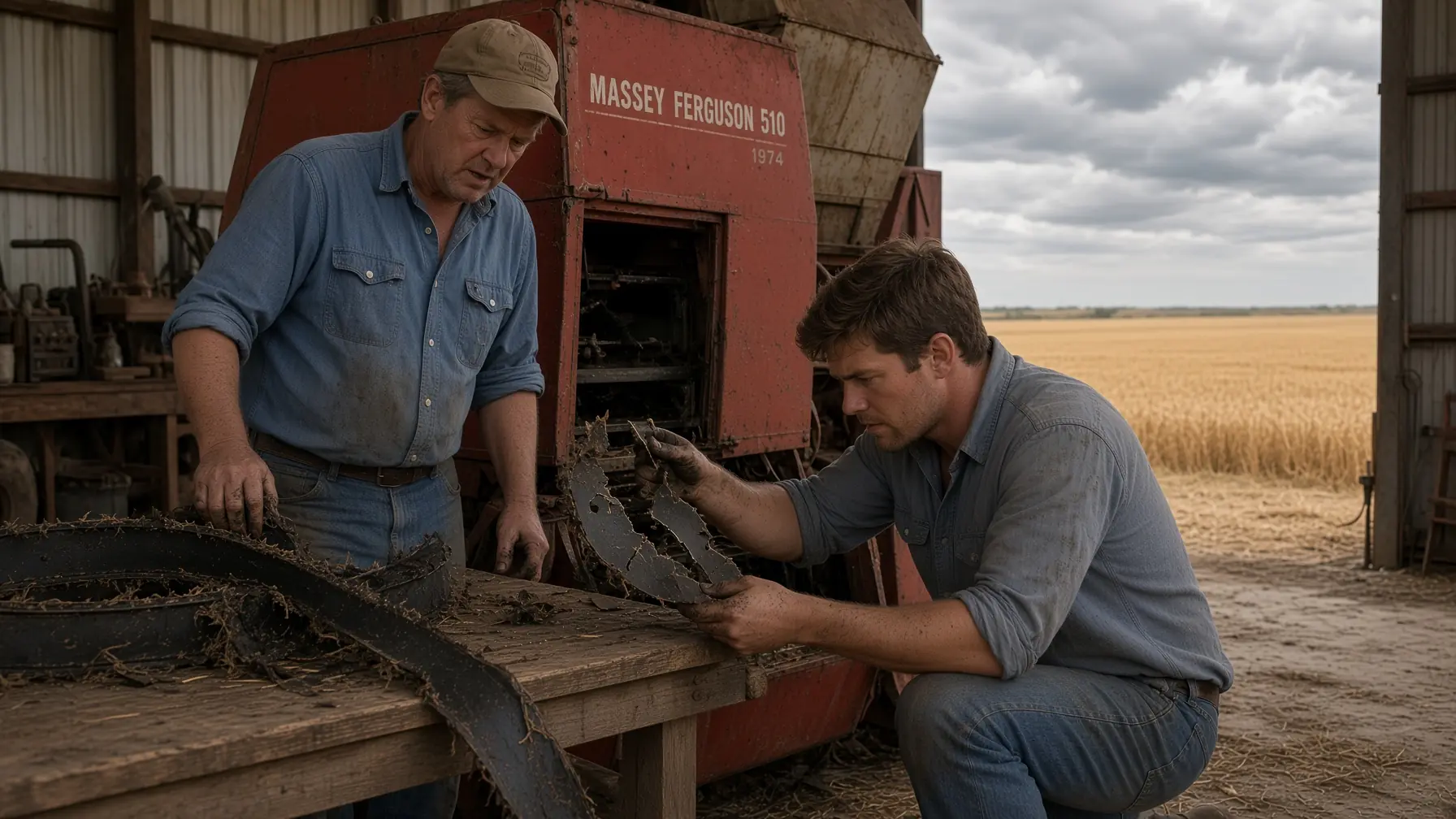
Norbert cut the throttle, shut the engine down, and sat inside the dusty cab for several seconds before climbing out. At sixty-three, he had spent enough years around farm equipment to know that dramatic failures were sometimes easier because they announced themselves clearly. Slow failures made a man think, and thinking during harvest usually cost more time than turning wrenches. He opened the feeder-house access panel and saw strands of shredded belt hanging where the main drive belt had once been.
The belt itself was not the problem that worried him. Belts were ordinary, and Norbert had changed enough of them on the 510 that he could almost perform the job without looking at the manual. What bothered him was the polished black wear along one side and the smell of overheated rubber around the pulley. Something had forced the belt to run wrong long enough to destroy it.
Norbert crawled underneath with a flashlight and a pair of wrenches. Dust stuck immediately to the sweat on his neck, and every movement reminded him that crawling beneath machines had been easier twenty years earlier. He worked for nearly two hours before finding side play in the main drive shaft and a cracked bearing race tucked behind the assembly. When he turned the shaft by hand, he could feel the roughness travel through his fingers.
The bearing number was still visible beneath grease and dust. Timken 07100S, Norbert wrote in the small notebook he carried in his shirt pocket. The shaft itself did not appear bent, but the bearing had allowed it to run off-center long enough to heat the belt and probably shorten the life of several belts before that one. Replacing the bearing meant pulling the shaft, and pulling the shaft meant removing the feeder house.
That changed the job completely. A belt could be replaced in the field, but the feeder house was heavy enough that Norbert wanted a loader or proper lifting arrangement, and the bearing race would likely need a press once the shaft was on the bench. He owned neither a hydraulic press nor enough time to improvise badly. The wheat had reached the stage where every day mattered.
The farm sat four miles south of Nickerson on flat ground that seemed to stretch until sky and field forgot where one ended. Norbert had farmed those four hundred and eighty acres since 1968, growing winter wheat on land his father had worked before him. The soil was not legendary Kansas black earth, and nobody from a seed company would have filmed a commercial there unless they needed an honest background. Norbert’s father had called the land reliable, which in their family was close to affection.
Reliability mattered because Norbert had never been wealthy enough to absorb many dramatic surprises. The Haas farm had survived drought, low wheat prices, equipment repairs, two interest-rate shocks, and one medical bill that took almost three years to pay. Norbert owned the ground free and clear by 1991, but cash still moved through the farm in narrow channels. A good harvest could repair several problems at once, while a bad one tended to invite new problems before the old ones left.
The 1974 Massey Ferguson 510 was part of that reality. Norbert bought it used in 1981 at an estate sale near Pretty Prairie for eleven thousand four hundred dollars after walking around it three times and listening to the engine longer than the auctioneer liked. It already looked old when he bought it, but its price fit his operation and its size fit his fields. For ten seasons it had cut nearly every acre he asked of it.
The hour meter showed a little over sixty-two hundred hours. Norbert suspected that figure was probably optimistic, but he had no better number and no reason to argue with a gauge that had been counting since Gerald Ford was president. The cab smelled of wheat dust, hydraulic fluid, sun-baked rubber, and the faint hot-metal odor that old combines acquired after thousands of hours. The original red paint had faded toward orange across the hood and nearly pink on the upper panels.
Norbert did not love the combine in the sentimental way people sometimes loved old tractors after they no longer depended on them. He respected it because it had paid for itself several times, and because most of its failures had occurred in ways he could understand. A broken chain could be replaced, a hydraulic fitting could be tightened, and a belt could be changed by lamplight after supper. The 510 remained useful because Norbert knew where to put his hands when something stopped.
This failure went deeper than his tools could conveniently reach. He spent another hour checking the shaft and confirming the bearing race had cracked rather than merely loosened. The pulley alignment was visibly wrong, and the shredded belt had been the final symptom rather than the first cause. By noon Norbert knew enough to admit he needed outside help.
He ate a sandwich standing beside the tailgate while studying the sky. High clouds had begun forming in the west, thin enough that they meant nothing yet but familiar enough that he checked the radio forecast before starting the truck. The local station said conditions should remain dry through Friday, with a strong chance of rain developing Saturday afternoon. Norbert turned the key and drove toward Nickerson.
The grain elevator maintained a payphone near the office because farmers were forever needing to call home, a dealer, a parts counter, or someone whose truck had disappeared. Norbert carried three phone numbers in his notebook and called Midwest Ag Equipment in Hutchinson first. The service writer recognized the model immediately. His reaction was not encouraging.
“We’re full through harvest,” the man said. Norbert asked whether they could make an emergency service call just to pull the feeder house and press a bearing. The man explained that three late-model combines were already waiting on major repairs, field-service technicians were working from before sunrise until well after dark, and taking another machine meant promising work they could not perform. “Honestly, on a 510, you might want to start thinking about replacement,” he added.
Norbert stared at the concrete wall beside the payphone. He knew the service writer was not insulting him, but the sentence still irritated him because replacement sounded simple only when someone else financed it. A ten-year-old combine in decent condition could cost more cash than Norbert wanted tied up in machinery, while something newer could easily require a loan large enough to follow him into retirement. “I’m not shopping today,” he said.
The second call went to a shop in Haven. Their service manager sounded more sympathetic but gave an even longer timeline. He had three combines already in the queue, one technician out with a back injury, and no available slot until mid-October. Norbert said the wheat would be either harvested or ruined by then.
“I know,” the manager replied. “I’m sorry.” Norbert believed him, which somehow made the problem no smaller. A shop could be honest, overworked, and completely useless to a farmer at the same time.
The third dealer was in Wichita. Norbert stood by the payphone through two transfers and several minutes of hold music played so poorly through the receiver that it sounded like a radio underwater. When the service writer finally returned, he said the original Timken 07100S bearing was no longer stocked through their normal agricultural supplier. They could order a cross-referenced replacement, but delivery inside three weeks could not be guaranteed.
Labor would be twelve hours if nothing else was damaged. At forty-eight dollars an hour, that placed labor alone at five hundred seventy-six dollars, plus travel, parts, and any additional repair discovered after disassembly. The bearing had to be prepaid before the dealer placed the order. Norbert wrote every number down.
He thanked the service writer, hung up, and remained beside the phone. A truck carrying corn rolled across the scale outside, its air brakes releasing with a sharp hiss. The elevator manager, Lee Harmon, stepped from the office and asked whether Norbert had found someone. Norbert shook his head.
Lee knew the Haas farm and knew what three wet days could do to mature wheat. He asked what the crop looked like, and Norbert said the last sample suggested around forty-two bushels per acre if the test strips represented the field honestly. At three dollars and forty cents a bushel, four hundred and eighty acres at that yield represented more than sixty-eight thousand dollars of gross crop value. Lee whistled softly.
“If Saturday rain hits hard, you could lose heads,” Lee said. Norbert nodded because wheat did not have to fall completely to cost money. Shattering, lodging, moisture changes, disease pressure, and quality deterioration could turn a profitable week into several smaller disappointments. Every percentage point of loss represented hundreds of dollars.
Lee asked whether Norbert could hire a custom cutter. Norbert said he would start calling, but harvest was beginning across several counties and most crews had their own contracts lined up. The nearest custom operator Lee knew had already committed equipment near Stafford. Norbert wrote down the number anyway.
He called from the payphone. The custom operator answered from somewhere windy enough that Norbert could barely hear him. The man had two machines committed through Monday and could possibly reach Nickerson Tuesday if nothing broke. Norbert looked at the weather forecast posted inside the elevator office and thanked him.
He returned to the pickup at three in the afternoon. His notebook contained prices, waiting times, phone numbers, and no solution. Norbert sat behind the steering wheel for several minutes without starting the engine. The grain elevator cast a long shadow across the lot.
He considered buying another combine. There were machines for sale within driving distance, including a 1978 John Deere 6600 someone near Lyons wanted twenty-eight thousand dollars for and a newer Massey dealer listing in Wichita at nearly twice that. Norbert had enough equity to borrow, but buying equipment during a breakdown three days before weather arrived was exactly how a farmer paid too much for the wrong machine. Desperation was rarely a good negotiator.
The bank would also ask questions. Norbert had an operating line with Prairie State Bank in Nickerson, and though his relationship with loan officer Frank Delaney was solid, adding tens of thousands in machinery debt before harvest settlement would require paperwork and explanation. Norbert could probably get approval. He hated that “probably” was even entering his thinking because of one bearing.
He drove home slowly. Dust lifted behind the truck along County Road 61 while combines already working farther south appeared as tiny moving shapes against the horizon. Every machine he saw reminded him that other farmers were cutting while his crop remained standing. He turned the radio off because the harvest reports irritated him.
Peg was sitting at the kitchen table when he came in. At fourteen, she kept a notebook of household expenses and had recently decided she was responsible for correcting her father whenever he left receipts in his shirt pockets. She looked at his face and asked, “How bad?” Norbert said, “Bad enough that you’re asking.”
Peg poured him coffee. Norbert explained the shops, the unavailable bearing, the labor estimate, and the weather. She listened more carefully than many adults did, then asked whether Carl knew. Norbert had not called him yet.
Carl Haas was twenty-three and working at the grain elevator in Hutchinson after two years in the Army. He had come home with no clear plan beyond earning money, helping when needed, and refusing to discuss whether military life had been good for him. Norbert sometimes worried Carl was drifting. Carl considered that an improvement over being ordered where to drift.
Norbert called the Hutchinson elevator shortly after five. Someone fetched Carl from the loading area, and his voice came through the farmhouse wall phone over the clatter of equipment in the background. Norbert described the bearing. Carl asked three questions before saying anything else.
“Is the shaft blue from heat?” he asked. Norbert said no. Carl asked whether there was measurable play at the pulley end. Norbert said enough to see. Carl asked whether the inner race had spun on the shaft.
“Doesn’t look like it,” Norbert replied. Carl said, “I’ll come out in the morning.” Norbert started to say he had work, but Carl had already told someone beside him that he needed Thursday off.
Carl arrived at seven the next morning in a blue pickup with one dented fender and a toolbox that had belonged to his grandfather. He wore work boots, an Army field jacket with the name tape removed, and the same expression he had worn as a teenager whenever he believed something could be fixed if everyone would stop talking long enough. Norbert led him to the combine. Carl crawled beneath the feeder house without saying hello to the machine.
He remained there almost thirty minutes. Norbert handed him different tools twice and listened while Carl rotated the shaft by hand. When Carl finally slid back out, dust had turned one side of his face brown. He sat on the concrete floor and said, “Bearing’s done, but the shaft looks straight.”
“You sure?” Norbert asked. Carl said no, because he had not measured it. “I’m sure enough not to buy a shaft before we pull it.”
Norbert appreciated the distinction. Carl said the feeder house needed to come off, the shaft needed to come out, and the race should be pressed rather than beaten from the housing with whatever large hammer happened to be available. Norbert asked whether he had a press. Carl answered, “Not yet.”
That was the first moment Peg laughed all morning. She had been standing near the shed door carrying a notebook because she claimed someone had to keep track of what the men were spending. Carl asked whether she planned to charge them accounting fees. Peg said she had not decided.
Carl drove back to Hutchinson before nine. He went first to Dennis Schuler’s machine shop on the south side of town, where he had helped pour a concrete floor three summers earlier in exchange for cash and all the hamburgers Dennis’s wife could cook. Dennis listened to the problem, pointed toward a twelve-ton hydraulic press, and said, “Bring it back before I forget you have it.” Carl asked what he wanted for rent.
Dennis looked offended. “You gave me three Saturdays in August.” Carl said that had been three years ago. Dennis answered, “Concrete’s still there.”
They loaded the press into Carl’s pickup. Dennis also lent him a micrometer, a bearing separator, and several pieces of heavy plate that might help support the assembly safely. Before Carl left, Dennis asked which bearing he needed.
“Timken 07100S.”
Dennis frowned. “Old.”
“Discontinued, apparently.”
“Everything good gets discontinued.”
Carl smiled. “You sound seventy.”
“I feel eighty.”
The bearing became the next problem. Carl stopped at two supply counters in Hutchinson and found neither original stock nor the replacement listed in their catalogs. One clerk recommended calling Wichita Bearing and Power Transmission because they supplied industrial customers rather than only farm dealerships. Carl used the shop phone at Dennis’s place.
The first supplier transferred him twice. The second had nothing. The third gave him a cross-reference number Carl wanted to verify before buying.
At home, Norbert waited near the wall phone. The sky had cleared after dawn, and the wheat looked ready enough that he could almost hear money drying in the field. He checked the forecast every hour even though the forecast did not change. Saturday rain probability increased from fifty to sixty percent.
Peg found him looking through old parts manuals. “Dad, staring at weather doesn’t stop it,” she said. Norbert answered, “I know.” She replied, “Then you’re doing a convincing imitation of someone who thinks it might.”
At eleven, Carl called. He had confirmed the original 07100S could cross to a currently produced Timken 02877 assembly suitable for the application after checking dimensions rather than trusting one listing blindly. A Wichita industrial bearing house had three on the shelf for thirty-four dollars each. Carl told them to hold two.
“Why two?” Norbert asked. Carl said, “Because if we drive forty miles for one thirty-four-dollar bearing and discover we need another, I’ll feel stupid longer than the second bearing will sit on a shelf.” Norbert approved that logic.
Carl drove to Wichita. The trip took most of the middle of the day because road construction slowed traffic outside the city and the supply house had paperwork ready under the wrong Haas. He returned shortly before two with two bearings, a receipt, and a bag of hamburgers Peg claimed was the most useful thing anyone had brought to the farm. Norbert asked what they had spent so far.
“Sixty-eight on bearings,” Peg said from her notebook. Carl added that Dennis wanted nothing for the press. Peg wrote PRESS — $0 with enough emphasis to make the number look suspicious.
Removing the feeder house required more planning than force. Norbert positioned his International 574 loader where the bucket could support part of the weight, while Carl used a come-along and chain arrangement to control movement. They disconnected hydraulics, removed the drive chain, marked alignment positions, and supported the assembly before loosening primary mounts. Carl refused to hurry even while Norbert checked his watch repeatedly.
“Wheat doesn’t care how neat this looks,” Norbert said. Carl answered, “Neither does gravity.” Norbert stopped looking at his watch.
The feeder house came free in roughly ninety minutes. They lowered it onto blocking inside the shed, where Carl could work without crawling through dirt. Peg brought water and watched from far enough away to avoid being recruited. Norbert cleaned around the shaft while Carl organized tools.
The damaged race looked worse once removed from load. Cracking had progressed along one side, and the wear pattern around the assembly clearly showed the shaft had not been running concentrically. Carl pointed to the polished edge. “That belt didn’t die Wednesday,” he said.
Norbert knew exactly what he meant. He had replaced four feeder-drive belts over the previous two harvests and blamed dust, age, cheap rubber, and his own tendency to run the machine hard during hot afternoons. Each belt had been a symptom. The bearing had been slowly teaching him something he had not understood.
Carl removed the shaft carefully and wiped it clean. He examined the surface under bright light, then measured several points with Dennis’s micrometer. The first reading was 0.9997 inch. The second was effectively the same.
“Spec’s one inch,” Carl said. Norbert asked whether three ten-thousandths mattered. Carl shook his head and said normal tolerances and wear still left enough material for proper seating if the rest of the shaft remained true. They checked for obvious runout using the best setup available in the farm shop and found nothing that suggested replacement.
Pressing the old race out took twenty minutes. It fought harder than Carl expected, enough that he stopped once and reset the support because he disliked how the assembly had shifted. Norbert suggested more pressure. Carl said, “More pressure on something sitting wrong just breaks it faster.”
Norbert heard his own father in the sentence. He said nothing. The second setup moved the race cleanly.
The new bearing seated in less time. Carl pressed it steadily, checking alignment rather than driving it by feel. When it reached position, he ran one finger around the edge and rotated the shaft. Smooth movement returned.
Norbert expected relief. Instead, Carl looked at the mounting points. “Something’s still wrong.”
Norbert frowned. “We found the bearing.”
“We found what failed.”
Carl pointed toward a wear mark near one side of the mounting bracket. The pattern suggested the shaft assembly had been running slightly out of alignment even before the bearing deteriorated badly. He did not yet know whether that came from wear, an old repair, frame distortion, or original tolerance. With rain approaching, they did not have time to turn a bearing replacement into an engineering investigation.
Carl measured what he could. The misalignment was slight enough that the replacement would likely operate through harvest if assembly remained careful. He told Norbert they should revisit it after the season. Norbert wrote CHECK SHAFT ALIGNMENT AFTER HARVEST in the maintenance notebook.
That evening, neighbors began calling. News moved through farming communities faster than weather radio because everyone wanted to know whose machine had stopped and whether the failure might happen to theirs. Cal Richardson, who farmed west of Nickerson, offered his older combine if he finished his own ground first. Norbert thanked him but knew Cal still had more than six hundred acres ahead.
Another neighbor, Warren Bell, offered to come help with the feeder house. Carl said they had enough hands. Norbert appreciated the offer anyway.
Not everyone was optimistic. A farmer named Lester Wade stopped by for parts and looked at the disassembled Massey. He said, “You’re pouring time into a seventeen-year-old machine.” Norbert answered, “We’ve poured about sixty-eight dollars so far.”
Lester said a machine with sixty-two hundred hours could fail somewhere else tomorrow. Norbert agreed. That seemed to disappoint him.
“You should buy newer,” Lester said. Norbert asked whether Lester planned to lend him the money. Lester laughed and changed the subject.
That evening Frank Delaney from Prairie State Bank called. Word had reached him that Norbert’s combine was down, and he wanted to know whether the farm might need temporary credit for custom harvest or equipment replacement. Norbert appreciated the proactive call even while resenting that his machine failure had become a banking topic before supper. He said they were repairing it.
Frank asked whether Norbert wanted a line increase approved just in case. Norbert considered saying no out of pride. Then he remembered the weather.
“Prepare it,” he said. “Doesn’t mean I’ll use it.” Frank answered, “That’s usually the best time to arrange credit.”
Norbert slept badly Thursday night. He dreamed the wheat had turned black while he searched for a wrench that kept changing size. At four-thirty he gave up, dressed, and walked to the machine shed.
Carl was already there. He had slept on the sofa because driving back to Hutchinson made no sense. Norbert asked why he was awake.
“Same reason you are.”
They started before six. Reinstalling the feeder house took longer than removing it because every connection needed to return without forcing alignment. Carl used the loader and come-along to raise the assembly in small increments while Norbert guided mounting points. They worked without music, radio, or unnecessary conversation.
By eight-thirty, primary mounts were installed. Carl reconnected the hydraulic lines and checked them twice. The chain drive went back on next.
The replacement belt came from the Nickerson farm-supply store. The exact agricultural listing was not in stock, but Carl had measured and confirmed a Gates B78 matched the required dimensions closely enough for the application. The belt cost twenty-two dollars. Peg wrote the total repair cost as ninety dollars before correcting herself that fuel for the Wichita trip had not been included.
Carl told her to leave fuel out because they would have driven somewhere that week anyway. Peg said, “That’s not accounting.” Norbert said, “She’s going to run a bank someday.”
The feeder house was mechanically assembled by ten-thirty Friday morning. Carl refused to attach the header immediately. He wanted to run the drive unloaded first and listen for anything abnormal.
Norbert climbed into the cab and started the combine. The diesel settled into its familiar rough rhythm. Carl stood beside the feeder house with one hand resting carefully against the casing where he could feel vibration without exposing himself to moving components.
“Bring it up slow,” he called. Norbert increased speed gradually. The feeder drive turned.
They let it run for twenty minutes. Carl checked bearing temperature repeatedly and listened from several positions. Nothing heated abnormally, no vibration increased, and the belt tracked correctly.
He shut the machine down. Norbert asked, “Ready?” Carl said, “For the header.”
They mounted it. Another twenty-minute test followed. Carl remained cautious enough that Norbert wanted to argue and grateful enough that he did not.
By eleven-fifteen, Norbert drove toward the field. Peg followed in the pickup with a grain sample container because the elevator moisture test had not been updated since Monday. Carl rode on the combine platform until Norbert told him to get off before somebody saw them breaking enough rules to cancel the repair’s good luck. Carl jumped down and followed in his truck.
The first pass was only a test. Norbert lowered the header just below the heads and eased forward. Wheat entered cleanly.
The feeder house pulled without hesitation. The cylinder accepted the crop. Grain began appearing in the tank.
Norbert felt the vibration through the seat. Every farmer learned a machine’s normal rhythm by spending enough years inside it, and the 510 sounded better than it had the previous season. He realized that almost immediately.
Peg took a grain sample at the end of the pass. The portable moisture meter read 13.2 percent. She tested twice because Norbert had taught her never to trust one reading when money depended on it.
“Cutting moisture,” she said. Norbert looked west. Clouds remained thin.
“Then we cut.”
He did not begin with four hundred and eighty acres in his mind. Thinking about total acres made every pass feel too small. He thought about the first round, then the second, then the grain tank filling.
The tank reached capacity in roughly twenty-three minutes. Norbert swung the unloading auger over the wagon staged at the field edge. Golden wheat poured through the air in a steady stream.
Carl stood beside the tractor watching the feeder house rather than the grain. He listened for belt slap, watched pulley tracking, and checked the bearing after the combine stopped. Everything looked normal.
“Go,” he told Norbert.
The machine ran north to south across the field in twenty-two-foot passes. Dust streamed behind it. Afternoon temperature climbed into the eighties.
By three, Norbert had stopped checking the repaired bearing every pass. By four, Carl had stopped expecting it to fail. The 510 kept working.
The first new problem appeared at four-thirty when the unloading auger chain began jumping. Norbert felt his stomach drop because one repair often seemed to invite unrelated failures simply to test a man’s sense of humor. Carl found the chain slightly loose rather than damaged.
They adjusted tension in twenty minutes. Norbert said, “If you tell me that’s related to the bearing, I’m selling the machine.” Carl answered, “It’s related to being old.”
Norbert looked at him. “So am I.” Carl said, “You make different noises.”
They kept cutting.
By sunset the field looked transformed. Long rows of stubble replaced standing wheat, and loaded wagons cycled toward temporary storage because Norbert did not want to lose time waiting at the elevator. Peg recorded estimated bushels and kept everyone supplied with sandwiches.
At seven-thirty, Cal Richardson arrived after finishing his own day. He brought another wagon and offered to haul. Norbert started to refuse.
Cal said, “You can repay me next time my machine dies.” Norbert nodded. Farm favors were debts only if people insisted on pretending they were not.
They ran until nine. Dew settled enough that moisture began climbing past fourteen percent and straw changed character through the machine. Norbert stopped rather than forcing another two hours that could cost quality.
The acreage tally surprised him. They had cut roughly three hundred and forty acres. Carl said the machine had earned the second bearing they bought even though it remained unopened on the workbench.
Norbert climbed down slowly. His back hurt from twelve hours in the seat, and his hands still vibrated after touching the machine all day. Carl handed him water.
“Hundred forty left,” Carl said. Norbert looked west. Lightning flickered faintly near the horizon.
“Tomorrow.”
They checked the feeder-house bearing before leaving. Temperature was normal. Belt wear looked even.
Carl stood with his flashlight inside the open access panel. “This is running better than before the failure.” Norbert nodded.
He had noticed too.
That bothered him in a useful way. The combine had been warning him long before Wednesday, but gradual deterioration had become normal because it happened slowly enough for Norbert to adjust his expectations. Machines could teach owners to tolerate problems one small change at a time.
Saturday began at five. Norbert ate eggs while listening to the forecast. Rain was expected by late afternoon, possibly earlier if the system accelerated.
Peg asked how much time they needed. Norbert said eight hours if nothing broke. Everyone at the table understood the dangerous part of that sentence.
They were in the field before six. Morning air was cool enough that the engine seemed happier, and wheat moisture held below fourteen percent after the sun rose. Carl followed during the first rounds.
By eight, he drove to Hutchinson because his supervisor had already given him more time off than expected. Norbert told him to go. Carl hesitated.
“If it breaks?” Carl asked. Norbert pointed toward the farmhouse. “Phone still works.”
Carl looked at the combine. “You sure?” Norbert said, “You fixed it.”
That sentence mattered more to Carl than Norbert realized. He nodded and drove away.
The first two hours went smoothly. Peg hauled samples. Cal moved grain with his extra wagon.
At ten-twenty, a dark band of clouds became visible southwest of the farm. Norbert watched it through dusty cab glass. The radio forecast had moved arrival time earlier.
He increased speed slightly. Not enough to overload the machine, but enough that the urgency became visible. The Massey responded.
By eleven, less than sixty acres remained. Wind began changing direction. Wheat heads moved in broad waves across the final field.
Norbert remembered another harvest in 1973 when a storm arrived before his father finished. They lost nearly a quarter of one field to lodging and shattering before they could return. His father spent two weeks pretending not to be angry at weather.
Norbert understood that anger now. Weather never apologized. It simply changed the math.
At noon, thunder became audible. Cal radioed that they had one wagon empty and one nearly full. Peg stood at the field edge watching the sky.
Norbert made another pass. The feeder house never hesitated.
At one-fifteen, twenty acres remained. Dust turned darker beneath the thickening clouds. Temperature dropped.
Norbert kept cutting.
At one-forty, the final strip disappeared beneath the header. He raised the cutter bar at the field edge and let the machine clear itself before slowing the cylinder. Peg threw both arms into the air.
Cal honked the tractor horn. Norbert smiled inside the cab.
He did not feel triumphant yet. Grain still needed safe storage, wagons needed unloading, and a combine full of dust had several hot components that deserved inspection before weather hit. Farmers rarely celebrated until machinery was parked.
The first drops arrived at four-twenty. Norbert stood inside the machine shed while rain tapped the metal roof above him. The 510 sat nearby ticking as the engine cooled.
Carl arrived twenty minutes later. His supervisor had let him leave early when the storm reached Hutchinson. He walked into the shed soaked at the shoulders.
“Finished?”
“One-forty.”
Carl looked outside at the rain. “Close.”
Norbert nodded. “Close enough.”
The rain intensified before five. Water ran across the yard in thin sheets while wind pushed it against the shed doors. Norbert imagined four hundred and eighty acres of standing wheat taking that punishment and felt physically ill despite knowing the grain was already safe.