The strawberry milkshake hit Grant Holloway just below the left ear.
Cold first.
Then sticky.
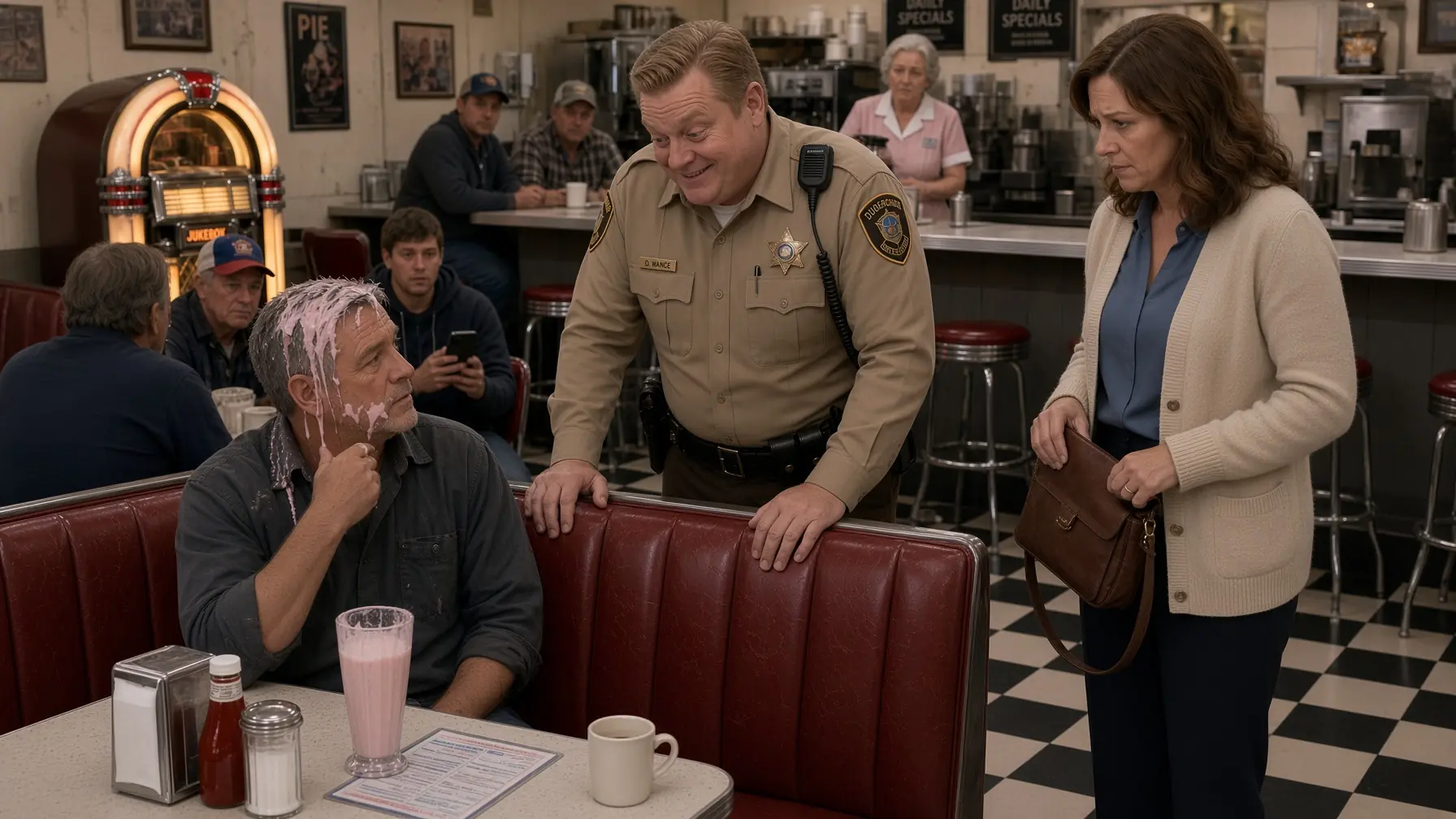
It ran beneath the collar of his faded work shirt, across the back of his neck, and down between his shoulder blades.
A piece of strawberry slid from his gray hair and landed beside his coffee cup.
The Rusty Spoon diner went silent.
Forks stopped.
Someone near the counter whispered:
“Jesus.”
The jukebox kept playing an old George Strait song as though nothing unusual had happened.
Grant did not move.
Sheriff Wade Reddick stood beside the booth holding an empty glass upside down.
Six-foot-two.
Two hundred forty pounds.
Heavy through the waist.
Right shoulder slightly lower than the left.
Old knee problem, probably.
Weight carried too far forward.
Grant noticed all of it automatically.
Thirty years earlier, those details might have determined whether a man went home alive.
Now they merely told him that Sheriff Reddick would fall badly if somebody swept the wrong leg.
Grant looked up.
Wade smiled.
“Well.”
He turned toward the diner.
“Looks like Holloway finally got some color.”
Nobody laughed at first.
Then three people did.
Quietly.
Nervously.
Not because Wade was funny.
Because Wade Reddick had been sheriff of Mercer County for thirteen years.
His cousin ran county inspections.
His brother-in-law chaired the zoning board.
One of his oldest friends owned the towing company used by the sheriff’s department.
People around Hawthorne, Colorado, had learned that refusing Wade small things sometimes created large inconveniences.
A building permit disappeared.
A traffic stop lasted forty minutes.
A business suddenly received three inspections in one week.
Nothing dramatic enough to prove.
Everything obvious enough to understand.
Grant wiped milkshake from his cheek with a napkin.
Across from him sat his wife.
Claire.
Forty-nine.
Brown hair streaked with gray.
The woman who had slept beside him through nightmares he never explained completely.
The woman who knew he had served twenty-four years in the Navy.
Knew he had been deployed repeatedly.
Knew there were medals in a locked box Grant never displayed.
Knew he had retired three years earlier with enough scars to predict weather better than most local forecasts.
She did not know everything.
Almost nobody did.
But she knew enough that Grant expected one thing from her.
Not violence.
Not outrage.
Just:
Stop.
Instead Claire lowered her eyes.
“Grant.”
Her voice was quiet.
“Please.”
Grant stared.
She continued:
“Why do you always make things worse?”
That hurt.
More than the milkshake.
More than the laughter.
More than Sheriff Wade Reddick putting one hand on the edge of their table like he owned the diner too.
Grant had spent half his adult life entering rooms where men wanted him dead.
He had been shot at in countries Claire could not find on a map.
He had once held pressure on a teammate’s femoral artery for twenty-three minutes while a helicopter fought through dust to reach them.
He understood fear.
He understood humiliation.
But betrayal was harder to train for.
Wade leaned closer.
“You got something to say, mechanic?”
That was what the town called Grant.
The mechanic.
He had bought a failing two-bay garage after retirement because fixing engines gave his hands something peaceful to do.
He worked three days a week.
Charged old people less than he should.
Restored an International Scout in the back bay.
Never corrected anybody who assumed he had spent his whole life under trucks.
Grant looked at Wade’s face.
Then the right hand resting near the sheriff’s belt.
He could put the man on the floor before Wade understood the fight had started.
He knew that with the calm certainty of knowing his own birthday.
But Grant had learned something more useful than fighting.
The man who makes you angry is sometimes asking you to make his case for him.
So Grant took another napkin.
Wiped his neck.
And said:
“No.”
Wade’s smile widened.
“No?”
“I’m done eating.”
Grant stood.
Claire grabbed her purse.
“I’ll wait in the truck.”
She walked toward the door.
Grant watched her.
That was when he saw it.
As Claire passed Wade, the sheriff gave her a tiny nod.
Barely visible.
Claire’s eyes dropped.
Her right hand tightened around the strap of her purse.
Then she continued outside.
Grant stopped breathing for half a second.
The milkshake was public.
The nod was private.
And private things were usually more important.
He put twenty dollars on the table.
Wade said:
“That covering your meal or the cleanup?”
Grant looked at him.
“Both.”
Then walked out.
Three years earlier, Grant Holloway had retired from a Navy career that officially looked less interesting than it had actually been.
His public record listed logistics assignments.
Training commands.
Special warfare support.
Several deployments.
Senior enlisted leadership.
Enough to explain the ribbons.
Not enough to explain why parts of his service history contained language such as:
Assignment details withheld.
Or why certain former colleagues addressed him as Master Chief despite Grant insisting everyone call him Grant.
For nearly fifteen years, he had served inside a joint special operations organization whose name almost never appeared in his hometown newspapers.
He was not a superhero.
That irritated him when civilians spoke about special operators as though they were.
He had been a professional.
A very well-trained one.
Planning.
Reconnaissance.
Direct-action support.
Sensitive recoveries.
Hostage situations.
Years of practicing how not to panic when everyone else had a reason to.
Most missions remained classified.
Some probably always would.
Grant had no desire to talk about them.
The quiet after retirement felt like oxygen.
He bought a small property outside Hawthorne.
Opened Holloway Automotive.
Married Claire, whom he had known since high school and reconnected with after his final deployment cycle.
She knew he had lived a hard life.
She knew he hated fireworks.
She knew he sat facing restaurant entrances without thinking.
She knew he sometimes woke at 3:00 a.m. and checked every door in the house.
But Grant never gave her mission names.
Never described targets.
Never turned classified memories into bedroom stories.
Claire once asked:
“Were you some kind of SEAL?”
Grant answered:
“I worked around people who hated that question.”
She laughed.
That was enough.
Until Hawthorne.
The problem with Wade Reddick had begun six months before the milkshake.
Grant’s garage sat on three acres near the county road.
Behind it was an old service lane leading to a gravel pit and two abandoned storage buildings.
The lane belonged to Grant.
He knew because he had read every line of the title before buying the property.
One morning, he arrived to find a sheriff’s SUV parked behind the garage.
A deputy was transferring several sealed boxes from an unmarked pickup into a county evidence van.
Grant walked over.
“Morning.”
Deputy Ellis North turned.
Young.
Maybe twenty-six.
Nervous.
“Morning.”
“What are you doing?”
“Sheriff’s business.”
“On my land?”
Ellis looked toward the service lane.
“We use this access sometimes.”
“Who gave permission?”
The deputy hesitated.
“I don’t know.”
Grant nodded.
“Find out before using it again.”
Ellis gave an awkward smile.
“I’ll mention it.”
Grant went to work.
He thought the matter was finished.
It was not.
Three days later, Sheriff Wade Reddick came personally.
“You giving my deputies trouble?”
Grant continued changing brake pads on a Subaru.
“No.”
“They say you told them they can’t use that lane.”
“That’s correct.”
Wade laughed.
“It’s a road.”
“It’s my road.”
“We’ve used it twenty years.”
“Then you’ve trespassed for twenty years.”
The laugh disappeared.
“You new people come in here and think paperwork means everything.”
Grant slid from beneath the Subaru.
“I’ve been here three years.”
“Exactly.”
“My family’s been in this county since 1948.”
Grant wiped his hands.
“Congratulations.”
Wade stared.
“What are you hiding back there?”
Grant almost smiled.
“Apparently your deputies.”
That conversation ended badly.
Not with threats.
Wade was too experienced for obvious threats.
He simply said:
“You’ll learn how things work around here.”
Grant answered:
“I usually start with the deed.”
The inspections began two weeks later.
Fire code.
Environmental.
Waste oil.
Zoning.
Signage.
Building use.
Grant passed all of them except one minor labeling issue on a used-oil tank.
He corrected it that afternoon.
Then the towing contracts changed.
Customers whose cars broke down inside sheriff jurisdiction were suddenly directed toward another garage.
Grant noticed.
Said nothing.
Then Claire began acting differently.
She asked whether they should sell.
Grant laughed the first time.
“Sell what?”
“The shop.”
“Why?”
“It’s too much stress.”
“It’s a garage.”
“You know what I mean.”
“No.”
She stopped there.
Two weeks later:
“Maybe Wade isn’t someone you should antagonize.”
“I’m not antagonizing him.”
“You told his deputies they couldn’t use the lane.”
“They can’t.”
Claire turned away.
“This is exactly what I mean.”
Grant studied her.
“Has he spoken to you?”
“No.”
Too fast.
Grant noticed.
He did not press.
Not yet.
After the diner humiliation, Claire was already inside their truck when Grant came outside.
He opened the driver’s door.
She said:
“Please just take me home.”
Grant sat.
Closed the door.
Did not start the engine.
Claire looked straight ahead.
“What was that?”
“What was what?”
“The nod.”
Nothing.
Grant waited.
Claire’s breathing changed.
He knew enough about interrogation to know silence made people reveal what questions sometimes concealed.
After twenty seconds, Claire said:
“Start the truck.”
Grant did not.
“Claire.”
“Please.”
“What does Wade have on you?”
Her head snapped toward him.
That answered more than words.
Grant remained calm.
“Money?”
“No.”
“Affair?”
Her face changed.
Not guilt.
Insult.
“No.”
“Family?”
She looked away.
Grant’s voice softened.
“Your brother.”
Claire began crying.
Her younger brother, Daniel, had struggled with alcohol since his divorce.
Two DUIs.
One probation violation.
Grant had helped him find treatment the previous year.
“What happened?”
Claire wiped her eyes.
“Daniel got pulled over again.”
“When?”
“Three months ago.”
Grant stared.
“You didn’t tell me.”
“He wasn’t driving drunk.”
“Then what?”
“He had pain pills in the truck.”
“Prescription?”
“Expired.”
“His?”
“Yes.”
“Anything else?”
Claire hesitated.
“There was a handgun under the seat.”
Grant closed his eyes.
Daniel was prohibited from possessing firearms because of an earlier felony conviction.
That was serious.
Claire continued.
“Wade called me.”
“Personally?”
“Yes.”
“He said Daniel could go back to prison.”
“That may be true.”
“He said maybe it didn’t have to become a big case.”
Grant went still.
“What did he want?”
“At first?”
“Yes.”
“He wanted you to stop complaining.”
“About the lane?”
She nodded.
“Then he wanted me to tell him if you were talking to lawyers.”
Grant stared through the windshield at the diner.
Inside, Wade could still be seen laughing beside the counter.
“What else?”
Claire whispered:
“He asked about your safe.”
Every muscle in Grant’s body tightened.
“What safe?”
“The one in your study.”
“What did you tell him?”
“That I don’t know the combination.”
“True.”
“Yes.”
“What does he think is inside?”
“I don’t know.”
Grant did.
Not exactly.
But enough.
Old service records.
A secure encrypted drive containing personal documents.
His retirement papers.
A few letters from men he had served with.
Nothing classified.
Nothing illegal.
But Wade’s interest in the safe suggested the sheriff had moved beyond neighborhood intimidation.
“Anything else?”
Claire began crying harder.
“He told me you weren’t who you said you were.”
Grant looked at her.
“He said he ran your name and parts were missing.”
“That is not unusual.”
“I didn’t know that.”
“You could have asked me.”
“I was scared.”
Grant leaned back.
The anger came.
Cold.
Precise.
He wanted to say:
You should have trusted me.
Instead he asked:
“Why did you nod?”
Claire wiped her cheek.
“He told me this morning that if you embarrassed him again, Daniel’s case would go to the district attorney.”
“Again?”
“You complained about the inspection vehicles.”
Grant remembered an email he had sent asking county employees not to park on his private service lane.
Claire continued:
“He said if you stayed quiet at lunch, maybe Daniel’s problem stayed small.”
“So when he poured the milkshake—”
“I wanted you to let it go.”
Grant looked at his wife.
“You thought that was the price.”
She nodded.
He understood.
Did not forgive.
Not yet.
But understood.
Grant started the engine.
Claire whispered:
“Where are we going?”
“Home.”
“And then?”
Grant looked through the diner glass at Wade.
“Then I verify everything.”
At home, Grant opened the safe.
Claire watched from the doorway.
He removed a black binder.
A small encrypted drive.
A photograph of six men standing in front of a helicopter somewhere dusty.
Then an old business card.
COMMANDER JULIAN HAYES
JUDGE ADVOCATE GENERAL’S CORPS
Grant had not spoken to Julian in four years.
He dialed.
The call connected on the fifth ring.
“Hayes.”
“Julian.”
Silence.
Then:
“Who is this?”
“Grant Holloway.”
Another silence.
Longer.
“You’re alive.”
Grant smiled faintly.
“Last I checked.”
“I heard you disappeared into Colorado.”
“Retired.”
“Same thing for you.”
Julian’s tone changed.
“What happened?”
Grant did not say:
A sheriff poured a milkshake over me.
That sounded ridiculous without context.
Instead:
“I may have a county sheriff attempting to coerce my wife through her brother’s criminal exposure.”
Silence.
Then:
“Start at the beginning.”
Grant did.
The service road.
Sheriff vehicles.
Inspections.
Towing pressure.
Daniel.
The safe.
The diner.
Julian interrupted only twice.
When Grant finished, Julian said:
“Do not contact anyone from your old command.”
“I wasn’t planning to.”
“Good.”
“Do not imply federal authority you don’t have.”
“I know.”
“Do not tell this sheriff anything about your past.”
“Wasn’t planning that either.”
Julian paused.
“Do you have documentation?”
Grant looked at the desk.
“Some.”
“Then your job is not to remind anyone who you were.”
“What is it?”
“Prove what he is doing now.”
That sentence settled Grant.
Exactly.
He had called because Julian always separated ego from mission.
Grant said:
“Where do I start?”
“Your wife writes everything down tonight.”
“Dates.”
“Calls.”
“Exact language if she remembers it.”
“Your brother-in-law gets his own criminal attorney.”
“Independent.”
“Not somebody recommended by the sheriff.”
“Then we determine whether any official records were altered, delayed, or used as leverage.”
Grant nodded.
Julian continued:
“And Grant?”
“Yes?”
“If Wade Reddick really accessed restricted military information improperly, do not chase that yourself.”
“Why?”
“Because then it stops being a local corruption problem.”
Daniel’s attorney discovered the first major irregularity.
There had been a traffic stop.
There had been pills.
There had been a firearm.
But no formal arrest.
No evidence booking for the handgun.
No charging referral.
Only an incident number marked:
pending supplemental investigation.
Three months pending.
Daniel had effectively been left in legal limbo.
Enough danger to scare Claire.
Not enough process for an attorney to challenge.
The attorney, Monica Reyes, said:
“That is unusual.”
Grant asked:
“Illegal?”
“I didn’t say that.”
“Good.”
She continued:
“But if a sheriff is holding possible charges over a family member to influence unrelated behavior, that is another matter.”
Claire sat beside Grant.
Pale.
Monica asked:
“Did Sheriff Reddick ever explicitly say he would help Daniel if Grant cooperated?”
Claire thought.
“Yes.”
“When?”
“In my car outside the grocery store.”
“Anyone else there?”
“No.”
“Recording?”
“No.”
“Text?”
“No.”
Monica nodded.
“Then we treat it as an allegation.”
Grant liked her immediately.
No exaggeration.
No magic evidence.
Facts where facts existed.
Unknown where they didn’t.
Grant began documenting.
He had done it professionally for decades.
Observation was boring until survival depended on it.
Every county vehicle entering his property.
Every inspection.
Every notice.
Every tow referral that changed.
He requested public records.
Towing contracts.
Inspection logs.
Incident reports.
County vehicle GPS records where obtainable.
Board minutes.
Campaign finance filings.
Claire documented every contact with Wade.
Then something unexpected appeared.
Grant was not the only business owner having trouble.
A body shop owner named Hector Ruiz had lost sheriff referrals after refusing to donate to a reelection event.
A restaurant owner had received repeated occupancy inspections after publicly criticizing Wade.
A rancher had been threatened with nuisance enforcement during a property-line dispute involving Wade’s cousin.
None of these stories proved a criminal scheme.
Together they deserved attention.
Julian connected Grant with a former federal public-corruption prosecutor named Lena Price.
She listened.
Then asked:
“Why is Wade interested in your military history?”
“I don’t know.”
“What does he think you have?”
“No idea.”
“Has he tried to search your property?”
“No.”
“Threatened a warrant?”
“Not directly.”
Lena looked at Grant.
“What are you not telling me?”
Grant smiled slightly.
“You were a prosecutor.”
“Yes.”
“I was something that trained me not to answer broad questions.”
She almost smiled.
“What did you do in the Navy?”
“Special operations.”
“How special?”
“Special enough that some assignment records are not public.”
Lena’s expression changed.
“That could explain why a small-town sheriff running database queries sees gaps.”
“Yes.”
“Would those gaps give him a reason to believe you were criminal?”
“No.”
“Could he misuse law-enforcement databases trying to fill them?”
“That’s what Julian wondered.”
Lena tapped her pen.
“Then we check legally.”
The investigation widened quietly.
Not because Grant called old commandos.
Not because helicopters arrived.
Because database systems logged access.
Queries left trails.
A state inspector found that Wade’s credentials had been used to run Grant through several systems unrelated to any documented criminal investigation.
Then another query.
Then another.
One requested information that local law enforcement had no obvious operational reason to seek.
That brought federal attention.
Not Grant’s old unit.
The Department of Justice Office of Inspector General became interested because one database inquiry had crossed into a restricted federal records system through a law-enforcement portal.
Grant’s past became relevant for exactly one reason:
Someone had gone looking for it without a documented case.
The irony amused him.
Wade wanted to discover whether Grant possessed hidden power.
By searching for it improperly, he created evidence of his own misuse of power.
Wade noticed pressure changing.
Grant knew because the harassment stopped.
No more inspections.
No sheriff vehicles on the service road.
No calls to Claire.
For nearly three weeks, nothing happened.
That worried Grant more.
Then Wade came to the garage alone.
Grant was rebuilding a carburetor.
The sheriff walked inside.
“No cameras?”
Grant looked toward the corner.
“Security system records continuously.”
Wade’s eyes flicked toward it.
Good.
Grant had lied.
The system recorded motion, not continuously.
But Wade did not know that.
The sheriff leaned against the workbench.
“You've been making noise.”
“Have I?”
“Records requests.”
“Legal.”
“Talking to people.”
“Also legal.”
Wade smiled.
“You think you’re clever.”
“No.”
“I think I’m organized.”
Wade looked around.
“Claire told me you used to be some kind of Navy mechanic.”
Grant continued working.
“She told you that?”
“Everybody knows.”
“Okay.”
“But your record’s weird.”
Grant stopped.
Finally.
“Why were you looking?”
The sheriff realized the mistake.
Too late.
“Routine.”
“Routine for what investigation?”
Wade smiled again.
“You ask too many questions.”
Grant returned to the carburetor.
“You should meet my lawyer.”
“I don’t need a lawyer.”
“Everybody eventually does.”
Wade stepped closer.
“You think your old military friends are going to ride in here and save you?”
Grant looked up.
“No.”
“Then what’s your plan?”
Grant thought about telling him.
About twenty years of operational planning.
About rooms entered in darkness.
About waiting eighteen hours for one target to make one predictable mistake.
About missions where patience mattered more than firepower.
Instead:
“I’m fixing a carburetor.”
Wade laughed.
“You really are just a mechanic.”
Grant smiled.
“Yes.”
“That should worry you more than it does.”
The first search warrants were served six weeks later.
Not at Grant’s garage.
At the sheriff’s administrative offices.
At the county towing contractor.
At the home of Wade’s campaign treasurer.
Computers.
Financial records.
Phone backups.
Grant learned about it from the news like everyone else.
Claire stood in their kitchen holding her coffee.
“Is this because of us?”
“Partly.”
She looked at him.
“What did you do?”
“I made phone calls.”
“That’s all?”
“Mostly.”
She stared.
Grant understood the question beneath the question.
Who are you?
He had avoided it for years.
Not because he distrusted her.
Because some identities become armor.
He had spent three years trying to take his off.
That evening, Grant opened the safe again.
He removed the photograph.
Six men.
Desert.
Helicopter.
Faces younger.
Two were dead now.
He handed it to Claire.
“That’s me.”
She looked.
Grant was barely recognizable.
Lean.
Dark beard.
Body armor.
Weapon.
“I thought you repaired equipment.”
“I did sometimes.”
“What else?”
Grant sat.
“I spent most of my final fifteen years assigned to a joint special-mission organization.”
Claire waited.
“I can’t tell you operations.”
“I’m not asking.”
“I supervised teams.”
“What kind?”
“The kind sent when ordinary options had already failed.”
She swallowed.
“Hostages?”
“Sometimes.”
“Terrorism?”
“Sometimes.”
“Did you kill people?”
Grant looked at her.
“Yes.”
Claire’s eyes filled.
Not fear.
Grief.
“For twenty years?”
“Not every day.”
He smiled weakly.
She did not.
Grant continued.
“My job was never about being the toughest person in a room.”
“It was usually about knowing when not to move.”
Claire sat beside him.
“Why didn’t you tell me?”
“I told you what I could.”
“No.”
“You told me enough to make me stop asking.”
That landed.
Grant nodded.
“You’re right.”
Claire looked at the photograph.
“I thought you were broken.”
He frowned.
“When?”
“At the diner.”
Her voice cracked.
“I thought retirement took everything from you.”
“You stopped sleeping.”
“You stopped talking.”
“You spent whole afternoons underneath old trucks.”
“And Wade…”
She wiped her face.
“He seemed powerful.”
“He seemed connected.”
“I thought you were one stubborn old man trying to fight someone who could crush us.”
Grant leaned forward.
“That is what I was.”
“No.”
She looked at the photograph.
“You were this.”
Grant shook his head.
“That man is retired.”
“Then who are you now?”
He thought.
“A mechanic.”
Claire laughed through tears.
“That’s not funny.”
“Yes, it is.”
Then Grant became serious.
“What I used to be should never have mattered to Wade.”
“He didn’t know.”
“And he still shouldn’t have treated me that way.”
“That’s the point.”
The case against Wade took almost a year.
It did not become a story where one milkshake brought down a county.
Investigators found financial relationships.
Preferential towing arrangements.
Misuse of county resources.
Improper database access.
Pressure on local businesses.
Campaign contributions connected to county favors.
Some accusations were proven.
Some were not.
Daniel’s case became especially important.
The firearm and pills had indeed existed.
Daniel had broken the law.
Grant never denied it.
Neither did Claire.
Daniel ultimately accepted responsibility through a negotiated court disposition that included treatment, supervision, and firearm restrictions.
But records also showed Wade had intentionally delayed the referral while communicating privately with Claire.
That did not erase Daniel’s conduct.
It created a separate question about Wade’s.
Lena Price explained it to Claire carefully.
“Your brother can be guilty of something.”
“And the sheriff can still misuse that guilt.”
“Both can be true.”
Claire nodded.
That became one of the hardest lessons of the entire year.
People wanted heroes clean and villains dirty.
Reality rarely cooperated.
The diner video surfaced unexpectedly.
A seventeen-year-old waitress named Jenna had recorded part of the confrontation from behind the counter.
She had not posted it because her mother told her not to antagonize the sheriff.
Once investigators interviewed employees, she turned it over.
The video showed Wade taking Grant’s milkshake.
Pouring it over him.
Laughing.
Then Grant standing and leaving without touching him.
It also captured Claire passing Wade.
The nod.
Tiny.
Almost meaningless without context.
Painful once context existed.
Federal prosecutors did not use the milkshake as the center of the case.
It was not the serious offense.
But during a later civil proceeding, Grant’s attorney played it to demonstrate the atmosphere of intimidation surrounding Wade.
Wade watched from the opposite table.
For the first time since the diner, Grant looked directly at him.
The sheriff looked older.
Smaller.
Not because Grant had changed.
Because authority had.
Without the uniform and room full of people afraid to laugh at his jokes, Wade was just a defendant listening to evidence.
Grant felt no satisfaction.
That surprised him.
He had imagined this moment once.
Maybe twice.
He thought revenge would feel warmer.
Instead he felt tired.
The question of Grant’s identity became public during pretrial litigation when Wade’s defense argued that the sheriff had legitimate security reasons to investigate him because of anomalies in his background.
That argument failed badly.
Government lawyers produced an unclassified confirmation of Grant’s service.
Twenty-four years United States Navy.
Senior enlisted special warfare assignments.
Multiple combat deployments.
Decorations that most people in Hawthorne did not understand.
A former commanding officer testified only to what was legally releasable.
Grant Holloway had held one of the highest enlisted leadership positions inside a national-level special operations organization.
His record contained protected information because of his assignments.
Nothing in those gaps indicated criminal activity.
The courtroom went silent.
Claire sat behind Grant.
Reporters began writing.
The next morning, Hawthorne woke to headlines.
“RETIRED MECHANIC” IN SHERIFF CASE WAS ELITE SPECIAL OPERATIONS LEADER
Grant hated every version.
At the garage, three strangers came just to stare at him.
One asked:
“How many people did you kill?”
Grant closed the hood of a Ford F-150 and said:
“Your alternator is failing.”
The man blinked.
“What?”
“That’s what I can help you with.”
Wade eventually resigned before trial on some state charges and later entered pleas on several federal counts connected to official misconduct and unauthorized database use.
Other allegations went to trial.
He was convicted on some.
Acquitted on others.
The towing-company owner entered a separate plea.
County officials adopted new controls for database access and conflict-of-interest reporting.
No law was named after Grant.
No governor shook his hand.
No Navy team arrived at the diner.
Grant preferred it that way.
He did not want Hawthorne learning the wrong lesson.
The wrong lesson was:
Be careful who you bully because he might secretly be dangerous.
Grant thought that lesson was garbage.
A retired schoolteacher deserved dignity.
A janitor.
A drunk recovering from addiction.
A mechanic who had never worn a uniform.
A homeless man.
Someone with no senator to call.
Someone with no classified record.
Someone who could not fight back.
Especially that person.
His marriage survived.
Barely at first.
Claire had lied by omission.
Grant had too.
Different reasons.
Different stakes.
Still damage.
They went to counseling in Denver because Claire refused to use anybody in Mercer County.
The first session was unpleasant.
The counselor asked:
“Do you trust your wife?”
Grant answered:
“No.”
Claire cried.
The counselor asked:
“Do you love her?”
“Yes.”
“Those are different questions.”
Grant nodded.
Then the counselor asked Claire:
“Do you trust Grant?”
Claire hesitated.
“That depends which version.”
Grant looked at her.
It hurt.
It was also fair.
They worked.
Not romantically.
Not quickly.
Claire explained fear.
Grant explained compartmentalization.
She learned that secrecy had been Grant’s survival skill long before marriage.
He learned that what kept missions secure could make a spouse feel permanently outside the wire.
Six months later, Claire came to the garage carrying lunch.
She found Grant beneath a Chevy.
“You hungry?”
“Yes.”
She sat on the concrete floor.
“You have chairs.”
“I know.”
She leaned against the tire.
Grant slid out.
“What?”
Claire handed him a sandwich.
“I’m trying to stop acting like your life starts only when you explain it to me.”
Grant looked at her.
“And I’m trying to stop believing silence is always protection.”
She smiled.
“Look at us.”
“Emotionally competent.”
“Terrifying.”
They ate on the garage floor.
A year after Wade left office, the Rusty Spoon invited Grant and Claire back.
The owner wanted to apologize.
Grant said no.
Claire asked why.
“I don’t need the room repaired.”
“You still avoid it.”
“I eat somewhere else.”
“That sounds like avoiding.”
Grant sighed.
They went.
Same booth.
Different sheriff.
Strawberry milkshake on the menu.
Claire looked at it.
“Absolutely not.”
Grant ordered one.
She stared.
“You’re sick.”
“It’s a milkshake.”
The waitress who brought it was Jenna.
Older now.
College student.
She smiled nervously.
“On the house.”
Grant shook his head.
“No.”
“Mr. Holloway—”
“I pay for food.”
She rolled her eyes.
“Fine.”
He tipped forty percent.
Claire noticed.
“Very principled.”
“Quiet.”
They ate.
Nobody stared after the first few minutes.
That was what Grant wanted.
Normality.
Near closing time, a young deputy entered.
He recognized Grant immediately.
That still happened.
The deputy approached.
“Master Chief Holloway?”
Grant looked up.
“Grant.”
“Sorry.”
The deputy smiled.
“My instructor used your case in ethics training.”
Grant groaned.
“Of course he did.”
“He said something I wanted to ask about.”
Claire looked amused.
Grant said:
“Go ahead.”
“He said you could have destroyed Sheriff Reddick physically in that diner.”
Claire raised an eyebrow.
Grant looked at the deputy.
“Your instructor sounds dramatic.”
“But could you?”
Grant took a drink of milkshake.
“Probably.”
The deputy waited.
“Then why didn’t you?”
Grant set down the glass.
“Because putting a man on the floor is not the same thing as winning.”
The deputy nodded.
Grant continued.
“If I broke his jaw, what would everyone remember?”
“That you assaulted the sheriff.”
“Exactly.”
“What if he deserved it?”
Grant smiled.
“That sentence has filled prisons.”
The deputy looked embarrassed.
Grant softened.
“I had spent years learning how to control situations.”
“That day, controlling the situation meant controlling myself.”
Claire reached beneath the table and took Grant’s hand.
The deputy asked:
“What did you see when he poured the milkshake?”
Grant thought.
“A man who needed me to react.”
“And you didn’t.”
“No.”
“Because of your training?”
“Partly.”
“What was the other part?”
Grant looked at Claire.
“I noticed something more important.”
She knew.
The nod.
That tiny movement had changed everything.
Grant turned back.
“People miss information when anger becomes the loudest thing in the room.”
Grant never told the deputy what operations he had led.
Never mentioned the men whose names still lived in his phone even though they were dead.
Never described the nights when teams waited motionless in darkness for one correct moment.
He simply finished his milkshake.
Paid the bill.
Walked outside with Claire.
The sheriff’s office across town belonged to someone else now.
Grant’s garage still opened at seven each morning.
Oil changes.
Brake jobs.
Old pickups.
The International Scout eventually ran.
Grant drove it on Sundays.
His life became quiet again.
Not secret exactly.
Just private.
There was a difference.
People in Hawthorne now knew enough of his past to treat him differently.
Grant disliked that most of all.
Men who once called him “old mechanic” suddenly said “Master Chief.”
Business owners offered free meals.
Someone asked him to lead the Independence Day parade.
He declined.
One afternoon, Hector Ruiz stopped by the garage.
“You know what’s funny?”
“What?”
“Everybody respects you now.”
Grant kept tightening a bolt.
“That isn’t funny.”
“No.”
Hector leaned against the bench.
“It kind of is.”
Grant looked up.
“They should’ve respected the mechanic.”
Hector nodded.
“That’s what I mean.”
Years later, Claire asked Grant whether he regretted hiding who he had been.
They were sitting on the porch.
Colorado evening.
Old truck in the driveway.
Grant’s hands no longer as steady as they once were.
He thought before answering.
“No.”
“Not at all?”
“I regret believing that hiding my past meant I didn’t have to explain my present.”
Claire waited.
He continued.
“I wanted to be nobody.”
“You were never nobody.”
“You know what I mean.”
“Yes.”
Grant looked toward the road.
“For twenty years, my value came from being useful in very specific situations.”
“After retirement, I wanted to see who I was when nobody needed that version of me.”
“And?”
“I’m still figuring it out.”
Claire smiled.
“That sounds inconvenient.”
“It is.”
She leaned against him.
After a while she said:
“You know I really did think you were just becoming an old mechanic.”
Grant smiled.
“I did become an old mechanic.”
She slapped his arm.
“You know what I mean.”
“Yes.”
“Are you angry I thought Wade could intimidate you?”
Grant considered.
“I was.”
“Not now?”
“No.”
“Why?”
“Because Wade could intimidate us.”
Claire looked surprised.
Grant continued.
“Being capable doesn’t make you immune to institutions.”
“A sheriff can arrest you.”
“A bank can freeze things.”
“A prosecutor can charge you.”
“A county can make your business miserable.”
“I spent years working around dangerous men.”
“That never meant I was bulletproof.”
“So what changed?”
Grant looked toward Claire.
“We stopped acting alone.”
That was the real answer.
Not his old unit.
Not secret skills.
Not some phone call that summoned powerful friends.
Claire told the truth.
Daniel hired counsel.
Local business owners compared experiences.
Lawyers requested records.
Inspectors followed database logs.
Investigators built a case.
Jurors evaluated evidence.
Grant’s past made the story interesting.
It did not make the case.
Wade Reddick had not fallen because he poured a milkshake over the wrong man.
He fell because he had spent years believing power meant nobody would look closely.
Eventually somebody did.
Grant kept one photograph from the diner.
Not the video.
A still image Jenna had printed for him years later.
Wade standing over the booth.
Glass tilted.
Milkshake running down Grant’s shirt.
Claire looking away.
Most people thought Grant kept it to remember the humiliation.
They were wrong.
On the back, Grant had written one line:
Look past the obvious.
Because the milkshake was never the most important thing in the room.
The nod was.
The hesitation.
The fear in Claire’s hand.
The question of why a sheriff cared about an old mechanic’s safe.
Those were clues.
Anger wanted Grant to stand.
Training told him to watch.
And watching changed everything.
People later told the story as though Sheriff Wade Reddick had made one enormous mistake.
He humiliated a retired mechanic without realizing the man had once led some of America’s most sensitive military missions.
Grant always corrected them.
“No.”
“What was the mistake?”
“He thought being powerless and appearing powerless were the same thing.”
Then, after a pause:
“And he thought people without power didn’t matter.”
That was worse.
Because Grant had possessed resources.
Experience.
Connections.
A pension.
A lawyer who answered his phone.
A wife who eventually told the truth.
Other people Wade pressured had less.
Grant understood why his own identity produced headlines.
A quiet mechanic secretly had an extraordinary career.
Good story.
But the part that mattered happened before anyone learned who Grant Holloway had been.
An older man sat peacefully in a diner.
A sheriff decided humiliation was safe because he believed the man could do nothing about it.
That decision was already wrong.
The medals did not make it wrong.
The classified assignments did not make it wrong.
The title Master Chief did not make it wrong.
Grant had not earned the right to dignity by surviving dangerous missions.
He had possessed it before he joined the Navy.
Before he wore a uniform.
Before anyone saluted him.
Before Wade Reddick ever learned his name.
And if Grant had truly been nothing more than a tired old mechanic with grease beneath his fingernails?
The milkshake still should never have been poured.