Caleb Walker had come to Ashford Ridge, Colorado, because he wanted mornings that did not begin with radios. After twelve years in the Navy, most of them spent in special operations units where somebody was always watching a clock, a doorway, a rooftop, or the hands of a stranger, he had developed a private fantasy about living somewhere quiet enough that the loudest problem might be snow on the driveway. Ashford Ridge seemed to offer exactly that, a mountain town of fewer than nine thousand people tucked between pine-covered slopes and ranch country two hours from Denver. Caleb bought a modest cedar-sided house outside town, unpacked slowly, and told himself that nobody there needed to know what he used to do unless he decided to tell them.
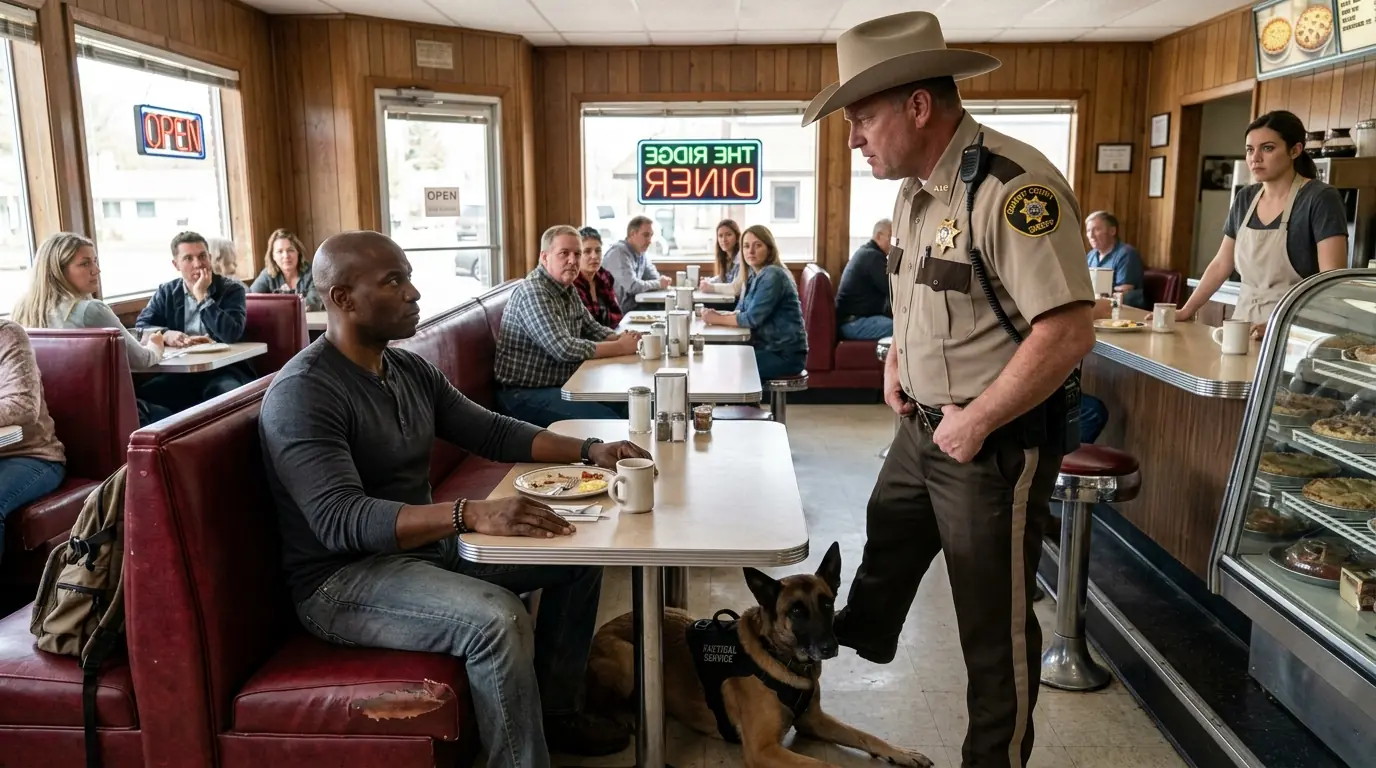
Kodiak arrived with him and adapted faster. The Belgian Malinois was eleven years old, black-masked, lean, scarred along one flank, and gray around the muzzle in a way that made strangers assume he was simply an aging shepherd mix until they watched him move. He had spent most of his working life as a military multipurpose canine, trained for tracking, detection, and protection work before age and old injuries finally pushed him into retirement. Caleb had formally adopted him eighteen months earlier after years of deployments in which the dog had repeatedly worked beside his unit and once saved Caleb’s life in a way neither of them could possibly understand as heroism at the time.
That particular story began on a dry mountainside thousands of miles from Colorado. Caleb’s team had been moving through a narrow compound corridor after midnight when Kodiak suddenly stopped, braced, and refused the hand signal directing him forward, something so unusual that Caleb instinctively halted the men behind him. Seconds later, a buried explosive detonated along the path they would have entered, throwing dirt, fragments, and part of a wall across the passage while Kodiak lunged backward against his line. Caleb took shrapnel through the thigh and shoulder, but the blast that might have caught four men directly hit empty ground instead.
Kodiak later found the route toward the evacuation point when smoke and dust turned everything into confusion. Caleb remembered one hand pressed against his own bleeding leg and the other buried in the dog’s harness as they moved through darkness with gunfire somewhere behind them. Nobody at the time stopped to describe the moment as loyalty or courage because men were hurt and the work was not finished. Years later, when Caleb signed the adoption papers and Kodiak leaned against his knee in a quiet stateside kennel, he finally understood how much of his future had once depended on that dog refusing to obey a single command.
Retirement had not been easy for either of them. Kodiak woke at unfamiliar noises, watched doors automatically, and sometimes searched rooms he had already searched five minutes earlier, while Caleb discovered that a grocery-store parking lot could feel more complicated than a hostile street because there were too many harmless movements to classify. He slept badly, hated fireworks, and could not sit comfortably with his back exposed in restaurants, habits that embarrassed him only until his therapist reminded him that surviving through vigilance taught the body lessons the mind could not simply cancel. Ashford Ridge was supposed to become the place where those lessons slowly stopped being necessary.
For six weeks, the plan seemed to work. Caleb repaired the fence behind his new house, learned which trail above town stayed shaded through the afternoon, and discovered that Kodiak liked lying on the porch whenever mule deer wandered through the lower meadow. He avoided questions about the military by saying he had worked for the government, which was both true and sufficiently boring to end most conversations. The only person who pushed harder was Ruth Miller, the seventy-year-old owner of Miller’s Diner, who had looked once at Kodiak, once at Caleb, and said, “Government my foot, that dog stands like somebody taught him not to waste movement.”
Caleb had laughed. Ruth had owned the diner for thirty-eight years and possessed the rare local authority that came from feeding three generations of people while remembering which marriages had ended, which children had disappointed their parents, and which adults were still treated like children because the town refused to update its memory. She never asked Caleb directly what he had done. Instead, she designated the booth in the far rear corner as “his” because it placed a wall behind him and enough room beside the table for Kodiak to lie without blocking the aisle.
Kodiak was allowed inside because he had been trained as a working dog and Caleb had documentation from the veterans’ organization helping with his transition, though technically Kodiak was now retired rather than an active service animal performing a defined disability task. Ruth could have required him to remain outside under the diner’s ordinary pet policy, but she made a private decision after watching Caleb’s first two visits. “If anybody complains,” she told him, “they can eat somewhere that doesn’t know how to cook potatoes.”
Caleb told her he did not need special treatment. Ruth answered that she had not asked what he needed. She said Kodiak behaved better than half the human customers and tipped exactly as well as the other half. Caleb stopped arguing.
On the Saturday everything changed, Caleb arrived at 7:40 in the morning after walking four miles with Kodiak along the creek trail. Snow still clung to the highest ridges, but early September had brought a clean blue sky and enough cold to make the diner windows fog from the inside. Ruth poured coffee before he sat, and waitress Lena Ortiz carried a bowl of water to Kodiak without asking. Caleb ordered eggs, toast, potatoes, and bacon while Kodiak settled beneath the end of the booth with his harness still on.
The harness looked ordinary except for the compact equipment module fixed along the upper strap. A veterans’ canine-support nonprofit had issued it after several retired working dogs in their program went missing during emergencies, and Caleb had paid to add a rugged camera system with cellular backup after Kodiak suffered a seizure while alone in the yard the previous winter. The device recorded short rolling clips whenever the dog was outside the house, but only preserved and uploaded them automatically after sudden impact, unusual movement, manual activation, or a high-stress biometric event detected through the collar sensor. Caleb used it mostly to monitor Kodiak’s declining joints and make sure an old dog trained to hide discomfort did not quietly injure himself on trails.
He had never imagined the system would become evidence of a crime. To Caleb, it was no more dramatic than the motion camera above his garage. The video feed went to an encrypted cloud account managed through the nonprofit’s platform, and emergency clips were automatically mirrored to his phone and to a designated legal contact because the program served veterans whose dogs sometimes accompanied them during medical crises. His designated contact was attorney Marissa Cole, an old friend from Virginia Beach who had represented several veterans in disability and employment matters and complained every year that Caleb made her emergency-contact forms unnecessarily complicated.
At 7:52, the front door of Miller’s Diner opened. Conversations stopped before Caleb turned his head. He knew enough about small towns to understand that silence could identify authority faster than a uniform.
Sheriff Clayton Rusk entered wearing a tan county uniform beneath a dark jacket, with a silver star pinned over his chest and a wide campaign-style hat he removed only after crossing the threshold. He was fifty-six, heavy through the middle, with iron-gray hair, weathered cheeks, and the practiced smile of an elected man who had spent too many years confusing familiarity with affection. Two deputies followed him, one younger and broad-shouldered, the other thin and nervous-looking, and neither seemed surprised when customers lowered their voices. Ruth Miller’s expression became flat.
Caleb had seen Rusk once before at a gas station. The sheriff had looked at the Colorado plates on Caleb’s truck, then at Caleb, then at Kodiak through the open rear window, but said nothing. Caleb remembered the glance because people who assessed strangers professionally tended to recognize the same habit in others. At the time he had dismissed it as curiosity.
Rusk paused beside the counter and surveyed the diner. His eyes passed over ranchers, construction workers, an elderly couple, two teenagers, and three families before stopping on Caleb in the rear booth. The pause lasted just long enough for Caleb to know the sheriff had found what he was looking for, though whether that was an unfamiliar face, a Black man sitting alone, or simply an opportunity remained unclear. Then Rusk smiled.
“Well,” he said loudly, “Ruth’s letting anything in here these days.” Ruth kept filling a coffee cup. “Morning, Clayton.”
Rusk ignored the greeting. He walked toward Caleb with both deputies behind him while conversation faded completely. Kodiak lifted his head but did not rise.
Caleb took one sip of coffee. “Morning, Sheriff.” Rusk stopped beside the booth.
“You new?” he asked. Caleb said he had been in town a little over a month. “Name?”
“Caleb Walker.” Rusk looked at Kodiak.
“That thing yours?” Caleb answered yes. “Military dog.”
Rusk laughed. “Military dog.” He looked toward Deputy Eric Sloan, the younger of the two, as if Caleb had told a joke. “Everybody buys a vest online now and suddenly their mutt fought in Afghanistan.”
Caleb felt the first flicker of anger. He touched two fingers to the edge of the table, a small grounding habit he had learned after leaving the service. “He’s retired,” he said.
“Sure he is.” Rusk leaned closer to inspect the harness. “What branch did the dog serve in, Air Force?”
Several men at the counter laughed weakly. Caleb noticed that none looked amused. The distinction mattered.
Kodiak lowered his chin but kept his eyes on Rusk. Caleb knew that posture. The dog was not preparing to attack, but he had categorized the sheriff as something requiring attention.
Rusk looked back at Caleb. “You carry?” he asked.
The question was abrupt enough that Deputy Sloan glanced at his boss. Caleb answered, “Not this morning.”
“You a felon?” Rusk asked. Caleb felt Ruth stop moving behind the counter.
“No.” Rusk smiled.
“Just checking.” He looked toward the customers as though inviting approval for vigilance. Nobody offered it.
Caleb asked, “Is there something you need from me, Sheriff?” The question was polite. Rusk heard challenge anyway.
“I ask questions around here.” Caleb nodded once. “Then ask one.”
Rusk’s smile disappeared. “You got a problem with law enforcement?” Caleb answered no.
“You looked at me funny when I walked in.” Caleb almost laughed. “I looked at you because you walked toward my table.”
Rusk leaned one hand on the booth. “See, that smart mouth is what gets people in trouble.” Caleb said nothing.
The sheriff studied him. Then he said, “Where’d you say you came from?”
“I didn’t.” Rusk’s eyes narrowed.
Caleb added, “Virginia.” The sheriff nodded slowly. “Makes sense.”
“What does?” Caleb asked. Rusk shrugged.
“Out-of-state attitude.” He glanced at Caleb’s skin, then toward the other diners. “People around here know how to show respect.”
The words alone were not racial. The tone and look made the meaning harder to miss. Caleb had lived long enough to recognize when someone wanted him to notice without leaving enough language to quote cleanly later.
Ruth stepped from behind the counter. “Clayton, your usual table’s open.” Rusk did not look at her.
“I’m talking to our new resident.” Ruth said, “He’s eating.”
Rusk turned. “You run the diner, Ruth.” Then he tapped the badge on his chest. “I run the county.”
Caleb watched Ruth’s jaw tighten. Nobody corrected him.
That silence told Caleb more about Ashford Ridge than six weeks of polite conversation had managed. People were not impressed by Rusk. They were careful around him.
Kodiak shifted. One rear leg moved beneath his body, relieving pressure from an arthritic hip. Rusk noticed.
“What’s wrong with him?” he asked. Caleb answered, “Age.”
“Looks mean.” Caleb said, “He’s controlled.”
Rusk leaned down without asking. His hand moved toward Kodiak’s head.
Caleb’s voice changed. “Don’t touch him.”
The words were quiet. Rusk stopped and looked up.
“You giving me an order?” Caleb said, “I’m asking you not to touch my dog.”
Rusk stood. “Dog going to bite me?”
“No.” Caleb looked directly at him. “I still don’t want strangers putting hands on him.”
Rusk laughed again. “Strangers.” He looked around the diner. “You hear that?”
Nobody answered. The sheriff’s face reddened slightly.
“I’ve lived in this county my whole life.” Caleb replied, “Then you’re a familiar stranger.”
Ruth closed her eyes. Lena stopped beside the kitchen doors with a coffeepot frozen in her hand.
Deputy Sloan whispered, “Sheriff.” Rusk ignored him.
“You think you’re funny?” he asked. Caleb answered, “Not particularly.”
Rusk stepped around the end of the booth. Kodiak rose.
The movement was smooth, almost silent, and entirely controlled. He did not lunge, bark, or show teeth. He simply stood beside Caleb’s leg and watched Rusk.
The sheriff took one step back. “Control your animal.” Caleb placed one hand lightly against Kodiak’s shoulder.
“He is controlled.” Rusk pointed at the dog. “He threatened me.”
“No.” Caleb’s voice remained even. “He stood up.”
Rusk looked toward Sloan. “You see that dog come at me?” Sloan hesitated.
“I saw him stand, sir.” The other deputy, Nathan Briggs, stared at the floor.
Rusk’s face hardened. “You calling me a liar too?”
Sloan immediately answered, “No, Sheriff.” Caleb saw what happened.
One sentence from the boss changed what everyone around him was willing to say. That was not leadership. It was conditioning.
Kodiak shifted closer to Caleb. His tail remained low. His ears were forward.
Rusk looked at the dog and said, “Filthy mutt.” Caleb felt his hand tighten.
“Sheriff.” Ruth’s voice carried from the counter. “Enough.”
Rusk turned his head. “Stay out of it.”
Then he kicked Kodiak.
It happened so quickly that several people gasped before Caleb fully registered the movement. Rusk drove the front of his boot into the dog’s ribs just behind the shoulder, a sharp sideways strike intended to force space between them. Kodiak yelped once and staggered into the booth.
Every sound in the diner vanished. Caleb heard the scrape of Kodiak’s nails against tile.
The dog recovered instantly. He turned toward Rusk with a low growl that came from somewhere deeper than ordinary anger. His weight shifted forward.
Caleb’s training moved before thought. “Kodiak, stay.”
The dog froze. Muscles remained tight beneath the harness, but he did not advance.
Rusk laughed. “See?” he said. “Aggressive.”
Caleb looked at Kodiak. “Down.”
The dog lowered himself slowly, pain visible when his right foreleg touched the floor. Caleb’s anger became something much colder.
“You kicked him,” Caleb said. Rusk answered, “He came at me.”
“No.” Caleb looked toward the room. “He stood.”
Rusk leaned over the table. “You want to argue with the sheriff about what the sheriff saw?” Caleb said, “Yes.”
Something changed in the room. The answer was too simple.
Rusk reached across the table and grabbed Caleb’s sweatshirt near the shoulder. “Stand up when I’m talking to you.”
Caleb did not decide to fight. His body identified contact, leverage, balance, and threat before language caught up.
His left hand trapped Rusk’s wrist. His right hand controlled the elbow.
Caleb rose while turning his hips, redirected the sheriff’s forward pressure past him, and guided Rusk across the edge of the booth. The movement lasted less than two seconds.
Rusk hit the adjacent table chest-first. Plates jumped, silverware scattered, and a coffee mug shattered on the floor.
Caleb controlled the sheriff’s arm behind his back. He did not strike him.
He did not choke him. He did not drive his head into the table intentionally, though Rusk’s cheek hit the laminate when his own momentum carried him forward.
Caleb planted one knee against the outside of Rusk’s thigh and kept pressure on the shoulder just below the point that would risk injury. “Stop moving,” he said. His voice sounded almost bored.
Rusk cursed and tried to twist. Caleb increased control slightly.
“Stop.” Rusk stopped.
Deputy Sloan drew his handgun. “Let him go!”
Caleb turned his head without releasing Rusk. “I will, but I need to know you’re not going to shoot me when I stand.”
“Release the sheriff now!” Sloan shouted. Nathan Briggs drew his weapon too, though his hands visibly trembled.
Customers ducked beneath tables. Ruth yelled, “Nobody shoot in my diner!”
Caleb looked toward Sloan. “I’m releasing him.”
He took his knee away first. Then he let go of the wrist and stepped backward with both hands raised.
Rusk spun away from the table, face red and breathing hard. “Cuff him!”
Caleb did not resist. Sloan moved behind him and pulled his arms down.
Metal closed around Caleb’s wrists. Rusk shouted, “Tighter.”
Sloan hesitated. Then he tightened one cuff another notch.
Caleb felt the metal bite. He said nothing.
Kodiak tried to stand. Caleb looked directly at him.
“Kodiak, down.” The dog obeyed.
Rusk touched his cheek and looked at the small smear of blood from where skin had scraped the table. His eyes changed.
“You assaulted a peace officer.” Caleb answered, “You grabbed me after kicking my dog.”
Rusk stepped toward him. Sloan moved subtly between them.
The sheriff noticed. “Get out of my way.”
Sloan did not move immediately. Then he stepped aside.
Rusk stopped six inches from Caleb. “You’re going to prison.”
Caleb met his eyes. “Maybe.”
That answer seemed to disturb Rusk more than denial.
A quiet electronic tone sounded beneath the table.
Everyone looked down.
The small module on Kodiak’s harness flashed once. Then Caleb’s phone, still lying beside his coffee, vibrated.
Rusk looked toward it. “What’s that?”
Caleb saw the notification preview on the screen. KODIAK EVENT ALERT — IMPACT DETECTED. CLIP UPLOADED. EMERGENCY CONTACT NOTIFIED.
He exhaled slowly.
“Nothing you can put back,” he said.
Rusk stared. “What?”
Caleb looked toward Kodiak’s harness. “The camera uploads automatically after impact.”
The sheriff’s face changed.
Sloan looked at the dog. Briggs did too.
Rusk said, “Camera?” Caleb nodded.
“Front and side angle from the harness.” He glanced toward his phone. “Off-site upload.”
Rusk reached for Kodiak. Caleb’s voice became sharp for the first time.
“Do not touch that dog.”
Every person in the diner heard the difference. Sloan moved before Rusk did.
“Sheriff, we should preserve it.” Rusk turned toward him.
“You telling me what to do?” Sloan swallowed.
“I’m saying if it’s evidence, we shouldn’t handle it more than necessary.”
Caleb looked at the deputy. For the first time that morning, Sloan had chosen procedure over instinctive loyalty.
Rusk noticed too. “Take the phone.”
Sloan looked at Caleb. “Is that your phone?”
“Yes.”
“It’s evidence.” Caleb answered, “Then document it.”
Sloan nodded.
Rusk reached for the device himself. Caleb said, “Sheriff, the footage isn’t stored there.”
Rusk stopped. “Where is it?”
“My attorney already has access.”
That was not exactly true yet. Marissa had received an automated alert and could access the file, but Caleb had no way of knowing whether she had opened it.
The effect on Rusk was immediate. “Your attorney.”
“Yes.” Caleb looked toward the sheriff’s scraped cheek. “Retired military dogs make me overly organized.”
Ruth made a sound that might have been a laugh. Rusk looked at her.
“Not one word.” Ruth’s expression changed from fear to anger.
“This is my diner.” Rusk stepped toward her.
Caleb said, “Sheriff.”
Rusk turned. Caleb raised his cuffed hands as much as Sloan’s grip allowed.
“You already have one assault allegation to explain.” Rusk’s face darkened.
Sloan said, “Sheriff, maybe we should call a supervisor.”
Ruth stared at him. “He is the supervisor.”
The sentence landed heavily.
That was the problem with elected power in a small county. Rusk did not merely work for the sheriff.
He was the sheriff.
The nearest command authority outside his personal chain was the undersheriff, who was reportedly hunting near Grand Junction for the weekend. County commissioners controlled budgets but did not simply command the elected sheriff during an active incident.
Rusk understood that arrangement better than anyone. He looked around the room and regained some confidence.
“Everybody here witnessed him attack me.” Caleb said, “They witnessed everything.”
Rusk ignored him. “Briggs, start getting names.”
Deputy Briggs holstered his weapon and looked toward the diners. Nobody volunteered.
Ruth pointed at the ceiling. “Start with my cameras.”
Rusk looked up.
Two black security domes covered the dining room. He had apparently forgotten them.
Ruth smiled without warmth. “Installed them after somebody kept breaking my back window.”
Rusk looked at her. “I’ll need the recorder.”
“You’ll need a warrant or my permission.” Ruth crossed her arms.
Caleb almost smiled. Rusk did not.
“You obstruct this investigation and I’ll shut this place down.” Ruth’s face went pale, but she held her ground.
“With what authority?” Caleb asked.
Rusk turned. “You don’t get to talk anymore.”
Caleb nodded. “That’s probably better for both of us.”
A customer near the counter raised his phone. Rusk noticed immediately.
“Put that away.” The man froze.
“Now.” The customer lowered it.
Ruth said, “Nobody deletes anything.” Rusk glared at her.
Lena Ortiz stood beside the kitchen door. Her hands were shaking.
She had seen the kick from less than twelve feet away. Caleb knew it.
Rusk knew it too.
“Lena,” he said, suddenly softer, “you saw that dog lunge.”
Lena’s face changed. She looked at Kodiak.
The dog remained down.
Rusk repeated, “You saw it.”
Lena whispered, “I saw him stand.”
Rusk stared at her.
“That’s all?”
She swallowed. “He stood.”
Ruth stepped closer to Lena.
The sheriff’s expression hardened. “We’ll talk at the station.”
Lena said nothing.
Caleb looked toward her. He wanted to tell her she did not owe anyone courage on command.
Rusk turned back to Sloan. “Take him in.”
Caleb said, “What about Kodiak?”
Rusk laughed. “Animal control.”
“No.”
Sloan looked at him. Caleb kept his tone measured.
“He has military retirement records, veterinary requirements, and a documented handling protocol.” He nodded toward Ruth.
“Ruth knows my veterinarian.” Ruth immediately said, “Dr. Elena Marquez at Ridgeview Animal Clinic.”
Rusk said, “Dog stays as evidence.”
Caleb looked at him.
“You kicked an eleven-year-old retired working dog hard enough to trigger an impact alert.” He paused.
“If you take custody of him after that, your lawyer is going to have a very interesting afternoon.”
Rusk’s face reddened.
Sloan said, “Sheriff, the dog may need a veterinary exam anyway.”
For once, Rusk listened. “Fine.”
He pointed at Ruth. “She takes it.”
“Him,” Caleb said.
Rusk looked over. “What?”
“His name is Kodiak.”
Rusk smiled. “You’re still worried about manners?”
Caleb answered, “I’m worried about accuracy.”
Sloan guided him toward the door.
Kodiak tried to rise again. Caleb stopped.
“Kodiak, stay with Ruth.”
The dog watched him. For perhaps the first time in years, he hesitated at a command.
Caleb’s chest tightened.
“Stay.”
Kodiak lowered himself.
Ruth crouched beside him. “I’ve got him.”
Caleb believed her.
Outside, morning sunlight looked offensively peaceful. Sloan led him toward a patrol SUV while three customers stood against the diner windows watching.
Rusk came out behind them. “Assault on a peace officer, resisting, obstruction, dangerous animal.”
Sloan looked uncomfortable.
Caleb said, “You might want to leave room on the form.”
“For what?” Rusk asked.
“Facts.”
The sheriff stepped closer. “Keep talking.”
Caleb looked toward him. “No.”
Sloan opened the rear door.
As Caleb bent to enter, his phone chimed again in an evidence bag Sloan had started documenting. The screen lit long enough for all three men to see another preview.