The first thing Sarah Johnson noticed was the way Mike Santos kept checking the rearview mirror. He had done it six times since leaving downtown Bayhaven, always looking past Sarah toward the road behind them rather than checking traffic beside the taxi. His shoulders tightened more with every mile as glass towers gave way to warehouses, tire shops, apartment blocks, and the older industrial road leading toward the coastal highway. Sarah finally looked up from the message her younger brother had sent and asked, “Is something wrong?”
Mike gave a quick smile that carried no humor. He was fifty-one, narrow through the shoulders, with silver beginning around his temples and a white taxi shirt polished clean despite being worn thin at the collar. Both hands stayed precisely at ten and two on the steering wheel, the habit of a man whose livelihood depended on avoiding even small mistakes. “Nothing, ma’am,” he said, then looked in the mirror again.
Sarah closed her phone. “You keep checking behind us.” Mike hesitated long enough to tell her that whatever bothered him was something he had already learned not to discuss with passengers. Sarah waited instead of filling the silence.
Her brother Daniel was getting married that evening at a waterfront hotel thirty minutes south of the city. Sarah had spent the entire morning refusing department calls, left her uniform hanging inside the closet, put on a red dress Daniel’s fiancée had chosen for the family photographs, and packed only one overnight bag. For one day, Captain Sarah Johnson intended to attend a wedding as a sister rather than as the commander whose appearance in a precinct could make conversations stop halfway through a sentence. She had even left her city vehicle at home.
Sarah was forty-four and had spent twenty-one years in law enforcement. She had worked narcotics, homicide, patrol supervision, training, and internal investigations before becoming captain of Bayhaven’s Professional Standards and Accountability Division eight months earlier. Her position did not make her the police chief, but it gave her citywide authority over administrative investigations and put her office in regular contact with command staff from every district. Most supervisors knew her face in uniform, but Sarah had learned long ago how dramatically people could fail to recognize authority when it arrived without its costume.
Mike eventually sighed. “I normally don’t take Harbor Cut Road anymore.” Sarah looked through the windshield at the nearly empty two-lane stretch running between warehouses and drainage fields. “Then why today?” she asked.
“You told dispatch you needed the fastest route to Grand Bay Hotel.” Mike tapped the navigation screen. “This saves almost twenty minutes, and traffic on the interstate is already bad.” Sarah asked why he avoided it.
His fingers tightened on the wheel. “Police checkpoint.” Sarah glanced ahead, but the road still looked empty.
“A legal checkpoint?” she asked. Mike laughed once.
Sarah heard the difference immediately. That was not the laugh of someone complaining about an inconvenient ticket or resenting ordinary enforcement. It was the sound of somebody who had learned that complaining could be more dangerous than whatever had happened first. “Tell me,” she said.
Mike looked at her through the mirror. “You a lawyer?” Sarah answered, “No.” She did not tell him what she did instead.
He drove another half mile before speaking. “There’s a sergeant who works this road sometimes, Sergeant Davis, big guy with a shaved head.” Mike said taxi drivers warned one another when Davis appeared because he liked finding violations that existed only until money changed hands. “Speeding, bad tires, illegal route, broken light, commercial permit problem, whatever he thinks you’ll believe.”
Sarah’s expression did not change. “He issues citations?” she asked. Mike shook his head.
“Sometimes.” He swallowed. “Mostly he says the ticket will be five hundred dollars, maybe seven hundred, and the taxi will be impounded until court, but if you pay something now he can make it disappear.” Sarah asked how much something meant.
“Whatever you have.” Mike stared through the windshield. “Hundred, two hundred, three hundred if he thinks you did well that day.”
Sarah felt her attention narrowing. “Cash?” she asked. Mike nodded.
“Always.” He said Davis sometimes instructed drivers to place the money inside their registration wallet or under the citation pad so cameras would not show an obvious exchange. Several taxi drivers carried emergency cash specifically because losing a car for even one night meant losing income needed for rent, fuel, lease payments, groceries, and school bills. “Everybody knows, ma’am.”
“Everybody who?” Sarah asked. Mike glanced toward her.
“Taxi drivers.” He shrugged. “Delivery guys, rideshare people, some food truck owners.”
Sarah looked ahead again. “Does the department know?” Mike’s mouth tightened.
“We tried.” His voice became quieter. “Nothing happened.”
Sarah felt something colder than anger settle inside her. “Who tried?” she asked.
Mike explained that a driver named Ahmed Rahman complained after Davis allegedly took two hundred dollars from him six months earlier. Another driver, Carla Mendez, reported being threatened with impoundment after refusing to pay, and a courier claimed officers emptied his wallet before letting him leave. None of the drivers received follow-up beyond being told the department had found insufficient evidence.
“Did anybody have video?” Sarah asked. Mike nodded reluctantly.
“Ahmed had dash camera.” He glanced at her through the mirror. “They said it didn’t show the money clearly.”
That answer bothered Sarah more than she showed. In her office, a complaint did not become meaningless simply because one camera angle failed to capture the entire alleged offense. Investigators compared video, officer reports, dispatch logs, citations, body-camera activation, location history, witnesses, bank records, and patterns across similar complaints. Somebody deciding an unclear cash exchange meant there was nothing further to examine sounded less like investigation and more like closure.
Mike suddenly slowed. His breathing changed.
Sarah looked ahead.
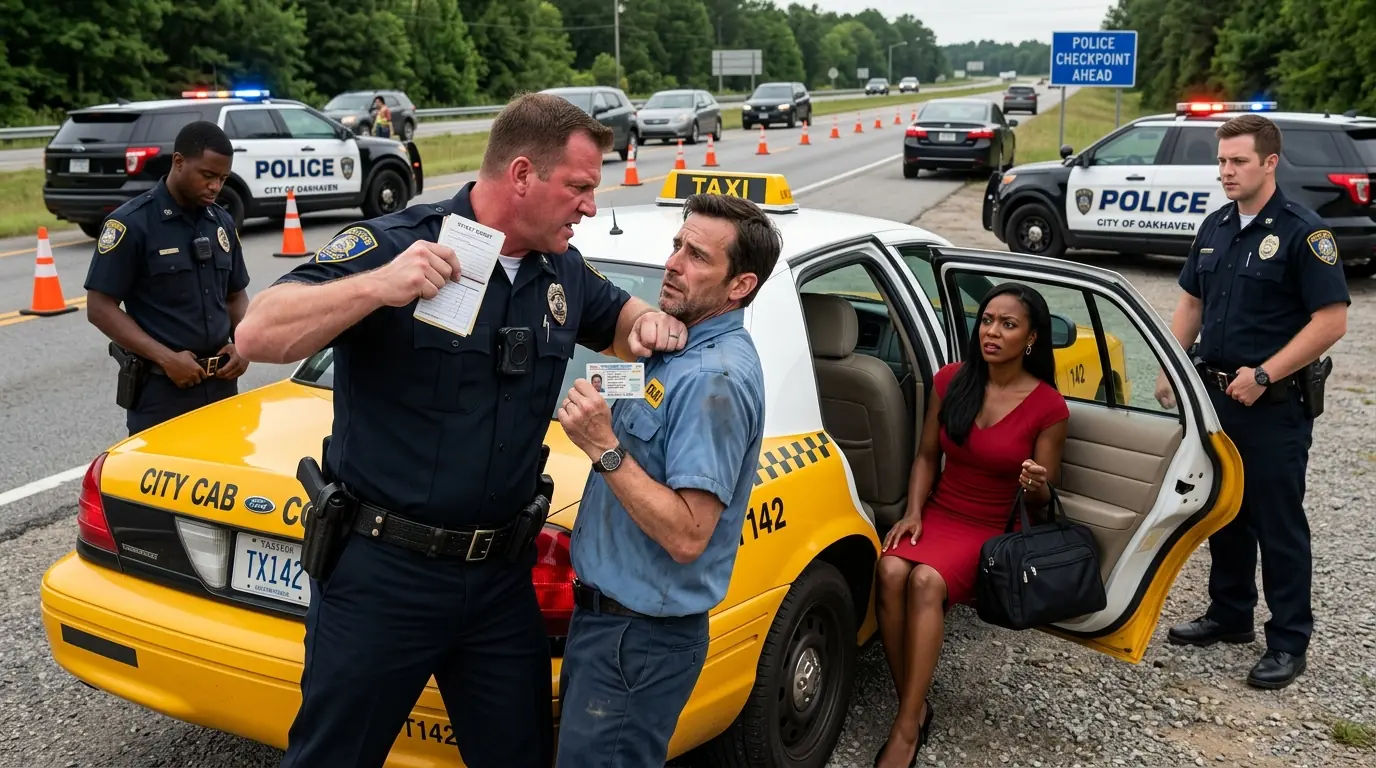
Three marked Bayhaven Police Department vehicles were parked diagonally beside the road near an abandoned weigh station. Orange cones narrowed traffic into one lane, and four uniformed officers stood near the shoulder while a fifth spoke to the driver of a delivery van. One broad-shouldered sergeant stepped away from the patrol car and raised his hand.
Mike whispered, “That’s him.”
Sarah looked at the sergeant. Thomas Davis was perhaps forty-six, tall, thick through the chest, with sunglasses hiding his eyes and three chevrons beneath the rocker on his sleeve. He raised one palm toward Mike’s taxi.
Mike slowed immediately.
“Stay calm,” Sarah said. He looked at her through the mirror.
“Ma’am, please.” His voice was almost apologetic. “If he asks, just say I drove normally.”
“I will say exactly what happened.”
“That can make it worse.”
Sarah understood then how deeply the fear went. Mike was not asking her to lie for him. He was asking her not to tell too much truth.
The taxi stopped beside the cones. Davis approached the driver’s side while two younger officers remained near their cruisers and another stood beside the delivery van. Mike lowered his window.
“Out,” Davis said.
Mike blinked. “Sergeant, what did I do?”
“I said get out.” Davis struck the roof twice with his knuckles. “Now.”
Mike looked at Sarah. She gave him no signal except a slight nod reminding him that he was not alone.
He opened the door. Davis stepped back while Mike emerged with both hands visible. The sergeant said, “You think this road is a racetrack?”
Mike looked confused. “No, Sergeant.”
“You were doing sixty-two.”
Mike glanced toward Sarah because they both knew the taxi had spent most of the last mile below forty-five. “Sir, I don’t think I was.”
Davis’s head tilted. “You calling me a liar?”
“No.” Mike immediately lowered his gaze. “I’m just saying maybe—”
“License and commercial permit.”
Mike reached slowly toward his wallet. His hand visibly shook as he passed over his driver’s license and laminated taxi credentials. Davis barely looked at them.
“Registration.” Mike returned to the taxi, opened the document wallet, and handed it over. Davis glanced at the papers for perhaps two seconds.
“Insurance?” Mike produced that too.
Sarah remained in the rear seat. Through the open window she could hear everything, and because the taxi was still running, its dashboard camera continued recording forward with a smaller cabin-facing lens above the mirror. She did not know whether the microphone worked. She hoped it did.
Davis returned Mike’s insurance but kept the other documents. “Five hundred dollar fine.” Mike stared at him.
“For speeding?”
“For reckless commercial operation.”
Mike’s face changed. “Sergeant, I wasn’t reckless.”
Davis lowered his sunglasses slightly. “You want me to add obstruction?”
Mike looked toward the other officers. One of them, a young Black officer Sarah recognized vaguely as Patrolman Evan Brooks, looked away. Another officer, a woman with the name Chen on her uniform, watched Davis with visible discomfort but did not move.
Mike clasped his hands together. “Please, Sergeant, I made maybe seventy dollars today.” Davis smiled.
“Then today was slow.”
“My wife is sick.” Mike’s voice cracked. “I have two children in school.”
Davis shrugged. “Not my problem.”
Mike asked whether he could receive the citation and pay through court. Davis stepped closer.
“You want the real ticket?” He tapped the pad against Mike’s chest. “Fine, five hundred, plus commercial review, plus tow, plus storage.”
Mike went pale. “Tow?”
“Taxi gets impounded.”
“Why?”
“Because I said it does.”
Sarah felt her jaw tighten.
Mike whispered, “Sir, please.”
Davis looked around once. Then his voice dropped enough that Sarah had to lean slightly toward the open window.
“How much cash you have?”
Mike closed his eyes.
Sarah felt the entire encounter change.
“Maybe fifty.”
Davis laughed. “Don’t insult me.”
“That’s all.”
“You drove airport runs today.”
Mike looked genuinely confused. “How do you know?”
Davis’s smile vanished as quickly as it appeared. “Because I asked how much money you have.”
Mike put one hand against his shirt pocket. “Fifty-two dollars.”
“Then find more.”
“I can’t.”
Davis stepped closer. “Three hundred and you leave.”
Mike stared at him.
“Sergeant, please.”
Davis grabbed his collar.
The movement was sudden enough that the taxi door rattled when Mike stumbled backward. Davis twisted the fabric and pulled Mike toward him.
“I’m tired of you people thinking you can negotiate with me.”
Officer Chen took one half-step forward. She stopped.
Mike raised both hands. “I’m not fighting you.”
Davis shoved him against the side of the taxi.
Metal shook.
Sarah opened the rear door.
Her sandals touched the pavement.
The officers finally looked at her.
Sarah stood, smoothed the red dress automatically, and closed the door behind her. Her overnight bag remained on the seat.
“Sergeant,” she said, “release him.”
Davis turned.
For perhaps two seconds, he seemed more surprised by Sarah’s tone than by the words themselves. Then his expression shifted into amusement.
“Get back in the vehicle.”
Sarah remained where she was. “His documents are valid, and I observed no speeding or reckless operation during this ride.”
Davis kept one fist twisted in Mike’s collar. “Ma’am, I’m conducting police business.”
“So I can see.”
“Then get back in the cab.”
Sarah looked at his hand. “Release him.”
Davis stared at her.
Mike whispered, “Ma’am, please don’t.”
The fear in his voice was not fear for himself anymore. He believed Sarah was about to become another person Davis could punish.
Davis finally released Mike’s collar. Sarah noticed a red mark forming along the side of Mike’s neck.
“There.” Davis spread his hands. “Happy?”
“No.”
The answer surprised him.
Sarah stepped slightly closer. “You accused him of speeding without showing any measurement, changed the alleged violation to reckless commercial operation, threatened impoundment, demanded cash, and then used force when he said he could not pay.”
Davis’s jaw tightened.
“You a lawyer?”
“No.”
“Then shut your mouth about police procedure.”
Sarah looked toward the other officers.
None met her eyes except Chen.
Davis noticed.
“Everybody hear me?” he said loudly. “This passenger is interfering with an enforcement stop.”
Sarah returned her attention to him. “I am standing on a public roadside describing what I witnessed.”
“You’re obstructing.”
“How?”
He took one step closer.
“You want to find out?”
Sarah did not move.
Davis was almost a foot taller than she was in her sandals. His badge reflected sunlight near her eye.
“You think because you’ve got a nice dress and a mouth you can tell me how to do my job?” he asked.
Sarah answered, “No.”
His smile returned.
“I think your oath tells you how to do your job.”
Officer Chen lowered her gaze.
Davis pointed toward the taxi. “Get back inside before I arrest you.”
“For what offense?”
“Obstruction.”
“What act constitutes the obstruction?”
His face reddened.
Mike whispered again, “Please.”
Sarah could hear his breathing.
Davis leaned close enough that she could smell coffee and mint gum. “Let me explain something to you.”
Sarah waited.
“I run this road.”
She said nothing.
“I decide who gets cited, who gets towed, and who goes home.”
Still she said nothing.
“No one at headquarters is coming out here asking questions.”
Officer Brooks shifted his feet.
Davis continued. “So unless you want to spend your brother’s wedding or whatever you’re dressed for sitting in a holding cell, tell me your name and get back inside.”
Sarah’s expression changed slightly.
“How did you know I’m going to a wedding?”
Davis looked toward her overnight bag through the open taxi window. “Lucky guess.”
Sarah held his eyes.
“Identification,” he said.
“You’re requesting identification from me?”
“I’m ordering it.”
“Am I detained?”
“You are now.”
“For what?”
Davis exhaled sharply. “Interfering with an officer.”
Sarah nodded once.
“All right.”
Mike looked horrified.
Sarah opened the taxi door and reached inside. Davis watched closely, one hand resting near his belt.
Her overnight bag sat on the rear seat. Beneath a folded shawl, makeup case, and pair of shoes was a black leather credential wallet Sarah had almost left at home because she promised Daniel she would not bring work to the wedding.
She removed it.
Officer Chen recognized the city seal immediately.
Her face changed.
Davis did not notice.
Sarah placed the closed case on the taxi’s hood.
He stared at it.
“What’s that?”
“My identification.”
“Open it.”
Sarah rested one thumb on the clasp.
Officer Chen whispered, “Sergeant.”
Davis looked toward her. “What?”
Chen stared at Sarah now.
“Sir, I think that’s Captain Johnson.”
The road became very quiet.
Davis looked back at Sarah.
For the first time, he truly studied her face.
The red dress disappeared from his perception.
The plain sandals disappeared.
The passenger disappeared.
Recognition arrived.
Sarah opened the case.
Her gold captain’s badge sat beside the official identification card bearing her photograph, rank, and assignment.
Davis’s hand fell from his belt.
Nobody spoke.
Mike looked from the credential to Sarah.
Then back to Davis.
Officer Brooks whispered something under his breath.
Sarah closed the case.
Davis swallowed.
“Captain.”
She said nothing.
“Ma’am, I didn’t recognize you.”
“I know.”
He glanced toward Mike.
“This situation has been misunderstood.”
Sarah looked at Mike’s torn collar.
“No.”
Davis’s breathing changed.
“Captain, this driver was operating recklessly.”
Sarah asked, “What was his measured speed?”
Davis hesitated.
“We observed excessive speed.”
“Measured how?”
“The vehicle appeared—”
“What was the speed?”
He did not answer.
Sarah looked toward the officers.
“Who measured it?”
Nobody spoke.
She turned to Chen.
“Officer?”
Chen swallowed. “I didn’t, Captain.”
“Brooks?”
He shook his head.
“No, ma’am.”
Sarah returned to Davis.
“Radar?”
He glanced toward his patrol car.
Sarah asked, “Lidar?”
Nothing.
“Pacing?”
Nothing.
“Then what supported sixty-two?”
Davis’s face hardened slightly, old reflex fighting new fear.
“Captain, with respect, I don’t think we should conduct this conversation roadside.”
“On that point, we agree.”
His shoulders loosened.
Then Sarah continued.
“So we are going to stop this encounter exactly where it is.”
Davis stared.