The auction yard outside Worth County, Iowa, looked like it had been painted in gray. A heavy sky hung low over the flat winter fields, and a cold wind moved through the line of bare trees behind the old farmhouse. Farmers stood shoulder to shoulder in canvas coats, denim jackets, plaid shirts, knit caps, muddy boots, and work gloves, their faces weathered by years of sun, debt, and waiting. In front of them, on a rough wooden auction stand, sat a cedar chest with a rusted brass lock and a chalkboard sign that read, “HAWTHORNE SEED CHEST — HEIRLOOM LOT.”
Daniel Hawthorne stood near the front of the crowd with one hand tucked into the pocket of his dark quilted farm jacket. He was forty-nine years old, broad through the shoulders, with sun-worn skin, tired brown eyes, a black mustache, and the kind of rough hands that told more history than any document. On his head was a faded green seed-company cap that had once belonged to his grandfather, and beneath his jacket he wore a red plaid flannel shirt tucked into worn blue jeans. He looked like any other farmer in that yard, which was exactly why the man in the charcoal overcoat thought he could dismiss him.
Elias Mercer stood beside the auction stand, neat and stiff in a dark business suit, black leather gloves, polished shoes, and a wool overcoat that had clearly never known the inside of a feed store. He represented Meridian AgriGen, one of the largest seed companies in the Midwest, and he carried himself like the sale had ended before the auctioneer ever lifted the microphone. His rectangular glasses caught the dull light, hiding his cold gray eyes whenever he turned his head. Every farmer there knew why he had come.
The cedar chest had been found in the loft of the abandoned Hawthorne granary after Daniel’s aunt died. Inside were cloth seed bags, brittle envelopes, handwritten labels, and a folded 1936 ledger written in his grandfather’s careful hand. The seeds were old, rare, and nearly forgotten, but the legend around them had survived longer than anyone expected. People said the Hawthorne line of corn and winter wheat had produced when other fields failed during dry years, and Meridian AgriGen wanted that chest locked away before independent farmers could test whether the stories were true.
The auctioneer, Harold Benton, stood at the microphone in a tan canvas coat and brimmed hat, holding his clipboard against the wind. “Ladies and gentlemen,” he called, “we are now opening bidding on the Hawthorne Seed Chest, including all documents, labels, seed packets, ledger books, and associated storage rights.” The crowd pressed closer, not because the chest looked valuable, but because everyone understood what it might mean. A box of old seeds was small enough to fit in one man’s arms, yet it suddenly felt heavier than every tractor and hay wagon sold that morning.
Elias Mercer adjusted his gloves and stepped closer to the stand. “Let’s not romanticize this,” he said, loud enough for the nearest farmers to hear. “That chest is a historical curiosity, and it needs professional preservation.” Daniel looked at him from under the brim of his cap. Elias smiled thinly. “Professional preservation, of course, means corporate custody.”
A murmur passed through the crowd. Farmers knew what “corporate custody” meant. It meant the seed line would disappear into a lab, become a file number, and reemerge years later under a license no ordinary farmer could afford. It meant the people whose families saved those seeds through hunger and dust would have to ask permission to plant what their grandparents had protected.
His grandfather, Samuel Hawthorne, had saved those seeds during the Dust Bowl by hiding them in flour sacks beneath the kitchen floor. Daniel had heard the story a hundred times when he was a boy, usually while sitting on a milk crate in the granary, watching his grandfather sort kernels by hand. Samuel used to say, “Seed ain’t just what you plant, Danny. Seed is memory that still knows how to live.” Daniel had not understood it then, but standing in that auction yard, he understood it completely.
The auctioneer cleared his throat. “We’ll start the bidding at five thousand dollars.” Elias raised his bidder card before Harold finished the sentence. “Five thousand,” Harold called. “Do I hear six?”
The crowd stayed still. Five thousand dollars for an old box of seeds was already more than most people expected. Farmers watched each other from the corners of their eyes, measuring courage against bank statements. Nobody wanted Meridian to take the chest, but wanting and bidding were not the same thing.
“Ten thousand,” Elias said, not waiting for another bidder. He said it lazily, like a man ordering wine. A few farmers swore under their breath. Harold blinked, then called, “We have ten thousand dollars from bidder twelve. Do I hear eleven?”
Daniel’s hand moved before his fear could stop it. “Eleven thousand,” he said. The whole crowd turned toward him. Elias turned too, slowly, as if annoyed that dust had blown onto his coat.
Harold looked uncertain. “Eleven thousand from bidder forty-seven.” Elias stared at Daniel with faint amusement. “Twenty thousand,” he said. The crowd reacted louder this time, boots shifting against gravel, whispers breaking open. It was not a bid meant to win fairly; it was meant to scare everyone else away.
Daniel felt his throat tighten. Twenty thousand dollars was more money than he could explain to his wife without starting a fight at the kitchen table. But he thought of his grandfather’s ledger, the brittle envelopes, and the names written on cloth bags in pencil: Hawthorne Yellow Dent, Samuel’s Red Winter, Drought Hollow Corn. He raised his hand again.
“Twenty-one thousand.” Elias laughed softly, and the laugh cut worse than a shout. “Mr. Hawthorne, isn’t it?” he said. “You do realize this is a cash auction.” Daniel kept his eyes on the auctioneer. “I know where I’m standing.”
Elias stepped closer, lowering his voice but making sure enough people heard. “That chest belongs to people with money now, not dirt-handed men still praying to dead grandfathers.” Daniel’s jaw tightened. Several older farmers behind him went still. Harold looked down at his clipboard as if he wished the microphone would swallow him.
“My grandfather buried those seeds so men like you couldn’t turn survival into a contract,” Daniel said. His voice stayed steady, but his hand was shaking inside his glove. Elias’s smile faded. The crowd felt the change instantly.
“Thirty thousand,” Elias snapped. Harold repeated it, voice thinner now. “Thirty thousand dollars from bidder twelve.” He looked around, but he already knew where the next bid would come from. Daniel stood in the silence, feeling every eye on his back.
Thirty thousand was impossible. That was the truth. Daniel had fifteen thousand in savings, another ten he could maybe borrow from his brother, and a line of credit he had promised himself not to touch again. He could not buy the chest alone. He knew it, Elias knew it, and so did everyone in the crowd.
Elias leaned toward him. “Look around, farmer,” he said, contempt sharp. “These people can barely save their own barns. You think they can save you?” Daniel looked over his shoulder at the crowd. He saw worn coats, tired faces, and men who knew too well what it meant to lose something one acre at a time.
“No, Mercer,” Daniel said. “I’m not asking them to save me.” He raised his hand again. “I’m showing them how we stop bowing.” Then he said, “Thirty-one thousand.”
For several seconds, nobody breathed. Then a voice came from the back. “Put five hundred on my number with his.” Everyone turned. It was Mary Ellen Voss, a widow who farmed eighty acres with her two sons and still wore her late husband’s brown chore coat to every winter auction.
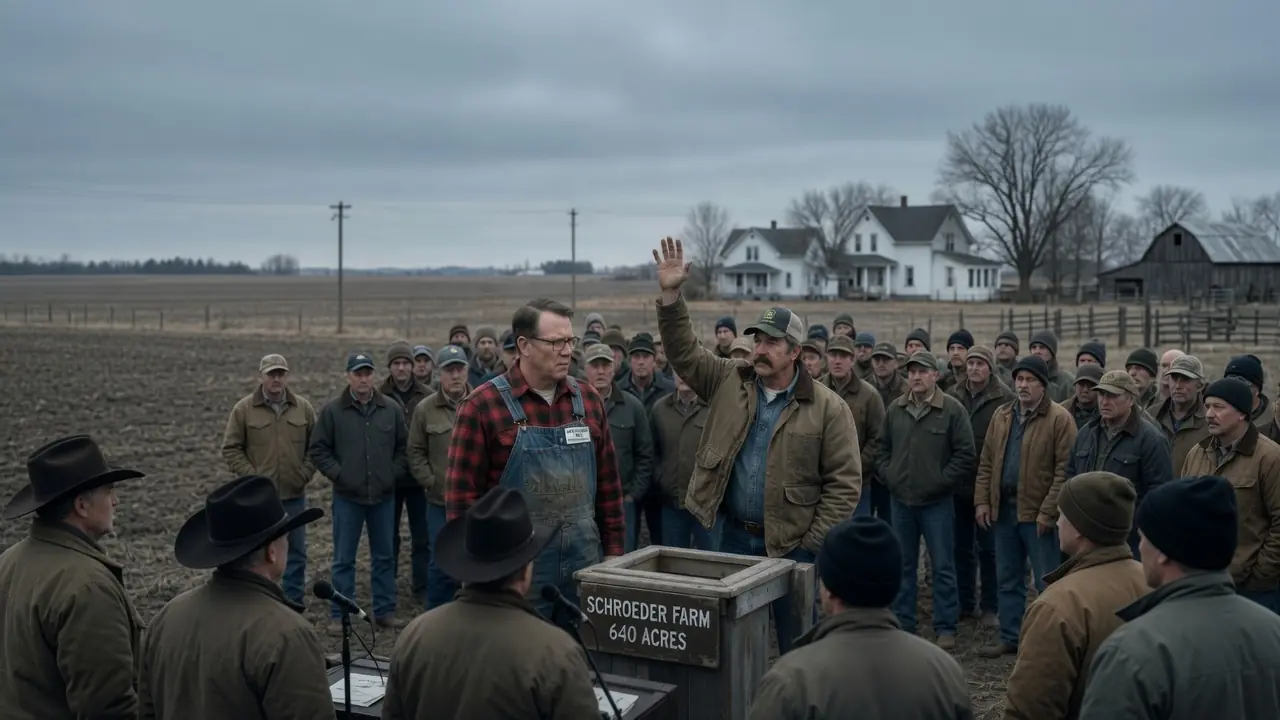
Another voice followed. “I’ll put in a thousand.” That was Frank Tiller, dairy farmer, hands wrapped in cracked leather gloves. Then another farmer raised a hand. Then another. Within one minute, the auction yard stopped being a crowd and became something else entirely.
Harold Benton looked lost. “Folks, this is not a cooperative lot.” Mary Ellen shouted back, “Then write fast, Harold.” A few farmers laughed, but not lightly. The laugh carried anger, fear, and the first spark of power anyone had felt all morning.
Elias’s face hardened. “This is irregular.” Daniel finally looked directly at him. “So is stealing a seed line from the families who kept it alive.” Elias turned to Harold. “You cannot accept pooled bids without formal registration.”
Harold hesitated. He was an auction official, not a man built for moral crises. But he was also from Worth County, and his father had planted Hawthorne corn in 1957. He looked at the chest, then at the crowd, then at Elias Mercer’s polished shoes sinking slightly into the gravel. “I can accept a designated buyer backed by registered contributors,” Harold said carefully.
The crowd erupted in approval. Elias’s jaw flexed. “Fine,” he said. “Fifty thousand.” The number fell like a hammer. For a moment, the farmers’ courage wavered under the weight of it.
Daniel felt the old fear return. Fifty thousand dollars for seeds that might not even sprout. Fifty thousand dollars to fight a company that could spend ten times that on lunch for lawyers. He looked at the cedar chest and imagined it locked in a Meridian vault, its labels scanned, its history stripped, its future sold back to farmers in glossy bags.
Before he could speak, a young man in a denim jacket stepped forward. “My dad died owing Meridian money for seed he couldn’t replant,” he said. “I’ll put in two thousand.” An older woman raised her hand. “My family has planted Hawthorne wheat for three generations. Five hundred.” A mechanic from town called out, “I don’t farm, but I fix half the tractors here. Count me in for three hundred.”
Daniel’s eyes burned, but he did not look away. More hands went up. Five hundred. Two hundred. A thousand. Fifty dollars from a teenage farmhand who had come only to watch. The bids were no longer just money; they were names written back onto the chest.
Harold added quickly with a pencil. “We have combined backing at fifty-two thousand four hundred.” His voice had changed. It was stronger now. He looked toward Elias. “Bid stands at fifty-two thousand four hundred through bidder forty-seven.”
Elias’s expression turned cold enough to empty the air. “One hundred thousand.” The crowd went silent again, and this time even Harold lowered his pencil. Elias adjusted his coat and said, “Let’s end the theater.”
Daniel stared at him. One hundred thousand dollars was not a bid; it was a wall. Around him, the farmers who had found their courage moments earlier sank back into reality. Nobody had that kind of money lying around during a hard season. Not for an old chest, not for a principle, not even for memory.
Elias looked satisfied. “That is what the future costs,” he said. “And you people cannot afford it.” Daniel slowly lowered his hand. The movement hurt more than he expected. Harold looked at him with regret.
Then an engine rumbled behind the crowd. A dusty red pickup rolled into the yard and stopped near the grain truck. Daniel turned and saw his older brother, Calvin Hawthorne, stepping out with a folder in one hand and a face like thunder. Beside him came Daniel’s daughter, Elise, home from college in a brown barn jacket and muddy boots.
Calvin pushed through the crowd. “Danny,” he said, breathless, “don’t you dare lower that hand yet.” Daniel frowned. “Cal, I can’t.” Calvin shoved the folder into his chest. “Grandpa left more than stories.”
Daniel opened the folder with numb fingers. Inside was a yellowed copy of Samuel Hawthorne’s 1941 seed trust agreement, signed by three neighboring families and witnessed by the county clerk. The document stated that the Hawthorne Seed Chest and its contents could not be sold for exclusive private control if a family descendant or county farmer collective matched the reserve value within the auction period. Daniel stared at the words until they blurred.
Elise stepped beside him. “I found it in the university archive,” she said. “Grandpa filed a copy with the county extension office after the war. The chest isn’t just property. It’s a community trust.” Elias’s face changed for the first time. Not fear yet, but recognition that the ground had shifted under him.
Harold took the document and read it silently. Then he read it again. “Well,” he said into the microphone, voice rough, “that changes the terms.” Elias snapped, “That document is irrelevant without legal review.” Harold looked over his glasses. “Maybe. But it is recorded, witnessed, and attached to the seed ledger lot.”
The crowd began to stir. Daniel felt his daughter’s hand on his arm. “The trust sets the reserve at assessed preservation value,” Elise whispered. “Not corporate market value.” Harold checked the ledger note attached to the auction file. “Preservation reserve is listed at fifty thousand dollars.”
Daniel looked at Elias. Slowly, he raised his hand again. “Fifty-two thousand four hundred, backed by the county farmers.” Harold nodded. “Bid accepted under trust terms.”
Elias stepped forward, rage flashing beneath his polished surface. “Meridian AgriGen will sue every person in this yard.” Mary Ellen Voss called from the crowd, “Get in line behind the weather and the bank.” This time the laughter was louder, realer, and it belonged to people who had remembered they were not alone.
Harold lifted the gavel. “Any qualifying community bid above fifty-two thousand four hundred?” Nobody spoke. Elias tried to raise his card again, but Harold shook his head. “Exclusive corporate bid does not qualify under the trust restriction.” Elias looked as if he had swallowed glass.
“Going once,” Harold called. Daniel kept his hand raised. “Going twice.” The wind moved across the field and rattled the bare branches behind the farmhouse. “Sold to bidder forty-seven on behalf of the Worth County Farmer Seed Trust.”
The gavel struck wood. The sound was small, but it seemed to travel across every acre surrounding the auction yard. Farmers who had stood silent all morning began clapping, not wildly, not like a celebration at a fair, but with the heavy relief of people who had seen something nearly lost and pulled it back at the last second.
Elias Mercer did not clap. He removed his gloves slowly, shoved them into his coat pocket, and stepped close to Daniel. “You think you won today,” he said. “But you still have seeds older than your machinery, debts bigger than your pride, and a county full of farmers who can’t agree on rainfall, let alone preservation.”
Daniel looked at him calmly. “Maybe.” He picked up the cedar chest with both hands. “But we have the chest.” Elias’s mouth tightened. Daniel added, “And you don’t.”
Meridian’s representatives left before the paperwork was finished. Their black SUV rolled down the gravel drive, past the white farmhouse, past the bare trees, and out toward the highway. Nobody waved. Harold and Calvin set up a folding table, and one by one, farmers signed the trust contribution sheet.
Some gave money. Some pledged storage space. One retired schoolteacher offered to transcribe the ledger. A mechanic offered to repair the old seed cleaner in Daniel’s barn. Mary Ellen promised an acre of bottomland for test planting in spring.
By sunset, the Hawthorne Seed Chest sat in Daniel’s pickup under a quilt from Mary Ellen’s truck. It looked smaller there, almost ordinary. Daniel stood beside it while Elise photographed every page of the ledger with her phone. Calvin leaned against the tailgate and said, “Grandpa would’ve enjoyed watching that suit turn purple.”
Daniel laughed for the first time all day. Then he grew quiet. “I almost let it go.” Elise looked up from the ledger. “But you didn’t.” Daniel touched the cedar lid. “No. We didn’t.”
Spring came late that year. Rain turned the low fields soft, and the first test plots were planted across five farms in Worth County. Nobody expected miracles. Half the seeds might fail, the extension agent warned, and the other half might produce uneven stands. But when the first green shoots broke through the soil, farmers drove out just to see them.
By July, the Hawthorne corn stood shorter than modern hybrids but thick-stalked and stubborn. The wheat held steady through a dry spell that curled the leaves in neighboring fields. Word spread fast, but this time the farmers were careful. They documented everything, saved seed properly, and brought in university researchers who agreed in writing that the line would remain open-source under the community trust.
Meridian AgriGen filed two lawsuits. They lost the first on standing and withdrew the second after the public attention turned ugly. A newspaper headline called it “The Little Seed Chest That Beat a Giant.” Daniel hated the headline, but Mary Ellen clipped it and taped it inside the seed-cleaning shed.
The Hawthorne Seed Trust did not make anyone rich. That was never the point. It gave farmers another option, a line of seed they could save, trade, study, and improve without signing away control. It reminded them that survival was not always invented in laboratories or boardrooms; sometimes it was preserved in barns by people who did not know history would need them later.
Years afterward, Daniel would remember the auction less as a victory than as a beginning. He remembered the gray sky, the cold wind, Elias Mercer’s contempt, and the terrible weight of raising his hand when he had no idea how he would pay. But most of all, he remembered the hands that rose after his. Mary Ellen, Frank, the mechanic, the teenage farmhand, his brother, his daughter, and every farmer who decided that a seed chest was worth more than its price.
At the next county fair, the trust displayed the cedar chest behind glass with the original ledger open beside it. Children pressed their noses near the case and asked why everyone cared so much about old seeds. Daniel told them the truth. “Because somebody saved them before we knew we needed them.”
A little boy asked if the seeds were magic. Daniel smiled and shook his head. “No,” he said. “They’re better than magic. They’re proof.” The boy frowned. “Proof of what?”
Daniel looked across the fairgrounds at the farmers talking beside the display, at Elise explaining the trust to a reporter, at Mary Ellen handing out small paper packets of approved seed samples for school gardens. “Proof that people don’t have to let everything valuable get bought,” he said. “Proof that sometimes, if one person raises a hand, others remember they can raise theirs too.”
That was the story of the Hawthorne Seed Chest. Not a treasure box, not a miracle crop, not a perfect answer to modern farming. It was a small cedar chest full of old seeds, saved by one generation, nearly taken by another, and protected by a crowd of people who were tired of watching everything that mattered disappear into someone else’s paperwork.
And on that cold gray morning in Worth County, when Elias Mercer came to bury it, Daniel Hawthorne raised his hand. Then the farmers raised theirs. And the future of those seeds stayed where it belonged: in the dirt, in the weather, in the hands of people who knew how to keep things alive.