Nobody in the Iron Horse Saloon cared who cooked supper as long as the plate arrived hot and full. The cattle hands, prospectors, freight drivers, and miners who crowded the tables every night rarely looked beyond the swinging kitchen doors except when the stew ran low. To most of them, the broad woman working beside the stove was no more remarkable than the iron range, the water barrel, or the butcher block. Her name was Mabel Harlan, though half the men who ate her food every night did not know it.
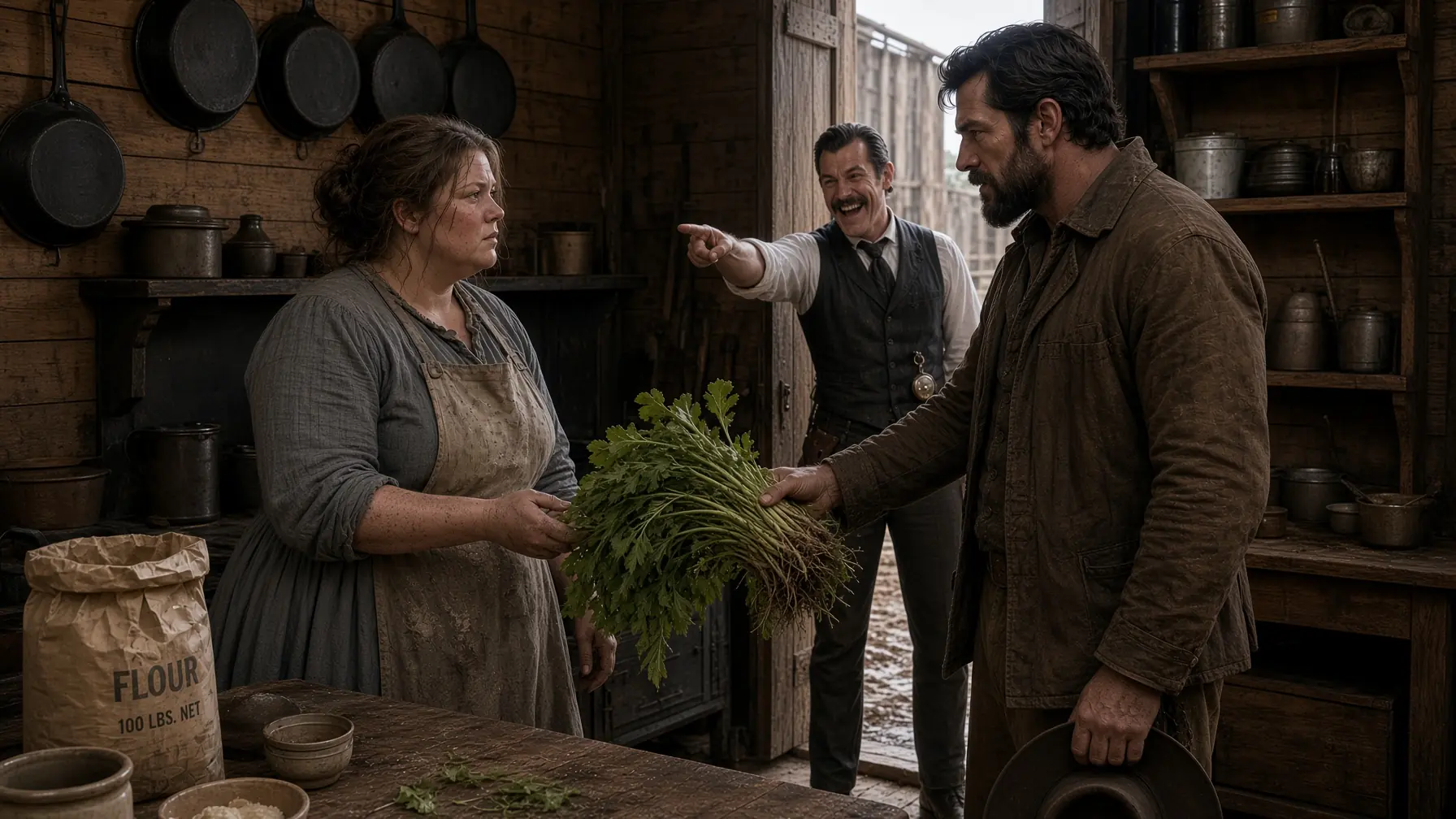
Mabel was twenty-nine years old and built with the heavy strength of somebody who had spent most of her life lifting what other people considered too heavy. Her arms were thick, her shoulders broad, and her faded gray dress disappeared beneath a canvas apron permanently marked by flour, grease, smoke, and old burns. Strands of brown hair escaped the knot behind her head whenever the kitchen became hot, which meant they were almost always stuck against her damp forehead by noon.
The kitchen smelled of rendered pork fat, boiled onions, stale beer drifting in from the saloon, and wet wool drying too close to the stove. Mabel moved through it with the deliberate efficiency of someone who had repeated the same motions thousands of times: chop, stir, lift, carry, wash, begin again. She could move a stockpot that required two men when it was full, could break down a side of beef without wasting meat, and could judge an oven’s heat by holding her palm near the door for three seconds. Nobody had ever called any of that skill.
Victor Sloane, owner of the Iron Horse, called it employment. He was a narrow man with a polished mustache, sharp cheekbones, and a silver watch he checked whenever somebody else seemed to be moving slower than he preferred. Victor believed every minute he paid for belonged to him, including the minutes Mabel spent breathing.
“Table four wants another round of stew,” he barked one evening, pushing through the kitchen doors. “And put more gravy in it this time. Those boys are paying in good silver.”
Mabel took the ladle and filled three bowls. Victor hovered until she added another spoonful to each, then snapped, “Move along, Mabel. They haven’t got all night.” She handed him the tray without answering, and he carried it out as though the food had appeared because he ordered it loudly enough.
He never thanked her. Neither did most customers, although a few occasionally shouted complaints about salt, portion size, or how long they had waited. Once a drunken drover wandered into the kitchen looking for the alley door, knocked a sack of cornmeal from Mabel’s hands, and cursed her for standing in his way.
“Damn cow takes up half the room,” he muttered before stumbling past.
Mabel had looked at the cornmeal scattered across the floor. Then she fetched the broom. She had learned years earlier that indignation was expensive when a woman had no family nearby, no savings worth mentioning, and no better employment waiting down the street.
She had come to Deadwood Country after her father died and the small boardinghouse where she worked closed. Victor provided a narrow room behind the kitchen, meals, and wages that sounded reasonable until he began subtracting charges for lodging, laundry soap, broken dishes, fuel, and anything else he believed could be entered into a ledger. Mabel knew the arrangement favored him. She also knew February nights in the Dakota Territory were cold enough to make bad employment feel safer than no employment.
Her body made things worse. Mabel had been heavy since girlhood, and the frontier possessed no shortage of men eager to treat a large woman as though her shape were a public invitation to comment. She learned to walk past laughter, ignore jokes, and stop hoping anyone might someday look at her with the admiring curiosity reserved for slimmer women in illustrations left behind by traveling salesmen. She used those illustrated pages to start the stove.
The kitchen became the one place where appearance mattered less than result. Flour did not care how wide her hips were, yeast did not laugh, and cast iron rewarded attention with consistency. Mabel trusted ingredients because they behaved according to rules she could learn.
Her favorite thing to make was cornbread.
She kept one black skillet for it and refused to let Victor’s dishwasher soak the iron in harsh lye water. Before supper, she heated the skillet directly on the range, added bacon drippings, and waited until the fat shimmered just short of smoking. Into a bowl went coarse stone-ground cornmeal, a smaller amount of wheat flour, clabbered milk from a farmer outside town, salt, soda, and an egg when she could afford one.
Mabel never measured anymore. Her fingers knew the feel of batter that would remain tender rather than turn dense, and her ear recognized the sound she wanted when the mixture hit the hot grease. A proper hiss meant the crust would begin forming before the skillet reached the oven.
She poured.
The batter exploded around the edges in a ring of bubbles. Mabel waited several seconds, watching the border turn darker, then slid the skillet into the oven. Twenty-five minutes later the cornbread came out with a cracked golden top, a crisp brown edge, and enough savory smoke from the bacon fat to make three cowboys near the kitchen doors turn their heads without understanding why.
That evening, winter arrived with violence.
A storm swept down from the Black Hills just after sunset, driving snow sideways through every gap around the saloon door. The windows rattled, horses stamped uneasily outside, and customers abandoned the colder tables to gather around the potbellied stove. Then the front doors flew open hard enough to extinguish two lamps.
A stranger filled the doorway.
He was enormous, taller than most men in the room and built heavily across the chest and shoulders beneath a buffalo-hide coat crusted with snow. A dark beard covered most of his face, ice clung to it, and a wide hat shadowed eyes that moved slowly across the saloon. The room quieted without anybody asking it to.
Victor appeared behind the bar. “Evening, stranger. Whiskey?”
“Food.”
The man’s voice was deep but tired rather than threatening.
“Stew and cornbread, then. Two bits.”
The stranger placed a silver coin on the bar and chose a small table against the wall. He removed his gloves but not his coat, stretching large scarred hands toward the stove for a moment before sitting. Victor hurried into the kitchen.
“Mabel, one stew and a big piece of bread. Fast.”
She filled a plate.
The stew had simmered most of the afternoon with beef bones, onions, potatoes, carrots, and the last of the turnips from autumn storage. Mabel cut a thick wedge from the fresh skillet of cornbread and placed it beside the bowl. Victor took the plate and disappeared.
Mabel returned to trimming salted beef.
She heard the saloon gradually recover from the stranger’s entrance. Cards slapped tables again, somebody restarted the piano, and men resumed conversations designed to be heard from three tables away. Then a chair scraped loudly across the floor.
Mabel stopped cutting.
The stranger had tasted the cornbread.
His name was Rhett Callahan, though nobody in the Iron Horse knew it yet. He had spent four days in the high timber checking trap lines and searching for two missing pack animals after a storm drove them from his claim. Most of what he had eaten during that time came from dried meat, biscuits hard enough to injure somebody, and coffee boiled so many times it tasted like a scorched boot.
The stew was good.
The bread stopped him.
Rhett took one bite, chewed slowly, and stared down at the wedge in his hand. He tasted the slight sourness from clabbered milk, the mineral roughness of genuine stone-ground meal, the salt, the smoke, and the crisp fried edge created only when batter struck properly heated grease.
He took another bite.
Then he stood.
Several men watched as Rhett carried his plate toward the kitchen doors. Victor hurried to intercept him.
“Need something else?”
Rhett continued walking.
“Patrons aren’t allowed back there.”
“I need to speak to whoever baked this.”
Victor laughed. “Mabel?”
Rhett stopped.
Victor tilted his head toward the doors. “Nothing back there but a stove and the big woman running it. Tell me what’s wrong and I’ll deal with her.”
Rhett looked at him for several seconds. “Nothing is wrong.”
Victor’s smile weakened.
“Then sit down.”
“Move.”
Rhett did not threaten him. He simply waited until Victor, after calculating the difference between pride and physical dimensions, stepped aside. Rhett pushed through the kitchen doors.
Mabel had turned toward him with her cleaver still in one hand. Men did not enter her kitchen unless they were drunk, angry, or lost, and none of those possibilities usually improved her evening. She stared at the stranger in the buffalo coat.
“You make this?” he asked.
Mabel glanced at his plate.
“I did.”
“What’s wrong with it?”
Rhett seemed surprised by the question. Then he removed his hat.
“Nothing.”
Mabel did not lower the cleaver.
Rhett held up the remaining bread. “You heated the skillet first.”
Her expression changed.
“Yes.”
“Bacon drippings?”
“Yes.”
“Stone-ground meal?”
Mabel lowered the cleaver an inch. “Mostly.”
Rhett took another bite, considered it, then looked directly at her.
“My mother made cornbread this way outside Knoxville when I was a boy. Haven’t tasted one done properly since she died.”
Mabel stared.
Rhett continued, “Most places make it too soft or too sweet. Yours has structure.”
Nobody had ever said the word structure about something Mabel cooked.
He looked at the burn marks along her forearms and the flour across her apron, then met her eyes again. “Fine piece of work, ma’am. I wanted to thank the hands that made it.”
Mabel felt something tighten painfully beneath her ribs.
She had been called strong before, though rarely as praise. She had been called useful, dependable, enormous, slow, ugly, sturdy, ox, cow, and worse. Nobody had ever walked into that kitchen solely because he believed something she created deserved respect.
“Thank you,” she finally said.
Rhett nodded.
He did not stare at her body. He did not compliment her with exaggerated kindness designed to prove he was charitable. He simply treated her like someone who knew what she was doing.
“I’ll probably pass through again after the thaw,” he said. “Hope you’re still cooking.”
Mabel almost told him she would be.
Instead she said, “Winter lasts a while here.”
Rhett smiled slightly. “So do I.”
Then he put his hat back on and left.
Mabel stood motionless until the swinging doors stopped moving.
Afterward she looked at her hands.
Thick fingers.
Burn scars.
Cracked knuckles.
Flour embedded around the nails.
For years she had seen them only as evidence of labor.
That night, for the first time, she saw tools.
Winter settled over the territory like iron.
Snow buried the road, temperatures dropped below zero for days at a time, and the Iron Horse became a cramped refuge for men trapped between jobs and seasons. Tempers shortened as money disappeared. Victor began stretching food farther while increasing prices.
Mabel continued cooking.
Something had changed, though not enough for anyone else to name immediately. She scrubbed her cast iron more carefully, rejected meat that smelled spoiled, and stopped allowing Victor to bully her into serving food she considered unsafe. When he told her to thicken stew with flour contaminated by weevils, Mabel sifted it first and threw the insects into the stove.
Victor noticed.
“You’re getting particular.”
“I’ve always been particular.”
“Not with my money.”
Mabel looked at him. “People stop buying stew if they get sick.”
He opened his mouth, then closed it.
That bothered him more than an argument would have.
For years Mabel had responded to humiliation by shrinking into work. Now she met Victor’s eyes. She still followed reasonable instructions, but she no longer reacted as though every insult contained a truth she had failed to recognize.
One February morning, Victor announced that food costs required another reduction in portions. “Pork ends and beans until spring,” he said. “Water the beans down.”
“The miners won’t stay full.”
“They’ll drink more whiskey.”
“That what you want?”
“That is exactly what I want.”
Mabel peeled another potato.
Victor leaned against the butcher block. “Don’t start thinking you’re important because some half-wild mountain man praised your bread.”
Her knife stopped.
Victor continued. “You’re hired help, Mabel. An oversized hired hand I provide a roof to when nobody else would.”
Mabel resumed peeling.
He waited for her to look wounded.
She did not.
“Leave the pork by the stove,” she said.
Victor smiled, believing he had won.
When he left, Mabel set the knife down because her hand had started shaking. Rhett Callahan had not transformed her life with five respectful sentences, and she did not pretend otherwise. But once somebody had described her work accurately, Victor’s description of her became harder to accept as fact.
She checked the small tin box beneath the floorboard in her room that night.
Twenty-seven dollars and forty cents.
Not enough to begin a new life.
Enough to begin thinking about one.
April turned the snow to mud.
Freight wagons returned, cattle began moving again, and the Iron Horse filled with men carrying fresh wages. Mabel worked fourteen-hour days frying ham, baking bread, thickening stews, and making breakfast cakes for customers who had forgotten winter poverty the instant silver returned to their pockets.
Then the piano stopped.
Mabel heard the shift through the kitchen doors before she understood it. Conversations lowered, chairs scraped, and boots crossed the saloon floor with a slow weight she remembered. A second later, the kitchen doors opened.
Rhett Callahan stood there.
Without his buffalo coat, he somehow looked larger. He wore a canvas work jacket over red flannel, his beard was trimmed shorter, and winter had made his face leaner around the eyes. In one hand he carried a burlap sack.
Mabel’s pulse stumbled.
“I said I’d come back.”
“You did.”
Rhett set the sack on her butcher block.
Inside were bundles of wild onions and early greens gathered near a creek farther south. Their roots had been wrapped in damp cloth to keep them fresh.
Mabel touched one bundle.
“You carried these three days?”
“Closer to four.”
“For stew?”
Rhett shook his head.
“For you.”
Mabel looked at him.
“Why?”
“You said winter lasts a while.”
She almost smiled.
“So?”
“Thought you might want proof it ended.”
That was when Victor entered.
He took one look at Rhett and his expression soured. “I told you patrons stay out of my kitchen.”
“I’m not here to eat.”
“What are you here for?”
Rhett looked at Mabel rather than Victor.
“I bought a small timber claim north of Black Ridge last year. Thirty acres, good water, a cabin, smokehouse, enough cleared ground for a garden once somebody smarter than me decides where it belongs.”
Mabel stopped breathing normally.
Rhett removed his hat.
“I’ve spent most of my life alone because it was easier. I’m starting to think easier isn’t always better.”
Victor laughed behind him.
Rhett ignored it.
“I remembered this kitchen all winter,” he said. “Not only the food. You.”
Mabel’s face became hot.
Rhett continued carefully. “I’m not asking you to come cook for me.”
Victor laughed again. “Then what in hell are you asking?”
Rhett turned slightly. “Wasn’t talking to you.”
Then he faced Mabel.
“I’m asking whether you’d consider leaving this place and seeing the claim. You can say no. You can come for a month and decide you hate it. You can work somewhere else entirely if that’s what you want.”
Mabel swallowed.
“What would I be there?”
Rhett answered without hesitation. “A partner, if after some time we both decide we can stand each other.”
Victor barked another laugh.
“A partner?”
Mabel flinched.
Victor pointed toward her. “Look at her.”
Rhett did.
Completely.
Mabel felt the old instinct to lower her eyes.
She did not.
Rhett turned back to Victor. “I am.”
Victor’s smile disappeared.
“She owes me.”
Mabel looked at him.
Victor recovered immediately. “Room and board through the month. Laundry charges. Winter fuel. You walk out now, you owe seventeen dollars and eighty cents.”
Mabel’s stomach tightened.
Rhett reached toward his pocket.
She stopped him.
“No.”
Both men looked at her.
Mabel untied her apron.
“No one pays Victor for me.”
Rhett’s hand dropped.
Mabel crossed the kitchen to the shelf where Victor kept his account ledger during supper. She took it down and opened to her page.
“What are you doing?” Victor demanded.
“Checking.”
“You don’t touch my books.”
“You put my wages in them.”
Mabel ran one thick finger down the entries. She could read, though Victor often behaved as though she could not. Charges appeared for lodging, meals, soap, fuel, laundry, and two broken plates she remembered Victor’s bartender dropping during a fight.
She turned the ledger toward him.
“You charged me six dollars for January coal.”
“So?”
“I hauled the coal.”
“Still had to buy it.”
“You charged room and board separately.”
Victor’s face tightened.
Mabel turned another page.
“You deducted nine dollars for two broken serving platters.”
“You broke them.”
“Eddie Walsh broke them when he threw a chair.”
Victor said nothing.
Several saloon customers had gathered near the kitchen doors.
Mabel saw them.
So did Victor.
Ted Walsh, Eddie’s brother, spoke from the doorway. “Eddie did break those.”
Victor glared at him.
Ted shrugged. “Whole room saw it.”
Another man said, “I did.”
Victor’s face darkened.
Mabel continued through the ledger.
By the end, even accepting charges she disliked but could not dispute, Victor owed her considerably more in unpaid wages than she owed him for the remaining lodging period. He had assumed she would never calculate it.
Rhett leaned against the butcher block without speaking.
This was Mabel’s fight now.
Victor grabbed for the ledger.
Mabel closed it beneath one hand.
“I want my final wages.”
“You walk out, you get nothing.”
“Then I go to the sheriff.”
Victor laughed, but the sound lacked confidence. “Over cook’s wages?”
Rhett finally spoke.
“Sheriff likes ledgers.”
Victor looked toward him.
Rhett added, “Especially ones with altered numbers.”
Victor’s eyes flicked back to the page.
That was enough.
Mabel realized he knew some of the entries would not survive inspection.
“Pay me what the ledger says you owe after legitimate room and board,” she said. “Keep the disputed amount until Sheriff Bennett looks at it if you want.”
Victor glanced toward the customers in the doorway.
Public shame was finally costing him more than money.
He opened the cash drawer.
Mabel counted every coin.
Thirty-four dollars and twelve cents.
Combined with her savings, it was more money than she had possessed at one time in her life.
Victor slammed the drawer.
“You won’t last a month up there.”
Mabel folded the money into a cloth purse.
“Maybe.”
“You’ll come crawling back.”
“Maybe.”
Victor blinked.
Mabel looked at him. “But if I do, it’ll be because I chose wrong, not because you were right about me.”
The words left the room quiet.
Mabel walked to the peg beside the pantry and removed her coat. Then she stopped.
Her skillet.
The black iron pan hung above the stove, seasoned through years of heat and bacon fat. Victor technically owned most of the kitchen equipment, but Mabel had bought that particular skillet from a peddler with her own money four years earlier.
She took it down.
Victor opened his mouth.
Mabel looked at him.
He closed it.
Her trunk was in the back room.
Rhett carried it to the wagon, but only after Mabel handed it to him. She carried the skillet herself.
They walked through the center of the Iron Horse together.
Men watched.
Some looked amused.
Others looked embarrassed.
Ted Walsh removed his hat.
“Good bread, Mabel,” he said.
She stopped.
After all those years, the compliment was almost comically late.
Still, she nodded.
“Thank you.”
Outside, spring sunlight reflected from puddles along the street. Mud clung to Mabel’s boots immediately, and the wagon ride toward Black Ridge promised two days of cold nights and bad roads. Nothing about the future looked easy.
That was why she trusted it.
Rhett helped secure her trunk, then climbed onto the wagon seat. “Ready?”
Mabel looked back at the Iron Horse.
Victor stood inside the doorway.
For years she had believed he held her there with necessity.
Maybe necessity had been real once.
Now she understood that fear had continued doing Victor’s work long after necessity weakened.
“Ready.”
They rode north.
Rhett did not propose marriage on the trail.
He did not tell Mabel she had been beautiful all along or insist every man in Deadwood had been blind. He talked about timber prices, the creek, a bear that had repeatedly stolen smoked meat from his shed, and how he had built his chimney twice because the first version filled the cabin with smoke.
Mabel eventually asked, “You really remembered the cornbread all winter?”
“Yes.”
“Not me?”
Rhett looked toward her.
“Both.”
Her cheeks warmed.
He returned his attention to the horses.
That answer was enough.
The Black Ridge claim sat higher than Mabel expected. Rhett’s cabin was solid but plain, with two rooms, a stone chimney, shelves built slightly crooked, and a table large enough for four people despite his insistence that he had always lived alone. The creek ran fifty yards downhill, clear and cold beneath cottonwoods.
Mabel walked through every room.
Rhett stayed outside.
He understood she needed to inspect what he had invited her into without having him standing behind her waiting for approval.
When she came out, she asked, “Where would I sleep?”
“Cabin.”
“And you?”
“Smokehouse if you want.”
Mabel stared at him.
“It smells like pork.”
“I’ve slept worse places.”
She almost laughed.
“There’s another room.”
“Only if you’re comfortable.”
Mabel looked at the man who could probably carry her trunk beneath one arm yet stood waiting as though her answer had more weight than he did. “Other room,” she said.
Rhett nodded.
That became the arrangement.
Spring turned into summer.
Mabel discovered mountain living involved far more labor than saloon work, but the labor belonged to a life she participated in shaping. She planted beans, potatoes, onions, squash, and the wild ramps Rhett had carried from the south, while Rhett repaired fences, cut timber, hunted, and taught her which berries and mushrooms were safe.
She cooked because she loved cooking.
That distinction changed everything.
Rhett chopped vegetables.
Badly.
Mabel discovered this the first week when he reduced three onions into pieces ranging from dust to chunks large enough to require separate cooking times. She stared at the cutting board.
“What?”
“You said you were useful.”
“I cut trees.”
“This is smaller.”
“Exactly. Harder target.”
Mabel laughed.
It came out before she could stop it.
Rhett stared.
She became self-conscious immediately.
“What?”
“Nothing.”
“You’re staring.”
“Hadn’t heard you laugh.”
Her smile disappeared halfway.
Rhett looked back at the onion.
“Sounds good.”
He resumed chopping.
Mabel turned toward the stove so he would not see her eyes filling.
Their courtship happened without either of them naming it at first.
Rhett brought her interesting ingredients from trapping routes. Mabel learned he preferred coffee far too strong and pretended not to know when she deliberately made his cup that way. On cold evenings they sat outside until stars filled the sky and talked about things neither had told many people.
Rhett had been engaged once.
His fiancée died of influenza three weeks before their wedding.
After that, he left Tennessee, worked timber camps, hunted, trapped, and eventually bought the Black Ridge claim because silence asked nothing of him. Mabel understood immediately.
“You weren’t looking for solitude.”
“No.”
“You were looking for someplace nobody expected you to stop grieving.”
Rhett looked at her.
“That about covers it.”
Mabel told him about Victor.
Not only the insults.
The deeper part.
How gradually she had accepted the idea that a woman shaped like her should be grateful for tolerance instead of expecting affection. Saying the words aloud embarrassed her more than she expected.
Rhett did not immediately contradict her.
That surprised her.
Then he said, “You spent years around men who needed somebody beneath them.”
Mabel looked at him.
“People like that will use whatever feature is easiest. Weight. Poverty. Age. A limp. A bad name. Doesn’t make the feature the problem.”
She thought about that for days.
In September, Rhett asked whether she wanted to remain through winter.
Mabel stood beside the garden examining potatoes.
“Do you want me to?”
“Yes.”
“As your cook?”
“No.”
“Housekeeper?”
“No.”
She looked at him.
“What, then?”
Rhett removed his hat.
He did that whenever something mattered.
“As Mabel.”
Her throat tightened.
“That’s not an occupation.”
“I know.”
“What do you expect me to do?”
“Whatever work we agree needs doing.”
“And what do I get?”
“Half of whatever this place becomes.”
Mabel frowned. “You own the claim.”
“Then we can put the arrangement in writing.”
He did.
At the land office in town, they arranged documentation recognizing Mabel’s financial interest in improvements and livestock she purchased with her money rather than relying on promises that would vanish if Rhett died. The clerk thought the precaution unusually formal for two unmarried frontier people.
Mabel did not care.
Respect that disappeared when circumstances changed was not respect she wanted.
Winter returned.
This time Mabel entered it with shelves full of preserves, smoked meat overhead, sacks of flour and meal stored dry, and her black skillet hanging beside a stove she helped choose. The first blizzard hit in December.
She made cornbread.
Rhett sat at the table while she cut the first wedge.
He tasted it.
Then stopped.
Mabel crossed her arms.
“Well?”
He looked at the bread.
“Better.”
“Better than what?”
“First one.”
Mabel stared at him in mock offense. “Impossible.”
“Better.”
“Why?”
Rhett considered.
“Maybe because you’re eating this batch too.”
Mabel’s face softened.
At the Iron Horse, she had eaten scraps standing beside the stove after everyone else was served.
At Black Ridge, her plate waited at the same table.
The difference seemed small enough that no ballad would ever mention it.
It mattered more than almost anything.
Rhett proposed in March.
No kneeling.
No ring hidden in food.
They were repairing a section of fence damaged by snow when he put down the hammer and said, “I think we’re good at this.”
Mabel looked at the broken fence.
“You need higher standards.”
“I meant the life.”
She stopped.
Rhett rubbed one gloved hand across his beard.
“I love you.”
Mabel stared at him.
He continued before fear could stop either of them. “I don’t need an answer this minute.”
“Yes.”
Rhett blinked.
“Yes what?”
“Yes, I love you.”
He exhaled.
“Oh.”
Mabel laughed. “That’s impressive courtship.”
“I had more prepared.”
“Save it.”
Then she kissed him.
They married in May at the county courthouse with the land clerk and an elderly storekeeper as witnesses. Mabel wore a blue dress she sewed herself because she refused to spend money on something she would wear once. Rhett wore a clean shirt and looked more nervous than he had facing an injured grizzly the previous autumn.
Nothing magical happened afterward.
Mabel remained heavy.
Her burn scars remained.
Rhett snored.
He left socks in places that made no sense.
She occasionally became quiet for entire afternoons after remembering something Victor had said years earlier.
Marriage did not remove old wounds.
It gave them a place where those wounds were not constantly reopened.
Three years later, Rhett and Mabel opened a small roadside kitchen near the junction where freight wagons turned toward Deadwood.
They called it Harlan & Callahan’s Table.
Mabel insisted her name come first because she did most of the cooking.
Rhett agreed immediately because he preferred living.
Freighters stopped.
Ranch families stopped.
Miners stopped.
Mabel served stew, beans, roast meat, vegetables, biscuits, and cornbread from the same black skillet she carried out of the Iron Horse.
One afternoon a young woman named Elsie arrived looking for work.
She was painfully thin, nervous, and apologized after almost every sentence.
Mabel hired her to help with dishes and baking.
Three days later Elsie broke a plate.
She froze.
“I’m sorry,” she whispered. “Take it out of my wages.”
Mabel looked at the pieces.
“Did you throw it?”
“No.”
“Then accidents happen.”
Elsie stared.
Mabel handed her a broom.
“Clean it before somebody cuts a foot.”
That was all.
Months later, Elsie told Mabel she almost cried that day.
Mabel understood.
Years passed.
The roadside kitchen expanded.
Rhett added a second room.
Then a porch.
Then two guest rooms for travelers stranded by weather.
One wall displayed no photographs of famous men or hunting trophies.
Only a framed handwritten menu.
At the bottom, beneath stew and coffee, were the words:
Skillet Cornbread — Served Hot.
Customers frequently complimented it.
Mabel always said thank you.
She never acted as though praise embarrassed her anymore.
One summer afternoon, a freight driver asked Rhett how the two of them met.
Rhett pointed toward the kitchen.
“Cornbread.”
The driver laughed. “You married a woman over bread?”
Mabel called from the stove, “Watch your next sentence.”
The room laughed.
Rhett smiled.
“No.”
He looked toward her.
“I noticed her because of the bread.”
Mabel paused.
Rhett continued, “I married her because once I started looking, I found out who made it.”
The freight driver went quiet.
So did Mabel.
Later that night, after the customers had left and the lamps burned low, she stood beside the sink washing the black skillet. Rhett came behind her and rested one hand lightly against the middle of her back.
“Too much?”
She shook her head.
“No.”
The Iron Horse Saloon closed eventually.
Victor Sloane sold it after a gambling debt swallowed more of his money than he expected. Somebody later told Mabel he moved east and opened another drinking establishment.
She felt almost nothing.
That surprised her.
For years she imagined that escaping Victor would only feel complete if he suffered enough to balance what he had done. Time taught her otherwise.
His misery was not required for her happiness.
One autumn, Mabel and Rhett passed through the old town on their way south.
The Iron Horse building was still there, though the sign had changed.
Mabel stood across the muddy street for a moment.
Rhett waited beside the wagon.
“You want to go inside?”
“No.”
“You sure?”
“Yes.”
She looked at the swinging doors.
Once, that kitchen had been the entire map of her future.
Now it was simply a building.
Mabel climbed back onto the wagon.
Rhett handed her the reins.
“You driving?”
“You complain too much when I drive.”
“I complain because you hit every hole.”
“Then be quiet.”
Rhett smiled.
“Yes, ma’am.”
They rode away.
The skillet sat wrapped in cloth behind them.
Mabel had once believed its value came from being the only thing she could control.
She eventually understood something better.
The skillet had never saved her.
Neither had Rhett.
A stranger had simply walked into a kitchen and described something accurately: her hands knew how to make something good.
That small piece of truth made the larger lies harder to keep believing.
Mabel did the rest.
She counted her wages.
She confronted Victor.
She untied her apron.
She chose the wagon.
She chose Black Ridge.
She chose partnership.
She chose love only after learning that gratitude and love were not the same thing.
Years later, customers still talked about the first bite of Mabel Callahan’s cornbread.
They mentioned the crisp bacon-fried edges, the coarse meal, the sour tang, and the way steam escaped when the wedge broke open.
Rhett always listened.
Sometimes someone would ask for the recipe.
Mabel never refused.
She would explain the meal, the clabbered milk, the hot skillet, and the importance of not overworking the batter. Then she would point toward the cast iron and say, “The pan has to be hot enough to answer when the batter hits.”
People usually understood she was talking about cooking.
Rhett knew better.
On quiet evenings, when the last traveler had gone and the kitchen finally belonged only to them, Mabel sometimes caught him looking at her hands.
They were older now.
Still broad.
Still scarred.
Still strong.
She would raise an eyebrow.
“What?”
Rhett would smile.
“Fine piece of work, ma’am.”
And even after all those years, Mabel Harlan Callahan would smile like the woman in the Iron Horse kitchen hearing it for the first time.