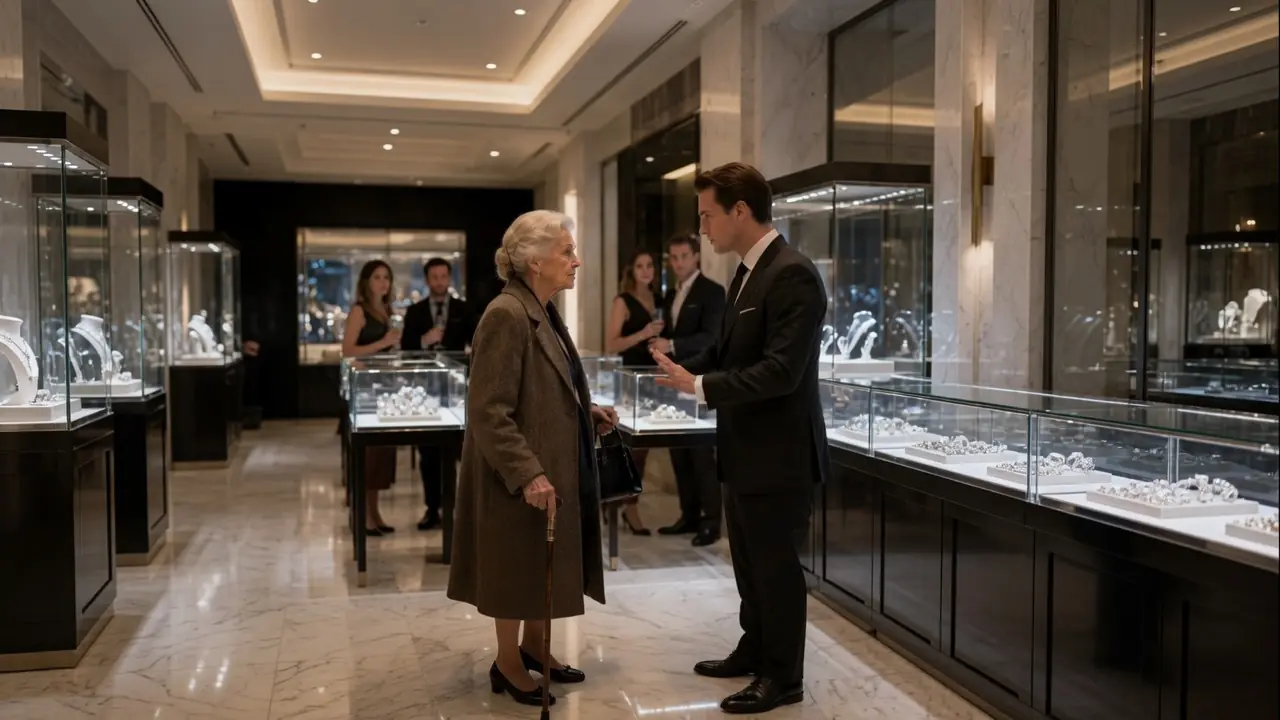
Eleanor Whitmore stepped into the diamond boutique on Madison Avenue just after noon, leaning gently on her cane while the glass doors closed behind her with a soft whisper. The room around her glittered with white marble, crystal chandeliers, polished display cases, and diamonds arranged beneath perfect lights like tiny captured stars. She wore an old brown wool coat, clean but faded at the elbows, and a pair of worn leather pumps she had polished carefully that morning. At ninety years old, she moved slowly, not because she was helpless, but because she had learned the value of taking in a room before letting the room take in her.
The first person to judge her was not a customer, though several looked up when she entered. It was the young salesman standing near the center display case, a handsome man named Preston Vale with a fitted black suit and a smile that changed the second his eyes reached her shoes. He looked at the cracks in the leather, the practical heel, the cane in her right hand, and the lack of diamonds around her wrist or neck. By the time his gaze returned to her face, he had already decided exactly how much respect she deserved.
Eleanor noticed the look because she had been noticing that kind of look all her life. It was the same look bank clerks had given her in the 1960s when she opened her first business account with money hidden in an envelope under her coat. It was the same look jewelry suppliers gave her late husband when they assumed a Black-owned store would never survive in a wealthy district. It was the same look people offered when they mistook age, simplicity, or silence for weakness.
She did not speak first. She simply walked toward the center case, where a large white diamond rested on black velvet beneath a single column of light. The stone was famous in the industry, not only because of its size, but because of its history. Eleanor knew that history better than anyone in the room, because her company had bought the stone at auction twenty-two years earlier.
Preston stepped in front of the case before she could reach it. His smile was polished, but his body language was a locked door. “Ma’am, you’re welcome to look,” he said, keeping his hands folded neatly in front of him, “but please don’t touch anything.” The words were soft enough to pretend courtesy, but loud enough for nearby customers to hear.
A young couple holding champagne flutes glanced over. A businessman studying loose diamonds lifted his eyes from his tray. Behind another glass case, a woman in a black dress stopped mid-sentence and watched with curious amusement. The boutique did not become loud, but it became aware, and that was worse.
Eleanor stopped directly in front of Preston and looked at him with calm gray eyes. “I heard you,” she said. Her voice carried no anger, no embarrassment, and no apology. That seemed to unsettle him more than a complaint would have.
Preston gave a small, practiced laugh, the kind people use when they want an insult to sound like professionalism. “It’s just policy,” he said, glancing again at her shoes before forcing his eyes back to her face. Eleanor looked past him to the diamond, then returned her gaze to him. “Policy,” she repeated softly, as if testing the word for cracks.
Eleanor shifted her cane slightly and took one slow step to the side. Preston moved with her immediately, still blocking her path. It was a small movement, but everyone who was watching understood its meaning. He was not simply protecting the diamonds; he was preventing her from belonging near them.
“Is there a problem?” a new voice asked. The boutique manager, Daniel Pierce, approached from the far end of the showroom in a perfectly tailored black suit. He was forty-eight, handsome in a controlled way, and carried himself with the confidence of a man who knew how to flatter wealth before it entered the room. He looked first at Preston, then at Eleanor, and his face performed the same quick calculation.
Preston smiled with visible relief. “No problem at all, Mr. Pierce,” he said. “I was simply explaining that our collection pieces are available for viewing only unless appointments are arranged in advance.” Daniel nodded as if that sounded reasonable. Then his eyes moved over Eleanor’s cane, old coat, modest handbag, and worn shoes.
Eleanor watched the judgment form behind Daniel’s smile. It took less than a second, but she saw it clearly. That was something age had given her, the ability to read disrespect before it fully dressed itself in manners. Daniel did not see a customer, a collector, or a woman with a history; he saw an inconvenience.
“Ma’am,” Daniel said smoothly, stepping closer, “Preston is correct.” He gestured gently toward the cases, as if the diamonds were delicate children and Eleanor had wandered too near them. “Our boutique handles rare pieces, and we must follow strict viewing procedures.” His voice sounded kind, but his eyes were already pushing her toward the exit.
Eleanor tilted her head slightly. “And if I had entered wearing newer shoes?” she asked. Preston’s smile tightened, and Daniel’s expression flickered. The question was too direct to ignore, yet too calm to dismiss as hysteria. Several customers looked up again.
Daniel cleared his throat. “This has nothing to do with your shoes,” he said. Eleanor looked down at her pumps, then back at him. “That is interesting,” she replied. “Because your salesman noticed them before he noticed me.”
A small silence opened around them. Preston’s jaw flexed, and Daniel’s polite smile thinned at the edges. He was beginning to dislike the fact that she was not behaving like a woman he could embarrass into leaving. Eleanor’s cane remained steady in her hand, and her shoulders stayed perfectly straight.
Daniel lowered his voice, though not enough to keep others from hearing. “Ma’am, I do not want this to become uncomfortable.” Eleanor’s eyes sharpened. “For whom?” she asked. The young woman with the champagne glass covered her mouth with one hand, not laughing now, only realizing the old woman was far less fragile than she looked.
Preston stepped in again, annoyed that the scene had not ended. “There are other stores more suited for browsing,” he said. “This is a private luxury boutique, not a public showroom.” Eleanor looked at him for a long moment. “Luxury must be very weak,” she said, “if an old woman’s presence can threaten it.”
Daniel’s face hardened. “That is enough,” he said. Eleanor did not move. He took one step closer, lowering his voice into something colder. “If you don’t get out, I’ll call security to throw you out.”
The words crossed the showroom and changed the air completely. The young couple froze. The businessman lowered his diamond loupe. Preston looked briefly satisfied, as if Daniel had finally said what everyone of their kind should have been allowed to say.
Eleanor did not flinch. She opened her handbag with slow, careful fingers and removed a slim phone. Preston gave a quiet laugh under his breath, assuming she was calling a relative, a driver, or someone to rescue her from embarrassment. Daniel folded his hands in front of him, waiting with the impatience of a man who believed the scene was almost over.
Eleanor tapped one message and sent it. She put the phone back in her handbag, rested both hands over the head of her cane, and waited. Preston glanced at Daniel, then smirked at the customers as if inviting them to share the absurdity of the moment.
Thirty seconds later, every employee phone in the boutique vibrated at exactly the same time. The sound came from Preston’s pocket, Daniel’s jacket, the reception desk, the manager’s office, and the security station near the rear entrance. Preston frowned and reached for his phone. Daniel did the same, but the moment he read the message, every trace of color left his face.
The rear office door opened so quickly it struck the wall. A woman in a navy suit hurried out first, followed by two senior staff members and a security supervisor who suddenly looked far less willing to throw anyone anywhere. The woman in navy was Miranda Cole, regional director of Whitmore Luxury Holdings. She did not look at Daniel first, and she did not look at Preston at all.
She walked straight to Eleanor and stopped with both hands clasped in front of her. “Mrs. Whitmore,” Miranda said, her voice full of respect and visible alarm. “Welcome back.” The entire showroom went silent.
Preston blinked as if he had misheard. Daniel stared at Miranda, then at Eleanor, then back at the message on his phone. The young couple near the entrance slowly lowered their champagne glasses. The businessman pushed his tray of diamonds away from him as if distance might protect him from the shame now filling the room.
Eleanor looked at Miranda calmly. “Thank you, Miranda.” Her voice had not changed at all. That was what made the moment so devastating. She had sounded the same when she was being insulted as she sounded when everyone discovered she owned the room.
Preston swallowed. “Mrs. Whitmore?” he whispered. Miranda turned toward him, and her expression made him take half a step back. “Eleanor Whitmore,” she said, each word careful and cutting. “Founder and majority owner of Whitmore Luxury Holdings, including this boutique, this building, and the collection you were just preventing her from viewing.”
The silence that followed was worse than shouting. Daniel’s eyes dropped to Eleanor’s worn shoes, then immediately lifted again, as if he understood too late what those shoes had exposed in him. Preston looked physically smaller, his polished suit suddenly unable to hide the cheapness of his judgment. Eleanor let them sit inside that silence before she spoke.
“I would like the center case opened,” she said. Miranda turned immediately. “Of course, Mrs. Whitmore.” Daniel moved as if to assist, but Eleanor raised one hand slightly. He stopped.
“Not you,” she said. Daniel’s face tightened with humiliation. Miranda nodded to another senior associate, who rushed forward with the proper key and access card. The case opened with a soft mechanical click, and the great white diamond sat between them like a witness.
Eleanor stepped closer and looked down at it. “My husband purchased the first stone that built this company from a man who laughed at his borrowed suit,” she said. Her voice remained gentle, but every employee heard it. “He told me that diamonds were not valuable because they glittered. They were valuable because pressure could not destroy them.”
No one spoke. Eleanor looked at Preston. “You saw my shoes and decided I was not worth your courtesy.” Preston opened his mouth, then closed it. There was no safe answer because everyone had seen exactly what he had done.
Daniel tried to recover enough authority to save himself. “Mrs. Whitmore, I sincerely apologize for the misunderstanding,” he said. Eleanor turned toward him. “There was no misunderstanding,” she replied. “You understood perfectly what your employee was doing, and you chose to support it.”
Daniel’s face went still. Miranda looked down at her tablet, already pulling up records. Eleanor noticed and nodded once. “Read them,” she said. Miranda hesitated only a moment before obeying.
“There are eight customer complaints involving Mr. Vale over the last year,” Miranda said. Preston’s head snapped toward her. “Eight?” he repeated, as if the number itself had betrayed him. Miranda continued, “Five mention dismissive treatment based on appearance, two mention refusal to show collection pieces, and one mentions a threat to call security.”
Eleanor looked at Daniel. “Were you aware?” Daniel’s throat moved. “Some complaints reached my desk,” he admitted. “But Mr. Vale’s sales numbers were strong.” The answer settled over the room like dust.
“So profit made you blind,” Eleanor said. Daniel lowered his eyes. “Yes, ma’am,” he said quietly. His honesty did not save him from the shame, but it at least prevented him from adding another lie to the pile.
Preston rushed to speak. “Mrs. Whitmore, I treat serious buyers with respect,” he said. The sentence died the moment it left his mouth. Eleanor looked at him with sadness rather than surprise. “That is not a defense, Mr. Vale,” she said. “That is the confession.”
The young couple near the entrance exchanged a guilty look. The businessman stared at his own shoes. In that moment, everyone understood the lesson was not that Eleanor was secretly rich. The lesson was that Preston believed respect had to be earned through visible wealth before he would offer it.
Eleanor turned to the security supervisor. “Has Mr. Vale asked security to remove customers before?” The man hesitated, then nodded. “Yes, Mrs. Whitmore.” Preston turned pale. “Only when necessary,” he said.
“Necessary,” Eleanor repeated. “A word people use when they want cruelty to sound organized.” She looked toward Miranda. “Suspend every security removal connected to sales floor judgment pending review.” Miranda typed quickly.
Then Eleanor faced the employees gathered around the boutique. “How many of you have seen a customer treated differently because they looked old, poor, Black, tired, plain, or inconvenient?” For a moment, nobody moved. Then a junior associate near the bridal case raised her hand.
Another hand rose from reception. Then one from the polishing station. Then security, then back office, then an older associate who looked relieved and ashamed at the same time. Within seconds, nearly half the employees had raised their hands.
Eleanor looked at the hands with deep disappointment. She was not shocked, and that made it sadder. A business does not rot in one dramatic moment. It rots when enough people learn to stay quiet because speaking up costs more than silence.
“That ends today,” Eleanor said. Her voice was calm, but the chandeliered room seemed to bend around it. “No employee in any Whitmore boutique will be rewarded for humiliating people who do not look profitable.” She looked at Preston. “And no manager will be protected for ignoring it.”
Miranda stepped forward, her expression formal now. “Mr. Vale, your employment is terminated effective immediately pending final documentation of policy violations.” Preston stared at her. “You cannot be serious,” he said.
Eleanor’s eyes did not leave his face. “You told a ninety-year-old woman not to touch anything before she had spoken ten words,” she said. “You hid contempt behind policy. You watched your manager threaten to call security on me.” Her voice softened just enough to cut deeper. “I am very serious.”
Preston looked toward Daniel for help, but Daniel had none to offer. Security did not grab him or shame him further. A supervisor simply escorted him to collect his belongings, and he walked away through the same room where he had performed his superiority minutes earlier. His polished shoes made small sounds against the marble, but no one watched him with admiration now.
Daniel remained standing in front of Eleanor, pale and rigid. “Mrs. Whitmore,” he said, “I accept responsibility.” Eleanor studied him carefully. “Do you?” she asked. He nodded. “Yes, ma’am.”
“Then tell them,” Eleanor said. Daniel looked confused. She turned slightly toward the employees. “Tell your staff what you did.”
Daniel faced the room, and the perfect confidence he wore every day finally cracked. “I dismissed complaints because Preston sold well,” he said. “I valued revenue over the way customers and employees were treated.” He swallowed. “That was my failure.”
The junior associate who had raised her hand first looked down, wiping one eye quickly. Eleanor noticed, as she noticed most things. “What is your name?” she asked. The young woman straightened. “Lena, ma’am.”
“Did you report him?” Eleanor asked. Lena nodded. “Twice.” Eleanor looked back at Daniel. Daniel closed his eyes briefly. “I told her he had a difficult style but strong client instincts,” he admitted. Eleanor’s face hardened.
“Apologize to her,” Eleanor said. Daniel turned to Lena. “I am sorry,” he said, his voice rough. “You tried to protect customers, and I taught you your honesty mattered less than his numbers.” Lena nodded, but she did not rush to comfort him. Eleanor approved of that.
The white diamond remained open in its case. Eleanor looked down at it again and thought of her husband, Samuel, who had died twelve years earlier after building the company beside her brick by brick. Samuel had loved beautiful things, but he had hated the arrogance luxury sometimes bred. He used to say the true test of an elegant room was how it treated someone who entered without looking important.
Eleanor turned to Miranda. “Every boutique in the group will receive new customer dignity standards within thirty days.” Miranda nodded. “Yes, Mrs. Whitmore.” Eleanor continued, “Every complaint must bypass local management and reach regional review. No exceptions.”
Daniel looked as if another blow had landed, and perhaps it had. Eleanor was not merely punishing one salesman. She was removing the comfortable hiding places where his behavior had lived. That was harder than firing him, and far more necessary.
By then, several customers looked ready to leave, ashamed to have witnessed the scene without intervening. Eleanor noticed them too. She turned toward the young couple first. “You heard what he said to me,” she said. The woman lowered her champagne glass. “Yes,” she whispered.
“And you said nothing,” Eleanor said. There was no cruelty in it, only truth. The woman’s eyes filled. “I’m sorry,” she said.
Eleanor nodded once. “Remember that discomfort next time,” she replied. Then she looked toward the businessman near the diamond tray. He straightened. “All of you should remember it. Silence is how disrespect learns it is safe.”
Nobody argued. The boutique that had smelled like wealth when Eleanor entered now smelled like exposed polish, too bright and too clean to hide what had happened. Eleanor placed one gloved hand on the edge of the open display case and took a slow breath.
“I came here today to decide whether this store deserved the Sterling-white diamond for another year,” she said. Miranda’s face changed instantly. Daniel looked up, startled. The center stone was the boutique’s most valuable display piece, a symbol that brought clients from across the country.
Eleanor closed the case with a soft click. “It does not,” she said. Daniel looked as if the floor had disappeared beneath him. Miranda typed the instruction before anyone could speak.
“The diamond will be transferred to the Chicago flagship,” Eleanor said. “This boutique will earn it back when its culture deserves to guard something valuable.” She looked around the room. “And by valuable, I do not only mean stones.”
That afternoon, Eleanor stayed for nearly three hours. She spoke with employees in private, listened to stories, reviewed complaint records, and learned how many moments had been smoothed over because the clients who suffered them did not look expensive enough to matter. She did not shout once. She did not need to.
By the end of the day, Preston was gone, Daniel was placed under formal review, and Lena had been asked to help develop a new reporting process for floor staff. The boutique did not feel triumphant. It felt sober, which Eleanor considered a more useful beginning than celebration.
Before leaving, Eleanor stood one last time near the doorway where she had first been judged. Her cane rested lightly in her hand, and her old shoes still showed the same cracks Preston had noticed. Miranda offered to have a car brought around, but Eleanor declined. “I would like to walk a little,” she said.
Outside, the city moved as if nothing inside the boutique had changed. Taxis passed, people hurried, and sunlight flashed against expensive windows. Eleanor paused on the sidewalk and looked down at her worn leather pumps. She smiled faintly, because those shoes had carried her into boardrooms, hospital rooms, courtrooms, and stores where people did not know whether to welcome her until someone told them who she was.
Years later, new employees at Whitmore Luxury Holdings would hear the story during training. They would hear about the ninety-year-old woman in old shoes, the salesman who said, “It’s just policy,” and the manager who threatened to call security. They would also hear what Eleanor said afterward, because she insisted that this be the lesson. “Respect given only after wealth is proven is not respect. It is calculation.”
The boutique changed slowly after that. Not perfectly, because no culture becomes clean in one afternoon, but visibly enough that customers noticed. Staff greeted the elderly, the plainly dressed, the nervous, and the wealthy with the same basic dignity. Complaints were no longer treated like stains to hide beneath good sales numbers.
Daniel stayed only six months. To his credit, he improved before he resigned, but Eleanor knew some people could repair damage without remaining in the room they damaged. Lena eventually became assistant manager. On her first day in the role, she placed a small note behind the reception desk where every employee could see it.
It read: Policy is never an excuse for contempt. Eleanor saw it during her next visit and smiled. The diamond had not yet returned, but something more important had begun to shine. For Eleanor Whitmore, that was enough.