At three o’clock in the morning, hail began hammering Josie Wilder’s roof so violently that she woke believing someone was throwing stones at the house. She ran to the window and saw white pellets bouncing beneath the barn lantern, while beyond them, up the steep south-facing hillside, seventy-two wooden strawberry barrels stood in rows beneath the protective netting she and Frank Raines had finished tightening only two days earlier. Josie dressed in the dark, pulled on her boots, and reached the first row before the storm had completely passed. By sunrise she would know whether two years of work had survived twenty minutes of weather, and whether Gideon Harcourt, the richest farmer in Caro Valley, had finally been right when he called her little hillside operation a slow failure.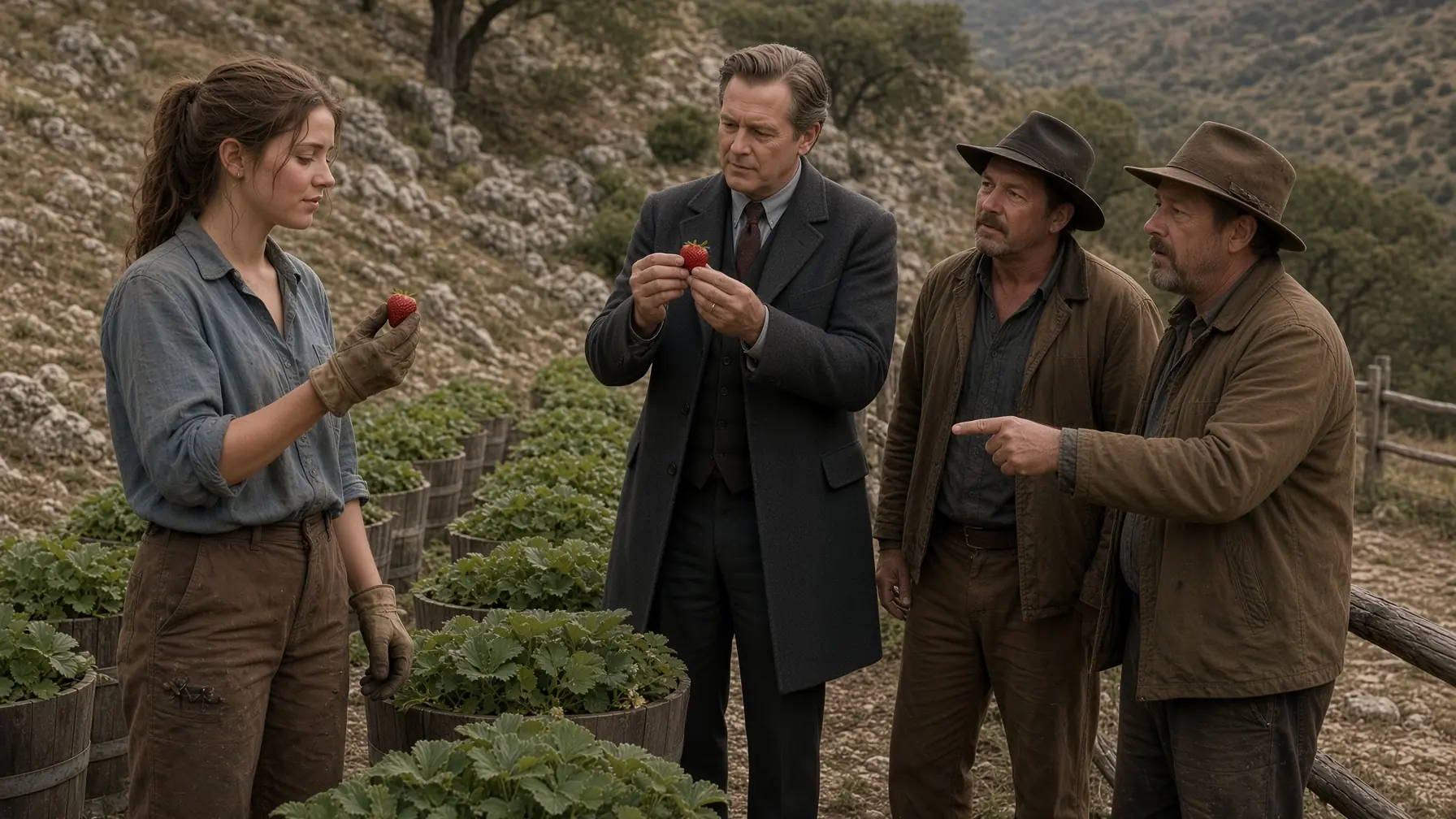
Two years earlier, nobody in the valley would have imagined that question mattered. Josie had been twenty-two when she buried her father on the upper edge of those same four acres, beside the grave where her mother had been laid three years before. She had no husband, almost no cash, no crop worth mentioning, and a hillside that most farmers considered too rocky for serious production. What she did have was a weather-beaten house, a leaning barn, eleven dollars in a tin box beneath a floorboard, and fifty-eight old oak barrels her father had collected for reasons he had never lived long enough to explain.
Jonas Wilder had spent most of his fifty-four years trying to make that land behave like the rich bottom fields below it. He planted corn twice and watched both crops come up thin, tried chickens until foxes solved that experiment, then earned most of his living repairing fences, hauling freight, and working seasonally for larger farms. He was not lazy and he was not foolish; he simply possessed land whose steep grade, shallow soil, and exposed limestone punished the methods that worked so well a few hundred feet lower. When he died after years of lung trouble, Josie inherited not a functioning farm but a question nobody else seemed interested in answering.
The funeral was small enough that Josie remembered every face. Della Marsh came from the eastern valley, old Pastor Dean stood near the fence, and several men from neighboring farms shifted awkwardly in the wet grass before leaving quickly once the prayer was finished. Gideon Harcourt did not attend, but three days later he rode up the hill wearing clean boots and carrying an offer to buy the property. Josie had heard enough about Gideon to know that when a man who owned nearly three hundred acres of bottomland suddenly wanted four acres everybody called worthless, the interesting part was not the price but the reason.
“I’m prepared to improve the offer I made your father,” Gideon told her at the gate. He was in his early fifties, broad across the chest, neatly dressed, and spoke with the calm patience of someone accustomed to other people eventually agreeing with him. “You’re alone now, Miss Wilder, and winter doesn’t make difficult land easier.” Josie looked down toward his flat black fields and said, “I’ll think about it,” because saying no immediately would have told him more than she wanted him to know.
The number he offered was generous enough to make her suspicious. Gideon had warehouses in Caro Crossing, supply agreements with several stores, and a produce contract with Holt Mountain Hotel up the pass, and men like that did not become wealthy by paying more for land than they believed it was worth. Josie watched him ride away, then turned toward the barn where the barrels stood beneath the afternoon sun. It was while looking at them that she remembered her mother’s old wash tub.
Eleanor Wilder had once planted strawberries in a dented zinc tub beside the house when Josie was eight. The garden below had stayed wet after spring rain, but the tub sat slightly above the slope, its drainage holes clear, its soil loose, and its berries hung over the rim instead of lying against mud. Josie remembered asking why those strawberries looked better than the ones in the garden, and her mother answering, “Sometimes you stop fighting the ground and give the plant different ground.” Twenty-four hours after remembering that sentence, Josie dragged the first barrel away from the barn wall.
She did not immediately start planting. First she went to the small agricultural office in the county seat, borrowed two state bulletins about strawberry production, and spent evenings reading them beside the stove until she understood just enough to recognize how much she did not know. Strawberries wanted fertile but well-drained soil, consistent moisture without waterlogged roots, good light, manageable disease pressure, and protection from the worst frost pockets. Her rocky hillside was terrible corn ground, but the slope drained quickly, faced south, received long hours of sun, and allowed cold night air to move downhill rather than settle around the plants.
The barrels could solve the soil problem if she used them properly. Instead of balancing full barrels dangerously on tall posts, Josie cut many of them into deep half-barrels, repaired the soundest staves, opened drainage holes, and set them on low timber cradles anchored along the contour of the slope. She filled them with a mixture of compost, workable loam from an old chicken enclosure, leaf mold, and lighter mineral soil, adjusting the mixture until water moved through without leaving it dry by afternoon. It was ugly, laborious work, and she ruined two barrels before learning how much pressure old oak could take.
The main thing she could not manufacture was planting stock. For that she went to Della Marsh, a sixty-one-year-old widow who grew vegetables and a modest strawberry patch on twelve acres east of town. Della listened while Josie described the hillside, the barrels, the drainage, the southern exposure, and the eleven dollars that made buying enough crowns outright impossible. When Josie offered twenty percent of the first marketable crop in exchange for planting stock, Della stared at her for several seconds and said, “Twenty-five, because if this fails, I don’t get paid at all.”
Josie agreed. Della supplied a hardy everbearing variety and enough crowns to begin a small commercial trial rather than pretend four acres could become a strawberry empire in one spring. “And keep your mouth shut about it until something grows,” Della added as Josie prepared to leave. “This valley can talk an idea to death faster than weather can kill it.”
By April, the hillside looked ridiculous. Forty-three repaired barrels sat in staggered rows on timber cradles, each one holding several crowns, while additional empty frames marked where Josie hoped to expand if the first planting earned anything. A fourteen-year-old boy stopped at the fence one afternoon and asked why the strawberries were growing in barrels instead of the ground. Josie told him, “Because the ground and I have agreed to stop arguing,” and he laughed all the way down the hill.
Other people laughed too. At the grain store she became the Barrel Girl, and men who had never walked her slope explained to one another why containers would dry too quickly, why the roots would freeze, why the barrels would rot, and why a young woman with no serious farming experience was confusing desperation with invention. Josie heard most of it through Della and pretended not to care. The truth was that she cared enough to check every plant each morning before breakfast.
May came cool and wet, and the first leaves opened. Josie learned quickly that container growing created problems of its own: barrels dried faster during sunny spells, nutrients washed through more readily, and watering each unit by hand was exhausting. She rigged a simple gravity-fed line from a small elevated cistern beside the barn, not an automatic miracle but enough to let her control moisture with less labor. By early June the plants were dense, dark green, and flowering heavily enough that Della stopped calling the project an experiment when nobody else was listening.
The first hotel representative arrived in the third week of June. His name was Frederick Lane, purchasing manager for Holt Mountain Hotel, and he had heard through a market vendor that someone on the Wilder slope was producing exceptionally clean strawberries. He walked the rows with Josie, examining fruit that hung over barrel rims without mud stains or damage from standing moisture. When he asked whether she could guarantee enough volume for the hotel’s entire breakfast and dessert operation, Josie answered, “No, and anyone who tells you otherwise after looking at forty-three barrels is lying.”
Frederick stopped. Josie explained that she could provide a smaller premium lot on scheduled days, sorted to an agreed grade, and that she would rather promise thirty pounds and deliver thirty than promise eighty and arrive with forty. He picked another berry, inspected its underside, then ate it. “I’d like the chef to see these,” he said.
Chef Marguerite Bell did not care about Josie’s age, hardship, dead parents, or neighbors. She cared whether strawberries arrived firm, flavorful, clean, and on time, and her first inspection lasted perhaps three minutes. She cut one berry, tasted half, looked at Frederick, and said, “I’ll use whatever quantity she can reliably bring.” The price they offered was considerably above the general market price because the hotel wanted a premium product in small quantities, not because Josie had somehow discovered a magical crop.
Josie did not accept immediately. She read the agreement twice, asked what happened if weather reduced supply, negotiated language allowing her to declare a short crop without automatically breaching the entire arrangement, and refused an exclusivity clause that would have prevented her from selling surplus elsewhere. Frederick seemed more impressed by her caution than he had been by the berries. When he left, Josie sat at the kitchen table staring at the signed paper beside the eleven-dollar tin box her father had left behind.
The first harvest was exhausting. Josie picked before the heat built, graded in the barn, packed shallow trays, and delivered only fruit she believed would survive the trip up the mountain without bruising. The hotel bought almost everything that met specification, while Della took her contracted share and a local store purchased smaller and irregular fruit at a lower price. For the first time since her father became ill, the Wilder property had produced something that paid more than it cost to grow.
That was when Gideon Harcourt returned. He stopped at the fence and looked over the barrel rows with the same expression he had once used on the supposedly worthless hillside, only now the calculation behind his eyes was more obvious. “I hear Lane is buying from you,” he said. Josie answered, “He is,” and waited.
Gideon told her Holt Mountain Hotel had purchased from his operation for years and eventually would require more strawberries than forty-three barrels could provide. “Right now you’re interesting,” he said. “Interesting does not scale, and four acres of rock is still four acres of rock.” Josie knew enough by then to recognize the dangerous part of his argument: he was correct about volume.
What Gideon failed to understand was that Josie no longer believed she needed to beat him acre for acre. North of her property sat the Raines place, eight acres of similarly neglected hillside owned by seventy-year-old Eli Raines and his grandson Frank. Beyond it lay several other slopes the valley considered marginal because farmers had spent decades measuring them by how poorly they grew lowland crops. Josie began wondering whether the thing worth expanding was not her acreage but the method.
Frank came to her first. He was twenty-five, broad-shouldered, sunburned, and careful in the way men become careful after watching older relatives lose money they cannot replace. His grandfather had rejected two offers from Gideon but could not make the Raines hillside profitable. Frank looked over Josie’s barrels and asked whether she would come tell Eli what she had done.
Eli did not ask for inspiration. He asked what it cost, how much labor it required, how quickly barrels failed, how much water the plants used, how many pounds Josie had actually sold, and what happened when a late frost came. Josie answered every question, including the ones whose answers were disappointing. When she finished, Eli said, “I’ve got forty old whiskey casks in the far barn,” and Frank was already walking toward them before anybody formally agreed to anything.
Josie did not offer to own the Raines crop or take a percentage forever. She proposed helping them build their own system in exchange for coordinating quality standards and delivery schedules if the crop eventually qualified for hotel sales. Two farms producing the same grade could promise a buyer more than either could alone. Eli listened, looked at Frank, and said, “Come back Saturday.”
Building on the Raines slope taught Josie something Gideon would later miss. The method was not simply “put strawberries in barrels.” Eli knew exactly where cold air collected, which section took the hardest northwest wind, and where water crossed after a storm, so they rotated the layout, strengthened exposed cradles, and left vulnerable depressions unused. Josie brought container experience; Eli brought seventy years of knowing that particular hillside; Frank understood timber well enough to improve the framing after building only three units.
By autumn they had forty-two productive setups prepared for the following season. Frank worked beside Josie without treating every disagreement as a contest, and when she rejected one of his braces because she thought the angle was wrong, he built a test section and made her watch it carry more weight than hers. She admitted he was right after only twenty minutes, which he later claimed was a record. Josie told him not to become ambitious.
Their hotel arrangement grew carefully. Frederick extended Josie’s supply agreement and agreed to evaluate Raines fruit separately once it produced, while Della supplied additional crowns on credit after receiving her full share from the first harvest. Josie spent more money than she liked and accepted that expansion meant new risk. Gideon watched all of it.
That winter, word reached Josie that Gideon had purchased sixty new barrels. He installed them on a flat trial section of his bottomland and began telling merchants that elevated berry production was an innovation his operation had been developing. Josie was angry for an evening, then walked his field from the public road and realized he had copied the visible part of the system. He had not copied the reasons behind it.
The bottomland could certainly grow strawberries in containers. In some ways it might grow them extremely well, because Gideon had irrigation, labor, equipment, and access to excellent soil amendments. What it could not automatically reproduce was the Wilder slope’s air drainage, cooler nights, rapid shedding of heavy rain, or the management practices Josie had developed by watching plants every day. More importantly, Gideon was treating the barrels as a shortcut to premium quality rather than a production system whose weak points had to be managed.
By February he made a larger move. He offered Holt Mountain Hotel greater volume at a lower price and proposed becoming the hotel’s exclusive valley supplier. At almost the same time, Josie’s usual agricultural supplier stopped extending her credit, and the owner of another nearby hillside suddenly accepted an unusually generous purchase offer from Gideon. Nobody could prove Gideon had ordered the credit decision, so Josie refused to turn suspicion into fact, but she understood the larger message.
Gideon had money. He had relationships. He had enough capital to make mistakes without being destroyed by them, and Josie did not. For ten minutes after reading Frederick’s warning letter about Gideon’s proposal, she allowed herself to be furious. Then she made coffee and opened her ledger.
She went to Eli and Frank that afternoon. “I need to know whether we’re actually building something together or whether we’re two farms sharing a delivery wagon,” she told them. Eli asked what difference she meant, and Josie explained that she wanted a coordinated standard: same grading rules, same recordkeeping, clear growing requirements, shared delivery planning, and no using the name if the fruit did not meet specification. “If we promise quality together, one bad farm can damage every good one,” she said.
Eli looked toward the winter hillside. “You’re twenty-three.”
“I know.”
“You’re asking men twice and three times your age to let you tell them when their berries aren’t good enough.”
“I know that too.”
Frank leaned against the barn door. “She’s also the one with the contract.”
Eli looked at his grandson, then at Josie. “All right.”
Spring arrived cold. The Raines crowns broke dormancy well, Josie’s older plants returned strongly, and Gideon began constructing a much larger barrel operation on the hillside parcel he had recently purchased. From a distance, Josie could see his crews working quickly, spacing supports farther apart than she and Frank ever would, because every additional post and brace cost labor and time. Eli watched them one afternoon and said only, “He’s building for a photograph.”
That sentence stayed with Josie. Her own first structures had been ugly, overbuilt, revised repeatedly, and strengthened after every storm revealed a weakness. She and Frank had started using removable hail netting above the most valuable rows after a smaller storm bruised fruit the previous year, and the system was possible precisely because the barrel blocks were compact. When the May forecast began mentioning severe thunderstorms, Josie did not know hail was coming, but she knew enough to prepare for wind and damaging weather.
For two days she and Frank tightened anchors, added cross-bracing, checked every timber cradle, and stretched protective netting over the fruiting blocks. They did not cover every leaf perfectly, and they did not pretend cloth could defeat a major storm. Their goal was simply to reduce impact on the developing berries and prevent loose structures from becoming hazards. On Wednesday evening Frank looked at the blackening western sky and asked, “How bad?” and Josie answered, “Bad enough that I’d rather feel foolish tomorrow than sorry.”
At three Thursday morning, the hail arrived. Stones roughly the size of large marbles struck the roof, the barn, the fields, and every crop in Caro Valley for nearly twenty minutes, accompanied by hard rain and powerful wind. Josie waited until the worst lightning had moved east before going onto the hillside; no crop was worth walking into an active electrical storm. When she finally climbed the rows with a lantern, her stomach tightened at every broken leaf she saw.
The damage was real. One upper frame had shifted, two barrels cracked around old staves, exposed leaves were shredded, and several unprotected blossoms were gone. But the netting had absorbed much of the direct hail impact, the anchored frames remained upright, and the containers drained the accompanying rain instead of leaving roots in standing water. Most of the developing crop was still there.
The valley floor looked different at sunrise. Della’s low strawberry planting had been hit directly across its entire acreage, and the rain following the hail left damaged fruit and leaves pressed into mud. Gideon’s conventional berry field suffered heavily too, while his new hillside barrel project presented another problem entirely. Several rushed frames had collapsed or shifted when poorly braced supports took the wind load, and sections of his protective cloth had torn loose because crews had fastened it as an afterthought.
Josie did not celebrate. She drove to Della first and found the older woman standing in her damaged field doing the arithmetic farmers always did after weather—what could recover, what could be replanted, what insurance might cover, and what was simply gone. When Della asked how the Wilder slope had fared, Josie told her honestly. “Better than this,” Della said, looking across her flattened rows, and Josie wished there were a kinder answer.
Then she went to the Raines property. Frank had cut his forearm repairing a damaged frame and needed more attention for it than he wanted to admit, while their upper block had lost several plants and two old casks. Eli sat on the porch studying Gideon’s distant hillside and said, “He built too quickly.” Josie looked at the collapsed shapes against the ridge and answered, “He copied what he could see.”
Four days later, Barrett Voss came up the Wilder track. He was fifty-one, had mocked Josie’s barrels loudly during her first spring, and had just lost a large portion of his own berry field to hail. “There needs to be a growers’ meeting before Harcourt gets to tell everybody what this storm means,” he said. Josie asked why he was telling her, and Barrett answered, “Because your crop is still standing.”
The meeting filled the Caro Crossing grain hall the following Saturday. Farmers came carrying notebooks and bad news, Frederick Lane arrived from Holt Mountain Hotel, and beside him sat Margaret Shaw, the hotel company’s regional purchasing director. Gideon stood near the front with two managers, looking composed enough that someone who did not know him might believe the storm had merely changed his schedule. Josie sat to one side with a folder on her lap and no prepared speech.
Gideon spoke first. He acknowledged his losses, described the failed hillside frames as a first-year engineering problem that his capital could correct, and emphasized that his operation still possessed the labor, acreage, distribution network, and financing necessary to guarantee large deliveries. Most of what he said was true. That was what made him difficult.
Then Frederick raised one hand. “The hotel’s existing supplier retained most of its crop.”
People turned toward Josie.
Gideon’s expression barely changed. “Miss Wilder operates four acres.”
“With coordinated production from the Raines property,” Frederick replied.
Barrett looked at Josie. “Show them.”
She carried the folder to the front table. Instead of telling anyone she was smarter than Gideon, she laid out eighteen months of delivery records, actual weights, quality grades, rejected trays, weather losses, and payment receipts. Her rejection rate to the hotel was below two percent, and she had never missed an agreed delivery without notifying the buyer in advance.
Then she showed the storm records. She did not claim the hillside was hail-proof, because it was not; she showed damaged plants, broken barrels, repair costs, and the proportion of crop still marketable after protection and drainage had done their work. She compared those numbers with voluntary figures provided by other growers, including Della, Barrett, and the Raines property. “This system loses crops too,” Josie told the room. “The difference is that we have learned which risks we can reduce.”
Gideon stood. “This is two seasons of data from one small operator.”
He stopped there.
The words young woman never came out, but several people in the room heard where the sentence had been heading.
August Crane, one of the oldest produce buyers in the valley, stood from the back wall. “I’ve bought strawberries here for forty years, and hers are better,” he said. “You can argue acreage all afternoon, Gideon, but acreage doesn’t go on a dessert plate.”
Nobody laughed. That made the sentence stronger.
Margaret Shaw spoke next. Holt Mountain Hotel was not seeking the cheapest fruit; it was seeking reliable premium fruit at a price the kitchen could justify, and Josie’s delivery history had been the strongest among the hotel’s local specialty suppliers. Margaret was willing to discuss a larger agreement, but not with one tiny farm pretending it could suddenly produce commercial volume. She wanted to know whether Josie’s quality could survive expansion.
Josie answered before Gideon could. “That’s the only question that matters.”
Margaret looked at her. “Then come to the hotel Monday and answer it.”
The meeting did not end with Gideon humiliated in front of cheering farmers. He challenged several assumptions, reminded everyone that larger operations could absorb bad seasons more effectively, and left before the final discussion finished. Some farmers still believed his capital would eventually win. Josie went home knowing he remained dangerous because money and infrastructure did not vanish simply because a meeting had gone against him.
Monday’s meeting lasted almost three hours. Margaret asked what made a hillside suitable, how Josie would measure quality, what failures disqualified a farm, who would pay for inspections, how disputes would be handled, and what happened if a producer missed the standard after accepting hotel orders. Josie answered what she knew and said “I don’t know yet” often enough that Margaret eventually smiled.
“What you’re describing is not one farm,” Margaret said. “You’re describing a production standard.”
Josie nodded. “That’s what I finally figured out.”
“And who controls the standard?”
“The growers who meet it.”
Margaret leaned back. “Not you?”
“I should help establish it because I have the records, but if the only thing holding it together is me, then it isn’t a system.”
That answer changed the meeting.
The hotel offered to develop a three-year supply agreement with a formally organized hillside growers’ cooperative, provided the cooperative established measurable grading, delivery, recordkeeping, and production requirements. Josie insisted that the hotel could reject fruit that failed its purchasing specifications but could not decide which local farmer was socially acceptable enough to join. If a property met the agricultural and quality standard, the cooperative would be able to admit it. Margaret argued for two rounds before agreeing.
Josie did something equally important afterward. She paid a lawyer in the county seat to review the cooperative documents rather than pretending she understood forty pages of contract language because she had survived a few negotiations. The bill hurt. Signing an agreement she did not understand could have hurt much more.
By late June, the Caro Valley Hillside Growers Cooperative had four founding operations: Wilder, Raines, Barrett Voss, and Clara Sutton, a forty-three-year-old farmer whose six rocky acres on East Ridge had nearly driven her out of agriculture. Clara started with only twenty barrels because that was what she could afford. Josie preferred twenty well-managed barrels to a hundred purchased on hope.
The hotel signed for three years. Volume targets increased gradually instead of demanding impossible expansion in the first season, and premium pricing depended on meeting quality standards rather than simply carrying the cooperative name. When Margaret signed the final page, Eli Raines sat at the end of the table staring at his copy. Six months earlier he had been considering selling his land to Gideon Harcourt.
Gideon did not attend the signing. He challenged the arrangement privately with the hotel one more time, arguing that established growers were being unfairly excluded. Frederick answered that the door was open to any producer whose property, method, records, and fruit met the same standards. Gideon never submitted an application.
Summer became work. Josie, Frank, Clara, Barrett’s daughter, and several part-time pickers moved through the hillside blocks before heat softened the fruit, while the hotel accepted deliveries under the new cooperative label. More farms asked questions, but Josie refused to certify anyone merely because expansion sounded impressive. One woman drove almost two hours from the next county and was told to run a trial season first because her soil conditions were different enough that Josie could not predict the result confidently.
That refusal surprised people. Growth was supposed to mean saying yes.
Josie had learned the opposite. Every farm admitted without evidence made the cooperative larger and weaker at the same time. A reputation built slowly from good deliveries could be destroyed quickly by one member who wanted the premium price without accepting the discipline attached to it.
Her relationship with Frank changed more slowly than everything else. He had become the person she looked for whenever a frame failed, a delivery ran late, or a decision did not feel right, yet she spent months behaving as though this were merely an efficient division of labor. Frank never forced the issue. That probably made it harder to ignore.
One August evening Josie returned from inspecting the distant trial farm and found him repairing a gate near the upper fence. She stopped the wagon beside him and said, “I need to tell you something, and I need you not to make it complicated.” Frank rested both hands on the gate and answered, “I’ll do my best.”
Josie told him she was bad at the part of life that could not be solved with measurements. She told him she worked too much, explained too little, resisted help until exhaustion made resistance impossible, and had noticed that every room felt more stable when he was in it. Then she said, “At the cooperative signing, you were sitting against the wall because there wasn’t room at the table, and it bothered me all day.”
Frank looked at her for several seconds. “That wasn’t especially complicated.”
“I haven’t finished.”
“Of course you haven’t.”
She glared at him, and he smiled.
Frank reached up and took the hand she had resting on the side of the wagon. “I’ve known everything you just warned me about for eight months,” he said. “I was waiting for you to stop being busy enough to admit this conversation existed.” Josie looked at their hands and thought about her mother placing strawberries in a broken wash tub because the ordinary garden did not work.
They did not marry the following week. They did not abandon the farms for a romantic ending, and Frank did not become the man who secretly deserved credit for Josie’s success. They simply began allowing the relationship to become another thing they tended deliberately instead of another subject Josie postponed until after harvest.
By the following spring, the cooperative had seven participating farms. Rosalie Kern’s trial property in the next county had passed after adjustments to its growing mix and watering schedule, while two additional Caro Valley hillsides entered production over winter. Holt Mountain Hotel began discussing whether the model could serve two other resort properties, but Josie refused to expand the certification faster than growers could maintain it.
Gideon Harcourt stopped visiting her fence. He shifted attention toward grain storage and consolidation farther south, markets where his scale and capital actually provided the advantages he understood best. Josie never knew whether he accepted that she had beaten him at anything, and eventually she stopped caring.
Because Josie had not really beaten Gideon. He still owned far more land, still had more money, and still ran one of the valley’s largest agricultural businesses. What changed was that his definition of worthless land no longer controlled what happened to everyone else’s hillside.
Years earlier, Gideon had looked at four acres of shallow soil and stone and seen only what could not be grown there. Jonas Wilder had spent years trying to force conventional crops into that ground because he had inherited the same assumption. Eleanor Wilder, with one rusted wash tub and no theory grander than observation, had noticed something different.
Josie remembered the fuller version of her mother’s lesson one May morning while standing above rows of new leaves. Eleanor had told her, “Sometimes you have to be willing to look foolish first, because everybody understands the old way and nobody trusts the strange thing until it works.” As a child, Josie had remembered only the strawberries.
Now she understood the rest.
Below her, Caro Valley stretched broad and green beneath the morning light. The Raines barrels covered the next slope, Barrett’s new rows showed farther north, and Clara Sutton’s first expanded block stood against East Ridge where corn had failed four seasons in a row. None of those farms had become easy.
Frames still broke. Crowns still died. Weather still ignored contracts, markets still changed, and every premium buyer remained free to find another supplier if quality slipped. Josie preferred that truth to the fairy tale people were beginning to tell about the girl who had turned worthless land into gold.
The land had never been worthless. It had simply been badly matched to what people kept demanding from it. Josie had not defeated nature, invented strawberries, or discovered some secret that trained farmers were too foolish to understand. She had been desperate enough to examine the conditions she actually possessed instead of grieving forever over the conditions she did not.
That morning Frank was already below the barn replacing a brace damaged by the previous week’s wind. Josie heard the steady sound of his hammer as she walked down the slope, and beside the kitchen door sat a letter from Rosalie asking whether a new section of her ridge might qualify for certification. There were deliveries to prepare, accounts to reconcile, and a meeting with the hotel the following week about second-year pricing.
Josie went to work.
Behind her, the old barrels stood in long rows across hillsides the valley had once dismissed as useless, their oak dark against the pale stone and their strawberries hanging clean above the ground. Nobody along the road laughed at the Barrel Girl anymore, but that was never the part Josie considered important.
The important thing was that the berries were still growing.