The steel gates of Blackridge Penitentiary opened shortly after sunrise.
A transport bus rolled slowly through them, its tires grinding across wet gravel beneath a gray winter sky. The walls on either side were nearly thirty feet high, topped with coils of razor wire that glistened in the morning mist.
Inside the bus, twelve prisoners sat chained in pairs.
Some stared through the reinforced windows.
Others cursed under their breath.
One man slept with his head against the metal wall as though arriving at a maximum-security prison was nothing more than another stop along a familiar road.
Caleb Mercer sat alone near the back.
His wrists were secured in front of him. His ankles were chained. A faded scar ran from beneath his left ear to the collar of his shirt.
He did not look nervous.
He did not look angry.
He simply watched.
He counted the guard towers.
He studied the time between the rotating searchlights.
He noticed which security cameras moved and which remained fixed. He watched the officers near the vehicle entrance and the way one of them favored his right knee.
To anyone else, Caleb appeared calm.
To someone trained to recognize danger, he appeared to be measuring the prison before he had even entered it.
The bus stopped inside the receiving yard.
The rear doors opened.
“On your feet,” an officer shouted.
Chains rattled as the prisoners stood.
Caleb stepped down without hesitation.
The air inside Blackridge smelled of cold metal, bleach, old concrete, and something less visible but equally strong.
Fear.
Officer Wade Keller processed the new arrivals. He was a broad-shouldered man in his late forties whose face had settled into a permanent expression of exhaustion.
When Caleb reached the front of the line, Keller checked the paper file attached to his clipboard.
“Caleb Mercer,” he said.
Caleb nodded.
Keller turned one page, then frowned.
There was almost nothing in the file.
No detailed history.
No known affiliations.
No family information beyond a birth date and a birthplace that no longer existed under the same name.
“Your records are incomplete,” Keller said.
“They usually are.”
Keller looked up.
“You trying to be clever?”
“No.”
The answer was calm and immediate.
Keller studied him for another second before tossing a folded prison uniform across the counter.
“Follow procedure, Mercer. No talking during movement. No fighting. No trouble.”
Caleb caught the uniform.
“I understand.”
Keller pointed toward the changing area.
As Caleb walked away, the officer glanced down at the thin file one more time.
He had worked at Blackridge for nineteen years.
Every inmate had a story.
Even the men who lied about everything had thick files filled with arrests, evaluations, addresses, known associates, and court transcripts.
Caleb Mercer’s file looked as though someone had carefully removed his entire life.
By noon, Caleb had been assigned to Cell Block C.
Blackridge’s C Block was known among the officers as the kingdom.
It had its own rules, its own economy, and its own ruler.
Damon Rourke had spent eleven years building his reputation inside those walls. Almost no one used his real name anymore.
They called him Blade.
He was six feet five inches tall, with heavy shoulders, a shaved head, and a line of old scars running across both forearms. He controlled gambling, contraband, protection, and most of the fear inside C Block.
The guards knew it.
The inmates knew it.
Even the warden knew it.
As long as Blade kept the violence organized and away from the officers, certain things were quietly ignored.
Caleb entered the cell block carrying a thin mattress, two sheets, a plastic cup, and everything else the prison believed a man needed.
Conversations slowed as he passed.
New prisoners were always examined.
Their walk mattered.
Their eyes mattered.
The way they held their belongings mattered.
Fear could be seen in the shoulders. Weakness appeared in the speed of a man’s steps.
Caleb walked neither quickly nor slowly.
He looked at no one directly, yet somehow seemed aware of everyone around him.
From the upper tier, Blade rested his arms against the railing.
“Fresh meat,” he called.
Laughter moved through the block.
Caleb kept walking.
Blade watched him until the cell door closed behind him.
That afternoon, during lunch, Caleb carried his tray toward an empty table near the wall.
Before he could sit, five men surrounded him.
At their center stood Blade.
Beside him was Silas Kane, a narrow-faced inmate known as Spider because of the way he moved through the prison, always listening and always appearing where he was not wanted.
Blade looked at Caleb’s tray.
Then he looked at Caleb.
“You got a name, new fish?”
“Mercer.”
“Just Mercer?”
“That’s enough.”
A few men nearby turned in their seats.
Blade smiled.
“You forgot a word.”
Caleb waited.
Blade leaned closer.
“Sir.”
The dining hall slowly became quiet.
Forks paused above trays.
Even the inmates who pretended not to care were listening.
Caleb looked at Blade for the first time.
There was no challenge in his expression.
No fear either.
He regarded the larger man with the detached patience of someone waiting for an unnecessary noise to stop.
Spider placed one hand against Caleb’s chest and shoved him backward.
“The boss asked you a question.”
Caleb looked down at the hand.
Then he looked back at Spider.
“Take it away.”
Spider laughed.
“What are you going to do?”
Caleb straightened his shirt.
“I heard him,” he said. “I’m deciding whether he is worth answering.”
The laughter stopped.
Blade’s smile remained, but something behind it changed.
No one spoke to him that way.
Not in C Block.
Not anywhere inside Blackridge.
“You think you’re special?” Blade asked.
“No.”
“You think you’re dangerous?”
Caleb picked up his tray.
“I think you talk too much.”
Whispers spread across the room.
Several guards stood near the doors. They saw what was happening, but none of them approached.
Blade leaned forward until only a few inches separated their faces.
“You’ll answer me eventually.”
Caleb’s expression did not change.
“Perhaps.”
He stepped around Blade.
“But you may not like the answer.”
That night, Caleb sat on the edge of his bunk while the sounds of the prison moved through the walls.
Men argued over cards.
Someone shouted from the lower tier.
A toilet flushed repeatedly in a distant cell.
His cellmate, a thin older prisoner named Lewis Grant, lay on the upper bunk and stared at the ceiling.
“You made a mistake today,” Lewis said.
Caleb removed his shoes and placed them neatly beneath the bed.
“Probably.”
“Blade doesn’t forget disrespect.”
“I didn’t disrespect him.”
Lewis looked down.
“You told him he wasn’t worth answering.”
“That was an observation.”
Despite himself, Lewis gave a quiet laugh.
Then his expression became serious again.
“He’ll come after you.”
Caleb lay back and folded his hands behind his head.
“I know.”
“You don’t sound worried.”
Caleb stared at the narrow strip of moonlight cutting through the bars.
“Worry does not change what comes through the door.”
The following morning, the cell block felt different.
Blade felt it too.
He had ruled Blackridge because men lowered their eyes when he approached. Fear was not merely a tool to him. It was proof that he existed.
Caleb had looked through him as though he were nothing.
That could not be allowed.
During lunch, Blade and his men surrounded Caleb again.
This time, the entire room noticed immediately.
“Morning, Mercer,” Blade said. “Sleep well?”
Caleb continued eating.
Blade moved closer.
“I’m talking to you.”
Caleb lifted his eyes.
“Are you?”
The question was spoken softly.
It was not defiance.
It was dismissal.
Spider shoved Caleb’s shoulder.
Caleb’s hand moved so quickly that several inmates did not see it happen.
One moment, Spider’s hand was on him.
The next, Caleb had caught Blade’s wrist as the larger man reached forward.
Caleb did not squeeze.
He did not twist.
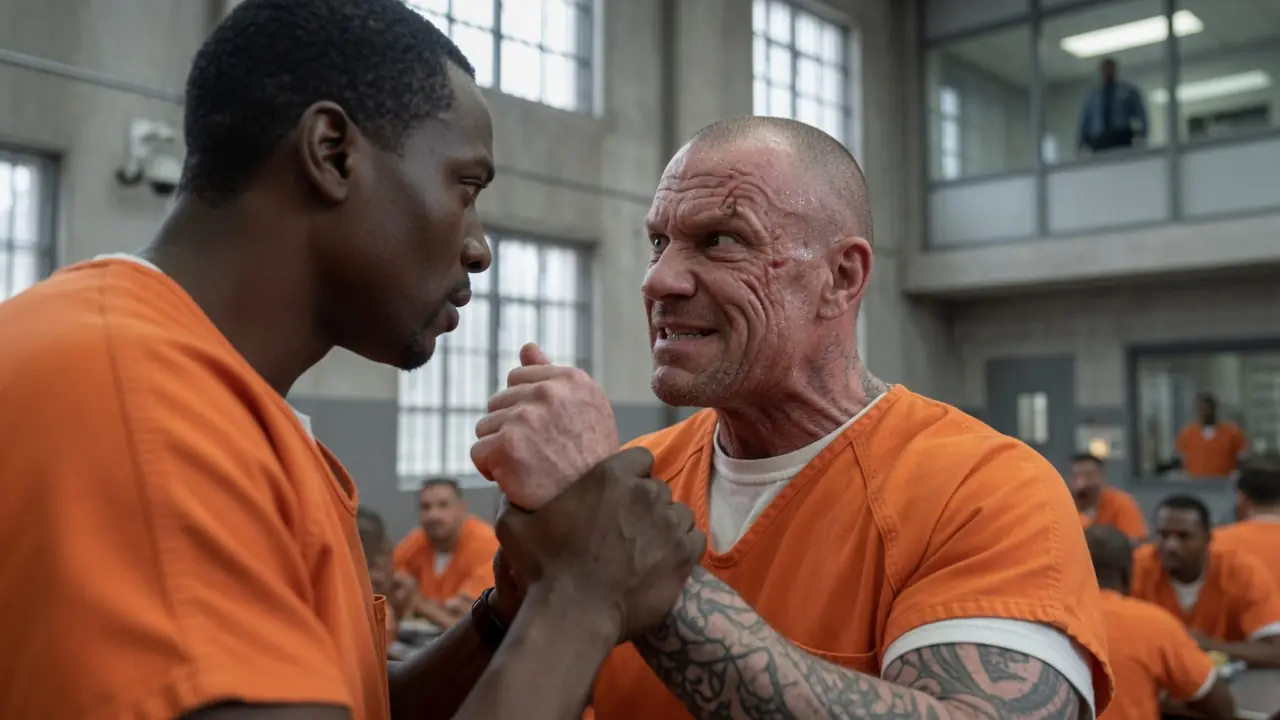
He simply held the wrist at an angle that stopped Blade’s entire body.
For the first time, surprise appeared on Blade’s face.
Caleb leaned slightly closer.
“Do not touch me again.”
The dining hall was silent.
Blade tried to pull away.
Caleb released him immediately.
That made the moment worse.
He had not struggled.
He had not needed to.
Blade forced a laugh.
“You think that little trick scares me?”
“No.”
Caleb picked up his tray.
“But it should help you make a better decision.”
“You’re in my house,” Blade said.
Caleb paused.
Then he looked around at the guards, the locked doors, the concrete walls, and the men sitting beneath the cameras.
“No, Blade,” he said. “None of this belongs to you.”
He walked away.
Blade did not attack him that day.
He could not risk losing control in front of the entire dining hall without first knowing what he was dealing with.
But his silence was not mercy.
It was preparation.
Over the next two weeks, Caleb’s life inside Blackridge became a campaign of small punishments.
His bunk was torn apart while he worked.
His sheets were soaked in dirty water.
The single photograph inside his locker was ripped in half.
It showed Caleb as a much younger man standing beside an older woman outside a small white house.
He said nothing when he found it destroyed.
He carefully placed the pieces inside a book and returned the book to the shelf.
Lewis watched from the upper bunk.
“You are going to keep letting them do this?”
Caleb folded his blanket.
“I have lived through worse.”
“That isn’t an answer.”
Caleb looked at the torn photograph.
“It is the only answer that matters.”
In the yard, Blade’s men followed him.
They insulted him.
They bumped his shoulder during movement.
They took food from his tray.
Caleb never responded.
Some inmates believed he was afraid.
Others began to understand that he was restraining himself.
There was a difference.
One afternoon, Caleb was assigned to laundry duty.
The room was hot and filled with steam from the industrial dryers. The machines created a constant low roar that swallowed voices and footsteps.
Caleb was folding towels when Spider and two other men entered.
The door closed behind them.
Spider smiled.
“No guards in here today.”
Caleb continued folding.
“You should leave.”
One of the men grabbed Caleb by the shirt and shoved him against a dryer.
“Where’s that voice now?”
Caleb looked at the fist twisted in his uniform.
“Are you finished?”
Spider struck him across the face.
Caleb’s head turned slightly.
A thin line of blood appeared at the corner of his mouth.
He looked back at Spider.
The expression in his eyes caused Spider’s smile to fade.
“You should have stayed invisible,” Spider said.
Caleb wiped the blood away with his thumb.
“I was invisible for a long time.”
His voice became quieter.
“It did not make me harmless.”
Footsteps sounded in the corridor.
A guard opened the door.
“What is going on?”
Spider stepped away.
“Nothing.”
Caleb returned to folding the towel.
The guard glanced from him to the others but asked no further questions.
That night, one of Blade’s younger followers approached him near the showers.
“Boss,” the man said, “maybe we should leave Mercer alone.”
Blade turned slowly.
“You afraid of him?”
“No.”
“Then why are you talking?”
The man lowered his eyes.
Blade moved closer.
“He bleeds. Spider proved that.”
But Blade had not seen Caleb’s face after the punch.
Spider had.
And for the first time since entering Blackridge, he began avoiding the new prisoner.
Blade noticed.
His anger deepened.
The ambush came three mornings later.
Breakfast ended at seven.
The inmates were moved to the yard at eight.
Showers opened at nine.
It was predictable, and predictability was the closest thing prisoners had to freedom.
Blade knew that the camera near the rear shower wall had not worked for months. A maintenance request had been submitted twice and ignored.
Steam gathered heavily in that corner.
Noise from the water covered almost everything.
Blade waited there with Spider and three others.
Two carried sharpened pieces of plastic.
Another held a narrow strip of metal torn from a ventilation grate.
“End it quickly,” Blade said.
Caleb entered with a towel over one shoulder.
He felt the silence before he saw them.
The showers were rarely silent.
Men argued over soap.
They complained about water temperature.
They shouted across the room.
Now there was only running water.
Caleb placed his towel on a bench.
He turned the valve and stood beneath the stream.
Steam rolled around him.
Spider moved first.
The sharpened plastic flashed through the mist.
Caleb shifted aside, but the edge cut across his ribs.
It was not deep.
A narrow line of blood appeared.
Caleb looked down at it.
Then he looked at Spider.
“You should not have done that.”
Spider lunged again.
Caleb caught his wrist and turned it until the weapon fell.
He did not continue twisting after Spider dropped to one knee.
Instead, he pushed him backward and stepped aside as the second man attacked.
Caleb moved with frightening efficiency.
He did not fight like a prisoner.
Prison fights were wild. They were driven by panic, anger, and the desperate need to survive.
Caleb wasted no motion.
He avoided blows by inches.
He used balance rather than strength.
He redirected each attacker into a wall, a bench, or another man.
Blade charged through the steam.
Caleb turned at the last moment and drove his shoulder into Blade’s chest.
The larger man struck the tiled wall with a heavy sound.
Blade swung again.
Caleb stepped inside the strike and trapped his arm.
For several seconds, they stood face-to-face.
Blade’s breathing was loud.
Caleb’s remained steady.
“You think this makes you king?” Caleb asked.
“I already am.”
Caleb took the weapon from his hand and allowed it to fall between them.
“No. You are only the loudest frightened man in the room.”
Blade’s face twisted with rage.
Caleb released him and stepped back.
Around them, the other men lay groaning against the wet floor.
“I told you to walk away,” Caleb said.
The alarm began to ring.
Guards rushed through the door with batons raised.
Caleb placed both hands on the wall without being told.
He did not resist.
Within an hour, the story had spread through the entire prison.
Four men had cornered Caleb Mercer in the showers.
Caleb had walked out.
The others had not.
The details changed each time the story was told.
Some said Caleb had served in an elite military unit.
Others claimed he had been a federal agent.
One inmate insisted Caleb had killed men overseas for a government that later erased him.
No one knew the truth.
Caleb refused to discuss it.
After the shower incident, inmates began calling him the Ghost.
Men stepped aside when he entered a corridor.
Conversations stopped when he passed.
Even some officers watched him with new caution.
Blade was taken to the infirmary with bruised ribs and an injured shoulder.
His physical wounds would heal.
His reputation would not.
For years, fear had been his crown.
Now every man in Blackridge knew that someone else had refused to bow.
One of Blade’s remaining followers was Owen Maddox, a nervous prisoner nicknamed Twitch. Before his conviction, Twitch had broken into private networks, stolen financial records, and sold personal information to the highest bidder.
Inside Blackridge, he had managed to obtain a small illegal phone.
Blade summoned him to the infirmary.
“Find out who Mercer is.”
Twitch looked toward the door.
“Why?”
“Because no one moves like that unless he has done it before.”
The search took two nights.
Caleb Mercer barely existed in public records.
There was a birth certificate.
A military enlistment under a restricted classification.
Then nothing for nearly eighteen years.
Twitch searched deeper.
He found fragments in foreign databases. He discovered references to a classified unit that officially had never existed. Most of the pages were redacted or corrupted.
Then he found a photograph.
The image was grainy and nearly fifteen years old, but the man in it had the same eyes.
Beneath the photograph were several words.
MERCER, CALEB J.
STATUS: CLASSIFIED.
SPECIAL OPERATIONS AFFILIATION: UNCONFIRMED.
KNOWN ALIASES: SPECTER. GRAY MAN. GHOST.
The remaining information had been removed.
Twitch stared at the screen.
He found one more document referring to an operation in Eastern Europe. It listed thirty-seven armed men killed during a single extraction mission.
The name of the operative responsible had been blacked out.
But the alias remained.
Ghost.
Twitch carried the phone to the infirmary.
Blade read the screen twice.
“This proves nothing.”
“Boss, there is no record of where he lived for eighteen years.”
“So?”
“That does not happen by accident.”
Blade looked again at the photograph.
The calm eyes staring from the screen were the same eyes that had watched him in the showers.
For the first time in years, Blade felt something stronger than anger.
Fear.
“What did I bring into this prison?” he whispered.
Twitch leaned closer.
“Leave him alone.”
Blade’s pride would not allow it.
If he avoided Caleb, every inmate would know why.
Fear had built his kingdom.
If the kingdom saw fear in him, it would collapse.
Blade returned to C Block two weeks later.
His shoulder remained stiff, but he walked as though he felt no pain.
He gathered six men.
They chose the yard because there would be nowhere for Caleb to disappear. The attack would happen in daylight, in front of the entire prison.
Either Blade would regain his position, or he would lose it forever.
Caleb sensed the plan before anyone spoke to him.
The yard had become too quiet.
Men avoided one particular section near the benches.
Officers in the towers appeared distracted by an argument near the basketball court.
Caleb was cleaning beside the fence when Blade approached with six men.
Weapons were hidden in their sleeves.
The circle formed slowly.
Caleb placed the mop against a bench.
Blade stopped several feet away.
“You had your moment,” he said. “Now it ends.”
Caleb looked at the men surrounding him.
“Walk away.”
Blade laughed, but his voice was unsteady.
“You still think you can give orders?”
“I am giving you a chance.”
“I do not need one.”
Caleb’s expression hardened.
“Everyone needs one.”
Blade drew a narrow blade.
The others followed.
The yard erupted.
The first man rushed from Caleb’s left.
Caleb caught his arm, turned with the momentum, and sent him crashing into another attacker.
A second man swung from behind.
Caleb ducked and swept his leg from beneath him.
The remaining men attacked together.
Sirens began.
Officers shouted from the towers.
Inmates ran toward the fences, not to escape, but to watch.
Within moments, five of Blade’s men were on the ground.
None were dead.
Caleb had controlled every movement, every strike, and every decision.
Only Blade remained.
His weapon trembled slightly in his hand.
Caleb stepped toward him.
“I do not want your position.”
“You took it the day you arrived.”
“I want to be left alone.”
“Peace died when you entered my block.”
Caleb shook his head.
“No. Your illusion did.”
Blade lunged.
Caleb moved aside, caught his wrist, and forced the weapon from his hand.
Blade dropped to one knee.
Caleb could have continued.
Everyone watching understood that.
Instead, he released him.
“You could have walked away,” Caleb said.
Blade looked up, hatred and humiliation twisting his face.
“I do not bow to ghosts.”
Caleb stepped back.
“You have been bowing to fear your entire life.”
Blade reached for the fallen weapon.
Caleb struck once.
Blade collapsed onto the dirt.
The entire yard became silent.
Caleb stood over him for a moment.
Then he raised both hands.
“I am finished.”
The guards approached carefully.
No one rushed him.
No one shouted unnecessary orders.
Officer Keller placed the restraints on Caleb’s wrists.
As he was led away, men pressed against the fences.
No one celebrated.
They simply watched.
It was not fear in their faces anymore.
It was respect.
Caleb spent three days in solitary confinement.
The cell contained a steel bed, a toilet, and a light that never completely turned off.
On the fourth morning, the door opened.
Warden Ellis Ward entered alone.
He was a gray-haired man with tired eyes and the careful posture of someone who had spent decades surrounded by violence.
“You have caused considerable trouble,” the warden said.
Caleb remained seated.
“So I have been told.”
“I have managed this institution for twenty-two years. I have never seen one inmate change the behavior of an entire block in less than a month.”
Caleb looked up.
“I did not change them.”
“The assaults have stopped. Extortion complaints are down. Men who have not attended classes in years are asking for library access.”
“They were waiting for Blade to become weak.”
“Perhaps.”
The warden stepped closer.
“The review board has examined your case.”
Caleb’s expression did not change.
“They found irregularities.”
“They usually do.”
“There are agencies requesting custody of you.”
Caleb looked toward the small window in the door.
“Which agency?”
“They did not say.”
“Then they are probably not permitted to.”
The warden studied him.
“What are you, Mercer?”
Caleb thought for several seconds.
“A man who made choices.”
“That is not an answer.”
“It is the only honest one.”
The warden rested one hand against the steel table.
“Fear kept this prison under control.”
“No,” Caleb said. “Fear kept it unstable. Everyone was simply waiting for the next explosion.”
“And what keeps men quiet?”
“Respect.”
“You believe these men respect you?”
“They know I could have killed Blade.”
“But you did not.”
“That is why they respect me.”
The warden nodded slowly.
“What happens when you leave?”
“The same thing that happens in every place ruled by fear. Someone else will try to take control.”
“And then?”
“That depends on whether the men here remember the difference between strength and cruelty.”
Caleb was returned to C Block.
The prison remained quieter.
Men still argued. Fights still occurred. Blackridge did not become peaceful simply because one bully had fallen.
But something had changed.
The inmates no longer accepted Blade’s old rules without question.
Some enrolled in education programs.
Others returned to work assignments they had abandoned years earlier.
Lewis began reading history books from the prison library.
Caleb spoke little.
He did not create a gang.
He did not collect favors.
He refused gifts, protection payments, and invitations to control the contraband trade.
That confused the other prisoners more than anything else.
Blade had ruled because he wanted power.
Caleb had power because he did not want it.
Blade was transferred to another facility two months later.
He left before sunrise under heavy guard.
He never spoke Caleb’s name again.
Several weeks after that, officers arrived at Caleb’s cell.
“You are being moved,” Keller said.
Caleb stood.
“Where?”
Keller looked at the order in his hand.
“It does not say.”
Caleb glanced toward Lewis.
The older prisoner sat on the upper bunk.
“So this is it?” Lewis asked.
“It appears so.”
“Are you coming back?”
Caleb gave the smallest hint of a smile.
“I have learned not to make promises about locked doors.”
He was led through the block.
Men moved to the railings as he passed.
No one shouted.
No one tried to touch him.
They simply watched the quiet man who had entered Blackridge as another nameless prisoner and changed the balance of the entire institution without ever asking to lead it.
The outer gates opened.
A black vehicle waited beyond them.
It carried no government markings.
Two men in dark coats stood beside the rear door.
Caleb entered without resistance.
The vehicle drove away.
No official transfer appeared in the prison records.
No destination was listed.
By the end of the week, even Caleb Mercer’s inmate number had disappeared from the system.
Some believed the government had reclaimed him for another mission.
Others believed he had been released under a name no one would ever discover.
Years later, a former Blackridge inmate claimed he saw Caleb walking through a small town in Montana, carrying groceries beneath a quiet afternoon sky.
The man called his name.
Caleb looked back.
For one brief moment, their eyes met.
Then he disappeared into the crowd.
No one ever proved the story.
But long after he vanished, Blackridge remembered the lesson he left behind.
The most dangerous man inside those walls had never been the loudest.
He had never needed a throne, a gang, or a weapon to prove his strength.
He had only needed the patience to offer his enemies one final chance to walk away.