Nancy Harwell had never been afraid of work, but she had always been afraid of losing the farm. The Harwell place sat outside Saddleback, Texas, in a shallow stretch of open country where wheat fields used to bend gold beneath the wind and the barn used to smell of hay, flour dust, and her father’s pipe tobacco. Now the east fence sagged, the barn roof leaked through a patch of warped boards, and half the field lay dry because two bad harvests had taken more from them than grain. Her father, Thomas Harwell, still sat on the porch every evening watching the land as if he could will it back to life with nothing but pride.
The paper from the First Frontier Bank sat folded in Nancy’s pocket like a stone. Sixty days. Four hundred and twenty dollars. Every cent paid, or the farm would belong to the bank by autumn. She had read the words so many times that she could see them even when her eyes were closed.
Her father had tried to smile when she told him, but the effort made him look older than his fifty-three years. His hands, once strong enough to lift grain sacks two at a time, now trembled when he reached for his coffee cup. Illness had stolen his strength slowly, and bad weather had stolen the farm faster. Nancy watched both disappear and felt the same helpless anger every time.
“I’ll find work,” she told him that evening as the sun slid behind the wheat stubble. “I heard Callaway Ranch is hiring a cook and housekeeper.” Thomas looked at her with grief and pride tangled together. “You should not have to save what I failed to protect,” he said.
“You did not fail,” Nancy answered. “The rain failed us. The harvest failed us. And maybe the bank failed us most of all.” She rested a hand on his shoulder, feeling the sharpness beneath his shirt. “But the farm is still ours today, and as long as it is ours, I will fight for it.”
The next morning, she packed one small bag before dawn. She folded two work dresses, a shawl, her mother’s comb, a spare apron, and the bank paper she could not bring herself to leave behind. The farmhouse kitchen was quiet except for the soft scrape of her father’s chair as he stood to see her off. He pressed an old pocketknife into her hand, not because she needed it, but because fathers sometimes give what they can when they cannot give what they wish.
Callaway Ranch was nine miles east, beyond the red ridge and a long stretch of prairie grass that shimmered beneath the sun. Nancy expected rough fences, muddy yards, and men shouting orders over cattle noise. Instead, she found straight posts, swept steps, full water troughs, healthy horses, clean sheds, and a farmhouse that looked cared for in every board. Whoever ran this place noticed everything.
Henry Callaway met her at the front gate. He was younger than she expected, perhaps twenty-seven, tall and lean from work rather than vanity, with dark brown hair, steady eyes, and sleeves rolled over strong forearms. He did not stare at her dress, her worn boots, or the tiredness she had tried to hide. He looked directly at her face and said, “Miss Harwell, Martha Merritt told me you might come.”
“She was kind to speak for me,” Nancy said. Henry opened the gate. “Martha is kind, but she is not careless with praise.” He offered his hand, firm without trying to prove strength. “If she says you are capable, I believe her until you give me reason not to.”
The work was exactly as hard as Nancy expected. Before sunrise, she lit the stove, mixed biscuit dough, fried eggs, sliced ham, and brewed coffee strong enough to keep tired men honest. After breakfast, she scrubbed pans, swept floors, aired bedding, checked supplies, and learned the rhythm of the ranch house. By noon, her back ached, but the ache felt better than sitting helpless beside unpaid bills.
The ranch hands were polite at first in the guarded way men are polite when they are not sure a young woman belongs among their routines. Cletus, the oldest, watched how she handled the stove. Arnold watched how she kept count of flour and coffee. Tom and Jesse watched whether she would complain when the wash water turned cold before the last shirt was clean.
She did not complain. By the end of the first week, the kitchen shelves were reorganized, the pantry ledger was corrected, the coffee was no longer running out too early, and the meals arrived on time. On the eighth morning, Cletus left a stack of dry firewood by the kitchen door without being asked. Nancy saw it, smiled to herself, and understood that respect had finally entered the house quietly.
Henry noticed too. He noticed the corrected ledger, the clean storeroom, the meals that stretched supplies without feeling stingy. He noticed the way the men stopped testing her and started asking whether she needed anything from town. He never praised loudly, but one evening he stood in the kitchen doorway and said, “This house runs smoother since you came.”
Nancy wiped flour from her hands onto her apron. “A house tells you what it needs if you listen.” Henry smiled slightly. “So does a ranch.” Their eyes met longer than the words required, and Nancy looked away first because she had come for wages, not warmth. Still, the smile stayed with her through the rest of the evening.
What surprised her most was that Henry never treated her like charity. He paid her fairly at the end of each week, counted the coins in front of her, and never acted as if paying a woman properly was generosity. He asked her opinion about household purchases, listened when she suggested changing suppliers, and once delayed a grain order because she found an overcharge hidden in the bill. “You have an eye for crooked numbers,” he told her.
“My father taught me to read ledgers,” Nancy replied. “And the bank taught me to fear them.” The words slipped out before she meant them to. Henry’s expression changed, but he did not press her. He only said, “Some numbers are written to confuse honest people.”
That sentence stayed in her mind for days. It was too exact, too close to the unease she had carried since Gerald Caldwell slid that bank paper across the counter. She had never understood the fees added to her father’s debt, only that the total seemed to grow even when they paid what little they could. Each time she read the papers, she felt a wrongness she could not prove.
Evenings at Callaway Ranch became her quietest comfort. After the last dish was dried and the ranch hands had gone to the bunkhouse, Henry often sat on the porch with coffee, looking out over the darkening fields. Nancy sometimes joined him, intending to stay only a minute, then stayed until the lanterns burned low. They spoke of wheat, cattle feed, weather, land, and the stubborn pride required to keep either farm or ranch alive.
One night, Henry asked about her father’s farm. Nancy hesitated, then told him about the broken fence, the bad harvests, the leaking barn, and the sixty-day deadline. She did not tell him the full debt at first because saying the amount aloud made it feel like shame. Henry listened with the same attention he gave to the land, steady and complete.
“You love that farm,” he said. Nancy looked toward the dark fields beyond his porch. “It is the only place that still holds my mother’s voice.” Henry did not respond quickly. When he did, his voice was softer than before. “Then it is not only land.”
The next morning, Henry offered to ride out and look at the farm’s fence line. Nancy refused at once because pride rose faster than gratitude. “I cannot ask that of you,” she said. Henry adjusted the bridle on his horse and looked at her calmly. “You did not ask. I offered.”
He came on Sunday afternoon with two ranch hands, a wagon of spare rails, and tools. Thomas Harwell tried to protest from the porch, but Henry spoke to him like one landowner to another, not like a young man pitying an older one. “A straight fence keeps wandering cattle out of wheat,” Henry said. “If your field fails, mine loses a future supplier.”
Thomas looked at him sharply, recognizing the dignity in the excuse. “A future supplier?” he asked. Henry nodded. “If Miss Harwell’s figures are right, this land could produce fine wheat again with repairs and the proper seed.” Nancy stood nearby, unable to speak for a moment. Henry had found a way to help without making her father feel small.
They worked until sunset. Nancy carried water, held boards steady, and tied wire where Henry showed her. At one point, he stood behind her to guide her hands around a stubborn knot, his voice low near her ear. Their fingers brushed, and both went still for a heartbeat too long before the wire pulled tight.
Nancy stepped back, cheeks warm from more than the heat. Henry cleared his throat and returned to the fence post with unusual concentration. Cletus, who had seen everything, suddenly found the horizon very interesting. Thomas watched from the porch with tired eyes that looked, for the first time in months, amused.
That evening, Nancy served supper at the farm: beans, cornbread, sliced onions, and fresh butter she had saved carefully. Henry ate at the porch table beside her father, speaking of soil, wheat prices, and seed rotation. He did not act like a wealthy ranch owner visiting a poor farm. He acted like a neighbor discussing work that mattered.
After the men left, Thomas sat with Nancy beneath the porch lantern. “That Callaway boy has a careful heart,” he said. Nancy folded the dish towel slowly. “He is my employer.” Thomas gave her a look that fathers reserve for daughters who think they are hiding something well. “Maybe so.”
The weeks passed, and Nancy’s wages began filling a small tin beneath her bed. Every Saturday night, she counted the coins twice, added the new pay, and wrote the total in a notebook. It was not enough. No matter how carefully she saved, the bank deadline moved closer like a storm that did not care how hard she worked.
One evening, Henry found her in the ranch kitchen staring at the bank paper. She folded it quickly, but not before he saw the name at the top. First Frontier Bank. Gerald Caldwell. His face changed so sharply that Nancy forgot to be embarrassed.
“What is it?” she asked. Henry stood very still. “Caldwell is the banker holding your father’s debt?” Nancy nodded. “Do you know him?” For several seconds, Henry did not answer.
“He is my father,” Henry said at last. The words seemed to pull the air from the room. Nancy felt the kitchen tilt around her, the stove heat suddenly too strong, the paper in her hand too heavy. She looked at Henry as if seeing him through a new and terrible frame.
Henry’s jaw tightened, not with defense, but with shame. “I left home six years ago because of him.” Nancy did not move. He continued, speaking carefully, as if each word had been waiting years to be said. “I watched him take land from good families through false fees buried in legal language.”
Nancy’s hand closed around the bank paper. “My father said the debt grew wrong.” Her voice sounded distant. “I thought maybe we were too tired to understand.” Henry stepped closer but stopped before reaching for her. “You were not wrong.”
He brought a locked tin box from his office and placed it on the kitchen table. Inside were statements, letters, copies of fee schedules, and testimonies from former bank clerks. He had collected them for years, too ashamed to ignore his father’s wrongs but too alone to challenge them publicly. “A son accusing his father can be dismissed as bitterness,” he said. “But a harmed family standing beside evidence cannot be ignored.”
Nancy looked at the documents until tears blurred the ink. The farm had not failed only because of weather. Her father had not been careless. The debt that had haunted them was built, at least partly, on deception. For the first time, anger gave her more strength than fear.
“I will stand beside you,” she said. Henry looked at her with something like admiration and sorrow together. “It will be hard.” Nancy lifted her chin. “So is watching my father lose the land he broke himself to keep.”
They rode into Saddleback the next morning. It was not dramatic, not loud, not like stories told around supper fires. It was two people carrying papers into town beneath a clear sky, both knowing that truth often arrived quietly before it changed everything. Sheriff Amos Reed read the documents one page at a time, asked three questions, then reached for his hat.
Gerald Caldwell was outside the bank when they arrived. He saw Henry first, then Nancy, and his face settled into the hard expression of a man who understood danger only when it wore proof. “You brought the debtor’s daughter to my door,” he said to Henry. “I raised you better than this.”
Henry’s voice was calm. “You raised me well enough to know the difference between law and justice.” Nancy stood beside him with the debt paper in one hand and her fear held tight beneath her ribs. She wanted to tremble, but she did not. Her father’s farm, her mother’s memory, and her own dignity stood with her.
Sheriff Reed read enough aloud for the gathering townspeople to understand. The fees against the Harwell farm had been improperly added, repeated, and hidden beneath language meant to confuse. The debt was declared unlawfully inflated, and the foreclosure action was suspended pending review. Gerald Caldwell did not shout, because men like him rarely wasted power on shouting when silence had served them better.
But silence could not save him from ink. Papers had made his power, and papers now undid it. When the sheriff escorted him away for formal inquiry, Gerald looked once at Henry. The expression in his eyes was not only anger. It was the colder realization that his own son had chosen truth over blood.
Henry did not look satisfied. He looked tired, relieved, and older than he had that morning. Nancy understood then that doing the right thing did not always feel victorious. Sometimes it felt like setting down a weight you had carried so long that your shoulders ached without it.
When Nancy rode home and told Thomas, he covered his face with both hands. His shoulders shook once, then again. Nancy knelt beside his chair and placed the cleared papers in his lap. “The farm is safe, Papa,” she whispered.
Thomas tried to speak, but the words would not come. Instead, he held the papers to his chest as if they were a child returned from a far country. Nancy looked out over the fields and felt the first clean breath she had taken in months. The land was not healed yet, but it was still theirs.
A week later, Henry came to the farm with a written proposal. Not charity. Not rescue. A partnership. Callaway Ranch would buy wheat from Harwell Farm for feed and household flour at a fair fixed rate for three years, provided the land was restored and planted by season’s end.
Thomas read the agreement slowly, then looked at Henry. “This is generous.” Henry shook his head. “It is practical. My ranch needs a reliable supplier, and your daughter has already shown me she knows how to make hard things work.” Nancy lowered her eyes, but she could not hide the warmth rising in her face.
The farm came back to life in pieces. Henry sent two men to help finish the barn roof, and Nancy insisted on working beside them. Thomas supervised from the porch, growing stronger with each day he had a reason to rise. Seed sacks arrived, the east field was turned, and the repaired fence stood straight against the wind.
Nancy continued working at Callaway Ranch while helping at home whenever she could. Her days were long, but they no longer felt hopeless. She cooked, kept accounts, rode between ranch and farm, and learned from Henry how to judge rain by the smell of wind over dry grass. In return, she taught him how wheat roots told a farmer whether the soil was truly waking.
Their affection grew the way crops grow, not all at once, but daily, quietly, through attention. Henry carried water without being asked. Nancy mended his torn sleeve and pretended not to notice him watching her fingers. He saved the last peach from a supply basket because she once mentioned liking them.
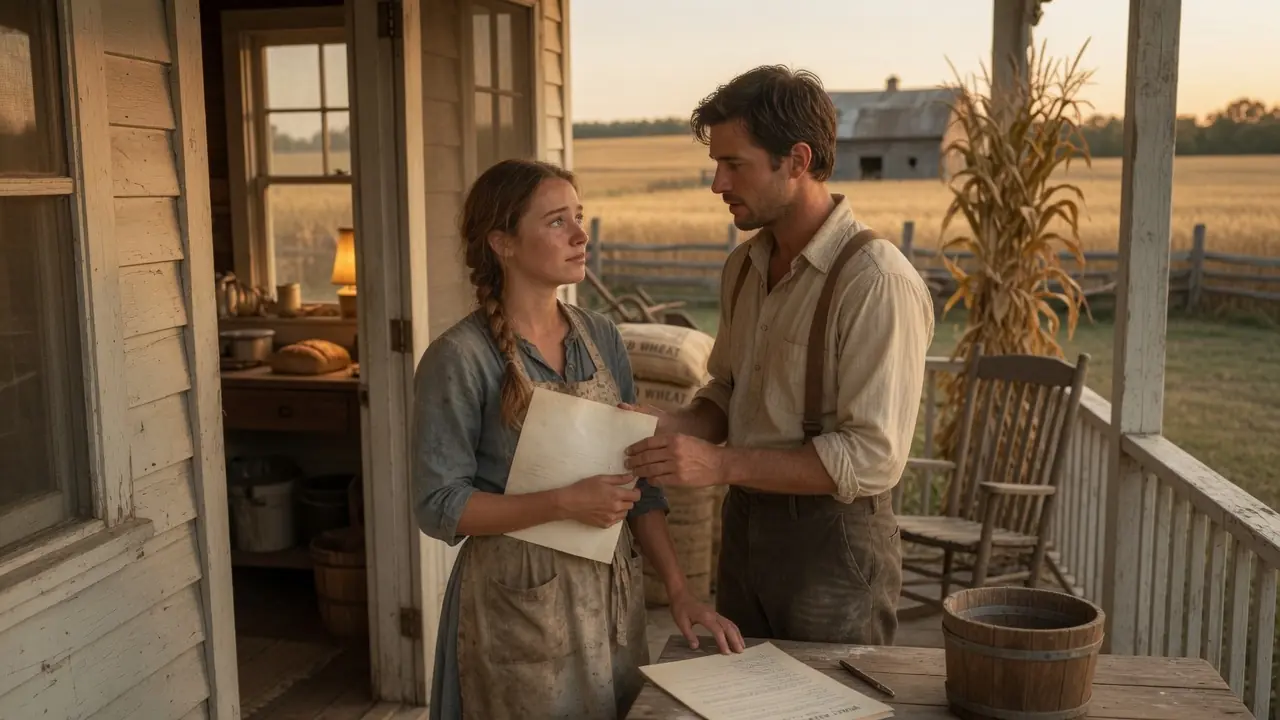
One late afternoon during harvest season, Nancy stood on the front porch of the Harwell farmhouse holding the signed wheat contract against her chest. The fields beyond the porch glowed gold, not as full as they once had been, but alive. The barn roof no longer showed sky through its boards, and fresh bread cooled on the windowsill. For the first time in a long while, the farm looked like a future instead of a memory.
Henry came up the steps slowly, his sleeves rolled, dust on his boots, and a softness in his face that made Nancy forget what she meant to say. He had spent the day helping repair the last gate near the south pasture. His hands were marked with work, but there was gentleness in the way he reached for the contract. “You do not have to hold that so tightly anymore,” he said.
Nancy looked down and realized her fingers had creased the paper. “I suppose I am afraid it will disappear.” Henry carefully took it from her hands and laid it on the porch table. “Then let it rest where both of us can see it.” His fingertips brushed hers.
Neither of them pulled away. The farm became quiet around them, the kind of quiet that is not empty but full of every unsaid thing. Nancy looked up at him, and the late light touched his face with the warmth of the fields behind her. She realized then that Henry had never once made her feel poor.
“I came to your ranch because I needed wages,” she said softly. “I told myself that was all it was.” Henry’s eyes stayed on hers. “And was it?” She shook her head, tears filling her eyes before she could stop them.
“No,” she said. “I found work, and I found help, and I found the truth about what happened to my father.” She swallowed, her voice trembling. “But somewhere in all that, I found you.” Henry stepped closer, close enough that she could feel the warmth of him.
“I did not save you, Nancy,” he said. “You were already fighting before I knew your name.” He lifted her work-worn hand between both of his. “I only had the sense to stand where I should.” The tenderness in his voice was almost too much to bear.
Nancy looked toward the field, then back at him. “Then stay beside me a little longer.” A small smile touched his mouth. “As your employer?” “No.” Her fingers tightened around his. “As the man I trust.”
Henry’s expression changed, not suddenly, but deeply. He lowered his forehead toward hers, stopping just short, giving her every chance to step back. She did not. When he kissed her, it was gentle and careful, not claiming, not urgent, but full of everything that had grown between them through work, courage, and quiet evenings.
Nancy closed her eyes and felt the whole farm around her: the porch boards beneath her boots, the bread cooling in the window, the repaired fence, the wheat breathing in the wind, her father’s chair beside the door. Nothing about the kiss felt like escape. It felt like coming home to a part of herself she had not known was waiting. When they stepped apart, Henry still held her hand.
Thomas cleared his throat from inside the screen door. Nancy startled, but Henry only smiled with the look of a man caught doing something honorable at exactly the wrong moment. Thomas pushed the door open and leaned on his cane. “If you plan to court my daughter,” he said, “you might start by asking properly.”
Nancy covered her face with one hand, laughing and crying at the same time. Henry straightened immediately. “Mr. Harwell, I would like permission to court Nancy with honest intentions.” Thomas pretended to consider it longer than necessary. “Honest intentions are the only kind allowed on this porch.”
Henry nodded. “Then those are the kind I bring.” Thomas looked from Henry to Nancy, and his sternness softened. “Then you may stay for supper.” He turned back inside. “But wash first. I will not have fence dust at my table.”
They ate that evening with the door open to the fields. Beans, bread, preserved peaches, and coffee tasted finer than any feast Nancy could imagine. Henry sat across from her father, speaking not as a rescuer, not as a rich man, but as someone who intended to belong carefully. Nancy watched him and felt the peace of being respected in the place she loved most.
In the weeks that followed, courtship did not change the work. If anything, it made the work sweeter. Henry still rose before dawn, Nancy still checked pantry ledgers, Thomas still worried over weather, and the fields still demanded more than any one person could give. But now, when Henry rode away at dusk, he touched Nancy’s hand before mounting, and that small gesture filled the evening with promise.
The first wheat delivery to Callaway Ranch arrived before winter. Thomas insisted on riding with the wagon despite Nancy’s protests. Henry met them at the barn and inspected the sacks with the seriousness of a buyer, not the softness of a suitor. Then he paid the agreed price in full and shook Thomas’s hand before touching Nancy’s shoulder gently.
That payment did more than settle an account. It restored something no bank paper had the right to take. Thomas stood taller after it, and Nancy saw years return to his face, not all of them, but enough to matter. Pride, when returned properly, can heal like rain.
By spring, the Harwell farm had green rows again. Nancy walked between them at dawn, trailing her fingers over the young wheat. Henry joined her without speaking, and together they watched the light rise over the fields. “This land likes you,” he said.
Nancy smiled. “Land does not like anyone. It only answers care.” Henry looked at her, then at the field. “Then it knows your voice.” She laughed softly, but the words settled deep.
They married the next harvest season on the Harwell farm porch. It was not grand, but every board had been scrubbed, every window opened, and every table covered with food made by women from nearby farms who had heard the story and wanted to help. Thomas walked Nancy from the kitchen door to Henry, slow but proud. The wheat behind them moved in the wind like a blessing.
Henry’s vows were simple. He promised honesty, partnership, and never mistaking her strength for something that meant she should carry burdens alone. Nancy promised the same, adding that she would correct his ledgers whenever necessary. The guests laughed, and Henry said softly, “I expect nothing less.”
Years later, people would tell the story many ways. Some said a poor farmer’s daughter took a job on a ranch and found justice. Others said a ranch owner turned against his own father to save a good family’s land. Nancy knew both were true, but neither was the whole truth.
The whole truth was quieter. A young woman refused to let shame make her small. A young man chose right even when it cost him blood and name. And somewhere between wheat fields, hard work, repaired fences, and late-afternoon porch light, two people learned that kindness becomes love when it is joined with respect.
Nancy Harwell had gone to Callaway Ranch to save her father’s farm.
Henry Callaway helped her save much more than that.
He helped her believe that the life ahead could be built not from fear, but from trust, soil, work, and a love steady enough to stand beside her through every season.