In the fall of 2021, I moved into a rented townhouse in southern Illinois because I believed silence would help me heal.
I was twenty-seven, newly single, and living alone for the first time.
Until then, I had always shared my space with someone. First my parents, then college roommates, then the man I had believed I would marry.
When that relationship ended, it ended badly enough that I wanted distance from everything connected to it. I accepted a late-shift position managing inventory at a distribution center, found an affordable townhouse near work, and convinced myself that starting over would feel clean.
The townhouse stood in a quiet cul-de-sac just off a rural highway.
Every unit looked almost identical.
Beige vinyl siding.
Small concrete driveways.
Neatly trimmed hedges.
Wind chimes hanging from porch roofs.
Mailboxes decorated with family names in black lettering.
The neighborhood seemed designed to be forgettable.
Most of the residents were older couples who kept their curtains open during the day and went inside before dark. A few young families lived near the entrance. Children rode bicycles between the mailboxes in the afternoon, but by nine at night, the street usually became silent.
I liked that.
After everything I had been through, I wanted to live somewhere no one asked questions.
For the first week, I barely spoke to anyone.
Then I began noticing the man three doors down.
His name, according to the mailbox, was Darren Pike.
He appeared to be in his mid-forties, tall and heavy through the shoulders, with a thick stomach, a scruffy brown beard, and dark hair that always looked unwashed.
There was nothing remarkable about his clothing.
Jeans.
Work boots.
Plain T-shirts or an old jacket.
What unsettled me was what he did at night.
I worked late and usually arrived home between nine-thirty and ten-thirty. Almost every time I turned into the cul-de-sac, Darren was outside.
Sometimes he leaned against his porch railing with a cigarette.
Sometimes he paced slowly between his driveway and mailbox.
Sometimes he simply stood near the road.
He never checked his phone.
Never waved at passing cars.
Never shifted restlessly or seemed distracted.
He stood completely still and watched.
The first time I noticed him staring at me, I gave a polite nod.
He did not respond.
The second time, I raised one hand in an awkward wave.
Nothing.
His face remained blank as he followed my car with his eyes.
When I stepped out, he watched me walk to my door.
I told myself he was socially awkward.
Maybe he worked nights.
Maybe he had insomnia.
Maybe standing outside was his way of getting air.
When I mentioned him to my mother, she laughed gently.
“You’ve spent too much time listening to crime podcasts.”
A friend suggested he might be lonely.
Another said I should introduce myself instead of assuming the worst.
I considered it.
But every instinct I had rejected the idea.
It was not simply that Darren watched me.
It was how still he became while doing it.
Most people caught staring will look away.
Darren never did.
In the middle of September, the noises began.
I had worked a twelve-hour shift and arrived home exhausted. I reheated soup, watched half an episode of a television show, and fell asleep shortly after midnight.
At 2:37 a.m., I woke to metal scraping against wood.
The sound came from the backyard.
My bedroom was on the ground floor at the rear of the townhouse. A sliding glass door in the adjoining living area opened onto a small fenced yard covered with decorative gravel.
The sound came again.
Slow.
Deliberate.
It resembled the wooden gate being pulled open against its metal latch.
I sat upright.
For several seconds, I listened.
Nothing.
Then gravel shifted outside.
One footstep.
A pause.
Another.
Not the scattered scratching of a raccoon.
Not the quick movement of a cat.
Someone was walking slowly across my yard.
My phone was charging beside the bed.
I picked it up and slipped out from beneath the blanket.
At the time, the only object I owned that even resembled a weapon was an old kitchen knife I kept inside the nightstand. The blade was dull enough that it struggled with tomatoes, but I carried it anyway.
The vertical blinds over the glass door were closed.
I crouched near the wall and looked through a narrow opening.
The backyard was almost completely dark.
My motion-activated light had not turned on.
I could see the pale gravel near the door and the black outline of the fence.
Nothing moved.
Then another footstep sounded close enough that I felt it through the floor.
I called 911.
The dispatcher kept me on the line while two officers drove toward the townhouse.
I stayed on the bedroom floor, staring at the dark hall, convinced that at any moment the glass door would slide open.
Ten minutes later, red and blue light flickered across the front walls.
The officers searched the yard.
One remained with me while the other walked the fence line with a flashlight.
They found no one.
The gate was closed.
The latch appeared undamaged.
There were no clear footprints because gravel covered the entire yard.
“Probably an animal,” one officer said.
“It sounded like a person.”
“Raccoons make more noise than you’d think.”
He gave me the practiced expression of someone trying to appear patient.
They filed an incident note and left.
I stayed awake until sunrise.
When daylight came, I walked into the yard.
At first, everything appeared normal.
Then I saw the stone.
It was flat and roughly the size of a paperback book, wedged beneath the bottom of the wooden gate.
The gate had a spring hinge that pulled it closed automatically.
With the stone underneath it, the gate looked shut from a distance but had not fully latched.
Someone could pull it open without touching the noisy metal release.
I removed the stone and called the police again.
The dispatcher added the information to the previous report.
I asked whether officers could check nearby doorbell cameras.
She explained that unless a crime had occurred, there was little they could investigate.
“But someone entered my yard.”
“You did not see anyone enter.”
“I heard someone.”
“I understand.”
Her voice suggested she did not.
For two nights, nothing happened.
Then, at 2:14 a.m., I woke to the back door handle turning.
The first movement was gentle.
A careful pressure.
Then came a harder rattle.
Someone pulled the handle twice.
I stopped breathing.
There was a person on the other side of the glass.
I could feel it with a certainty that made my skin tighten.
The vertical blinds hid the yard from view, but a faint shadow crossed the bottom edge.
I picked up my phone and crawled into the hallway.
The handle turned again.
This time, the lock clicked beneath the pressure.
My motion light activated.
A tall silhouette appeared behind the blinds.
The man did not run.
He stood there.
Waiting.
I called 911 again.
By the time officers arrived, the yard was empty.
This time they found several large impressions in the gravel leading from the gate to the door.
One officer photographed them.
The other advised me to keep my windows and doors locked.
“They already are.”
“Good.”
“What happens when he breaks the glass?”
“Call us.”
“I am calling you now.”
He looked uncomfortable.
“We can increase patrols in the area.”
The next morning, I bought two security cameras.
One went above the front door.
The second faced the backyard.
I installed additional locks on the sliding door and placed a wooden dowel inside the track.
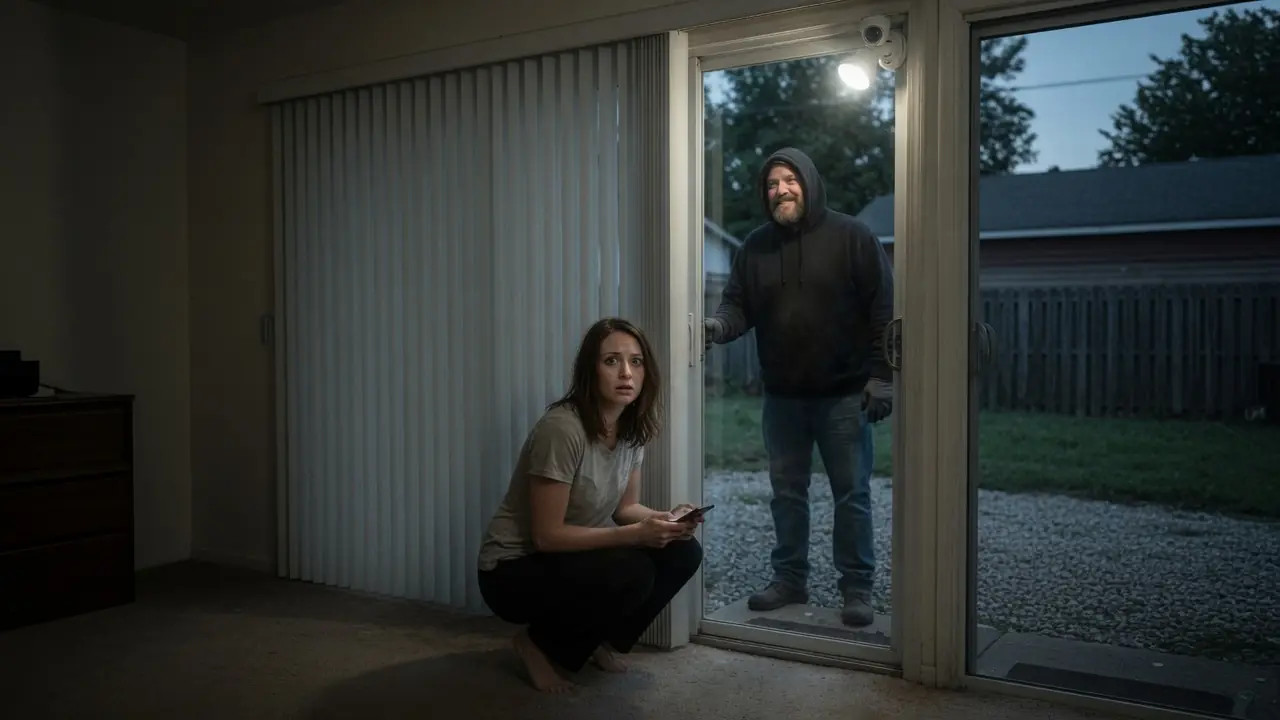
That evening, I left the lights off and sat on the living-room floor watching the live camera feeds.
Two o’clock passed.
Then 2:14.
Nothing.
At 2:23, the backyard camera sent an alert.
A man entered the frame.
He came through the gate without hesitation.
Tall.
Broad.
Black hoodie pulled over his head.
Dark jeans.
Gloves.
He stayed near the fence until the final few steps, almost as though he understood the limits of the motion detector.
Then he walked directly to the glass door.
He looked up at the camera.
The lower half of his face was visible.
A beard.
Heavy cheeks.
A mouth slowly widening into a smile.
He knew I was watching.
The smile remained while he stepped backward.
He did not rush.
He did not hide his face.
He stared into the lens until darkness swallowed him beyond the gate.
The police watched the video in my living room.
The younger officer finally admitted, “That’s disturbing.”
“Is that enough to speak to Darren Pike?”
I showed them the house three doors down.
The older officer shook his head.
“The face isn’t clear enough to identify him.”
“He has the same build.”
“That is not probable cause.”
“Could you at least knock on his door?”
“We can’t accuse a neighbor based on a body type.”
“I’m not asking you to arrest him.”
The officer looked toward the dark backyard.
“He didn’t attempt entry on the recording.”
“He came onto private property.”
“Do you have a no-trespassing sign?”
I stared at him.
The question was so absurd that for several seconds I could not speak.
They left after advising me to improve the lighting.
I packed a bag and drove to a hotel.
When I returned the following afternoon, there were four muddy handprints on the glass door.
Two near the top.
Two near the bottom.
The arrangement looked as though someone had pressed both hands against the glass while standing, then crouched and done it again.
I imagined him lowering himself outside my dark house.
Placing his face close to the glass.
Trying to see beneath the blinds.
I broke my lease that day.
The property manager reminded me that I would lose my deposit and might owe an additional month’s rent.
I told her to send the bill.
Two friends helped me load everything into a rented truck.
Darren stood in his driveway during most of the move.
He smoked one cigarette after another.
He never approached.
Never smiled.
Never looked away.
As I completed my final check, I opened the mailbox.
A folded piece of notebook paper had been pushed behind a grocery advertisement.
The message was written in small, cramped letters.
The cops leave. I don’t.
The officer who took that final report did not dismiss me.
He placed the note inside an evidence bag and asked several detailed questions about Darren.
He promised officers would attempt to speak with him and conduct additional patrols.
By then, it no longer mattered.
I drove away from the cul-de-sac before sunset and never returned.
A month later, a woman named Kayla Morgan sent me a message through Facebook.
She said she had moved into my former townhouse.
Her message read:
Hi. Sorry to bother you. The landlord said you lived here before me. Did you ever see a man in a black hoodie near the backyard? I keep hearing footsteps after two in the morning. Last night someone knocked on the glass door and stood there for almost ten minutes.
I stared at the message for a long time.
I told myself I should answer.
I should warn her.
I should send the videos and police reports.
But fear can make a person selfish.
I blocked her account.
For years, I told myself that I had done it because I could not survive being pulled back into the situation.
The truth is less comforting.
Someone once stood outside my glass door while the neighbors slept and the police drove away.
When another woman reached out from that same place, I did exactly what I had always been afraid everyone else would do.
I looked away.
I do not know what happened to Kayla.
Her account disappeared several months later.
The townhouse was listed for rent again the following spring.
The advertisement described the cul-de-sac as peaceful, safe, and ideal for a single professional.
In one photograph, the sliding glass door was visible behind a row of carefully opened blinds.
Someone had removed the backyard camera.
Three doors down, a tall man stood beside his mailbox.
Story Two: Do Not Answer the Bedroom Phone
In 2020, I worked for a property-preservation company in upstate New York.
The job involved entering foreclosed houses after the former owners were gone.
We changed locks.
Photographed belongings.
Drained pipes before winter.
Removed trash and furniture.
Boarded broken windows.
Most houses were depressing rather than frightening.
You could usually reconstruct the final months of someone’s life from what they left behind.
Unopened bills.
Empty medicine bottles.
Family photographs placed face down.
Children’s height marks on walls that now belonged to a bank.
The house outside Havenbrook felt wrong before I entered it.
Havenbrook had once been a small manufacturing town. By 2020, its mill was closed, half the stores on Main Street were empty, and weeds grew through cracks in the gas-station parking lot.
The property stood several miles beyond town on a dirt road surrounded by dense woodland.
No neighboring houses were visible.
The file identified the former owner as Eleanor Voss, an eighty-three-year-old widow who had died without known heirs.
The utilities had been disconnected for more than a year.
My assignment was simple.
Inventory everything.
Remove items with no listed value.
Secure the property before winter.
I arrived shortly after nine on a Monday morning.
The house was small and one story, with faded green siding and vines climbing over the front porch.
The front door had swollen inside its frame.
I shouldered it open and entered.
The air smelled stale, dusty, and faintly metallic.
Nothing appeared disturbed.
The living room contained heavy furniture covered in lace cloths. Porcelain figurines crowded a cabinet. Faded landscape paintings hung along the walls.
It reminded me of my grandmother’s home after she moved into assisted living.
I removed my work phone and began photographing each room.
The phone rang.
I jumped hard enough to drop my measuring tape.
That alone was strange.
I had checked the signal before entering.
No bars.
The caller identification displayed only:
UNKNOWN CALLER
I answered.
“Hello?”
Static whispered through the speaker.
“Hello?”
No response.
After several seconds, the call ended.
I assumed the phone had briefly connected to a distant tower.
That happened in rural areas.
I continued working.
The hallway contained three doors.
The first opened into a nearly empty bedroom with a stained mattress on the floor.
The second led to a sewing room.
Spools of thread covered a desk. Fabric filled plastic containers. An old sewing machine sat beneath the window.
A corkboard hung on the opposite wall.
It was covered with newspaper obituaries.
Dozens of them.
Every clipping had been cut carefully and pinned in rows.
Most came from the Havenbrook Gazette.
The deaths covered nearly twenty years.
Men.
Women.
Children.
Some names had been underlined.
Others had telephone numbers written beside them.
I photographed the board.
The master bedroom stood at the end of the hall.
A large wooden bed occupied most of the room.
On the nightstand sat an old rotary telephone.
The plastic had faded from white to yellow. A long coiled cord connected the receiver to the base.
I lifted it.
No dial tone.
The cable ran behind the nightstand and ended where someone had cut it near the wall.
The phone was not connected to anything.
I returned the receiver.
While examining the bathroom, my work phone rang again.
UNKNOWN CALLER
I hesitated before answering.
For five seconds, I heard only faint crackling.
Then a woman whispered:
“Don’t answer the phone in the bedroom.”
The line disconnected.
I stood in the hallway with the phone pressed against my ear.
Every doorway was empty.
I searched outside.
No vehicles had arrived.
No one moved among the trees.
I tried calling my supervisor.
The call failed.
The phone showed one bar, then none.
I should have left.
Instead, I convinced myself that another employee was playing an elaborate joke.
People in my line of work had strange senses of humor. Someone might have found a way to route calls through the company system.
I returned to the living room and began packing low-value items.
Books.
Glassware.
Porcelain figures.
I kept glancing toward the hallway.
The rotary telephone rang.
Its mechanical bell screamed through the house.
I froze with a cardboard box in my hands.
The sound came again.
Sharp.
Metallic.
Impossible.
I walked toward the bedroom.
The phone rang every four seconds.
The receiver trembled against its cradle.
Its severed cord lay clearly visible behind the table.
I remained in the doorway.
The voice on my work phone had warned me not to answer.
I had no intention of touching it.
After the ninth ring, it stopped.
The silence afterward felt larger than the house.
I decided to leave after checking the basement.
That decision remains one of the most foolish things I have ever made.
The basement door was located in the kitchen.
Cold air moved upward when I opened it.
I descended with a flashlight.
The smell became stronger below.
Mold.
Rust.
Damp wood.
Shelves lined the walls, filled with paint cans, broken tools, and cloudy glass jars.
In the rear corner stood a small table.
A gray cordless phone rested on it.
Unlike the rotary telephone upstairs, this model appeared to come from the early 2000s.
Its charging base was plugged into a dead outlet.
Dust covered both pieces.
Beside the phone lay a stack of notebooks.
I opened the first.
Every page followed the same format.
A name.
A date.
A short sentence.
Lena H. — July 3, 2019. Rang once. Did not answer.
Carl M. — September 12, 2019. Picked up. Warned him.
Denise Porter — November 8, 2019. Bedroom phone. Stayed twelve minutes.
Michael Crane — January 16, 2020. Would not listen.
The entries continued.
Some names appeared on the obituary board upstairs.
I turned pages faster.
The final written entry was dated three days before Eleanor Voss died.
Eleanor V. — Answered after fourth ring. Voice confirmed.
Below it, in different handwriting, someone had added:
House remains active.
A floorboard creaked behind me.
I dropped the notebook.
My flashlight swept across the basement.
Shelves.
Furnace.
Water heater.
Dark space beneath the stairs.
Nothing.
Then the cordless phone rang.
It produced a thin electronic chirp.
The display lit green.
There was no electricity in the house.
The outlet was dead.
The battery compartment stood open and empty.
Still, the phone rang.
The display showed a single word.
EVAN
My name.
I ran.
I struck my shoulder against the basement doorway, stumbled through the kitchen, and left the front door hanging open.
I drove all the way back to the office without stopping.
My supervisor, Greg, listened while I described the obituaries and possible evidence of unauthorized occupants.
I did not mention the impossible calls.
I told him the property felt unsafe and might contain hidden wiring, surveillance equipment, or a squatter.
Greg reassigned the job to another employee named Mark Ellison.
I wanted to warn Mark.
I also feared he would laugh.
Two days later, he sent me a text.
The dead phone in the bedroom rang while I was standing beside it. What the hell did you find in this place?
I called immediately.
Mark answered from his truck.
He said he had entered the house shortly after eight.
The basement table and notebooks were gone.
The obituary board remained.
While he photographed the master bedroom, the rotary telephone rang.
He did not answer.
“What else happened?” I asked.
There was a long silence.
“Nothing.”
“Mark.”
“I left.”
His voice sounded distant.
“I’m not going back.”
He quit the following morning.
He never returned his company equipment.
Months later, I found his social-media profile and confirmed he was alive. He had moved to Pennsylvania and begun working in construction.
He never responded to my messages.
Greg reported possible squatters to the police.
Officers searched the house.
No one was inside.
They found no telephone service, electrical power, hidden speaker system, or obvious surveillance equipment.
The notebooks were still missing.
The bank eventually hired another company.
Three months later, the house burned.
Investigators attributed the fire to undetermined causes.
The foundation was cleared, and the land remained empty.
I tried to forget it.
Then, in 2022, my personal phone rang at 3:11 in the morning.
The caller identification displayed:
UNKNOWN CALLER
I answered before remembering the house.
For several seconds, there was only static.
Then I heard my own voice.
Not a recording I recognized.
My voice sounded frightened and distant, as though speaking from the other end of a long tunnel.
“Don’t answer the phone in the bedroom.”
The call ended.
I lived in an apartment at the time.
There was no landline.
No rotary telephone.
I sat awake until morning.
Three days later, a padded envelope arrived without a return address.
Inside was one page torn from a yellowed notebook.
My name had been written at the top.
Evan Marsh — October 17, 2022. Answered immediately. Warning delivered.
Beneath it, another line had been added in darker ink.
Waiting for bedroom contact.
I moved the following month.
I changed my number.
I stopped working in property preservation.
It has been almost four years since the envelope arrived.
Nothing else has happened.
But I no longer keep a phone beside my bed.
And whenever I stay in a hotel, I disconnect the room telephone before sleeping.
Usually, nothing happens.
Once, in a motel outside Albany, the disconnected phone rang anyway.
I left before the second ring.
Story Three: The Knocking Beneath the Floor
I rented the house because it was inexpensive.
That should have been my first warning.
In 2019, I was twenty-eight and working overnight security at a manufacturing plant on the edge of town. The pay was not good, but the night differential helped.
The rental house stood in an older neighborhood where most properties had been built before the 1950s.
One story.
Narrow hallway.
Small fenced yard.
Detached garage.
Creaking hardwood floors.
The landlord, Mr. Collins, described the basement as “unfinished but dry.”
It was unfinished.
It was not dry.
The basement door stood in the hallway between the bathroom and kitchen.
The door was unusually heavy and scraped across the floor whenever it opened.
The light switch was located halfway down the stairs, which meant anyone entering had to descend four steps in darkness before reaching it.
The first time I went below, I felt uneasy.
Not terrified.
Just watched.
A single bulb hung from a cord near the center of the basement. Its weak light barely reached the corners.
The space smelled of old timber and damp stone.
I stored spare furniture, tools, and several boxes along one wall.
Then I went upstairs and rarely returned.
For the first few months, nothing unusual happened.
The house made ordinary noises.
Pipes rattled when the shower ran.
The refrigerator hummed too loudly.
One kitchen cabinet swung open whenever the furnace started.
By October, I had stopped noticing most of it.
Then I came home from work at three in the morning and heard three knocks from behind the basement door.
Soft.
Evenly spaced.
Tap.
Tap.
Tap.
I stopped in the hallway.
The sound came again.
Three quiet knocks from the other side.
I stood there holding my keys, listening.
Nothing followed.
I told myself the pipes had shifted.
Then I went into my bedroom, locked the door, and slept with the television on.
The next morning, I checked the basement.
The door resisted as usual.
I descended, turned on the light, and searched the space.
No broken windows.
No open vents.
No disturbed boxes.
Dust remained across the floor without footprints.
I left convinced that the noise had come from the house settling.
Several nights later, I was brushing my teeth when something struck the basement door.
One hard knock.
Close enough to make the wooden panel vibrate.
I stepped out of the bathroom.
The hallway was empty.
The basement door remained closed.
I pressed one ear against it.
At first, I heard nothing.
Then came breathing.
Slow.
Steady.
Human.
Someone stood on the other side of the door.
I backed away.
The breathing stopped.
I called Mr. Collins the following morning.
He arrived with a flashlight and a hammer.
We searched the basement together.
He checked the windows, foundation, furnace opening, and narrow crawl space beneath the rear addition.
There was no sign of entry.
“You work nights,” he said. “You’re probably overtired.”
“I heard breathing.”
“The furnace draws air through these walls.”
“The furnace was off.”
Mr. Collins looked around the basement.
“Old houses make noises.”
I did not tell him how familiar that sentence had become.
For one week, the basement remained silent.
Then, at approximately two in the morning, I was watching television when the door began to open.
The hinges creaked slowly.
The heavy wood dragged across the hallway floor.
I muted the television.
The door continued opening until darkness filled the frame.
I knew I had closed it.
I had not entered the basement in days.
I grabbed a flashlight and approached.
The light switch below did nothing.
The bulb had burned out.
I pointed the flashlight down the stairs.
The beam revealed the first five steps.
Nothing more.
Then footsteps began climbing.
Slowly.
One step.
A pause.
Another.
The wood groaned beneath weight.
I slammed the basement door and held the handle.
Pressure struck from the other side.
Not a violent push.
A steady force.
Someone leaned against the door.
My feet slid several inches along the floor.
Then the pressure vanished.
I locked the door and called the police.
Two officers searched the entire house.
They entered the basement with weapons drawn.
I waited outside.
They returned fifteen minutes later and found nothing.
One officer asked whether I had been watching a horror movie.
The other recommended replacing the burned-out bulb.
After they left, I installed a padlock on the basement door.
For almost a month, nothing happened.
The silence restored just enough confidence for me to begin feeling foolish.
Then I returned from work at 3:20 one morning and found the padlock on the floor.
The metal body had split near the hinge.
The basement door stood open by several inches.
I did not enter.
I packed clothes and spent three nights at a friend’s apartment.
When I returned during daylight, the door remained open exactly as I had left it.
Nothing was missing.
The boxes downstairs were undisturbed.
I nailed the door shut.
Not lightly.
I drove six long nails through the frame and placed a heavy dining chair beneath the handle.
Mr. Collins would have been furious.
I no longer cared.
Two nights later, I woke to a low voice beneath my bed.
It did not form words.
It sounded like someone humming with a closed mouth.
A deep vibration rose through the floorboards directly under my mattress.
I remained completely still.
The humming stopped.
Then three knocks came from beneath the bed.
Tap.
Tap.
Tap.
I left the house barefoot.
The police searched again.
Nothing.
The basement door remained nailed shut.
The chair had not moved.
No one was found below.
I packed what I could carry and moved out.
I abandoned everything in the basement.
Tools.
Furniture.
Family photographs.
Boxes of books.
Losing them felt easier than opening that door again.
Mr. Collins kept my deposit and threatened to sue over the damaged frame.
He never did.
Several months later, curiosity defeated judgment.
I searched the property records.
The house had been constructed in 1948 by a man named Harold Greeley.
Greeley lived there with his wife and younger brother, Samuel.
In 1957, Samuel disappeared.
According to a newspaper article, Harold claimed his brother had left town after an argument.
No body was recovered.
The basement had been renovated later that same year.
A second article, published in 1986, reported that a tenant had contacted police after hearing “persistent movement beneath the basement stairs.”
Officers found nothing.
The tenant moved out after three weeks.
I located two former renters online.
One did not reply.
The other, a woman named Pamela Reed, agreed to speak with me by telephone.
She had lived in the house during the early 2000s.
“Did you hear knocking?” I asked.
She was silent for so long that I thought the call had disconnected.
“Three times?”
“Yes.”
“Always three?”
“Usually.”
Pamela exhaled.
“Did you ever remove the shelf beneath the stairs?”
“No.”
“What shelf?”
“There used to be a wooden storage unit built against the foundation.”
“I saw it.”
“Behind it is a door.”
My stomach tightened.
“A door to what?”
“I don’t know.”
“You lived there. Didn’t you open it?”
“I tried.”
Pamela explained that after weeks of knocking, she moved the shelving unit.
A narrow wooden panel had been installed directly into the foundation wall.
There was no handle.
Only three small dents near the center, as though someone had struck it repeatedly from the other side.
She pried the panel loose.
Behind it was packed soil.
Nothing more.
“That makes no sense,” I said.
“I know.”
“What happened after you opened it?”
“The noises moved upstairs.”
I closed my eyes.
“Under the bedroom?”
“Yes.”
Pamela had left the house the following morning.
Before ending the call, she asked one question.
“Did you ever knock back?”
“No.”
“Good.”
“Why?”
“Because my husband did.”
“What happened?”
She began crying.
Pamela’s husband had responded after hearing three knocks beneath the stairs.
He struck the wall three times with his fist.
For the rest of the night, something followed him through the house.
It knocked from inside kitchen cabinets.
Behind the bathroom mirror.
Beneath his pillow.
Three days later, he disappeared while driving home from work.
Police found his car beside the highway.
The driver’s door was open.
The keys remained in the ignition.
Mud covered the back seat.
Three dents had been pressed into the roof from the inside.
His body was never found.
I wanted to dismiss her story.
Grief can reshape memories.
Old houses encourage superstition.
People connect unrelated events because randomness is harder to accept.
Then Mr. Collins called me.
It had been almost a year since I moved out.
He sounded frightened.
“Did you ever do work in the basement?”
“No.”
“Did you remove anything beneath the stairs?”
“No.”
There was a pause.
“The new tenant found a door.”
I gripped the phone.
“What happened?”
“He opened it.”
“And?”
“Police are here.”
Mr. Collins lowered his voice.
“There’s a room behind the foundation.”
A construction crew had examined the wall after the new tenant complained of odors.
The packed soil behind the panel was only several feet thick.
Beyond it stood a narrow chamber built outside the official basement dimensions.
Inside were a rusted cot, food cans, several notebooks, and human remains.
Investigators believed the bones belonged to at least two people.
One had been dead for decades.
The other for less than ten years.
Police arrested no one.
The house had apparently contained a hidden room accessible through a sealed exterior tunnel, though part of it had collapsed.
For years, someone may have entered and remained beneath the house without tenants knowing.
That explanation should have made me feel better.
It did not explain the padlock.
It did not explain how the nailed door remained closed while the humming came from beneath my bed.
It did not explain why officers searching the basement never noticed the false dimensions.
And it did not explain what workers found scratched repeatedly into the hidden room’s wooden door.
Three words.
Written hundreds of times.
PLEASE KNOCK BACK.
The house was demolished.
The remains were never publicly identified.
I live in an apartment now.
Third floor.
Concrete construction.
No basement.
Sometimes, shortly before I fall asleep, I hear pipes shift inside the walls.
I wait.
Most nights, nothing follows.
But once or twice a year, usually near the end of October, three quiet taps come from beneath the floor.
Tap.
Tap.
Tap.
I never answer.
I know better now.
Some doors are not asking to be opened.
They are asking whether anyone is listening.