No one at the Willow Creek Animal Rescue knew where the old dog had come from.
He had been found wandering beside a rural highway on a cold November morning, his fur tangled with mud and burrs, his ribs visible beneath a faded golden coat.
He wore no collar.
He had no identification chip.
There were no missing-dog reports that matched him.
The only thing he carried was a small brown teddy bear.
The toy was torn across one side, its stuffing exposed through several old seams. One plastic eye was missing, and the red ribbon around its neck had faded almost white.
The dog held it gently between his teeth as the rescue workers approached.
The moment anyone tried to take it, he growled.
Not a frightened whine.
Not a warning bark.
A deep, desperate sound that came from somewhere below fear.
The workers eventually used a blanket to guide him into the rescue van, but the teddy bear remained pressed beneath his chest the entire ride.
They named him Bear.
It seemed appropriate at first because of the toy.
Later, the name began to feel cruel.
Bear spent nearly six years at Willow Creek.
During that time, hundreds of dogs arrived and left.
Puppies with oversized paws were adopted within days.
Friendly Labradors went home with families.
Small dogs were carried out in the arms of elderly couples.
Even frightened animals eventually learned to trust again.
Bear remained.
He lived in the kennel farthest from the front lobby, where the noise of visitors was softer.
Every morning, staff found him curled tightly around the teddy bear.
Every night, he slept with his chin resting over its worn body.
He never destroyed it.
He never played with it.
He guarded it.
When volunteers entered his kennel, Bear moved between them and the toy.
If they came too close, his body stiffened.
His ears flattened.
His lips lifted.
He never bit anyone, but he made it clear that the bear belonged to him and that no human had the right to touch it.
The rescue staff tried everything.
Treats.
Soft voices.
Long walks.
Different toys.
A behavior specialist spent weeks sitting outside Bear’s kennel without looking at him directly.
Bear eventually accepted food from her hand.
He allowed her to fasten a leash.
But if she reached toward the teddy bear, the trust disappeared instantly.
“He’s protecting more than a toy,” she told the staff.
“What do you mean?” asked Emma, the shelter manager.
The specialist watched Bear pull the bear closer to his chest.
“He thinks it connects him to someone.”
Emma looked at the old dog.
“To who?”
“That’s what he’s waiting to find out.”
Bear was not always aggressive.
On quiet afternoons, he sat near the fence and watched cars enter the rescue parking lot.
Every time a young girl stepped out, Bear stood.
He would move slowly toward the front of the kennel, the teddy bear hanging from his mouth.
He watched each visitor carefully.
Dark hair.
Light hair.
Tall.
Some girls approached his kennel and whispered to him.
Bear stared into their faces.
Then, after a few seconds, he turned away.
As the years passed, he stood less often.
His legs became stiff.
White fur spread across his muzzle.
His hearing weakened.
But he continued to watch.
Emma often found him facing the parking lot long after visitors had gone.
“Who are you waiting for, old man?” she would ask.
Bear never answered.
He only lowered his head onto the teddy bear.
More than one family considered adopting him.
Most changed their minds after hearing about his behavior.
A retired man visited Bear three times and took him on long walks.
Bear seemed comfortable with him.
On the fourth visit, the man brought a new blue blanket and tried to place it beside the teddy bear.
Bear snapped at the air near his hand.
The man never returned.
Another couple wanted a quiet senior dog.
They stood outside the kennel while Bear watched them suspiciously.
“He looks sad,” the woman said.
“He looks dangerous,” her husband replied.
They adopted a younger dog instead.
The rescue never placed Bear on the urgent list.
Emma refused.
“He has spent too much of his life being left behind,” she said. “We are not giving up on him now.”
Still, every year became harder.
Bear developed arthritis in his hips.
His eyesight began to cloud.
He required medication twice a day.
He no longer ran during walks.
He moved carefully, keeping the teddy bear nearby whenever possible.
If staff removed it to wash his bedding, he paced until it was returned.
The toy itself was falling apart.
Emma repaired it again and again.
She always waited until Bear was asleep under light sedation during medical examinations.
Even then, she worked quickly.
She replaced missing stuffing but never changed the shape.
She reinforced the red ribbon without removing it.
She found a plastic eye similar to the original but decided not to attach it.
Something told her the missing eye mattered.
The toy looked exactly as Bear remembered it.
And Bear remembered everything.
Years before Willow Creek, his name had been Cooper.
He had lived in a small blue house in Cedar Falls with a six-year-old girl named Lily Bennett.
Lily’s father gave her the puppy on her fifth birthday.
Cooper was too large for his own feet and afraid of the vacuum cleaner.
He followed Lily from room to room.
He slept beside her bed.
He waited outside the bathroom door.
When she cried, he placed his head in her lap.
The teddy bear had been Lily’s first.
Her mother bought it before Lily was born.
By the time Cooper arrived, the bear was already worn.
Lily named it Mr. Buttons.
One afternoon, she placed Mr. Buttons between Cooper’s paws and told him, “You have to protect him when I’m at school.”
Cooper took the responsibility seriously.
He carried the bear around the house.
He slept beside it.
He once growled at Lily’s father when he tried to move it from the couch.
Lily laughed so hard she fell onto the floor.
“You’re his daddy now,” she told Cooper.
From then on, the teddy bear belonged to both of them.
Two summers later, the Bennett family drove north to visit Lily’s grandmother.
Cooper came with them.
A thunderstorm struck while they stopped at a roadside market.
The sky darkened without warning.
Wind shook the signs.
Thunder exploded overhead.
Lily’s father opened the rear door to secure a loose window cover.
A clap of thunder sent Cooper into panic.
He jumped from the vehicle.
By the time Lily’s father turned around, the dog was running across the parking lot.
“Cooper!”
Lily’s scream followed him into the rain.
Her father chased him.
So did two employees from the market.
But Cooper crossed the road and disappeared into a line of trees.
They searched until dark.
The next morning, they searched again.
They printed posters.
They contacted shelters.
Lily insisted on staying in the area for five days.
She called his name until her voice disappeared.
Before the family finally left, Lily placed Mr. Buttons beneath a covered bench near the market.
Her father tried to stop her.
“He’ll know it’s mine,” she said. “He’ll wait with it until we come back.”
They returned the following weekend.
The teddy bear was gone.
Cooper was not there.
Lily believed that meant he had found it.
For months, she asked to search again.
Her parents drove through nearby towns.
They called every rescue organization they could find.
But Cooper had moved farther than anyone realized.
After finding the teddy bear, he followed the family’s fading scent along the highway.
He wandered through fields.
A farmer fed him for several weeks.
Then Cooper disappeared during hunting season.
Someone later saw a golden dog near a freight yard.
Another report placed one near a campground.
Years passed.
The Bennett family moved twice.
Phone numbers changed.
Old missing posters disappeared from store windows.
But Lily never forgot him.
She kept a photograph beside her bed.
It showed her sitting in the backyard, arms around Cooper’s neck while Mr. Buttons rested between them.
The photograph survived childhood.
It survived high school.
It went with her to college.
When Lily was nineteen, her father admitted something he had never told her.
“I found blood near the highway the day after he disappeared.”
Lily stared at him.
“You thought he was dead?”
“I thought he had been hit.”
“Why didn’t you tell me?”
“You were six.”
“You let me keep waiting.”
Her father’s eyes filled.
“I didn’t want to take hope away from you.”
Lily left the room angry.
But that night, she looked at Cooper’s photograph and realized hope had already changed.
It was no longer the belief that he would come home tomorrow.
It was the refusal to believe he had been forgotten.
At twenty-two, Lily graduated from veterinary nursing school.
Her choice surprised no one.
She began working at a small animal clinic outside Sacramento.
She was especially patient with frightened dogs.
She never forced them to accept touch.
She sat near them.
Waited.
Let them decide.
Colleagues often asked why she seemed to understand lost animals so well.
She gave different answers.
Sometimes she mentioned Cooper.
Sometimes she did not.
On her twenty-fourth birthday, Lily decided to adopt a dog.
Her apartment had a small fenced yard.
Her work schedule was stable.
She had spent years helping other people care for their animals.
It was time to bring one home.
A coworker told her about Willow Creek Animal Rescue.
“They have a lot of older dogs,” she said. “Most people only go there for puppies.”
Lily smiled.
“Then I’ll look at the ones nobody else wants.”
She arrived at Willow Creek on a rainy Saturday afternoon.
The parking lot was nearly empty.
Emma met her in the lobby.
“What kind of dog are you looking for?”
“An older one.”
“Large or small?”
“It doesn’t matter.”
“Friendly with other animals?”
“I don’t have any.”
Emma studied her.
“Do you have experience with dogs that are afraid?”
“I work in a veterinary clinic.”
“That helps.”
Lily followed her past several kennels.
Dogs barked and jumped against gates.
A small terrier spun in circles.
A shepherd pressed one paw through the bars.
Lily stopped to speak to each of them.
At the far end, one kennel remained quiet.
An old golden dog lay on a blanket with his back toward the aisle.
His fur was pale and thin.
His hips rose sharply beneath his body.
Between his front paws rested a small brown teddy bear.
Lily stopped walking.
The sound around her seemed to disappear.
She looked at the toy.
One eye missing.
A faded red ribbon.
A tear along the left side repaired with uneven stitching.
Her breath caught.
“Where did he get that?”
Emma looked toward Bear.
“He had it when he was found.”
Lily stepped closer to the kennel.
Bear did not turn.
“What’s his name?”
“We call him Bear.”
Lily stared at the teddy bear.
“No.”
Emma frowned.
“No?”
Lily’s eyes filled.
“That bear was named Mr. Buttons.”
Bear’s ears moved.
Only slightly.
Emma looked from Lily to the dog.
“What did you say?”
Lily gripped the kennel railing.
“My teddy bear was exactly like that.”
Many toys looked alike.
Emma knew that.
But Lily’s voice did not sound uncertain.
“Where did you lose it?”
“A roadside market north of Cedar Falls.”
Emma felt a chill.
Bear had been found more than two hundred miles from there.
“How long ago?”
“Seventeen years.”
Bear lifted his head.
Slowly.
His cloudy eyes turned toward the aisle.
Lily stopped breathing.
The dog stared at her.
He did not growl.
He did not move.
He simply watched.
Lily crouched several feet from the kennel door.
“Cooper?”
Bear’s body stiffened.
Emma had seen him respond to sounds before.
A food container.
A leash.
The engine of the rescue van.
She had never seen him react to a name like that.
His ears rose as far as age allowed.
Lily covered her mouth.
“It’s me.”
Her voice broke.
“Cooper, it’s Lily.”
The old dog tried to stand.
His back legs slipped beneath him.
Emma reached toward the kennel latch.
“Wait,” Lily whispered.
Bear struggled again.
He managed to rise.
The teddy bear remained between his teeth.
He approached the gate one careful step at a time.
When he reached the bars, he stopped.
Lily placed one hand against the floor outside.
She did not reach for him.
She did not call again.
She waited.
Bear lowered his head.
He smelled her fingers through the narrow gap.
For several seconds, nothing happened.
Then his body began to tremble.
A soft sound left his throat.
Not a growl.
A whine.
It rose higher until it became the cry of an animal who had waited too long.
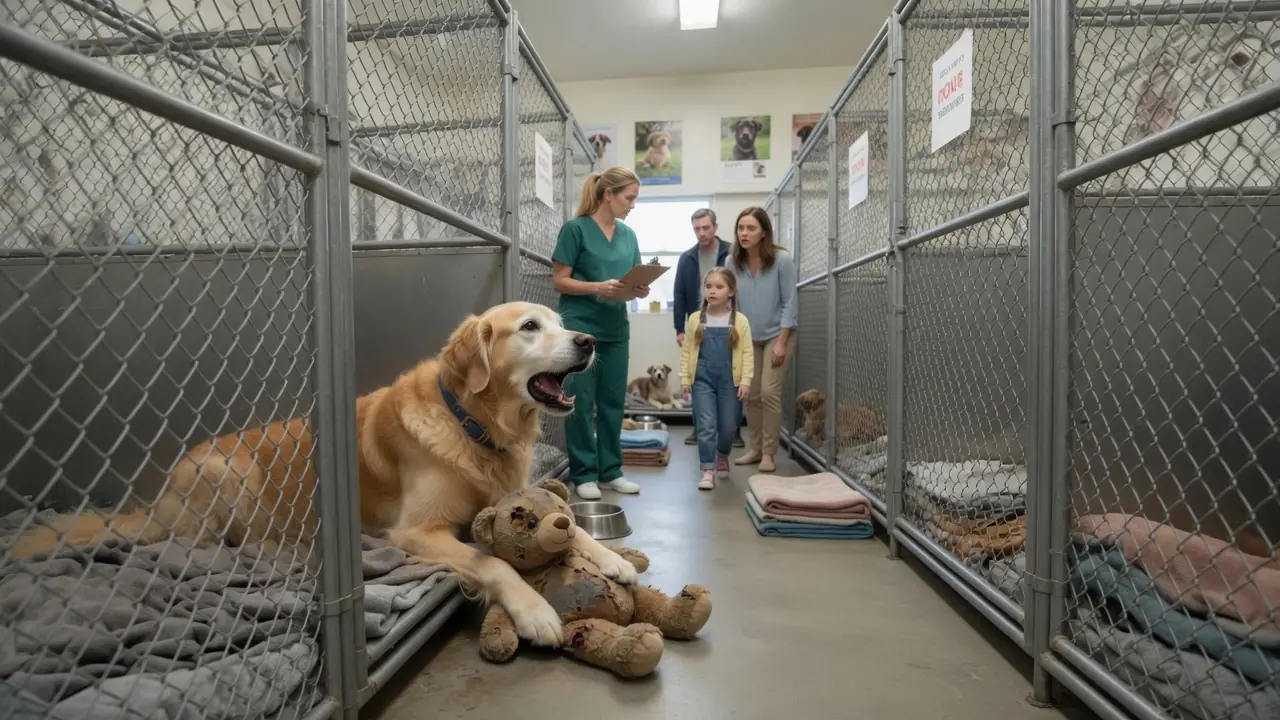
The teddy bear fell from his mouth.
Lily began to cry.
“Cooper.”
Bear pressed his face against the bars.
Lily placed both hands around his muzzle.
He did not pull away.
He licked her fingers once.
Then again.
His tail moved.
Only an inch at first.
Then faster.
His old legs failed, and he sank to the floor, still pushing his face toward her hands.
Emma opened the kennel.
“Go slowly.”
Lily entered on her knees.
Bear watched her.
For six years, he had guarded the teddy bear from every hand that reached toward it.
Now Lily lifted it carefully from the blanket.
Bear did not growl.
She held the toy against her chest.
“Oh, Mr. Buttons.”
A broken laugh escaped her.
“You kept him.”
Bear crawled forward.
He placed his head in her lap.
The old dog who had refused affection from almost everyone closed his eyes beneath her hand.
Lily touched the white fur around his face.
“You waited for me.”
Bear sighed.
His entire body relaxed.
Emma turned away for a moment because she could no longer see through her own tears.
Staff members gathered quietly outside the kennel.
No one spoke.
Bear had spent years treating every person as a possible threat.
With Lily, the fear disappeared in minutes.
She touched his paws.
The scar along his shoulder.
Then she reached toward the teddy bear again.
Bear opened one eye.
Lily placed the toy between them.
“Our baby,” she whispered.
His tail struck the blanket.
Once.
Twice.
Emma asked Lily to come to the office.
They needed proof.
Not because she doubted what she had seen, but because seventeen years was a long time.
Lily showed them the photograph stored on her phone.
A little girl sat in a backyard beside a young golden dog.
Between them rested the same teddy bear.
The missing plastic eye had still been attached then.
A small brown patch marked the dog’s left ear.
Bear had the same patch, faded by age.
Lily’s father emailed veterinary records from Cooper’s puppy vaccinations.
The records described a small scar near the base of his tail after he cut himself on a garden fence.
Emma checked.
The scar was there.
There was no doubt.
Bear was Cooper.
The staff removed the name card from his kennel.
Lily stayed with him until the rescue closed.
She fed him small pieces of chicken from her hand.
He followed her as far as his legs allowed.
When she walked toward the office, he tried to stand immediately.
“I’m not leaving,” she promised.
He watched her until she returned.
The adoption could not be completed that night.
Cooper needed a medical examination.
The rescue required home approval.
There were records to sign.
Lily understood.
Cooper did not.
When Emma guided him back into the kennel, panic returned.
He grabbed Mr. Buttons and tried to follow Lily.
His nails scraped against the floor.
Lily knelt outside the gate.
“I’ll come back tomorrow.”
Cooper pushed the toy through the bars toward her.
It was the first time anyone had seen him surrender it.
Lily stared.
“You want me to take him?”
Cooper nudged the bear again.
She accepted it.
“I’ll bring him home tomorrow.”
Cooper lay beside the gate and watched her leave.
He did not turn toward the parking lot after her car disappeared.
For the first time in years, he seemed certain that someone would return.
Lily came back before the rescue opened.
She was sitting on the front steps when Emma arrived.
Mr. Buttons rested inside a clean basket lined with a soft blue blanket.
Cooper’s medical exam showed severe arthritis, early kidney disease, hearing loss, and a heart condition.
The veterinarian spoke carefully.
“He may have months.”
Lily looked through the examination-room window.
Cooper lay on a mat with his head raised toward the door.
“Or?”
“A year, perhaps longer. There’s no way to know.”
“I’m still taking him.”
“You should understand the cost.”
“I understand.”
“The medication, tests, special food—”
“I work at a clinic.”
The veterinarian nodded.
“He may struggle with separation.”
“He spent seventeen years waiting.”
Lily’s voice became quiet.
“He won’t have to do it again.”
She signed the adoption papers.
When Cooper left Willow Creek, every staff member stood near the lobby.
Emma brought him outside in a support harness.
Lily opened the rear door of her car.
A thick orthopedic bed covered the seat.
Mr. Buttons waited in the center.
Cooper saw the teddy bear and moved faster than he had in years.
He climbed awkwardly into the car.
Then he turned toward Lily.
For one second, his expression looked uncertain.
Perhaps he remembered the day another car door opened during a storm.
The thunder.
The rain.
The moment he became lost.
Lily sat beside him.
“I’m coming too.”
She closed the door only after climbing inside.
Cooper rested his head on her leg.
They drove home together.
The first weeks were not easy.
Cooper woke during the night and wandered from room to room.
Sometimes he stood at the front door whining.
Lily believed he was reliving the years of searching.
She placed Mr. Buttons beside his bed.
She slept on the floor next to him until he learned that waking no longer meant being alone.
He disliked sudden noises.
He became frightened during storms.
On the first night thunder rolled across the city, Cooper tried to hide beneath the dining table.
Lily crawled under with him.
She held Mr. Buttons against his chest.
“I’m here.”
His breathing slowed.
“You don’t have to find me anymore.”
The apartment filled with photographs.
Old ones from Lily’s childhood.
New ones of Cooper sleeping in sunlight.
Cooper beside the kitchen table.
Cooper wearing a red winter coat.
Cooper resting with Mr. Buttons beneath one paw.
Lily’s father visited two months after the adoption.
He stood in the doorway and stared at the old dog.
“Cooper?”
The dog looked toward him.
His tail moved gently.
Lily’s father knelt.
“I’m sorry.”
He began crying before he reached the floor.
“I looked for you.”
Cooper approached him.
The old man placed both hands around the dog’s face.
“I should have kept looking.”
Lily knelt beside them.
“We all thought he was gone.”
Her father looked toward Mr. Buttons.
“He found the bear.”
“No.”
Lily touched Cooper’s back.
“The bear helped him find his way back.”
Cooper lived another eighteen months.
Longer than the veterinarian expected.
He spent that final year surrounded by everything he had once lost.
Lily.
Her father.
A home.
A bed near a window.
A yard where he could lie in the grass.
On good days, he walked slowly around the block.
On difficult days, Lily carried his back legs with a support strap.
He never let Mr. Buttons leave the house unless Lily carried it.
The aggression disappeared completely.
He allowed veterinarians to examine him.
He greeted visitors.
He even allowed a young child to touch the teddy bear after Lily said, “It’s okay.”
But every night, he slept with the toy between himself and Lily’s bed.
One spring morning, Cooper refused breakfast.
He did not rise when Lily called.
She sat beside him and understood.
His breathing was shallow.
Mr. Buttons rested beneath his chin.
Lily called her clinic.
A veterinarian came to the apartment.
There was no emergency rush.
No cold examination room.
No strangers carrying Cooper away.
Lily lay on the floor beside him.
She held his face in both hands.
“You found me.”
Cooper’s cloudy eyes remained on hers.
“I’m sorry it took so long.”
His tail moved once against the blanket.
Lily placed Mr. Buttons between his paws.
“You protected him perfectly.”
The veterinarian gave the medication.
Cooper’s breathing became peaceful.
His head grew heavier in Lily’s hands.
The last thing he saw was the little girl he had waited for.
She was older now.
Her voice had changed.
Her hands were larger.
But to Cooper, she was still Lily.
Still home.
After he died, Lily returned to Willow Creek carrying Mr. Buttons.
Emma met her near the old kennel.
The space now held a frightened shepherd mix that refused to come near people.
Lily sat outside the gate.
She placed the teddy bear in her lap.
“I thought the rescue might want it.”
Emma looked at the worn toy.
“Do you?”
Lily was silent for a long time.
Then she shook her head.
“No.”
She held the bear closer.
“He waited seventeen years with this.”
Emma nodded.
“It belongs with you.”
Lily smiled through tears.
She did not keep Mr. Buttons locked away.
She placed him inside a glass case at the veterinary clinic where she worked.
Beside it was a photograph of a six-year-old girl, a golden puppy, and a brown teddy bear with two plastic eyes.
A small card told Cooper’s story.
Not all lost animals forget.
Not all waiting looks gentle.
Sometimes fear is loyalty that has nowhere safe to go.
The display changed the clinic.
People began asking about senior dogs.
Several families adopted older animals from Willow Creek.
Donations arrived for dogs with medical needs.
Lily started a program called Cooper’s Promise.
It helped shelters care for animals whose owners might still be searching, even years later.
The program funded microchip scans, national database searches, old-photo comparisons, and long-term foster care for senior dogs.
Willow Creek placed Cooper’s photograph near the entrance.
Underneath it, Emma added a sentence.
He was never guarding a toy.
He was guarding the last piece of home he had left.
Years later, Lily still dreamed about the first moment she saw him in the shelter.
The white muzzle.
The cloudy eyes.
The teddy bear between his paws.
She remembered saying his name.
She remembered the instant anger left his body.
People often asked how Cooper recognized her after seventeen years.
Lily never tried to explain it scientifically.
Maybe it was her voice.
Maybe her scent.
Maybe the way she said Mr. Buttons.
Or perhaps Cooper had been comparing every face to the memory of one little girl for so long that age could not erase her.
He did not need proof.
He did not need time.
He only needed to hear the name he had carried through highways, fields, storms, and years of lonely kennels.
Cooper.
When Lily whispered it, the old dog finally understood.
He had not been abandoned.
He had not waited for nothing.
The child he loved had grown up.
And she had come back for him.