“Sir, I believe you’ve mistaken this hotel for somewhere else.”
The receptionist’s voice carried farther than necessary across the marble lobby of the Beaumont Grand. Conversations softened beneath the crystal chandeliers, and several guests turned toward the old man standing just inside the revolving doors. Rainwater dripped from the hem of his faded brown coat and formed a dark crescent around his worn leather shoes.
The old man glanced down at the water, then back at the young woman behind the reception desk. “I’m sorry about the floor,” he said quietly. “The cab left me half a block away.”
Her name tag read VANESSA COLE, GUEST RELATIONS. Her pale smile never reached her eyes.
“There’s a motel on Briar Street,” she said. “Clean rooms. Reasonable rates. It may be more suitable for you.”
A man drinking champagne near the lobby bar gave a low chuckle. His companion covered her mouth, pretending to cough, while her gaze moved over the old man’s frayed cuffs and battered suitcase.
The old man heard them. His expression did not change.
He was perhaps seventy-five, broad-shouldered despite his age, with silver hair combed neatly back and deep lines around watchful gray eyes. His coat was old but carefully buttoned. The suitcase in his right hand looked older still, its leather scarred, its brass corners green with age.
“I have a reservation,” he said.
Vanessa tapped one manicured finger against the keyboard without looking at the screen. “Under what name?”
“Elias Ward.”
She typed slowly, sighed, and shook her head almost immediately. “Nothing is coming up.”
“Perhaps you should try again.”
“I know how to search our system, sir.”
A second receptionist, a young man named Brent, leaned toward Vanessa and whispered something behind his hand. She suppressed a smile.
The old man watched them both. “Could you search by confirmation number?”
Vanessa folded her hands. “I’m sure the motel on Briar Street won’t require one.”
This time the laughter came from three people near the concierge desk. One of them, a middle-aged businessman with a red silk tie, lifted his phone as if checking a message, though its camera was pointed directly toward the old man.
At the far side of the lobby, the hotel manager observed the scene.
Daniel Mercer was forty-three, polished from his silver cuff links to the shine on his Italian shoes. He had managed the Beaumont Grand for six years and had built his career on the ability to recognize important guests before they announced themselves. Politicians, actors, financiers, foreign diplomats—Daniel knew how they dressed, how they moved, and how they expected to be treated.
The old man matched none of those categories.
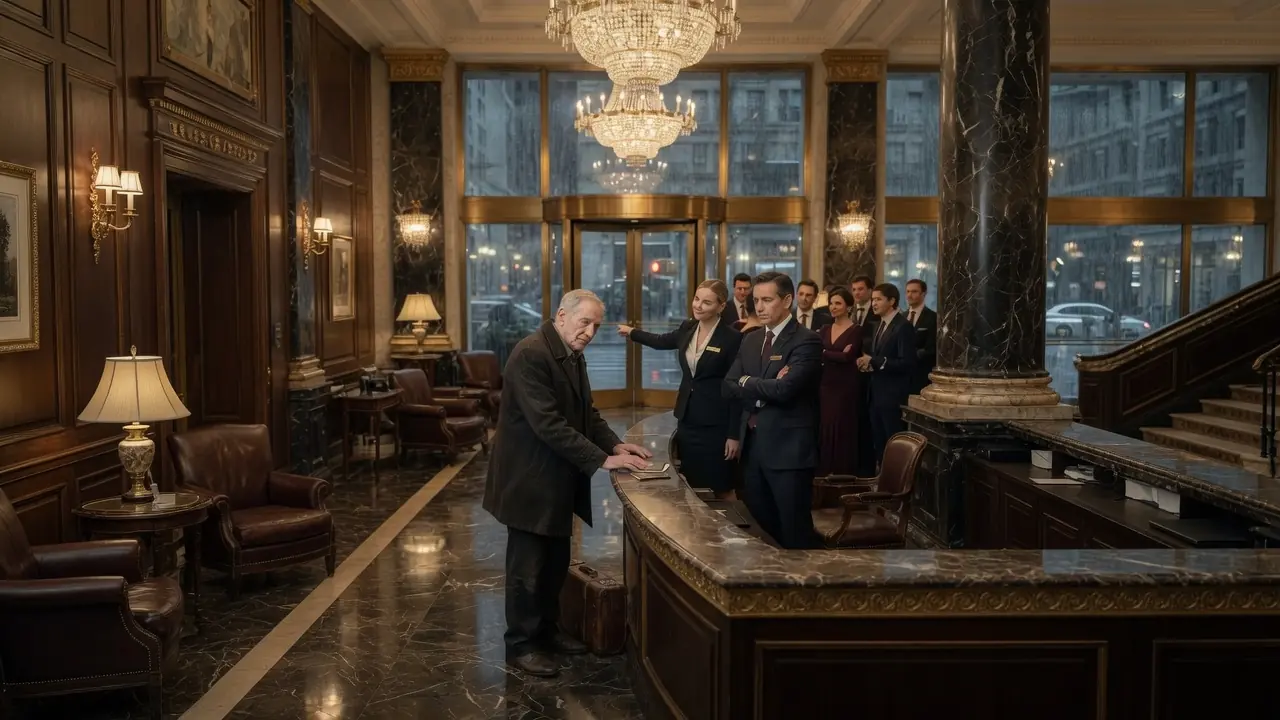
Daniel noticed the puddle on the marble. He noticed the suitcase that would look out of place even in a bus station. He noticed the curious guests, several of whom were attending a private investment conference upstairs.
Most importantly, he noticed that Vanessa appeared to have the situation under control.
So he remained silent.
A bell attendant named Noah Pierce stood a few feet away, holding a brass luggage cart. He was twenty-six, new to the hotel, and still possessed the dangerous habit of caring more about people than protocol.
Noah stepped forward. “Sir, may I take your suitcase while they locate the reservation?”
Vanessa turned sharply. “Noah, please attend to the Harrington luggage.”
“The Harrington luggage is already upstairs.”
“Then polish the cart.”
Noah’s jaw tightened. He looked at the old man, whose fingers had turned pale around the suitcase handle.
“I can hold it,” Elias said. “Thank you.”
Daniel finally approached, not because the old man needed assistance, but because the attention of the lobby had become uncomfortable.
“Good evening,” he said, wearing the calm smile he used when removing intoxicated guests without causing a scene. “I’m Daniel Mercer, the general manager. Is there a difficulty?”
Elias studied him for several seconds. “I have a reservation.”
Daniel glanced at Vanessa.
“She claims he has one,” Vanessa said. “There’s nothing in the system.”
“I said I have one,” Elias corrected.
Vanessa’s cheeks reddened. “Sir, I’m trying to help.”
“No,” Elias said. “You’re trying to make me leave.”
The lobby grew quieter.
Daniel lowered his voice. “Mr. Ward, we are nearly at capacity tonight. It’s possible your reservation was made for another property.”
“It was made for this one.”
“Do you recall which type of room you requested?”
“The Presidential Suite.”
For one breath, nobody reacted.
Then Brent laughed.
It escaped him in a short, sharp burst before he turned it into a cough. Vanessa stared at the old man, and the businessman with the red tie stopped pretending to check his phone.
Even Daniel’s professional smile faltered.
The Presidential Suite occupied most of the twenty-second floor. It cost more for one night than many people earned in several months. Guests who stayed there usually arrived in black cars with assistants, security personnel, and enough luggage to require two carts.
Elias Ward stood alone in a wet coat, carrying one broken suitcase.
Vanessa tilted her head. “The Presidential Suite?”
“Yes.”
“Are you aware of the nightly rate?”
“I was informed.”
“And you still believe that is what you reserved?”
Elias’s gray eyes hardened. “Young woman, age has taken some things from me. My hearing remains adequate.”
A woman near the elevators laughed openly. Brent lowered his eyes, but his shoulders shook.
Noah did not smile.
Daniel clasped his hands in front of him. “Mr. Ward, perhaps there has been confusion. That suite is not typically reserved through ordinary channels.”
“I didn’t use ordinary channels.”
“What agency handled the booking?”
“The owner’s office.”
The smile disappeared from Daniel’s face, though only for an instant.
The Beaumont Grand belonged to the Beaumont Heritage Group, an international hospitality company controlled by a board in New York. Daniel had met the regional vice president twice. He had never met the company’s owner, who rarely appeared in public and had reportedly been ill for several years.
Daniel decided the old man was either confused or attempting an elaborate joke.
“Of course,” he said carefully. “May I see the confirmation?”
Elias placed his suitcase on the floor and reached inside his coat. Vanessa instinctively stepped backward, then looked embarrassed when he produced a folded sheet of paper.
The page had softened from the rain. Daniel took it between two fingers.
Across the top was the gold emblem of the Beaumont Heritage Group. Below it were the dates, the suite designation, and an authorization code Daniel recognized as belonging to the executive reservation system.
His eyes moved to the name.
ELIAS JONATHAN WARD.
She hesitated. “I already searched—”
“The executive ledger.”
Her fingers moved quickly. The amusement left her face.
“There is a reservation,” she whispered.
Brent leaned toward the screen. “That can’t be right.”
Daniel’s gaze remained on the old man. “It appears your booking was entered through a restricted system. My apologies for the delay.”
“Not for the delay,” Elias said. “Only for finding the reservation?”
Daniel felt several guests watching him. “And for the misunderstanding.”
Elias nodded once, accepting the words without accepting the apology.
Vanessa swallowed. “The suite requires a security authorization.”
“I brought a card.”
She turned the payment terminal toward him with a faint trace of her earlier confidence. Perhaps, she seemed to think, the payment would fail and restore order to the world.
Elias removed a plain black card from an old wallet.
There was no visible bank name, only a small silver crest.
Vanessa inserted it.
The screen processed for two seconds.
AUTHORIZED.
Her lips parted.
The terminal displayed a payment guarantee large enough to cover the suite for a month.
Brent stopped smiling.
Daniel felt something cold settle in his stomach. He had learned long ago that wealth did not always announce itself, but this was more than hidden wealth. Executive reservation. Restricted authorization. The owner’s office.
“Your identification, please,” Vanessa said, her voice suddenly polite.
Elias opened the wallet again and handed her a passport.
Daniel reached for it before she could.
The cover was dark blue, the edges softened from use. He opened it to the identification page.
For several seconds, the letters made no sense.
Then the name aligned with a memory Daniel had buried beneath years of corporate ambition.
ELIAS JONATHAN WARD.
Not Beaumont.
Ward.
Daniel turned the page and saw the date of birth, the photograph taken perhaps eight years earlier, and a notation affixed inside the back cover by the company’s executive travel office.
He remembered a framed article in the training center where he had begun his career.
He remembered a black-and-white photograph of two young men standing outside a small roadside inn in Vermont.
One man had been Arthur Beaumont.
The other had been Elias Ward.
The color drained from Daniel’s face.
Vanessa saw it first. “Mr. Mercer?”
Daniel closed the passport carefully. “Where did you get this?”
Elias’s eyes narrowed. “From the United States government.”
“I mean—” Daniel lowered his voice. “Mr. Ward, are you Elias Ward, the co-founder of Beaumont Heritage?”
The lobby went silent.
The businessman in the red tie lowered his phone.
Vanessa’s hand rose slowly to her mouth.
Elias took the passport from Daniel. “I was wondering how long it would take someone here to recognize the name.”
No one laughed now.
Thirty-eight years earlier, Elias Ward and Arthur Beaumont had purchased a failing twelve-room inn with money borrowed against a truck and two wedding rings. Arthur became the public face of the company. Elias designed its service model, acquired its first properties, and negotiated the agreements that transformed one Vermont inn into an international brand.
Then, twenty-one years ago, Elias vanished from corporate life.
Newspapers reported a disagreement between the founders. Some claimed he had sold his interest. Others said he had suffered a breakdown after the death of his only son. The company stopped using his name, and a new generation of executives remembered only Arthur Beaumont.
Yet Elias had never sold everything.
According to company records rarely discussed outside the boardroom, the old man standing in the lobby still held the largest block of private voting shares in the Beaumont Heritage Group.
Daniel’s mouth had gone dry.
“Mr. Ward,” he said, “I had no idea you were coming.”
“That was the purpose.”
Vanessa stepped away from the desk as though distance might erase what she had said.
Daniel turned toward the watching guests. “Ladies and gentlemen, we apologize for the interruption.”
“No,” Elias said. His voice was not loud, but it stopped Daniel instantly. “Let them watch. They seemed interested a moment ago.”
The businessman with the phone slipped it into his pocket.
Elias looked across the lobby, from the gleaming columns to the velvet chairs, the imported flowers, and the staff members who could no longer meet his eyes.
“When Arthur and I opened our first inn,” he said, “we had one rule. Nobody who came through the door was to be made ashamed of what they wore, what they carried, or what they could afford.”
Daniel forced himself to hold the old man’s gaze.
Elias continued. “A guest could be turned away because there were no rooms. A violent guest could be removed. A dishonest guest could be refused. But no person was to be humiliated for looking poor.”
Vanessa’s face had turned crimson. “Mr. Ward, I truly apologize.”
“You recommended a motel before asking for my confirmation number.”
“I misunderstood the situation.”
“You understood it perfectly. You decided what I deserved before I spoke.”
Her eyes filled with tears, though whether from shame or fear for her job, Elias could not tell.
Daniel stepped between them. “The responsibility is mine. I observed the interaction and should have intervened.”
“Yes,” Elias said. “You should have.”
The words struck harder because they contained no anger.
Daniel straightened. “Please allow us to escort you to your suite. I will personally ensure that every detail is handled.”
Elias picked up his suitcase.
Noah moved forward again. “May I carry that for you, sir?”
For the first time since entering the hotel, Elias smiled.
“Yes,” he said. “You may.”
Noah took the suitcase carefully. It was heavier than he expected.
Daniel gestured toward the private elevators, but Elias did not move.
“Before I go upstairs,” the old man said, “I would like the names of everyone who was working in this lobby tonight.”
Vanessa went still.
Daniel nodded. “Of course.”
“And I want security footage preserved from the moment I entered.”
“Certainly.”
“No edits. No missing minutes. No conveniently malfunctioning cameras.”
Daniel’s stomach tightened. “You have my word.”
Elias looked at him with tired gray eyes. “I don’t know you well enough for that to mean anything.”
He walked toward the elevator with Noah beside him.
As the doors closed, the lobby remained silent.
Then every employee began talking at once.
Vanessa turned on Daniel. “Why didn’t anyone tell us he was coming?”
“Because he didn’t want us to know.”
“Is he going to fire us?”
Daniel looked toward the elevator numbers climbing above the door. “I don’t know.”
Brent whispered, “He can’t just show up and judge the entire hotel from one misunderstanding.”
Daniel faced him. “You laughed at a guest.”
“I thought he was joking.”
“You laughed before you knew.”
Brent’s face hardened. “So did half the lobby.”
“The lobby doesn’t work here.”
Vanessa gripped the edge of the desk. “What are we supposed to do?”
Daniel had no answer.
On the twenty-second floor, Noah unlocked the Presidential Suite and pushed open the double doors.
The rooms beyond were larger than the house where he had grown up. Floor-to-ceiling windows looked across the rain-washed city. Fresh white lilies stood on the dining table, a fire glowed beneath a carved stone mantel, and a silver tray held champagne, fruit, and chocolates stamped with the Beaumont crest.
Elias entered slowly.
He did not look impressed.
Noah set the suitcase beside the bedroom door. “Is there anything else I can bring you?”
“A towel would be useful.”
Noah glanced at the antique table where six folded towels had been arranged beside the champagne. He picked up the top one and handed it to Elias.
The old man dried his hair and face. “You can speak honestly.”
“About what?”
“About what happened downstairs.”
Noah hesitated.
Elias sat in a high-backed chair near the windows. “Honesty becomes difficult in expensive buildings.”
Noah looked toward the door. “They shouldn’t have treated you that way.”
“Would they have treated me differently if I were not Elias Ward?”
Noah took a moment before answering. “No.”
Elias studied him. “That wasn’t the question.”
Noah exhaled. “Yes. They would have.”
“Would you?”
“I offered to take your bag before I knew your name.”
“That does not prove you respected me. It proves you were willing to carry luggage.”
Noah’s expression tightened, but he did not retreat. “Then I don’t know how to prove it.”
“You don’t. Not tonight.”
Rain traced silver paths down the windows.
Elias looked toward the suitcase. “Open it.”
Noah frowned. “Sir?”
“The left clasp is broken. Press the lid down while you release the right one.”
Noah crouched beside the suitcase and followed the instruction. The lid opened with a soft groan.
Inside were no expensive clothes.
There were two folded shirts, a shaving kit, a stack of old letters tied with string, and a framed photograph wrapped in a gray sweater.
Noah lifted the photograph carefully.
It showed two young men standing in front of a modest white inn. One was tall and fair-haired, with an easy grin. The other was dark-haired and serious, though his eyes contained a quiet amusement.
Between them stood a woman holding a handwritten sign that read OPEN AT LAST.
“That’s you,” Noah said.
“And Arthur Beaumont.”
“Who is the woman?”
Elias’s gaze settled on the photograph. “My wife, Margaret.”
Noah returned it to the suitcase. “Was this the first hotel?”
“We called it a hotel. Most people called it a leaking house with too many beds.”
A faint smile touched Elias’s face and disappeared.
“Why did you come here without telling anyone?” Noah asked.
Elias leaned back. “Because three months ago, a woman named Rosa Martinez wrote me a letter.”
Noah recognized the name. Rosa had worked in housekeeping for almost seventeen years. She had been dismissed in the spring after management accused her of stealing a guest’s diamond bracelet.
“She said this hotel had forgotten what it was built to be,” Elias continued. “She said employees were afraid, complaints disappeared, and guests were valued according to appearance rather than need.”
“Rosa was fired.”
“I know.”
“They said she stole jewelry.”
“Do you believe she did?”
Noah’s eyes moved away.
Elias noticed. “You know something.”
“I know she found the bracelet.”
“That is different from stealing it.”
“She found it under a bed in Suite Nineteen Twelve. She gave it to her supervisor.”
“What happened then?”
“The supervisor took it to management. Two days later, the guest reported it missing. Security searched Rosa’s locker and found the bracelet in her coat pocket.”
“And you believe it was planted.”
Noah rubbed his palms against his trousers. “Rosa had worked here since I was a kid. My mother cleaned rooms with her at another hotel. Rosa returned cash, watches, medication—anything she found. She once took a bus across town after her shift to return a child’s stuffed rabbit.”
“Did you tell management?”
“I tried.”
“What did Mr. Mercer say?”
“I never reached him. His assistant sent me to human resources. Human resources told me the investigation was closed.”
Elias’s face became unreadable. “Who was Rosa’s supervisor?”
“Linda Shaw.”
“And where is she now?”
“She was promoted.”
“To what?”
“Director of Guest Services.”
Elias looked toward the rain.
After a long silence, he said, “Lock the door.”
Noah obeyed.
Elias reached beneath the shirts in the suitcase and removed a thin black folder. Inside were printed emails, staff complaints, expense reports, and photographs.
He placed one page on the table.
Noah recognized the Beaumont Grand’s service corridor. The image showed Linda Shaw speaking with Vanessa beside an open housekeeping locker.
The time stamp was from the night before the bracelet had been discovered.
“Where did you get this?” Noah asked.
“Rosa sent me the location of a camera management claimed was broken. It was not connected to the hotel’s main security system. The camera belonged to a linen supplier monitoring repeated theft from its deliveries.”
The photograph did not show the bracelet being planted, but it proved Linda and Vanessa had entered the staff locker room at a time neither woman had disclosed.
“Why would Vanessa help frame Rosa?” Noah asked.
“That is one of the questions I came here to answer.”
A knock sounded at the suite door.
Noah and Elias exchanged a look.
“Who is it?” Elias called.
“Daniel Mercer.”
Elias closed the folder and slid it beneath the cushion of his chair. “Let him in.”
Daniel entered carrying a leather binder. His expression had recovered its professional calm, but tension showed in the muscles around his mouth.
“I brought the staff roster and a written report of the incident,” he said.
“That was quick.”
“I wanted to address the matter immediately.”
“Did you preserve the footage?”
“Yes.”
“All of it?”
Daniel paused. “Our security director is creating a protected copy.”
“His name?”
“Marcus Vale.”
Elias nodded. “I would like to meet him tomorrow morning.”
“Certainly.”
“And Linda Shaw.”
The change in Daniel’s face was small, but Elias saw it.
“May I ask why?”
“You may.”
Daniel waited.
Elias said nothing more.
After a moment, Daniel placed the binder on the table. “Mr. Ward, I hope you understand that tonight’s incident does not reflect the standards of this hotel.”
“It reflects them precisely.”
“It reflects a lapse.”
“A lapse is a waiter dropping a glass. What happened downstairs required several people to believe the same thing at the same time.”
Daniel’s eyes moved to Noah. “You may return to the lobby.”
“No,” Elias said. “He may stay.”
Daniel’s jaw tightened. “This concerns senior management.”
“It concerns anyone who works here.”
Noah remained near the door.
Daniel lowered himself into a chair opposite Elias. “You arrived unannounced and dressed in a manner that invited confusion.”
The room became very still.
Elias leaned forward. “My clothing invited nothing.”
“I’m not defending the behavior.”
“You just blamed my coat for it.”
Daniel exhaled through his nose. “I am trying to explain the context.”
“Context is the word educated men use when they want cruelty to sound complicated.”
A flush rose along Daniel’s neck.
Elias opened the staff roster. “How long has Vanessa worked here?”
“Four years.”
“Complaints?”
“None of significance.”
“That answer was prepared before you came upstairs.”
Daniel’s gaze sharpened. “You believe I am hiding something.”
“I believe you are frightened.”
“Of losing my position?”
“Perhaps. Or perhaps of what I will discover before you do.”
Daniel stood. “I have devoted six years to this property. Revenue has doubled. Our occupancy is the highest in the region. We have hosted presidents, royal families, and some of the most influential people in the country.”
“And an old man in a wet coat defeated you in six minutes.”
Daniel stared at him.
Elias’s voice softened. “Do you know why?”
“Enlighten me.”
“Because you have trained yourself to look upward. You recognize power when it arrives with guards and cameras. You no longer recognize humanity when it arrives alone.”
Daniel collected his binder. “Will there be anything else tonight?”
“Yes. Do not warn Linda Shaw that I asked for her.”
“She will need to be informed of the meeting.”
“Tell her at eight fifty-five. I will see her at nine.”
Daniel’s expression changed again.
This time, Noah saw it too.
The manager left without another word.
When the door closed, Noah said, “He knows something.”
“Possibly.”
“You think he framed Rosa?”
“I think fear usually points toward the locked door. It does not tell us what is behind it.”
Elias removed the folder from beneath the cushion. “Tomorrow, I need you to do something that may cost you your job.”
Noah gave a humorless laugh. “Working here may already cost me my job.”
“I need access to the employee service areas without management escort.”
“I can take you through them.”
“No. They’ll watch me now.”
“What do you need?”
Elias handed him a list of names. “Speak to these employees. Quietly. Ask whether they are willing to meet me in the old ballroom at six tomorrow evening.”
Noah read the list. Housekeepers, kitchen staff, maintenance workers, two former receptionists, and a night auditor.
“Why the old ballroom?”
“Rosa said the cameras there haven’t worked in years.”
Noah looked at him. “You trust her information more than the hotel’s?”
“At the moment, yes.”
By eight the next morning, the Beaumont Grand had transformed.
Fresh flowers appeared throughout the lobby. Employees received urgent reminders about greeting procedures and uniform standards. Daniel ordered pastries and imported coffee delivered to the Presidential Suite, along with a handwritten apology from the staff.
Elias sent everything back unopened.
At nine, Linda Shaw entered the suite.
She was fifty-one, slender, impeccably dressed, with auburn hair arranged in a smooth knot. Her expression conveyed concern, humility, and just enough surprise to appear sincere.
“Mr. Ward,” she said, extending both hands. “What an honor.”
Elias did not take them.
Linda lowered her hands gracefully. “Mr. Mercer told me about the terrible misunderstanding last night. I am deeply embarrassed.”
“You were not present.”
“As director of guest services, I am responsible for the culture of the front desk.”
“That is true.”
Linda sat only after he gestured toward a chair. Daniel remained standing behind her, while Marcus Vale, the security director, positioned himself near the windows.
Marcus was a thickset former police officer with a shaved head and a manner that seemed permanently suspicious. He carried a tablet containing the preserved lobby footage.
Elias watched the three of them settle into their roles.
Linda was warmth.
Marcus was authority.
Daniel was control.
“Let’s begin with last night,” Elias said. “How many formal complaints have been made against Vanessa Cole?”
Linda’s eyebrows lifted. “I would need to review her file.”
“You reviewed it at six thirty this morning.”
For the first time, her smile weakened.
Elias continued. “You accessed the personnel database, printed three documents, and left them in Daniel’s office.”
Daniel looked at Marcus.
Marcus frowned. “How could you know that?”
“The executive reservation system grants me temporary oversight access when I visit a property.”
That was not entirely true. The access had been arranged by an old board member who still owed Elias several favors.
Linda folded her hands. “There were two complaints.”
“Not zero?”
“No. Two.”
“Describe them.”
“One guest felt Miss Cole had spoken dismissively to her mother. Another believed she had been given slower service because she was using a discount certificate.”
“What happened?”
“We counseled Miss Cole.”
“Both complaints were marked unsubstantiated.”
“Because neither could be verified.”
“Did you interview witnesses?”
“I don’t recall.”
“I do.” Elias opened the black folder. “You interviewed no one.”
Daniel’s head turned toward Linda.
She maintained her composure. “I followed normal procedure.”
“Did you follow normal procedure when Rosa Martinez was accused of theft?”
Marcus shifted his weight.
Linda’s fingers tightened. “That matter was investigated thoroughly.”
“By you?”
“By security.”
Marcus spoke. “We recovered the bracelet from her personal belongings.”
“After Linda entered the locker room with Vanessa Cole.”
Silence fell across the room.
Daniel looked at Linda. “What is he talking about?”
Linda’s smile vanished. “I have no idea.”
Elias placed the photograph on the table.
Marcus stepped closer. Daniel picked it up.
The timestamp was clearly visible.
“This proves nothing,” Linda said. “I inspect service areas regularly.”
“At eleven forty-three at night?”
“There had been complaints about missing supplies.”
“With a receptionist?”
“Vanessa reported suspicious activity.”
“Why was that visit omitted from the investigation?”
Linda turned toward Marcus. “You prepared the report.”
“You never told me you were there,” Marcus said.
Daniel’s eyes moved between them. “Was the locker search recorded?”
Marcus shook his head. “The locker-room camera was offline.”
“The main camera was offline,” Elias corrected. “A supplier’s camera was not.”
Linda stood. “This is absurd. You arrive without warning, deceive the staff, and now accuse me based on one photograph.”
“I have not accused you.”
“You implied—”
“I asked questions.”
“You have already decided what happened.”
Elias looked up at her. “Have you?”
Linda’s mouth closed.
Daniel said, “Sit down.”
She stared at him. “Excuse me?”
“Sit down, Linda.”
Slowly, she returned to the chair.
Elias turned to Marcus. “Where is the bracelet now?”
“It was returned to the guest.”
“Who was the guest?”
Marcus hesitated. “Mrs. Evelyn Harcourt.”
Daniel’s face changed.
Elias noticed. “You know her.”
“She chairs the Beaumont Arts Foundation.”
“She also sits on the hotel advisory council,” Elias said. “And her son’s investment firm owns fourteen percent of this property’s operating partnership.”
Linda’s voice became cold. “Are you suggesting Mrs. Harcourt participated in a conspiracy against a housekeeper?”
“I am suggesting wealthy people are no more immune to dishonesty than poor ones.”
Daniel walked toward the windows.
Elias continued. “Mrs. Harcourt’s insurance company paid her claim three weeks before the bracelet was supposedly recovered.”
Marcus frowned. “That wasn’t in the report.”
“No. It was not.”
“Why would she report it stolen after receiving an insurance payment?” Daniel asked.
“She reported it missing to the insurer while staying in Boston. Then she wore it to a charity dinner here and lost it again.”
Linda’s eyes flickered.
Elias saw the answer before she spoke.
“Rosa found the bracelet,” he said. “You recognized it. If it was returned publicly, Mrs. Harcourt’s insurance fraud would be exposed.”
Daniel turned from the window. “Linda?”
Linda’s composure cracked. “You don’t understand.”
“Then explain.”
“Evelyn was drunk when she lost it. She begged me to handle the matter discreetly.”
“So you placed it in Rosa’s locker?” Daniel asked.
“No.”
“Vanessa did?”
“No!”
“Then who?”
Linda rose again, breathing hard. “Rosa threatened to go to the police. She said she had already photographed the bracelet and the serial number. If Evelyn was exposed, the advisory council would have removed our arts funding and canceled the winter gala.”
Daniel stared at her. “What did you do?”
“I told Rosa to give me one day.”
“And?”
“She refused.”
Elias’s voice remained calm. “Who placed the bracelet in her pocket?”
Linda looked toward Marcus.
Marcus’s face darkened. “Don’t.”
Daniel stepped between them. “Marcus?”
The security director’s hands curled into fists. “She told me the bracelet had been found in Rosa’s locker.”
“You performed the search,” Elias said. “But you didn’t plant it.”
Marcus said nothing.
Linda began to cry. “I was protecting the hotel.”
“No,” Elias said. “You were protecting a donor.”
“She could have destroyed everything!”
“So you destroyed Rosa instead.”
Linda wiped her face. “I slipped the bracelet into the pocket before security arrived. Vanessa was outside the locker room. She never saw me do it.”
“Why was Vanessa there?” Daniel asked.
“She had complained about Rosa.”
“What complaint?”
Linda looked at the floor. “Rosa saw her taking cash from a guest’s envelope.”
Daniel went still.
Elias closed the folder. “So Vanessa helped direct suspicion toward the woman who could expose her, and you used the opportunity to protect Mrs. Harcourt.”
Linda shook her head. “It wasn’t planned like that.”
“Cruelty rarely begins with a complete plan,” Elias said. “It begins with one person deciding another person is easier to sacrifice.”
Daniel crossed the room and opened the suite door.
“Marcus, escort Linda to a conference room and remain with her.”
Linda looked at him in disbelief. “Daniel, please.”
“You framed an employee.”
“I protected this property.”
“You lied to me.”
“You never wanted details!” she shouted. “You wanted problems to disappear before they reached your desk.”
Daniel flinched.
Linda gave a bitter laugh. “Don’t pretend you are innocent. Every time I warned you about staff complaints, you asked whether they affected guest ratings. Every time someone was pushed out, you signed the paperwork without reading it.”
Daniel’s face became pale.
Elias said nothing.
Marcus led Linda from the room.
Daniel remained at the open door for several seconds before closing it.
“She’s right,” he said quietly.
Elias watched him.
“I didn’t know about the bracelet,” Daniel continued. “But I created the conditions that allowed it.”
“That realization is useful only if it costs you something.”
Daniel looked toward him. “What do you intend to do?”
“Listen.”
“To whom?”
“To the people you stopped hearing.”
At six that evening, thirty-two employees gathered in the old ballroom.
The room had once hosted orchestras and wedding receptions. Now its chandeliers were unlit, its curtains dusty, and its parquet floor covered by stacked chairs waiting for refurbishment.
Noah stood near the entrance, admitting people one at a time.
Housekeepers arrived first, still wearing uniforms beneath winter coats. Kitchen workers came through the service corridor. A maintenance engineer named Calvin brought two former employees who had been dismissed after reporting unsafe electrical wiring.
Elias sat at a plain table with a notebook.
He listened for nearly three hours.
A dishwasher described unpaid overtime erased from his time sheets.
A housekeeper said luxury toiletries were charged against cleaning staff whenever guests took more than the allotted number.
A former receptionist explained that employees had been instructed to delay guests who appeared poor, intoxicated, homeless, or “unlikely to produce favorable social media exposure.”
A young concierge named Amira admitted that staff secretly used a code in guest profiles.
NR meant normal risk.
HR meant high risk.
LVP meant low-value presence.
Elias wrote down every word.
“Who created the codes?” he asked.
Amira looked toward the floor. “Mr. Mercer approved the guest segmentation system.”
Daniel, standing unseen behind the ballroom’s partially open service door, closed his eyes.
He had come intending to observe for only a few minutes. Instead, he remained for the entire meeting.
He heard employees describe him as distant, ambitious, and impossible to approach. He heard that his assistants filtered complaints to protect his schedule. He heard that department heads competed to hide problems because Daniel rewarded perfect reports and punished bad numbers.
Near nine o’clock, Rosa Martinez entered the ballroom.
She was sixty, with tired brown eyes and silver threaded through her black hair. Noah embraced her before leading her to Elias.
“You came,” Elias said.
“You answered my letter.”
“I should have answered sooner.”
Rosa sat across from him. “I didn’t write because I wanted my job back.”
“Why did you write?”
“Because the hotel was becoming cruel.”
The room fell silent around her.
Rosa looked toward the employees. “People think cruelty is shouting or hitting. Sometimes it is. But sometimes it is making a person feel invisible every day until they begin to believe they are.”
Elias’s pen stopped moving.
His wife had once said almost the same words.
Rosa continued. “When I started here, Mr. Beaumont visited every Christmas. He ate with the kitchen staff. He knew the names of our children. After he became sick, everything changed.”
“Arthur died four years ago,” Elias said.
Rosa nodded. “And the hotel forgot him before he was buried.”
Daniel stepped into the ballroom.
Several employees immediately stopped speaking.
Elias looked toward him. “You were not invited.”
“I know.”
“Then why are you here?”
Daniel walked to the center of the room. He had removed his jacket and tie. Without them, he looked less like a hotel manager and more like a tired man who had finally reached the end of a long performance.
“I came to hear what was being said about me.”
A few employees lowered their eyes.
Daniel continued. “I nearly left when I heard the first complaint. Then I realized leaving was what I have been doing for six years.”
No one responded.
He looked at Rosa. “I signed your termination.”
“Yes.”
“I did not read the complete report.”
“I know.”
“I told myself that delegation was leadership.”
Rosa’s expression remained guarded. “And now?”
“Now I think it was cowardice.”
Daniel faced the room. “Tomorrow morning, Linda Shaw will be dismissed and referred to the district attorney. Vanessa Cole has been suspended pending investigation. Every employee complaint from the past three years will be reviewed by an external firm.”
Murmurs spread through the ballroom.
Elias closed his notebook. “You made those decisions without consulting the ownership group.”
Daniel met his gaze. “Yes.”
“You may not have authority.”
“Then fire me.”
The room went quiet again.
Daniel’s voice shook slightly, though he continued. “I spent my career trying to become the kind of manager important people would respect. I did not notice that I had become the kind ordinary people feared.”
Elias studied him for a long moment.
Then Rosa spoke.
“Apologies are easy in rooms full of witnesses.”
Daniel nodded. “You’re right.”
“What happens after Mr. Ward leaves?”
Daniel looked around the ballroom. “That depends on whether any of you are willing to help rebuild what I damaged.”
A maintenance worker laughed bitterly. “You want the people you ignored to save your hotel?”
“No,” Daniel said. “I want them to decide whether it deserves saving.”
The meeting ended shortly before midnight.
As employees departed, Elias remained seated beside Rosa.
“Will you return?” he asked.
“To work?”
“Yes.”
“No.”
He appeared surprised.
Rosa smiled faintly. “You thought correcting the injustice would restore everything.”
“I hoped it might.”
“My husband found work in Arizona after I was fired. We are moving next month to be near our daughter.”
Elias lowered his eyes. “Then the hotel has lost you permanently.”
“Yes.”
“I’m sorry.”
“So am I.”
She reached into her bag and placed an old envelope on the table. “There is something else you should know.”
The envelope was addressed to Elias in handwriting he recognized immediately.
Arthur Beaumont’s handwriting.
Elias stared at it without touching it.
“Where did you get this?”
“Mr. Beaumont gave it to me before his last surgery,” Rosa said. “He told me to send it only if the hotel became something the two of you would have hated.”
Elias’s fingers trembled as he opened the envelope.
Inside was a letter dated four years earlier.
Elias,
If you are reading this, then I failed to keep our promise alive.
You were always better at seeing what I refused to see. I liked the buildings, the deals, and the applause. You cared about the people carrying towels through the back halls. I told myself both things mattered equally, but I know now which one built the company and which one merely made it famous.
There is something I never told you about Thomas.
Elias stopped breathing.
Rosa watched him carefully. “Are you all right?”
He continued reading.
Your son did not die believing you had abandoned him.
I was with him at the hospital after the accident. He asked for you. I told him you were on the way, though the storm had closed the highway and I knew you might not arrive in time.
Before he lost consciousness, Thomas gave me a message.
He said, “Tell Dad I know why he stayed. Tell him the families at the inn needed him too.”
I never delivered those words.
I was angry with you. I blamed you for choosing the hotel during the flood instead of driving to the hospital sooner. I wanted you to carry the guilt because I was carrying it too.
That was my greatest betrayal.
I am sorry.
Elias lowered the letter.
For twenty-one years, he had believed his son died waiting for him.
Thomas had been twenty-nine, driving home during a winter storm when a truck crossed the median. At the same time, a flood had trapped fourteen guests and five employees inside the company’s original Vermont inn.
Elias stayed to organize the evacuation.
By the time he reached the hospital, Thomas was dead.
Arthur told him the boy had repeatedly asked why his father had not come.
That lie destroyed their friendship.
It drove Elias from the company, from the hotels, and eventually from nearly everyone who reminded him of the life he had lost.
Rosa placed one hand over his.
“He wanted you to forgive yourself,” she said.
Elias stared at the faded ink.
“No,” he whispered. “Arthur wanted me to forgive him.”
“Maybe both.”
Across the ballroom, Noah and Daniel stood in silence.
Neither had meant to overhear, but Elias’s grief filled the room more completely than any spoken confession.
He folded the letter carefully.
“Why did Arthur give this to you?” he asked.
“He trusted me.”
“More than he trusted his lawyers?”
Rosa smiled. “Lawyers do what instructions require. Housekeepers decide whether a room is truly clean.”
A sound escaped Elias that was half laugh, half sob.
He pressed the letter against his chest and lowered his head.
For the first time since arriving at the Beaumont Grand, the old man appeared his age.
The following morning, police entered through the same revolving doors Elias had used two nights earlier.
Linda Shaw was escorted from a conference room without handcuffs, though two detectives walked beside her. Vanessa left separately after admitting she had concealed evidence about Rosa and falsified several guest complaints.
Mrs. Evelyn Harcourt’s attorney arrived before noon.
By evening, the story had reached the press.
The public version focused on insurance fraud, a wrongful termination, and corruption inside a luxury hotel. The private version was more complicated.
The board convened an emergency meeting and demanded Daniel’s resignation.
Elias refused to accept it.
“He failed,” Elias told the directors through a video conference from the Presidential Suite. “Then he finally looked at what his failure had done. I am not interested in leaders who have never fallen. I am interested in whether they stand differently afterward.”
One director objected. “The brand’s reputation is at risk.”
“The brand deserves the reputation it earned.”
“We need stability.”
“You mean silence.”
The director leaned toward his camera. “With respect, Elias, you have been absent from this company for two decades.”
“Yes,” Elias said. “And in my absence, people like you learned to confuse profit with proof of virtue.”
The board fell quiet.
Elias announced the creation of an independent employee council with authority to review disciplinary actions, working conditions, and guest-treatment policies. Anonymous complaints would go directly to an external ethics office rather than through hotel management.
He also ordered the removal of every guest-value code from the company’s reservation system.
No more LVP.
No more quiet instructions to delay, discourage, or embarrass people who appeared unlikely to spend enough.
Daniel remained manager under a one-year probation monitored by the employee council.
Rosa received a formal public apology, full back pay, and a settlement she initially refused.
Elias persuaded her to accept it by saying, “Justice should inconvenience the people who denied it.”
She used part of the money to buy a small house near her daughter.
Noah was promoted to guest-services supervisor, though he objected that he had too little experience.
“You noticed a human being while everyone else noticed a coat,” Elias told him. “We can teach the rest.”
Three weeks later, the lobby of the Beaumont Grand looked exactly as it had on the night Elias arrived.
The chandeliers still glittered. The marble still shone. Expensive perfume drifted near the elevators, and polished cars stopped beneath the covered entrance.
But a small brass plaque now stood behind the reception desk.
It carried the first rule Elias and Arthur had written for their original inn:
NO PERSON ENTERING THIS HOUSE WILL BE MADE ASHAMED OF THEIR CIRCUMSTANCES.
Vanessa’s old position remained empty while the hotel changed its hiring procedures.
One rainy afternoon, a woman in a grocery-store uniform entered the lobby with two children. Her car had broken down several blocks away, and her phone battery was dead.
She approached the desk cautiously.
The new receptionist smiled before looking at her clothes.
“Good afternoon,” he said. “How can we help?”
Daniel observed from across the lobby.
He did not interfere.
He simply watched long enough to make certain kindness no longer required an important name.
Upstairs, Elias packed his belongings into the battered suitcase.
Noah stood beside the door. “You know the hotel could buy you a new one.”
“This one still closes.”
“Barely.”
“That describes me as well.”
Noah smiled. “Where will you go?”
“Vermont.”
“To the first inn?”
Elias nodded.
The original property had been closed for twelve years. The company planned to sell it, but Elias had canceled the sale.
“What will you do with it?” Noah asked.
“Repair the roof. Replace the pipes. Open the kitchen.”
“You’re reopening it?”
“Not as a luxury hotel.”
“What, then?”
Elias fastened the working clasp and pressed down on the broken side.
“A place for families staying near the county hospital,” he said. “No charge for parents with sick children.”
Noah looked toward the suitcase. “Because of Thomas?”
“Because I spent twenty-one years believing I had chosen strangers over my son.”
“And now?”
Elias picked up Arthur’s letter from the table.
“Now I understand Thomas never asked me to choose.”
Noah took the suitcase before Elias could lift it.
They rode the elevator to the lobby together.
Employees paused as Elias crossed the marble floor. Some smiled. Others nodded. No one applauded, and Elias was grateful for that.
Daniel waited beside the revolving doors.
“I arranged a car,” he said.
Elias looked through the glass.
A black limousine stood beneath the hotel canopy.
He shook his head. “Cancel it.”
“It’s raining.”
“I survived the first walk.”
Daniel glanced at the battered suitcase in Noah’s hand. “At least let the hotel pay for a cab.”
Elias considered him, then nodded. “A cab is acceptable.”
They stood in silence while the doorman called one.
Daniel looked older than he had three weeks earlier, but also less polished in a way that suited him.
“Will you return?” he asked.
“Someday.”
“Unannounced?”
“Certainly.”
Daniel almost smiled. “Should I warn the staff?”
“If you do, I’ll wear a worse coat.”
The cab pulled to the curb.
Noah placed the suitcase in the trunk while Elias turned back toward the hotel.
His eyes moved over the plaque, the reception desk, and the people crossing the lobby without knowing the history contained in its walls.
Then he looked at Daniel.
“Arthur and I believed a great hotel was measured by how important people felt inside it,” Elias said. “We were wrong.”
Daniel waited.
“It is measured by whether unimportant people are allowed to feel important.”
Elias stepped into the rain.
The doorman raised an umbrella, but the old man gently pushed it aside and walked the few feet to the cab beneath the open sky.
Before getting inside, he looked up at the highest windows of the Beaumont Grand.
For a moment, he could almost see Arthur standing there as a young man, grinning beside the leaking roof of their first impossible hotel.
Elias touched the letter inside his coat.
Then he entered the cab and closed the door.
As the car pulled away, Daniel remained beneath the canopy, watching until it disappeared into the rain.
Behind him, the revolving doors turned again.
A tired delivery driver entered carrying three heavy boxes. His uniform was stained, his hair wet, and his shoes left muddy prints across the polished marble.
Several guests looked toward him.
Daniel walked forward.
Not to ask what he was delivering.
Not to protect the floor.
Not to decide whether he belonged.
He reached for the heaviest box and said, “Let me help you.”